REVIEW 4 minor 1 cited by
Beyond the Positive Partial Transpose Squared Conjecture: The Qutrit Case
T0 review · 0 major / 4 minor · reviewed 2026-08-01 · deepseek-v4-flash
Pith's one-line read For qutrit maps, composing any 1-undistillable map with any Schmidt-number-two map always yields an entanglement breaking map, in either order, and the 1-undistillable class is exactly the largest such cone.
desk verdict A clean, correct qutrit result that sharpens the PPT-squared problem and gives a maximality characterization; worth a serious referee. read the letter →
The pith
A machine-rendered reading of the paper's core claim, the machinery that carries it, and where it could break.
The reading
What carries the argument
The Choi-Jamiołkowski correspondence connects map composition to entanglement swapping, so that a composed map is entanglement breaking exactly when the post-selected terminal state is separable. The proof engine is Proposition 11, which characterizes 1-undistillability of a map by requiring that every rank-two local filtering of its Choi matrix be positive under partial transpose (PPT). Combined with the low-dimensional fact that every PPT operator on a 2×3 or 3×2 system is separable, this makes each term in the decomposition of the composed Choi matrix separable. The state-level extension relies on Theorem 9, which shows that when the relevant cones are closed under local filtering, provin
What would settle it
Find a qutrit completely positive map with a 1-distillable Choi matrix for which composition with every Schmidt-number-two map, in both orders, is still entanglement breaking; Theorem 6 says such a map cannot exist. Alternatively, exhibit a two-qutrit state in UND_1 and a two-qutrit state with Schmidt number at most two, together with a single positive operator M_BC, such that the post-selected state on AD is entangled; that would contradict Corollary 10.
Extended reading notes
Core claim
Working with qutrit completely positive maps, the central result is an equivalence. A cone X of such maps is contained in the 1-undistillable cone UND_1 if and only if every map in X, composed with every map whose Choi matrix has Schmidt number at most two, gives an entanglement breaking map, in either order. One direction, Theorem 4, proves that composing any 1-undistillable map with any 2-superpositive map yields an entanglement breaking map for both orders of composition. The converse, Theorem 6, proves that any map outside UND_1 fails against some 2-superpositive map on at least one side. Thus UND_1 is simultaneously the maximal compatible cone and a complete test for 1-undistillability
Load-bearing premise
The proof chain leans on the low-dimensional fact that every PPT operator on a 2×3 or 3×2 system is separable; if that criterion fails for the rank-two local-filtered summands used in the proof, the composition theorem no longer follows.
Editorial extensions
If this is right
- The qutrit PPT squared conjecture becomes a special case of a broader phenomenon, since every PPT qutrit state is 1-undistillable and has Schmidt number at most two.
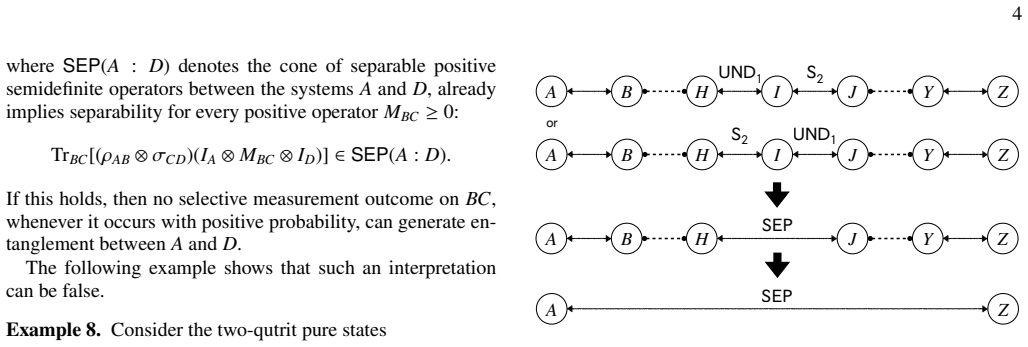
- A 1-undistillable two-qutrit link cannot be used with any Schmidt-number-two link to produce terminal entanglement in a single selective entanglement-swapping step, in either order.
- For every qutrit map outside UND_1, there is a Schmidt-number-two map that witnesses the failure of EB-composability, on at least one side of the composition.
- Distillable, non-PPT entanglement in a Schmidt-number-two link does not by itself make the link directly useful as a repeater link when paired with a 1-undistillable link.
- The entanglement-breaking conclusion extends from a single maximally entangled outcome to arbitrary selective measurements, because the 1-undistillable and Schmidt-number-two state cones are closed under local filtering.
Reading between the lines
- Editorial extension: The same proof recipe could be tested in higher dimensions by replacing the testing cone with maps whose Choi matrices have Schmidt number at most k, and asking whether the compatible cone is exactly the (k-1)-undistillable class; the obstruction is that PPT operators on 2⊗d subsystems need not be separable for d>3.
- Editorial extension: The maximality theorem is stated against the full testing cone SP_2; against smaller testing cones, such as PPT, the maximal compatible cone can be strictly larger, as the Werner-Holevo example shows. Mapping out this hierarchy of testing cones would complete the boundary picture.
- Editorial extension: Theorem 9 is a transferable device: any pair of state cones closed under local filtering inherits the single-outcome separability guarantee for all selective measurement outcomes, so similar bridges could be reused in other repeater-based protocols.
Editorial analysis
A structured set of objections, weighed in public.
Referee Report
Summary. The paper studies the EB-composability problem for ordered pairs of cones of completely positive maps, where (X,Y) is EB-composable if Φ∘Ψ is entanglement breaking for every Φ∈X and Ψ∈Y. In the qutrit setting, it proves that (UND_1, SP_2) and (SP_2, UND_1) are EB-composable (Theorem 4), and that UND_1 is exactly the largest cone of qutrit CP maps that is EB-composable with SP_2 in either order (Theorem 6). It then goes from the map-composition formulation to the full state-level entanglement-swapping picture: for cones closed under local filtering, separability of the maximally-entangled-outcome post-selected state implies separability of the state obtained from every positive operator on the intermediate systems (Theorem 9). Applying this to UND_1 and S_2 gives Corollary 10, a universal obstruction to terminal entanglement generation whenever one link is 1-undistillable and the other has Schmidt number at most two. The proofs are contained in Appendices B–E.
Significance. This is a substantial step beyond the qutrit PPT squared theorem. The paper replaces the pair (PPT, PPT) by the larger pair (UND_1, SP_2) and proves both a positive composition result and a sharp maximality statement: any qutrit map outside UND_1 is detected by some SP_2 test map in at least one order. The state-level extension via Theorem 9 is also valuable, since it shows that the maximally entangled-outcome criterion controls all selective measurements under a natural closure assumption. The proofs are complete and self-contained modulo standard facts: the Horodecki criterion for 2⊗3 and 3⊗2 systems, the Choi–Jamiołkowski correspondence, and the cited inclusion UND_1⊆SP_2 for qutrits. Proposition 11 is derived from the definition of 1-undistillability, and the key steps in Appendices B, D, and E check out. There is no parameter fitting, no numerical conjecture, and the maximality claim is a sharp, falsifiable statement. The paper itself explicitly acknowledges the reliance on the 2⊗3 Horodecki criterion in the Discussion.
minor comments (4)
- [Section III, Corollary 10] The step from Theorems 4 and 9 to Corollary 10 is quite compressed. It would help readers if the authors explicitly stated the Choi map for a given state ρ_AB (i.e., the CP map whose Choi matrix is proportional to ρ_AB) and explained how the two orderings in Corollary 10 correspond to the two orderings in Theorem 4. The step is justified by the Choi–Jamiołkowski correspondence and by scaling, but a few sentences would remove a potential source of confusion.
- [Appendix E, Lemma 12, (A)⇒(B)] In the definition of ρ'_AB=(I_A⊗X†)ρ_AB(I_A⊗X), it is easy to miss that this is a legitimate local filter of ρ_AB with L=I_A and R=X†. The proof also uses cyclicity of the partial trace over BC to move X and X† across ρ_AB⊗σ_CD; stating this explicitly would make the argument easier to verify.
- [Conjecture 1 and Theorem 9] The phrase 'post-selected unnormalized state' for a general positive operator M_BC may be ambiguous, since the physical post-measurement state for a POVM element M is usually written with √M on both sides. For X=ρ_AB⊗σ_CD, the identity Tr_BC[√M X √M] = Tr_BC[X M] holds by spectral decomposition, so the formulation is correct; a brief remark would prevent confusion.
- [Appendix A, Definition of Schmidt number] The decomposition ρ=Σ|ψ_i⟩⟨ψ_i| in the definition of Schmidt number should be explicitly allowed to include positive weights, or the vectors should be allowed to be unnormalized, to avoid ambiguity with the unnormalized maximally entangled state used throughout the paper.
Circularity Check
No circularity: all central claims are proven from definitions and external criteria, with no fitted parameters or load-bearing self-citation.
full rationale
I walked the derivation chain from Proposition 11 through Theorems 4, 6, 9, and Lemma 12. Proposition 11's equivalences are proven directly from the definition of 1-undistillability (no Schmidt-rank-≤2 vector violating the partial transpose) and involve only elementary filter/Kraus manipulations; none of the equivalences is asserted by definition. Theorem 4's proof uses Proposition 11 to show that each summand of the composed Choi matrix is PPT on a 2⊗3 or 3⊗2 support, then invokes the external Horodecki criterion (PPT ⇔ separability for 2⊗3 and 3⊗2) to conclude separability. This is a legitimate external theorem, and the paper explicitly acknowledges its load-bearing role in the Discussion. Theorem 6's converse follows from Proposition 11(v)/(vi) together with the Choi bijection between SP2 and S2, so no 'prediction' is secretly an input. Lemma 12 is an equivalence among measurement formulations and is proven by local-filtering closure, which the paper independently verifies for the relevant cones; there is no fitted parameter, no renaming of a known result, and no self-citation chain supporting the central claim. The manuscript's own limitation note about higher dimensions confirms, rather than conceals, the external assumption. Therefore no circular step is present.
Assumptions & free parameters
assumptions (5)
- domain assumption PPT ⟺ separable for bipartite systems with one party of dimension 2 (2⊗3 and 3⊗2).
- domain assumption Every 1-undistillable two-qutrit state has Schmidt number at most two.
- standard math The Choi–Jamiołkowski correspondence maps states to CP maps and preserves membership in the cones UND_1 and SP_2/S_2.
- standard math The cones SEP, PPT, S_n, UND_n are closed under local filtering.
- standard math The identity Tr_BC[(C_Ψ⊗C_Φ)(I⊗|φ+⟩⟨φ+|⊗I)] = C_{Φ∘Ψ}.
Cite this review
Pith. "Pith review of Beyond the Positive Partial Transpose Squared Conjecture: The Qutrit Case." pith.science (2026). https://pith.science/paper/GE625KDD
@misc{pith2026260715947,
  author       = {Pith},
  title        = {Pith review of: Beyond the Positive Partial Transpose Squared Conjecture: The Qutrit Case},
  year         = {2026},
  howpublished = {\url{https://pith.science/paper/GE625KDD}},
  note         = {Machine review of arXiv:2607.15947}
}
abstract
Entanglement swapping is a fundamental operation in quantum repeaters for establishing entanglement between distant parties. The positive partial transpose (PPT) squared conjecture asks whether two PPT entangled links can generate terminal entanglement through entanglement swapping, or equivalently, whether the composition of two PPT maps is always entanglement breaking. Motivated by this conjecture, we investigate the map-composition problem beyond the PPT setting. For qutrit completely positive (CP) maps, we prove that the composition of any CP map whose Choi matrix is $1$-undistillable with any CP map whose Choi matrix has Schmidt number at most two is entanglement breaking in either order. Moreover, we show that the cone of $1$-undistillable CP maps is exactly the largest qutrit cone of CP maps whose composition with every CP map whose Choi matrix has Schmidt number at most two is entanglement breaking in both orders. Finally, although map composition captures only the standard maximally entangled outcome in entanglement swapping, we prove that any $1$-undistillable two-qutrit state and any state of Schmidt number at most two cannot generate terminal entanglement under an arbitrary selective measurement on the intermediate systems.
Figures


Forward citations
Cited by 1 Pith paper
-
Every PPT channel has finite entanglement-breaking index
Every positive-partial-transpose channel is claimed to become entanglement-breaking after finitely many iterations, but the paper's additional uniform bound of 3 for a large family is false as stated.
Reference graph
Works this paper leans on
-
[1]
M. A. Nielsen and I. L. Chuang,Quantum Computation and Quantum Information(Cambridge University Press, 2010)
2010
-
[2]
Briegel, W
H.-J. Briegel, W. Dür, J. I. Cirac, and P. Zoller, Phys. Rev. Lett. 81, 5932 (1998)
1998
-
[3]
L.-M. Duan, M. D. Lukin, J. I. Cirac, and P. Zoller, Nature414, 413 (2001)
2001
-
[4]
˙Zukowski, A
M. ˙Zukowski, A. Zeilinger, M. A. Horne, and A. K. Ekert, Phys. Rev. Lett.71, 4287 (1993)
1993
-
[5]
C. H. Bennett, G. Brassard, C. Crépeau, R. Jozsa, A. Peres, and W. K. Wootters, Phys. Rev. Lett.70, 1895 (1993)
1993
-
[6]
C. H. Bennett, G. Brassard, S. Popescu, B. Schumacher, J. A. Smolin, and W. K. Wootters, Phys. Rev. Lett.76, 722 (1996)
1996
-
[7]
Deutsch, A
D. Deutsch, A. Ekert, R. Jozsa, C. Macchiavello, S. Popescu, and A. Sanpera, Phys. Rev. Lett.77, 2818 (1996)
1996
-
[8]
Peres, Phys
A. Peres, Phys. Rev. Lett.77, 1413 (1996)
1996
Show all 27 references
-
[9]
Horodecki, P
M. Horodecki, P. Horodecki, and R. Horodecki, Phys. Lett. A 223, 1 (1996)
1996
-
[10]
Horodecki, M
K. Horodecki, M. Horodecki, P. Horodecki, and J. Oppenheim, Phys. Rev. Lett.94, 160502 (2005)
2005
-
[11]
D. P. Chi, J. W. Choi, J. S. Kim, T. Kim, and S. Lee, Phys. Rev. A75, 032306 (2007)
2007
-
[12]
Horodecki, P
M. Horodecki, P. Horodecki, and R. Horodecki, Phys. Rev. Lett. 6 80, 5239 (1998)
1998
-
[13]
D. P. DiVincenzo, P. W. Shor, J. A. Smolin, B. M. Terhal, and A. V . Thapliyal, Phys. Rev. A61, 062312 (2000)
2000
-
[14]
W. Dür, J. I. Cirac, M. Lewenstein, and D. Bruß, Phys. Rev. A 61, 062313 (2000)
2000
-
[15]
Christandl,PPT square conjecture, BanffInternational Re- search Station workshop, Operator Structures in Quantum In- formation Theory (2012)
M. Christandl,PPT square conjecture, BanffInternational Re- search Station workshop, Operator Structures in Quantum In- formation Theory (2012)
2012
-
[16]
Christandl, A
M. Christandl, A. Müller-Hermes, and M. M. Wolf, Ann. Henri Poincaré20, 2295 (2019)
2019
-
[17]
Choi, Linear Algebra Appl.10, 285 (1975)
M.-D. Choi, Linear Algebra Appl.10, 285 (1975)
1975
-
[18]
Jamiołkowski, Rep
A. Jamiołkowski, Rep. Math. Phys.3, 275 (1972)
1972
-
[19]
Horodecki, P
M. Horodecki, P. W. Shor, and M. B. Ruskai, Rev. Math. Phys. 15, 629 (2003)
2003
-
[20]
L. Chen, Y . Yang, and W.-S. Tang, Phys. Rev. A99, 012337 (2019)
2019
-
[21]
B. M. Terhal and P. Horodecki, Phys. Rev. A61, 040301 (2000)
2000
-
[22]
L. Chen, Y . Yang, and W.-S. Tang, Quantum Inf. Process.16, 75 (2017)
2017
-
[23]
Horodecki and P
M. Horodecki and P. Horodecki, Phys. Rev. A59, 4206 (1999)
1999
-
[24]
Lami and V
L. Lami and V . Giovannetti, J. Math. Phys.56, 092201 (2015)
2015
-
[25]
Rahaman, S
M. Rahaman, S. Jaques, and V . I. Paulsen, J. Math. Phys.59, 062201 (2018)
2018
-
[26]
Skowronek, E
Ł. Skowronek, E. Størmer, and K. ˙Zyczkowski, J. Math. Phys. 50, 062106 (2009)
2009
-
[27]
m00 m01 m10 m11 #! = m00 + 1 2m11 1√ 2m01 1√ 2m10 1 2m11 and Ψ
D. Chru ´sci´nski and A. Kossakowski, Open Syst. Inf. Dyn.13, 17 (2006). Appendix A: Preliminaries This appendix collects the notations and elementary facts used in the main text. We first recall Schmidt rank, Schmidt number, and superpositive maps. We then present equivalent ...
2006
Reviewed August 1, 2026 · model on record in the stance chip above.
Discussion (0). Continue with ORCID to comment.