REVIEW 2 major objections 4 minor 23 references
For a transparent-end Kerr–BR black hole, scalar superradiance requires two gates, and a magnetic field closes the window at BM≈0.243.
Reviewed by Pith at T0; open to challenge. T0 means a machine referee read the full paper against a public rubric. the ladder, T0–T4 →
T0 review · deepseek-v4-flash
2026-08-01 21:25 UTC pith:SYXZ3KK7
load-bearing objection A careful, well-scoped scattering calculation on the new Kerr-BR spacetime that establishes a double-gate superradiance criterion and a magnetic-field closure; the main caveat is the non-unique outer boundary condition, which the authors themselves flag. the 2 major comments →
Massless scalar scattering by Kerr-Bertotti-Robinson black holes:transparent-end channels and superradiance
The pith
A machine-rendered reading of the paper's core claim, the machinery that carries it, and where it could break.
Core claim
On the rotating Kerr–BR spacetime, the massless scalar obeys the conformal wave equation because the Ricci scalar vanishes, and a conformal prefactor separates the equation exactly into angular and radial parts. For nonzero magnetic-field parameter B, the coordinate end lies at finite optical distance, so the scattering problem is not asymptotically flat. Imposing an ingoing horizon condition and a transparent flux-carrying condition at that end, current conservation gives R+Γ=1. Superradiance then requires both 0<ω<kΩ_H and q∞²>0. For a/M=0.9 and the co-rotating dipole, the external field suppresses the peak amplification and closes the open superradiant window at BM≈0.243; the amplificatio
What carries the argument
The load-bearing object is the pair of gates in the transparent-end formulation: the ingoing future-horizon condition, which sets the local superradiant threshold ω<kΩ_H, and the outer propagation condition q∞²>0, which decides whether an incident propagating channel exists at the finite optical endpoint. Concretely, the outer boundary data are written as u∼A_in e^{-iq∞r*}+A_out e^{+iq∞r*}, with q∞² determined by the exact finite limit of the radial potential. Current conservation then enforces R+Γ=1, so any positive amplification Z=R−1 requires both gates open. The conformal prefactor makes the separation exact, and the axial regularity condition k=n(1+β) shifts the superradiant threshold i
Load-bearing premise
The load-bearing premise is that the transparent, flux-carrying boundary condition at the coordinate end describes the physical outer world of the Kerr–BR black hole; the authors state explicitly in Sections 4.2 and 7 that this is a modeling prescription rather than a geometrically forced condition, so if a completed universe imposes different outer data the reported coefficients and the BM≈0.243 closure are not direct observables.
What would settle it
Solve the same separated radial problem with a reflecting (zero-field or zero-slope) boundary condition at the coordinate end and look for unstable superradiant modes around BM=0.243: the transparent-end model predicts only a closing of the scattering channel, not a spectral instability, so a growing mode at that field strength would reveal the boundary dependence of the result. Alternatively, derive q∞² for a concrete maximal extension or external junction; if the outer propagation condition stays positive for 0<ω<kΩ_H when BM>0.243, the claimed window closure does not survive that completion
If this is right
- The Kerr–BR scattering problem has no boundary-independent reflection coefficient: any reported R, Γ, or Z must be accompanied by a specified outer boundary model.
- An external observer can extract superradiant energy from a massless scalar only when both gates are open; q∞²≤0 kills the channel regardless of the horizon condition.
- For a/M=0.9 and the co-rotating dipole, the open superradiant window vanishes entirely for BM above about 0.243; at BM=0.06 the peak amplification is already suppressed by about 4.4% relative to B=0.
- Near the edge of the outer gate, the amplification coefficient is proportional to q∞ to leading order, so the closure is smooth and can be probed at arbitrarily small outer wave numbers.
- The exact separated equations and the transparent-end response provide a reproducible benchmark for any future physically completed Kerr–BR model with a different outer boundary condition.
Where Pith is reading between the lines
- The same double-gate logic suggests that, with a reflecting outer boundary, the local horizon superradiance would not simply vanish but would likely produce trapped growing modes; this is an inference drawn from the paper's boundary-condition discussion, not one of its numerical results.
- If a fully extended Kerr–BR universe supplies an exterior reservoir with its own matching conditions, the BM≈0.243 closure should be regarded as a model-dependent prediction to test against that completion, not as a universal observable.
- The linear threshold law Z∝q∞ could serve as a numerical probe for other modes and spins: a deviation from linearity at small q∞ would signal an endpoint resonance or a breakdown of the transparent-end regularization.
- The magnetic field acts as a high-pass filter on the outer channel, conceptually analogous to a plasma-frequency cutoff for photon superradiance; making that analogy quantitative might yield a closed-form estimate of the critical BM for other multipoles.
Editorial analysis
A structured set of objections, weighed in public.
Referee Report
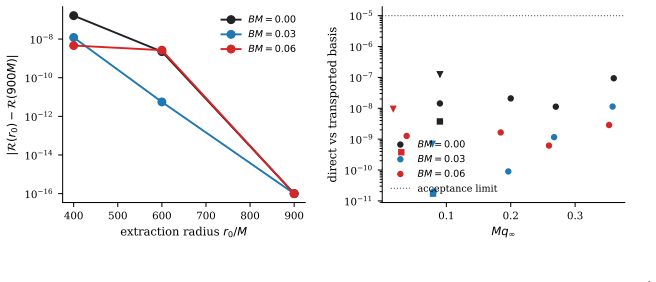
Summary. The paper studies real-frequency scattering of a neutral massless scalar on the rotating Kerr-Bertotti-Robinson (Kerr-BR) spacetime. Using tracelessness of the Maxwell stress tensor, the minimally coupled wave equation is shown to coincide with the conformal wave equation; a conformal prefactor separates it into angular and radial ODEs in the Carter-like frame. For B≠0, r→∞ lies at finite tortoise distance, so the authors define an explicit 'transparent-end' Robin problem at the coordinate end, emphasize that R, Γ, Z are conditional on this choice, and derive the outer propagation limit q∞². Current conservation yields R+Γ=1; open-channel superradiance requires both 0<ω<kΩ_H and q∞²>0. Numerical solutions for a/M=0.9 show the field suppresses co-rotating dipole amplification and that the open superradiant interval closes at BM≈0.2428, with Z vanishing linearly as q∞→0.
Significance. Strengths: exact conformal separation including the Ω prefactor; explicit cancellation of the leading terms in the outer potential; current-conservation identity; and an unusually thorough numerical error budget (Kerr angular benchmark 4×10^-15, Wronskian drift 1.7×10^-8, extraction-radius and transported-basis agreement, and a quantitative Kerr absorption cross-section limit). The paper is also careful to state that the reported reflection data are conditional on the transparent-end boundary prescription, which I do not regard as a defect. If the technical issue in Eq. (2.8) is resolved, the double-gate mechanism and its quantitative closure would be a valuable and reproducible result for non-asymptotically-flat black hole scattering.
major comments (2)
- [§2, Eq. (2.8)] Eq. (2.8) does not appear to be the root set of ∆=0 with the definitions in Eqs. (2.3)–(2.5). For example, at M=1, a/M=0.9, BM=0.06, the printed expression gives r_+/M≈1.4401, whereas solving αr²−2dr+a²=0 with the stated α and d gives a different value (≈1.4327 if α is read as (1−B²M²I₂)/I₁², and ≈1.4396 under the alternative reading α=1−B²M²I₂/I₁²). Substituting the printed r₊ into ∆ leaves a nonzero residual. Since Ω_H=a/(r₊²+a²) enters the superradiant edge throughout §4.1 and §6.2, the critical-field claim BM≈0.243 depends on this formula. Please correct Eq. (2.8) and state which root expression was used by the production code; if the printed expression was used, the finite-B curves should be recomputed.
- [§6.2, Fig. 3] The critical field is quoted as BM_crit=0.2427791435, but the angular-solver convergence checks in §5.1 are reported for the weak-field scan 0≤BM≤0.06. The continuation to BM≈0.243 is the load-bearing use of the angular eigenvalue, so please report the 24-vs-30-function Galerkin shift and the eigenpair residual at a few values near the critical field (including BM_crit itself). The reported 8.3×10^-17 agreement between the two threshold methods is a useful consistency check, but it does not by itself bound the angular truncation error at the closure point.
minor comments (4)
- [§5.2] The phrase 'unit-flux amplitude factor 7.55' would be clearer if the normalization convention were stated explicitly, e.g., the factor q∞^{−1/2} in the unit-flux endpoint basis.
- [Eq. (5.1)] The symbol π_ℓ is used for parity but not defined in the main text; please define it where the basis is introduced.
- [Eq. (4.9)] The quantity J₀ is introduced only in Appendix B; in the main-text statement of the linear threshold law, specify that J₀ is the endpoint current of the horizon-normalized threshold solution.
- [Abstract and Fig. 3] The abstract states that the field 'closes the open superradiant window at BM≃0.243'. Since this statement is conditional on the transparent-end model, consider adding that qualifier in the abstract itself, even though the body is explicit.
Circularity Check
No significant circularity: the central quantitative result is an independent numerical solution of the derived equations, not an input.
full rationale
The derivation is self-contained and non-circular. The conformal separation is explicitly checked in Appendix A, and the outer wave number q∞² in Eq. (4.4) is derived by direct expansion with symbolic verification, not assumed. The reflection coefficient R and the double-gate condition (4.8) are built from the definitions (4.6)–(4.7) and current conservation, and the paper openly states that q∞²>0 defines the open channel and that no R is reported when q∞²≤0. The central quantitative finding, BMcrit≈0.243, is obtained by solving q∞²[ω=kΩ_H,B]=0 using the independently benchmarked angular eigenvalue, not by fitting to superradiance data. The paper repeatedly emphasizes that R, Γ, Z are conditional response coefficients for the transparent-end prescription, and it supports the numerics with Wronskian drift, extraction-radius convergence, transported-basis comparison, and a published Kerr absorption cross-section benchmark. No load-bearing claim reduces to a self-citation or to a fitted parameter; the transparent Robin boundary condition is an openly declared modeling choice, not a hidden input disguised as a prediction.
Axiom & Free-Parameter Ledger
axioms (5)
- domain assumption The Kerr–BR line element (2.1)–(2.5) is an exact solution of the Einstein–Maxwell equations.
- standard math For R[g]=0, the minimally coupled massless equation coincides with the conformal wave equation (3.1), and the conformal factor identity (3.2) allows separation.
- domain assumption Azimuthal regularity on both axis halves fixes k = n/C with C=1/(1+β), so the mode is e^{ikφ} with integer n.
- ad hoc to paper The transparent-end Robin condition (4.5) with q∞²>0 defines the open scattering problem; R, Γ, Z are conditional on this boundary model.
- domain assumption The nonresonant threshold expansion (appendix B) assumes v_{B,0} ≠ 0, verified numerically for the displayed threshold.
read the original abstract
We formulate and numerically solve the real-frequency scattering problem for a neutral, minimally coupled, massless scalar on the rotating Kerr--Bertotti--Robinson (Kerr--BR) black-hole geometry, using a specified transparent boundary condition at the coordinate end. Since the Maxwell stress tensor of the background is traceless, the minimally coupled wave equation reduces to the four-dimensional conformal wave equation, enabling exact Carter-like separation after scaling the scalar field by the conformal factor. Unlike the asymptotically flat case, the coordinate end $r\to\infty$ lies at a finite tortoise distance. We show that the resulting reflection data are conditional on this boundary prescription rather than defining a unique, observer-independent cross section. Within the transparent-end model,open-channel superradiance is governed by a double-gate mechanism requiring both the local horizon condition and the outer propagation condition $q_\infty^2>0$. At the benchmark spin $a/M=0.9$, the co-rotating dipole amplification decreases as the external magnetic field increases. Crucially, the field narrows and closes the open superradiant window at $BM\simeq0.243$. Near the propagation threshold, the amplification coefficient vanishes linearly with the outer wave number.
Figures



Reference graph
Works this paper leans on
-
[1]
Ernst,Black holes in a magnetic universe,J
F.J. Ernst,Black holes in a magnetic universe,J. Math. Phys.17(1976) 54
1976
-
[2]
Ernst and W.J
F.J. Ernst and W.J. Wild,Kerr black holes in a magnetic universe,J. Math. Phys.17 (1976) 182
1976
-
[3]
J. Podolsky and H. Ovcharenko,Kerr Black Hole in a Uniform Bertotti-Robinson Magnetic Field: An Exact Solution,Phys. Rev. Lett.135(2025) 181401 [2507.05199]
arXiv 2025
-
[4]
F. Gray, D. Kubiznak, H. Ovcharenko and J. Podolsky,Hidden symmetries and separability structures of Ovcharenko-Podolsk´ y and conformal-to-Carter spacetimes, Phys. Rev. D113(2026) 044050 [2511.21538]
arXiv 2026
-
[5]
Wald,Black hole in a uniform magnetic field,Phys
R.M. Wald,Black hole in a uniform magnetic field,Phys. Rev. D10(1974) 1680
1974
-
[6]
Aliev and D.V
A.N. Aliev and D.V. Galtsov,Magnetized Black Holes,Sov. Phys. Usp.32(1989) 75
1989
-
[7]
L. Ma and H. Lu,New Rotating Black Hole in Electromagnetic Fields: Cosmological Horizon without Cosmological Constant,2606.23782
-
[8]
L. Ma and H. Lu,Demagnetizing KBR and New Ricci-flat Rotating Metric, 2605.13954
-
[9]
G.W. Gibbons, A.H. Mujtaba and C.N. Pope,Ergoregions in Magnetised Black Hole Spacetimes,Class. Quant. Grav.30(2013) 125008 [1301.3927]
Pith/arXiv arXiv 2013
-
[10]
K. Glampedakis and N. Andersson,Scattering of scalar waves by rotating black holes, Class. Quant. Grav.18(2001) 1939 [gr-qc/0102100]
Pith/arXiv arXiv 2001
-
[11]
C.F.B. Macedo, L.C.S. Leite, E.S. Oliveira, S.R. Dolan and L.C.B. Crispino,Absorption of planar massless scalar waves by Kerr black holes,Phys. Rev. D88(2013) 064033 [1308.0018]
Pith/arXiv arXiv 2013
-
[12]
V. Cardoso and O.J.C. Dias,Small Kerr-anti-de Sitter black holes are unstable,Phys. Rev. D70(2004) 084011 [hep-th/0405006]. 18
Pith/arXiv arXiv 2004
-
[13]
V. Cardoso, O.J.C. Dias, J.P.S. Lemos and S. Yoshida,The Black hole bomb and superradiant instabilities,Phys. Rev. D70(2004) 044039 [hep-th/0404096]
Pith/arXiv arXiv 2004
-
[14]
G. Mustafa, O. Donmez, D.J. Gogoi, S.G. Ghosh, I. Hussain and C. Yuan,Dynamics, Ringdown, and Accretion-Driven Multiple Quasi-Periodic Oscillations of Kerr-Bertotti-Robinson Black Holes,2602.08911
-
[15]
H. Xu, H. Chen and S.-J. Zhang,Horizon-Evanescent Scalar Clouds from Coupled Rotation and Magnetic Fields around Black Holes,2606.27958
-
[16]
T. Hartman, W. Song and A. Strominger,Holographic Derivation of Kerr-Newman Scattering Amplitudes for General Charge and Spin,JHEP03(2010) 118 [ 0908.3909]
Pith/arXiv arXiv 2010
-
[17]
M. Guica, T. Hartman, W. Song and A. Strominger,The Kerr/CFT Correspondence, Phys. Rev. D80(2009) 124008 [0809.4266]
Pith/arXiv arXiv 2009
-
[18]
I. Bredberg, T. Hartman, W. Song and A. Strominger,Black Hole Superradiance From Kerr/CFT,JHEP04(2010) 019 [0907.3477]
Pith/arXiv arXiv 2010
-
[19]
E. Berti, V. Cardoso and M. Casals,Eigenvalues and eigenfunctions of spin-weighted spheroidal harmonics in four and higher dimensions,Phys. Rev. D73(2006) 024013 [gr-qc/0511111]
Pith/arXiv arXiv 2006
-
[20]
R. Brito, V. Cardoso and P. Pani,Superradiance – the 2020 Edition,Lect. Notes Phys. 971(2020) [1501.06570]
Pith/arXiv arXiv 2020
-
[21]
J.P. Conlon and C.A.R. Herdeiro,Can black hole superradiance be induced by galactic plasmas?,Phys. Lett. B780(2018) 169 [1701.02034]
Pith/arXiv arXiv 2018
-
[22]
A. Dima and E. Barausse,Numerical investigation of plasma-driven superradiant instabilities,Class. Quant. Grav.37(2020) 175006 [2001.11484]
Pith/arXiv arXiv 2020
-
[23]
Siahaan,Kerr–Bertotti–Robinson spacetime and the Kerr/CFT correspondence, Nucl
H.M. Siahaan,Kerr–Bertotti–Robinson spacetime and the Kerr/CFT correspondence, Nucl. Phys. B1028(2026) 117514 [2512.12533]. 19
arXiv 2026
discussion (0)
Sign in with ORCID, Apple, or X to comment. Anyone can read and Pith papers without signing in.