REVIEW 4 minor 37 references
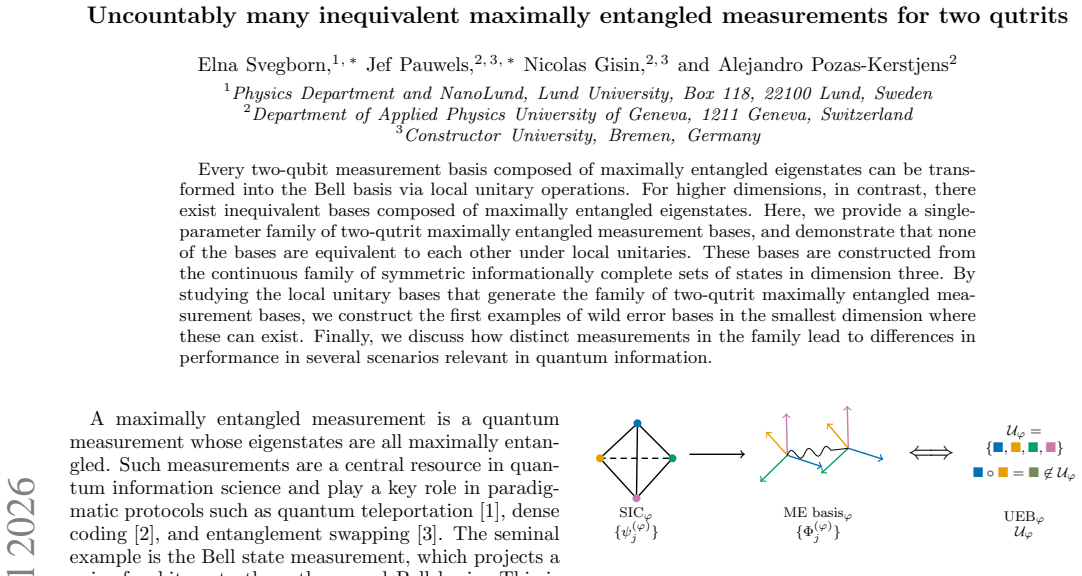
This paper proves that for two qutrits there are uncountably many physically distinct maximally entangled measurements, parameterized by a single angle φ.
Reviewed by Pith at T0; open to challenge. T0 means a machine referee read the full paper against a public rubric. the ladder, T0–T4 →
T0 review · deepseek-v4-flash
2026-08-01 21:03 UTC pith:25GFWKNP
load-bearing objection A genuinely new classification result for maximally entangled qutrit measurements, but the printed proof of the central theorem has a concrete arithmetic error that needs fixing before the paper is final.
Uncountably many inequivalent maximally entangled measurements for two qutrits
The pith
A machine-rendered reading of the paper's core claim, the machinery that carries it, and where it could break.
Core claim
The paper's central result is Theorem 1: for real phases φ₁ and φ₂, the unitary error bases U_{φ₁} and U_{φ₂}—and hence the maximally entangled qutrit bases they generate—are equivalent under local unitary operations if and only if φ₁ ± φ₂ = 2πk/9 for some integer k. The proof uses an invariant I(U) = Σ_{i,j,k,l} |Tr(U_i† U_j U_k† U_l)|⁴, which is computed exactly as 51273 + 7776 cos(9φ); equality of the invariant forces the cosine condition, and explicit unitary conjugations show the condition is also sufficient. Because each φ is equivalent only to a countable set of siblings, the family contains a continuously infinite number of inequivalent maximally entangled measurements. As a corollar
What carries the argument
The construction starts from any qutrit SIC and uses Eq. (1) of Ref. [12] to build a bipartite basis; setting α = 0 makes every basis state maximally entangled. Each basis is generated by single-qutrit unitaries U_φ = {Z^a, Z^a X_+(φ), Z^a X_-(φ)}, which behave like Weyl pairs with opposite commutator phases. The classification of inequivalent bases rests on the invariant I(U) = Σ_{i,j,k,l} |Tr(U_i† U_j U_k† U_l)|⁴, invariant under left-right equivalence with permutations; its exact value collapses the equivalence question to the cosine condition cos(9φ₁) = cos(9φ₂).
Load-bearing premise
The construction relies on the claim that Eq. (1) of Ref. [12] turns every d=3 SIC into a complete orthonormal bipartite basis; the paper verifies the single-particle purity condition but does not reproduce a general proof of completeness or orthonormality, and if that failed for some φ the objects of Theorem 1 would not be well-defined bases.
What would settle it
Numerically check unitarity and orthonormality of M_φ in Eq. (B1) for, say, φ = π/9: compute M†M and verify it equals the 9×9 identity to numerical precision. Then, to test Theorem 1, choose φ₁ = 0 and φ₂ = π/18 (so cos(9φ₁) = 1 and cos(9φ₂) = 0) and attempt a direct search over unitaries A, B, phases, and a permutation satisfying U_i = e^{iθ_i} A V_{π(i)} B; finding a solution would refute the theorem, as would an invariant mismatch contradicting the formula I(U_φ) = 51273 + 7776 cos(9φ).
If this is right
- Only the generalized Bell basis and its local equivalents in the family are nice error bases; every other member is wild, and these are the first wild error bases known for U(3).
- No member of the family except the Bell-equivalent ones can be ideally localized with finite shared entanglement; localizing any wild member requires at least two copies of the maximally entangled state |Ω+⟩, and non-Bell members are not in the Clifford group.
- Members with φ = 2πk/3^l sit at finite levels of the Clifford hierarchy; φ = 2π/27 gives the simplest non-Clifford maximally entangled measurement, while φ = π/9, which generates the smallest wild projective group found (order 36), lies at no finite level.
- In quantum repeater chains, using wild bases can make the set of correction unitaries grow indefinitely with chain length, whereas nice bases keep corrections bounded; in magic-state injection, the family allows non-stabilizerness injection without single-qutrit non-Clifford operations, something qubit Bell measurements cannot do.
Where Pith is reading between the lines
- The equivalence condition being identical to the SIC equivalence condition suggests the SIC-to-measurement map may preserve equivalence classes more broadly; if so, inequivalent SICs in higher dimensions would automatically yield inequivalent maximally entangled measurements wherever the construction extends.
- The wildness of U_φ for φ/π irrational implies the set of errors generated by repeated compositions is infinite; one could test whether the correction-set growth in repeater chains is actually realizable with realistic noise models, which the paper leaves open.
- The paper leaves open whether different φ inject different amounts of magic; a direct simulation of magic-state injection with φ = 2π/27 versus φ = 0 could quantify any advantage over Bell-plus-rotation schemes.
- Because distributions from maximally entangled states and measurements in triangle networks admit local models (Appendix G), the family is unlikely to produce network nonlocality in star-like topologies; the square network remains a promising testbed where this obstruction disappears.
Editorial analysis
A structured set of objections, weighed in public.
Referee Report
Summary. Using the continuous family of SICs in dimension three and the construction of Ref. [12], the paper defines a one-parameter family of two-qutrit bases (Eq. (3)) whose elements are maximally entangled, together with the associated unitary error bases U_φ (Eq. (4)). The main theorem (Theorem 1, Appendix D) states that U_{φ1} and U_{φ2} — and hence the corresponding measurement bases — are equivalent under local unitaries iff φ1 ± φ2 = 2πk/9. The proof uses an invariant I(U) computed by finite enumeration, plus explicit unitaries generating the forward direction. From this the paper infers a continuum of inequivalent maximally entangled qutrit measurements, shows that every non-Bell member is a wild error basis in the minimal dimension d=3, analyzes localization complexity and Clifford-hierarchy level, and discusses applications to magic-state injection and quantum repeaters.
Significance. If correct, the result is significant: it provides the first wild error bases in dimension 3, demonstrates the smallest dimension in which a continuum of inequivalent maximally entangled measurements exists, and connects SIC geometry to measurement classification. The proof is structurally complete: an invariant for necessity, explicit conjugations for sufficiency, and a direct check that the SIC equivalence condition coincides with the measurement equivalence condition. The paper is also careful to state limitations (e.g., Appendix G local models for triangle networks). I found no load-bearing technical error; the issues are local (abstract wording and a typographical ambiguity in Appendix D).
minor comments (4)
- [Abstract] The statement 'none of the bases are equivalent to each other' is contradicted by Theorem 1, which gives nontrivial equivalences for φ1 ± φ2 = 2πk/9 (e.g., φ=0 and φ=2π/9). Please replace it by 'almost all' or 'no two generic bases', or explicitly state the discrete equivalence condition.
- [Appendix D, Table] The alleged arithmetic inconsistency disappears if the header is read as 0, 3^4, |P0|^4, |P1|^4, |P2|^4: the counts sum to 5184 + 405 + 3×324 = 6561 = 9^4. Please typeset 3^4 as a single entry to avoid the misreading that there is a separate count column '4'. Also, the intermediate constant 18438 should be 18468 (since 32805 + 18468 = 51273, matching the final formula).
- [Eq. (3), Appendix A] Orthonormality and completeness of Eq. (3) are not shown explicitly; the purity calculation in Appendix A establishes maximal entanglement but not that the nine vectors form a basis. A short proof using Σ_j |ψ_j,ψ_j*⟩ = d√d |Ω+⟩ would make the construction self-contained and remove a potential concern.
- [Theorem 1 proof] The finite enumeration underlying I(U_φ) is reported as a table without derivation or code. Since the table is easy to misread, including a brief derivation (or a reference to a script) would improve verifiability.
Circularity Check
No circular reduction in the main derivation: Theorem 1 follows from the trace invariant and explicit unitaries, with self-citations only in auxiliary localization/Clifford discussion. An Appendix D occurrence-count inconsistency is a correctness gap, not circularity.
full rationale
The derivation chain for the central claim is not circular. The measurement family is obtained by inserting the continuous qutrit SIC family into the external construction of Ref. [12], Eq. (1). Theorem 1's necessity direction is based on the invariant I(U) in Eq. (9), computed symbolically in Appendix D, while its sufficiency direction is supplied by the explicit unitaries D and R exhibited in Appendix D. Neither step assumes the SIC equivalence condition φ1±φ2=2πk/9 from Ref. [19]; the coincidence with that condition is reported after the proof as a derived consequence, not used as an input. The wild-error-basis claim uses the external classification of three-dimensional nice error bases from Refs. [5,9]. The Clifford/localization discussions invoke the authors' earlier frameworks [15,28], but the listed Clifford levels are obtained from phase-polynomial computations using the external diagonal-gate criterion of Ref. [34], so those self-citations are not load-bearing for the main equivalence result. One issue should be flagged without counting as circularity: the occurrence-count table in Appendix D, as printed, lists counts 5184, 405, 324, 324, 324, which sum to 6885 rather than 9^4=6561 index quadruples, so the printed table does not by itself verify I(Uφ)=51273+7776cos(9φ). This is an arithmetic/verification gap in the manuscript, not a reduction of the theorem to its own inputs, and therefore does not raise the circularity score.
Axiom & Free-Parameter Ledger
free parameters (1)
- φ =
free label in [0, π/3]
axioms (6)
- domain assumption There exists a continuous one-parameter family of SIC sets in dimension 3, with fiducial |ϕ(φ)⟩ = (|1⟩ − e^{iφ}|2⟩)/√2 for φ ∈ [0, π/3].
- domain assumption Formula (1) from Ref. [12] maps any SIC to an orthonormal isoentangled bipartite basis.
- standard math Local unitary equivalence of maximally entangled bases is equivalent to left-right equivalence of unitary error bases (Lemma 1, after Ref. [5]).
- domain assumption Every nice unitary error basis in dimension 3 is projectively equivalent to the Weyl–Heisenberg basis.
- domain assumption The Clifford-hierarchy level of a diagonal unitary is determined by the phase-polynomial formula Eq. (E6) of Cui–Gottesman–Krishna.
- domain assumption Ideal localization of a joint measurement requires the single-site generating unitaries to form a nice error basis.
read the original abstract
Every two-qubit measurement basis composed of maximally entangled eigenstates can be transformed into the Bell basis via local unitary operations. For higher dimensions, in contrast, there exist inequivalent bases composed of maximally entangled eigenstates. Here, we provide a single-parameter family of two-qutrit maximally entangled measurement bases, and demonstrate that none of the bases are equivalent to each other under local unitaries. These bases are constructed from the continuous family of symmetric informationally complete sets of states in dimension three. By studying the local unitary bases that generate the family of two-qutrit maximally entangled measurement bases, we construct the first examples of wild error bases in the smallest dimension where these can exist. Finally, we discuss how distinct measurements in the family lead to differences in performance in several scenarios relevant in quantum information.
Figures
Reference graph
Works this paper leans on
-
[1]
C. H. Bennett, G. Brassard, C. Cr´ epeau, R. Jozsa, A. Peres, and W. K. Wootters, Teleporting an unknown quantum state via dual classical and Einstein-Podolsky- Rosen channels, Phys. Rev. Lett.70, 1895 (1993)
1993
-
[2]
C. H. Bennett and S. J. Wiesner, Communication via one- and two-particle operators on Einstein-Podolsky- Rosen states, Phys. Rev. Lett.69, 2881 (1992)
1992
-
[3]
Event-ready-detectors
M. ˙Zukowski, A. Zeilinger, M. A. Horne, and A. K. Ek- ert, “Event-ready-detectors” Bell experiment via entan- glement swapping, Phys. Rev. Lett.71, 4287 (1993)
1993
-
[4]
K. G. H. Vollbrecht and R. F. Werner, Why two qubits are special, J. Math. Phys.41, 6772–6782 (2000), arXiv:quant-ph/9910064
Pith/arXiv arXiv 2000
-
[5]
R. F. Werner, All teleportation and dense coding schemes, J. Phys. A: Math. Gen.34, 7081 (2001), arXiv:quant-ph/0003070
Pith/arXiv arXiv 2001
-
[6]
C. Popp and B. C. Hiesmayr, Special features of the Weyl–Heisenberg Bell basis imply unusual entanglement structure of Bell-diagonal states, New J. Phys.26, 013039 (2024), arXiv:2307.10727
Pith/arXiv arXiv 2024
-
[7]
B. Baumgartner, B. C. Hiesmayr, and H. Narnhofer, State space for two qutrits has a phase space structure in its core, Phys. Rev. A74, 032327 (2006), arXiv:quant- ph/0606083
arXiv 2006
-
[8]
Knill, Non-binary unitary error bases and quantum codes (1996), arXiv:quant-ph/9608048
E. Knill, Non-binary unitary error bases and quantum codes (1996), arXiv:quant-ph/9608048
Pith/arXiv arXiv 1996
-
[9]
Klappenecker and M
A. Klappenecker and M. R¨ otteler, Unitary error bases: Constructions, equivalence, and applications, inAp- plied Algebra, Algebraic Algorithms and Error-Correcting Codes, edited by M. Fossorier, T. Høholdt, and A. Poli (Springer Berlin Heidelberg, Berlin, Heidelberg, 2003) pp. 139–149
2003
-
[10]
A. Klappenecker and M. R¨ otteler, On the monomiality of nice error bases, IEEE Trans. Inf. Theory51, 1084 (2005), arXiv:quant-ph/0301078
Pith/arXiv arXiv 2005
-
[11]
A. Tavakoli, A. Pozas-Kerstjens, M.-X. Luo, and M.-O. Renou, Bell nonlocality in networks, Rep. Prog. Phys. 85, 056001 (2022), arXiv:2104.10700
Pith/arXiv arXiv 2022
-
[12]
J. Czartowski and K. ˙Zyczkowski, Bipartite quantum measurements with optimal single-sided distinguishabil- ity, Quantum5, 442 (2021), arXiv:2010.14868
Pith/arXiv arXiv 2021
-
[13]
D. Beckman, D. Gottesman, M. A. Nielsen, and J. Preskill, Causal and localizable quantum opera- tions, Phys. Rev. A64, 052309 (2001), arXiv:quant- ph/0102043
arXiv 2001
-
[14]
B. Musto and J. Vicary, Quantum Latin squares and uni- tary error bases, Quantum Inf. Comput.16, 1318 (2016), arXiv:1504.02715. 6
Pith/arXiv arXiv 2016
-
[15]
J. Pauwels, A. Pozas-Kerstjens, F. Del Santo, and N. Gisin, Classification of joint quantum measurements based on entanglement cost of localization, Phys. Rev. X 15, 021013 (2025), arXiv:2408.00831
arXiv 2025
-
[16]
S. Popescu and L. Vaidman, Causality constraints on nonlocal quantum measurements, Phys. Rev. A49, 4331 (1994), arXiv:hep-th/9306087
Pith/arXiv arXiv 1994
-
[17]
J. M. Renes, R. Blume-Kohout, A. J. Scott, and C. M. Caves, Symmetric informationally complete quantum measurements, J. Math. Phys.45, 2171–2180 (2004), arXiv:quant-ph/0310075
Pith/arXiv arXiv 2004
-
[18]
F. Del Santo, J. Czartowski, K. ˙Zyczkowski, and N. Gisin, Iso-entangled bases and joint measurements, Phys. Rev. Res.6, 023085 (2024), arXiv:2307.06998
Pith/arXiv arXiv 2024
-
[19]
Zhu, SIC POVMs and Clifford groups in prime di- mensions, J
H. Zhu, SIC POVMs and Clifford groups in prime di- mensions, J. Phys. A: Math. Theor.43, 305305 (2010), arXiv:1003.3591
Pith/arXiv arXiv 2010
-
[20]
J. I. Cirac, W. D¨ ur, B. Kraus, and M. Lewenstein, Entan- gling operations and their implementation using a small amount of entanglement, Phys. Rev. Lett.86, 544 (2001), arXiv:quant-ph/0007057
Pith/arXiv arXiv 2001
-
[21]
W. D¨ ur and J. I. Cirac, Nonlocal operations: Purifica- tion, storage, compression, tomography, and probabilis- tic implementation, Phys. Rev. A64, 012317 (2001), arXiv:quant-ph/0012148
Pith/arXiv arXiv 2001
-
[23]
B. Groisman and B. Reznik, Measurements of semilocal and nonmaximally entangled states, Phys. Rev. A66, 022110 (2002), arXiv:quant-ph/0111012
Pith/arXiv arXiv 2002
-
[24]
B. Groisman, B. Reznik, and L. Vaidman, Instantaneous measurements of nonlocal variables, J. Mod. Opt.50, 943 (2003), arXiv:quant-ph/0111124
Pith/arXiv arXiv 2003
-
[25]
S. R. Clark, A. J. Connor, D. Jaksch, and S. Popescu, En- tanglement consumption of instantaneous nonlocal quan- tum measurements, New J. Phys.12, 083034 (2010), arXiv:1004.0865
Pith/arXiv arXiv 2010
-
[26]
S. Akibue and J. Miyazaki, Localization of joint quantum measurements onC d ⊗C d by entangled resources with Schmidt number at mostd, Phys. Rev. A113, 052430 (2026), arXiv:2601.02660
Pith/arXiv arXiv 2026
-
[27]
A. Gatto Lamas and E. Chitambar, Multipartite nonlo- cality in Clifford networks, Phys. Rev. Lett.130, 240802 (2023), arXiv:2208.04731
Pith/arXiv arXiv 2023
-
[28]
J. Pauwels, C. Branciard, A. Pozas-Kerstjens, and N. Gisin, Symmetric localizable multipartite quantum measurements from Pauli orbits, Phys. Rev. A113, 052432 (2026), arXiv:2509.01851
Pith/arXiv arXiv 2026
-
[29]
D. Gottesman, The Heisenberg representaiton of quan- tum computers, inGroup 22: International Colloquium on Group Theoretical Methods in Physics, edited by S. P. Corney, R. Delbourgo, and P. D. Jarvis (Inter- national Press of Boston Inc., Boston, 1998) pp. 32–43, arXiv:quant-ph/9807006
Pith/arXiv arXiv 1998
-
[30]
S. Bravyi and D. Gosset, Improved classical simulation of quantum circuits dominated by Clifford gates, Phys. Rev. Lett.116, 250501 (2016), arXiv:1601.07601
Pith/arXiv arXiv 2016
-
[31]
Gottesman and I
D. Gottesman and I. L. Chuang, Demonstrating the vi- ability of universal quantum computation using telepor- tation and single-qubit operations, Nature402, 390–393 (1999)
1999
-
[32]
S. Bravyi and A. Kitaev, Universal quantum computa- tion with ideal Clifford gates and noisy ancillas, Phys. Rev. A71, 022316 (2005), arXiv:quant-ph/0403025
Pith/arXiv arXiv 2005
-
[33]
F. Speelman, Instantaneous non-local computation of lowT-depth quantum circuits, in11th Conference on the Theory of Quantum Computation, Communication and Cryptography (TQC 2016), Leibniz International Proceedings in Informatics (LIPIcs), Vol. 61, edited by A. Broadbent (Schloss Dagstuhl – Leibniz-Zentrum f¨ ur Informatik, Dagstuhl, Germany, 2016) pp. 9:1...
Pith/arXiv arXiv 2016
-
[34]
S. X. Cui, D. Gottesman, and A. Krishna, Diagonal gates in the Clifford hierarchy, Phys. Rev. A95, 012329 (2017), arXiv:1608.06596
Pith/arXiv arXiv 2017
-
[35]
K. Chakraborty and A. Leverrier, Practical position- based quantum cryptography, Phys. Rev. A92, 052304 (2015), arXiv:1507.00626. Appendix A: Bases of maximally entangled states In this appendix we derive the conditions under which the construction of Ref. [12] produces bases of maximally en- tangled states. Using the defining property of SICs,|⟨ψ i|ψj⟩|2...
Pith/arXiv arXiv 2015
-
[36]
However, an important special case is that of diagonal unitaries, which has been completely characterized in the case of qudits of prime dimensions [34]
Clifford level of diagonal unitaries In general, it is difficult to fully characterize the unitaries that belong to a certain level of the Clifford hierarchy. However, an important special case is that of diagonal unitaries, which has been completely characterized in the case of qudits of prime dimensions [34]. Consider thatDis a diagonal unitary acting o...
-
[37]
The V aidman hierarchy with finite entanglement consumption To bound the minimal entanglement cost to localize a given measurement, we first consider the teleportation- based localization protocol of Ref. [15]. The main idea behind this protocol is to use a finite number of rounds of blind back-and-forth teleportation without communication during the prot...
-
[38]
Simplifications for measurements with tetrahedral symmetry Given the combinatorial explosion of the previous method, in the following we describe an alternative that, exploiting the fact that the measurements we consider have tetrahedral symmetry, enables us to upper bound the Vaidman level of the measurement. 13 Recall that the eigenbasis of the maximall...
discussion (0)
Sign in with ORCID, Apple, or X to comment. Anyone can read and Pith papers without signing in.