REVIEW 3 major objections 6 minor 230 references
Reaching 10^7 GeV: heavy-ion photon collisions set an energy record
Reviewed by Pith at T0; open to challenge. T0 means a machine referee read the full paper against a public rubric. the ladder, T0–T4 →
T0 review · deepseek-v4-flash
2026-08-01 15:09 UTC pith:BYMQJPQR
load-bearing objection A solid, honest review of UPC physics that deserves peer review, but it has real formula errors and copyediting problems that must be fixed before it can be used as an archival reference. the 3 major comments →
Ultra-peripheral Collisions
The pith
A machine-rendered reading of the paper's core claim, the machinery that carries it, and where it could break.
Core claim
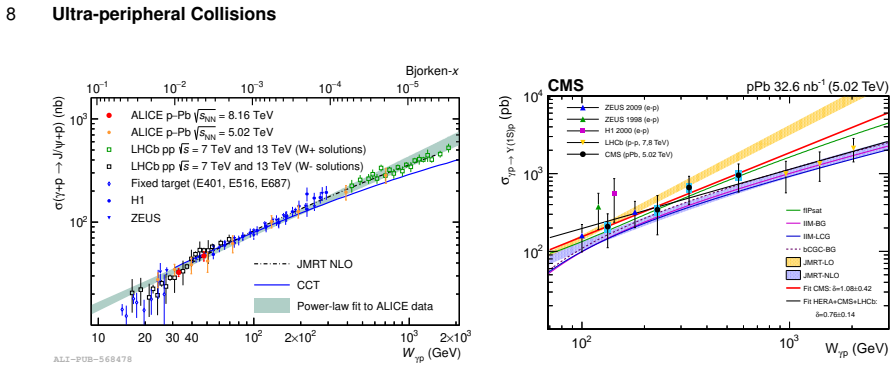
The central assertion is that UPCs now supply the most energetic photons available and that this capability has transformed several areas of physics. The review documents coherent J/psi photoproduction data spanning three orders of magnitude in x for both protons (down to ~10^-6) and nuclei (down to ~10^-5), measurements of nuclear shadowing and of event-by-event gluon-field fluctuations, two-photon production of tau pairs giving new constraints on tau electromagnetic moments, observation of light-by-light scattering and searches for axion-like particles, and the use of two-source interference to measure hadronic radii. The review's narrative is that these results, taken together, establish
What carries the argument
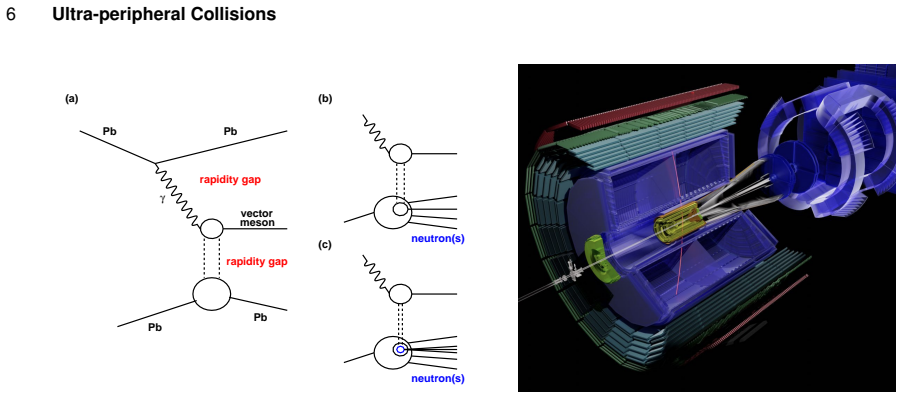
The argument rests on the equivalent-photon (Weizsäcker–Williams) description: a relativistic nucleus carries a pancake of virtual photons whose flux is set by the charge Z and the impact-parameter cutoff b>2R_A, with energy up to about gamma hbar c / b. That flux drives (1) photoproduction, where a photon from one ion interacts with the other, and (2) two-photon interactions. For diffractive photoproduction, the Good–Walker formalism separates coherent (target stays in ground state) from incoherent (nucleon/hotspot) production, relating the former to the average gluon density and the latter to its fluctuations; the two-source interference amplitude then connects the observed pT and rapidity
Load-bearing premise
The load-bearing premise is that coherent and incoherent photoproduction can be cleanly separated by whether the target nucleus remains in its ground state, and that each exchanged photon acts independently (factorization); the review itself states in Sec. 3.1.1 that it is not clear how this works in quantum field theory, and in Sec. 2.3 that factorization fails for incoherent production.
What would settle it
A precise measurement of the pT spectrum of coherent-like rho photoproduction in events with nuclear breakup, compared to the Good–Walker prediction, could falsify the coherence classification; alternatively, a violation of the factorization relation (Eq. 9) at high transverse momentum would invalidate the standard extraction of photonuclear cross sections using neutron tagging.
If this is right
- Photonuclear cross sections for coherent J/psi on protons and nuclei now span three orders of magnitude in x, giving a direct handle on the low-x gluon distribution and a baseline for saturation searches.
- Two-photon production of tau pairs at the LHC places the current best limits on the tau anomalous magnetic moment and electric dipole moment.
- Light-by-light scattering has been observed in lead–lead UPCs, and the same channel provides the most sensitive axion-like-particle search for masses roughly 5–90 GeV.
- Coherent photoproduction of rho mesons acts as a two-source interferometer; the azimuthal asymmetry it produces enables precision measurements of hadronic radii and neutron-skin thickness.
- Planned higher-energy colliders would extend this program to x ~ 10^-7 and open new kinematic windows for beyond-standard-model searches.
Where Pith is reading between the lines
- If the Good–Walker distinction between coherent and incoherent production fails for events in which the target nucleus breaks up (as the low-pT peaks in breakup events suggest), then the extracted gluon-fluctuation signals and the shadowing/saturation separation would need to be revisited; the review itself flags this as an open conceptual problem.
- The review's use of factorization to remove the two-fold photon-energy ambiguity rests on Eq. 9; a violation at larger pT, hinted by existing data, would require new unfolding techniques for exclusive photoproduction.
- The near-linear scaling of rho photoproduction with atomic number A sits between the coherent A^(4/3) and black-disk A^(2/3) limits; extending these measurements to a wider range of nuclei (including neutron-rich isotopes) could map the transition from shadowing to saturation.
- Manuscript flag: Eq. 29, the Breit–Wheeler pair-production cross section, carries an in-text 'check equation' note; if that formula contains an error, the quantitative two-photon luminosity comparisons would need to be rechecked.
Editorial analysis
A structured set of objections, weighed in public.
Referee Report
Summary. This manuscript is a commissioned-style review of ultra-peripheral collisions (UPCs) at RHIC and the LHC, covering the equivalent-photon flux, photonuclear vector-meson photoproduction as a probe of nuclear structure and saturation, two-photon processes (dileptons, tau pairs, light-by-light, ALPs, monopoles), and quantum interference between photon sources. The organizing claim is that UPCs are the energy frontier for photon physics, reaching photon–nucleon center-of-mass energies above HERA and probing Bjorken-x down to 10^-6 for protons and 10^-5 for nuclei. The review is largely a synthesis of published experimental results and model comparisons, and it is candid about tensions, such as the ATLAS/ALICE midrapidity J/psi discrepancy, the difficulty of distinguishing shadowing from saturation, and the conceptual issues with the Good–Walker classification of coherence.
Significance. If the formulas and references are corrected, this would be a valuable and timely archival reference. The review's strengths are its breadth, its honest treatment of model failures and open questions, and its useful compilation of recent LHC and RHIC results, including very new measurements. It also gives appropriate attention to emerging topics such as subnucleonic gluon fluctuations, impact-parameter-dependent nuclear PDFs, and two-source quantum interference. The paper does not present new data or a new derivation, so its significance rests on accuracy and completeness as a survey. That significance is real but conditional on the technical soundness of the printed formulas, since the review explicitly aims to be a usable reference for the field.
major comments (3)
- [Sec. 4.2, Eq. (29)] Equation (29), the Breit–Wheeler cross section, is not usable as printed. The text immediately following the equation reads 'check equation', indicating that the authors have not verified it, and the logarithmic term is missing required parentheses/brackets. This equation is used in the discussion of gamma-gamma to lepton-pair production and is compared with ATLAS data in Sec. 4.2. For a review that is intended as an archival reference, a core cross-section formula cannot be left in an unverified, unreproducible state. This must be corrected and checked against a standard reference.
- [Sec. 5, Eq. (32)] Equation (32), the two-source interference amplitude central to Section 5, is malformed. The phase factors are written as e^{-phi2} instead of e^{i phi2}, and the k_perp·b exponent is missing the imaginary unit. As printed, the equation is not a valid quantum-mechanical amplitude and cannot be used to derive the interference effects described in the text, including the EPR-like discussion. Since this equation is the basis for the review's claims about two-source interferometry and nuclear radius measurements, it must be corrected and the surrounding discussion checked for consistency.
- [Sec. 3.1.1 and Sec. 2.3] The review is properly cautious about the Good–Walker formalism and the factorization assumption, and those caveats are acknowledged rather than hidden. However, the manuscript still leans heavily on the coherent/incoherent separation for several physics claims, especially the interpretation of gluon-density fluctuations in Sec. 3.1.9. Given that the review itself states 'it is not clear how it works in quantum field theory' and notes unexplained lead-versus-gold behavior, the conclusions built on this separation should be framed with an explicit statement that a failure of the Good–Walker classification would require reinterpreting those signals. The current text does note some of this, but the implications for the fluctuation claims could be stated more directly.
minor comments (6)
- [Sec. 2.4] The abbreviation 'GDP' is used where 'GDR' (Giant Dipole Resonance) is meant. Please correct.
- [Table 1 and Sec. 1] Table 1 lists Max W_gamma-p for PbPb as 750 GeV, while the text in Sec. 1 states 700 GeV. Please harmonize.
- [Sec. 2] There is a typo in the text: 'expected fro relativistic particles' should be 'for'.
- [Sec. 3.1.8, Eq. (25)] The text calls J0 a 'modified Bessel function'; it is the ordinary Bessel function of the first kind. The symbol J0 is used correctly in the integral, but the wording is wrong.
- [References] The citation 'Klein, Spencer and others (2020)' is malformed; the author list should be formatted consistently. Also check the style of the arXiv identifiers for consistency.
- [Sec. 6] The phrase 'theorist are attempting' should be 'theorists are attempting'.
Circularity Check
No circularity: the review is anchored by external measurements and benchmarked models; flagged formula defects are verification issues, not circular reductions.
full rationale
This is a review article, not a derivation, and its central assertions—UPCs are the photon-energy frontier, coherent J/psi photoproduction reaches x about 10^-6/10^-5, shadowing/saturation models are tested, two-photon processes constrain tau moments and ALPs, and two-source interference is observed—are anchored to measured results from HERA, RHIC (STAR/PHENIX), and LHC (ALICE/ATLAS/CMS/LHCb) collaborations and to accelerator parameters. The authors' self-citations (STARlight, nOOn, the Klein–Nystrand interference formalism, the Cepila–Contreras hot-spot model, and their previous reviews) are used to identify specific published tools and models, but each is benchmarked against external data or is a code-based generator; none functions as a uniqueness theorem or as an input that the review's conclusions recapitulate by construction. The unfolding in Eq. 15 is a standard inversion of measured rapidity distributions with computed photon fluxes, not a fitted parameter renamed as a prediction. The Good–Walker caveats in Sec. 3.1.1 are explicitly acknowledged, so the review does not conceal the fragility of the coherence classification; that is a physics risk, not a circular reduction. Formula defects (Eq. 29 contains the literal text '(check equation)' and Eq. 32 drops the imaginary unit in the phase factors) are real verification/copyediting problems that undermine the review's reference reliability, but they do not make the review's claims equivalent to their inputs. No circular step can be quoted.
Axiom & Free-Parameter Ledger
free parameters (5)
- J/psi photoproduction power-law exponent delta =
0.70 ± 0.04
- HERA gluon growth exponent lambda =
0.1 to 0.4 over Q^2 = 1 to 150 GeV^2
- Baryon transport slope alpha_B =
1.04 ± 0.22
- Woods-Saxon parameters (R_WS, d) and Yukawa range a =
R_WS ~ 1.2 A^(1/3), d ~ 0.53 fm, a = 0.7 fm
- Proton dipole form factor scale =
0.71 GeV^2
axioms (6)
- standard math Equivalent-photon (Weizsaecker-Williams) approximation: the boosted electromagnetic field of an ion is a flux of quasi-real photons with the spectrum of Eq. 1.
- domain assumption Impact-parameter factorization: UPC cross sections factor as sigma = integral d^2b P1(b) P2(b) ... P_nohad(b) (Eq. 9), i.e., each exchanged photon does exactly one thing.
- domain assumption Point-charge photon emitter for UPC flux with b > 2R_A; the nuclear charge distribution enters only via form factors.
- domain assumption Pomeron-exchange description of diffraction: diffractive vector meson production is mediated by a colorless two-gluon exchange, and x of the probe is m^2/W^2.
- domain assumption Good-Walker approach: coherent cross sections measure |<A>|^2, incoherent measure <|A|^2> - |<A>|^2, with sigma_coh + sigma_inc <= sigma_tot/2 (Eqs. 21-22).
- domain assumption Destructive interference sign between the two photon-emission amplitudes for identical ions and its EPR interpretation (Eq. 32).
invented entities (5)
-
Pomeron
no independent evidence
-
Energy-dependent gluon hotspots
no independent evidence
-
Gluonic junction
no independent evidence
-
Axion-like particle (ALP)
independent evidence
-
Magnetic monopole
independent evidence
read the original abstract
Photons in ultra-peripheral collisions of heavy ions (and protons) can be used for a variety of physics purposes - for studies of nuclear structure at low Bjorken$-x$, as probes of beyond-standard-model physics at the highest possible photon energies, and to explore new regimes of quantum mechanics via interferometry between two photon sources that share no common origin. This review will present the origins of photons in ultra-peripheral collisions and discuss the important physics that is being done with these photons, with particular emphasis on those on the energy frontier for photon physics.
Figures



Reference graph
Works this paper leans on
-
[2]
Benedikt, M. and others. Future Circular Collider Feasibility Study Report: Volume 1, Physics, Experiments, Detectors. Eur. Phys. J. C. 2025. doi:10.1140/epjc/s10052-025-15077-x. arXiv:2505.00272
Pith/arXiv arXiv 2025
-
[4]
Letter of intent for ALICE 3: A next-generation heavy-ion experiment at the LHC
Musa, Luciano and others. Letter of intent for ALICE 3: A next-generation heavy-ion experiment at the LHC. 2022. arXiv:2211.02491
Pith/arXiv arXiv 2022
-
[9]
Observation of nuclear suppression in coherent (1S) photoproduction off heavy nuclei at the LHC
Belyaev, Andrey and others. Observation of nuclear suppression in coherent (1S) photoproduction off heavy nuclei at the LHC. 2026. arXiv:2604.05814
Pith/arXiv arXiv 2026
-
[10]
Broz, M. and Contreras, J. G. and Tapia Takaki, J. D. A generator of forward neutrons for ultra-peripheral collisions: nOOn. Comput. Phys. Commun. 2020. doi:10.1016/j.cpc.2020.107181. arXiv:1908.08263
arXiv 2020
-
[13]
and Nystrand, Joakim and Vogt, Ramona
Klein, Spencer R. and Nystrand, Joakim and Vogt, Ramona. Heavy quark photoproduction in ultraperipheral heavy ion collisions. Phys. Rev. C. 2002. doi:10.1103/PhysRevC.66.044906. arXiv:hep-ph/0206220
Pith/arXiv arXiv 2002
-
[14]
Gon c alves, Victor P. and Martins, Daniel E. and Rangel, Murilo S. and Tasevsky, Marek. Top quark pair production in the exclusive processes at the LHC. Phys. Rev. D. 2020. doi:10.1103/PhysRevD.102.074014. arXiv:2007.04565
Pith/arXiv arXiv 2020
-
[15]
and Nystrand, Joakim and Vogt, Ramona
Klein, Spencer R. and Nystrand, Joakim and Vogt, Ramona. Photoproduction of top in peripheral heavy ion collisions. Eur. Phys. J. C. 2001. doi:10.1007/s100520100739. arXiv:hep-ph/0005157
Pith/arXiv arXiv 2001
-
[16]
Gon c alves, V. P. Photoproduction of top quarks in coherent hadron-hadron interactions. Phys. Rev. D. 2013. doi:10.1103/PhysRevD.88.054025
-
[17]
Goncalves, Victor P. and Santana, Luana and Sch. Inclusive heavy meson photoproduction in pPb and PbPb collisions. 2026. arXiv:2603.17612
arXiv 2026
-
[18]
Goncalves, V. P. and Machado, M. V. T. The QCD pomeron in ultraperipheral heavy ion collisions. 3. Photonuclear production of heavy quarks. Eur. Phys. J. C. 2003. doi:10.1140/epjc/s2003-01348-4. arXiv:hep-ph/0308120
Pith/arXiv arXiv 2003
-
[19]
Cacciari, Matteo and Innocenti, Gian Michele and Sta \'s to, Anna M. Inclusive open charm photoproduction in ultraperipheral collisions at the LHC with in the generalized photon-nucleus fixed-order next-to-leading logarithm framework. Phys. Rev. D. 2025. doi:10.1103/1w13-r2tr. arXiv:2506.09893
arXiv 2025
-
[20]
Inclusive D0 photoproduction in ultraperipheral collisions
Gimeno-Estivill, Patricia and Lappi, Tuomas and M. Inclusive D0 photoproduction in ultraperipheral collisions. Phys. Rev. D. 2025. doi:10.1103/7741-585p. arXiv:2503.16108
Pith/arXiv arXiv 2025
-
[21]
Measurement of D0 Meson Photoproduction in Ultraperipheral Heavy Ion Collisions
Chekhovsky, Vladimir and others. Measurement of D0 Meson Photoproduction in Ultraperipheral Heavy Ion Collisions. Phys. Rev. Lett. 2026. doi:10.1103/lckg-sdh9. arXiv:2509.08626
Pith/arXiv arXiv 2026
-
[23]
Multiphoton exchange processes in ultraperipheral relativistic heavy ion collisions
Baur, Gerhard and Hencken, Kai and Aste, Andreas and Trautmann, Dirk and Klein, Spencer R. Multiphoton exchange processes in ultraperipheral relativistic heavy ion collisions. Nucl. Phys. A. 2003. doi:10.1016/j.nuclphysa.2003.09.006. arXiv:nucl-th/0307031
Pith/arXiv arXiv 2003
-
[24]
and Nystrand, Joakim and Seger, Janet and Gorbunov, Yuri and Butterworth, Joey
Klein, Spencer R. and Nystrand, Joakim and Seger, Janet and Gorbunov, Yuri and Butterworth, Joey. STARlight: A Monte Carlo simulation program for ultra-peripheral collisions of relativistic ions. Comput. Phys. Commun. 2017. doi:10.1016/j.cpc.2016.10.016. arXiv:1607.03838
Pith/arXiv arXiv 2017
-
[32]
Evidence of Spin-Interference Effects in Exclusive J/ e^+e^- Photoproduction in Ultraperipheral Heavy-Ion Collisions. 2025. arXiv:2512.02865
arXiv 2025
-
[35]
Tumasyan, Armen and others. Azimuthal Correlations within Exclusive Dijets with Large Momentum Transfer in Photon-Lead Collisions. Phys. Rev. Lett. 2023. doi:10.1103/PhysRevLett.131.051901. arXiv:2205.00045
Pith/arXiv arXiv 2023
-
[36]
Anisotropy in Dijet Production in Exclusive and Inclusive Processes
Hatta, Yoshitaka and Xiao, Bo-Wen and Yuan, Feng and Zhou, Jian. Anisotropy in Dijet Production in Exclusive and Inclusive Processes. Phys. Rev. Lett. 2021. doi:10.1103/PhysRevLett.126.142001. arXiv:2010.10774
Pith/arXiv arXiv 2021
-
[39]
Chekhovsky, Vladimir and others. Probing Gluon Fluctuations in Nuclei with the First Energy-Dependent Measurement of Incoherent J/ Photoproduction in Ultraperipheral PbPb Collisions. Phys. Rev. Lett. 2025. doi:10.1103/w9kp-f8xr. arXiv:2503.08903
Pith/arXiv arXiv 2025
-
[40]
Contreras, J. G. Gluon shadowing at small x from coherent J/ photoproduction data at energies available at the CERN Large Hadron Collider. Phys. Rev. C. 2017. doi:10.1103/PhysRevC.96.015203. arXiv:1610.03350
Pith/arXiv arXiv 2017
-
[41]
Chekhovsky, Vladimir and others. Observation of Coherent (1020) Meson Photoproduction in Ultraperipheral PbPb Collisions at sNN=5.36 \, \, TeV. Phys. Rev. Lett. 2025. doi:10.1103/2ssw-wwyy. arXiv:2504.05193
arXiv 2025
-
[44]
Citron, Z. and others. Report from Working Group 5 : Future physics opportunities for high-density QCD at the LHC with heavy-ion and proton beams. CERN Yellow Rep. Monogr. 2019. doi:10.23731/CYRM-2019-007.1159. arXiv:1812.06772
Pith/arXiv arXiv 2019
-
[53]
Sirunyan, Albert M and others. Measurement of exclusive (770)^0 photoproduction in ultraperipheral pPb collisions at s_NN = 5.02 TeV. Eur. Phys. J. C. 2019. doi:10.1140/epjc/s10052-019-7202-9. arXiv:1902.01339
Pith/arXiv arXiv 2019
-
[55]
Sirunyan, Albert M. and others. Measurement of exclusive photoproduction from protons in pPb collisions at s_NN = 5.02 TeV. Eur. Phys. J. C. 2019. doi:10.1140/epjc/s10052-019-6774-8. arXiv:1809.11080
Pith/arXiv arXiv 2019
-
[59]
Guzey, V. and Strikman, M. and Zhalov, M. Disentangling coherent and incoherent quasielastic J/ photoproduction on nuclei by neutron tagging in ultraperipheral ion collisions at the LHC. Eur. Phys. J. C. 2014. doi:10.1140/epjc/s10052-014-2942-z. arXiv:1312.6486
Pith/arXiv arXiv 2014
-
[60]
Klein, Spencer R. and Nystrand, Joakim. Does particle decay cause wave function collapse: An Experimental test. Phys. Lett. A. 2003. doi:10.1016/S0375-9601(03)00076-8. arXiv:quant-ph/0206060
Pith/arXiv arXiv 2003
-
[61]
and Xu, Zhangbu and Yang, Shuai and Zha, Wangmei and Zhou, Jian
Brandenburg, James Daniel and Klein, Spencer R. and Xu, Zhangbu and Yang, Shuai and Zha, Wangmei and Zhou, Jian. Probing quantum phenomena through photoproduction in relativistic heavy-ion collisions. Prog. Part. Nucl. Phys. 2025. doi:10.1016/j.ppnp.2025.104174. arXiv:2504.18342
arXiv 2025
-
[62]
Azimuthal angular entanglement between decaying particles in ultra-peripheral ion collisions
Klein, Spencer R. Azimuthal angular entanglement between decaying particles in ultra-peripheral ion collisions. 2026. arXiv:2601.22212
arXiv 2026
-
[63]
Klein, Spencer R. Quantum mechanical aspects of coherent photoproduction: the limits of coherence, and multiple vector mesons. Phys. Proc. UPC. 2024. doi:10.17161/xdb61m86. arXiv:2404.04450
Pith/arXiv arXiv 2024
-
[66]
Sj. An introduction to PYTHIA 8.2. Comput. Phys. Commun. 2015. doi:10.1016/j.cpc.2015.01.024. arXiv:1410.3012
Pith/arXiv arXiv 2015
-
[67]
Vermaseren, J. A. M. Two Photon Processes at Very High-Energies. Nucl. Phys. B. 1983. doi:10.1016/0550-3213(83)90336-X
-
[68]
Klein, Spencer and Mueller, A. H. and Xiao, Bo-Wen and Yuan, Feng. Lepton Pair Production Through Two Photon Process in Heavy Ion Collisions. Phys. Rev. D. 2020. doi:10.1103/PhysRevD.102.094013. arXiv:2003.02947
Pith/arXiv arXiv 2020
-
[69]
Klein, Spencer and Mueller, A. H. and Xiao, Bo-Wen and Yuan, Feng. Acoplanarity of a Lepton Pair to Probe the Electromagnetic Property of Quark Matter. Phys. Rev. Lett. 2019. doi:10.1103/PhysRevLett.122.132301. arXiv:1811.05519
Pith/arXiv arXiv 2019
-
[72]
Devi, Neha and Seger, Janet and Kim, Minjung and Klein, Spencer R. Photoproduction and detection of ' + - + - decays in ultraperipheral collisions and at an electron-ion collider. Phys. Rev. C. 2026. doi:10.1103/wpbg-h511. arXiv:2505.00916
arXiv 2026
-
[73]
A Decade of Collectivity in Small Systems
Grosse-Oetringhaus, Jan Fiete and Wiedemann, Urs Achim. A Decade of Collectivity in Small Systems. 2024. arXiv:2407.07484
Pith/arXiv arXiv 2024
-
[75]
and Ji, Yuanjing and Dong, Xin and Kim, Minjung
Sweger, Zachary and Yoo, Saeahram and Zeng, Ziyuan and Cebra, Daniel and Klein, Spencer R. and Ji, Yuanjing and Dong, Xin and Kim, Minjung. Modeling backward-angle (u-channel) virtual Compton scattering at the future Electron-Ion Collider. Phys. Rev. C. 2023. doi:10.1103/PhysRevC.108.055205. arXiv:2308.10478
Pith/arXiv arXiv 2023
-
[76]
Gayoso, C. Ayerbe and others. Progress and opportunities in backward angle (u-channel) physics. Eur. Phys. J. A. 2021. doi:10.1140/epja/s10050-021-00625-2. arXiv:2107.06748
Pith/arXiv arXiv 2021
-
[77]
Hayrapetyan, Aram and others. Observation of in proton-proton collisions and limits on the anomalous electromagnetic moments of the lepton. Rept. Prog. Phys. 2024. doi:10.1088/1361-6633/ad6fcb. arXiv:2406.03975
Pith/arXiv arXiv 2024
-
[78]
Observation of lepton pair production in ultraperipheral lead-lead collisions at s_NN = 5.02 TeV
Tumasyan, Armen and others. Observation of lepton pair production in ultraperipheral lead-lead collisions at s_NN = 5.02 TeV. Phys. Rev. Lett. 2023. doi:10.1103/PhysRevLett.131.151803. arXiv:2206.05192
Pith/arXiv arXiv 2023
-
[79]
Bound-Free Pair Production in LHC Pb-Pb Operation at 6.37 Z TeV per Beam
Jowett, John and Auchmann, Bernhard and Bahamonde Castro, Cristina and Kalliokoski, Matti and Lechner, Anton and Mertens, Tom and Schaumann, Michaela and Xu, Chen. Bound-Free Pair Production in LHC Pb-Pb Operation at 6.37 Z TeV per Beam. 7th International Particle Accelerator Conference. 2016. doi:10.18429/JACoW-IPAC2016-TUPMW028
-
[80]
Blanford, G. and Christian, D. C. and Gollwitzer, K. and Mandelkern, M. and Munger, C. T. and Schultz, J. and Zioulas, G. Observation of atomic anti-hydrogen. Phys. Rev. Lett. 1998. doi:10.1103/PhysRevLett.80.3037
-
[81]
Baur, G. and others. Production of anti--hydrogen. Phys. Lett. B. 1996. doi:10.1016/0370-2693(96)00005-6
-
[82]
Production of QED pairs at small impact parameter in relativistic heavy ion collisions
Hencken, Kai and Baur, Gerhard and Trautmann, Dirk. Production of QED pairs at small impact parameter in relativistic heavy ion collisions. Phys. Rev. C. 2004. doi:10.1103/PhysRevC.69.054902. arXiv:nucl-th/0402061
Pith/arXiv arXiv 2004
-
[83]
Ivanov, D. Yu. and Schiller, A. and Serbo, V. G. Large Coulomb corrections to the e+ e- pair production at relativistic heavy ion colliders. Phys. Lett. B. 1999. doi:10.1016/S0370-2693(99)00323-8. arXiv:hep-ph/9809449
Pith/arXiv arXiv 1999
-
[84]
Cahn, Robert N. and Jackson, John David. Realistic equivalent photon yields in heavy ion collisions. Phys. Rev. D. 1990. doi:10.1103/PhysRevD.42.3690
-
[85]
Coherent Higgs Production in Relativistic Heavy Ion Collisions
Papageorgiu, Elena. Coherent Higgs Production in Relativistic Heavy Ion Collisions. Phys. Rev. D. 1989. doi:10.1103/PhysRevD.40.92
-
[86]
Sirunyan, Albert M and others. Evidence for light-by-light scattering and searches for axion-like particles in ultraperipheral PbPb collisions at s_NN = 5.02 TeV. Phys. Lett. B. 2019. doi:10.1016/j.physletb.2019.134826. arXiv:1810.04602
arXiv 2019
-
[90]
Klein, Spencer R. and Labont \'e , Mathias C. and Sweger, Zachary and Miller, Gerald A. and Vogt, Ramona. Imaging baryon number density within the proton. 2026. arXiv:2603.03730
arXiv 2026
-
[91]
Vidovic, M. and Greiner, M. and Best, C. and Soff, G. Impact parameter dependence of the electromagnetic particle production in ultrarelativistic heavy ion collisions. Phys. Rev. C. 1993. doi:10.1103/PhysRevC.47.2308
-
[92]
Klusek-Gawenda, Mariola and Goncalves, Victor P. and Szczurek, Antoni. Light-by-Light scattering in ultraperipheral heavy ion collisions: Estimating inelastic contributions. Phys. Lett. B. 2025. doi:10.1016/j.physletb.2025.139614. arXiv:2503.08624
arXiv 2025
-
[93]
Can gluons trace baryon number?
Kharzeev, D. Can gluons trace baryon number?. Phys. Lett. B. 1996. doi:10.1016/0370-2693(96)00435-2. arXiv:nucl-th/9602027
Pith/arXiv arXiv 1996
-
[94]
Nese, Sigurd. New probes of nuclear gluon dynamics through photoproduction of charm in inelastic ultra-peripheral PbPb collisions with ALICE. EPJ Web Conf. 2026. doi:10.1051/epjconf/202636413001. arXiv:2509.11814
arXiv 2026
-
[95]
Zha, W. and Klein, S. R. and Ma, R. and Ruan, L. and Todoroki, T. and Tang, Z. and Xu, Z. and Yang, C. and Yang, Q. and Yang, S. Coherent J/ photoproduction in hadronic heavy-ion collisions. Phys. Rev. C. 2018. doi:10.1103/PhysRevC.97.044910. arXiv:1705.01460
Pith/arXiv arXiv 2018
-
[96]
and others
Vannucci, F. and others. Evidence for Two Processes at the ISR. Lect. Notes Phys. 1980
1980
-
[97]
Greiner, Martin and Vidovic, Mario and Soff, Gerhard. Electromagnetic production of Higgs bosons, SUSY particles, glueballs and mesons in ultrarelativistic heavy ion collisions. Phys. Rev. C. 1993. doi:10.1103/PhysRevC.47.2288
-
[98]
Gluons and the quark sea at high energies: Distributions, polarization, tomography
Boer, Daniel and others. Gluons and the quark sea at high energies: Distributions, polarization, tomography. 2011. arXiv:1108.1713
Pith/arXiv arXiv 2011
-
[99]
Exclusive diffractive processes in electron-ion collisions
Toll, Tobias and Ullrich, Thomas. Exclusive diffractive processes in electron-ion collisions. Phys. Rev. C. 2013. doi:10.1103/PhysRevC.87.024913. arXiv:1211.3048
Pith/arXiv arXiv 2013
-
[100]
Using coherent dipion photoproduction to image gold nuclei
Klein, Spencer R. Using coherent dipion photoproduction to image gold nuclei. SciPost Phys. Proc. 2022. doi:10.21468/SciPostPhysProc.8.128. arXiv:2107.10447
Pith/arXiv arXiv 2022
-
[101]
Exclusive photon-photon production of muon pairs in proton-proton collisions at s =7 TeV
Chatrchyan, Serguei and others. Exclusive photon-photon production of muon pairs in proton-proton collisions at s =7 TeV. JHEP. 2012. doi:10.1007/JHEP01(2012)052. arXiv:1111.5536
Pith/arXiv arXiv 2012
-
[102]
von Weizsacker, C. F. Radiation emitted in collisions of very fast electrons. Z. Phys. 1934. doi:10.1007/BF01333110
-
[103]
Williams, E. J. Nature of the high-energy particles of penetrating radiation and status of ionization and radiation formulae. Phys. Rev. 1934. doi:10.1103/PhysRev.45.729
-
[104]
, title=
Fermi, E. , title=. Zeitschrift f. "1924" , month=
1924
-
[105]
Bertulani, Carlos A. and Baur, Gerhard. Electromagnetic Processes in Relativistic Heavy Ion Collisions. Phys. Rept. 1988. doi:10.1016/0370-1573(88)90142-1
-
[106]
CEPC-SPPC Preliminary Conceptual Design Report
Ahmad, Muhammd and others. CEPC-SPPC Preliminary Conceptual Design Report. 1. Physics and Detector. 2015
2015
-
[107]
New opportunities at the photon energy frontier
Klein, Spencer and others. New opportunities at the photon energy frontier. 2020. arXiv:2009.03838
Pith/arXiv arXiv 2020
-
[108]
Klein, Spencer R. and M. Imaging the nucleus with high-energy photons. Nature Rev. Phys. 2019. doi:10.1038/s42254-019-0107-6. arXiv:1910.10858
Pith/arXiv arXiv 2019
-
[109]
Bertulani, Carlos A. and Klein, Spencer R. and Nystrand, Joakim. Physics of ultra-peripheral nuclear collisions. Ann. Rev. Nucl. Part. Sci. 2005. doi:10.1146/annurev.nucl.55.090704.151526. arXiv:nucl-ex/0502005
arXiv 2005
-
[110]
Contreras, J. G. and Tapia Takaki, J. D. Ultra-peripheral heavy-ion collisions at the LHC. Int. J. Mod. Phys. A. 2015. doi:10.1142/S0217751X15420129
-
[112]
Ultraperipheral nuclear collisions
Klein, Spencer and Nystrand, Joakim. Ultraperipheral nuclear collisions. Phys. Today. 2017. doi:10.1063/PT.3.3727
-
[113]
ON THE PRODUCTION OF ELECTRONS AND POSITRONS BY A COLLISION OF TWO PARTICLES
Landau, Lev Davidovich and Lifschitz, Evgeny Mikhailovich. ON THE PRODUCTION OF ELECTRONS AND POSITRONS BY A COLLISION OF TWO PARTICLES. Phys. Z. Sowjetunion. 1934. doi:10.1016/B978-0-08-010586-4.50021-3
-
[116]
Light-by-light scattering in ultraperipheral collisions of heavy ions at two future detectors
Jucha, Pawe and K usek-Gawenda, Mariola and Szczurek, Antoni. Light-by-light scattering in ultraperipheral collisions of heavy ions at two future detectors. Phys. Rev. D. 2024. doi:10.1103/PhysRevD.109.014004. arXiv:2308.01550
Pith/arXiv arXiv 2024
-
[117]
Baur, Gerhard and Hencken, Kai and Trautmann, Dirk and Sadovsky, Serguei and Kharlov, Yuri. Coherent gamma gamma and gamma-A interactions in very peripheral collisions at relativistic ion colliders. Phys. Rept. 2002. doi:10.1016/S0370-1573(01)00101-6. arXiv:hep-ph/0112211
Pith/arXiv arXiv 2002
-
[118]
Two photon physics in nucleus-nucleus collisions at RHIC
Nystrand, Joakim and Klein, Spencer. Two photon physics in nucleus-nucleus collisions at RHIC. Workshop on Photon Interactions and the Photon Structure. 1998. arXiv:nucl-ex/9811007
Pith/arXiv arXiv 1998
-
[119]
Baur, G. and Ferreira Filho, L. G. COHERENT PARTICLE PRODUCTION AT RELATIVISTIC HEAVY ION COLLIDERS INCLUDING STRONG ABSORPTION EFFECTS. Nucl. Phys. A. 1990. doi:10.1016/0375-9474(90)90191-N
-
[120]
Comment on '' _c production in photon-induced interactions at the LHC''
Klein, Spencer R. Comment on '' _c production in photon-induced interactions at the LHC''. Phys. Rev. D. 2018. doi:10.1103/PhysRevD.98.118501. arXiv:1808.08253
Pith/arXiv arXiv 2018
-
[122]
Photonuclear and Two-photon Interactions at High-Energy Nuclear Colliders
Klein, Spencer and Steinberg, Peter. Photonuclear and Two-photon Interactions at High-Energy Nuclear Colliders. Ann. Rev. Nucl. Part. Sci. 2020. doi:10.1146/annurev-nucl-030320-033923. arXiv:2005.01872
Pith/arXiv arXiv 2020
-
[124]
Tracking the baryon number with nuclear collisions
STAR Collaboration. Tracking the baryon number with nuclear collisions. 2024. arXiv:2408.15441
Pith/arXiv arXiv 2024
-
[127]
Cepila, J. and Contreras, J. G. and Vaculciak, M. Exclusive quarkonium photoproduction: Predictions with the Balitsky-Kovchegov equation including the full impact-parameter dependence. Phys. Rev. D. 2025. doi:10.1103/PhysRevD.111.056002. arXiv:2501.09462
arXiv 2025
-
[128]
Peredo, Marco Alcazar and Hentschinski, Martin. Ratio of J/ and (2s) exclusive photoproduction cross sections as an indicator for the presence of nonlinear QCD evolution. Phys. Rev. D. 2024. doi:10.1103/PhysRevD.109.014032. arXiv:2308.15430
Pith/arXiv arXiv 2024
-
[129]
Klusek-Gawenda, Mariola and Tapia Takaki, J. Daniel. Exclusive Four-pion Photoproduction in Ultra-peripheral Heavy-ion Collisions at RHIC and LHC Energies. Acta Phys. Polon. B. 2020. doi:10.5506/APhysPolB.51.1393. arXiv:2005.13624
Pith/arXiv arXiv 2020
discussion (0)
Sign in with ORCID, Apple, or X to comment. Anyone can read and Pith papers without signing in.