REVIEW 3 major objections 4 minor 77 references
Isochoric thermodynamic preconditioning for resolving mechanically induced phase change in fractured porous media
T0 review · 3 major / 4 minor · reviewed 2026-08-01 · deepseek-v4-flash
Pith's one-line read Sudden fracture opening can vaporize water faster than adaptive time stepping can see; this paper's isochoric free-expansion preconditioner resolves the transient in both volume- and pressure-based flow models.
desk verdict The isochoric preconditioner is a genuinely new idea and the detection claim holds; the quantitative transient results ride on an acknowledged but untested free-expansion assumption. read the letter →
The pith
A machine-rendered reading of the paper's core claim, the machinery that carries it, and where it could break.
The reading
What carries the argument
The central object is the isochoric equilibrium calculation: an equilibrium flash at fixed specific volume with either fixed temperature (vT specification) or fixed specific internal energy (uv specification). In the persistent-variable formulation the flash is cast as a constrained minimization solved through a semi-smooth KKT system in which phase fractions can be zero, so no phase stability checks or primary-variable switching are needed. The preconditioning step uses the free-expansion path v* = gamma v(t^n) (with u or T held) to initialize the secondary thermodynamic variables before the coupled Newton solve; a Schur complement reduction then feeds thermodynamically consistent derivativ
What would settle it
Run the same fracture-opening scenario with a fully coupled solver that takes time steps far smaller than the transient (for example, milliseconds around the jump) without the preconditioner, or with a finely resolved reference simulation; if the small-step solution produces no vapor or a materially different pressure drop or gas fraction, the preconditioner's predicted transient is an artifact of the free-expansion assumption. A laboratory check would be a rapid-dilation experiment that measures on-fault pressure and vapor content during the opening and compares them to the isochoric-flash pr
Extended reading notes
Core claim
The paper's central claim is that abrupt pore-volume change should be handed to the flow solver as a thermodynamic event, resolved by isochoric equilibrium, before transport is advanced. Concretely, when the fracture aperture jumps by a factor gamma, the fluid specific volume is set to v* = gamma v(t^n), the pre-event specific internal energy (or temperature, in the isothermal case) is held fixed, and an equilibrium calculation at fixed (u,v) or (v,T) produces the new pressure, temperature, saturations, and phase fractions. This free-expansion flash is a nonlinear preconditioner that applies equally to volume- and pressure-based global formulations. The paper reports that without it, both pr
Load-bearing premise
The post-opening state is fixed by assuming an instantaneous free expansion of a closed local fluid parcel: specific volume jumps to the pore-volume ratio while specific internal energy (or temperature) stays fixed, with no mass, energy, or heat exchange during the event; every reported transient quantity inherits this idealization.
Editorial extensions
If this is right
- Unpreconditioned pressure- and volume-based simulations step over the vaporization transient; the isochoric preconditioner makes both formulations resolve it, so the fast event can be captured without prior knowledge of its timing.
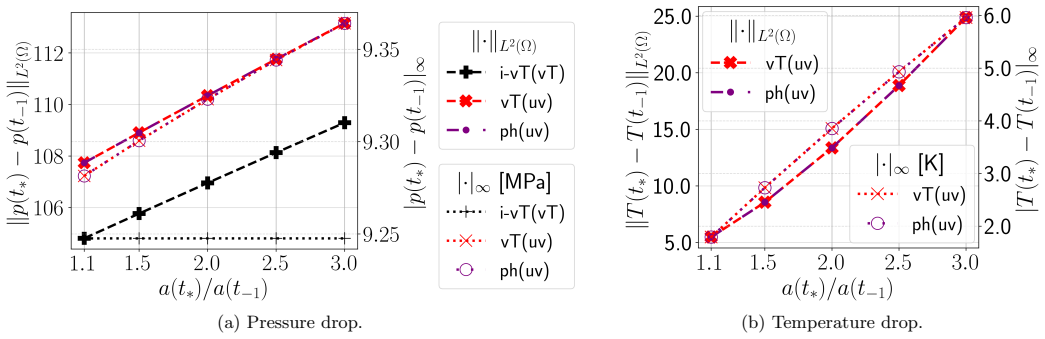
- Within the tested aperture range (gamma = 1.1 to 3.0), peak gas content, expansion-induced cooling, and the durations of the gas and pressure transients all increase monotonically with gamma.
- Thermal and isothermal runs give nearly identical transient durations; the thermal runs differ in the phase-evolution path and leave the fracture slightly warmer after recovery.
- Pressure-enthalpy and volume-temperature formulations recover the same physical solution while differing in nonlinear convergence, so the equilibrium specification can be chosen for numerical convenience without changing the physics.
- The modeled transient pressure reduction (roughly 10 MPa to 0.8 MPa) is large enough that ignoring geomechanical feedback in fully coupled simulations could misrepresent the subsequent mechanical response.
Reading between the lines
- The same preconditioner should detect rapid pore-volume compaction as well as dilation: compacting a closed parcel with fixed internal energy would raise pressure and temperature, and the flash would similarly initialize the compressed state, a testable extension the paper does not run.
- Comparing the paper's isochoric (constant-internal-energy) free expansion against an isenthalpic (constant-enthalpy) initialization on identical fracture-opening cases would show how much the choice of thermodynamic path matters and which idealization is closer to a fully resolved solution.
- By making the thermodynamic event explicit, the preconditioner doubles as an automatic event detector: it could flag time steps where the physically implied state change is large, guiding adaptive stepping instead of relying on trial-and-error step cuts.
- If the claimed coordinate invariance holds generally, it suggests that reservoir simulators can keep their established pressure-based transport codes and still capture mechanically induced phase change simply by adding an isochoric flash as a pre-step, no rewrite of the global solver required.
Signed reviews
Editorial analysis
A structured set of objections, weighed in public.
Referee Report
Summary. The paper develops a persistent-variable formulation for thermal compositional flow in fractured porous media in which specific volume is promoted to an independent transport variable. From a fully coupled flow–transport–equilibrium system, the authors derive volume-based models and show that classical pressure-based formulations are recovered by eliminating local thermodynamic variables. To handle abrupt fracture opening, they introduce a nonlinear preconditioner that assumes instantaneous free expansion of a closed local fluid amount: specific volume is set to v* = γ v(t^n) (Eq. 3.9), internal energy is held fixed in thermal cases, and a uv- or vT-flash is performed before the coupled transport solve (Algorithm 1, lines 14–15). Numerical examples show that unpreconditioned simulations step over the transient vaporization event, while preconditioned vT- and ph-based runs resolve it, and that gas content, cooling, and transient durations increase monotonically with aperture ratio. The paper also reports that pressure- and volume-based formulations recover the same physical solution but differ in nonlinear robustness.
Significance. If the central modeling premise is accepted, the paper makes a useful methodological contribution: it shows a thermodynamically motivated initialization strategy that prevents adaptive time stepping from skipping short-lived phase-change events, demonstrates that the global equilibrium specification can be chosen independently of the thermodynamic preconditioner, and provides a clean derivation connecting volume-based and pressure-based formulations. The work is reproducible (Docker/Zenodo archive), the derivations are parameter-free, and no model parameters are fitted to the reported results. The main caveat is that every reported transient quantity is a consequence of the assumed free-expansion thermodynamic path; the paper acknowledges this idealization but does not validate it or quantify its influence. The numerical claim about detecting transients is robust in the sense that the preconditioner changes the solver behavior, but the physical claim about mechanically induced vaporization is conditional on the unvalidated uv-flash assumption.
major comments (3)
- [§3.2, Eq. (3.9), Algorithm 1] The post-opening state is fixed by v* = γ v(t^n) and, for thermal runs, u(t^n), followed by a uv-flash. This free-expansion assumption is the only mechanism that distinguishes preconditioned from unpreconditioned simulations, so all reported transient quantities — peak gas saturation, temperature drop, pressure drop, and transient durations in Figures 5–12 and Section 4.3 — inherit it. The paper explicitly states that the transition is 'not uniquely prescribed by the governing equations' and acknowledges the isenthalpic choice of Sanchez-Alfaro et al. [44], but it provides no resolved reference solution, no comparison with the isenthalpic alternative, and no sensitivity study. If the actual path involves work done on the fluid by the moving fracture walls or finite-rate opening, the quantitative claims (e.g., 6.51–66.36% gas, 9.25–9.36 MPa pressure drop) would shift. Please add a compari
- [§4.2, Abstract] The statement that unpreconditioned simulations 'miss transient vaporization' is partly a statement about adaptive time stepping: as the paper explains, the time step spanning t_-1 and t* exceeds the transient duration τ_g, so the solver advances directly from the pre-expansion state to the post-transient state. The preconditioner does not detect an independently known physical event; it imposes a thermodynamic path and then resolves the consequences. The abstract's phrasing 'preconditioned models resolve it' should be qualified as 'resolve the vaporization predicted by the free-expansion model.' This distinction is central because the paper's headline physical result is not a validation of mechanically induced vaporization but a demonstration that a prescribed uv-flash can be embedded in the nonlinear solver.
- [§4.3, conclusion] The principal conceptual claim that 'equilibrium specification controls the numerical properties of the nonlinear problem rather than the recovered physical response' is supported only by comparing the vT and ph global formulations on a single scenario. The uv global formulation is explicitly not run because 'we do not expect' it to change the results. That expectation is plausible from the governing-equation structure, but it remains a conjecture. Given that this coordinate-invariance claim is highlighted in the abstract and conclusion, either run the uv formulation or restrict the claim to the formulations actually tested, and report quantitative differences between the vT and ph solutions rather than relying on visual 'indistinguishability.'
minor comments (4)
- [Figure 5 caption] The caption labels the first panel 'v [mol m^{-3}]', but v is defined in Eq. (2.29) as specific volume, so the units should be m^3/mol (or the label should be changed to density).
- [Eq. (2.8) and text after Eq. (2.9)] The text refers to 'the enthalpy mobility λ_u'; the symbol is defined as λ_h. Please correct the typo.
- [Algorithm 1, line 15] The pseudocode calls NPIPM with σ_pre but does not explicitly show the computation of v* and, in the thermal case, u(t^n), which the text in §3.2 describes. Adding these steps would make the algorithm self-contained.
- [Abstract and §4.3] The abstract says pressure–enthalpy and volume–temperature formulations 'recover identical physical solutions,' while Section 4.3 says 'virtually identical' or 'indistinguishable.' Please choose one wording and, ideally, give a quantitative measure (e.g., maximum relative difference in gas saturation or pressure) to support the claim.
Circularity Check
No significant circularity: the isochoric preconditioner's post-opening state is an explicit modeling assumption, not a fitted or self-referential prediction.
full rationale
The derivation chain is self-contained and does not reduce to its own inputs. The central quantity that drives the reported vaporization is the post-opening specific volume v* = gamma v(t^n) (Eq. 3.9), combined with fixed specific internal energy in the thermal case, followed by a uv-flash. This is an openly stated modeling idealization: Section 3.2 explicitly says 'the present work adopts free expansion of a closed local fluid amount, whereas Sanchez-Alfaro et al. [44] model the co-seismic transition as isenthalpic' and calls both 'different idealizations of the short mechanical event.' The gas saturation, temperature drop, and pressure drop are then computed from the equation-of-state equilibrium calculation rather than being inserted as fitted outputs. No parameters are fitted to the reported transient quantities; the aperture scaling factor gamma is a prescribed scenario input. The numerical claim that unpreconditioned simulations 'step over' the transient is supported by the adaptive-time-stepping behavior and does not depend on circular reasoning. Self-citations [45,46] supply the flash solver and persistent-variable numerical machinery, but the governing equations and the preconditioner algorithm are stated in the paper, and no load-bearing uniqueness or physical result is imported solely through a self-citation. The acknowledged idealization is a physical-modeling caveat, not a circular derivation, so the appropriate circularity score is minimal.
Assumptions & free parameters
assumptions (4)
- domain assumption Free-expansion model for the mechanical event: during abrupt fracture-aperture increase, pore volume changes before significant mass/energy exchange, preserving specific internal energy (thermal) or temperature (isothermal); the new state is v* = γ v(t^n).
- domain assumption Local thermodynamic equilibrium and instantaneous phase separation: all phases share pressure and temperature, phase separation is instantaneous, and equilibrium solves the KKT system (Eq. 2.13).
- domain assumption Water is modeled by the extended Peng-Robinson EoS rather than a more accurate water formulation (e.g., IAPWS); transport properties (viscosity, thermal conductivity) are constant.
- domain assumption Gravity, capillary effects, and molecular diffusion are neglected; relative permeability is linear (k_rβ = s_β).
Cite this review
Pith. "Pith review of Isochoric thermodynamic preconditioning for resolving mechanically induced phase change in fractured porous media." pith.science (2026). https://pith.science/paper/HWJND6ET
@misc{pith2026260718608,
  author       = {Pith},
  title        = {Pith review of: Isochoric thermodynamic preconditioning for resolving mechanically induced phase change in fractured porous media},
  year         = {2026},
  howpublished = {\url{https://pith.science/paper/HWJND6ET}},
  note         = {Machine review of arXiv:2607.18608}
}
read the original abstract
Rapid pore-volume changes can trigger phase change on timescales shorter than characteristic transport times and may therefore be skipped by conventional nonlinear solves and adaptive time stepping. We present a persistent-variable framework for transport in fractured porous media, introducing specific volume as an independent variable. Starting from a fully coupled system, we derive volume-based models and recover classical pressure-based formulations by eliminating local thermodynamic variables. To resolve abrupt fracture opening, we introduce a nonlinear preconditioner that assumes instantaneous free expansion and resolves the fluid state through an isochoric equilibrium calculation before advancing the transport problem. The preconditioner applies to both volume- and pressure-based models. In the studied fracture-opening cases, unpreconditioned simulations miss transient vaporization, whereas the preconditioned models do not. Across the investigated aperture range, larger openings produce monotonic increases in gas content, expansion-induced cooling, and durations of transients. Thermal effects alter the phase evolution but have otherwise minor influence on the overall transient duration. Within the proof-of-concept setting, fracture opening generates substantial transient pressure reductions, indicating that geomechanical feedback may become important in fully coupled applications. Pressure-enthalpy and volume-temperature formulations recover identical physical solutions but exhibit different nonlinear robustness, with the pressure-enthalpy formulation proving more robust in some recompression-dominated cases. These results show that equilibrium specifications control the numerical properties of the nonlinear problem rather than recovered physical responses, while isochoric preconditioning connects the nonlinear initialization directly to the underlying thermodynamics.
Figures


Figures from the paper (10 more)



Reference graph
Works this paper leans on
-
[44]
Earthquakes Trigger Rapid Flash Boiling Front at Optimal Geologic Conditions
Pablo Sanchez-Alfaro et al. “Earthquakes Trigger Rapid Flash Boiling Front at Optimal Geologic Conditions” . In: Geophysical Research Letters51.16 (2024), e2023GL108109.doi:10.1029/2023GL108109
-
[1]
Lake.Enhanced Oil Recovery
Larry W. Lake.Enhanced Oil Recovery. Englewood Cliffs, NJ: Prentice Hall, 1989.isbn: 978-0132816014
1989
-
[2]
Mathematical Structure of the Black-Oil Model for Petroleum Reservoir Simulation
John A. Trangenstein and John B. Bell. “Mathematical Structure of the Black-Oil Model for Petroleum Reservoir Simulation” . In:SIAM Journal on Applied Mathematics49.3 (1989), pp. 749–783.doi:10.1137/0149044
-
[3]
Mathematical Structure of Compositional Reservoir Simulation
John A. Trangenstein and John B. Bell. “Mathematical Structure of Compositional Reservoir Simulation” . en. In:SIAM J. Sci. and Stat. Comput.10.5 (Sept. 1989). Publisher: Society for Industrial & Applied Mathematics (SIAM), pp. 817–845.issn: 0196-5204, 2168-3417.doi:10.1137/0910049
-
[4]
Comparison of Nonlinear Formulations for Two-Phase Multi-Component EOS Based Simulation
Denis V. Voskov and Hamdi A. Tchelepi. “Comparison of Nonlinear Formulations for Two-Phase Multi-Component EOS Based Simulation” . In:Journal of Petroleum Science and Engineering82-83 (2012), pp. 101–111.doi:10. 1016/j.petrol.2011.10.012
2012
-
[5]
LeVeque.Finite volume methods for hyperbolic problems
Randall J. LeVeque.Finite volume methods for hyperbolic problems. 1st ed. Cambridge texts in applied mathe- matics ; 31. Cambridge: Cambridge University Press, 2002.isbn: 1-107-13246-0
2002
-
[6]
An Introduction to Multipoint Flux Approximations for Quadrilateral Grids
Ivar Aavatsmark. “An Introduction to Multipoint Flux Approximations for Quadrilateral Grids” . In:Computa- tional Geosciences6.3 (Sept. 2002), pp. 405–432.issn: 1573-1499.doi:10.1023/A:1021291114475. (Visited on 07/18/2025)
-
[7]
Convergence of MPF A on triangulations and for Richards’ equation
Runhild A. Klausen, Florin A. Radu, and Geir T. Eigestad. “Convergence of MPF A on triangulations and for Richards’ equation” . In:International Journal for Numerical Methods in Fluids58.12 (2008), pp. 1327–1351.doi: 10.1002/fld.1787
Show all 77 references
-
[8]
Symmetric Positive Definite Flux-Continuous Full-Tensor Finite-Volume Schemes on Unstructured Cell-Centered Triangular Grids
Helmer A. Friis, Michael G. Edwards, and Johannes Mykkeltveit. “Symmetric Positive Definite Flux-Continuous Full-Tensor Finite-Volume Schemes on Unstructured Cell-Centered Triangular Grids” . In:SIAM Journal on Sci- entific Computing31.2 (Jan. 2009), pp. 1192–1220.issn: 1064-8...
2009
-
[9]
A Constrained Pressure-Temperature Residual (CPTR) Method for Non-Isothermal Multi- phase Flow in Porous Media
Thomas Roy et al. “A Constrained Pressure-Temperature Residual (CPTR) Method for Non-Isothermal Multi- phase Flow in Porous Media” . In:SIAM Journal on Scientific Computing42.4 (Jan. 2020), B1014–B1040.issn: 1064-8275.doi:10.1137/19M1292023
2020 doi
-
[10]
J. R. Wallis, Richard P. Kendall, and Todd E. Little, eds.Constrained Residual Acceleration of Conjugate Residual Methods. Vol. SPE Reservoir Simulation Symposium. SPE Reservoir Simulation Conference. Feb. 1985, SPE- 13536–MS.doi:10.2118/13536-MS
1985 doi
-
[11]
A block preconditioner for thermo-poromechanics with frictional deformation of fractures
Yury Zabegaev, Inga Berre, and Eirik Keilegavlen. “A block preconditioner for thermo-poromechanics with frictional deformation of fractures” . In:Computer Methods in Applied Mechanics and Engineering448 (2026), p. 118440.issn: 0045-7825.doi:10.1016/j.cma.2025.118440
2026
-
[12]
The isothermal flash problem. Part I. Stability
Michael L. Michelsen. “The isothermal flash problem. Part I. Stability” . In:Fluid Phase Equilibria9 (1982), pp. 1– 19.doi:10.1016/0378-3812(82)85001-2
1982 doi
-
[13]
The isothermal flash problem. Part II. Phase-split calculation
Michael L. Michelsen. “The isothermal flash problem. Part II. Phase-split calculation” . In:Fluid Phase Equilibria 9 (1982), pp. 21–40.doi:10.1016/0378-3812(82)85002-4
1982 doi
-
[14]
Procedure for use of electronic digital computers in calculating flash vaporiza- tion hydrocarbon equilibrium
Henry H. Rachford and J. D. Rice. “Procedure for use of electronic digital computers in calculating flash vaporiza- tion hydrocarbon equilibrium” . In:Journal of Petroleum Technology4.10 (1952), pp. 19–3.doi:10.2118/952327- G
1952 doi
-
[15]
Di Zhu and Ryosuke Okuno, eds.Analysis of Narrow-Boiling Behavior for Thermal Compositional Simulation. Vol. Day 1 Mon, February 23. SPE Reservoir Simulation Conference. Feb. 2015, D011S001R002.doi:10.2118/ 173234-MS
2015
-
[16]
A robust algorithm for isenthalpic flash of narrow-boiling fluids
Di Zhu and Ryosuke Okuno. “A robust algorithm for isenthalpic flash of narrow-boiling fluids” . In:Fluid Phase Equilib.379 (2014), pp. 26–51.doi:10.1016/j.fluid.2014.07.003
2014 doi
-
[17]
Multiphase isenthalpic flash integrated with stability analysis
Di Zhu and Ryosuke Okuno. “Multiphase isenthalpic flash integrated with stability analysis” . In:Fluid Phase Equilib.423 (2016), pp. 203–219.doi:10.1016/j.fluid.2016.04.005
2016 doi
-
[18]
Multiphase isenthalpic and isentropic flash algorithms
Michael L. Michelsen. “Multiphase isenthalpic and isentropic flash algorithms” . In:Fluid Phase Equilibria33.1-2 (Dec. 1987), pp. 13–27.issn: 0378-3812.doi:10.1016/0378-3812(87)87002-4
1987 doi
-
[19]
Hydrothermal, multiphase convection of H 2O-NaCl fluids from ambient to magmatic tem- peratures: a new numerical scheme and benchmarks for code comparison
Philipp Weis et al. “Hydrothermal, multiphase convection of H 2O-NaCl fluids from ambient to magmatic tem- peratures: a new numerical scheme and benchmarks for code comparison” . en. In:Geofluids14.3 (Aug. 2014). Publisher: Wiley, pp. 347–371.issn: 1468-8115, 1468-8123.doi:10....
2014 doi
-
[20]
An efficient numerical simulator for geothermal simulation: A benchmark study
Yang Wang et al. “An efficient numerical simulator for geothermal simulation: A benchmark study” . In:Applied Energy264 (2020), p. 114693.doi:10.1016/j.apenergy.2020.114693
2020
-
[21]
Unified thermo-compositional-mechanical framework for reservoir simulation
Timur T. Garipov et al. “Unified thermo-compositional-mechanical framework for reservoir simulation” . In:Com- putational Geosciences22.4 (Aug. 2018), pp. 1039–1057.issn: 1573-1499.doi:10.1007/s10596-018-9737-5. 23
2018 doi
-
[22]
Geothermal reservoir simulation: 1. Mathematical models for liquid- and vapor-dominated hydrothermal systems
Charles R. Faust and James W. Mercer. “Geothermal reservoir simulation: 1. Mathematical models for liquid- and vapor-dominated hydrothermal systems” . In:Water Resources Research15.1 (1979), pp. 23–30.doi:10.1029/ WR015i001p00023
1979
-
[23]
Hayba and Steven E
Daniel O. Hayba and Steven E. Ingebritsen.The computer model Hydrotherm, a three-dimensional finite-difference model to simulate ground-water flow and heat transport in the temperature range of 0 to 1,200 degrees C. Tech. rep. 94-4045. U.S. Geological Survey ; USGS Earth Scien...
1994 doi
-
[24]
A modified energy equation model for flow boiling in porous media and its application to transpiration cooling at low pressures with transient effect
Haowei Hu et al. “A modified energy equation model for flow boiling in porous media and its application to transpiration cooling at low pressures with transient effect” . In:International Journal of Heat and Mass Transfer 158 (2020), p. 119745.issn: 0017-9310.doi:10.1016/j.ijh...
2020
-
[25]
The Open Porous Media Flow reservoir simulator
Atgeirr F. Rasmussen et al. “The Open Porous Media Flow reservoir simulator” . In:Computers & Mathematics with Applications81 (2021), pp. 159–185.issn: 0898-1221.doi:10.1016/j.camwa.2020.05.014
2021 doi
-
[26]
open Delft Advanced Research Terra Simulator (open-DARTS)
Denis V. Voskov et al. “open Delft Advanced Research Terra Simulator (open-DARTS)” . In:Journal of Open Source Software9.99 (2024), p. 6737.doi:10.21105/joss.06737
2024 doi
-
[27]
An Introduction to Reservoir Simulation Using MATLAB/GNU Octave
Lie Knut-Andreas. “An Introduction to Reservoir Simulation Using MATLAB/GNU Octave” . In:Cambridge University Press & Assessment(2019).url:https://www.cambridge.org/universitypress/subjects/earth- and- environmental- science/applied- geoscience- petroleum- and- mining- geoscie...
2019
-
[28]
GEOS: A performance portable multi-physics simulation framework for subsurface applications
Randolph R. Settgast et al. “GEOS: A performance portable multi-physics simulation framework for subsurface applications” . In:Journal of Open Source Software9.102 (2024), p. 6973.doi:10.21105/joss.06973
2024 doi
-
[29]
General Purpose Compositional Model
G´ abor A´ cs, S´ andor Doleschall, and´Eva Farkas. “General Purpose Compositional Model” . In:Society of Petroleum Engineers Journal25.4 (Aug. 1985), pp. 543–553.issn: 0197-7520.doi:10.2118/10515-PA
1985 doi
-
[30]
Compositional modeling in porous media using constant volume flash and flux computation without the need for phase identification
Ondˇ rej Pol ´ ıvka and Jiˇ r ´ ı Mikyˇ ska. “Compositional modeling in porous media using constant volume flash and flux computation without the need for phase identification” . In:Journal of Computational Physics272 (2014), pp. 149–169.issn: 0021-9991.doi:10.1016/j.jcp.2014.04.029
2014 doi
-
[31]
Fully implicit two-phase VT-flash compositional flow simulation en- hanced by multilayer nonlinear elimination
Yiteng Li, Haijian Yang, and Shuyu Sun. “Fully implicit two-phase VT-flash compositional flow simulation en- hanced by multilayer nonlinear elimination” . In:Journal of Computational Physics449 (2022), p. 110790.issn: 0021-9991.doi:10.1016/j.jcp.2021.110790
2022
-
[32]
Dynamic optimization of thermodynamically rigorous models of multiphase flow in porous subsurface oil reservoirs
Tobias K. S. Ritschel and John B. Jørgensen. “Dynamic optimization of thermodynamically rigorous models of multiphase flow in porous subsurface oil reservoirs” . In:Journal of Process Control78 (2019), pp. 45–56.issn: 0959-1524.doi:10.1016/j.jprocont.2019.03.014
2019 doi
-
[33]
Application of the numerical density-enthalpy method to the multi-phase flow through a porous medium
D. Ibrahim, Fred J. Vermolen, and Cornelis Vuik. “Application of the numerical density-enthalpy method to the multi-phase flow through a porous medium” . In:Procedia Computer Science1.1 (2010). ICCS 2010, pp. 781–790. issn: 1877-0509.doi:10.1016/j.procs.2010.04.084
2010 doi
-
[34]
Decompression boiling and natural steam cap formation in high-enthalpy geothermal systems
Samuel W. Scott. “Decompression boiling and natural steam cap formation in high-enthalpy geothermal systems” . In:Journal of Volcanology and Geothermal Research395 (2020), p. 106765.issn: 0377-0273.doi:10.1016/j. jvolgeores.2019.106765
2020
-
[35]
Non-isothermal two-phase flow in deformable porous media: systematic open-source implementation and verification procedure
Norbert Grunwald et al. “Non-isothermal two-phase flow in deformable porous media: systematic open-source implementation and verification procedure” . In:Geomechanics and Geophysics for Geo-Energy and Geo-Resources 8.3 (May 2022), p. 107.issn: 2363-8427.doi:10.1007/s40948-022-00394-2
2022 doi
-
[36]
Simulation of coupled multiphase flow and geomechanics in porous media with embedded discrete fractures
Matteo Cusini et al. “Simulation of coupled multiphase flow and geomechanics in porous media with embedded discrete fractures” . In:International Journal for Numerical and Analytical Methods in Geomechanics45.5 (2021), pp. 563–584.doi:10.1002/nag.3168
2021 doi
-
[37]
John Wiley & Sons, Ltd, 2003.isbn: 9780470849200
Oliver Coussy.Poromechanics. John Wiley & Sons, Ltd, 2003.isbn: 9780470849200
2003
-
[38]
Fault slip in hydraulic stimulation of geothermal reservoirs: Governing mechanisms and process-structure interaction
Inga Berre, Ivar Stefansson, and Eirik Keilegavlen. “Fault slip in hydraulic stimulation of geothermal reservoirs: Governing mechanisms and process-structure interaction” . In:The Leading Edge39.12 (Dec. 2020), pp. 893–900. issn: 1070-485X.doi:10.1190/tle39120893.1
2020 doi
-
[39]
Postinjection Normal Closure of Fractures as a Mechanism for Induced Seismicity
Eren Ucar, Inga Berre, and Eirik Keilegavlen. “Postinjection Normal Closure of Fractures as a Mechanism for Induced Seismicity” . In:Geophysical Research Letters44.19 (2017), pp. 9598–9606.doi:10.1002/2017GL074282
2017 doi
-
[40]
Hydro-mechanical simulation and analysis of induced seismicity for a hydraulic stimulation test at the Reykjanes geothermal field, Iceland
Eirik Keilegavlen et al. “Hydro-mechanical simulation and analysis of induced seismicity for a hydraulic stimulation test at the Reykjanes geothermal field, Iceland” . In:Geothermics97 (Dec. 2021), p. 102223.issn: 0375-6505.doi: 10.1016/j.geothermics.2021.102223
2021
-
[41]
A fully coupled numerical model of thermo-hydro-mechanical processes and fracture contact mechanics in porous media
Ivar Stefansson, Inga Berre, and Eirik Keilegavlen. “A fully coupled numerical model of thermo-hydro-mechanical processes and fracture contact mechanics in porous media” . In:Computer Methods in Applied Mechanics and Engineering386 (2021), p. 114122.issn: 0045-7825.doi:10.1016...
2021
-
[42]
Flash vaporization during earthquakes evidenced by gold deposits
Dion K. Weatherley and Richard W. Henley. “Flash vaporization during earthquakes evidenced by gold deposits” . In:Nature Geoscience6.4 (Apr. 2013), pp. 294–298.issn: 1752-0908.doi:10.1038/ngeo1759
2013 doi
-
[43]
Dilatancy-induced fluid pressure drop during dynamic rupture: Direct experimental evidence and consequences for earthquake dynamics
Nicolas Brantut. “Dilatancy-induced fluid pressure drop during dynamic rupture: Direct experimental evidence and consequences for earthquake dynamics” . In:Earth and Planetary Science Letters538 (2020), p. 116179.issn: 0012-821X.doi:10.1016/j.epsl.2020.116179
2020
-
[45]
Unified Flash Calculations with Isenthalpic and Isochoric Constraints
Veljko Lipovac et al. “Unified Flash Calculations with Isenthalpic and Isochoric Constraints” . In:Fluid Phase Equilibria578 (2023), p. 113991.doi:10.1016/j.fluid.2023.113991
2023
-
[46]
2025.doi:10.48550/arXiv.2512.04205
Veljko Lipovac et al.Persistent-variable thermal compositional simulation of multiphase flow with phase separation in porous media. 2025.doi:10.48550/arXiv.2512.04205. arXiv:2512.04205 [physics.comp-ph]
2025 doi
-
[47]
PorePy: An Open-Source Software for Simulation of Multiphysics Processes in Fractured Porous Media
Eirik Keilegavlen et al. “PorePy: An Open-Source Software for Simulation of Multiphysics Processes in Fractured Porous Media” . In:Computational Geosciences25 (2021), pp. 243–265.doi:10.1007/s10596-020-10002-5
2021 doi
-
[48]
State function based flash specifications
Michael L. Michelsen. “State function based flash specifications” . In:Fluid Phase Equilibria158 (1999), pp. 617– 626.doi:10.1016/S0378-3812(99)00092-8
1999 doi
-
[49]
An analysis of the unified formulation for the equilibrium problem of compositional multiphase mixtures
Ibtihel Ben Gharbia et al. “An analysis of the unified formulation for the equilibrium problem of compositional multiphase mixtures” . In:ESAIM: Mathematical Modelling and Numerical Analysis55.6 (2021), pp. 2981–3016. doi:10.1051/m2an/2021075
2021
-
[50]
Flow in Fractured Porous Media: A Review of Conceptual Models and Discretization Approaches
Inga Berre, Florian Doster, and Eirik Keilegavlen. “Flow in Fractured Porous Media: A Review of Conceptual Models and Discretization Approaches” . In:Transport in Porous Media130.1 (Oct. 2019), pp. 215–236.issn: 1573-1634.doi:10.1007/s11242-018-1171-6
2019 doi
-
[51]
Domain Decomposition for Some Transmission Problems in Flow in Porous Media
Clarisse Alboin et al. “Domain Decomposition for Some Transmission Problems in Flow in Porous Media” . In: Numerical Treatment of Multiphase Flows in Porous Media. Ed. by Zhangxin Chen, Richard E. Ewing, and Zhong-Ci Shi. Berlin, Heidelberg: Springer Berlin Heidelberg, 2000, p...
2000
-
[52]
Modeling fractures as interfaces for flow and transport in porous media
Clarisse Alboin et al. “Modeling fractures as interfaces for flow and transport in porous media” . In:Fluid flow and transport in porous media: mathematical and numerical treatment (South Hadley, MA, 2001). Vol. 295. Contemp. Math. Amer. Math. Soc., Providence, RI, 2002, pp. 1...
2001 doi
-
[53]
Modeling Fractures and Barriers as Interfaces for Flow in Porous Media
Vincent Martin, J´ erˆ ome Jaffr´ e, and Jean E. Roberts. “Modeling Fractures and Barriers as Interfaces for Flow in Porous Media” . In:SIAM Journal on Scientific Computing26.5 (Jan. 2005), pp. 1667–1691.issn: 1064-8275, 1095-7197.doi:10.1137/s1064827503429363
2005 doi
-
[54]
Functional analysis and exterior calculus on mixed- dimensional geometries
Wietse M. Boon, Jan M. Nordbotten, and Jon E. Vatne. “Functional analysis and exterior calculus on mixed- dimensional geometries” . In:Annali di Matematica Pura ed Applicata (1923 -)200.2 (Apr. 2021), pp. 757–789. issn: 1618-1891.doi:10.1007/s10231-020-01013-1
1923 doi
-
[55]
Flexible and rigorous numerical modelling of multiphysics processes in fractured porous media using PorePy
Ivar Stefansson et al. “Flexible and rigorous numerical modelling of multiphysics processes in fractured porous media using PorePy” . In:Results in Applied Mathematics21 (2024), p. 100428.issn: 2590-0374.doi:10.1016/ j.rinam.2023.100428
2024
-
[56]
Mixed-Dimensional Approach for Compositional Multiphase Flow in High-Enthalpy Fractured Geothermal Reservoirs
Omar Duran, Veljko Lipovac, and Inga Berre. “Mixed-Dimensional Approach for Compositional Multiphase Flow in High-Enthalpy Fractured Geothermal Reservoirs” . In:50th Workshop on Geothermal Reservoir Engineering
-
[57]
A Unified Compositional Flow Model for Simulating Multiphase High-Enthalpy Geothermal Reservoirs
Micheal B. Oguntola et al. “A Unified Compositional Flow Model for Simulating Multiphase High-Enthalpy Geothermal Reservoirs” . In:50th Workshop on Geothermal Reservoir Engineering 2025. Stanford Geothermal Program, 2025. Chap. 2.isbn: 9798331318550.url:https://api.nva.unit.no...
2025
-
[58]
Oguntola et al.Mathematical Modeling of Salt Precipitation and Multi-Phase Flow in High Enthalpy Fractured Geothermal Systems
Micheal B. Oguntola et al.Mathematical Modeling of Salt Precipitation and Multi-Phase Flow in High Enthalpy Fractured Geothermal Systems. 2026.doi:10.48550/arXiv.2606.14328. arXiv:2606.14328 [math.NA]
2026 doi
-
[59]
Hydraulic Properties of Porous Media and Their Relation to Drainage Design
R. H. Brooks and Arthur T. Corey. “Hydraulic Properties of Porous Media and Their Relation to Drainage Design” . en. In:Transactions of the ASAE7.1 (1964), pp. 0026–0028.issn: 2151-0059.doi:10.13031/2013.40684
1964
-
[60]
An effective thermal conductivity model of geological porous media for coupled thermo-hydro-mechanical systems with multiphase flow
Fuguo Tong, Lanru Jing, and Robert W. Zimmerman. “An effective thermal conductivity model of geological porous media for coupled thermo-hydro-mechanical systems with multiphase flow” . In:International Journal of Rock Mechanics and Mining Sciences46.8 (2009), pp. 1358–1369.iss...
2009 doi
-
[61]
A New Two-Constant Equation of State
Ding-Yu Peng and Donald B. Robinson. “A New Two-Constant Equation of State” . In:Industrial & engineering chemistry fundamentals15.1 (1976), pp. 59–64.doi:10.1021/i160057a011. 25
1976 doi
-
[62]
Peng-Robinson equation of state: 40 years through cubics
Juan Sebastian Lopez-Echeverry, Simon Reif-Acherman, and Eduard Araujo-Lopez. “Peng-Robinson equation of state: 40 years through cubics” . In:Fluid Phase Equilib.447 (2017), pp. 39–71.doi:10.1016/j.fluid.2017.05. 007
2017 doi
-
[63]
The IAPWS Industrial Formulation 1997 for the Thermodynamic Properties of Water and Steam
Wolfgang Wagner et al. “The IAPWS Industrial Formulation 1997 for the Thermodynamic Properties of Water and Steam” . In:Journal of Engineering for Gas Turbines and Power122 (2000), pp. 150–184.issn: 0742-4795. doi:10.1115/1.483186
1997 doi
-
[64]
The system H2O–NaCl. Part I: Correlation formulae for phase relations in temperature–pressure–composition space from 0 to 1000°C, 0 to 5000bar, and 0 to 1 XNaCl
Thomas Driesner and Christoph A. Heinrich. “The system H2O–NaCl. Part I: Correlation formulae for phase relations in temperature–pressure–composition space from 0 to 1000°C, 0 to 5000bar, and 0 to 1 XNaCl” . en. In: Geochimica et Cosmochimica Acta71.20 (Oct. 2007). Publisher: ...
2007 doi
-
[65]
Calculating Viscosities of Reservoir Fluids From Their Compositions
John Lohrenz, Bruce G. Bray, and Charles R. Clark. “Calculating Viscosities of Reservoir Fluids From Their Compositions” . In:Journal of Petroleum Technology16.10 (Oct. 1964), pp. 1171–1176.issn: 0149-2136.doi: 10.2118/915-PA
1964 doi
-
[66]
Correlation and Prediction of Thermal Conductivity Using the Redlich–Kwong Cubic Equation of State and the Geometric Similitude Concept for Pure Substances and Mixtures
Luis F. Cardona, Luis A. Forero, and Jorge A. Vel´ asquez. “Correlation and Prediction of Thermal Conductivity Using the Redlich–Kwong Cubic Equation of State and the Geometric Similitude Concept for Pure Substances and Mixtures” . In:Industrial & Engineering Chemistry Researc...
2019
-
[67]
Equation of state analog correlations for the viscosity and thermal conductivity of hydro- carbons and reservoir fluids
Xian-Qi Guo et al. “Equation of state analog correlations for the viscosity and thermal conductivity of hydro- carbons and reservoir fluids” . In:Journal of Petroleum Science and Engineering30.1 (2001), pp. 15–27.issn: 0920-4105.doi:10.1016/S0920-4105(01)00098-5
2001 doi
-
[68]
A Helmholtz Free Energy Formulation of the Thermodynamic Proper- ties of the Mixture{Water + Ammonia}
Reiner Tillner-Roth and Daniel G. Friend. “A Helmholtz Free Energy Formulation of the Thermodynamic Proper- ties of the Mixture{Water + Ammonia}” . In:Journal of Physical and Chemical Reference Data27.1 (Jan. 1998), pp. 63–96.issn: 0047-2689.doi:10.1063/1.556015
1998 doi
-
[69]
Helmholtz Energy Transformations of Common Cubic Equations of State for Use with Pure Fluids and Mixtures
Ian H. Bell and Andreas J ¨ager. “Helmholtz Energy Transformations of Common Cubic Equations of State for Use with Pure Fluids and Mixtures” . In:Journal of Research of the National Institute of Standards and Technology 121 (June 2016), pp. 238–263.issn: 1044-677X.doi:10.6028/...
2016 doi
-
[70]
Calculation of critical points from Helmholtz-energy-explicit mixture models
Ian H. Bell and Andreas J ¨ager. “Calculation of critical points from Helmholtz-energy-explicit mixture models” . In:Fluid Phase Equilibria433 (2017), pp. 159–173.issn: 0378-3812.doi:10.1016/j.fluid.2016.10.030
2017 doi
-
[71]
Finite-Volume Discretisations for Flow in Fractured Porous Media
Ivar Stefansson, Inga Berre, and Eirik Keilegavlen. “Finite-Volume Discretisations for Flow in Fractured Porous Media” . In:Transport in Porous Media124.2 (Sept. 2018), pp. 439–462.issn: 1573-1634.doi:10.1007/s11242- 018-1077-3
2018 doi
-
[72]
An Introduction to Multi-Point Flux (MPF A) and Stress (MPSA) Finite Volume Methods for Thermo-Poroelasticity
Jan M. Nordbotten and Eirik Keilegavlen. “An Introduction to Multi-Point Flux (MPF A) and Stress (MPSA) Finite Volume Methods for Thermo-Poroelasticity” . In:arXiv(2020).doi:10.48550/arXiv.2001.01990. arXiv: 2001.01990 [math.NA]
-
[73]
On the solution of nonlinear hyperbolic differential equations by finite differences
Richard Courant, Eugene Isaacson, and Mina Rees. “On the solution of nonlinear hyperbolic differential equations by finite differences” . en. In:Communications on Pure and Applied Mathematics5.3 (1952), pp. 243–255.issn: 1097-0312.doi:10.1002/cpa.3160050303
1952 doi
-
[74]
A new approach for solving nonlinear algebraic systems with complementarity conditions. Application to compositional multiphase equilibrium problems
Duc Thach Son Vu et al. “A new approach for solving nonlinear algebraic systems with complementarity conditions. Application to compositional multiphase equilibrium problems” . In:Mathematics and Computers in Simulation 190 (2021), pp. 1243–1274.doi:10.1016/j.matcom.2021.07.015
2021 doi
-
[75]
Newton trust-region methods with primary variable switching for simulating high temper- ature multiphase porous media flow
Heeho D. Park et al. “Newton trust-region methods with primary variable switching for simulating high temper- ature multiphase porous media flow” . In:Advances in Water Resources168 (2022), p. 104285.issn: 0309-1708. doi:10.1016/j.advwatres.2022.104285
2022
-
[76]
Hydraulic Characteristics of Rough Fractures in Linear Flow under Normal and Shear Load
Hee S. Lee and Tae-Foon Cho. “Hydraulic Characteristics of Rough Fractures in Linear Flow under Normal and Shear Load” . In:Rock Mechanics and Rock Engineering35.4 (Oct. 2002), pp. 299–318.issn: 1434-453X.doi: 10.1007/s00603-002-0028-y. 26
2002 doi
-
[2025]
Stanford Geothermal Program, 2025. Chap. 3.isbn: 9798331318550.url:https://api.nva.unit.no/ publication/0198f176b73c-ca04ea12-8874-44d0-b2bb-67c431c1f629
2025
Reviewed August 1, 2026 · model on record in the stance chip above.
Discussion (0). Continue with ORCID to comment.