REVIEW 3 major objections 5 minor 106 references
Small-transverse-momentum resummation is essential for making the precise ATLAS 13 TeV Z-boson measurement compatible with global PDF fits, and the apparent PDF shifts at fixed order are largely artifacts of missing logarithmic corrections.
Reviewed by Pith at T0; open to challenge. T0 means a machine referee read the full paper against a public rubric. the ladder, T0–T4 →
T0 review · deepseek-v4-flash
2026-08-01 13:10 UTC pith:NXIE7S47
load-bearing objection Resummation helps a lot, but the 'essential' claim leans on an approximate K-factor and a dataset that still sits at chi2/N=3.9. the 3 major comments →
Impact of Z-boson transverse-momentum resummation on PDF determination
The pith
A machine-rendered reading of the paper's core claim, the machinery that carries it, and where it could break.
Core claim
The central claim, stated on the paper's own terms, is that small-pT resummation corrections are not an optional refinement but fundamental for the compatibility of the very precise 13 TeV ATLAS Z-boson pT measurements with the baseline data set, even with a conservative pT >= 30 GeV cut. The apparent PDF distortions induced by these data at fixed order — a 5% depletion of the strange sea at low x and a 2.5% suppression of the gluon at x less than about 10^-3 with an enhancement near x around 0.03 — are largely mitigated once resummation is included. The impact on PDFs is moderate and manifests mainly as a stabilization of the gluon PDF in the x-region relevant for LHC phenomenology.
What carries the argument
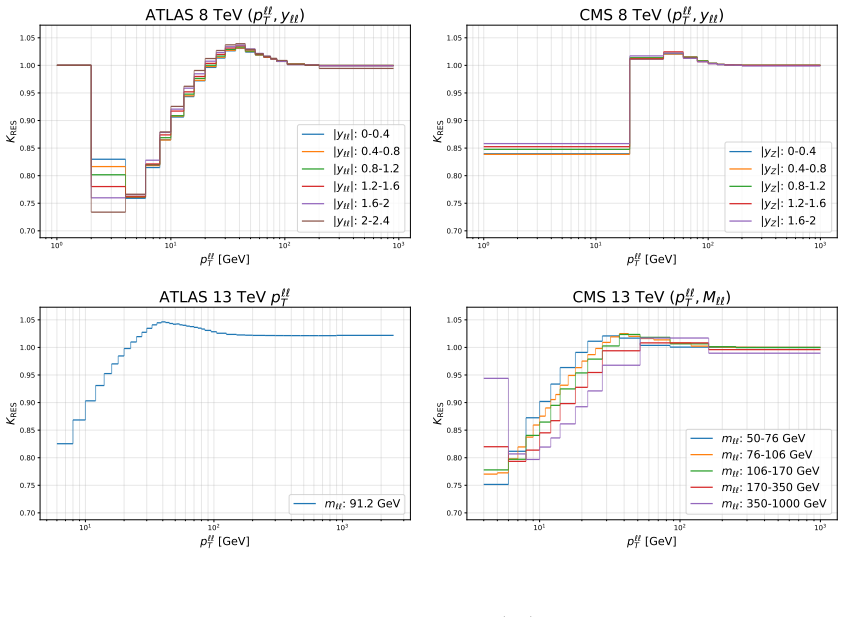
The load-bearing mechanism is a bin-by-bin resummation K-factor, K_RES = (d(sigma_RES+FO)/dpT)/(d(sigma_FO)/dpT), which rescales NNLO fixed-order predictions for the Z-pT spectrum by the ratio of RadISH N3LL'-resummed to fixed-order cross sections. The K-factor is computed with a fixed input PDF set (the previous NNPDF4.0 nominal set) and then applied multiplicatively to the data in the PDF fit; missing higher-order uncertainties are included through a theory covariance matrix built from 7-point renormalisation- and factorisation-scale variations. This K-factor is what converts an inconsistent data set into a compatible one, and the paper explicitly notes that testing its faithfulness requir
Load-bearing premise
The central conclusion depends on the approximation that resummation can be applied as a bin-by-bin multiplicative K-factor computed with a fixed PDF set, without reweighting individual partonic channels; if partonic-channel dependence matters, the improved compatibility of the 13 TeV data could be an artifact.
What would settle it
Compute the Z-pT spectrum with an exact resummed interpolation grid (e.g., interfacing RadISH with PineAPPL) for the ATLAS 13 TeV kinematics and compare the resulting fit chi2 and PDFs with the K-factor-based fit; if the exact fit shows chi2 per point above 6 or restores the fixed-order PDF distortions, the paper's central claim fails.
If this is right
- Future global PDF analyses should include resummed Z-pT predictions while retaining the 30 GeV cut; otherwise the 13 TeV ATLAS data would distort PDFs and degrade fit quality.
- The gluon PDF in the region relevant for gluon-fusion Higgs production is stabilized, so precision predictions for the Higgs cross section are unlikely to be significantly altered by the new Z-pT data once resummation is included.
- Numerically stable NNLOjet predictions allow removal of the extra 1% uncorrelated uncertainty previously assigned to 8 TeV Z-pT data, without significant PDF distortion.
- Extending fits to pT below about 30 GeV is not yet justified; the current correlation model for theoretical uncertainties is too restrictive in the low-pT region.
- Determination of alpha_s from global fits could benefit from resummed low-pT data, given the sensitivity of the pT peak to the strong coupling.
Where Pith is reading between the lines
- If the K-factor approximation is as accurate as the paper suggests, resummation should be standard practice for any high-precision DY observable entering PDF fits, including phi* and W-pT measurements; the mechanism is generic, not specific to the ATLAS 13 TeV data.
- The residual chi2 of about 4 for the ATLAS 13 TeV data suggests that resummation resolves most, but not all, of the tension; the remaining discrepancy is a candidate signal of underestimated experimental correlations or of non-perturbative effects, separable only by an exact resummed-grid implementation.
- One could test the correlation model directly: if scale variations are decoupled between low- and high-pT regions, the low-pT deterioration seen in the paper should largely disappear, which would mean the current theory covariance matrix is overcorrelated.
- A closure test using resummed pseudodata would establish whether the K-factor method biases PDFs; the paper's approximation could be validated or falsified without waiting for a full RadISH-PineAPPL interface.
Editorial analysis
A structured set of objections, weighed in public.
Referee Report
Summary. This paper investigates the impact of small-transverse-momentum resummation for neutral-current Drell-Yan production on collinear PDF determination. Using the NNPDF methodology, the authors include ATLAS and CMS Z-boson pT measurements at 8 and 13 TeV. Fixed-order NNLO predictions are supplemented with N3LL' RadISH resummation implemented as bin-by-bin K-factors (Eq. 2.5). A staged series of PDF fits is performed: first revisiting the 8 TeV data with exact NNLOjet predictions and removing the previous 1% numerical uncertainty; then adding the 13 TeV ATLAS/CMS data; then applying resummation with fixed and progressively lowered pT cuts. The main findings are that resummation markedly improves the description of the 13 TeV ATLAS data (chi2 per point from 7.83 to 3.94), stabilizes the extracted PDFs, and that lowering the pT cut below 30 GeV leads to deteriorating fit quality, partly attributed to the treatment of theory-uncertainty correlations.
Significance. If the central claim holds, the paper provides important guidance for future global PDF fits: small-pT resummation should be included even with a conservative pT>30 GeV cut, and apparent PDF distortions from the 13 TeV ATLAS Z-pT data at fixed order are largely artifacts of missing logarithmic corrections. The paper is also valuable as a methodological demonstration: it uses exact NNLO interpolation grids, full-colour dijet predictions, a theory covariance matrix, and a careful staged comparison of data sets and cuts. The availability of the PDF sets from the authors is a useful resource. However, the central mechanism is tested only through an approximate K-factor that is PDF-dependent and does not reweight partonic channels, and the residual chi2 remains significantly above one even after resummation; these issues need to be addressed before the 'essential' conclusion can be considered fully established.
major comments (3)
- [Eq. (2.5), Sect. 3.3.1] The central claim that resummation is 'essential' for compatibility of the 13 TeV ATLAS data is tested only through the multiplicative K-factor K_RES = (dσ_RES+FO)/(dσ_FO), evaluated once with the previous NNPDF4.0 PDF set. As the paper itself states in Sect. 3.3.1, this approach does not reweight individual partonic channels and is PDF-dependent. Since K_RES is a few percent in the fitted pT>30 GeV region while the ATLAS 13 TeV data have sub-percent uncertainties, the improvement from 7.83 to 3.94 and the gluon stabilization could in principle be an artifact of using a fixed, PDF-dependent rescaling. The analogy with NNLO K-factors [121] is not a substitute for a validation of the resummation K-factor. I request a quantitative robustness test, e.g., recomputing K_RES with an alternative input PDF set or with PDFs from the fitted ensemble, or a comparison with an exact RadISH-PineAPPL im
- [Sect. 2.2.3] The theory covariance matrix is built only from renormalisation- and factorisation-scale variations; resummation-scale variations are explicitly excluded. The paper states that 'its effect is marginal' and refers to Sect. 3.3, but I could not find any numerical evidence supporting this claim. Given that the analysis is precisely about the low-pT region where resummation effects are largest, the omission is load-bearing. The authors should either include the resummation-scale variation in the covariance matrix or provide a dedicated test (e.g., varying Q between m_ll/2, m_ll, and 2m_ll) showing the impact on the ATLAS 13 TeV chi2 and on the PDFs. Without such a test, the quoted improvement cannot be distinguished from a particular choice of resummation scale.
- [Table 3.4, Sect. 3.3.1] The paper describes the improvement of the ATLAS 13 TeV description from chi2/Ndat=7.83 to 3.94 as making the data 'compatible' with the baseline data set. However, a chi2 per point of 3.94 still represents a very poor description for 19 data points. Appendix A confirms that even heavily weighting the data set only reduces this to 3.57 while severely degrading the global fit, leading the authors to conclude that the measurement may have underestimated uncertainties. This should be reflected more carefully in the abstract and conclusions: resummation substantially improves but does not fully restore consistency. The current wording overstates the strength of the conclusion.
minor comments (5)
- [Sect. 2.2.2] Please clarify the resummation scale choice: Eq. (2.2) defines Q~m_ll, and the text says 'we choose Q=m_ll/2', but Fig. 2.1 appears to use a single scale. A brief sentence on the sensitivity to this choice would help.
- [Table 3.2 and Table 3.3] The total number of data points Ndat is reported as 4551 for the baseline and all subsequent fits, but the 13 TeV ATLAS and CMS data are added in Tables 3.3 and 3.4. The text states that 'the total number of data points does not include the data points in the 13 TeV ATLAS and CMS data sets', but this convention should also be stated in the main text where the total chi2 is discussed.
- [Footnote 2] The footnote about the contradiction with Ref. [175] is useful but somewhat terse. Please specify precisely which 'mismatch in the accounting of experimental uncertainties' was identified, to allow the reader to assess the claim.
- [Sect. 3.3.2, Table 3.6] The 'diagonal' and 'envelope' prescriptions used as diagnostics produce anomalously small chi2 values. It would be helpful to state explicitly whether these prescriptions are used only as diagnostics and are not recommended for production fits, to avoid misinterpretation.
- [General] There are occasional formatting issues in the equations and tables, such as the rendering of 'p_ll_T' and the use of 'N dat' in the text. These should be corrected in the final version.
Circularity Check
No significant circularity: the resummation K-factor is a theory input computed with a previous PDF set, not fitted to the 13 TeV data; the central claim rests on direct chi2 comparisons. Score 2 reflects minor caveats (PDF-dependent K-factor, one supporting self-citation), not a circular derivation.
full rationale
The central derivation is self-contained against data. Predictions are built from NNLO fixed order (NNLOjet) plus RadISH N3LL' resummation (eqs. 2.1-2.4); the K-factor in eq. (2.5) is a ratio of resummed to fixed-order spectra evaluated once with the NNPDF4.0 PDF set of [58]. It is not a fitted parameter, and the ATLAS 13 TeV data are not used in constructing it, so the improvement reported in Table 3.4 (ATLAS 13 TeV chi2/Ndat from 7.83 to 3.94) is a genuine data-theory comparison rather than a fitted quantity renamed as a prediction. The paper explicitly flags the K-factor approximation in Sect. 3.3.1: "K-factors rescale the cross section by a bin-dependent multiplicative correction that does not reweigh individual partonic channels," and leaves exact RadISH-PineAPPL interfacing to future work. This is a limitation/approximation, not a circular reduction: the correction is still first-principles resummation, and the target data were not used to tune it. The only self-citation with potential support role is ref. [121], invoked to argue that DY K-factor approximations are adequate; it has overlapping authorship but is not the main evidence for the conclusions. No uniqueness theorem, no ansatz smuggled via citation, and no renaming of known results were found. Score 2 reflects these minor caveats; the derivation itself is not circular.
Axiom & Free-Parameter Ledger
free parameters (4)
- Resummation scale Q =
m_ll/2
- Central renormalisation/factorisation scale =
sqrt(pT^2 + m_ll^2)
- Modified-log switch parameter p in RadISH =
6
- Large-pT cut =
150 GeV
axioms (5)
- domain assumption Collinear QCD factorization and NNLO fixed-order cross sections from NNLOjet describe the Z-boson transverse-momentum spectrum in the fitted region.
- domain assumption RadISH N3LL' resummation correctly sums the logarithmic corrections for pT/m_ll and the additive matching to NNLO is valid.
- ad hoc to paper Resummation can be approximated by bin-by-bin K-factors evaluated with NNPDF4.0 PDFs.
- domain assumption The 7-point scale-variation theory covariance matrix, with renormalisation-scale variations correlated within processes and factorisation-scale variations correlated across all data, is a valid estimator of missing higher-order uncertainties.
- domain assumption Electroweak corrections are negligible in the fitted region pT <= 150 GeV.
read the original abstract
We study the impact of small-transverse-momentum resummation for neutral-current Drell-Yan lepton-pair production on the determination of collinear parton distribution functions (PDFs). We focus on measurements of the Z-boson transverse-momentum spectrum performed by ATLAS and CMS at the LHC at centre-of-mass energies of 8 and 13 TeV, and include them in PDF fits based on the NNPDF methodology. Theoretical predictions are computed at next-to-next-to-leading order (NNLO) in perturbative QCD and are supplemented with small-transverse-momentum resummation corrections at next-to-next-to-next-to-leading logarithmic accuracy obtained with RadISH. Missing higher-order uncertainties are accounted for through a theory covariance matrix constructed from renormalisation- and factorisation-scale variations. We first revisit the treatment of the 8 TeV data, replacing the fixed-order predictions used in previous analyses with numerically stable NNLO calculations, and removing the additional numerical uncertainties introduced in earlier fits. We then assess the impact of the 13 TeV measurements, of resummation corrections, and of progressively lowering the minimum cut on the dilepton transverse momentum. We find that resummation improves the description of the Z boson transverse-momentum data and is essential for ensuring the overall consistency of the PDF fits. Nevertheless, it does not conclusively support extending the fitted kinematic region to transverse momenta below a few tens of GeV. The impact of resummation on PDFs is moderate, leading primarily to a stabilisation of the gluon PDF in a kinematic region of relevance for LHC phenomenology. Finally, we comment on the fact that the treatment of correlations among theoretical uncertainties may play a central role in PDF fits to measurements with percent- and sub-percent-level precision.
Figures


Reference graph
Works this paper leans on
-
[12]
X. Chen, T. Gehrmann, N. Glover, A. Huss, T.-Z. Yang and H.X. Zhu,Dilepton Rapidity Distribution in Drell-Yan Production to Third Order in QCD,Phys. Rev. Lett.128(2022), no. 5, 052001 [arXiv:2107.09085]
Pith/arXiv arXiv 2022
-
[13]
X. Chen, T. Gehrmann, E.W.N. Glover, A. Huss, P.F. Monni, E. Re, L. Rottoli and P. Torrielli, Third-Order Fiducial Predictions for Drell-Yan Production at the LHC,Phys. Rev. Lett.128 (2022), no. 25, 252001 [arXiv:2203.01565]
Pith/arXiv arXiv 2022
-
[14]
X. Chen, T. Gehrmann, N. Glover, A. Huss, T.-Z. Yang and H.X. Zhu,Transverse mass distribution and charge asymmetry in W boson production to third order in QCD,Phys. Lett. B840(2023) 137876 [arXiv:2205.11426]
Pith/arXiv arXiv 2023
-
[15]
X. Chen, T. Gehrmann, N. Glover, A. Huss, P.F. Monni, E. Re, L. Rottoli and P. Torrielli,Theory uncertainties in the fiducial Drell-Yan cross section and distributions, in56th Rencontres de Moriond on QCD and High Energy Interactions, 6, 2022 [arXiv:2206.11059]
Pith/arXiv arXiv 2022
-
[16]
T. Neumann and J. Campbell,Fiducial Drell-Yan production at the LHC improved by transverse-momentum resummation at N4LLp+N3LO,Phys. Rev. D107(2023), no. 1, L011506 [arXiv:2207.07056]
Pith/arXiv arXiv 2023
-
[17]
J. Campbell and T. Neumann,Third order QCD predictions for fiducial W-boson production,JHEP 11(2023) 127 [arXiv:2308.15382]
Pith/arXiv arXiv 2023
-
[18]
S. Dittmaier and M. Krämer,Electroweak radiative corrections to W boson production at hadron colliders,Phys. Rev. D65(2002) 073007 [hep-ph/0109062]
Pith/arXiv arXiv 2002
-
[19]
U. Baur and D. Wackeroth,Electroweak radiative corrections top¯p→W± →ℓ ±νbeyond the pole approximation,Phys. Rev. D70(2004) 073015 [hep-ph/0405191]
Pith/arXiv arXiv 2004
-
[20]
Zykunov,Radiative corrections to the Drell-Yan process at large dilepton invariant masses, Phys
V.A. Zykunov,Radiative corrections to the Drell-Yan process at large dilepton invariant masses, Phys. Atom. Nucl.69(2006) 1522
2006
-
[21]
A. Arbuzov, D. Bardin, S. Bondarenko, P. Christova, L. Kalinovskaya, G. Nanava and R. Sadykov, One-loop corrections to the Drell-Yan process in SANC. I. The Charged current case,Eur. Phys. J. C46(2006) 407–412 [hep-ph/0506110], [Erratum: Eur.Phys.J.C 50, 505 (2007)]
Pith/arXiv arXiv 2006
-
[22]
C.M. Carloni Calame, G. Montagna, O. Nicrosini and A. Vicini,Precision electroweak calculation of the charged current Drell-Yan process,JHEP12(2006) 016 [hep-ph/0609170]
Pith/arXiv arXiv 2006
-
[23]
U. Baur, O. Brein, W. Hollik, C. Schappacher and D. Wackeroth,Electroweak radiative corrections to neutral current Drell-Yan processes at hadron colliders,Phys. Rev. D65(2002) 033007 [hep-ph/0108274]
Pith/arXiv arXiv 2002
-
[24]
V.A. Zykunov,Weak radiative corrections to Drell-Yan process for large invariant mass of di-lepton pair,Phys. Rev. D75(2007) 073019 [hep-ph/0509315]. – 25 –
Pith/arXiv arXiv 2007
-
[25]
C.M. Carloni Calame, G. Montagna, O. Nicrosini and A. Vicini,Precision electroweak calculation of the production of a high transverse-momentum lepton pair at hadron colliders,JHEP10(2007) 109 [arXiv:0710.1722]
Pith/arXiv arXiv 2007
-
[26]
A. Arbuzov, D. Bardin, S. Bondarenko, P. Christova, L. Kalinovskaya, G. Nanava and R. Sadykov, One-loop corrections to the Drell–Yan process in SANC. (II). The Neutral current case,Eur. Phys. J. C54(2008) 451–460 [arXiv:0711.0625]
Pith/arXiv arXiv 2008
-
[27]
S. Dittmaier and M. Huber,Radiative corrections to the neutral-current Drell-Yan process in the Standard Model and its minimal supersymmetric extension,JHEP01(2010) 060 [arXiv:0911.2329]
Pith/arXiv arXiv 2010
-
[28]
L. Buonocore, M. Grazzini, S. Kallweit, C. Savoini and F. Tramontano,Mixed QCD-EW corrections topp→ℓν ℓ +Xat the LHC,Phys. Rev. D103(2021) 114012 [arXiv:2102.12539]
Pith/arXiv arXiv 2021
-
[29]
R. Bonciani, L. Buonocore, M. Grazzini, S. Kallweit, N. Rana, F. Tramontano and A. Vicini,Mixed Strong-Electroweak Corrections to the Drell-Yan Process,Phys. Rev. Lett.128(2022), no. 1, 012002 [arXiv:2106.11953]
Pith/arXiv arXiv 2022
-
[30]
F. Buccioni, F. Caola, H.A. Chawdhry, F. Devoto, M. Heller, A. von Manteuffel, K. Melnikov, R. Röntsch and C. Signorile-Signorile,Mixed QCD-electroweak corrections to dilepton production at the LHC in the high invariant mass region,JHEP06(2022) 022 [arXiv:2203.11237]
Pith/arXiv arXiv 2022
-
[31]
T. Armadillo, R. Bonciani, L. Buonocore, S. Devoto, M. Grazzini, S. Kallweit, N. Rana and A. Vicini,Mixed QCD-EW corrections to the neutral-current Drell-Yan process,JHEP07(2025) 141 [arXiv:2412.16095]. [32]ATLAScollaboration, G. Aad et al.,Measurement of the transverse momentum distribution of Drell–Yan lepton pairs in proton–proton collisions at√s= 13Te...
Pith/arXiv arXiv 2025
-
[33]
R. Boughezal, C. Focke, X. Liu and F. Petriello,W-boson production in association with a jet at next-to-next-to-leading order in perturbative QCD,Phys. Rev. Lett.115(2015), no. 6, 062002 [arXiv:1504.02131]
Pith/arXiv arXiv 2015
-
[34]
A. Gehrmann-De Ridder, T. Gehrmann, E.W.N. Glover, A. Huss and T.A. Morgan,Precise QCD predictions for the production of a Z boson in association with a hadronic jet,Phys. Rev. Lett.117 (2016), no. 2, 022001 [arXiv:1507.02850]
Pith/arXiv arXiv 2016
-
[35]
R. Boughezal, J.M. Campbell, R.K. Ellis, C. Focke, W.T. Giele, X. Liu and F. Petriello,Z-boson production in association with a jet at next-to-next-to-leading order in perturbative QCD,Phys. Rev. Lett.116(2016), no. 15, 152001 [arXiv:1512.01291]
Pith/arXiv arXiv 2016
-
[36]
R. Boughezal, X. Liu and F. Petriello,W-boson plus jet differential distributions at NNLO in QCD, Phys. Rev.D94(2016), no. 11, 113009 [arXiv:1602.06965]
Pith/arXiv arXiv 2016
-
[37]
R. Boughezal, X. Liu and F. Petriello,Phenomenology of the Z-boson plus jet process at NNLO, Phys. Rev.D94(2016), no. 7, 074015 [arXiv:1602.08140]
Pith/arXiv arXiv 2016
-
[38]
A. Gehrmann-De Ridder, T. Gehrmann, E.W.N. Glover, A. Huss and T.A. Morgan,The NNLO QCD corrections to Z boson production at large transverse momentum,JHEP07(2016) 133 [arXiv:1605.04295]
Pith/arXiv arXiv 2016
-
[39]
A. Gehrmann-De Ridder, T. Gehrmann, E.W.N. Glover, A. Huss and T.A. Morgan,NNLO QCD corrections for Drell-YanpZ T andϕ ∗ observables at the LHC,JHEP11(2016) 094 [arXiv:1610.01843]
Pith/arXiv arXiv 2016
-
[40]
R. Gauld, A. Gehrmann-De Ridder, T. Gehrmann, E.W.N. Glover and A. Huss,Precise predictions for the angular coefficients in Z-boson production at the LHC,JHEP11(2017) 003 [arXiv:1708.00008]
Pith/arXiv arXiv 2017
-
[41]
A. Gehrmann-De Ridder, T. Gehrmann, E.W.N. Glover, A. Huss and D.M. Walker,NNLO QCD – 26 – corrections to the transverse momentum distribution of weak gauge bosons,Phys. Rev. Lett.120 (2018), no. 12, 122001 [arXiv:1712.07543]
Pith/arXiv arXiv 2018
-
[42]
R. Gauld, A. Gehrmann-De Ridder, T. Gehrmann, E.W.N. Glover, A. Huss, I. Majer and A. Rodriguez Garcia,Transverse momentum distributions in low-mass Drell-Yan lepton pair production at NNLO QCD,Phys. Lett. B829(2022) 137111 [arXiv:2110.15839]
Pith/arXiv arXiv 2022
-
[43]
S. Camarda, L. Cieri and G. Ferrera,Drell–Yan lepton-pair production: qT resummation at N4LL accuracy,Phys. Lett. B845(2023) 138125 [arXiv:2303.12781]
Pith/arXiv arXiv 2023
-
[44]
V. Moos, I. Scimemi, A. Vladimirov and P. Zurita,Extraction of unpolarized transverse momentum distributions from the fit of Drell-Yan data at N4LL,JHEP05(2024) 036 [arXiv:2305.07473]
Pith/arXiv arXiv 2024
-
[45]
G. Billis, J.K.L. Michel and F.J. Tackmann,Drell-Yan transverse-momentum spectra at N3LL′ and approximate N4LL with SCETlib,JHEP02(2025) 170 [arXiv:2411.16004]
Pith/arXiv arXiv 2025
-
[46]
L. Cieri, G. Ferrera and G.F.R. Sborlini,Combining QED and QCD transverse-momentum resummation for Z boson production at hadron colliders,JHEP08(2018) 165 [arXiv:1805.11948]
Pith/arXiv arXiv 2018
-
[47]
A. Autieri, L. Cieri, G. Ferrera and G.F.R. Sborlini,Combining QED and QCD transverse-momentum resummation for W and Z boson production at hadron colliders,JHEP07 (2023) 104 [arXiv:2302.05403]
Pith/arXiv arXiv 2023
-
[48]
L. Buonocore, L. Rottoli and P. Torrielli,Resummation of combined QCD-electroweak effects in Drell Yan lepton-pair production,JHEP07(2024) 193 [arXiv:2404.15112]
Pith/arXiv arXiv 2024
-
[49]
R. Boughezal, A. Guffanti, F. Petriello and M. Ubiali,The impact of the LHC Z-boson transverse momentum data on PDF determinations,JHEP07(2017) 130 [arXiv:1705.00343]
Pith/arXiv arXiv 2017
-
[50]
E.R. Nocera and M. Ubiali,Constraining the gluon PDF at large x with LHC data,PoSDIS2017 (2018) 008 [arXiv:1709.09690]
Pith/arXiv arXiv 2018
-
[51]
T. Cridge, L.A. Harland-Lang and R.S. Thorne,The impact of LHC jet and ZpT data at up to approximate N3LO order in the MSHT global PDF fit,Eur. Phys. J. C84(2024), no. 4, 446 [arXiv:2312.12505]
Pith/arXiv arXiv 2024
- [52]
-
[53]
S. Bailey, T. Cridge, L.A. Harland-Lang, A.D. Martin and R.S. Thorne,Parton distributions from LHC, HERA, Tevatron and fixed target data: MSHT20 PDFs,Eur. Phys. J. C81(2021), no. 4, 341 [arXiv:2012.04684]. [54]NNPDFcollaboration, R.D. Ball et al.,The path to proton structure at 1% accuracy,Eur. Phys. J. C82(2022), no. 5, 428 [arXiv:2109.02653]. [55]ATLASc...
Pith/arXiv arXiv 2021
-
[61]
L.W. Whitlow, E.M. Riordan, S. Dasu, S. Rock and A. Bodek,Precise measurements of the proton and deuteron structure functions from a global analysis of the SLAC deep inelastic electron scattering cross-sections,Phys. Lett. B282(1992) 475–482. [62]BCDMScollaboration, A.C. Benvenuti et al.,A High Statistics Measurement of the Proton Structure Functions F(2)...
Pith/arXiv arXiv 1992
-
[65]
Mason,Measurement of the strange - antistrange asymmetry at NLO in QCD from NuTeV dimuon data, Ph.D
D.A. Mason,Measurement of the strange - antistrange asymmetry at NLO in QCD from NuTeV dimuon data, Ph.D. thesis, Oregon U., 2006. 10.2172/879078. [66]H1, ZEUScollaboration, H. Abramowicz et al.,Combination of measurements of inclusive deep inelastice ±pscattering cross sections and QCD analysis of HERA data,Eur. Phys. J. C75(2015), no. 12, 580 [arXiv:150...
Pith/arXiv arXiv 2006
-
[68]
Moreno et al.,Dimuon Production in Proton - Copper Collisions at√s= 38.8-GeV,Phys
G. Moreno et al.,Dimuon Production in Proton - Copper Collisions at√s= 38.8-GeV,Phys. Rev. D43(1991) 2815–2836. [69]NuSeacollaboration, J.C. Webb et al.,Absolute Drell-Yan Dimuon Cross Sections in 800 GeV/c ppandpdCollisions,hep-ex/0302019. [70]NuSeacollaboration, R.S. Towell et al.,Improved measurement of the anti-d / anti-u asymmetry in the nucleon sea,...
Pith/arXiv arXiv 1991
-
[97]
S. Spannagel,Top quark mass measurements with the CMS experiment at the LHC,PoSDIS2016 (2016) 150 [arXiv:1607.04972]. [98]ATLAScollaboration, G. Aad et al.,Measurement of thet ¯tproduction cross-section in the lepton+jets channel at√s= 13TeV with the ATLAS experiment,Phys. Lett. B810(2020) 135797 [arXiv:2006.13076]. [99]CMScollaboration, V. Khachatryan et...
Pith/arXiv arXiv 2016
-
[118]
S. Carrazza, E.R. Nocera, C. Schwan and M. Zaro,PineAPPL: combining EW and QCD corrections for fast evaluation of LHC processes,JHEP12(2020) 108 [arXiv:2008.12789]
Pith/arXiv arXiv 2020
-
[119]
T. Ježo, E.R. Nocera, T.R. Rabemananjara, C. Schwan, T. Sharma and J. Wissmann,PineAPPLv1: fast and flexible theory predictions for present and future colliders,arXiv:2606.17134
-
[120]
C. Schwan, T.R. Rabemananjara, A. Candido, F. Hekhorn, T. Sharma, S. Carrazza, A. Barontini, J. Wissmann and J.M. Cruz-Martinez,NNPDF/pineappl: v1.0.0, June, 2025. doi:10.5281/zenodo.15635174
-
[121]
J. Cruz-Martinez, A. Huss and C. Schwan,Fast interpolation grids for the Drell–Yan process,Eur. Phys. J. C85(2025), no. 4, 459 [arXiv:2501.13167]
Pith/arXiv arXiv 2025
-
[122]
Britzger et al.,NNLO interpolation grids for jet production at the LHC,Eur
D. Britzger et al.,NNLO interpolation grids for jet production at the LHC,Eur. Phys. J. C82 (2022), no. 10, 930 [arXiv:2207.13735]
Pith/arXiv arXiv 2022
-
[123]
X. Chen, T. Gehrmann, E.W.N. Glover, A. Huss and J. Mo,NNLO QCD corrections in full colour for jet production observables at the LHC,JHEP09(2022) 025 [arXiv:2204.10173]
Pith/arXiv arXiv 2022
-
[124]
A. Candido, F. Hekhorn, G. Magni, T.R. Rabemananjara and R. Stegeman,Yadism: yet another deep-inelastic scattering module,Eur. Phys. J. C84(2024), no. 7, 698 [arXiv:2401.15187]
Pith/arXiv arXiv 2024
-
[125]
A. Barontini, A. Candido, F. Hekhorn, G. Magni, N. Laurenti, T.R. Rabemananjara, C. Schwan and R. Stegeman,NNPDF/yadism: v0.13.10: Update N3LO coeff fnc, Feb., 2026. doi:10.5281/zenodo.18758473
-
[126]
M. Grazzini, S. Kallweit and M. Wiesemann,Fully differential NNLO computations with MATRIX, Eur. Phys. J. C78(2018), no. 7, 537 [arXiv:1711.06631]
Pith/arXiv arXiv 2018
-
[127]
C. Anastasiou, L.J. Dixon, K. Melnikov and F. Petriello,High precision QCD at hadron colliders: Electroweak gauge boson rapidity distributions at NNLO,Phys. Rev. D69(2004) 094008 [hep-ph/0312266]
Pith/arXiv arXiv 2004
-
[128]
A. Barontini, A. Candido, J.M. Cruz-Martinez, F. Hekhorn and C. Schwan,Pineline: Industrialization of high-energy theory predictions,Comput. Phys. Commun.297(2024) 109061 [arXiv:2302.12124]. [129]NNLOJETcollaboration, A. Huss et al.,NNLOJET: a parton-level event generator for jet cross sections at NNLO QCD accuracy,arXiv:2503.22804. – 31 –
Pith/arXiv arXiv 2024
-
[130]
A. Gehrmann-De Ridder, T. Gehrmann and E.W.N. Glover,Antenna subtraction at NNLO,JHEP 09(2005) 056 [hep-ph/0505111]
Pith/arXiv arXiv 2005
-
[131]
A. Daleo, T. Gehrmann and D. Maitre,Antenna subtraction with hadronic initial states,JHEP04 (2007) 016 [hep-ph/0612257]
Pith/arXiv arXiv 2007
-
[132]
J. Currie, E.W.N. Glover and S. Wells,Infrared structure at NNLO using antenna subtraction, JHEP04(2013) 066 [arXiv:1301.4693]
Pith/arXiv arXiv 2013
-
[133]
R. Boughezal, X. Liu and F. Petriello,N-jettiness soft function at next-to-next-to-leading order, Phys. Rev. D91(2015), no. 9, 094035 [arXiv:1504.02540]
Pith/arXiv arXiv 2015
-
[134]
J. Gaunt, M. Stahlhofen, F.J. Tackmann and J.R. Walsh,N-jettiness Subtractions for NNLO QCD Calculations,JHEP09(2015) 058 [arXiv:1505.04794]
Pith/arXiv arXiv 2015
-
[135]
C.W. Bauer, S. Fleming, D. Pirjol and I.W. Stewart,An Effective field theory for collinear and soft gluons: Heavy to light decays,Phys. Rev. D63(2001) 114020 [hep-ph/0011336]
Pith/arXiv arXiv 2001
-
[136]
C.W. Bauer, D. Pirjol and I.W. Stewart,Soft collinear factorization in effective field theory,Phys. Rev. D65(2002) 054022 [hep-ph/0109045]
Pith/arXiv arXiv 2002
-
[137]
Carrazza,Modeling NNLO jet corrections with neural networks,Acta Phys
S. Carrazza,Modeling NNLO jet corrections with neural networks,Acta Phys. Polon. B48(2017) 947 [arXiv:1704.00471]
Pith/arXiv arXiv 2017
-
[138]
P.F. Monni, E. Re and P. Torrielli,Higgs transverse-momentum resummation in direct space,Phys. Rev. Lett.116(2016), no. 24, 242001 [arXiv:1604.02191]
Pith/arXiv arXiv 2016
-
[139]
W. Bizon, P.F. Monni, E. Re, L. Rottoli and P. Torrielli,Momentum-space resummation for transverse observables and the Higgs p⊥ at N3LL+NNLO,JHEP02(2018) 108 [arXiv:1705.09127]
Pith/arXiv arXiv 2018
-
[140]
P.F. Monni, L. Rottoli and P. Torrielli,Higgs transverse momentum with a jet veto: a double-differential resummation,Phys. Rev. Lett.124(2020), no. 25, 252001 [arXiv:1909.04704]
Pith/arXiv arXiv 2020
-
[141]
E. Re, L. Rottoli and P. Torrielli,Fiducial Higgs and Drell-Yan distributions at N3LL′+NNLO with RadISH,arXiv:2104.07509
-
[142]
A. Banfi, G.P. Salam and G. Zanderighi,Semi-numerical resummation of event shapes,JHEP01 (2002) 018 [hep-ph/0112156]
Pith/arXiv arXiv 2002
-
[143]
A. Banfi, G.P. Salam and G. Zanderighi,Generalized resummation of QCD final state observables, Phys. Lett.B584(2004) 298–305 [hep-ph/0304148]
Pith/arXiv arXiv 2004
-
[144]
A. Banfi, G.P. Salam and G. Zanderighi,Principles of general final-state resummation and automated implementation,JHEP03(2005) 073 [hep-ph/0407286]
Pith/arXiv arXiv 2005
-
[145]
W. Bizoń, X. Chen, A. Gehrmann-De Ridder, T. Gehrmann, N. Glover, A. Huss, P.F. Monni, E. Re, L. Rottoli and P. Torrielli,Fiducial distributions in Higgs and Drell-Yan production at N3LL+NNLO,JHEP12(2018) 132 [arXiv:1805.05916]
Pith/arXiv arXiv 2018
-
[146]
W. Bizon, A. Gehrmann-De Ridder, T. Gehrmann, N. Glover, A. Huss, P.F. Monni, E. Re, L. Rottoli and D.M. Walker,The transverse momentum spectrum of weak gauge bosons at N3 LL + NNLO,Eur. Phys. J. C79(2019), no. 10, 868 [arXiv:1905.05171]
Pith/arXiv arXiv 2019
-
[147]
L. Rottoli, P. Torrielli and A. Vicini,Determination of the W-boson mass at hadron colliders,Eur. Phys. J. C83(2023), no. 10, 948 [arXiv:2301.04059]
Pith/arXiv arXiv 2023
-
[148]
P. Torrielli, L. Rottoli and A. Vicini,A new observable for W-mass determination,PoS RADCOR2023(2024) 038 [arXiv:2308.15993]
Pith/arXiv arXiv 2024
-
[149]
S. Catani and M. Grazzini,Higgs Boson Production at Hadron Colliders: Hard-Collinear Coefficients at the NNLO,Eur. Phys. J.C72(2012) 2013 [arXiv:1106.4652], [Erratum: Eur. Phys. J.C72,2132(2012)]. – 32 –
Pith/arXiv arXiv 2012
-
[150]
S. Catani, L. Cieri, D. de Florian, G. Ferrera and M. Grazzini,Vector boson production at hadron colliders: hard-collinear coefficients at the NNLO,Eur. Phys. J.C72(2012) 2195 [arXiv:1209.0158]
Pith/arXiv arXiv 2012
-
[151]
T. Gehrmann, T. Luebbert and L.L. Yang,Calculation of the transverse parton distribution functions at next-to-next-to-leading order,JHEP06(2014) 155 [arXiv:1403.6451]
Pith/arXiv arXiv 2014
-
[152]
T. Lübbert, J. Oredsson and M. Stahlhofen,Rapidity renormalized TMD soft and beam functions at two loops,JHEP03(2016) 168 [arXiv:1602.01829]
Pith/arXiv arXiv 2016
-
[153]
M.G. Echevarria, I. Scimemi and A. Vladimirov,Unpolarized Transverse Momentum Dependent Parton Distribution and Fragmentation Functions at next-to-next-to-leading order,JHEP09(2016) 004 [arXiv:1604.07869]
Pith/arXiv arXiv 2016
discussion (0)
Sign in with ORCID, Apple, or X to comment. Anyone can read and Pith papers without signing in.