REVIEW 3 major objections 4 minor 92 references
This paper claims that parametric matrix models (PMMs) can replace expensive in-medium similarity renormalization group (IMSRG) nuclear-matter calculations with a fast, accurate surrogate equipped with rigorously calibrated confidence inter
Reviewed by Pith at T0; open to challenge. T0 means a machine referee read the full paper against a public rubric. the ladder, T0–T4 →
T0 review · deepseek-v4-flash
2026-08-01 11:44 UTC pith:UAMGHSFD
load-bearing objection Strong emulator-validation paper with a real and self-admitted gap between the conformal-calibrated regime and the extrapolated saturation-point predictions. the 3 major comments →
PMM-IMSRG emulator for the nuclear equation of state with quantified uncertainties
The pith
A machine-rendered reading of the paper's core claim, the machinery that carries it, and where it could break.
Core claim
The paper's central claim is that an implicit-reduced-basis emulator — a PMM that learns the compressed Hamiltonian operators rather than the many-body wavefunctions — reproduces IMSRG nuclear-matter energies accurately across the parameter space while accelerating the calculation by about five orders of magnitude. This makes rigorous UQ of the nuclear EOS computationally routine. Using the trained emulator, the authors propagate both parametric and emulator uncertainties to pure neutron and symmetric matter, and carry out a Bayesian calibration of the N2LO three-nucleon couplings cD, cE, and F2 against empirical saturation properties. They find that adding the quark-mass-dependent F2 intera
What carries the argument
The key object is the parametric matrix model (PMM): the emulator learns a universal parameterized partial isometry u(Ns, Yp, n) = exp(i Σ fj mj)(:,1:k) that compresses the free-space Hamiltonian to a small 'in-medium' matrix whose exact diagonalization yields the ground-state energy (Sec. III, Eq. 24). The exponential finite-flow correction E = E0 + Σ αi exp(−βi s) (Eq. 20) handles the IMSRG s-dependence. The UQ machinery is split conformal prediction: a calibration set (disjoint from training/testing) converts three sensitivity/distance heuristics into half-interval widths with guaranteed coverage, and the authors estimate the error quantile function from 500 conformal levels for likelihoo
Load-bearing premise
The emulator's predictions at the physical limit — infinitely long flow and infinitely many single-particle states — must remain accurate even though the training data deliberately stops at 15 closed shells and modest s-values, so the learned universal forms carry the full burden of extrapolation.
What would settle it
Take a few LEC sets not in the training data, run the full IMSRG at the largest model space (25 closed shells) and at long flow times, and compare the resulting energies and saturation-derived quantities against the emulator's conformal intervals; if coverage falls below the requested rate or the saturation point moves by more than the quoted credible interval, the extrapolation assumption fails.
If this is right
- IMSRG-based Bayesian parameter estimation for the nuclear EOS becomes computationally routine, instead of prohibitive, because each call costs microseconds rather than hours.
- The conformal prediction UQ is a general recipe that can be attached to any smooth emulator, not just to PMMs or to EOS calculations.
- The calibrated posteriors can be propagated to the EOS of pure neutron matter and symmetric matter, where the paper finds EFT truncation errors dominate in SNM and LEC priors dominate in PNM.
- The trained emulator can extract expectation values of individual Hamiltonian pieces (cD, cE, F2, V0), providing a new diagnostic for why particular three-nucleon forces matter.
- The framework is positioned for extension to proton-fraction and temperature dependence needed for astrophysical EOS tables.
Where Pith is reading between the lines
- A stress test for the extrapolation would be retraining the emulator with a fraction of fully converged samples (large Ns, large s) in the training set; if the saturation-point posterior shifts significantly, the current inductive bias is doing more work than the data.
- Nothing in the conformal-calibration scheme depends on the PMM architecture, so the same uncertainty pipeline could be applied to eigenvector continuation or other reduced-basis emulators, letting papers compare UQ quality directly.
- The paper deliberately leaves EFT truncation errors out of the Bayesian likelihood; adding the truncation-error model it already uses for the EOS bands to the likelihood would be a natural next step and would likely widen the F2 posterior.
- The reported F2 constraint of 0.16+0.32−0.79 fm4 is consistent with zero; a dedicated few-body fit including the triton vertex in the same framework would test whether this weak constraint is an artifact of the exploratory Hamiltonian or real.
Editorial analysis
A structured set of objections, weighed in public.
Referee Report
Summary. The paper introduces a hybrid emulator for IMSRG calculations of nuclear matter, combining a parametric matrix model (PMM) for the Hamiltonian with learned exponential corrections in the IMSRG flow parameter s and the basis size N_s. The emulator's uncertainty estimates are obtained with split conformal prediction and are validated on withheld IMSRG test data that are deliberately more converged and larger in basis than the training data. The authors use the emulator to study saturation properties of symmetric nuclear matter, to constrain the N2LO 3N LECs c_D, c_E, and F_2 by a Bayesian fit to empirical saturation properties, and to propagate LEC, emulator, and EFT-truncation uncertainties to the PNM and SNM equations of state. They report approximately five orders of magnitude speedup over direct IMSRG evaluation.
Significance. If the method's central claims hold, this is a significant contribution: it demonstrates a practical path to emulating nonperturbative IMSRG calculations across LECs, density, flow parameter, and basis size, turning previously prohibitive Bayesian parameter estimation into a routine computation. The paper has several concrete strengths: the training/validation/calibration/test partitioning is explicit and stratified; the emulator is tested on genuinely withheld, harder test data; the conformal calibration tracks requested coverage closely (maximum under-coverage 0.55% for confidence levels above 10%); and the open-source pyPMM library makes the implementation reproducible. The Bayesian application is labeled exploratory, and the paper is candid about several limitations, including the omission of EFT truncation errors from the calibration and the breakdown of coverage guarantees for derived quantities.
major comments (3)
- [Sec. III.A, Eqs. (20), (24), (33)-(34), Fig. 3] The split-conformal validation is performed only for finite s and N_s. Figure 3 shows that training and validation data contain at most 15 and 20 closed shells, respectively, and mostly unconverged s; calibration and test data reach 25 shells and near-converged s, but no point has s=∞ or N_s=∞. Nevertheless, the saturation predictions in Figs. 6, 9, and 10 are evaluated at {N_s,s}={∞,∞}. The exponential finite-s ansatz (20) and the universal partial-isometry ansatz (24) are therefore load-bearing for the saturation-point and derived L/K/S results, not the conformal machinery. The uncertainty heuristic also explicitly excludes s and N_s from the distance-to-training-set term (Sec. III.A.1), so it cannot flag this extrapolation. I request a direct validation of emulated saturation properties against IMSRG saturation calculations at the largest shells and near-converged s, or an explicit se
- [Sec. IV.C.1, Eqs. (45)-(56)] The likelihood (56) uses quantile functions q_X for X∈{n_sat,E_sat,S,L,K} that are constructed from conformal intervals. However, Sec. III.A.2 states that propagating emulator uncertainties to derived quantities such as the incompressibility "breaks the coverage guarantees"; the same applies to the derivative-based L and S and to the density minimum defining n_sat. Thus the posterior distributions in Figs. 9-10 and the propagated bands in Figs. 11-12 treat as exact the very intervals whose coverage is not guaranteed in the extrapolated regime. If the s,N_s extrapolation is biased, the F_2 constraint and the EOS bands inherit the bias. Please either calibrate the derived-quantity intervals on a dedicated validation set or add an explicit extrapolation-bias term to the discrepancy model.
- [Sec. IV.B, Eq. (40)] The c_E(c_D) uncertainty used to generate Figs. 7 and 8 is a Gaussian process with an RBF kernel whose hyperparameters σ_f=0.12 and ℓ=10 are described as "somewhat arbitrary"; the GP is not conditioned on the actual triton-binding data or on an EFT truncation model. The resulting "LEC uncertainty" and "total uncertainty" bands are therefore not quantitative in the same sense as the emulator's conformal intervals. Given that these figures are presented as uncertainty bands, either calibrate this GP from the underlying few-body calculations or explicitly label the bands as exploratory sensitivity ranges.
minor comments (4)
- [Sec. IV.A, Fig. 6] The text says 20,000 random 3N LEC samples are used, while the figure caption says 10,000. Please make the numbers consistent.
- [Fig. 9] The caption contains a typo: "the uniform prior enforces the constraint |cD ≤ 5|" should read |c_D|≤5.
- [Sec. IV.C, footnote 10] The calibration omits EFT truncation errors, and the text is transparent about this. However, because the abstract and summary claim "quantified uncertainties" and "trustworthy confidence intervals" without this qualification, I recommend adding an explicit qualifier to the abstract and to the discussion of the F_2 constraint that the calibration accounts only for emulator error.
- [Sec. IV.D] The BUQEYE truncation-error model is applied pointwise in density, and the text notes that it neglects density correlations; this is appropriate as a stated limitation but should also be mentioned wherever the total uncertainty bands in Figs. 11-12 are summarized.
Circularity Check
No significant circularity: emulator is validated on withheld IMSRG data, LEC calibration is an explicit fit, and the s/N_s extrapolation is a stated correctness limitation, not a circular step.
full rationale
The central claim is that a PMM-based surrogate accurately emulates IMSRG nuclear-matter energies with calibrated uncertainties. That claim is tested against withheld IMSRG calculations (Figs. 4 and 5), so the accuracy and coverage statements do not reduce to the training data or to fitted parameters renamed as predictions. The LEC constraints in Sec. IVC are explicitly fits to empirical saturation properties, not predictions: the paper states it is 'calibrating 3N forces to empirical saturation properties' and repeatedly labels the interactions 'exploratory', and Eqs. (50)-(57) define a likelihood based on those empirical values. Propagating the resulting LEC posterior to the EOS is legitimate model-based uncertainty propagation. The self-citations to Refs. [23,24,32] supply the IMSRG nuclear-matter framework and the PMM formalism, but the present paper describes the equations, trains the emulator on IMSRG data, and evaluates it on disjoint withheld data; the load is not carried by citation alone. The stated limitations—that propagating emulator uncertainties to derived saturation quantities 'breaks the coverage guarantees' (Sec. IIIA2) and that EFT truncation errors are omitted from the calibration (Sec. IVC)—are correctness and scope limitations about extrapolation beyond the conformal calibration support, not instances of a prediction being equivalent to its inputs by construction. No equation in the paper is shown to reduce to another by definition, and no fitted parameter is presented as an independent prediction. Therefore, no significant circularity is present.
Axiom & Free-Parameter Ledger
free parameters (5)
- PMM trainable parameters (<30,000) =
not enumerated
- cD, cE =
cD = -2.8^{+3.2}_{-1.6}, cE = -1.21^{+0.29}_{-0.24} (posterior medians)
- F2 =
0.16^{+0.32}_{-0.79} fm^4
- GP kernel hyperparameters sigma_f, l =
sigma_f = 0.12, l = 10
- BUQEYE truncation hyperparameters mu0, tau0, y_ref =
1, 1, 16 MeV
axioms (7)
- domain assumption IMSRG(2) with NO2B truncation closes the flow equations and accurately represents nuclear-matter energies.
- domain assumption Exponential finite-s ansatz: E_IMSRG(s) = E0 + sum_i alpha_i(X) exp(-beta_i(X) s).
- ad hoc to paper The universal partial-isometry form Eq. (24) can approximate the true U(Ns,Yp,n) for sufficiently large l and expressive f_j.
- domain assumption Split-conformal coverage guarantees apply to the stratified calibration/test split.
- domain assumption The EMN 450 MeV chiral potentials with affine 3N LEC dependence represent the nuclear interaction.
- domain assumption PNM is independent of cD and cE for the nonlocal regulators used.
- domain assumption The empirical saturation point t9 distribution and the priors for S, L, K in Eqs. (41)–(42) encode the physical constraints used for calibration.
read the original abstract
We introduce a hybrid emulator for in-medium similarity renormalization group (IMSRG) calculations of nuclear matter, based on chiral nucleon-nucleon and three-nucleon interactions and an implicit-reduced-basis method emulator constructed from parametric matrix models (PMMs) which is capable of rigorously estimating its uncertainties via conformal predictions. The resulting PMM-IMSRG emulator enables fast and accurate predictions with trustworthy confidence intervals of the nuclear equation of state (EOS) across a wide range of input parameters, including low-energy couplings, IMSRG flow parameters, densities, and basis sizes. This framework provides the foundation for principled uncertainty quantification of the nuclear EOS and enables computationally demanding applications such as Bayesian parameter estimation using our IMSRG calculations. As a first application, we present results for the coupling constants of the two quark-mass-dependent three-nucleon interactions, recently identified to contribute at next-to-next-to-leading order in the chiral expansion based on a renormalization-group analysis, by fitting them to empirical saturation properties. We then propagate both parametric and emulator uncertainties to the EOS in the limits of pure neutron matter and symmetric nuclear matter.
Figures




Reference graph
Works this paper leans on
-
[1]
Conformal predictions We quantify our emulator uncertainties using split conformal predictions,7 which provide distribution-free finite-sample confidence guarantees that rely only on the exchangeability of data.8 For a comprehensive introduc- tiontothistechnique, wereferthereadertoRefs.[54,55]. The core concepts are an uncertainty heuristic and a calibrat...
-
[2]
Devise a functionU (X) which encodes a heuristic for the uncertainty of the emulator
-
[3]
Calculate the value of the score function—defined as the residual over the uncertainty heuristic—for each point in the calibration set S(Xi) = E(Xi) − ˆEi U (Xi) . (35)
-
[4]
8See Refs
For a desired miscoverage levelα (or coverage prob- ability 1 − α), define ˆq to be the ⌈(1 − α)(n + 1)⌉ n (36) 7The proposed conformal-prediction-based estimation of emu- lator uncertainty is broadly applicable and not limited to IMSRG calculations of the nuclear EOS. 8See Refs. [53] for recent applications of conformal predictions to quantifying uncerta...
-
[5]
ˆq is the multiplicative correction to the uncertainty heuristic, and thus the conformalized model which returns the lower and upper bounds of the confi- dence interval with miscoverage levelα for a test point X denoted by Cα(X) is Cα(X) = E(X) − ˆq U (X), E(X) + ˆq U (X) . (37) Although the conformalized model has statically guar- anteed coverage [56], t...
-
[6]
The sensitivity of the trained emulator to pertur- bations in the trainable parameters, SΘ(X) = 1 ℓ(Θ) ∂E ∂Θ X ⊙ Θ 2 2 , (38) where ⊙ is the elementwise product,Θ denotes the vector of all trainable parameters of the model, and ℓ(Θ) denotes the number of trainable parameters
-
[7]
The sensitivity of the trained emulator to pertur- bations in the input values, SX (X) = 1 ℓ(Xcont) ∂E ∂Xcont X ⊙ δ(Xcont) 2 2 , (39) where Xcont denotes only the continuous input fea- tures, ℓ(Xcont) denotes the number of continuous input features, andδ(Xcont) denotes the character- istic scale of each of the continuous input features, which we take to b...
-
[8]
The uncertainty heuristic for a test point is the normal- ized sum of these three contributions
The distance of the test point to the training set, Sd(X), defined by the mean unweighted Gower’s distance between the test point and all points in the training set within a distance threshold equal to the median unweighted Gower’s distance between all pairs of points in the training set, excluding any features that can have infinite values (s and Ns) [57...
-
[9]
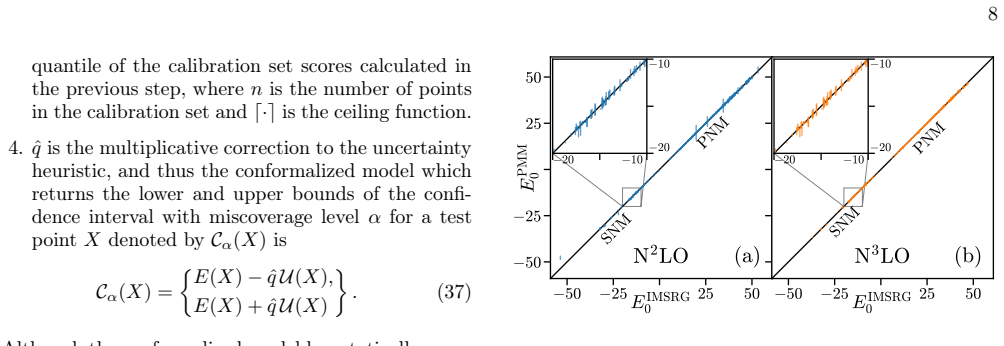
Accuracy of the emulator uncertainty estimate We first demonstrate the accuracy of our emulator on withheld test data across both SNM and PNM at N2LO and N3LO in Fig. 4. The test data includes both SNM and PNM, varies all LECs considered in this work (cD, cE, D2, F2) and the nuclear density, and includes data of themostconvergedIMSRGresultsforthelargestnu...
-
[10]
While neglecting these correlations may lead to misestima- tion of EFT predictions, rigorously quantifying and incorporating these uncertainties remains a work in progress [63]
Bayesian fit protocol The empirical observables used to constrain these LECs include the saturation density (nsat), saturation 10LEC uncertainties and the EFT truncation errors are corre- lated. While neglecting these correlations may lead to misestima- tion of EFT predictions, rigorously quantifying and incorporating these uncertainties remains a work in...
-
[11]
We use 32 random walkers, initialized at the maximum a posteriori (MAP) estimate plus random perturbations, discard 4000 burn-in steps, and generate 20 000 production steps
LEC constraints and predictions for the low-density EOS With the standard Monte Carlo sampler implemented in the Python packageemcee [68], we sample the poste- rior distribution of the LECs. We use 32 random walkers, initialized at the maximum a posteriori (MAP) estimate plus random perturbations, discard 4000 burn-in steps, and generate 20 000 production...
-
[12]
C. Drischler, J. W. Holt, and C. Wellenhofer, Annu. Rev. Nucl. Part. Sci.71, 403 (2021), arXiv:2101.01709
Pith/arXiv arXiv 2021
-
[13]
A. Sorensenet al., Prog. Part. Nucl. Phys.134, 104080 (2024), arXiv:2301.13253
Pith/arXiv arXiv 2024
-
[14]
Kumaret al.(MUSES), Living Rev
R. Kumaret al.(MUSES), Living Rev. Rel.27, 3 (2024), arXiv:2303.17021 [nucl-th]
Pith/arXiv arXiv 2024
-
[15]
K. Chatziioannou, H. T. Cromartie, S. Gandolfi, I. Tews, D. Radice, A. W. Steiner, and A. L. Watts, Rev. Mod. Phys. 97, 045007 (2025), arXiv:2407.11153
arXiv 2025
-
[16]
K. Agarwal, J. Jahan, B. Kardan, P. T. H. Pang, T. Re- ichert, and A. C. Semposki, (2025), arXiv:2511.20378
Pith/arXiv arXiv 2025
- [17]
-
[18]
J. Keller, C. Wellenhofer, K. Hebeler, and A. Schwenk, Phys. Rev. C103, 055806 (2021), arXiv:2011.05855
Pith/arXiv arXiv 2021
-
[19]
J. Keller, K. Hebeler, and A. Schwenk, Phys. Rev. Lett. 130, 072701 (2023), arXiv:2204.14016 [nucl-th]
Pith/arXiv arXiv 2023
-
[20]
J. W. Holt and N. Kaiser, Phys. Rev. C 95, 034326 (2017), arXiv:1612.04309
Pith/arXiv arXiv 2017
-
[21]
P. Wen, J. W. Holt, and A. Blackburn, (2024), arXiv:2412.19777 [nucl-th]
Pith/arXiv arXiv 2024
-
[22]
S. Brolli, C. Barbieri, and E. Vigezzi, Phys. Rev. Lett. 134, 182502 (2025), arXiv:2501.02646 [nucl-th]
Pith/arXiv arXiv 2025
-
[23]
G. Hagen, T. Papenbrock, A. Ekström, K. A. Wendt, G. Baardsen, S. Gandolfi, M. Hjorth-Jensen, and C. J. Horowitz, Phys. Rev. C 89, 014319 (2014), arXiv:1311.2925
Pith/arXiv arXiv 2014
-
[24]
G. Baardsen, A. Ekström, G. Hagen, and M. Hjorth-Jensen, Phys. Rev. C 88, 054312 (2013), arXiv:1306.5681
Pith/arXiv arXiv 2013
-
[25]
W. G. Jiang, C. Forssén, T. Djärv, and G. Hagen, (2022), arXiv:2212.13203
Pith/arXiv arXiv 2022
-
[26]
D. Lonardoni, I. Tews, S. Gandolfi, and J. Carlson, Phys. Rev. Res2, 022033(R) (2020), arXiv:1912.09411
Pith/arXiv arXiv 2020
-
[27]
P. Arthuis, C. Barbieri, F. Pederiva, and A. Roggero, Phys. Rev. C107, 044303 (2023), arXiv:2203.16167
Pith/arXiv arXiv 2023
-
[28]
B. Fore, J. Kim, M. Hjorth-Jensen, and A. Lovato, Com- mun. Phys.8, 108 (2025), arXiv:2407.21207 [nucl-th]
Pith/arXiv arXiv 2025
- [29]
-
[30]
R. Hu, S. Jin, X. Zhen, H. Shang, J. Pei, F. Xu, and F. Marino, (2025), 10.1103/q4p2-r1bt, arXiv:2508.09252 [nucl-th]
Pith/arXiv arXiv 2025
- [31]
-
[32]
W. H. Dickhoff and C. Barbieri, Prog. Part. Nucl. Phys. 52, 377 (2004), arXiv:nucl-th/0402034
Pith/arXiv arXiv 2004
- [33]
-
[34]
O. C. Udiani, Extending the In-Medium Similarity Renormalization Group to Nuclear Matter with Novel In- sights on Unitary Coupled-Cluster Theory, Ph.D. thesis, Michigan State University, East Lansing, MI (2025)
2025
-
[35]
In-medium similarity renormalization group calculations of nuclear matter,
O. Udiani, K. Yu, C. Drischler, S. J. Novario, and S. K. Bogner, “In-medium similarity renormalization group calculations of nuclear matter,” (2026), in prep
2026
-
[36]
X. Zhen, R. Hu, H. Shang, J. Chen, J. Pei, and F. Xu, Phys. Lett. B862, 139350 (2025), arXiv:2501.02479
Pith/arXiv arXiv 2025
-
[37]
T. Duguet, A. Ekström, R. J. Furnstahl, S. König, and D. Lee, Rev. Mod. Phys. 96, 031002 (2024), arXiv:2310.19419 [nucl-th]
Pith/arXiv arXiv 2024
-
[38]
C. Drischler, J. A. Melendez, R. J. Furnstahl, A. J. Garcia, and X. Zhang, Front. Phys. 10, 92931 (2023), supplemental, interactive Python code can be found on the companion websitehttps://github.com/buqeye/ frontiers-emulator-review, arXiv:2212.04912
Pith/arXiv arXiv 2023
-
[39]
C. L. Armstrong, B. T. Reed, T. Plohr, H. Rose, S. De, R. Somasundaram, and I. Tews, (2026), arXiv:2601.05999
arXiv 2026
-
[40]
C. L. Armstrong, P. Giuliani, K. Godbey, R. Somasun- daram, andI.Tews,Phys.Rev.Lett. 135,142501(2025), arXiv:2502.03680 [nucl-th]
arXiv 2025
-
[41]
R.Somasundaram, C.L.Armstrong, P.Giuliani, K.God- bey, S. Gandolfi, and I. Tews, Phys. Lett. B866, 139558 (2025), arXiv:2404.11566 [nucl-th]
Pith/arXiv arXiv 2025
-
[42]
W. G. Jiang, C. Forssén, T. Djärv, and G. Hagen, Phys. Rev. C109, 064314 (2024), arXiv:2212.13216
Pith/arXiv arXiv 2024
-
[43]
P. Cook, D. Jammooa, M. Hjorth-Jensen, D. D. Lee, and D. Lee, Nature Communications16, 5929 (2025)
2025
-
[44]
D. Frame, R. He, I. Ipsen, D. Lee, D. Lee, and E. Rrapaj, Phys. Rev. Lett.121, 032501 (2018), arXiv:1711.07090. 17
Pith/arXiv arXiv 2018
-
[45]
J. A. Melendez, C. Drischler, R. J. Furnstahl, A. J. Garcia, and X. Zhang, J. Phys. G 49, 102001 (2022), arXiv:2203.05528 [nucl-th]
Pith/arXiv arXiv 2022
- [46]
-
[47]
Cirigliano, M
V. Cirigliano, M. Dawid, W. Dekens, and S. Reddy, Phys. Rev. Lett.135, 022501 (2025)
2025
-
[48]
Hergert, S
H. Hergert, S. K. Bogner, T. D. Morris, A. Schwenk, and K. Tsukiyama,Memorial Volume in Honor of Gerald E. Brown, Physics Reports621, 165 (2016)
2016
-
[49]
In-medium similarity renormalization group approach to the nuclear many-body problem,
H. Hergert, S. K. Bogner, J. G. Lietz, T. D. Morris, S. J. Novario, N. M. Parzuchowski, and F. Yuan, “In-medium similarity renormalization group approach to the nuclear many-body problem,” in An Advanced Course in Com- putational Nuclear Physics: Bridging the Scales from Quarks to Neutron Stars, edited by M. Hjorth-Jensen, M. P. Lombardo, and U. van Kolck...
2017
- [50]
-
[51]
S. R. Stroberg, S. K. Bogner, H. Hergert, and J. D. Holt, Annu. Rev. Nucl. Part. Sci. 69, 307 (2019), arXiv:1902.06154
Pith/arXiv arXiv 2019
- [52]
-
[53]
S. Binder, J. Langhammer, A. Calci, P. Navratil, and R. Roth, Phys. Rev. C 87, 021303 (2013), arXiv:1211.4748 [nucl-th]
Pith/arXiv arXiv 2013
-
[54]
R. Roth, S. Binder, K. Vobig, A. Calci, J. Langhammer, and P. Navratil, (2011), arXiv:1112.0287
Pith/arXiv arXiv 2011
-
[55]
T. Djärv, A. Ekström, C. Forssén, and G. R. Jansen, Phys. Rev. C 104, 024324 (2021), arXiv:2104.14820 [nucl-th]
Pith/arXiv arXiv 2021
-
[56]
T. D. Morris, N. M. Parzuchowski, and S. K. Bogner, Phys. Rev. C92, 034331 (2015)
2015
-
[57]
C. Drischler, K. Hebeler, and A. Schwenk, Phys. Rev. Lett. 122, 042501 (2019), arXiv:1710.08220
Pith/arXiv arXiv 2019
-
[58]
D. R. Entem, R. Machleidt, and Y. Nosyk, Phys. Rev. C 96, 024004 (2017), arXiv:1703.05454
Pith/arXiv arXiv 2017
-
[59]
K. Hebeler and A. Schwenk, Phys. Rev. C82, 014314 (2010), arXiv:0911.0483
Pith/arXiv arXiv 2010
-
[60]
pyPMM: The Python Package for Parametric Matrix Models,
P. Cook, “pyPMM: The Python Package for Parametric Matrix Models,” (2026)
2026
-
[61]
Adam: Amethodforstochastic optimization,
D.P.KingmaandJ.Ba,“Adam: Amethodforstochastic optimization,” (2017), arXiv:1412.6980 [cs.LG]
Pith/arXiv arXiv 2017
-
[62]
Computational nuclear physics and post Hartree-Fock methods,
J. G. Lietz, S. Novario, G. R. Jansen, G. Hagen, and M. Hjorth-Jensen, “Computational nuclear physics and post Hartree-Fock methods,” in An Advanced Course in Computational Nuclear Physics: Bridging the Scales from Quarks to Neutron Stars, edited by M. Hjorth- Jensen, M. P. Lombardo, and U. van Kolck (Springer International Publishing, Cham, 2017) pp. 293–399
2017
-
[63]
Hergert, S
H. Hergert, S. K. Bogner, J. G. Lietz, T. D. Morris, S. J. Novario, N. M. Parzuchowski, and F. Yuan, in An Advanced Course in Computational Nuclear Physics: Bridging the Scales from Quarks to Neutron Stars, edited by M. Hjorth-Jensen, M. P. Lombardo, and U. van Kolck (Springer International Publishing, Cham, 2017) pp. 477–570
2017
-
[64]
H. Y. Dezdarani, R. Curry, and A. Gezerlis, Phys. Rev. C 113, 014004 (2026), arXiv:2507.08085
arXiv 2026
-
[65]
A. N. Angelopoulos and S. Bates, Foundations and Trends in Machine Learning16, 494 (2023)
2023
-
[66]
Distribution-free finite-sample guar- antees and split conformal prediction,
R. Hulsman, “Distribution-free finite-sample guar- antees and split conformal prediction,” (2022), arXiv:2210.14735 [stat.ML]
Pith/arXiv arXiv 2022
-
[67]
V. Vovk, A. Gammerman, and C. Saunders, inProceed- ings of the Sixteenth International Conference on Ma- chine Learning, ICML ’99 (Morgan Kaufmann Publishers Inc., San Francisco, CA, USA, 1999) p. 444–453
1999
-
[68]
J. C. Gower, Biometrics27, 857 (1971)
1971
-
[69]
C. Drischler, P. G. Giuliani, S. Bezoui, J. Piekarewicz, and F. Viens, Phys. Rev. C 110, 044320 (2024), arXiv:2405.02748
Pith/arXiv arXiv 2024
-
[70]
Coester, S
F. Coester, S. Cohen, B. Day, and C. M. Vincent, Phys. Rev. C1, 769 (1970)
1970
-
[71]
C. E. Rasmussen and C. K. I. Williams,Gaussian Pro- cesses for Machine Learning, Adaptive computation and machine learning series (University Press Group Limited, Cambridge, MA, 2006)
2006
-
[72]
J. A. Melendez, S. Wesolowski, and R. J. Furnstahl, Phys. Rev. C96, 024003 (2017), arXiv:1704.03308
Pith/arXiv arXiv 2017
-
[73]
J. A. Melendez, R. J. Furnstahl, D. R. Phillips, M. T. Pratola, and S. Wesolowski, Phys. Rev. C100, 044001 (2019), arXiv:1904.10581
Pith/arXiv arXiv 2019
-
[74]
N. L. Carter, R. J. Furnstahl, J. A. Melendez, and D. R. Phillips, (2026), arXiv:2602.05086
arXiv 2026
-
[75]
B. T. Reed, F. J. Fattoyev, C. J. Horowitz, and J. Piekarewicz, Phys. Rev. Lett. 126, 172503 (2021), arXiv:2101.03193
Pith/arXiv arXiv 2021
-
[76]
X. Roca-Maza and N. Paar, Prog. Part. Nucl. Phys.101, 96 (2018), arXiv:1804.06256
Pith/arXiv arXiv 2018
-
[77]
A. Giri, J. Kim, C. Drischler, C. Elster, and R. J. Furn- stahl, Phys. Rev. C113, 044001 (2026)
2026
-
[78]
Casella and R
G. Casella and R. L. Berger,Statistical Inference, 2nd ed., Chapman & Hall/CRC Texts in Statistical Science (Duxbury Press, Pacific Grove, CA, 2002)
2002
-
[79]
D.Foreman-Mackey, D.W.Hogg, D.Lang, andJ.Good- man, PASP 125, 306 (2013), arXiv:1202.3665 [astro- ph.IM]
Pith/arXiv arXiv 2013
- [80]
discussion (0)
Sign in with ORCID, Apple, or X to comment. Anyone can read and Pith papers without signing in.