REVIEW 3 major objections 3 minor 72 references
This paper argues that collapsing walls bounded by strings can merge elementary strings into composite strings carrying the full monopole flux, and that the resulting networks emit gravitational waves detectable by current and planned exper
Reviewed by Pith at T0; open to challenge. T0 means a machine referee read the full paper against a public rubric. the ladder, T0–T4 →
T0 review · deepseek-v4-flash
2026-08-01 10:07 UTC pith:UEQEABSK
load-bearing objection A plausible but unvalidated composite-string network drives the GW spectra; the flux counting is correct, but the 'effectively stable' scenario rests on unsupported assumptions about wall collapse and string lifetime. the 3 major comments →
Monopoles, Strings, Walls and Gravitational waves
The pith
A machine-rendered reading of the paper's core claim, the machinery that carries it, and where it could break.
Core claim
The central claim is that in SU(2)→U(1)→Z₂→1 breaking, the final Z₂→1 transition creates domain walls bounded by strings, and when these walls collapse, an order-one fraction of the events involve parallel minimal strings that merge into composite strings carrying two units of U(1) flux. This composite string carries exactly the same magnetic flux as the elementary monopole (4π/g) even though no monopole need be present. Because the network of these composite strings is not topologically stable — monopole–antimonopole pair nucleation can break it — its cosmological fate depends on the monopole mass and the tunneling rate: effectively stable if the decay lifetime exceeds the age of the univer
What carries the argument
The central object is the domain wall bounded by strings (WBS) and its collapse product. A wall bounded by two parallel unit-flux strings collapses into a composite string carrying double flux (4π/g), whereas anti-parallel strings annihilate. The relevant identity is the flux ratio: the minimal monopole carries 4π/g of U(1) flux while the minimal string carries 2π/g. This equality means the composite string is the magnetic dual of the monopole, and its stability is set by the monopole–antimonopole pair-creation rate. The paper uses the standard loop-scaling gravitational-wave formalism (with a delay factor d_s between wall collapse and the onset of string-loop scaling) to translate the netwo
Load-bearing premise
The load-bearing premise is that an order-one fraction (≈0.5) of collapsing walls bounded by strings are bounded by parallel unit-flux strings whose merger forms the composite-string network, and that this network reaches the standard scaling loop distribution after a parametrized delay d_s; the paper provides no derivation or simulation for either step.
What would settle it
Compute the monopole mass from the SU(2) breaking scale and evaluate the pair-creation rate Γ = (µ/2π)e^{-πκ}; if the resulting lifetime of the composite strings is shorter than the age of the universe, the 'effectively stable' scenarios (Gµ = 10⁻¹⁰, 10⁻¹²) are ruled out, leaving only the quasistable and metastable interpretations.
If this is right
- If the effectively stable scenario is realized, the predicted gravitational-wave background at Gµ = 10⁻¹⁰–10⁻¹² lies within reach of future space-based and ground-based interferometers, providing a direct probe of a flavor-gauge symmetry-breaking scale as low as 10² GeV.
- For the quasistable and metastable scenarios with Gµ ~ 10⁻⁷, the delayed string network produced by wall collapse yields spectra compatible with the recent pulsar-timing-array signal while staying below the current ground-based interferometer bound.
- The same three scenarios reappear in the SU(3)→SO(3)→Z₂→1 chain, so the predictive structure is not an artifact of the smallest group.
- The spectrum's shape and peak frequency depend on the delay factor d_s and the domain-wall scale v_DW, so combined pulsar-timing and interferometer observations can distinguish the three scenarios.
- Since the composite string carries the monopole flux, future observations of a gravitational-wave background from this network would indirectly indicate the existence of monopoles in this symmetry-breaking chain, even if the monopoles themselves are absent today.
Where Pith is reading between the lines
- The paper leaves the fraction f_s of wall collapses that yield parallel strings uncalculated; a dedicated field-theoretic simulation of WBS collapse could measure f_s and confirm the composite-network formation rate, directly testing the model's core premise.
- The effectively stable scenario's lifetime depends on the monopole mass through the nucleation exponent πκ, but the paper does not fix the monopole mass; fixing it from the SU(2) breaking scale would turn the 'effectively stable' spectra into a closed prediction.
- Because the composite strings carry the monopole flux and are embedded in the same gauge theory, the gravitational-wave signal could be correlated with other cosmic-string signatures (e.g., lensing or large-scale-structure effects) that future surveys might constrain.
- The same mechanism might operate in larger GUT chains, where a step such as SO(10)→...→U(1)→Z₂→1 could produce composite strings with flux equal to that of a GUT monopole, enlarging the parameter space for observable gravitational waves.
Editorial analysis
A structured set of objections, weighed in public.
Referee Report
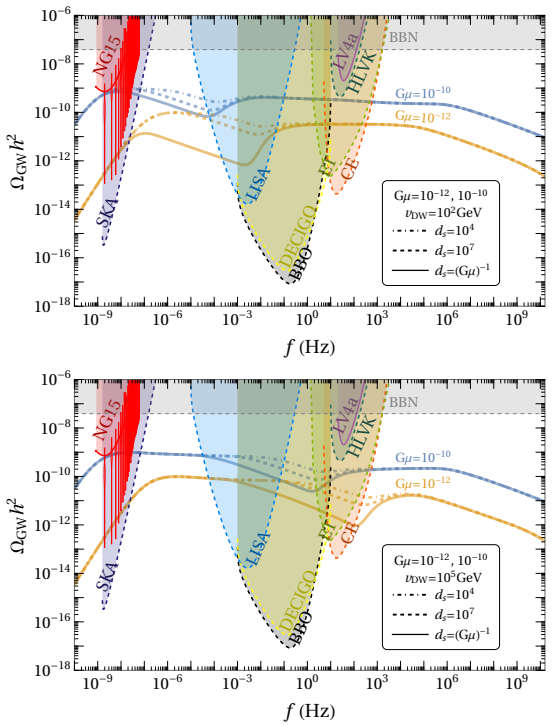
Summary. The paper studies the symmetry-breaking chain SU(2)→U(1)→Z2→1 and the analogous SU(3)→SO(3)→Z2→1 chain. It argues that the collapse of domain walls bounded by strings (WBS) can produce composite strings carrying 4π/g U(1) flux, i.e. the same flux as the minimal monopole, and that these composite strings form a network that is either effectively stable, quasistable, or metastable depending on inflation and tunneling assumptions. Using standard cosmic-string and domain-wall gravitational-wave templates, the authors compute spectra for the three scenarios and claim compatibility with the PTA signal and the LVK Run 4 bound.
Significance. If the composite-string network formation is established, the paper would introduce a new SGWB source from flavor-gauge-symmetry breaking and connect it to current and future detectors. The flux-counting argument is clean and the gravitational-wave formulas follow well-known templates. The three-scenario taxonomy and the SU(3) correspondence are useful. However, the central novelty rests on unquantified assumptions about WBS collapse dynamics and the approach to string-loop scaling; in its present form the paper is a plausible scenario rather than a fully demonstrated prediction.
major comments (3)
- [§2 and §3, Eqs. (10), (11)] The central new ingredient is the claim that an order-one fraction f_s of collapsing WBS yield parallel unit-flux strings that merge into doubly charged composite strings. However, f_s is introduced only heuristically (“Naively one may expect f_s to be around 0.5 or so”) and never appears in the gravitational-wave formulas. In Eq. (10) and Eq. (11) the composite-string term Ω_str(f,t_s,t_end) is added without any factor of f_s, so the plotted spectra in Figs. 2–4 correspond to f_s=1. If f_s is 0.5, the composite-string contribution is reduced by a factor 2; if f_s is smaller, the effectively stable spectra in Fig. 2 may fall below the quoted sensitivity curves. Because the composite-string network is the paper’s main claim, this is a load-bearing omission. A quantitative estimate of f_s, or an explicit inclusion of f_s with conservative values, is needed.
- [§3, Eq. (9)] Eq. (9) postulates that after WBS collapse the composite-string network immediately enters the standard scaling loop distribution from time t_s=d_s R_c, with d_s treated as a free parameter spanning four to twelve orders of magnitude in Figs. 2 and 3. The loop number density at t_s and the approach to scaling are not derived or simulated. The amplitude of Ω_str(f,t_s,t_end) is directly proportional to this assumed seed density and to its onset time. Without a computation of the conversion of collapsing WBS into long composite strings and loops, the predicted amplitudes are not robust. This is the most fragile link in the paper’s case, and it should be addressed either by modeling the collapse dynamics or by demonstrating insensitivity of the conclusions to the initial loop density.
- [§2 and §3, “effectively stable” scenario] The effectively stable scenario is defined by requiring the composite-string decay lifetime to be at least the age of the universe, but the lifetime is never evaluated. The tunneling decay rate quoted for metastable strings, Γ=(μ/2π)e^{-πκ} with κ=m_M^2/μ, should also control the decay of the doubly charged composite strings. To decide whether they are effectively stable one must specify the monopole mass m_M (equivalently the SU(2) breaking scale), which is never given. Thus Fig. 2 is not a prediction for a fully specified model; it implicitly assumes a sufficiently large κ without stating the associated parameter range. Please specify the monopole mass and verify the lifetime condition for the quoted Gμ values, or state the stability condition as an explicit assumption with its allowed range.
minor comments (3)
- [Eq. (8)] The first branch of the piecewise domain is typeset ambiguously: “for 1/w a(Rc)/a(td) ≤ f̃ ≤ 1/w” is hard to parse. Please clarify the frequency interval and any missing brackets.
- [Eq. (5)] The expression “Γk−n / ζ(n) Gµ2 2k f” appears to be a typographical artifact; please check the intended form (for example Γ(k)^{-n}/ζ(n) Gμ^2 (2k/f)).
- [Figs. 2 and 3] For Gμ=10^{-10} and 10^{-12}, the label d_s=(Gμ)^{-1} denotes very different values (10^{10} and 10^{12}); the captions should state these values explicitly to help the reader identify the curves. The legend entry “NG15 LV4a” is also ambiguous.
Circularity Check
No significant circularity: the flux-counting argument and the GW spectra rely on standard topology and published formulas; heuristic fractions and scanned parameters are model inputs, not fitted predictions.
full rationale
The paper's central claim—that collapsing WBS with parallel unit-flux strings merge into a composite string carrying the monopole flux 4π/g—is derived from homotopy and flux conservation in Section 2, not from a fitted parameter. Eq. (3) gives π1(U(1)/Z2)=Z, and the text explicitly assigns 4π/g to the monopole and 2π/g to the minimal string; the merger figure and the bullet list then argue that parallel strings form a 4π/g composite string. This is self-contained topological reasoning. The GW spectra are computed using standard, externally published formulas (Eqs. 5–8 for strings and WBS, Eqs. 12–14 for metastable strings) with model parameters scanned over chosen values: Gμ=10^-10, 10^-12, √κ=8–8.2, t_M=10^2–10^4 s, d_s=10^4…10^10. Scanning parameters to show compatibility with PTA/LVK bounds is not circular; it is a parameter-space demonstration. The heuristic statements about f_s≈0.5 and the delay factor d_s are unsupported model assumptions, not quantities derived from the target spectra, so they are correctness risks rather than circular reductions. The citation [80] for flux-matching nucleation timing is a self-citation, but it is not load-bearing for the flux identity itself, which is established independently in Section 2; it only motivates t_*=t_d for the metastable case. No step reduces an output to an input by construction.
Axiom & Free-Parameter Ledger
free parameters (7)
- Gμ (string tension) =
10^-7, 10^-10, 10^-12
- v_DW (domain wall VEV) =
10^2, 10^5, 10^8 GeV
- d_s (delay factor) =
10^4, 10^7, 10^10, (Gμ)^-1
- t_M (monopole horizon reentry time) =
10^2–10^4 s
- κ (metastability factor) =
√κ = 8–8.2 (κ ∼ 64-67)
- f_s (fraction of parallel-string walls) =
~0.5
- monopole mass m_M / scale v_m =
unspecified
axioms (6)
- standard math π1(U(1)/Z2)=Z and π2(SU(2)/U(1))=Z (topological charges of strings and monopoles)
- domain assumption WBS collapse dynamics: strings dominate until R_c=μ/σ, walls collapse at t_d=1/(Gσ)
- domain assumption Scaling loop distribution n(l,t) for cosmic string networks (Eq. 13 and references)
- domain assumption Quantum tunneling decay rate Γ_MM=(μ/2π)e^(-πκ) for meta/quasistable strings
- ad hoc to paper Inflation dilutes primordial monopoles and the composite string network forms from WBS collapse at t_s=d_s R_c with standard scaling
- ad hoc to paper Composite strings carry 4π/g flux and are effectively stable if lifetime > age of universe
read the original abstract
The gauge symmetry breaking $SU(2) \to U(1) \to Z_2 \to 1$ successively produces monopoles, strings and domain walls bounded by strings (WBS), with the elementary monopole carrying a $U(1)$ magnetic flux twice as large as the elementary string. The elementary strings and subsequently WBS emit gravitational waves, and during their decay, the WBS yield a network of composite strings that carry the same $U(1)$ flux as the monopoles. Depending on the cosmological evolution, we provide the gravitational wave spectra generated by the elementary strings and WBS, in combination with the composite strings which are either effectively stable, quasistable, or metastable. These three scenarios are also realized in the symmetry breaking chain $SU(3) \to SO(3) \to Z_2 \to 1$. Both $SU(2)$ and $SU(3)$ have appeared in the literature as flavor gauge symmetries.
Figures



Reference graph
Works this paper leans on
-
[1]
Georgi,The State of the Art—Gauge Theories,AIP Conf
H. Georgi,The State of the Art—Gauge Theories,AIP Conf. Proc.23(1975) 575
1975
-
[2]
Fritzsch and P
H. Fritzsch and P. Minkowski,Unified Interactions of Leptons and Hadrons,Annals Phys. 93(1975) 193
1975
-
[3]
Gursey, P
F. Gursey, P. Ramond and P. Sikivie,A Universal Gauge Theory Model Based on E6, Phys. Lett. B60(1976) 177
1976
-
[4]
Achiman and B
Y. Achiman and B. Stech,Quark Lepton Symmetry and Mass Scales in an E6 Unified Gauge Model,Phys. Lett. B77(1978) 389
1978
-
[5]
Shafi,E(6) as a Unifying Gauge Symmetry,Phys
Q. Shafi,E(6) as a Unifying Gauge Symmetry,Phys. Lett. B79(1978) 301
1978
-
[6]
’t Hooft,Magnetic Monopoles in Unified Gauge Theories,Nucl
G. ’t Hooft,Magnetic Monopoles in Unified Gauge Theories,Nucl. Phys. B79(1974) 276
1974
-
[7]
Polyakov,Particle Spectrum in Quantum Field Theory,JETP Lett.20(1974) 194
A.M. Polyakov,Particle Spectrum in Quantum Field Theory,JETP Lett.20(1974) 194
1974
-
[8]
Lazarides, M
G. Lazarides, M. Magg and Q. Shafi,Phase Transitions and Magnetic Monopoles in SO(10),Phys. Lett. B97(1980) 87
1980
-
[9]
Kibble, G
T.W.B. Kibble, G. Lazarides and Q. Shafi,Strings in SO(10),Phys. Lett. B113(1982) 237. 8
1982
-
[10]
Kibble, G
T.W.B. Kibble, G. Lazarides and Q. Shafi,Walls Bounded by Strings,Phys. Rev. D26 (1982) 435
1982
-
[11]
J.T. M¨ akinen, V.V. Dmitriev, J. Nissinen, J. Rysti, G.E. Volovik, A.N. Yudin et al., Half-quantum vortices and walls bounded by strings in the polar-distorted phases of topological superfluid3He,Nature Commun.10(2019) 237 [1807.04328]
Pith/arXiv arXiv 2019
-
[12]
G. Lazarides and Q. Shafi,Monopoles, Strings, and Necklaces inSO(10)andE 6,JHEP 10(2019) 193 [1904.06880]
Pith/arXiv arXiv 2019
-
[13]
G. Lazarides, Q. Shafi and A. Tiwari,Composite topological structures in SO(10),JHEP 05(2023) 119 [2303.15159]
Pith/arXiv arXiv 2023
-
[14]
R. Maji and Q. Shafi,Superheavy metastable strings in SO(10),JHEP06(2025) 217 [2504.09055]. [15]LIGO Scientific, Virgocollaboration,Observation of Gravitational Waves from a Binary Black Hole Merger,Phys. Rev. Lett.116(2016) 061102 [1602.03837]
Pith/arXiv arXiv 2025
-
[16]
W. Buchmuller, V. Domcke and K. Schmitz,Stochastic gravitational-wave background from metastable cosmic strings,JCAP12(2021) 006 [2107.04578]. [17]NANOGravcollaboration,The NANOGrav 15 yr Data Set: Search for Signals from New Physics,Astrophys. J. Lett.951(2023) L11 [2306.16219]
Pith/arXiv arXiv 2021
-
[18]
G. Lazarides, R. Maji and Q. Shafi,Gravitational waves from quasi-stable strings,JCAP 08(2022) 042 [2203.11204]
Pith/arXiv arXiv 2022
-
[19]
G. Lazarides, R. Maji and Q. Shafi,Superheavy quasistable strings and walls bounded by strings in the light of NANOGrav 15 year data,Phys. Rev. D108(2023) 095041 [2306.17788]
Pith/arXiv arXiv 2023
-
[20]
R. Maji, W.-I. Park and Q. Shafi,Gravitational waves from walls bounded by strings in SO(10) model of pseudo-Goldstone dark matter,Phys. Lett. B845(2023) 138127 [2305.11775]. [21]NANOGravcollaboration,The NANOGrav 15 yr Data Set: Evidence for a Gravitational-wave Background,Astrophys. J. Lett.951(2023) L8 [2306.16213]. [22]EPTA, InPTA:collaboration,The se...
Pith/arXiv arXiv 2023
-
[23]
D.J. Reardon et al.,Search for an Isotropic Gravitational-wave Background with the Parkes Pulsar Timing Array,Astrophys. J. Lett.951(2023) L6 [2306.16215]. 9
Pith/arXiv arXiv 2023
-
[24]
H. Xu et al.,Searching for the Nano-Hertz Stochastic Gravitational Wave Background with the Chinese Pulsar Timing Array Data Release I,Res. Astron. Astrophys.23(2023) 075024 [2306.16216]
Pith/arXiv arXiv 2023
-
[25]
D.I. Dunsky, A. Ghoshal, H. Murayama, Y. Sakakihara and G. White,GUTs, hybrid topological defects, and gravitational waves,Phys. Rev. D106(2022) 075030 [2111.08750]
Pith/arXiv arXiv 2022
-
[26]
R. Maji and Q. Shafi,C-parity, magnetic monopoles, and higher frequency gravitational waves,Phys. Rev. D111(2025) 075027 [2502.10135]
Pith/arXiv arXiv 2025
-
[27]
A. Ghoshal, I. Gogoladze and A. Tiwari,Gravitational Waves from hybrid defects as probe of Flavor symmetry breaking: Machine-Learning Approach,2605.31600
-
[28]
S. Antusch, K. Hinze and S. Saad,Metastable cosmic strings and gravitational waves from flavor symmetry breaking,Phys. Rev. D112(2025) 035043 [2503.05868]
Pith/arXiv arXiv 2025
-
[29]
W. Buchmuller,Metastable strings and dumbbells in supersymmetric hybrid inflation, JHEP04(2021) 168 [2102.08923]
Pith/arXiv arXiv 2021
-
[30]
W. Buchmuller, V. Domcke and K. Schmitz,Metastable cosmic strings,JCAP11(2023) 020 [2307.04691]
Pith/arXiv arXiv 2023
-
[31]
G. Lazarides, R. Maji, A. Moursy and Q. Shafi,Inflation, superheavy metastable strings and gravitational waves in non-supersymmetric flipped SU(5),JCAP03(2024) 006 [2308.07094]
Pith/arXiv arXiv 2024
-
[32]
R. Maji and W.-I. Park,SupersymmetricU(1) B−L flat direction and NANOGrav 15 year data,JCAP01(2024) 015 [2308.11439]
Pith/arXiv arXiv 2024
-
[33]
A. Afzal, Q. Shafi and A. Tiwari,Gravitational wave emission from metastable current-carrying strings in E6,Phys. Lett. B850(2024) 138516 [2311.05564]
Pith/arXiv arXiv 2024
- [34]
-
[35]
B. Fu, S.F. King, L. Marsili, S. Pascoli, J. Turner and Y.-L. Zhou,Testing realistic SO(10) SUSY GUTs with proton decay and gravitational waves,Phys. Rev. D109(2024) 055025 [2308.05799]
Pith/arXiv arXiv 2024
-
[36]
A. Chitose, M. Ibe, Y. Nakayama, S. Shirai and K. Watanabe,Revisiting Metastable Cosmic String Breaking,2312.15662
-
[37]
Y. Bao, K. Harigaya and L.-T. Wang,Crescendo beyond the horizon: more gravitational waves from domain walls bounded by inflated cosmic strings,JHEP11(2024) 032 [2407.17525]. 10
Pith/arXiv arXiv 2024
-
[38]
R. Maji and Q. Shafi,Kinetic mixing, proton decay and gravitational waves in SO(10), JHEP10(2024) 157 [2408.14350]
Pith/arXiv arXiv 2024
-
[39]
R. Maji, A. Moursy and Q. Shafi,Induced gravitational waves, metastable cosmic strings and primordial black holes in GUTs,JCAP01(2025) 106 [2409.13584]
Pith/arXiv arXiv 2025
-
[40]
A. Chitose, M. Ibe, S. Neda and S. Shirai,Do Cosmic String Segments Emit Gravitational Waves?,2507.12386
-
[41]
J. Ingoldby, V.V. Khoze and J. Turner,Metastable strings and gravitational waves in one-scale models,JHEP04(2026) 094 [2511.08546]
arXiv 2026
-
[42]
D.H. Asl and K. Schmitz,New gravitational-wave templates for metastable cosmic strings: Loop breaking versus network collapse,2604.28097
-
[43]
S. Blasi, M. Grandjean and A. Mariotti,Metastable strings at PTAs: classical stability analysis,2605.03003
-
[44]
A. de Giorgi, J. Ingoldby, V.V. Khoze and J. Turner,Thermal Metastable Strings in One-Scale Models and Gravitational Waves,2606.02689
-
[45]
J. Hua, B. Fu and Y.-L. Tang,One-Dimensional Simulations of the Topological Defects in a 3:1U(1)Model,2607.13066. [46]LIGO Scientific, VIRGO, KAGRAcollaboration,Upper Limits on the Isotropic Gravitational-Wave Background from the first part of LIGO, Virgo, and KAGRA’s fourth Observing Run,2508.20721. [47]LIGO Scientific, VIRGO, KAGRAcollaboration,Cosmolog...
-
[48]
X. Martin and A. Vilenkin,Gravitational radiation from monopoles connected by strings, Phys. Rev. D55(1997) 6054 [gr-qc/9612008]
Pith/arXiv arXiv 1997
-
[49]
Maggiore,Gravitational wave experiments and early universe cosmology,Phys
M. Maggiore,Gravitational wave experiments and early universe cosmology,Phys. Rept. 331(2000) 283 [gr-qc/9909001]
Pith/arXiv arXiv 2000
-
[50]
E. Thrane and J.D. Romano,Sensitivity curves for searches for gravitational-wave backgrounds,Phys. Rev. D88(2013) 124032 [1310.5300]
Pith/arXiv arXiv 2013
-
[51]
K. Schmitz,New Sensitivity Curves for Gravitational-Wave Signals from Cosmological Phase Transitions,JHEP01(2021) 097 [2002.04615]
Pith/arXiv arXiv 2021
-
[52]
Janssen et al.,Gravitational wave astronomy with the SKA,PoSAASKA14(2015) 037 [1501.00127]
G. Janssen et al.,Gravitational wave astronomy with the SKA,PoSAASKA14(2015) 037 [1501.00127]. 11
Pith/arXiv arXiv 2015
-
[53]
Bartolo et al.,Science with the space-based interferometer LISA
N. Bartolo et al.,Science with the space-based interferometer LISA. IV: Probing inflation with gravitational waves,JCAP12(2016) 026 [1610.06481]
Pith/arXiv arXiv 2016
-
[54]
Sato et al.,The status of DECIGO,Journal of Physics: Conference Series840(2017) 012010
S. Sato et al.,The status of DECIGO,Journal of Physics: Conference Series840(2017) 012010
2017
-
[55]
J. Crowder and N.J. Cornish,Beyond LISA: Exploring future gravitational wave missions, Phys. Rev. D72(2005) 083005 [gr-qc/0506015]
Pith/arXiv arXiv 2005
-
[56]
V. Corbin and N.J. Cornish,Detecting the cosmic gravitational wave background with the big bang observer,Class. Quant. Grav.23(2006) 2435 [gr-qc/0512039]. [57]KAGRA, LIGO Scientific, Virgo, VIRGOcollaboration,Prospects for observing and localizing gravitational-wave transients with Advanced LIGO, Advanced Virgo and KAGRA,Living Rev. Rel.21(2018) 3 [1304.0670]
Pith/arXiv arXiv 2006
-
[58]
G. Mentasti and M. Peloso,ET sensitivity to the anisotropic Stochastic Gravitational Wave Background,JCAP03(2021) 080 [2010.00486]
Pith/arXiv arXiv 2021
-
[59]
T. Regimbau, M. Evans, N. Christensen, E. Katsavounidis, B. Sathyaprakash and S. Vitale,Digging deeper: Observing primordial gravitational waves below the binary black hole produced stochastic background,Phys. Rev. Lett.118(2017) 151105 [1611.08943]
Pith/arXiv arXiv 2017
-
[60]
Vachaspati and A
T. Vachaspati and A. Vilenkin,Gravitational Radiation from Cosmic Strings,Phys. Rev. D31(1985) 3052
1985
-
[61]
Vilenkin and E.P.S
A. Vilenkin and E.P.S. Shellard,Cosmic Strings and Other Topological Defects, Cambridge University Press (7, 2000)
2000
-
[62]
V. Vanchurin, K.D. Olum and A. Vilenkin,Scaling of cosmic string loops,Phys. Rev. D 74(2006) 063527 [gr-qc/0511159]
Pith/arXiv arXiv 2006
-
[63]
C. Ringeval, M. Sakellariadou and F. Bouchet,Cosmological evolution of cosmic string loops,JCAP02(2007) 023 [astro-ph/0511646]
Pith/arXiv arXiv 2007
-
[64]
K.D. Olum and V. Vanchurin,Cosmic string loops in the expanding Universe,Phys. Rev. D75(2007) 063521 [astro-ph/0610419]
Pith/arXiv arXiv 2007
-
[65]
S. Olmez, V. Mandic and X. Siemens,Gravitational-Wave Stochastic Background from Kinks and Cusps on Cosmic Strings,Phys. Rev. D81(2010) 104028 [1004.0890]
Pith/arXiv arXiv 2010
-
[66]
J.J. Blanco-Pillado, K.D. Olum and B. Shlaer,The number of cosmic string loops,Phys. Rev. D89(2014) 023512 [1309.6637]
Pith/arXiv arXiv 2014
-
[67]
J.J. Blanco-Pillado and K.D. Olum,Stochastic gravitational wave background from smoothed cosmic string loops,Phys. Rev. D96(2017) 104046 [1709.02693]. 12
Pith/arXiv arXiv 2017
-
[68]
Y. Cui, M. Lewicki, D.E. Morrissey and J.D. Wells,Probing the pre-BBN universe with gravitational waves from cosmic strings,JHEP01(2019) 081 [1808.08968]
Pith/arXiv arXiv 2019
-
[69]
T. Damour and A. Vilenkin,Gravitational wave bursts from cusps and kinks on cosmic strings,Phys. Rev. D64(2001) 064008 [gr-qc/0104026]
Pith/arXiv arXiv 2001
-
[70]
X. Martin and A. Vilenkin,Gravitational wave background from hybrid topological defects, Phys. Rev. Lett.77(1996) 2879 [astro-ph/9606022]
Pith/arXiv arXiv 1996
-
[71]
T. Hiramatsu, M. Kawasaki and K. Saikawa,On the estimation of gravitational wave spectrum from cosmic domain walls,JCAP02(2014) 031 [1309.5001]. [72]Planckcollaboration,Planck 2018 results. VI. Cosmological parameters,Astron. Astrophys.641(2020) A6 [1807.06209] [Erratum:Astron. Astrophys.652(2021) C4]
Pith/arXiv arXiv 2014
-
[73]
Vilenkin,Cosmic string dynamics with friction,Phys
A. Vilenkin,Cosmic string dynamics with friction,Phys. Rev. D43(1991) 1060
1991
-
[74]
J. Garriga and M. Sakellariadou,Effects of friction on cosmic strings,Phys. Rev. D48 (1993) 2502 [hep-th/9303024]
Pith/arXiv arXiv 1993
-
[75]
J.J. Blanco-Pillado and K.D. Olum,Form of cosmic string cusps,Phys. Rev. D59(1999) 063508 [gr-qc/9810005] [Erratum: Phys.Rev.D 103, 029902 (2021)]
Pith/arXiv arXiv 1999
-
[76]
D. Matsunami, L. Pogosian, A. Saurabh and T. Vachaspati,Decay of Cosmic String Loops Due to Particle Radiation,Phys. Rev. Lett.122(2019) 201301 [1903.05102]
Pith/arXiv arXiv 2019
-
[77]
P. Auclair, D.A. Steer and T. Vachaspati,Particle emission and gravitational radiation from cosmic strings: observational constraints,Phys. Rev. D101(2020) 083511 [1911.12066]
Pith/arXiv arXiv 2020
-
[78]
L. Leblond, B. Shlaer and X. Siemens,Gravitational Waves from Broken Cosmic Strings: The Bursts and the Beads,Phys. Rev. D79(2009) 123519 [0903.4686]
Pith/arXiv arXiv 2009
-
[79]
Y. Cui, M. Lewicki and D.E. Morrissey,Gravitational Wave Bursts as Harbingers of Cosmic Strings Diluted by Inflation,Phys. Rev. Lett.125(2020) 211302 [1912.08832]
Pith/arXiv arXiv 2020
-
[80]
R. Maji and Q. Shafi,Superconducting strings inE 6,Phys. Rev. D112(2025) L101903 [2509.15985]. 13
arXiv 2025
discussion (0)
Sign in with ORCID, Apple, or X to comment. Anyone can read and Pith papers without signing in.