REVIEW 4 major objections 4 minor 49 references
A High-Order Flux Reconstruction Actuator-Line Framework for Rotating-Blade Aerodynamics on Fixed Cartesian Grids
T0 review · 4 major / 4 minor · reviewed 2026-08-01 · deepseek-v4-flash
Pith's one-line read A high-order actuator-line framework predicts VAWT power within 6% of high-fidelity data.
desk verdict Worth a serious look for the wake validation and the kernel criterion, but treat the 6% CP claim as a DMST result until the solver is shown to produce its own induction. read the letter →
The pith
A machine-rendered reading of the paper's core claim, the machinery that carries it, and where it could break.
The reading
What carries the argument
The load-bearing mechanism is the actuator-line source term: each blade is represented as a rotating point force, projected onto the fixed Cartesian grid through an isotropic Gaussian kernel of width ε = max(2h/p, c/κc), where h is mesh size, p the polynomial degree, c the chord, and κc=4.3. This kernel converts blade-element lift and drag into volumetric momentum and energy sources added to the compressible Navier-Stokes equations solved by the FR/CPR discretization (a high-order 'flux reconstruction/correction procedure via reconstruction' scheme). The angle of attack comes from the local velocity triangle in a four-quadrant formulation, with a modified Boeing-Vertol model adding rate-depe
What would settle it
Run the same FR/CPR-ALM case without DMST on a mesh fine enough for the kernel to be chord-controlled (h < cp/(2κc) ≈ 0.049 m for this geometry), sample the resolved velocity at the actuator point, and compute CP(λ). If the resulting curve deviates substantially from the DMST-corrected coarse curve, then the 6% agreement is not produced by the coupled solver. A complementary check: on the fine mesh, measure the induced velocity at the blade and compare it to the DMST values uu and ud; a large mismatch would indicate the correction is misrepresenting induction.
Extended reading notes
Core claim
On the paper's own terms, the discovery is that a two-dimensional FR/CPR-ALM formulation with a single actuator point per blade, an isotropic Gaussian kernel for force projection, and a Boeing-Vertol dynamic-stall correction captures the essential physics of a straight-bladed vertical-axis turbine. The predicted power coefficient rises from 0.027 at λ=1.5 to a peak of 0.443 at λ=4.0, within 5.7% of the 3D LES-ALM peak, then declines to 0.229 at λ=7.0, and the agreement with the reference curve is within 6% over the operating window bracketing the optimum. The authors derive a mesh-resolution criterion h < cp/(2κc) for the Gaussian kernel and show that on the coarse production mesh the kernel
Load-bearing premise
The central performance claim rests on the assumption that on the coarse production mesh the Gaussian-smeared actuator force produces negligible resolved-flow induction feedback, so that an externally imposed DMST correction recovers the physical inflow; if the smearing over-softens the force or the correction double-counts induction, the reported power curve is essentially a DMST/BEMT result rather than a product of the coupled FR/CPR-ALM solver.
Editorial extensions
If this is right
- The power-coefficient curve CP(λ) matches 3D LES-ALM reference data within 6% around the optimal tip-speed ratios, with the peak within 5.7%.
- The mean near-wake velocity profile agrees with experimental and LES-ALM measurements at x/D=1, reproducing the deficit magnitude and lateral asymmetry.
- The Boeing-Vertol dynamic-stall correction is regime-dependent: +23% CP at λ=1.5, -10.7% at λ=3.5, +6.9% at λ=5.5.
- A single 30-second simulation at λ=3.5 takes about 37 minutes on 48 CPU cores, making parametric tip-speed-ratio sweeps practical.
- The derived kernel-resolution criterion h < cp/(2κc) tells when the Gaussian width is chord-controlled rather than mesh-controlled, providing a rule for other meshes and airfoils.
Reading between the lines
- Editorial inference: the same coarse-mesh-plus-external-DMST recipe could in principle be carried over to horizontal-axis rotors or actuator-disk farm layouts, but the paper only demonstrates a two-dimensional VAWT, so that transfer is untested.
- Editorial inference: because the DMST correction effectively prescribes the rotor's induction, the coupled solver's main role is transporting the wake; a natural test is to run a fully resolved, fine-mesh case with self-consistent induction feedback and compare the two power curves to quantify how much physics the correction is replacing.
- Editorial inference: the 2D single-actuator-point-per-blade representation is spanwise-infinite; extending to 3D with multiple spanwise actuator elements would be needed to resolve tip vortices and spanwise load variation, which the paper notes as straightforward but does not simulate.
- Editorial inference: the large low-λ overprediction (C_P=0.075 at λ=2.0 vs -0.05 reference) suggests the framework's quantitative utility is concentrated near the optimum, not in deep-stall performance, which matters for design loads.
Signed reviews
Editorial analysis
A structured set of objections, weighed in public.
Referee Report
Summary. The paper presents a two-dimensional FR/CPR (flux reconstruction / correction procedure via reconstruction) solver coupled to a rotating actuator-line model (ALM) with isotropic Gaussian force projection for vertical-axis wind turbine (VAWT) aerodynamics on fixed Cartesian grids. A modified Boeing-Vertol dynamic stall correction is used, and a Double Multiple Streamtube (DMST) induction model is imposed when the resolved flow provides negligible induction feedback. The manuscript reports a near-wake validation against Bachant & Wosnik and Hezaveh et al., and a power-coefficient curve CP(λ) that agrees with 3D LES-ALM data to within about 6% near the optimal tip-speed ratio. It also documents azimuthal loading, lift hysteresis, wake structure, and computational cost. The main claim is that the FR/CPR-ALM framework is an accurate and efficient geometry-free tool for VAWT analysis.
Significance. The topic is timely and the paper is unusually candid about a key limitation: the manuscript itself states in Sec. III D 1 that direct sampling of the resolved velocity yields a power curve nearly coincident with the zero-induction result, and in Sec. III C that on the production mesh the Gaussian kernel is mesh-controlled, diluting induced velocity. This confirms the central concern that the reported CP(λ) curve is effectively a DMST/BEMT prediction using tabulated static polars and an empirical dynamic-stall correction, not a prediction produced by the coupled FR/CPR-ALM solution. The wake comparison at x/D=1 and λ=1.9 is a legitimate positive result with quantitative data, and the kernel-resolution criterion is useful for practitioners, but the wake validation alone does not support the headline 6% performance claim. The paper also compares against LES-ALM results that use the same actuator-line methodology and static polar source, so the performance comparison is not independent of the engineering model being implicitly tested. With a reframing of the claims and additional supporting analysis, the contribution could be a useful demonstration of high-order ALM wake simulation wi
major comments (4)
- [Sec. III D 1, III D 2 and III C] The central CP(λ) claim is not a direct product of the coupled FR/CPR-ALM solver. The manuscript states in Sec. III D 1 that direct sampling of the resolved velocity at the blade yields a power curve 'nearly coincident with the zero-induction result,' and Sec. III C shows that the production mesh operates in the mesh-controlled regime with ε=0.043 m, smearing the force over ~0.17 m. The DMST correction in Eqs. (43)-(44) then replaces the inflow velocity with U∞(1-au) or U∞(1-2au) in the force evaluation (Eq. (27)), while the resolved flow field is not decelerated to match this velocity. The momentum source in Eq. (39) is therefore evaluated with a blade-inflow velocity inconsistent with the resolved field it acts on. Consequently the 'within 6%' agreement with LES-ALM in Sec. III D 3 validates the DMST/BEMT model with Sheldahl-Klimas polars and the Boeing-Vertol correction, not the high-
- [Sec. III B, Fig. 5] The near-wake validation is a genuine positive result, but it is limited and not independent enough to carry the performance claim. The comparison is made only at λ=1.9, far below the optimal regime (λ≈4-4.5), and in the deep-stall regime where 2D simulations are known to behave poorly. The manuscript itself notes that the 2D formulation overpredicts the deficit depth relative to experiment and LES. The reference 'ALM-LES' of Hezaveh et al. shares the same actuator-line modeling approach and, like the present work, uses Sheldahl-Klimas static airfoil data, so the agreement partly reflects a common modeling base rather than an independent validation of the FR/CPR discretization. Quantified error measures (e.g., velocity-deficit error norms) and a comparison at a near-optimal tip-speed ratio would substantially strengthen the validation. As written, the wake result supports the claim that
- [Sec. III D 3, Table II] The 'within 6%' agreement is asserted only around the optimum, while the off-design behavior is much worse and is not discussed as a limitation. Table II shows that at λ=2.0 the present method gives ⟨CP⟩=0.075 while the 3D LES-ALM reference is −0.05, a discrepancy of order 0.125 in CP; at λ=1.5 the present value is 0.027 and the reference is not reported. Even near the optimum, the λ=4.5 point differs from the reference by approximately 6.6% (0.439 vs 0.47), slightly above the stated 6%. The selected range λ=3.5-5.5 brackets the peak and gives good agreement, but the paper should state precisely which points are included in the 'within 6%' claim and explicitly acknowledge the large low-λ discrepancies. Without this, the abstract's 'matches high-fidelity LES-ALM data to within 6%' is misleading as a global validation statement.
- [Sec. II B, Eqs. (38), (45)-(46)] The results depend on several user-set parameters for which no sensitivity study is reported: the chord-fraction constant κ_c=4.3 in Eq. (38), the kernel truncation radius r_c=4ε, the DMST under-relaxation factor 0.9/0.1 in Eq. (46), and the unspecified bypass threshold in Eq. (33) that removes the singularity as α*_L→α0. These parameters directly affect the smeared force distribution and the induction update, and therefore the reported CP and wake fields. In particular, κ_c controls whether the kernel is chord- or mesh-controlled, and the choice κ_c=4.3 is not justified beyond a single value. A parameter sensitivity study, or at least a statement of the threshold value and its influence on the dynamic-stall correction, is needed to establish that the headline results are robust rather than tuned.
minor comments (4)
- [Abstract and Introduction] Typos: 'one of the most fastest-growing' should be 'one of the fastest-growing'; 'V AWTs' appears with inconsistent spacing in several places.
- [References] Reference 37 is listed as 'unpublished' and reference 33 is listed as a preprint 'submitted/accepted'; such references should be updated or marked as 'in preparation' with a DOI if available.
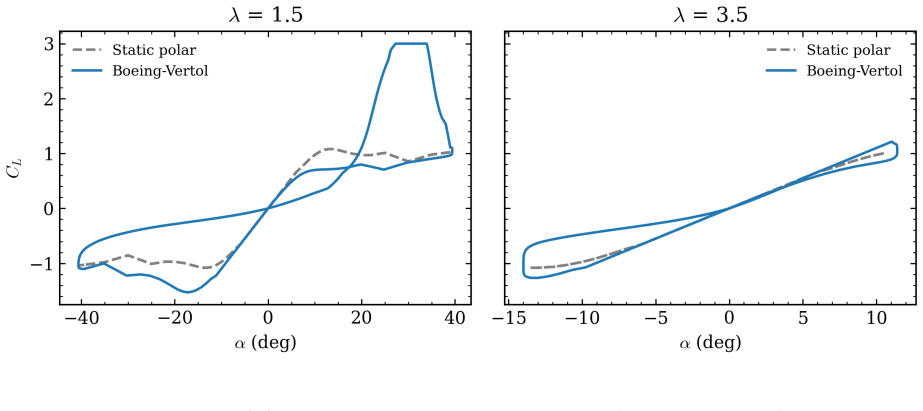
- [Fig. 7 and Fig. 8] The figure captions and axes would benefit from explicit labels for the static and Boeing-Vertol cases in the legend, and from stating the azimuthal averaging procedure in the caption or text.
- [Sec. III D 3] The phrase 'high-fidelity three-dimensional LES-ALM' is potentially misleading: the reference is an actuator-line LES, not a blade-resolved simulation. The text should say 'LES with an actuator-line model' to avoid implying geometric resolution of the blades.
Circularity Check
The CP curve is effectively a DMST/BEMT result with externally imposed inflow; the FR/CPR resolved flow contributes negligible induction, so the 6% LES-ALM agreement is attributed to the wrong component.
-
other
[Sec. III D 1–2 and III D 3 (Eqs. 27, 40–46)]
"However, we found that direct sampling of the resolved velocity field at the blade yields a power coefficient curve nearly coincident with the zero-induction result. ... Therefore, induction is modeled explicitly through DMST correction ... The effective inflow velocity in each half cycle is uu = U∞(1−au), ud = U∞(1−2au). ... Figure 6 presents the time-averaged power coefficient ... obtained with the DMST induction correction and the Boeing-Vertol dynamic stall model."
In Eq. (27) the blade relative velocity uses uloc 'equal to uu or ud depending on the azimuthal half', i.e. the DMST-determined values, not the FR/CPR-resolved velocity. The paper states the resolved field supplies negligible induction feedback. Thus CL, CD, forces, torque and CP (Eqs. 33–41) are computed entirely from the external DMST/BEMT inflow plus static polars and the Boeing-Vertol correction; the solver only advects the prescribed body forces. Presenting the resulting CP comparison as validation of the FR/CPR-ALM framework renames the DMST input as a solver prediction: the claimed 'prediction' reduces by construction to the external induction model.
full rationale
The paper's wake comparison (Sec. III B) is a genuine, self-contained validation of the source-term coupling on fixed grids: the mean wake profile is compared with experiment and 3D LES-ALM, and the mesh study shows grid convergence. But the central performance claim is different. Sec. III D1 reports that direct sampling of the resolved velocity gives a CP curve nearly coincident with zero-induction, and Sec. III D2 replaces the blade-inflow velocity with DMST values. Consequently the power coefficient is a DMST/BEMT calculation with Sheldahl-Klimas polars and Boeing-Vertol hysteresis, not a prediction of the coupled FR/CPR-ALM solver. The 5.7% peak agreement with Shamsoddin and Porté-Agel therefore evidences the external engineering model, not the high-order solver's induction coupling. No additional circularity was found: the self-citations to prior FR/CPR source-term work are contextual rather than load-bearing, and the kernel-width criterion is a conventional resolution condition. The central claim should be stated as conditional on the DMST induction correction.
Assumptions & free parameters
free parameters (4)
- kappa_c (chord-fraction constant in Gaussian width) =
4.3
- Kernel truncation radius r_c =
4*epsilon
- Under-relaxation factors in DMST induction update =
0.9 / 0.1
- Bypass threshold in dynamic-stall correction (Eq. 33) =
not specified
assumptions (6)
- standard math The two-dimensional compressible Navier-Stokes equations with a perfect-gas closure govern the flow.
- domain assumption Each blade is modeled as a single spanwise-uniform actuator point in 2D.
- domain assumption Static airfoil polars from Sheldahl and Klimas (ref 17) are valid for the NACA 0018 section at the simulated Reynolds number and angle range.
- domain assumption The modified Boeing-Vertol dynamic-stall model (Eqs. 29–33) captures the unsteady lift and drag behavior.
- domain assumption The Double Multiple Streamtube (DMST) induction correction with Glauert's high-loading extension correctly recovers the physical inflow when resolved induction feedback is negligible.
- domain assumption The Gaussian kernel representation of blade forces is adequate for capturing the rotor-induced momentum deficit and wake dynamics.
Cite this review
Pith. "Pith review of A High-Order Flux Reconstruction Actuator-Line Framework for Rotating-Blade Aerodynamics on Fixed Cartesian Grids." pith.science (2026). https://pith.science/paper/U5GS7NY6
@misc{pith2026260720347,
  author       = {Pith},
  title        = {Pith review of: A High-Order Flux Reconstruction Actuator-Line Framework for Rotating-Blade Aerodynamics on Fixed Cartesian Grids},
  year         = {2026},
  howpublished = {\url{https://pith.science/paper/U5GS7NY6}},
  note         = {Machine review of arXiv:2607.20347}
}
read the original abstract
This work couples a high-order flux reconstruction/correction procedure via reconstruction (FR/CPR) solver with a rotating actuator-line model (ALM) to simulate rotating-blade aerodynamics on fixed Cartesian grids. Blade loading is represented by volumetric body force source terms projected through an isotropic Gaussian kernel in a blade-attached frame, eliminating the need to resolve blade geometry. Vertical-axis wind turbines (VAWTs) serve as the demonstration configuration, with a modified Boeing-Vertol dynamic stall model incorporated to capture unsteady lift and drag. A mesh-resolution criterion for the Gaussian projection kernel on reasonably coarse meshes is derived. It shows that cost-effective coarse meshes can operate in a mesh-controlled regime with negligible induction feedback, motivating a Double Multiple Streamtube (DMST) correction to recover the physical inflow. Simulations are carried out over a range of tip-speed ratios at a chord-based Reynolds number of Re_c ~ 3.6 x 10^5. The framework is validated against experimental near-wake measurements and previously reported LES-ALM results, and the mean wake profile shows good agreement. The predicted power-coefficient curve matches high-fidelity three-dimensional LES-ALM data to within 6% around the optimal VAWT operation conditions. The framework also captures the regime-dependent influence of dynamic stall, azimuthal blade loading, lift hysteresis, and characteristic wake structures. These results demonstrate that the FR/CPR-ALM framework provides an accurate and computationally efficient geometry-free approach for VAWT analysis, making it well suited for parametric studies and large-scale wind energy applications.
Figures


Figures from the paper (11 more)




Reference graph
Works this paper leans on
-
[1]
2026 , organization=
Imran, Abdullah Al and Yu, Meilin , title =. 2026 , organization=
2026
-
[2]
Fluids Engineering Division Summer Meeting , volume=
A high-order computational framework for wind farm modeling using flux reconstruction and actuator disk models , author=. Fluids Engineering Division Summer Meeting , volume=. 2025 , organization=
2025
-
[3]
AIAA AVIATION FORUM AND ASCEND 2025 , pages=
Development and Validation of a Source-Term Based High-Order CFD Framework for Vertical Axis Wind Turbine Simulation , author=. AIAA AVIATION FORUM AND ASCEND 2025 , pages=. 2025 , DOI=
2025
-
[4]
2002 , publisher=
Wind turbine design: with emphasis on Darrieus concept , author=. 2002 , publisher=
2002
-
[5]
The phenomenon of dynamic stall , author=
-
[6]
A mathematical model of unsteady aerodynamics and radial flow for application to helicopter rotors , author=
-
[7]
2006 , publisher=
Principles of helicopter aerodynamics with CD extra , author=. 2006 , publisher=
2006
-
[8]
Journal of the American Helicopter society , volume=
A Semi-Empirical model for dynamic stall , author=. Journal of the American Helicopter society , volume=. 1989 , publisher=
1989
Show all 49 references
-
[9]
Wind Energy: An International Journal for Progress and Applications in Wind Power Conversion Technology , volume=
Simulating dynamic stall in a two-dimensional vertical-axis wind turbine: verification and validation with particle image velocimetry data , author=. Wind Energy: An International Journal for Progress and Applications in Wind Power Conversion Technology , volume=. 2010 , publisher=
2010
-
[10]
Energy Procedia , volume=
2D CFD modeling of H-Darrieus wind turbines using a transition turbulence model , author=. Energy Procedia , volume=. 2014 , publisher=
2014
-
[11]
Renewable energy , volume=
2.5 D large eddy simulation of vertical axis wind turbine in consideration of high angle of attack flow , author=. Renewable energy , volume=. 2013 , publisher=
2013
-
[12]
Renewable Energy , volume=
Near wake flow analysis of a vertical axis wind turbine by stereoscopic particle image velocimetry , author=. Renewable Energy , volume=. 2014 , publisher=
2014
-
[13]
Numerical modeling of wind turbine wakes , author=. J. Fluids Eng. , volume=
-
[14]
Technical University of Denmark , author=
Actuator disc methods applied to wind turbines. Technical University of Denmark , author=. 2003 , school=
2003
-
[15]
Actuator line modeling of wind turbine wakes , author=
-
[16]
1981 , institution=
Aerodynamic characteristics of seven symmetrical airfoil sections through 180-degree angle of attack for use in aerodynamic analysis of vertical axis wind turbines , author=. 1981 , institution=
1981
-
[17]
Energies , volume=
A large-eddy simulation study of vertical axis wind turbine wakes in the atmospheric boundary layer , author=. Energies , volume=. 2016 , publisher=
2016
-
[18]
Energy Conversion and Management , volume=
Effectiveness of two-dimensional CFD simulations for Darrieus VAWTs: a combined numerical and experimental assessment , author=. Energy Conversion and Management , volume=. 2017 , publisher=
2017
-
[19]
Reynolds number dependence of cross-flow turbine performance and near-wake characteristics , author=
-
[20]
Energy Conversion and Management , volume=
Tailoring the actuator line theory to the simulation of Vertical-Axis Wind Turbines , author=. Energy Conversion and Management , volume=. 2021 , publisher=
2021
-
[21]
Wind Energy , volume=
Simulation and wake analysis of a single vertical axis wind turbine , author=. Wind Energy , volume=. 2017 , publisher=
2017
-
[22]
Fluids Engineering Division Summer Meeting , volume=
Performance and near-wake measurements for a vertical axis turbine at moderate Reynolds number , author=. Fluids Engineering Division Summer Meeting , volume=. 2013 , doi=
2013
-
[23]
Journal of Renewable and Sustainable Energy , volume=
Large-eddy simulation of helical-and straight-bladed vertical-axis wind turbines in boundary layer turbulence , author=. Journal of Renewable and Sustainable Energy , volume=. 2022 , publisher=
2022
-
[24]
Cockburn and C.-W
B. Cockburn and C.-W. Shu. TVB Runge–Kutta local projection discontinuous Galerkin finite element method for conservation laws II: general framework. Mathematics of Computation. 1989. doi:https://doi.org/10.2307/2008474 , URL =
1989 doi
-
[25]
Journal of computational physics , volume=
A high-order accurate discontinuous finite element method for the numerical solution of the compressible Navier--Stokes equations , author=. Journal of computational physics , volume=. 1997 , publisher=. doi:10.1006/jcph.1996.5572 , url =
1997
-
[26]
Hesthaven, J. S. and Warburton, T. , title=
-
[27]
18th AIAA computational fluid dynamics conference , pages=
A flux reconstruction approach to high-order schemes including discontinuous Galerkin methods , author=. 18th AIAA computational fluid dynamics conference , pages=. 2007 , doi=
2007
-
[28]
Journal of Computational Physics , volume=
A unifying lifting collocation penalty formulation including the discontinuous Galerkin, spectral volume/difference methods for conservation laws on mixed grids , author=. Journal of Computational Physics , volume=. 2009 , publisher=
2009
-
[29]
47th AIAA aerospace sciences meeting including the new horizons forum and aerospace exposition , pages=
A reconstruction approach to high-order schemnes including discontinuous Galerkin for diffusion , author=. 47th AIAA aerospace sciences meeting including the new horizons forum and aerospace exposition , pages=
-
[30]
Journal of Scientific Computing , volume=
A new class of high-order energy stable flux reconstruction schemes , author=. Journal of Scientific Computing , volume=. 2011 , publisher=. doi:https://doi.org/10.1007/s10915-010-9420-z , url=
2011 doi
-
[31]
International Journal for Numerical Methods in Fluids , volume=
High-order CFD methods: current status and perspective , author=. International Journal for Numerical Methods in Fluids , volume=. 2013 , publisher=
2013
-
[32]
Handbook of numerical analysis , volume=
High-order flux reconstruction schemes , author=. Handbook of numerical analysis , volume=. 2016 , publisher=
2016
-
[33]
Journal of Computational Physics , volume=
Spectral difference method for unstructured grids I: Basic formulation , author=. Journal of Computational Physics , volume=. 2006 , publisher=
2006
-
[34]
Journal of computational physics , volume=
Approximate Riemann solvers, parameter vectors, and difference schemes , author=. Journal of computational physics , volume=. 1981 , publisher=
1981
-
[35]
arXiv preprint arXiv:2406.09993 , year=
Modelling Wind Turbines via Actuator Lines in High-Order h/p Solvers , author=. arXiv preprint arXiv:2406.09993 , year=
-
[36]
Journal of Fluids Engineering , volume=
High-Order Large Eddy Simulations of a Wind Turbine in Ducted and Open-Rotor Configurations , author=. Journal of Fluids Engineering , volume=. 2023 , publisher=
2023
-
[37]
Discontinuous Galerkin methodology for Large-Eddy Simulation of wind turbine wakes , booktitle =
Fr. Discontinuous Galerkin methodology for Large-Eddy Simulation of wind turbine wakes , booktitle =. 2016 , volume =. doi:10.1088/1742-6596/753/2/022037 , url =
2016 doi
-
[38]
and Schlatter, P
Kleusberg, E. and Schlatter, P. and Henningson, D. S. , title =. Journal of Physics: Conference Series , year =. doi:10.1088/1742-6596/854/1/012025 , url =
-
[39]
O'Dea, M. L. and others , title =. 2024 , note =
2024
-
[40]
and others , title =
Abedi, H. and others , title =. Engineering Proceedings , year =
-
[41]
M. L. Yu and Z. J. Wang and Y. Liu , journal =. On the accuracy and efficiency of discontinuous Galerkin, spectral difference and correction procedure via reconstruction methods , doi=
-
[42]
Wang and M
L. Wang and M. L. Yu , journal =. Comparison of ROW, ESDIRK, and BDF2 for Unsteady Flows with the High-Order Flux Reconstruction Formulation , volume =. 2020 , doi=
2020
-
[43]
SIAM Journal on Scientific and Statistical Computing , volume=
Total-variation-diminishing time discretizations , author=. SIAM Journal on Scientific and Statistical Computing , volume=. 1988 , publisher=
1988
-
[44]
, title =
Glauert, H. , title =. Aerodynamic Theory , volume =
-
[45]
and Cummins, P
Garrett, C. and Cummins, P. , title =. Journal of Fluid Mechanics , volume =
-
[46]
and Yu, Meilin , title =
Wisner, Kai S. and Yu, Meilin , title =. Journal of Renewable and Sustainable Energy , volume =. 2024 , month =
2024
-
[47]
Ting and Amir Fartaj , keywords =
Mazharul Islam and David S.-K. Ting and Amir Fartaj , keywords =. Aerodynamic models for Darrieus-type straight-bladed vertical axis wind turbines , journal =. 2008 , issn =
2008
-
[48]
Enhancing wind energy harvesting performance of vertical axis wind turbines with a new hybrid design: A fluid-structure interaction study , journal =
Kan Liu and Meilin Yu and Weidong Zhu , keywords =. Enhancing wind energy harvesting performance of vertical axis wind turbines with a new hybrid design: A fluid-structure interaction study , journal =. 2019 , issn =
2019
-
[49]
2005 , author =
Discontinuous Galerkin solution of the Reynolds-averaged Navier–Stokes and k– turbulence model equations , journal =. 2005 , author =
2005
Reviewed August 1, 2026 · model on record in the stance chip above.
Discussion (0). Continue with ORCID to comment.