REVIEW 3 major objections 4 minor 29 references
LLMs Get Lost in Evolving User Intent
T0 review · 3 major / 4 minor · reviewed 2026-08-01 · deepseek-v4-flash
Pith's one-line read Today's LLMs do not yet faithfully track and act on a user's intent as it evolves over a conversation, the paper argues, and it demonstrates the gap with a controllable multi-turn simulation built from static benchmarks.
desk verdict A genuinely reusable framework for turning static benchmarks into evolving-intent evaluations, with a plausible central finding whose absolute magnitudes are not yet cleanly separated from synthesis artifacts. read the letter →
The pith
A machine-rendered reading of the paper's core claim, the machinery that carries it, and where it could break.
The reading
What carries the argument
The central object is the intent-state tuple (f_t, C_t, C_rev_t, y_t): the target function, its arguments, the subset already revealed to the agent, and the answer. Three controlled transitions — argument reveal, argument revision, and function switch — update that state, and the agent's job is to maintain it. The framework's construction is retrospective: it extracts the source problem's intent, anchors it at the conversation's final turn, generates counterfactual arguments and predecessor functions, schedules when each transition occurs, and renders only the per-turn delta as natural language. A verification pipeline rejects any generated component that would change the source answer, so t
What would settle it
Replace the LLM-generated counterfactual and predecessor turns with human-authored paraphrases that realize the same intent schedule, keep the same final verifier, and have independent annotators confirm they read naturally. If the accuracy gap shrinks or disappears on human dialogue, the reported deficit is partly an artifact of synthetic dialogue; if it persists, the intent-tracking failure is genuine.
Extended reading notes
Core claim
On its own terms, the paper's discovery is that strong single-turn performance does not transfer to conversations in which user intent changes. It formalizes intent as a state — the function the user wants, its arguments, which arguments have been revealed so far, and the target answer — and defines three transitions: revealing a new argument, revising a previously stated argument, and switching to a related function while carrying over shared arguments. The framework extracts this state from a single-turn problem, places it at the final turn, and synthesizes a plausible earlier conversation (counterfactual values to be corrected, predecessor tasks that lead into the target) so that the orig
Load-bearing premise
The load-bearing premise is that the synthetic conversations are faithful proxies: the LLM-generated counterfactual arguments, predecessor functions, and rendered user turns must preserve the source problem's semantics after verification, so the measured degradation reflects intent tracking rather than confusion caused by awkward or contradictory synthetic dialogue. The paper locates this reliance in its verification stage (Section 4.3 and Appendix D) and concedes the rendere
Editorial extensions
If this is right
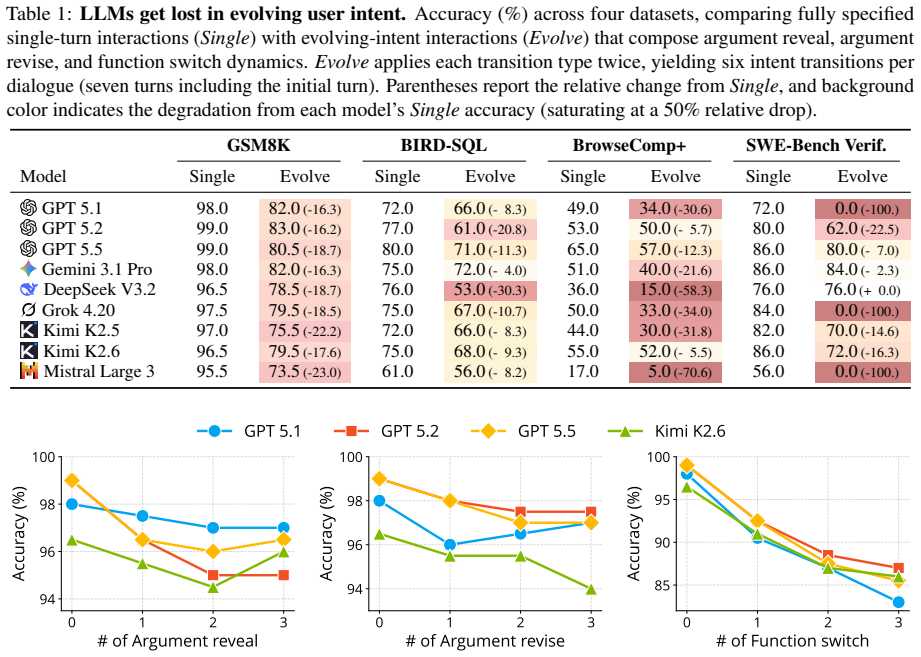
- Accuracy falls across all four domains — math, text-to-SQL, search, and coding — once intent evolves, even for models that are near-saturated in the single-turn setting.
- Function switches are the hardest transition, and their cost compounds when followed by further reveals or revisions; models can often handle the switch itself but lose earlier context as later updates arrive.
- Per-turn reasoning does not restore the lost performance, so the bottleneck appears to be maintaining an up-to-date belief over the user's intent rather than local problem-solving ability.
- Simple memory aids — a prompt to revisit context, or a perfect recap of the current intent — recover part of the gap but not all of it, meaning acting on correctly stated intent is also part of the difficulty.
- The framework can generate training data as well as evaluation data: a small reinforcement-learning run on evolving-intent dialogues improved a small open model's evolving-intent accuracy from 64% to 76% without hurting its single-turn accuracy.
Reading between the lines
- If the finding holds, single-turn leaderboards systematically overstate agent readiness for interactive use; a low-cost companion evaluation would be to run any verifiable benchmark through a backward-synthesis turn and report both numbers.
- The consistent ordering — reveal easiest, revision harder, switch hardest, composition worst — suggests a curriculum for training: expose agents to progressively combined transition types and reward only the final verifiable outcome.
- The anchor-at-final-turn trick is a general recipe: any domain with a verifiable answer, such as instruction following, planning, or UI delegation, could be given a similarly controlled evolving-intent stress test without new annotation.
- The oracle-recap result implies two separable failure modes — tracking the current intent and acting on a correctly stated intent — and future evaluations may want to report them independently to locate where a given model loses.
Editorial analysis
A structured set of objections, weighed in public.
Referee Report
Summary. The paper proposes a framework that converts verifiable single-turn benchmarks into multi-turn conversations with evolving user intent. It extracts a function-argument-answer triple from each source example (Section 4.1), synthesizes counterfactual arguments and predecessor functions to construct a plausible history (Section 4.2), and schedules/renders user turns so that the source intent is the final-turn anchor (Section 4.3), allowing the original dataset verifier to score the final action. Across GSM8K, BIRD-SQL, BrowseComp+, and SWE-Bench Verified, the authors report substantial accuracy drops from single-turn to evolving-intent settings (Table 1), with monotonic degradation as transition counts increase (Figure 4), partial recovery under oracle recap (Figure 6), and degraded turn-wise intent tracking after function switches (Table 3). They conclude that current LLMs do not faithfully track and act on evolving user intent.
Significance. If the measurement is clean, the finding is significant: it exposes a capability gap invisible to static evaluation, and the construction is scalable because final-turn scoring uses the original verifiers rather than new annotation. The paper includes several genuinely supportive controls — turn-matched repeats (Table 5), monotonic transition scaling (Figure 4), oracle recap (Figure 6), and capacity scaling (Figure 10) — which argue that the effect is tied to intent evolution rather than raw conversation length. The preliminary RL demonstration (Table 6) also broadens the contribution. The main caveat is that the headline Single-versus-Evolve comparison is not yet cleanly isolated from the synthesis pipeline's re-rendering cost; the missing single-turn re-render control is the central issue to resolve.
major comments (3)
- [Table 1; Eq. (6); Sections 4.1/4.3; Appendix D.1] The headline comparison conflates intent evolution with synthesis artifacts. The 'Single' column uses the original source prompt, while the 'Evolve' condition presents a multi-turn conversation whose final user turn is a re-rendered version of an LLM-extracted intent (Eq. 6), not the original text. No row reports accuracy on that re-rendered final turn presented alone. The verification in Appendix D.1 checks answer-equivalence using a GPT-5.1 reference solver and LLM judge — the same model family as several evaluated systems — so extraction/render errors are not excluded. Because source accuracies are near ceiling (95-99% on GSM8K), even a small extraction loss could account for a large relative drop. Please add the missing control: run each model on the final re-rendered anchor turn with no dialogue history, and use that as the baseline for the Evolve columns.
- [Table 1, SWE-Bench Verif. column; Section 5.1] The 0.0% cells for GPT 5.1, Grok 4.20, and Mistral Large 3 on SWE-Bench are budget timeouts, not wrong answers: the text states these agents 'easily exhaust the 100 tool-call budget, lingering in extended thinking and timing out.' Reporting these as 0.0% accuracy conflates tool-budget exhaustion with intent-tracking failure and inflates the domain-level degradation. The per-turn budget was raised only for Kimi K2.6 and DeepSeek V3.2. Please report timeout rate separately, report resolved rate conditional on completion, or rerun with a sufficient budget, and temper the SWE-Bench-specific claims accordingly.
- [Table 1; Figures 4-7] Evaluation sets are small (200/100/100/50 samples), yet no confidence intervals or significance tests are reported. Several cells differ by only 4-8 points on n=100 (e.g., BIRD-SQL GPT 5.1: 72 vs 66; GPT 5.5: 80 vs 71), which is within binomial sampling error, and the SWE-Bench 0.0 cells are based on 50 episodes. The monotonic effects in Figure 4 are supportive, but the precise effect sizes and some per-domain conclusions need uncertainty qualification. Add bootstrap confidence intervals or exact binomial intervals, especially where quantitative claims such as 'relative drops reaching up to roughly 30%' are made.
minor comments (4)
- [Section 5.3] The sentence 'Figure 6 separates two sources of error...' is confusing because Figure 6 plots the memory mechanisms; the subsequent turn-wise intent-tracking analysis is Table 3. Please re-label or move this introductory sentence.
- [Limitations vs. Sections 3 and C.1] The Limitations state that each user turn contains a single intent transition, but Section 3 says transition types 'may co-occur within the same turn,' and Algorithm 1's step 6 orders multiple event types within a turn. Please clarify whether the main evaluation enforces single-event turns or allows co-occurrence.
- [Table 3] The turn-wise intent-tracking analysis relies on an LLM judge without any human-validated subset or inter-judge agreement. Since this is an ancillary analysis, a brief caveat or a small human-evaluation sample would strengthen it.
- [Appendix C.2] The LLM naturalizer validation checks only that critical tokens are preserved. This is reasonable, but it does not guarantee semantic equivalence; the paper should state this as a limitation of the BrowseComp+ naturalized subset.
Circularity Check
No circular derivation: headline drops are measured with original verifiers; the missing re-rendered single-turn control is a validity caveat, not a circular step.
full rationale
The paper's central claim is empirical: single-turn accuracy is compared with accuracy on multi-turn conversations that end in an extracted anchor intent (Eq. 6; Sections 4.1 and 4.3). The Evolve accuracy is a measured outcome, not a quantity derived from the construction, so the observed drop is not equivalent to the pipeline's inputs by construction. Final scores are checked by each source dataset's native verifier (GSM8K exact-answer matching, BIRD-SQL execution-based verification, SWE-Bench tests), not by the same LLM that generated the conversations; thus the headline results are not fitted parameters relabeled as predictions. The LLM-based Extract/Counterfact/Predecessor components are screened by answer-preservation checks (Appendix D) using GPT-5.1 as a reference solver; this creates a possible selection or validity bias because the same model family is also evaluated, but it does not make the measured degradation a tautology. The paper's own Limitations section concedes that the verifier is exact only at the final turn and that rendered utterances may be stylistically uniform; these are external-validity caveats about the synthetic conversations, not circular reductions. Self-citations, e.g., Laban et al. 2026a in Section F.1, are contextual and not load-bearing: the main phenomenon is established by Tables 1 and 2 on external benchmarks, not by those citations. No uniqueness theorem, ansatz-by-citation, or renaming step forces the conclusion. The strongest interpretive concern is the absence of a single-turn control on the re-rendered final turn, which means part of the Single-vs-Evolve gap could reflect extraction/rendering cost rather than intent evolution; that is a confound to be addressed with an additional control, not a reduction of the result to its inputs.
Assumptions & free parameters
free parameters (3)
- Main-scenario transition budget (g=p=2; six intent transitions) =
two each of reveal, revise, switch; T=7 turns
- Per-turn tool-call budgets =
100 for most models; 200 for Kimi K2.6 and DeepSeek V3.2 on SWE
- Evaluation sample sizes =
200 GSM8K, 100 BIRD-SQL, 100 BrowseComp+, 50 SWE-Bench Verified
assumptions (5)
- domain assumption LLM-generated Extract/Counterfact/Predecessor outputs preserve the source problem's semantics after the described verification filters
- domain assumption The three transition types (argument reveal, revision, function switch) are a sufficient operationalization of evolving user intent
- domain assumption The rule-based renderer/prefix banks produce natural enough user utterances that failures reflect intent-tracking, not confusing phrasing
- domain assumption Original benchmark verifiers remain valid when the final turn is embedded in a multi-turn context
- domain assumption The LLM judge used for turn-wise intent tracking is reliable
Cite this review
Pith. "Pith review of LLMs Get Lost in Evolving User Intent." pith.science (2026). https://pith.science/paper/HNNPXHDG
@misc{pith2026260720734,
  author       = {Pith},
  title        = {Pith review of: LLMs Get Lost in Evolving User Intent},
  year         = {2026},
  howpublished = {\url{https://pith.science/paper/HNNPXHDG}},
  note         = {Machine review of arXiv:2607.20734}
}
read the original abstract
As LLMs become more capable, they are increasingly deployed as collaborative agents, taking on user-delegated tasks through iterative interaction. Yet genuine interaction is inherently dynamic: users rarely specify their intent upfront, instead disclosing, revising, and reshaping it as the conversation unfolds. Despite this, LLMs are still predominantly evaluated or trained in single-turn, fully-specified settings, leaving open a fundamental question: how well do LLMs track and act on user intent as it evolves over the course of a conversation? To study this, we introduce a framework that transforms static, single-turn tasks into dynamic multi-turn conversations in which the user's intent evolves across turns--incrementally revealed, revised, and at times redirected mid-conversation--while preserving each task's original evaluation protocol, enabling existing benchmarks to be reused as controlled testbeds without new annotation. Across multiple tasks, we surface a consistent phenomenon: strong static-setting performance does not transfer to the evolving-intent setting, with substantial drops across model families. Our findings point to a fundamental gap: today's LLMs do not yet faithfully track and act on the user's evolving intent, a capability invisible to static evaluation yet critical for future collaborative agents.
Figures


Figures from the paper (5 more)


Reference graph
Works this paper leans on
-
[1]
the described person
GOAL: The main question - WHAT to find/identify - Should describe what the query asks WITHOUT including the specific constraints - The goal MUST be self-contained: do NOT use "the described person", "the above institution", "this entity", or similar references to conditions - Do NOT use pronouns (she, he, it, they) without a named subject in the goal itse...
-
[2]
CONDITIONS: The factual constraints needed to narrow down the answer (2-8 items) - Each condition is a factual constraint extracted from the query - Conditions contain dates, locations, attributes, relationships, and identifying details - Preserve ALL specific details exactly (names, dates, numbers, places)
-
[3]
Each condition should be a direct quote or close paraphrase from the query text
-
[4]
InInternational Conference on Learning Representations
Flipping the dialogue: Training and evaluating user language models. InInternational Conference on Learning Representations. Robert N Oddy, NJ Belkin, and HM Brooks. 1982. Ask for information retrieval: Part i. background and theory. Journal of documentation, 38(2). OpenAI. 2025. GPT-5. https://openai.com/index/ gpt-5-system-card/. Tejal Patwardhan, Rache...
arXiv 1982
-
[5]
Training proactive and personalized llm agents. arXiv preprint arXiv:2511.02208. Yuqi Tang, Kehua Feng, Yunfeng Wang, Zhiwen Chen, Chengfei Lv, Gang Yu, Qiang Zhang, Keyan Ding, and Huajun Chen. 2025. Learning an efficient multi-turn dia- logue evaluator from multiple llm judges.arXiv preprint arXiv:2508.00454. Karen Ullrich, Jingtong Su, Claudia Shi, Arj...
arXiv 2025
-
[6]
Do NOT add INFERRED or DERIVED conditions --- only extract facts explicitly stated in the query - If the query doesn't explicitly say it, do NOT include it as a condition
-
[7]
The question refers
Do NOT create META-CONDITIONS that describe the query itself rather than providing constraints - A condition must NEVER start with "The question refers", "The query asks", "The focus is on", "This pertains to" - If something is part of what is being ASKED, it belongs in the GOAL, not conditions
-
[8]
that same person
Each condition MUST be self-contained and understandable on its own, without reading the other conditions - Do NOT use back-references like "that same person", "the aforementioned", "this institution", "the event mentioned above", "the same city", "the article discussed above" - If a condition refers to an entity or event described elsewhere, repeat the n...
2012
Show all 29 references
-
[9]
Conditions should not overlap
-
[10]
Do NOT add hints, search strategies, or reasoning - only extract information from the query
-
[14]
Do NOT over-split: closely related facts about the same event or criterion should stay in one condition
-
[15]
What is the name of the person who did X and Y?
Temporal or causal relationships between conditions should be made explicit within each condition where needed IMPORTANT: Clearly separate WHAT to find (goal) from the IDENTIFYING CRITERIA (conditions): - "What is the name of the person who did X and Y?" should become: - Goal:...
2023
-
[16]
eight" ->
REPLACE exactly ONE detail with a different value. This can be: - A year or date (e.g., 2016 -> 2017) - A number or quantity (e.g., "eight" -> "ten", "42 months" -> "36 months") - A temporal range endpoint (e.g., "between 2015 and 2020" -> "between 2015 and 2018") - A descript...
2016
-
[17]
The change should be PLAUSIBLE and CONTEXTUALLY APPROPRIATE --- it must make sense within the same domain
-
[18]
Keep the EXACT same sentence structure --- the perturbed condition must have the same length and form as the original, with only one value swapped
-
[19]
CRITICAL: Do NOT change the main subject/entity being searched for - If the question is about a specific person, company, or event, the perturbed condition must still be about that same entity - Only change a QUALIFYING DETAIL, not the core subject
-
[20]
The perturbed value should be close but different --- a nearby alternative that is realistic
-
[21]
road accident
CRITICAL: The perturbation must be a VALUE SWAP, NOT an addition or elaboration: - CORRECT: "road accident" -> "motorcycle accident" (swaps "road" for "motorcycle") - CORRECT: "2018" -> "2019" (swaps year value) The reason: in our evaluation framework, the original condition w...
2018
-
[22]
a" -> "an
CRITICAL: The perturbed condition must be obtainable by a SINGLE find-and-replace of original_value -> perturbed_value in the original condition. NO other characters may change: - Do NOT change articles (a/an) --- if the swap would require "a" -> "an" (e.g., "a multinomial" ->...
-
[23]
short-lived
The perturbed value must be the SAME TYPE of attribute as the original --- both must describe the same dimension: - CORRECT: "short-lived" -> "long-running" (both describe duration) - CORRECT: "early" -> "late" (both describe temporal position --- NOT "in the middle of" which ...
-
[24]
popular" ->
CRITICAL: Do NOT use synonyms, near-synonyms, or subset/superset values. The perturbed value must genuinely CONTRADICT the original when the original replaces it: - CORRECT: "popular" -> "controversial" (genuinely different attribute) - CORRECT: "African" -> "South American" (...
-
[25]
Select a SUBSET of conditions from the next goal as "shared" conditions
-
[26]
Generate 1-3 NEW conditions specific to the predecessor goal
-
[27]
New conditions must provide enough context for an AI to attempt answering the predecessor
-
[28]
New conditions must describe the SAME underlying subject/domain as the shared conditions
-
[29]
this author
New conditions must NOT contradict any shared conditions === RULES === - The predecessor must ask a GENUINELY DIFFERENT question than the next goal --- it must seek a DIFFERENT ENTITY or a DIFFERENT TYPE OF INFORMATION - The predecessor must ask about a DIFFERENT TYPE OF INFOR...
2024
-
[2021]
arXiv preprint arXiv:2110.14168
Training verifiers to solve math word problems. arXiv preprint arXiv:2110.14168. DeepSeek-AI. 2025. Deepseek-v3.2: Pushing the frontier of open large language models. Yao Dou, Michel Galley, Baolin Peng, Chris Kedzie, Weixin Cai, Alan Ritter, Chris Quirk, Wei Xu, and Jianfeng Gao
2025 arXiv
-
[2025]
Google DeepMind
Simulatorarena: Are user simulators reliable proxies for multi-turn evaluation of ai assistants? InConference on Empirical Methods in Natural Language Processing. Google DeepMind. 2026. Gemini 3.1 Pro Model Card. https://deepmind.google/models/model-cards/ gemini-3-1-pro/. Chr...
2026 arXiv
-
[2026]
arXiv preprint arXiv:2602.16173
Learning personalized agents from human feedback. arXiv preprint arXiv:2602.16173. Mistral AI. 2026. Ministral 3.arXiv preprint arXiv:2601.08584. Moonshot AI. 2026. Kimi K2.6. https://www.kimi.com/ blog/kimi-k2-6. Tarek Naous, Philippe Laban, Wei Xu, and Jennifer Neville
2026
Reviewed August 1, 2026 · model on record in the stance chip above.
Discussion (0). Continue with ORCID to comment.