REVIEW 4 major objections 4 minor 27 references
Autoregressive weather forecasters degrade because their own outputs push them out-of-distribution by the first step; fine-tuning on those biased one-step predictions (SOFT) substantially reduces long-horizon error and beats compared strate
Reviewed by Pith at T0; open to challenge. T0 means a machine referee read the full paper against a public rubric. the ladder, T0–T4 →
SOFT fine-tunes a weather model on its own one-step predictions, reducing long-horizon autoregressive error by aligning inputs with the training distribution.
T0 review reviewed 2026-08-01 challenge →
load-bearing objection SOFT is a cheap, consistently effective fine-tuning trick for autoregressive DLWP, but the paper's root-cause distribution-shift story is asserted rather than demonstrated; the empirical results are worth engaging with. the 4 major comments →
Nipping the Butterfly Effect in the Bud: Self-Output Fine-Tuning for Autoregressive Weather Prediction
The pith
A machine-rendered reading of the paper's core claim, the machinery that carries it, and where it could break.
The reading
Core claim
The paper's central claim is that the rapid error growth seen in autoregressive DLWP over week-long horizons is driven by a feedback loop between output errors and input distribution shift, not merely by the intrinsic chaos of the atmosphere. The authors derive a recurrence showing that each step's error is the sum of freshly introduced error and a propagated term amplified by the Jacobian of the system and the model's error function. Empirically, they show that the distribution of model predictions drifts away from the ground-truth manifold, that this out-of-distribution signature is already detectable at the first autoregressive step, and that it predicts increasing FID and MAE along the r
What carries the argument
The load-bearing mechanism is the error–distribution feedback loop, formalized in Proposition 3.1's recurrence e_t ≈ (J_g + J_eps)e_{t-1} + eps_t, which shows how single-step errors amplify through the combined Jacobian of the true dynamics and the model's error function. The remedy is the SOFT objective L = ||f_theta(stopgrad[f_base(X_{t-dt})]) - X_{t+dt}||_1, which exposes the model to its own one-step biases; Theorem 4.1 upper-bounds k-step rollout loss by this SOFT loss plus divergence terms, justifying single-step alignment as a proxy for multi-step training.
Load-bearing premise
The argument assumes that out-of-distribution input is the mechanism that converts small single-step errors into large roll-out errors, rather than a harmless symptom of chaotic amplification; the controlled experiment shows feeding predictions back hurts, but not that the harm is mediated by OOD.
What would settle it
Measure the error trajectory of a SOFT-trained model when it is evaluated on clean ground-truth inputs at every step: if the error reduction disappears while FID is still low, OOD calibration is not the operative mechanism. Alternatively, train with a noise augmentation that matches the empirical covariance of first-step predictions; if it matches SOFT's gain, the specific self-output input distribution is not necessary.
If this is right
- Long-horizon accuracy can be improved with a one-step objective, without unrolling the model over many steps during training, cutting memory and compute.
- Distributional discrepancy at the first autoregressive step is a measurable early-warning signal for later forecast collapse, enabling cheap diagnostics.
- Fine-tuning on self-generated inputs acts as a distributional calibration that transfers across different model architectures and can be layered on top of existing strategies like rollout or replay buffers.
- Because SOFT changes only the training input and not the inference pipeline, it can be dropped into currently deployed autoregressive DLWP systems with minimal modification.
Where Pith is reading between the lines
- This reasoning likely transfers beyond weather to other autoregressive generative tasks—speech, video, or learned world models—where model outputs feed back as inputs and prediction artifacts compound; the first-step discriminator test is a cheap diagnostic to check that transfer.
- If out-of-distribution input is truly the driver, SOFT should combine with longer rollouts for further gains; the paper tests SOFT as a post-hoc fine-tune, not jointly trained with multi-step objectives, which is a natural next experiment.
- A sharper test of the mechanism would be to match the empirical first-step error distribution (covariance and spectrum) in the training inputs without using the model's own outputs; if that matched SOFT's gain, the self-output source would not be the active ingredient.
Editorial analysis
A structured set of objections, weighed in public.
Referee Report
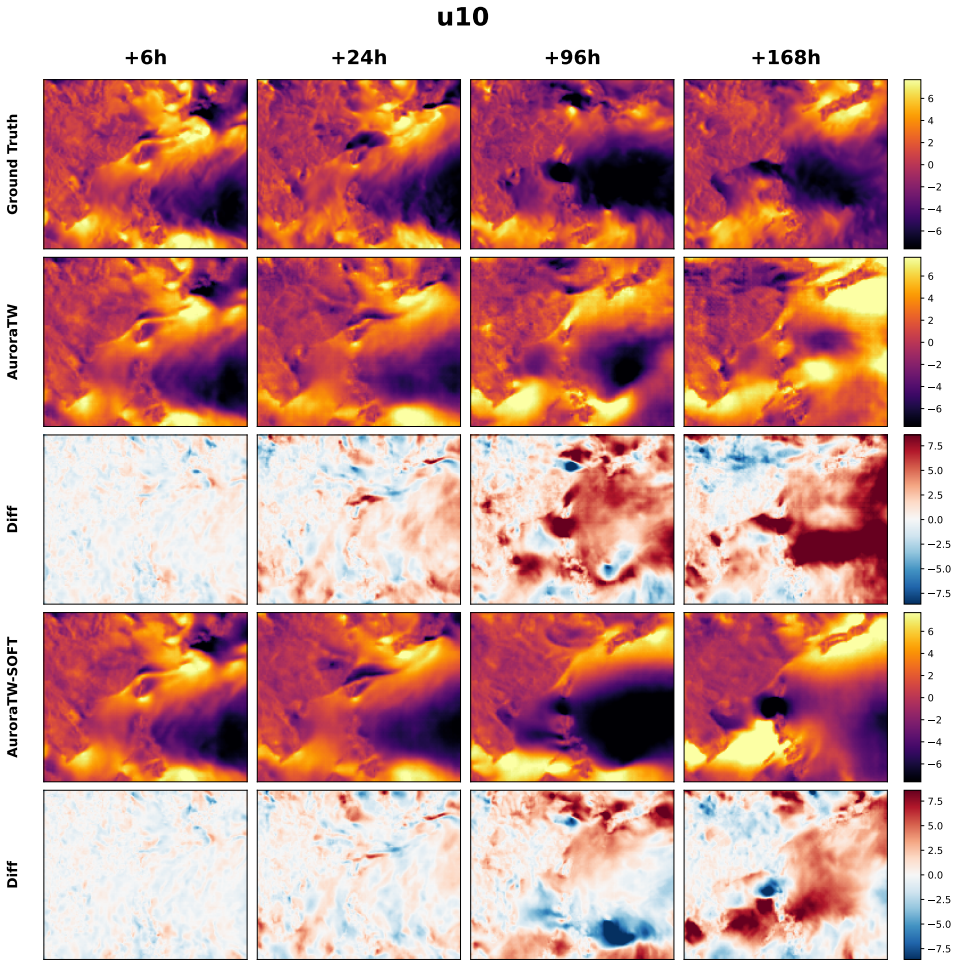
Summary. The paper claims that error growth in autoregressive deep-learning weather prediction is driven by a feedback loop: one-step prediction errors shift subsequent inputs out of the training distribution, and those OOD inputs cause larger errors, which in turn produce more OOD inputs. It presents a linearized error-propagation recurrence (Proposition 3.1), reports a binary discriminator that separates one-step predictions from ERA5 at ~100% accuracy, and proposes Self-Output Fine-Tuning (SOFT), which fine-tunes a model on its own one-step predictions. Experiments on regional ERA5 with Aurora and Pangu backbones compare SOFT with rollout tuning, replay buffer, Gaussian noise augmentation, and feature matching, reporting lower MAE and FID over 168-hour horizons.
Significance. If the empirical findings are robust, SOFT is an attractive plug-and-play training strategy: it is simple, computationally cheap, architecture-agnostic, and the open-source release is a concrete plus. However, the headline mechanistic claim — that OOD feedback is the root cause of error growth — is not established by the current evidence. SOFT may still be useful as a form of exposure-bias mitigation even if the causal narrative is incorrect, so the practical contribution has value, but the overclaiming and missing uncertainty quantification need to be addressed. The theoretical bound in Theorem 4.1 is too weak to justify the method as stated. The paper is likely salvageable as an empirical study of self-output fine-tuning, but it needs substantial revision.
major comments (4)
- [3.3, 3.4, Appendix C.4.4] The central causal link 'error → OOD → larger error' is not established. The evidence is a binary probe separating one-step predictions from ERA5 embeddings at ~100% accuracy, but no null control is reported. In a high-dimensional learned feature space, a probe can separate any two nonidentical sets, and deterministic predictors also introduce systematic smoothing/bias, so 'distinguishable from ground truth' is not equivalent to 'outside the training distribution.' The FID trend in Table 1 is computed in the AuroraTW encoder space, a model-specific distance rather than an independent measure of atmospheric realism. Proposition 3.1 only linearizes error propagation; it is consistent with chaotic sensitivity or spectral instability and does not require a distribution-shift mechanism. The feedback loop in Figure 5 is therefore asserted, not demonstrated. A null control (e.g., separating two
- [4.4, Theorem 4.1, Appendix B] The claimed theoretical justification is not established. The bound L_rollout ≤ 2 L_SOFT + 4||W||²(||(W−W_tilde)X_t||² + ||(W^{k−1}−W)X_t||²) contains unquantified terms involving the current weights W. Minimizing L_SOFT does not control those terms, and the first term vanishes only at W = W_tilde, i.e., where the model has not moved from the single-step solution. Additionally, the proof starts with ||W^k X_t − X_{t+2}|| (Appendix B, Eq. 17), which is not the k-step rollout loss; that loss should compare W^k X_t with X_{t+k}. As written, the theorem does not bound the claimed quantity. This section should either be corrected and strengthened or presented as heuristic motivation.
- [5.2, Tables 2-3] The state-of-the-art claim is not supported by the reported evidence. No error bars, seeds, or confidence intervals accompany Tables 2–6, and many reported differences are small (e.g., TW z_500 442.777 vs 446.555; NA z_500 1217.320 vs 1213.615, with ReplayBuffer lower), so the rankings may not be robust. Table 3's 'win rate' is undefined: §5.2.2 says it counts variables that rank first at 168h, but the table reports six lead times and the totals (37, 31, ...) cannot be reconstructed from 3 regions × 4 variables. In Table 2, for the EU region ReplayBuffer has lower MAE than SOFT on all four variables (e.g., t2m 4.566 vs 4.762), contradicting the 'best in bold' presentation. A clear definition of the win-rate protocol and uncertainty quantification are required before the state-of-the-art conclusion can be drawn.
- [5.4.2, Table 6] The Pangu-Weather ablation is used to support architectural generalization, but the reported numbers are not credible as presented. PanguTW baseline MAEs are an order of magnitude worse than AuroraTW on the same task (t2m 29.389 vs 3.029; z_500 2333 vs 443), and SOFT produces relative improvements of −36% to −59%. The paper states that Pangu was re-implemented from published pseudo-code and trained from scratch, so these numbers likely indicate a poorly converged or misconfigured baseline. Without training curves, single-step validation error, or comparison with the original Pangu performance, Table 6 cannot support the claim that SOFT is architecture-agnostic.
minor comments (4)
- [Limitations] The limitations paragraph says 'our experiments are currently limited to a regional East Asia subset,' but Sections 5.1.1, 5.2, and 5.3 report results for TW, EU, and NA. Please reconcile this statement with the actual experimental scope.
- [Tables 2 and 6] The variable name is written '10u' in some column headers and 'u10' elsewhere; please standardize.
- [Appendix C.4.2] The Rollout baseline uses K=2 steps. This is a very short unroll relative to the 168-hour evaluation and may considerably weaken the baseline; please discuss the choice or use a budget-matched longer rollout.
- [Table 4] FeatureMatching has higher FID than the single-step baseline for TW (1.173 vs 1.105), which is unexpected for a distributional-alignment baseline. Please check the implementation or explain why it underperforms.
Circularity Check
No significant circularity: empirical MAE results are self-contained; the theoretical bound is weak but not a definitional reduction.
full rationale
The paper's central empirical claim (SOFT reduces long-horizon MAE) is evaluated against ERA5 ground truth, an external benchmark, and is not fitted to the claim. Proposition 3.1 is a standard first-order Taylor expansion and does not assume the feedback-loop conclusion. The discriminator probe in Sec 3.3 / C.4.4 is a fixed-feature binary classifier; high accuracy is a standard two-sample separability test, not a parameter fitted to the target conclusion. FID uses a fixed AuroraTW encoder (C.4.3) for all methods, so it is not self-referential to the SOFT weight update. Theorem 4.1 is an algebraic inequality that upper-bounds rollout loss by the SOFT loss plus unquantified divergence terms; while this is a weak justification and arguably vacuous without bounds on ||(W-W̃)X_t||, it is an inequality derived by triangle inequality, not an equality-by-construction. No self-citations by the authors appear; all prior-work citations are to external groups. The causal claim that OOD inputs drive error growth is under-supported (no null control for the probe, and Prop 3.1 is consistent with other amplification mechanisms), but that is a validity/correctness concern, not a circularity. Score 0.
Axiom & Free-Parameter Ledger
free parameters (3)
- SOFT fine-tuning epochs =
50 main experiments; 25 in ablations
- Peak learning rate =
3e-5
- Rollout horizon K for the Rollout baseline =
2
axioms (6)
- standard math First-order Taylor expansion of f_theta around x_{t-1} is valid (e_{t-1} small)
- domain assumption Error growth in autoregressive DLWP is mainly driven by input distribution shift / OOD feedback
- domain assumption ERA5 reanalysis is treated as ground truth for weather states
- ad hoc to paper FID in AuroraTW encoder feature space measures atmospheric realism / distributional shift
- ad hoc to paper The bound in Theorem 4.1 is meaningful although its right-hand side includes unquantified terms involving W and W_tilde
- domain assumption Correcting first-step distributional bias with one-step own-output fine-tuning transfers to multi-step rollouts
Cite this review
Pith. "Pith review of Nipping the Butterfly Effect in the Bud: Self-Output Fine-Tuning for Autoregressive Weather Prediction." pith.science (2026). https://pith.science/paper/W7ZBT67Z
@misc{pith2026260721080,
  author       = {Pith},
  title        = {Pith review of: Nipping the Butterfly Effect in the Bud: Self-Output Fine-Tuning for Autoregressive Weather Prediction},
  year         = {2026},
  howpublished = {\url{https://pith.science/paper/W7ZBT67Z}},
  note         = {Machine review of arXiv:2607.21080}
}
read the original abstract
Long-horizon weather forecasting is a fundamental challenge in atmospheric science, for which autoregressive Deep Learning Weather Prediction (DLWP) has emerged as the primary paradigm. Although the autoregressive pipeline is highly scalable and flexible, its prediction errors grow rapidly over long forecasting horizons. In this work, we study this error growth phenomenon from both theoretical and empirical perspectives. Our analysis reveals that the growth is driven by a feedback loop between output errors and input distribution shifts. Specifically, the autoregressive process amplifies small initial output errors, which progressively corrupt subsequent input distributions, echoing the butterfly effect in atmospheric science and ultimately deteriorating forecasting accuracy over longer horizons. Furthermore, we show that this distributional shift originates at the earliest stage of inference, with out-of-distribution signatures detectable as early as the first autoregressive step. To mitigate this issue, we propose \textbf{Self-Output Fine-Tuning (SOFT)}, a plug-and-play strategy that leverages the model's own one-step predictions to calibrate the biased input distribution encountered at the first step. Extensive experiments demonstrate that, despite its simplicity, SOFT achieves state-of-the-art performance on long-horizon forecasting tasks and substantially reduces both prediction errors and distributional discrepancy. The success of SOFT highlights the importance of reexamining the fundamental pipeline of deep learning weather prediction, representing a critical pipeline advance for atmospheric science.
Figures




Reference graph
Works this paper leans on
-
[1]
Kushal Arora, Layla El Asri, Hareesh Bahuleyan, and Jackie Cheung. 2022. Why Exposure Bias Matters: An Imitation Learning Perspective of Error Accumula- tion in Language Generation. InFindings of the Association for Computational Linguistics: ACL 2022, Smaranda Muresan, Preslav Nakov, and Aline Villavicen- cio (Eds.). Association for Computational Linguis...
-
[2]
Peter Bauer, Alan Thorpe, and Gilbert Brunet. 2015. The quiet revolution of numerical weather prediction.Nature525, 7567 (2015), 47–55
2015
-
[3]
Samy Bengio, Oriol Vinyals, Navdeep Jaitly, and Noam Shazeer. 2015. Scheduled sampling for sequence prediction with recurrent neural networks.Advances in neural information processing systems28 (2015)
2015
-
[4]
Kaifeng Bi, Lingxi Xie, Hengheng Zhang, Xin Chen, Xiaotao Gu, and Qi Tian. 2023. Accurate medium-range global weather forecasting with 3D neural networks. Nature619, 7970 (2023), 533–538
2023
-
[5]
Cristian Bodnar, Wessel P Bruinsma, Ana Lucic, Megan Stanley, Anna Allen, Johannes Brandstetter, Patrick Garvan, Maik Riechert, Jonathan A Weyn, Haiyu Dong, et al. 2025. A foundation model for the Earth system.Nature(2025), 1–8
2025
-
[6]
Jerald A Brotzge, Don Berchoff, DaNa L Carlis, Frederick H Carr, Rachel Hogan Carr, Jordan J Gerth, Brian D Gross, Thomas M Hamill, Sue Ellen Haupt, Neil Jacobs, et al. 2023. Challenges and opportunities in numerical weather prediction. Bulletin of the American Meteorological Society104, 3 (2023), E698–E705
2023
-
[7]
Gilbert Brunet, David B Parsons, Dimitar Ivanov, Boram Lee, Peter Bauer, Natacha B Bernier, Veronique Bouchet, Andy Brown, Antonio Busalacchi, Georgina Campbell Flatter, et al. 2023. Advancing weather and climate forecast- ing for our changing world.Bulletin of the American Meteorological Society104, 4 (2023), E909–E927
2023
-
[8]
Kang Chen, Tao Han, Junchao Gong, Lei Bai, Fenghua Ling, Jing-Jia Luo, Xi Chen, Leiming Ma, Tianning Zhang, Rui Su, et al. 2023. Fengwu: Pushing the skillful global medium-range weather forecast beyond 10 days lead.arXiv preprint arXiv:2304.02948(2023)
arXiv 2023
-
[9]
Lei Chen, Xiaohui Zhong, Feng Zhang, Yuan Cheng, Yinghui Xu, Yuan Qi, and Hao Li. 2023. FuXi: a cascade machine learning forecasting system for 15-day global weather forecast.npj climate and atmospheric science6, 1 (2023), 190
2023
-
[10]
Erin Coughlan de Perez, BJJM van den Hurk, MK Van Aalst, Brenden Jongman, T Klose, and Pablo Suarez. 2015. Forecast-based financing: an approach for catalyzing humanitarian action based on extreme weather and climate forecasts. Natural Hazards and Earth System Sciences15, 4 (2015), 895–904
2015
-
[11]
2016.Deep Learning
Ian Goodfellow, Yoshua Bengio, and Aaron Courville. 2016.Deep Learning. MIT Press. http://www.deeplearningbook.org
2016
-
[12]
Hans Hersbach, Bill Bell, Paul Berrisford, Shoji Hirahara, András Horányi, Joaquín Muñoz-Sabater, Julien Nicolas, Carole Peubey, Raluca Radu, Dinand Schepers, et al. 2020. The ERA5 global reanalysis.Quarterly journal of the royal meteorological society146, 730 (2020), 1999–2049
2020
-
[13]
Alex Kendall and Yarin Gal. 2017. What uncertainties do we need in bayesian deep learning for computer vision?Advances in neural information processing systems30 (2017)
2017
-
[14]
Remi Lam, Alvaro Sanchez-Gonzalez, Matthew Willson, Peter Wirnsberger, Meire Fortunato, Ferran Alet, Suman Ravuri, Timo Ewalds, Zach Eaton-Rosen, Weihua Hu, et al . 2023. GraphCast: Learning skillful medium-range global weather forecasting.Science382, 6677 (2023), 1416–1424
2023
-
[15]
Remi Lam, Alvaro Sanchez-Gonzalez, Matthew Willson, Peter Wirnsberger, Meire Fortunato, Ferran Alet, Suman Ravuri, Timo Ewalds, Zach Eaton-Rosen, Weihua Hu, et al . 2023. Learning skillful medium-range global weather forecasting. Science382, 6677 (2023), 1416–1421
2023
-
[16]
Gerald A Meehl, Thomas Karl, David R Easterling, Stanley Changnon, Roger Pielke Jr, David Changnon, Jenni Evans, Pavel Ya Groisman, Thomas R Knutson, Kenneth E Kunkel, et al. 2000. An introduction to trends in extreme weather and climate events: observations, socioeconomic impacts, terrestrial ecological impacts, and model projections.Bulletin of the Amer...
2000
-
[17]
Tung Nguyen, Johannes Brandstetter, Ashish Kapoor, Jayesh K Gupta, and Aditya Grover. 2023. Climax: A foundation model for weather and climate.arXiv preprint arXiv:2301.10343(2023)
Pith/arXiv arXiv 2023
-
[18]
Tung Nguyen, Rohan Shah, Hritik Bansal, Troy Arcomano, Sandeep Madireddy, Romit Maulik, Veerabhadra Kotamarthi, Ian Foster, and Aditya Grover. 2024. Scaling transformers for skillful and reliable medium-range weather forecasting. InICLR 2024 Workshop on AI4DifferentialEquations In Science
2024
-
[19]
Peisong Niu, Ziqing Ma, Tian Zhou, Weiqi Chen, Lefei Shen, Rong Jin, and Liang Sun. 2025. Utilizing strategic pre-training to reduce overfitting: Baguan-a pre-trained weather forecasting model. InProceedings of the 31st ACM SIGKDD Conference on Knowledge Discovery and Data Mining V. 2. 2186–2197
2025
-
[20]
Jaideep Pathak, Shashank Subramanian, Peter Harrington, Sanjeev Raja, Ashesh Chattopadhyay, Morteza Mardani, Thorsten Kurth, David Hall, Zongyi Li, Kamyar Azizzadenesheli, et al. 2022. Fourcastnet: A global data-driven high- resolution weather model using adaptive fourier neural operators.arXiv preprint arXiv:2202.11214(2022)
Pith/arXiv arXiv 2022
-
[21]
Marc’Aurelio Ranzato, Sumit Chopra, Michael Auli, and Wojciech Zaremba
-
[22]
Stéphane Ross, Geoffrey Gordon, and Drew Bagnell. 2011. A reduction of imi- tation learning and structured prediction to no-regret online learning. InPro- ceedings of the fourteenth international conference on artificial intelligence and statistics. JMLR Workshop and Conference Proceedings, 627–635
2011
-
[23]
Damien Teney, Armand Mihai Nicolicioiu, Valentin Hartmann, and Ehsan Ab- basnejad. 2024. Neural redshift: Random networks are not random functions. In Proceedings of the IEEE/CVF Conference on Computer Vision and Pattern Recogni- tion. 4786–4796
2024
-
[24]
Dmitry Ulyanov, Andrea Vedaldi, and Victor Lempitsky. 2018. Deep image prior. InProceedings of the IEEE conference on computer vision and pattern recognition. 9446–9454
2018
-
[25]
Haowen Wang, Guowei Zhang, Xiang Zhang, Zeyuan Chen, Haiyang Xu, Dou Hoon Kwark, and Zhuowen Tu. 2025. Exploring the equivalence of closed- set generative and real data augmentation in image classification.arXiv preprint arXiv:2508.09550(2025)
Pith/arXiv arXiv 2025
-
[26]
Xiangyu Zhao, Zhiwang Zhou, Wenlong Zhang, Yihao Liu, Xiangyu Chen, Jun- chao Gong, Hao Chen, Ben Fei, Shiqi Chen, Wanli Ouyang, Xiao-Ming Wu, and Lei Bai. 2024. WeatherGFM: Learning A Weather Generalist Foundation Model via In-context Learning. arXiv:2411.05420 [cs.LG] https://arxiv.org/abs/2411. 05420 9 Appendix A Derivation of Error Propagation In this...
Pith/arXiv arXiv 2024
-
[2015]
Sequence level training with recurrent neural networks.arXiv preprint arXiv:1511.06732(2015)
Pith/arXiv arXiv 2015
This paper was first reviewed by deepseek-v4-flash on August 1, 2026.
discussion (0)
Sign in with ORCID, Apple, or X to comment. Anyone can read and Pith papers without signing in.