REVIEW 5 major objections 5 minor 271 references
Deformation, halo, and bubble structure: A paradigm shift of exotic phenomena in light to medium mass nuclei
T0 review · 5 major / 5 minor · reviewed 2026-08-01 · deepseek-v4-flash
Pith's one-line read This paper argues that a unified structure-plus-reaction toolkit—antisymmetrized molecular dynamics for structure, the Glauber model for reaction cross sections, and finite-range distorted wave Born approximation (FRDWBA) for Coulomb breaku
desk verdict A candid, internally honest review of the authors' own FRDWBA program; the halo and spin-parity claims are model-dependent because of the single-ℓ assumption and C²S=1, and the 'paradigm shift' framing oversells results whose final r-process abundances barely change. read the letter →
The pith
A machine-rendered reading of the paper's core claim, the machinery that carries it, and where it could break.
The reading
What carries the argument
The load-bearing object is the FRDWBA reduced transition amplitude, factorized under the local momentum approximation into a dynamics integral (evaluated as a Bremsstrahlung integral) and a structure integral containing the projectile ground-state wave function and the fragment-fragment potential Vbc(r1), which carries axially symmetric quadrupole deformation (Eqs. 30-31). Because the structure part is separable, deformation can be varied in the potential without altering the dynamics, and the single-ℓ dominance approximation—lowest ℓ rules the asymptotic wave function when the separation energy tends to zero—lets the authors use a spherical single-ℓ wave function despite deformation. For th
What would settle it
A precise Coulomb breakup measurement of 34Na on a lead target, combined with an independent mass measurement of its one-neutron separation energy: if the data cannot be fitted by the p-wave FRDWBA with any spectroscopic factor C²S ≤ 1 and a separation energy consistent with the mass value (0.17 ± 0.50 MeV), the single-ℓ approximation and the Jπ=2− halo assignment would be falsified. Similarly, if the extracted Sn for 37Mg using shell-model C²S=0.42 does not shift from 0.35 to 0.14 MeV as the paper predicts, the assumed relation between spectroscopic factor and breakup cross section breaks dow
Extended reading notes
Core claim
The central claim is that a weakly bound valence neutron can be described by its dominant low-ℓ component even in a deformed potential, so that the projectile ground-state wave function for 29Ne, 31Ne, 34Na, and 37Mg is well approximated by a spherical Woods-Saxon solution for ℓ=1, with deformation entering through the interaction potential. Using this wave function in the post-form FRDWBA, the authors reproduce measured one-neutron removal cross sections and parallel momentum distributions, concluding that each nucleus has a ground state with Jπ=3/2− and p-wave halo character. For two-neutron systems, hyperspherical three-body calculations with core+n and nn interactions predict Borromean h
Load-bearing premise
The single-ℓ dominance approximation: for very weakly bound valence neutrons, the lowest-ℓ component is assumed to dominate the asymptotic wave function even in a deformed potential, so the projectile ground state can be computed from a spherical Woods-Saxon well for one ℓ; if deformation-induced ℓ-mixing or core degrees of freedom are substantial, the extracted spin-parities and separation energies shift.
Editorial extensions
If this is right
- If the assignments hold, 29Ne, 31Ne, 34Na, and 37Mg join the established club of p-wave one-neutron halos, and their ground-state spin-parities (Jπ=3/2−) can be used as fixed inputs for future shell-model and ab initio studies.
- The predicted Borromean halos 31F, 39Na, and 40Mg have calculable matter radii and reaction cross sections that can be tested at next-generation rare-isotope beam facilities.
- FRDWBA rates for neutron capture on weakly bound dripline nuclei should replace Hauser-Feshbach rates in r-process network calculations; doing so shifts local abundances by several orders of magnitude even when only a few reactions are changed.
- The near-universal linear scaling between the relative-energy-spectrum peak and the one-neutron separation energy (slope ~1.01 across deformation values) provides a quick way to extract Sn for weakly bound deformed nuclei.
- Proton elastic scattering at the first diffraction peak can serve as a spectroscopic probe of diffuseness and thus of particle-hole configurations and bubble structure in these exotic nuclei.
Reading between the lines
- The single-ℓ dominance approximation is the hinge of the paper's conclusions; if deformation-induced ℓ-mixing or neglected core degrees of freedom turn out to be significant in these deformed drip-line nuclei, the extracted spin-parities and separation energies could shift, so the framework's reach may be limited to the most weakly bound systems.
- The paper's own sensitivity analysis (Sn decreasing from 0.35 to 0.14 MeV when C²S goes from 1 to 0.42 in 37Mg) implies that spectroscopic factors are a larger source of uncertainty than deformation; future work should combine FRDWBA with structure models that supply both the single-particle wave function and the spectroscopic factor consistently.
- A testable extension is to apply the same toolkit to nuclei just outside the island of inversion, such as neutron-rich carbon and oxygen isotopes, to see whether the predicted p-wave dominance and halo signatures persist or fade as the separation energy increases.
- The r-process abundance shifts reported here come from replacing only five reaction rates; since direct-capture dominance likely extends to many other weakly bound species, the cumulative effect on final abundances could be larger than the 'few orders of magnitude' shown, a point the paper leaves implicit.
Signed reviews
Editorial analysis
A structured set of objections, weighed in public.
Referee Report
Summary. This review proposes a unified framework for exotic structures in the island of inversion (N=20–28), combining antisymmetrized molecular dynamics (AMD) structure calculations with two reaction theories: the Glauber model for high-energy total reaction cross sections and the finite-range distorted wave Born approximation (FRDWBA) for Coulomb breakup. The paper applies this toolkit to claim one-neutron halo ground states with dominant p-wave (J^π=3/2^-) configurations for 29Ne, 31Ne, 34Na, and 37Mg; two-neutron Borromean halos for 29F, 31F, 39Na, and 40Mg; and to show that replacing Hauser-Feshbach (n,γ) rates with FRDWBA rates changes local r-process abundances by several orders of magnitude. The manuscript is unusually candid about its main approximations: it explicitly states that the single-ℓ dominance approximation is not fully self-consistent and that the C²S=1 spectroscopic assumption is an idealization. However, the impact of these approximations on the central structural and astrophysical claims is not quantified.
Significance. If validated, the paper would deliver a predictive AMD+FRDWBA/Glauber toolkit for dripline physics, with concrete experimental targets at FRIB, RIBF, and FAIR. The review's strengths include its honest treatment of uncertainties: Fig. 10 shows the explicit sensitivity of the extracted 37Mg separation energy to C²S and β2, and the Glauber calculations are parameter-free once densities are fixed. The predictions for 34Na and for two-neutron halos in 31F, 39Na, and 40Mg are falsifiable and timely. The weakness is that the load-bearing single-ℓ dominance approximation is tested only in a narrow sector (negative-parity ℓ=1,3,5 at β2=0.2) and no benchmark against more complete reaction frameworks (XCDCC, particle-rotor, or CDCC with core excitation) is provided. The C²S=1 assumption is shown by the paper's own analysis to shift extracted Sn values by a factor of ~2.5, which propagates into the halo classification and the astrophysical rates.
major comments (5)
- [Sec. 2.3, after Eq. (32)] The single-ℓ dominance approximation is the hinge of all FRDWBA conclusions. The text concedes the approach does not treat static deformation self-consistently, and Fig. 8 tests only negative-parity ℓ=1,3,5 at β2=0.2; it does not test s-wave (ℓ=0) mixing or dynamic core excitations. The consequences are visible in the paper's own results: Fig. 9 shows p- and s-wave cross sections overlapping within experimental bands for 29Ne and 31Ne, Table 6 gives a p-wave FWHM of 51 MeV/c vs. the measured 77(18) MeV/c for 31Ne, and Fig. 10 shows C²S-induced shifts. Please benchmark against an XCDCC or particle-rotor calculation for at least one nucleus (e.g., 31Ne) or provide a quantitative estimate of the systematic uncertainty from neglected ℓ-mixing. Without this, the J^π=3/2^- assignments and the extracted Sn values remain model-dependent.
- [Sec. 3.3.2, Fig. 10] The uniform C²S=1 assumption is adopted for all configurations despite the text citing shell-model values as low as 0.31 for 37Mg and breakup analyses giving 0.42. Fig. 10 shows that using C²S=0.42 instead of 1.0 changes the extracted 37Mg Sn from 0.35 MeV to 0.14 MeV, a factor ~2.5 shift. Because the extracted Sn values feed directly into the halo classification (low Sn is a prerequisite) and into the astrophysical rates of Sec. 4, this sensitivity must be propagated. The paper should either adopt literature C²S values where available or present C²S sensitivity plots for all four one-neutron halo candidates, not just 37Mg.
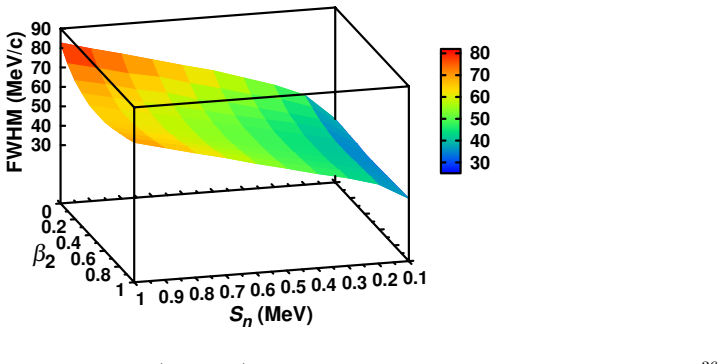
- [Table 6, Sec. 3.3.5] The calculated p-wave FWHM for 31Ne is 51.24 MeV/c (β2=0), while the measured inclusive width is 77(18) MeV/c on a carbon target. This is a ~40% discrepancy. The text notes the experimental widths are on carbon but does not address the target/mechanism mismatch: the measurements include nuclear breakup contributions, whereas the calculations are pure Coulomb breakup. Since narrow PMDs are a central halo signature, this discrepancy should be discussed quantitatively — e.g., an estimate of nuclear breakup contributions or an explicit statement that the comparison is only qualitative. The same caveat applies to the comparison with well-known halo nuclei such as 11Be.
- [Sec. 4.2, Figs. 20-22] The abstract claims the results demonstrate 'their role in the refinement of r-process nucleosynthesis models and elemental abundance predictions.' However, the network calculation modifies only five rates, and the paper itself states that 'the overall final abundance pattern remains largely unchanged.' Fig. 22 shows local changes up to a few orders of magnitude in the logarithmic ratio, but only for nuclei with low abundance. The claim should be qualified: the modified rates alter local isotopic abundances and can redirect flow near the drip line, but the global r-process pattern is stable under these replacements. Please soften the abstract and the concluding statements accordingly.
- [General — circularity and self-review] The review is to a large extent a summary of the authors' own program: the decisive methodological references [90,97,98,102,105-107,249] share authorship, and the quantities loop through the data — Woods-Saxon potentials are tuned to literature Sn values, and the cross sections are then compared with experimental data to re-extract Sn. The manuscript should explicitly delineate which inputs are taken from independent measurements and which are model outputs, and should discuss the extent to which the extracted Sn values are independent of the inputs used to generate the wave functions. This is a transparency issue that affects the reader's ability to assess the strength of the structural conclusions.
minor comments (5)
- [Fig. 8] Panel labels (a)-(d) are placed inside the panels. Consider moving them outside to avoid overlapping with the curves, especially the 29Ne and 31Ne panels where the labels sit near the x-axis.
- [Eq. (31)] The sign convention for β2 and the relation to the standard Bohr-Mottelson deformed potential should be stated explicitly. The text says β2 is the quadrupole deformation parameter, but the sign conventions matter for the comparison with, e.g., the Nilsson model.
- [Sec. 2.3] The adopted Woods-Saxon parameter values (r0, d, Vws) for each nucleus are scattered across the cited original papers. A summary table would make the review self-contained and help readers reproduce the calculations.
- [References] A number of the most load-bearing references (e.g., [90,97,98,102,105-107,249]) are by the authors themselves. Calling this out in a footnote or in the introduction would improve transparency.
- [Title and abstract] The phrase 'paradigm shift' in the title is stronger than the content supports; the paper presents a comprehensive toolkit and a set of candidly model-dependent applications. Consider softening the title to reflect the review's actual scope.
Circularity Check
No significant circularity: the review’s structural and astrophysical claims are checked against external data, and fitting steps are disclosed rather than mislabeled as predictions.
full rationale
The paper’s load-bearing results—FRDWBA Coulomb-breakup cross sections, extraction of one-neutron separation energies, two-neutron halo radii, and r-process abundance changes—are all compared with independent experimental data or are explicitly presented as sensitivity studies. The Woods–Saxon potential is tuned to literature separation energies, and the same separation energies are later re-extracted from cross-section comparisons; this is a disclosed analysis loop, not a claim that the extracted values are first-principles predictions. The paper explicitly states that ‘the extracted Sn values from Coulomb breakup data are intimately linked to the assumed C2S’ and shows how they shift with C2S and β2, so the model dependence is acknowledged rather than hidden. Similarly, the three-body force V3b is ‘adjusted freely to match the desired two-neutron separation energy s2n’, but the resulting matter radii are then compared to measured radii (e.g., for 29F), which is an independent check rather than a circular validation. The single-ℓ dominance approximation is justified by an in-paper numerical solution of the coupled-channel equation (Fig. 8) and by ANC calculations, not solely by the cited prior work; the limitation that static deformation is not treated self-consistently is also stated explicitly. Frequent self-citations occur because this is a review of the authors’ own program, but the decisive physics is either re-derived in the manuscript or benchmarked against external data, so the self-citations are not load-bearing in a way that makes the conclusions circular.
Assumptions & free parameters
free parameters (5)
- Spectroscopic factor C²S =
1.0 assumed (literature values 0.31–0.42)
- One-neutron separation energy Sn =
0.295 ± 0.055 MeV (31Ne, p-wave); 0.35 ± 0.06 MeV (37Mg)
- Quadrupole deformation β2 =
varied 0.0–0.5 in FRDWBA; β = 0.45–0.52 in AMD
- Woods-Saxon geometry (r0, d, Vws) =
values cited to references; 'adjusted according to the nucleus chosen for study'
- Three-body force strength V3b =
adjusted freely to match s2n
assumptions (7)
- domain assumption Glauber adiabatic and eikonal approximations with parametrized NN profile function (Eqs. 13–18)
- domain assumption Lowest-ℓ dominance for weakly bound valence neutrons (Ref. [102])
- domain assumption Local momentum approximation with K magnitude fixed at R = 10 fm
- ad hoc to paper C²S = 1 for all valence configurations
- domain assumption Gogny D1S effective interaction for AMD
- domain assumption Inert-core approximation for Borromean three-body systems
- domain assumption Single-multipole (E1) dominance in extracting (n,γ) from Coulomb dissociation
Cite this review
Pith. "Pith review of Deformation, halo, and bubble structure: A paradigm shift of exotic phenomena in light to medium mass nuclei." pith.science (2026). https://pith.science/paper/XRBKBGFY
@misc{pith2026260721730,
  author       = {Pith},
  title        = {Pith review of: Deformation, halo, and bubble structure: A paradigm shift of exotic phenomena in light to medium mass nuclei},
  year         = {2026},
  howpublished = {\url{https://pith.science/paper/XRBKBGFY}},
  note         = {Machine review of arXiv:2607.21730}
}
abstract
The emergence of exotic nuclear structures, such as deformation, one- and two-neutron halos, and bubble configurations, marks a paradigm shift in our understanding of light- to medium-mass nuclei far from stability, particularly near and within the island of inversion extending across $N=20-28$. In this review, we integrate microscopic structure calculations using the antisymmetrized molecular dynamics method with reaction theories such as the Glauber model for high-energy collisions, and highlight the use of the fully quantum mechanical finite-range distorted wave Born approximation for calculating both inclusive and exclusive Coulomb breakup observables for these medium mass systems. These theoretical frameworks enable precise probing of nuclear density profiles through observables such as total reaction cross sections, neutron removal cross sections, relative energy spectra, parallel momentum distributions, and angular distributions. Applications to several nuclei in the island of inversion reveal enhanced halo extensions, neutron-neutron correlations in Borromean nuclei, and central density depletions in bubbles, challenging traditional shell-model paradigms. Furthermore, the sensitivity of astrophysical reaction rates to these exotic inputs is explored, demonstrating their role in the refinement of r-process nucleosynthesis models and elemental abundance predictions. This unified approach not only bridges nuclear structure and reactions, but also highlights the driplines as frontiers for unraveling nuclear matter under extreme conditions, with implications for rare-isotope beam experiments and beyond.
Figures


Figures from the paper (19 more)




Reference graph
Works this paper leans on
-
[102]
Hamamoto, Dominance of low-ℓ component in weakly bound deformed single-neutron orbits, Phys
I. Hamamoto, Dominance of low-ℓ component in weakly bound deformed single-neutron orbits, Phys. Rev. C 69 (2004) 041306.doi:10.1103/PhysRevC.69.041306. URL https://link.aps.org/doi/10.1103/PhysRevC.69.041306
-
[1]
Tanihata, H
I. Tanihata, H. Toki, T. Kajino, Handbook of nuclear physics, 2023. doi:10.1007/ 978-981-19-6345-2
2023
-
[2]
W. Nazarewicz, L. G. Sobotka, The lessons learned from ephemeral nuclei, Physics Today 78 (2) (2025) 30–36. arXiv:https://pubs.aip.org/physicstoday/article-pdf/78/2/30/ 20370962/30\_1\_pt.yvjv.skzx.pdf, doi:10.1063/pt.yvjv.skzx. URL https://doi.org/10.1063/pt.yvjv.skzx
-
[3]
F. M. Nunes,Why are theorists excited about exotic nuclei?, Physics Today 74 (5) (2021) 34–
2021
-
[4]
J. Erler, N. Birge, M. Kortelainen, W. Nazarewicz, E. Olsen, A. M. Perhac, M. Stoitsov,The limits of the nuclear landscape, Nature 486 (7404) (2012) 509–512.doi:10.1038/nature11188. URL https://doi.org/10.1038/nature11188 54
-
[5]
G. G. Adamian, N. V. Antonenko, A. Diaz-Torres, S. Heinz,How to extend the chart of nuclides?, The European Physical Journal A 56 (2020) 47.doi:10.1140/epja/s10050-020-00046-7. URL https://doi.org/10.1140/epja/s10050-020-00046-7
-
[6]
D. S. Ahn, N. Fukuda, H. Geissel, N. Inabe, N. Iwasa, T. Kubo, K. Kusaka, D. J. Morrissey, D. Murai, T. Nakamura, M. Ohtake, H. Otsu, H. Sato, B. M. Sherrill, Y. Shimizu, H. Suzuki, H.Takeda, O.B.Tarasov, H.Ueno, Y.Yanagisawa, K.Yoshida,Locationoftheneutrondriplineat FluorineandNeon , Phys.Rev.Lett.123(2019)212501. doi:10.1103/PhysRevLett.123.212501. URL ...
-
[7]
D. S. Ahn, J. Amano, H. Baba, N. Fukuda, H. Geissel, N. Inabe, S. Ishikawa, N. Iwasa, T. Ko- matsubara, T. Kubo, K. Kusaka, D. J. Morrissey, T. Nakamura, M. Ohtake, H. Otsu, T. Sakak- ibara, H. Sato, B. M. Sherrill, Y. Shimizu, T. Sumikama, H. Suzuki, H. Takeda, O. B. Tarasov, H. Ueno, Y. Yanagisawa, K. Yoshida,Discovery of 39Na, Phys. Rev. Lett. 129 (202...
Show all 271 references
-
[8]
A. B. Balantekin, J. Carlson, D. J. Dean, G. M. Fuller, R. J. Furnstahl, M. Hjorth‐Jensen, R. V. F. Janssens, B. Li, W. Nazarewicz, F. M. Nunes, W. E. Ormand, S. Reddy, B. M. Sherrill, Nuclear theory and science of the facility for rare isotope beams, Modern Physics Letters A ...
2014 doi
-
[9]
H. L. Crawford, K. Fossez, S. König, A. Spyrou, A vision for the science of rare iso- topes, Annual Review of Nuclear and Particle Science 74 (2024) 141–172. doi:10.1146/ annurev-nucl-121423-091501
2024
-
[10]
B. A. Brown, A. Gade, S. R. Stroberg, J. Escher, K. Fossez, P. Giuliani, C. Hoffman, W. Nazarewicz, C.-Y. Seng, A. Sorensen, N. Vassh, D. Bazin, W. Brown, M. Caprio, H. Craw- ford, P. Danielewicz, C. Drischler, R. García Ruiz, et al., Motivations for early high‐profile frib ex...
2025 doi
-
[11]
Y. Ye, X. Yang, H. Sakurai, B. Hu,Physics of exotic nuclei, Nature Reviews Physics 7 (1) (2025) 21–37. doi:10.1038/s42254-024-00782-5. URL https://doi.org/10.1038/s42254-024-00782-5
2025 doi
-
[12]
arXiv:2503.15575
NuPECC, NuPECC long range plan 2024 for European nuclear physics, arXiv preprint arXiv:2503.15575 (2025). arXiv:2503.15575
2024 arXiv
-
[13]
URL https://dst.gov.in/sites/default/files/MSV2035-NP-Final.pdf
Mega science vision 2035: Nuclear physics, final Report (December 2023). URL https://dst.gov.in/sites/default/files/MSV2035-NP-Final.pdf
-
[14]
URL https://www.nishina.riken.jp/researcher/RIBFupgrade/RIBF_Upgrade_NCAC.pdf
RIBF Facility Upgrade Project, RIKEN Nishina Center for Accelerator-Based Science, Japan. URL https://www.nishina.riken.jp/researcher/RIBFupgrade/RIBF_Upgrade_NCAC.pdf
-
[15]
URL https://www.ukri.org/publications/stfc-nuclear-physics-advisory-panel-roadmap/
Science and Technology Facilities Council (STFC), UK Nuclear Physics Advisory Panel,UK nuclear physics roadmap 2024: the physics of nuclei, nuclear matter and nucleosynthesis , document accessed from UK Research and Innovation (UKRI) website (2024). URL https://www.ukri.org/pu...
2024
-
[16]
Andreoiu, S
C. Andreoiu, S. Barkanova, G. Christian, A. Gezerlis, G. Huber, J. W. Martin, R. Sandapen, The 2027-2034 vision for nuclear physics in Canada, with an outlook to 2041(2026). arXiv: 55 2602.22464. URL https://arxiv.org/abs/2602.22464
2027
-
[17]
Dobaczewski, I
J. Dobaczewski, I. Hamamoto, W. Nazarewicz, J. A. Sheikh,Nuclear shell structure at particle drip lines, Phys. Rev. Lett. 72 (1994) 981–984.doi:10.1103/PhysRevLett.72.981. URL https://link.aps.org/doi/10.1103/PhysRevLett.72.981
1994 doi
-
[18]
Sorlin, M
O. Sorlin, M. G. Porquet, Nuclear magic numbers: new features far from stability, Progress in Particle and Nuclear Physics 61 (2008) 602–673.doi:10.1016/j.ppnp.2008.05.001
2008 doi
-
[19]
Heyde, J
K. Heyde, J. L. Wood,Shape coexistence in atomic nuclei, Rev. Mod. Phys. 83 (2011) 1467–1521. doi:10.1103/RevModPhys.83.1467. URL https://link.aps.org/doi/10.1103/RevModPhys.83.1467
2011 doi
-
[20]
Nishibata, S
H. Nishibata, S. Kanaya, T. Shimoda, A. Odahara, S. Morimoto, A. Yagi, H. Kanaoka, M. R. Pearson, C. D. P. Levy, M. Kimura, N. Tsunoda, T. Otsuka,Structure of31Mg: Shape coexistence revealed by β−γ spectroscopy with spin-polarized 31Na, Phys. Rev. C 99 (2019) 024322.doi: 10.11...
2019 doi
-
[21]
B. P. Kay, C. R. Hoffman, A. O. Macchiavelli,Effect of weak binding on the apparent spin-orbit splitting in nuclei, Phys. Rev. Lett. 119 (2017) 182502.doi:10.1103/PhysRevLett.119.182502. URL https://link.aps.org/doi/10.1103/PhysRevLett.119.182502
2017 doi
-
[22]
Chen, Systematic trends in the spin-orbit splitting toward weak-binding, Frontiers in Physics 13 (2025)
J. Chen, Systematic trends in the spin-orbit splitting toward weak-binding, Frontiers in Physics 13 (2025). doi:10.3389/fphy.2025.1510848
2025
-
[23]
Kahlbow, T
J. Kahlbow, T. Aumann, O. Sorlin, Y. Kondo, T. Nakamura, F. Nowacki, A. Revel, N. L. Achouri, H. Al Falou, L. Atar, H. Baba, K. Boretzky, C. Caesar, D. Calvet, H. Chae, N. Chiga, A. Corsi, F. Delaunay, A. Delbart, Q. Deshayes, Z. Dombrádi, C. A. Douma, Z. Elekes, I. Gašparić, ...
2024
-
[25]
A. S. Jensen, K. Riisager, D. V. Fedorov, E. Garrido,Structure and reactions of quantum halos, Rev. Mod. Phys. 76 (2004) 215–261.doi:10.1103/RevModPhys.76.215. URL https://link.aps.org/doi/10.1103/RevModPhys.76.215
2004 doi
-
[26]
Mutschler, A
A. Mutschler, A. Lemasson, O. Sorlin, D. Bazin, C. Borcea, R. Borcea, Z. Dombrádi, J.-P. Ebran, A. Gade, H. Iwasaki, E. Khan, A. Lepailleur, F. Recchia, T. Roger, F. Rotaru, D. Sohler, 56 M. Stanoiu, S. R. Stroberg, J. A. Tostevin, M. Vandebrouck, D. Weisshaar, K. Wimmer,A pro...
2017 doi
-
[27]
Duguet, V
T. Duguet, V. Somà, S. Lecluse, C. Barbieri, P. Navrátil,Ab initio calculation of the potential bubble nucleus 34Si, Phys. Rev. C 95 (2017) 034319.doi:10.1103/PhysRevC.95.034319. URL https://link.aps.org/doi/10.1103/PhysRevC.95.034319
2017 doi
-
[28]
U. C. Perera, A. V. Afanasjev,Bubble nuclei: Single-particle versus Coulomb interaction effects, Phys. Rev. C 106 (2022) 024321.doi:10.1103/PhysRevC.106.024321. URL https://link.aps.org/doi/10.1103/PhysRevC.106.024321
2022 doi
-
[29]
E. K. Warburton, J. A. Becker, B. A. Brown,Mass systematics for A = 29 − 44 nuclei: The deformed a∼32 region, Phys. Rev. C 41 (1990) 1147–1166.doi:10.1103/PhysRevC.41.1147. URL https://link.aps.org/doi/10.1103/PhysRevC.41.1147
1990 doi
-
[30]
Thibault, R
C. Thibault, R. Klapisch, C. Rigaud, A. M. Poskanzer, R. Prieels, L. Lessard, W. Reisdorf,Direct measurement of the masses of11Li and 26−32Na with an on-line mass spectrometer, Phys. Rev. C 12 (1975) 644–657. doi:10.1103/PhysRevC.12.644. URL https://link.aps.org/doi/10.1103/Ph...
1975 doi
-
[31]
Huber, F
G. Huber, F. Touchard, S. Büttgenbach, C. Thibault, R. Klapisch, H. T. Duong, S. Liberman, J. Pinard, J. L. Vialle, P. Juncar, P. Jacquinot,Spins, magnetic moments, and isotope shifts of 21−31Na by high resolution laser spectroscopy of the atomicD1 line, Phys. Rev. C 18 (1978)...
1978 doi
-
[34]
Détraz, D
C. Détraz, D. Guillemaud, G. Huber, R. Klapisch, M. Langevin, F. Naulin, C. Thibault, L. C. Carraz, F. Touchard,Beta decay of27−32Na and their descendants, Phys. Rev. C 19 (1979) 164–
1979
-
[35]
Caurier, F
E. Caurier, F. Nowacki, A. Poves, J. Retamosa,Shell model study of the neutron rich isotopes from oxygen to silicon, Phys. Rev. C 58 (1998) 2033–2040.doi:10.1103/PhysRevC.58.2033. URL https://link.aps.org/doi/10.1103/PhysRevC.58.2033
1998 doi
-
[36]
Caurier, G
E. Caurier, G. Martínez-Pinedo, F. Nowacki, A. Poves, A. P. Zuker,The shell model as a unified viewofnuclearstructure , Rev.Mod.Phys.77(2005)427–488. doi:10.1103/RevModPhys.77.427. URL https://link.aps.org/doi/10.1103/RevModPhys.77.427 57
2005 doi
-
[37]
Otsuka, A
T. Otsuka, A. Gade, O. Sorlin, T. Suzuki, Y. Utsuno,Evolution of shell structure in exotic nuclei, Rev. Mod. Phys. 92 (2020) 015002.doi:10.1103/RevModPhys.92.015002. URL https://link.aps.org/doi/10.1103/RevModPhys.92.015002
2020 doi
-
[38]
Caurier, F
E. Caurier, F. Nowacki, A. Poves,Merging of the islands of inversion atN = 20 and N = 28 , Phys. Rev. C 90 (2014) 014302.doi:10.1103/PhysRevC.90.014302. URL https://link.aps.org/doi/10.1103/PhysRevC.90.014302
2014 doi
-
[39]
Doornenbal, H
P. Doornenbal, H. Scheit, S. Takeuchi, N. Aoi, K. Li, M. Matsushita, D. Steppenbeck, H. Wang, H. Baba, H. Crawford, C. R. Hoffman, R. Hughes, E. Ideguchi, N. Kobayashi, Y. Kondo, J. Lee, S. Michimasa, T. Motobayashi, H. Sakurai, M. Takechi, Y. Togano, R. Winkler, K. Yoneda,In-...
2013 doi
-
[40]
URL https://doi.org/10.1063/PT.3.4748
arXiv:https://pubs.aip.org/physicstoday/article-pdf/74/5/34/10125461/34\_1\ _online.pdf, doi:10.1063/PT.3.4748. URL https://doi.org/10.1063/PT.3.4748
-
[41]
A. Ono, H. Horiuchi, T. Maruyama, A. Ohnishi,Antisymmetrized version of molecular dynamics with two-nucleon collisions and its application to heavy ion reactions, Progress of Theoretical Physics 87 (5) (1992) 1185–1206.arXiv:https://academic.oup.com/ptp/article-pdf/87/5/ 1185/...
1992 doi
-
[42]
A. Ono, H. Horiuchi, T. Maruyama, A. Ohnishi, Fragment formation studied with antisym- metrized version of molecular dynamics with two-nucleon collisions, Phys. Rev. Lett. 68 (1992) 2898–2900. doi:10.1103/PhysRevLett.68.2898. URL https://link.aps.org/doi/10.1103/PhysRevLett.68.2898
1992 doi
-
[43]
Kanada-En’yo, M
Y. Kanada-En’yo, M. Kimura, H. Horiuchi,Antisymmetrized molecular dynamics: a new insight into the structure of nuclei, Comptes Rendus Physique 4 (4) (2003) 497–520.doi:https://doi. org/10.1016/S1631-0705(03)00062-8. URL https://www.sciencedirect.com/science/article/pii/S16310...
2003 doi
-
[44]
Kanada-En’yo, H
Y. Kanada-En’yo, H. Horiuchi, Structure of light unstable nuclei studied with antisym- metrized molecular dynamics, Progress of Theoretical Physics Supplement 142 (2001) 205–
2001
-
[45]
Berger, M
J. Berger, M. Girod, D. Gogny,Time-dependent quantum collective dynamics applied to nuclear fission, Computer Physics Communications 63 (1) (1991) 365–374.doi:https://doi.org/10. 1016/0010-4655(91)90263-K. URL https://www.sciencedirect.com/science/article/pii/001046559190263K
1991
-
[46]
D. L. Hill, J. A. Wheeler, Phys. Rev. 89 (1953) 1102–1145. doi:10.1103/PhysRev.89.1102, [link]. URL https://link.aps.org/doi/10.1103/PhysRev.89.1102 58
1953 doi
-
[47]
Kanada-En’yo, M
Y. Kanada-En’yo, M. Kimura, A. Ono,Antisymmetrized molecular dynamics and its applica- tions to cluster phenomena, Progress of Theoretical and Experimental Physics 2012 (1) (2012) 01A202. arXiv:https://academic.oup.com/ptep/article-pdf/2012/1/01A202/11578300/ pts001.pdf, doi:1...
2012 doi
-
[48]
Kanungo,Radii and Momentum Distribution of Unstable Nuclei, Springer Nature Singapore, Singapore, 2023, pp
R. Kanungo,Radii and Momentum Distribution of Unstable Nuclei, Springer Nature Singapore, Singapore, 2023, pp. 1081–1124.doi:10.1007/978-981-19-6345-2_66. URL https://doi.org/10.1007/978-981-19-6345-2_66
2023 doi
-
[49]
Tanihata, H
I. Tanihata, H. Hamagaki, O. Hashimoto, Y. Shida, N. Yoshikawa, K. Sugimoto, O. Yamakawa, T. Kobayashi, N. Takahashi,Measurements of interaction cross sections and nuclear radii in the light p-shell region, Phys. Rev. Lett. 55 (1985) 2676–2679.doi:10.1103/PhysRevLett.55.2676. ...
1985 doi
-
[50]
Kohama, K
A. Kohama, K. Iida, K. Oyamatsu,Difference between interaction cross sections and reaction cross sections, Phys. Rev. C 78 (2008) 061601.doi:10.1103/PhysRevC.78.061601. URL https://link.aps.org/doi/10.1103/PhysRevC.78.061601
2008 doi
-
[51]
Tanihata, H
I. Tanihata, H. Savajols, R. Kanungo,Recent experimental progress in nuclear halo structure studies, Prog. Part. Nucl. Phys. 68 (2013) 215–313. doi:https://doi.org/10.1016/j.ppnp. 2012.07.001. URL https://www.sciencedirect.com/science/article/pii/S0146641012001081
2013 doi
-
[52]
Bagchi, R
S. Bagchi, R. Kanungo, Y. K. Tanaka, H. Geissel, P. Doornenbal, W. Horiuchi, G. Hagen, T. Suzuki, N. Tsunoda, D. S. Ahn, H. Baba, K. Behr, F. Browne, S. Chen, M. L. Cortés, A. Estradé, N. Fukuda, M. Holl, K. Itahashi, N. Iwasa, G. R. Jansen, W. G. Jiang, S. Kaur, A. O. Macchia...
2020
-
[54]
Masui, W
H. Masui, W. Horiuchi, M. Kimura,Two-neutron halo structure of31Fand a novel pairing antihalo effect, Phys. Rev. C 101 (2020) 041303.doi:10.1103/PhysRevC.101.041303. URL https://link.aps.org/doi/10.1103/PhysRevC.101.041303
2020 doi
-
[55]
Singh, J
J. Singh, J. Casal, W. Horiuchi, N. R. Walet, W. Satuła,Prediction of two-neutron halos in the n=28 isotones40Mg and 39Na, Phys. Lett. B 853 (2024) 138694.doi:https://doi.org/10. 1016/j.physletb.2024.138694. URL https://www.sciencedirect.com/science/article/pii/S0370269324002521
2024
-
[56]
Tanihata, Nuclear Physics with RIB’s: How it all started, European Physical Journal Plus 131 (4) (2016) 90.doi:10.1140/epjp/i2016-16090-x
I. Tanihata, Nuclear Physics with RIB’s: How it all started, European Physical Journal Plus 131 (4) (2016) 90.doi:10.1140/epjp/i2016-16090-x
2016 doi
-
[57]
Ozawa, T
A. Ozawa, T. Suzuki, I. Tanihata,Nuclear size and related topics, Nucl. Phys. A 693 (1) (2001) 32–62, radioactive Nuclear Beams.doi:https://doi.org/10.1016/S0375-9474(01)01152-6. URL https://www.sciencedirect.com/science/article/pii/S0375947401011526 59
2001 doi
-
[58]
Abu-Ibrahim, Y
B. Abu-Ibrahim, Y. Suzuki,Utility of nucleon-target profile function in cross section calculations, Phys. Rev. C 61 (2000) 051601.doi:10.1103/PhysRevC.61.051601. URL https://link.aps.org/doi/10.1103/PhysRevC.61.051601
2000 doi
-
[59]
R. J. Glauber, Lectures in Theoretical Physics, edited by W. E. Brittin and L. G. Dunham, Interscience, New York, Vol. 1, p.315, 1959
1959
-
[60]
Horiuchi, Y
W. Horiuchi, Y. Suzuki, B. Abu-Ibrahim, A. Kohama,Erratum: Systematic analysis of reaction cross sections of carbon isotopes, Phys. Rev. C 76 (2007) 039903.doi:10.1103/PhysRevC.76. 039903. URL https://link.aps.org/doi/10.1103/PhysRevC.76.039903
2007 doi
-
[62]
Horiuchi, Y
W. Horiuchi, Y. Suzuki, B. Abu-Ibrahim, A. Kohama,Systematic analysis of reaction cross sec- tions of carbon isotopes, Phys. Rev. C 75 (2007) 044607.doi:10.1103/PhysRevC.75.044607. URL https://link.aps.org/doi/10.1103/PhysRevC.75.044607
2007 doi
-
[63]
J. A. Tostevin, J. S. Al-Khalili, Calculations of reaction cross sections for 19C at relativistic energies, Phys. Rev. C 59 (1999) R5–R8.doi:10.1103/PhysRevC.59.R5. URL https://link.aps.org/doi/10.1103/PhysRevC.59.R5
1999 doi
-
[64]
Abu-Ibrahim, W
B. Abu-Ibrahim, W. Horiuchi, A. Kohama, Y. Suzuki,Reaction cross sections of carbon isotopes incident on a proton, Phys. Rev. C 77 (2008) 034607.doi:10.1103/PhysRevC.77.034607. URL https://link.aps.org/doi/10.1103/PhysRevC.77.034607
2008 doi
-
[65]
J. S. Al-Khalili, J. A. Tostevin,Matter radii of light halo nuclei, Phys. Rev. Lett. 76 (1996) 3903–
1996
-
[66]
Abu-Ibrahim, W
B. Abu-Ibrahim, W. Horiuchi, A. Kohama, Y. Suzuki,Erratum: Reaction cross sections of carbon isotopes incident on a proton, Phys. Rev. C 80 (2009) 029903. doi:10.1103/PhysRevC.80. 029903. URL https://link.aps.org/doi/10.1103/PhysRevC.80.029903
2009 doi
-
[68]
Horiuchi, Y
W. Horiuchi, Y. Suzuki, P. Capel, D. Baye,Probing the weakly-bound neutron orbit of 31Ne with total reaction and one-neutron removal cross sections, Phys. Rev. C 81 (2010) 024606. doi:10.1103/PhysRevC.81.024606. URL https://link.aps.org/doi/10.1103/PhysRevC.81.024606
2010 doi
-
[69]
Abu-Ibrahim, S
B. Abu-Ibrahim, S. Iwasaki, W. Horiuchi, A. Kohama, Y. Suzuki, Elastic and total reaction cross sections of oxygen isotopes in glauber theory, Journal of the Physical Society of Japan 78 (4) (2009) 044201–044201. doi:10.1143/jpsj.78.044201
2009 doi
-
[71]
Nagahisa, W
T. Nagahisa, W. Horiuchi,Examination of the 22C radius determination with interaction cross sections, Phys. Rev. C 97 (2018) 054614.doi:10.1103/PhysRevC.97.054614. URL https://link.aps.org/doi/10.1103/PhysRevC.97.054614
2018 doi
-
[72]
S. M. Lenzi, A. Vitturi, F. Zardi, Systematic analysis of heavy-ion reaction data in terms of an eikonal approach: Elastic and inelastic scattering, Phys. Rev. C 40 (1989) 2114–2123.doi: 10.1103/PhysRevC.40.2114. URL https://link.aps.org/doi/10.1103/PhysRevC.40.2114
1989 doi
-
[73]
Horiuchi, Y
W. Horiuchi, Y. Suzuki,22C: An s-wave two-neutron halo nucleus, Phys. Rev. C 74 (2006) 034311. doi:10.1103/PhysRevC.74.034311. URL https://link.aps.org/doi/10.1103/PhysRevC.74.034311 60
2006 doi
-
[74]
Ray, Proton-nucleus total cross sections in the intermediate energy range, Phys
L. Ray, Proton-nucleus total cross sections in the intermediate energy range, Phys. Rev. C 20 (1979) 1857–1872. doi:10.1103/PhysRevC.20.1857. URL https://link.aps.org/doi/10.1103/PhysRevC.20.1857
1979 doi
-
[76]
Varga, S
K. Varga, S. C. Pieper, Y. Suzuki, R. B. Wiringa,Monte carlo integration in glauber model analysis of reactions of halo nuclei, Phys. Rev. C 66 (2002) 034611.doi:10.1103/PhysRevC.66. 034611. URL https://link.aps.org/doi/10.1103/PhysRevC.66.034611
2002 doi
-
[77]
S. M. Lenzi, F. Zardi, A. Vitturi, Multichannel approach to the glauber model for heavy-ion collisions, Phys. Rev. C 42 (1990) 2079–2092.doi:10.1103/PhysRevC.42.2079. URL https://link.aps.org/doi/10.1103/PhysRevC.42.2079
1990 doi
-
[78]
Horiuchi, Y
W. Horiuchi, Y. Suzuki, R. B. Wiringa,Glauber-theory calculations of high-energy nuclear scat- tering observables using variational monte carlo wave functions, Phys. Rev. Lett. 136 (2026) 202501. doi:10.1103/ppqx-yn59. URL https://link.aps.org/doi/10.1103/ppqx-yn59
2026 doi
-
[79]
Horiuchi, Y
W. Horiuchi, Y. Suzuki, R. B. Wiringa,Glauber-theory analysis of nuclear reactions on a12C target with variational monte carlo wave functions, Phys. Rev. C 113 (2026) 064601.doi:10. 1103/gcbk-s7tc. URL https://link.aps.org/doi/10.1103/gcbk-s7tc
2026 doi
-
[80]
Suzuki, K
Y. Suzuki, K. Yabana, R. G. Lovas, K. Varga, Structure and reactions of light exotic nuclei, Taylor & Francis, London, 2003.doi:10.4324/9780203168271
2003 doi
-
[81]
Hatakeyama, W
S. Hatakeyama, W. Horiuchi, Complete glauber calculations for proton–nucleus inelastic cross sections, Nuclear Physics A 985 (2019) 20–37.doi:10.1016/j.nuclphysa.2019.02.004
2019 doi
-
[82]
Horiuchi, S
W. Horiuchi, S. Hatakeyama, S. Ebata, Y. Suzuki, Low-lying electric-dipole strengths of ca, ni, and sn isotopes imprinted on total reaction cross sections, Phys. Rev. C 96 (2017) 024605. doi:10.1103/PhysRevC.96.024605. URL https://link.aps.org/doi/10.1103/PhysRevC.96.024605
2017 doi
-
[83]
Horiuchi, T
W. Horiuchi, T. Inakura, T. Nakatsukasa, Y. Suzuki, Systematic analysis of total reaction cross sections of unstable nuclei with glauber theory, Proceedings of the Conference on Advances in Radioactive Isotope Science (ARIS2014) (2015).doi:10.7566/jpscp.6.030079
2015 doi
-
[84]
Kanungo, A
R. Kanungo, A. Prochazka, W. Horiuchi, C. Nociforo, T. Aumann, D. Boutin, D. Cortina-Gil, B. Davids, M. Diakaki, F. Farinon, H. Geissel, R. Gernhäuser, J. Gerl, R. Janik, B. Jonson, B. Kindler, R. Knöbel, R. Krücken, M. Lantz, H. Lenske, Y. Litvinov, B. Lommel, K. Mahata, P. M...
2011
-
[85]
Horiuchi, Y
W. Horiuchi, Y. Suzuki, T. Inakura, Probing neutron-skin thickness with total reaction cross sections, Phys. Rev. C 89 (2014) 011601.doi:10.1103/PhysRevC.89.011601. URL https://link.aps.org/doi/10.1103/PhysRevC.89.011601 61
2014 doi
-
[86]
Estradé, R
A. Estradé, R. Kanungo, W. Horiuchi, F. Ameil, J. Atkinson, Y. Ayyad, D. Cortina-Gil, I. Dill- mann, A. Evdokimov, F. Farinon, H. Geissel, G. Guastalla, R. Janik, M. Kimura, R. Knöbel, J. Kurcewicz, Y. A. Litvinov, M. Marta, M. Mostazo, I. Mukha, C. Nociforo, H. J. Ong, S. Pie...
2014
-
[87]
Kanungo, W
R. Kanungo, W. Horiuchi, G. Hagen, G. R. Jansen, P. Navratil, F. Ameil, J. Atkinson, Y. Ayyad, D. Cortina-Gil, I. Dillmann, A. Estradé, A. Evdokimov, F. Farinon, H. Geissel, G. Guastalla, R. Janik, M. Kimura, R. Knöbel, J. Kurcewicz, Y. A. Litvinov, M. Marta, M. Mostazo, I. Mu...
2016
-
[88]
Bagchi, R
S. Bagchi, R. Kanungo, W. Horiuchi, G. Hagen, T. Morris, S. R. Stroberg, T. Suzuki, F. Ameil, J. Atkinson, Y. Ayyad, D. Cortina‐Gil, I. Dillmann, A. Estradé, A. Evdokimov, F. Farinon, H. Geissel, G. Guastalla, R. Janik, S. Kaur, R. Knöbel, J. Kurcewicz, Y. A. Litvinov, M. Mart...
2019
-
[89]
Kanungo, A
R. Kanungo, A. Prochazka, M. Uchida, W. Horiuchi, G. Hagen, T. Papenbrock, C. Nociforo, T. Aumann, D. Boutin, D. Cortina-Gil, B. Davids, M. Diakaki, F. Farinon, H. Geissel, R. Gern- häuser, J. Gerl, R. Janik, O. Jensen, B. Jonson, B. Kindler, R. Knöbel, R. Krücken, M. Lantz, H...
2011
-
[90]
Chatterjee, R
R. Chatterjee, R. Shyam, Breakup reactions of light and medium mass neutron drip line nuclei, Prog. Part. Nucl. Phys. 103 (2018) 67–108.doi:10.1016/j.ppnp.2018.06.001
2018 doi
-
[91]
H. Fuchs,On cross section transformations in reactions with three outgoing fragments, Nuclear Instruments and Methods in Physics Research 200 (2) (1982) 361–368.doi:https://doi.org/ 10.1016/0167-5087(82)90455-0. URL https://www.sciencedirect.com/science/article/pii/0167508782904550
1982
-
[92]
G. R. Satchler, Direct Nuclear Reactions, Clarendon Press, Oxford University Press, Oxford, New York, 1983
1983
-
[93]
S. Kaur, R. Kanungo, W. Horiuchi, G. Hagen, J. D. Holt, B. S. Hu, T. Miyagi, T. Suzuki, F. Ameil, J. Atkinson, Y. Ayyad, S. Bagchi, D. Cortina-Gil, I. Dillmann, A. Estradé, A. Evdoki- mov, F. Farinon, H. Geissel, G. Guastalla, R. Janik, R. Knöbel, J. Kurcewicz, Y. A. Litvinov,...
2022
-
[95]
Shyam, M
R. Shyam, M. Nagarajan,A distorted-wave born-approximation theory of heavy-ion-induced pro- jectile breakup reactions, Annals of Physics 163 (2) (1985) 265–287.doi:https://doi.org/10. 1016/0003-4916(85)90382-3. URL https://www.sciencedirect.com/science/article/pii/0003491685903823
1985
-
[96]
Banerjee, I
P. Banerjee, I. J. Thompson, J. A. Tostevin,Coulomb breakup of11Be and 19C, Phys. Rev. C 58 (1998) 1042–1051. doi:10.1103/PhysRevC.58.1042. URL https://link.aps.org/doi/10.1103/PhysRevC.58.1042
1998 doi
-
[98]
Chatterjee, Structure effects in the 15N(n, γ)16N radiative capture reaction from the Coulomb dissociation of16N, Phys
Neelam, Shubhchintak, R. Chatterjee, Structure effects in the 15N(n, γ)16N radiative capture reaction from the Coulomb dissociation of16N, Phys. Rev. C 92 (2015) 044615.doi:10.1103/ PhysRevC.92.044615. URL https://link.aps.org/doi/10.1103/PhysRevC.92.044615
2015 doi
-
[99]
Bonaccorso, D
A. Bonaccorso, D. Brink, C. A. Bertulani, Proton vs neutron halo breakup, Physical Review C 69 (2004). doi:10.1103/physrevc.69.024615
2004 doi
-
[100]
Chatterjee, Progress in breakup reaction theory with three charged particles in the final state, AIP Conference Proceedings 1524 (2013) 213–215.doi:10.1063/1.4801716
Shubhchintak, R. Chatterjee, Progress in breakup reaction theory with three charged particles in the final state, AIP Conference Proceedings 1524 (2013) 213–215.doi:10.1063/1.4801716. 63
2013 doi
-
[101]
Chatterjee, P
R. Chatterjee, P. Banerjee, R. Shyam,Projectile structure effects in the Coulomb breakup of one-neutron halo nuclei, Nuclear Physics A 675 (3) (2000) 477–502.doi:https://doi.org/10. 1016/S0375-9474(00)00179-2. URL https://www.sciencedirect.com/science/article/pii/S0375947400001792
2000
-
[103]
A. Bohr, B. R. Mottelson, Nuclear Structure, Benjamin, New York, 1969
1969
-
[104]
T. Misu, W. Nazarewicz, S.˚Aberg, Deformed nuclear halos, Nuclear Physics A 614 (1) (1997) 44–70. doi:https://doi.org/10.1016/S0375-9474(96)00458-7. URL https://www.sciencedirect.com/science/article/pii/S0375947496004587
1997 doi
-
[105]
Nordsieck, Reduction of an integral in the theory of Bremsstrahlung, Phys
A. Nordsieck, Reduction of an integral in the theory of Bremsstrahlung, Phys. Rev. 93 (1954) 785–787. doi:10.1103/PhysRev.93.785. URL https://link.aps.org/doi/10.1103/PhysRev.93.785
1954 doi
-
[106]
Singh, Shubhchintak, R
G. Singh, Shubhchintak, R. Chatterjee,Elastic Coulomb breakup of34Na, Phys. Rev. C 94 (2016) 024606. doi:10.1103/PhysRevC.94.024606. URL https://link.aps.org/doi/10.1103/PhysRevC.94.024606
2016 doi
-
[107]
Chatterjee, R
Shubhchintak, Neelam, R. Chatterjee, R. Shyam, K. Tsushima,Coulomb breakup of 37Mg and its ground state structure, Nuclear Physics A 939 (2015) 101–120.doi:https://doi.org/10. 1016/j.nuclphysa.2015.03.011. URL https://www.sciencedirect.com/science/article/pii/S0375947415000834
2015
-
[108]
de Diego, J
R. de Diego, J. M. Arias, J. A. Lay, A. M. Moro,Continuum-discretized coupled-channels calcu- lations with core excitation, Phys. Rev. C 89 (2014) 064609.doi:10.1103/PhysRevC.89.064609. URL https://link.aps.org/doi/10.1103/PhysRevC.89.064609
2014 doi
-
[109]
Chatterjee, Deformation effects in the Coulomb breakup of 31Ne, Nuclear Physics A 922 (2014) 99–111.doi:https://doi.org/10.1016/j.nuclphysa.2013.11.010
Shubhchintak, R. Chatterjee, Deformation effects in the Coulomb breakup of 31Ne, Nuclear Physics A 922 (2014) 99–111.doi:https://doi.org/10.1016/j.nuclphysa.2013.11.010. URL https://www.sciencedirect.com/science/article/pii/S0375947413007938
2014 doi
-
[110]
A. Moro, J. Lay, J. Gómez Camacho,Determining B(E1) distributions of weakly bound nuclei frombreakup cross sectionsusing continuumdiscretizedcoupled channelscalculations.application to 11Be, Phys. Lett. B 811 (2020) 135959.doi:https://doi.org/10.1016/j.physletb.2020. 135959. U...
2020 doi
-
[111]
Chatterjee, R
R. Chatterjee, R. Shyam, K. Tsushima, A. Thomas,Structure and Coulomb dissociation of23O within the quark–meson coupling model, Nuclear Physics A 913 (2013) 116–126. doi:https: //doi.org/10.1016/j.nuclphysa.2013.06.004. URL https://www.sciencedirect.com/science/article/pii/S03...
2013 doi
-
[112]
M. Dan, R. Chatterjee, M. Kimura,A description of the structure and electromagnetic breakup of 11Be with microscopic inputs, The European Physical Journal A 57 (2021) 2–12.doi:https: //doi.org/10.1140/epja/s10050-021-00526-4. URL https://doi.org/10.1140/epja/s10050-021-00526-4
2021 doi
-
[113]
Pesudo, M
V. Pesudo, M. J. G. Borge, A. M. Moro, J. A. Lay, E. Nácher, J. Gómez-Camacho, O. Tengblad, L. Acosta, M. Alcorta, M. A. G. Alvarez, C. Andreoiu, P. C. Bender, R. Braid, M. Cubero, A. Di Pietro, J. P. Fernández-García, P. Figuera, M. Fisichella, B. R. Fulton, A. B. Garnsworthy...
2017
-
[114]
F. M. Nunes, I. J. Thompson, Nuclear interference effects in8B sub-Coulomb breakup, Phys. Rev. C 57 (1998) R2818(R).doi:10.1103/physrevc.57.r2818
1998 doi
-
[115]
Garrido, D
E. Garrido, D. V. Fedorov, A. S. Jensen, Coulomb and nuclear breakup of three-body halo nuclei, Europhysics Letters (EPL) 50 (2000) 735–741.doi:10.1209/epl/i2000-00538-7
2000 doi
-
[116]
Tarutina, M
T. Tarutina, M. S. Hussein,Interference effects in the Coulomb dissociation of15,17,19C, Phys. Rev. C 70 (2004) 034603.doi:10.1103/PhysRevC.70.034603. URL https://link.aps.org/doi/10.1103/PhysRevC.70.034603
2004 doi
-
[117]
Choudhary, M
V. Choudhary, M. Dan, R. Chatterjee, M. Kimura, W. Horiuchi, Shubhchintak, G. Singh,The 19N(n, γ)20N capture rate in light of the probable bubble nature of20N, The European Physical Journal A 60 (2024) 184.doi:https://doi.org/10.1140/epja/s10050-024-01407-2. URL https://link.s...
2024 doi
-
[118]
Singh, T
J. Singh, T. Matsumoto, K. Ogata,Systematic study on the role of various higher-order processes in the breakup of weakly-bound projectiles, Prog. Theor. Exp. Phys. 2021 (7) (2021) 073D01. doi:10.1093/ptep/ptab055. URL https://doi.org/10.1093/ptep/ptab055
2021 doi
-
[119]
Mukeru, J
B. Mukeru, J. Lubian, L. Tomio,Coulomb-nuclear dynamics in the breakup of the weakly bound 8Li nucleus, Phys. Rev. C 105 (2022) 024603.doi:10.1103/PhysRevC.105.024603. URL https://link.aps.org/doi/10.1103/PhysRevC.105.024603
2022 doi
-
[120]
Margueron, A
J. Margueron, A. Bonaccorso, D. M. Brink,Coulomb-nuclear coupling and interference effects in the breakup of halo nuclei, Nuclear Physics A 703 (1) (2002) 105–129.doi:https://doi.org/ 10.1016/S0375-9474(01)01336-7. URL https://www.sciencedirect.com/science/article/pii/S0375947...
2002 doi
-
[121]
M. S. Hussein, R. Lichtenthäler, F. M. Nunes, I. J. Thompson, Scaling and interference in the dissociation of halo nuclei, Physics Letters B 640 (2006) 91–95.doi:10.1016/j.physletb.2006. 07.046
2006 doi
-
[122]
Feshbach,Unified theory of nuclear reactions, Annals of Physics 5 (4) (1958) 357–390.doi: 10.1016/0003-4916(58)90007-1
H. Feshbach,Unified theory of nuclear reactions, Annals of Physics 5 (4) (1958) 357–390.doi: 10.1016/0003-4916(58)90007-1. URL https://doi.org/10.1016/0003-4916(58)90007-1
1958 doi
-
[123]
Satou, T
Y. Satou, T. Nakamura, N. Fukuda, T. Sugimoto, Y. Kondo, N. Matsui, Y. Hashimoto, T. Nakabayashi, T. Okumura, M. Shinohara, et al.,Unbound excited states in 19,17c, Physics Letters B 660 (4) (2008) 320–325.doi:10.1016/j.physletb.2008.01.022. URL https://doi.org/10.1016/j.physl...
2008 doi
-
[124]
G. R. Satchler, W. G. Love,Folding model potentials from realistic interactions for heavy-ion scattering, Physics Reports 55 (3) (1979) 183–254.doi:10.1016/0370-1573(79)90081-4. URL https://doi.org/10.1016/0370-1573(79)90081-4 65
1979 doi
-
[125]
P.Descouvemont, L.F.Canto, M.S.Hussein, Coulombandnucleareffectsinbreakupandreaction cross sections, Phys. Rev. C 95 (2017) 014604.doi:10.1103/PhysRevC.95.014604. URL https://link.aps.org/doi/10.1103/PhysRevC.95.014604
2017 doi
-
[126]
M. B. Johnson, L. W. Owen, G. R. Satchler,Shell-model form factors for the90Zr(p, p ′ ) reaction, Phys. Rev. 142 (1966) 748–757.doi:10.1103/PhysRev.142.748. URL https://link.aps.org/doi/10.1103/PhysRev.142.748
1966 doi
-
[127]
W. G. Love, M. A. Franey,Effective nucleon-nucleon interaction for scattering at intermediate energies, Phys. Rev. C 24 (1981) 1073–1094.doi:10.1103/PhysRevC.24.1073. URL https://link.aps.org/doi/10.1103/PhysRevC.24.1073
1981 doi
-
[128]
M. A. Franey, W. G. Love,Nucleon-nucleon t-matrix interaction for scattering at intermediate energies, Phys. Rev. C 31 (1985) 488–498.doi:10.1103/PhysRevC.31.488. URL https://link.aps.org/doi/10.1103/PhysRevC.31.488
1985 doi
-
[129]
W. S. Gray, R. A. Kenefick, J. J. Kraushaar, G. R. Satchler,90Zr(p, p ′ ) reaction at 18.8 mev and the nuclear-shell model, Phys. Rev. 142 (1966) 735–748.doi:10.1103/PhysRev.142.735. URL https://link.aps.org/doi/10.1103/PhysRev.142.735
1966 doi
-
[130]
M. R. Xie, J. G. Li, N. Keeley, N. Michel, W. Zuo,Role of the overlap function in describing angular distributions of single-nucleon transfer reactions, Phys. Rev. C 113 (2026) 034608.doi: 10.1103/bz7z-tp1r. URL https://link.aps.org/doi/10.1103/bz7z-tp1r
2026 doi
-
[131]
Punta, J
P. Punta, J. A. Lay, A. M. Moro,Transfer reactions of exotic nuclei including core deformations: 11Be and 17C, Phys. Rev. C 108 (2023) 024613.doi:10.1103/PhysRevC.108.024613. URL https://link.aps.org/doi/10.1103/PhysRevC.108.024613
2023 doi
-
[132]
Punta, J
P. Punta, J. A. Lay, A. M. Moro, G. Colò,Pauli-blocking effects in nilsson states of weakly bound exotic nuclei, Phys. Rev. C 111 (2025) 064614.doi:10.1103/nj6g-fsj4. URL https://link.aps.org/doi/10.1103/nj6g-fsj4
2025 doi
-
[133]
Singh, A
G. Singh, A. M. Moro, Transfer reactions fromab initio overlaps, To be published
-
[134]
Alder, A
K. Alder, A. Bohr, T. Huus, B. Mottelson, A. Winther,Study of nuclear structure by electro- magnetic excitation with accelerated ions, Rev. Mod. Phys. 28 (1956) 432–542.doi:10.1103/ RevModPhys.28.432. URL https://link.aps.org/doi/10.1103/RevModPhys.28.432
1956 doi
-
[138]
D. Baye, P. Capel, G. Goldstein,Collisions of halo nuclei within a dynamical eikonal approxima- tion, Phys. Rev. Lett. 95 (2005) 082502.doi:10.1103/PhysRevLett.95.082502. URL https://link.aps.org/doi/10.1103/PhysRevLett.95.082502
2005 doi
-
[140]
E. C. Pinilla, P. Descouvemont, D. Baye,Three-body breakup of 11li with the eikonal method, Phys. Rev. C 85 (2012) 054610.doi:10.1103/PhysRevC.85.054610. URL https://link.aps.org/doi/10.1103/PhysRevC.85.054610
2012 doi
-
[142]
Hebborn, D
C. Hebborn, D. Baye, Simplified dynamical eikonal approximation, Phys. Rev. C 101 (2020) 054609. doi:10.1103/PhysRevC.101.054609. URL https://link.aps.org/doi/10.1103/PhysRevC.101.054609
2020 doi
-
[143]
Capel, D
P. Capel, D. Baye,Coupling-in-the-continuum effects in Coulomb dissociation of halo nuclei, Phys. Rev. C 71 (2005) 044609.doi:10.1103/PhysRevC.71.044609. URL https://link.aps.org/doi/10.1103/PhysRevC.71.044609
2005 doi
-
[144]
V. S. Melezhik, D. Baye,Nonperturbative time-dependent approach to breakup of halo nuclei, Phys. Rev. C 59 (1999) 3232–3239.doi:10.1103/PhysRevC.59.3232. URL https://link.aps.org/doi/10.1103/PhysRevC.59.3232
1999 doi
-
[145]
Goldstein, D
G. Goldstein, D. Baye, P. Capel,Dynamical eikonal approximation in breakup reactions of11Be, Phys. Rev. C 73 (2006) 024602.doi:10.1103/PhysRevC.73.024602. URL https://link.aps.org/doi/10.1103/PhysRevC.73.024602
2006 doi
-
[146]
G. H. Rawitscher,Effect of deuteron breakup on elastic deuteron - nucleus scattering, Phys. Rev. C 9 (1974) 2210–2229.doi:10.1103/PhysRevC.9.2210. URL https://link.aps.org/doi/10.1103/PhysRevC.9.2210
1974 doi
-
[148]
Kamimura, M
M. Kamimura, M. Yahiro, Y. Iseri, Y. Sakuragi, H. Kameyama, M. Kawai, Chapter i. pro- jectile breakup processes in nuclear reactions, Progress of Theoretical Physics Supplement 89 (1986) 1–10. arXiv:https://academic.oup.com/ptps/article-pdf/doi/10.1143/PTPS.89. 1/5376379/89-1....
1986 doi
-
[149]
V. S. Melezhik, D. Baye,Time-dependent analysis of the Coulomb breakup method for deter- mining the astrophysicals factor, Phys. Rev. C 64 (2001) 054612.doi:10.1103/PhysRevC.64. 054612. URL https://link.aps.org/doi/10.1103/PhysRevC.64.054612
2001 doi
-
[150]
Yahiro, Y
M. Yahiro, Y. Iseri, H. Kameyama, M. Kamimura, M. Kawai,Chapter iii. effects of deuteron vir- tual breakup on deuteron elastic and inelastic scattering, Progress of Theoretical Physics Supple- ment 89 (1986) 32–83. arXiv:https://academic.oup.com/ptps/article-pdf/doi/10.1143/ P...
1986 doi
-
[151]
Iseri, M
Y. Iseri, M. Yahiro, M. Kamimura, Chapter iv. coupled-channels approach to deuteron and 3He breakup reactions , Progress of Theoretical Physics Supplement 89 (1986) 84–117. arXiv:https://academic.oup.com/ptps/article-pdf/doi/10.1143/PTPS.89.84/ 5377833/89-84.pdf, doi:10.1143/P...
1986 doi
-
[152]
Kawai, M
M. Kawai, M. Kamimura, K. Takesako,Chapter v. coupled-channels variational method for nu- clear breakup and rearrangement processes, Progress of Theoretical Physics Supplement 89 (1986) 118–135. arXiv:https://academic.oup.com/ptps/article-pdf/doi/10.1143/PTPS.89.118/ 5376782/8...
1986 doi
-
[153]
Kawai, Chapter ii
M. Kawai, Chapter ii. formalism of the method of coupled discretized continuum channels , Progress of Theoretical Physics Supplement 89 (1986) 11–31.arXiv:https://academic.oup. com/ptps/article-pdf/doi/10.1143/PTPS.89.11/5376715/89-11.pdf, doi:10.1143/PTPS. 67 89.11. URL https...
1986 doi
-
[154]
Yahiro, K
M. Yahiro, K. Ogata, T. Matsumoto, K. Minomo, The continuum discretized coupled-channels method and its applications, Progress of Theoretical and Experimental Physics 2012 (1) (2012) 01A206. doi:10.1093/ptep/pts008
2012 doi
-
[155]
A. M. Moro, R. Crespo,Core excitation effects in the breakup of the one-neutron halo nucleus 11Be on a proton target, Phys. Rev. C 85 (2012) 054613.doi:10.1103/PhysRevC.85.054613. URL https://link.aps.org/doi/10.1103/PhysRevC.85.054613
2012 doi
-
[156]
Hagino, K
K. Hagino, K. Ogata, A. Moro,Coupled-channels calculations for nuclear reactions: From exotic nuclei to superheavy elements, Progress in Particle and Nuclear Physics 125 (2022) 103951.doi: https://doi.org/10.1016/j.ppnp.2022.103951. URL https://www.sciencedirect.com/science/ar...
2022
-
[157]
Sakuragi, M
Y. Sakuragi, M. Yahiro, M. Kamimura,Chapter vi. microscopic coupled-channels study of scat- tering and breakup of light heavy-ions, Progress of Theoretical Physics Supplement 89 (1986) 136–211. arXiv:https://academic.oup.com/ptps/article-pdf/doi/10.1143/PTPS.89.136/ 5376903/89...
1986 doi
-
[158]
R. Y. Rasoanaivo, G. H. Rawitscher, Discretization methods of the breakup continuum in deuteron-nucleus collisions, Phys. Rev. C 39 (1989) 1709–1720.doi:10.1103/PhysRevC.39.1709. URL https://link.aps.org/doi/10.1103/PhysRevC.39.1709
1989 doi
-
[159]
A. M. Moro, F. Pérez-Bernal, J. M. Arias, J. Gómez-Camacho,Coulomb breakup in a transformed harmonic oscillator basis, Phys. Rev. C 73 (2006) 044612.doi:10.1103/PhysRevC.73.044612. URL https://link.aps.org/doi/10.1103/PhysRevC.73.044612 68
2006 doi
-
[160]
Druet, D
T. Druet, D. Baye, P. Descouvemont, J.-M. Sparenberg,CDCC calculations with the Lagrange- mesh technique, Nuclear Physics A 845 (1) (2010) 88–105.doi:https://doi.org/10.1016/j. nuclphysa.2010.05.060. URL https://www.sciencedirect.com/science/article/pii/S0375947410005282
2010 doi
-
[161]
F. M. Nunes, I. J. Thompson,Multistep effects in sub-Coulomb breakup, Phys. Rev. C 59 (1999) 2652–2659. doi:10.1103/PhysRevC.59.2652. URL https://link.aps.org/doi/10.1103/PhysRevC.59.2652
1999 doi
-
[162]
Singh, T
J. Singh, T. Matsumoto, T. Fukui, K. Ogata,Three-body description of 9C: Role of low-lying resonances in breakup reactions, Phys. Rev. C 104 (2021) 034612.doi:10.1103/PhysRevC.104. 034612. URL https://link.aps.org/doi/10.1103/PhysRevC.104.034612
2021 doi
-
[163]
A. M. Moro, J. A. Lay,Interplay between valence and core excitation mechanisms in the breakup of halo nuclei, Phys. Rev. Lett. 109 (2012) 232502.doi:10.1103/PhysRevLett.109.232502. URL https://link.aps.org/doi/10.1103/PhysRevLett.109.232502
2012 doi
-
[164]
Sagawa, K
H. Sagawa, K. Hagino, Theoretical models for exotic nuclei (2nd edition), The European Physical Journal A 61 (2025) 192.doi:10.1140/epja/s10050-025-01641-2
2025 doi
-
[165]
Descouvemont, D
P. Descouvemont, D. Baye,The r-matrix theory, Reports on Progress in Physics 73 (3) (2010) 036301. doi:10.1088/0034-4885/73/3/036301. URL https://doi.org/10.1088/0034-4885/73/3/036301
2010 doi
-
[166]
Typel, R
S. Typel, R. Shyam,Dynamical description of the breakup of one-neutron halo nuclei11Be and 19C, Phys. Rev. C 64 (2001) 024605.doi:10.1103/PhysRevC.64.024605. URL https://link.aps.org/doi/10.1103/PhysRevC.64.024605
2001 doi
-
[167]
C. A. Bertulani, L. F. Canto, Semiclassical calculation of Coulomb break-up of weakly-bound nuclei, Nuclear Physics A 539 (1) (1992) 163–176.doi:10.1016/0375-9474(92)90240-K
1992 doi
-
[168]
C. A. Bertulani, L. F. Canto, M. S. Hussein, The structure and reactions of neutron-rich nuclei, Physics Reports 226 (6) (1993) 281–376.doi:10.1016/0370-1573(93)90128-Z
1993 doi
-
[170]
C. A. Bertulani, Relativistic continuum-continuum coupling in the dissociation of halo nuclei, Phys. Rev. Lett. 94 (2005) 072701.doi:10.1103/PhysRevLett.94.072701. URL https://link.aps.org/doi/10.1103/PhysRevLett.94.072701
2005 doi
-
[171]
A. M. Moro, J. Casal, M. Gómez-Ramos, The art of modeling nuclear reactions with weakly bound nuclei: status and perspectives, The European Physical Journal A 61 (2025) 47. doi: 10.1140/epja/s10050-025-01500-0
2025 doi
-
[172]
Tanaka, W
M. Tanaka, W. Horiuchi, M. Fukuda,Unveiling radii and neutron skins of unstable atomic nuclei via nuclear collisions, Frontiers in Physics 12 (2024) 1488428.doi:10.3389/fphy.2024.1488428. URL https://www.frontiersin.org/journals/physics/articles/10.3389/fphy.2024. 1488428 69
2024
-
[173]
Esbensen, G
H. Esbensen, G. F. Bertsch, C. A. Bertulani, Higher-order dynamical effects in Coulomb dissoci- ation, Nuclear Physics A 581 (1) (1995) 107–134.doi:10.1016/0375-9474(94)00423-K
1995 doi
-
[174]
Takechi, S
M. Takechi, S. Suzuki, D. Nishimura, M. Fukuda, T. Ohtsubo, M. Nagashima, T. Suzuki, T. Ya- maguchi, A. Ozawa, T. Moriguchi, H. Ohishi, T. Sumikama, H. Geissel, N. Aoi, R.-J. Chen, D.-Q. Fang, N. Fukuda, S. Fukuoka, H. Furuki, N. Inabe, Y. Ishibashi, T. Itoh, T. Izumikawa, D. ...
2014
-
[175]
Minomo, T
K. Minomo, T. Sumi, M. Kimura, K. Ogata, Y. R. Shimizu, M. Yahiro, Deformation effect on total reaction cross sections for neutron-rich ne isotopes, Phys. Rev. C 84 (2011) 034602. doi:10.1103/PhysRevC.84.034602. URL https://link.aps.org/doi/10.1103/PhysRevC.84.034602
2011 doi
-
[176]
URL https://link.aps.org/doi/10.1103/PhysRevC.19.164
doi:10.1103/PhysRevC.19.164. URL https://link.aps.org/doi/10.1103/PhysRevC.19.164
-
[177]
Takechi, T
M. Takechi, T. Ohtsubo, M. Fukuda, D. Nishimura, T. Kuboki, T. Suzuki, T. Yamaguchi, A. Ozawa, T. Moriguchi, H. Ooishi, D. Nagae, H. Suzuki, S. Suzuki, T. Izumikawa, T. Sumikama, M. Ishihara, H. Geissel, N. Aoi, R.-J. Chen, D.-Q. Fang, N. Fukuda, I. Hachiuma, N. Inabe, Y. Ishi...
2012
-
[178]
Horiuchi, T
W. Horiuchi, T. Inakura, T. Nakatsukasa, Y. Suzuki,Glauber-model analysis of total reaction cross sections forNe, Mg, Si, and S isotopes with skyrme-hartree-fock densities, Phys. Rev. C 86 (2012) 024614. doi:10.1103/PhysRevC.86.024614. URL https://link.aps.org/doi/10.1103/Phys...
2012 doi
-
[179]
Watanabe, K
S. Watanabe, K. Minomo, M. Shimada, S. Tagami, M. Kimura, M. Takechi, M. Fukuda, D. Nishimura, T. Suzuki, T. Matsumoto, Y. R. Shimizu, M. Yahiro,Ground-state properties of neutron-rich Mg isotopes, Phys. Rev. C 89 (2014) 044610.doi:10.1103/PhysRevC.89.044610. URL https://link....
2014 doi
-
[180]
Minomo, T
K. Minomo, T. Sumi, M. Kimura, K. Ogata, Y. R. Shimizu, M. Yahiro,Determination of the structure of 31Ne by a fully microscopic framework, Phys. Rev. Lett. 108 (2012) 052503.doi: 10.1103/PhysRevLett.108.052503. URL https://link.aps.org/doi/10.1103/PhysRevLett.108.052503
2012 doi
-
[181]
T. Sumi, K. Minomo, S. Tagami, M. Kimura, T. Matsumoto, K. Ogata, Y. R. Shimizu, M. Yahiro, Deformation of Ne isotopes in the region of the island of inversion, Phys. Rev. C 85 (2012) 064613. doi:10.1103/PhysRevC.85.064613. URL https://link.aps.org/doi/10.1103/PhysRevC.85.064613
2012 doi
-
[182]
Horiuchi, T
W. Horiuchi, T. Inakura, Deformation effect on nuclear density profile and radius enhance- ment in light- and medium-mass neutron-rich nuclei, Progress of Theoretical and Experimen- tal Physics 2021 (10) (2021) 103D02.arXiv:https://academic.oup.com/ptep/article-pdf/ 2021/10/10...
2021 doi
-
[183]
Hatakeyama, W
S. Hatakeyama, W. Horiuchi, A. Kohama,Nuclear surface diffuseness revealed in nucleon-nucleus diffraction, Phys. Rev. C 97 (2018) 054607.doi:10.1103/PhysRevC.97.054607. URL https://link.aps.org/doi/10.1103/PhysRevC.97.054607
2018 doi
-
[184]
Horiuchi, T
W. Horiuchi, T. Inakura, S. Michimasa,Large enhancement of total reaction cross sections at the edge of the island of inversion inTi, Cr, and Fe isotopes, Phys. Rev. C 105 (2022) 014316. 70 doi:10.1103/PhysRevC.105.014316. URL https://link.aps.org/doi/10.1103/PhysRevC.105.014316
2022 doi
-
[185]
Choudhary, W
V. Choudhary, W. Horiuchi, M. Kimura, R. Chatterjee,Enormous nuclear surface diffuseness of Ne and Mg isotopes in the island of inversion, Phys. Rev. C 104 (2021) 054313.doi:10.1103/ PhysRevC.104.054313. URL https://link.aps.org/doi/10.1103/PhysRevC.104.054313
2021 doi
-
[186]
Okada, W
M. Okada, W. Horiuchi, N. Itagaki,Shell-cluster transition in 48Ti, Phys. Rev. C 109 (2024) 054324. doi:10.1103/PhysRevC.109.054324. URL https://link.aps.org/doi/10.1103/PhysRevC.109.054324
2024 doi
-
[187]
Horiuchi, N
W. Horiuchi, N. Itagaki,Imprints of α clustering in the density profiles of12C and 16O, Phys. Rev. C 107 (2023) L021304.doi:10.1103/PhysRevC.107.L021304. URL https://link.aps.org/doi/10.1103/PhysRevC.107.L021304
2023 doi
-
[188]
Horiuchi, T
W. Horiuchi, T. Inakura, S. Michimasa, M. Tanaka,Enlarged deformation region in neutron-rich Zr isotopes promoted by the second intruder orbit, Phys. Rev. C 107 (2023) L041304. doi: 10.1103/PhysRevC.107.L041304. URL https://link.aps.org/doi/10.1103/PhysRevC.107.L041304
2023 doi
-
[189]
Horiuchi, N
W. Horiuchi, N. Itagaki,Density profiles near the nuclear surface of44,52Ti: An indication of α clustering, Phys. Rev. C 106 (2022) 044330.doi:10.1103/PhysRevC.106.044330. URL https://link.aps.org/doi/10.1103/PhysRevC.106.044330
2022 doi
-
[190]
E. Rodriguez-Vieitez, Structure and cross section data of neutron rich N∼20 nuclei produced in fragmentation and few-nucleon knockout reactions, Phd thesis, University of California, Berke- ley, available at https://publications.nscl.msu.edu/thesis/Rodriguez-Vieitez_2007_ 234....
2007
-
[191]
Kobayashi, T
N. Kobayashi, T. Nakamura, Y. Kondo, J. A. Tostevin, N. Aoi, H. Baba, R. Barthelemy, M. A. Famiano, N. Fukuda, N. Inabe, M. Ishihara, R. Kanungo, S. Kim, T. Kubo, G. S. Lee, H. S. Lee, M. Matsushita, T. Motobayashi, T. Ohnishi, N. A. Orr, H. Otsu, T. Sako, H. Sakurai, Y. Satou...
2016 doi
-
[192]
Yamaguchi, W
Y. Yamaguchi, W. Horiuchi, N. Itagaki,Evidence of bicluster structure in the ground state of 20Ne, Phys. Rev. C 108 (2023) 014322.doi:10.1103/PhysRevC.108.014322. URL https://link.aps.org/doi/10.1103/PhysRevC.108.014322
2023 doi
-
[193]
Barman, W
R. Barman, W. Horiuchi, M. Kimura, R. Chatterjee,Investigating nuclear density profiles to reveal particle-hole configurations in the island of inversion, Phys. Rev. C 111 (2025) 064305. doi:10.1103/PhysRevC.111.064305. URL https://link.aps.org/doi/10.1103/PhysRevC.111.064305
2025 doi
-
[194]
Takechi, T
M. Takechi, T. Ohtsubo, T. Kuboki, M. Fukuda, D. Nishimura, T. Suzuki, T. Yamaguchi, A. Ozawa, T. Moriguchi, T. Sumikama, H. Geissel, N. Aoi, N. Fukuda, I. Hachiuma, N. In- abe, Y. Ishibashi, Y. Itoh, D. Kameda, T. Kubo, K. Kusaka, M. Lantz, M. Mihara, Y. Miyashita, S. Momota,...
2010
-
[195]
Nummela, F
S. Nummela, F. Nowacki, P. Baumann, E. Caurier, J. Cederkäll, S. Courtin, P. Dessagne, A. Jokinen, A. Knipper, G. Le Scornet, L. G. Lyapin, C. Miehé, M. Oinonen, E. Poirier, Z. Radivojevic, M. Ramdhane, W. H. Trzaska, G. Walter, J. Äystö, ISOLDE Collaboration, Intruder feature...
2001 doi
-
[196]
H. Liu, J. Lee, P. Doornenbal, H. Scheit, S. Takeuchi, N. Aoi, K. Li, M. Matsushita, D. Step- penbeck, H. Wang, H. Baba, E. Ideguchi, N. Kobayashi, Y. Kondo, G. Lee, S. Michimasa, T. Motobayashi, A. Poves, H. Sakurai, M. Takechi, Y. Togano, J. Tostevin, Y. Utsuno,Intruder conf...
2017 doi
-
[198]
G. S. Blanpied, B. G. Ritchie, M. L. Barlett, G. W. Hoffmann, J. A. McGill, E. C. Milner, K. W. Jones, S. K. Nanda, R. de Swiniarski,Elastic and inelastic scattering of 0.8 GeV polarized protons 72 from 24Mg and 26Mg, Phys. Rev. C 37 (1988) 1987–1999.doi:10.1103/PhysRevC.37.19...
1988 doi
-
[199]
Tanaka, M
M. Tanaka, M. Takechi, A. Homma, M. Fukuda, D. Nishimura, T. Suzuki, Y. Tanaka, T. Moriguchi, D. S. Ahn, A. Aimaganbetov, M. Amano, H. Arakawa, S. Bagchi, K.-H. Behr, N. Burtebayev, K. Chikaato, H. Du, S. Ebata, T. Fujii, N. Fukuda, H. Geissel, T. Hori, W. Ho- riuchi, S. Hoshi...
2020
-
[200]
A. Gade, D. Bazin, B. A. Brown, C. M. Campbell, J. M. Cook, S. Ettenauer, T. Glasmacher, K. W. Kemper, S. McDaniel, A. Obertelli, T. Otsuka, A. Ratkiewicz, J. R. Terry, Y. Utsuno, D. Weisshaar, In-beam γ-ray spectroscopy of 35Mg and 33Na, Phys. Rev. C 83 (2011) 044305. doi:10....
2011 doi
-
[201]
G. S. Blanpied, B. G. Ritchie, M. L. Barlett, R. W. Fergerson, G. W. Hoffmann, J. A. McGill, B. H. Wildenthal,Elastic and inelastic scattering of 0.8 GeV protons from20Ne and 22Ne, Phys. Rev. C 38 (1988) 2180–2186.doi:10.1103/PhysRevC.38.2180. URL https://link.aps.org/doi/10.1...
1988 doi
-
[202]
W. Horiuchi,Single-particle decomposition of nuclear surface diffuseness, Progress of Theoretical and Experimental Physics 2021 (12) (2021) 123D01.arXiv:https://academic.oup.com/ptep/ article-pdf/2021/12/123D01/42899146/ptab136.pdf, doi:10.1093/ptep/ptab136. URL https://doi.or...
2021 doi
-
[204]
Horiuchi, T
W. Horiuchi, T. Inakura,Core swelling in spherical nuclei: An indication of the saturation of nuclear density, Phys. Rev. C 101 (2020) 061301(R).doi:10.1103/PhysRevC.101.061301. URL https://link.aps.org/doi/10.1103/PhysRevC.101.061301
2020 doi
-
[205]
Horiuchi, T
W. Horiuchi, T. Inakura,Pairing core swelling effect inPb isotopes at N > 126, Phys. Rev. C 105 (2022) 044303. doi:10.1103/PhysRevC.105.044303. URL https://link.aps.org/doi/10.1103/PhysRevC.105.044303
2022 doi
-
[206]
Zhukov, B
M. Zhukov, B. Danilin, D. Fedorov, J. Bang, I. Thompson, J. Vaagen,Bound state properties of Borromean halo nuclei: 6He and 11Li, Physics Reports 231 (4) (1993) 151–199.doi:https: //doi.org/10.1016/0370-1573(93)90141-Y. URL https://www.sciencedirect.com/science/article/pii/037...
1993
-
[207]
Alcorta, K
M. Alcorta, K. E. Rehm, B. B. Back, S. Bedoor, P. F. Bertone, C. M. Deibel, B. DiGiovine, H. Esbensen, J. P. Greene, C. R. Hoffman, C. L. Jiang, J. C. Lighthall, S. T. Marley, R. C. Pardo, M. Paul, A. M. Rogers, C. Ugalde, A. H. Wuosmaa,Fusion reactions with the one-neutron ha...
2011 doi
-
[210]
K. L. Jones, J. Kovoor, R. Kanungo,Status of experimental knowledge on the unbound nucleus 13Be, Frontiers in Physics 11 (2023) 1242668.doi:10.3389/fphy.2023.1242668. URL https://doi.org/10.3389/fphy.2023.1242668
2023
-
[211]
H. W. Hammer,Theory of Halo Nuclei, Springer Nature Singapore, Singapore, 2023, pp. 1027–
2023
-
[212]
X.-X. Sun, L. Guo,Microscopic study of fusion reactions with a weakly bound nucleus: Effects of deformed halo, Phys. Rev. C 107 (2023) L011601.doi:10.1103/PhysRevC.107.L011601. URL https://link.aps.org/doi/10.1103/PhysRevC.107.L011601
2023 doi
-
[213]
Choudhary, P
P. Choudhary, P. C. Srivastava,Ab initio no-core shell model study of neutron-rich 18,19,20C isotopes, Nuclear Physics A 1029 (2023) 122565.doi:10.1016/j.nuclphysa.2022.122565. URL https://doi.org/10.1016/j.nuclphysa.2022.122565
2023
-
[214]
island of in- version
P. Doornenbal, H. Scheit, S. Takeuchi, N. Aoi, K. Li, M. Matsushita, D. Steppenbeck, H. Wang, H. Baba, E. Ideguchi, N. Kobayashi, Y. Kondo, J. Lee, S. Michimasa, T. Motobayashi, A. Poves, H. Sakurai, M. Takechi, Y. Togano, K. Yoneda,Mapping the deformation in the “island of in...
2016 doi
-
[215]
island of inversion
P. Doornenbal, H. Scheit, N. Aoi, S. Takeuchi, K. Li, E. Takeshita, H. Wang, H. Baba, S. Deguchi, N. Fukuda, H. Geissel, R. Gernhäuser, J. Gibelin, I. Hachiuma, Y. Hara, C. Hinke, N. Inabe, K. Itahashi, S. Itoh, D. Kameda, S. Kanno, Y. Kawada, N. Kobayashi, Y. Kondo, R. Krücke...
2009
-
[216]
Nakamura, N
T. Nakamura, N. Kobayashi, Y. Kondo, Y. Satou, N. Aoi, H. Baba, S. Deguchi, N. Fukuda, J. Gibelin, N. Inabe, M. Ishihara, D. Kameda, Y. Kawada, T. Kubo, K. Kusaka, A. Mengoni, T. Motobayashi, T. Ohnishi, M. Ohtake, N. A. Orr, H. Otsu, T. Otsuka, A. Saito, H. Sakurai, S. Shimou...
2009
-
[217]
Rotival, T
V. Rotival, T. Duguet, New analysis method of the halo phenomenon in finite many-fermion systems: First applications to medium-mass atomic nuclei, Phys. Rev. C 79 (2009) 054308.doi: 10.1103/PhysRevC.79.054308. URL https://link.aps.org/doi/10.1103/PhysRevC.79.054308
2009 doi
-
[218]
Yanagisawa, M
Y. Yanagisawa, M. Notani, H. Sakurai, M. Kunibu, H. Akiyoshi, N. Aoi, H. Baba, K. Demichi, N. Fukuda, H. Hasegawa, Y. Higurashi, M. Ishihara, N. Iwasa, H. Iwasaki, T. Gomi, S. Kanno, M. Kurokawa, Y. Matsuyama, S. Michimasa, T. Minemura, T. Mizoi, T. Nakamura, A. Saito, M. Sera...
2003
-
[221]
Utsuno, T
Y. Utsuno, T. Otsuka, T. Mizusaki, M. Honma,Varying shell gap and deformation inN ∼ 20 unstable nuclei studied by the monte carlo shell model, Phys. Rev. C 60 (1999) 054315. doi: 10.1103/PhysRevC.60.054315. URL https://link.aps.org/doi/10.1103/PhysRevC.60.054315
1999 doi
-
[222]
Nakamura, N
T. Nakamura, N. Kobayashi, Y. Kondo, Y. Satou, J. A. Tostevin, Y. Utsuno, N. Aoi, H. Baba, N. Fukuda, J. Gibelin, N. Inabe, M. Ishihara, D. Kameda, T. Kubo, T. Motobayashi, T. Ohnishi, N. A. Orr, H. Otsu, T. Otsuka, H. Sakurai, T. Sumikama, H. Takeda, E. Takeshita, M. Takechi,...
2014 doi
-
[223]
Terry, D
J. Terry, D. Bazin, B. Brown, C. Campbell, J. Church, J. Cook, A. Davies, D.-C. Dinca, J. En- ders, A. Gade, T. Glasmacher, P. Hansen, J. Lecouey, T. Otsuka, B. Pritychenko, B. Sher- rill, J. Tostevin, Y. Utsuno, K. Yoneda, H. Zwahlen, Direct evidence for the onset of in- trud...
2006 doi
-
[224]
Yoneda, H
K. Yoneda, H. Sakurai, T. Gomi, T. Motobayashi, N. Aoi, N. Fukuda, U. Futakami, Z. Gacsi, Y. Higurashi, N. Imai, N. Iwasa, H. Iwasaki, T. Kubo, M. Kunibu, M. Kurokawa, Z. Liu, T. Mine- mura, A. Saito, M. Serata, S. Shimoura, S. Takeuchi, Y. Watanabe, K. Yamada, Y. Yanagi- sawa...
2001 doi
-
[225]
A. Watt, R. P. Singhal, M. H. Storm, R. R. Whitehead,A shell-model investigation of the binding energies of some exotic isotopes of sodium and magnesium, Journal of Physics G: Nuclear Physics 7 (7) (1981) L145.doi:10.1088/0305-4616/7/7/004. URL https://dx.doi.org/10.1088/0305-...
1981 doi
-
[227]
Iwasaki, T
H. Iwasaki, T. Motobayashi, H. Sakurai, K. Yoneda, T. Gomi, N. Aoi, N. Fukuda, Z. Fülöp, U. Futakami, Z. Gacsi, Y. Higurashi, N. Imai, N. Iwasa, T. Kubo, M. Kunibu, M. Kurokawa, Z. Liu, T. Minemura, A. Saito, M. Serata, S. Shimoura, S. Takeuchi, Y. Watanabe, K. Yamada, Y. Yana...
2001 doi
-
[228]
island of inversion
A. Gade, P. Adrich, D. Bazin, M. D. Bowen, B. A. Brown, C. M. Campbell, J. M. Cook, S. Et- tenauer, T. Glasmacher, K. W. Kemper, S. McDaniel, A. Obertelli, T. Otsuka, A. Ratkiewicz, K. Siwek, J. R. Terry, J. A. Tostevin, Y. Utsuno, D. Weisshaar,Spectroscopy of 36Mg: Interplay ...
2007 doi
-
[229]
Takechi, T
M. Takechi, T. Ohtsubo, T. Kuboki, M. Fukuda, D. Nishimura, T. Suzuki, T. Yamaguchi, A. Ozawa, T. Moriguchi, T. Sumikama, et al., Measurements of nuclear radii for neutron-rich Ne isotopes 28−32Ne, Nuclear Physics A 834 (1-4) (2010) 412c–415c
2010
-
[230]
Takechi, M., Suzuki, S., Nishimura, D., Fukuda, M., Ohtsubo, T., Nagashima, M., Suzuki, T., Yamaguchi, T., Ozawa, A., Moriguchi, T., Ohishi, H., Sumikama, T., Geissel, H., Ishihara, M., Aoi, N., Chen, Rui-Jiu, Fang, De-Qing, Fukuda, N., Fukuoka, S., Furuki, H., Inabe, N., Ishi...
2014
-
[231]
J. Hong, C. A. Bertulani, A. T. Kruppa,Neutron removal from the deformed halo nucleus31Ne, Phys. Rev. C 96 (2017) 064603.doi:10.1103/PhysRevC.96.064603. URL https://link.aps.org/doi/10.1103/PhysRevC.96.064603
2017 doi
-
[232]
Hamamoto,Nilsson diagrams for light neutron-rich nuclei with weakly-bound neutrons, Phys
I. Hamamoto,Nilsson diagrams for light neutron-rich nuclei with weakly-bound neutrons, Phys. Rev. C 76 (2007) 054319.doi:10.1103/PhysRevC.76.054319. URL https://link.aps.org/doi/10.1103/PhysRevC.76.054319
2007 doi
-
[233]
Hamamoto,Neutron shell structure and deformation in neutron-drip-line nuclei, Phys
I. Hamamoto,Neutron shell structure and deformation in neutron-drip-line nuclei, Phys. Rev. C 85 (2012) 064329. doi:10.1103/PhysRevC.85.064329. URL https://link.aps.org/doi/10.1103/PhysRevC.85.064329
2012 doi
-
[234]
Hamamoto,Interpretation of Coulomb breakup of31Ne in terms of deformation, Phys
I. Hamamoto,Interpretation of Coulomb breakup of31Ne in terms of deformation, Phys. Rev. C 81 (2010) 021304. doi:10.1103/PhysRevC.81.021304. URL https://link.aps.org/doi/10.1103/PhysRevC.81.021304
2010 doi
-
[235]
Kobayashi, T
N. Kobayashi, T. Nakamura, Y. Kondo, J. A. Tostevin, Y. Utsuno, N. Aoi, H. Baba, R. Barthelemy, M. A. Famiano, N. Fukuda, N. Inabe, M. Ishihara, R. Kanungo, S. Kim, T. Kubo, G. S. Lee, H. S. Lee, M. Matsushita, T. Motobayashi, T. Ohnishi, N. A. Orr, H. Otsu, T. Otsuka, T. Sako...
2014 doi
-
[236]
J. Li, N. Michel, H. Li, W. Zuo,One-neutron halo structure of29Ne, Physics Letters B 832 (2022) 137225. doi:https://doi.org/10.1016/j.physletb.2022.137225. URL https://www.sciencedirect.com/science/article/pii/S0370269322003598
2022
-
[237]
Urata, K
Y. Urata, K. Hagino, H. Sagawa,Ground state properties and Coulomb dissociation of the de- formed halo nucleus31Ne, Phys. Rev. C 83 (2011) 041303.doi:10.1103/PhysRevC.83.041303. URL https://link.aps.org/doi/10.1103/PhysRevC.83.041303
2011 doi
-
[238]
Urata, K
Y. Urata, K. Hagino, H. Sagawa,Reaction cross sections of the deformed halo nucleus31Ne, Phys. Rev. C 86 (2012) 044613.doi:10.1103/PhysRevC.86.044613. URL https://link.aps.org/doi/10.1103/PhysRevC.86.044613 76
2012 doi
-
[239]
Revel, Private communication
A. Revel, Private communication
-
[240]
M. Wang, W. Huang, F. Kondev, G. Audi, S. Naimi,The AME 2020 atomic mass evaluation (II). tables, graphs and references*, Chinese Physics C 45 (3) (2021) 030003. doi:10.1088/ 1674-1137/abddaf. URL https://dx.doi.org/10.1088/1674-1137/abddaf
2020 doi
-
[241]
Jurado, H
B. Jurado, H. Savajols, W. Mittig, N. Orr, P. Roussel-Chomaz, D. Baiborodin, W. Catford, M. Chartier, C. Demonchy, Z. Dlouhý, A. Gillibert, L. Giot, A. Khouaja, A. Lépine-Szily, S. Lukyanov, J. Mrazek, Y. Penionzhkevich, S. Pita, M. Rousseau, A. Villari,Mass measure- ments of ...
2007 doi
-
[242]
M. K. Sharma, R. N. Panda, M. K. Sharma, S. K. Patra,Search for halo structure in 37Mg using the glauber model and microscopic relativistic mean-field densities, Phys. Rev. C 93 (2016) 014322. doi:10.1103/PhysRevC.93.014322. URL https://link.aps.org/doi/10.1103/PhysRevC.93.014322
2016 doi
-
[243]
Gaudefroy, W
L. Gaudefroy, W. Mittig, N. A. Orr, S. Varet, M. Chartier, P. Roussel-Chomaz, J. P. Ebran, B. Fernández-Domínguez, G. Frémont, P. Gangnant, A. Gillibert, S. Grévy, J. F. Libin, V. A. Maslov, S. Paschalis, B. Pietras, Y.-E. Penionzhkevich, C. Spitaels, A. C. C. Villari,Direct m...
2012 doi
-
[244]
Nakamura, N
T. Nakamura, N. Fukuda, T. Kobayashi, N. Aoi, H. Iwasaki, T. Kubo, A. Mengoni, M. No- tani, H. Otsu, H. Sakurai, S. Shimoura, T. Teranishi, Y. X. Watanabe, K. Yoneda, M. Ishi- hara, Coulomb dissociation of19C and its halo structure, Phys. Rev. Lett. 83 (1999) 1112–1115. doi:10...
1999 doi
-
[245]
Banerjee, R
P. Banerjee, R. Shyam,Structure of 19C from Coulomb dissociation studies, Phys. Rev. C 61 (2000) 047301. doi:10.1103/PhysRevC.61.047301. URL https://link.aps.org/doi/10.1103/PhysRevC.61.047301
2000 doi
-
[247]
M. Wang, G. Audi, A. Wapstra, F. Kondev, M. MacCormick, X. Xu, B. Pfeiffer,The AME2012 atomic mass evaluation, Chinese Physics C 36 (12) (2012) 1603.doi:10.1088/1674-1137/36/ 12/003. URL https://dx.doi.org/10.1088/1674-1137/36/12/003
2012 doi
-
[249]
Manju, M. Dan, G. Singh, J. Singh, Shubhchintak, R. Chatterjee,Exploring the structure of29Ne, Nucl. Phys. A 1010 (2021) 122194.doi:https://doi.org/10.1016/j.nuclphysa.2021.122194. URL https://www.sciencedirect.com/science/article/pii/S0375947421000592
2021
-
[250]
G. Baur, K. Hencken, D. Trautmann,Electromagnetic dissociation as a tool for nuclear structure and astrophysics, Progress in Particle and Nuclear Physics 51 (2) (2003) 487–564.doi:https: //doi.org/10.1016/S0146-6410(03)90006-8. URL https://www.sciencedirect.com/science/article...
2003 doi
-
[251]
Capel,Combining halo-eft descriptions of nuclei and precise models of nuclear reactions, Few- Body Systems 63 (2022) 14.doi:10.1007/s00601-021-01718-w
P. Capel,Combining halo-eft descriptions of nuclei and precise models of nuclear reactions, Few- Body Systems 63 (2022) 14.doi:10.1007/s00601-021-01718-w. URL https://doi.org/10.1007/s00601-021-01718-w
2022 doi
-
[252]
Aumann, A
T. Aumann, A. Navin, D. P. Balamuth, D. Bazin, B. Blank, B. A. Brown, J. E. Bush, J. A. Caggiano, B. Davids, T. Glasmacher, V. Guimarães, P. G. Hansen, R. W. Ibbotson, D. Karnes, J. J. Kolata, V. Maddalena, B. Pritychenko, H. Scheit, B. M. Sherrill, J. A. Tostevin,One- neutron...
2000 doi
-
[253]
Palit, P
R. Palit, P. Adrich, T. Aumann, K. Boretzky, B. V. Carlson, D. Cortina, U. Datta Pramanik, T. W. Elze, H. Emling, H. Geissel, M. Hellström, K. L. Jones, J. V. Kratz, R. Kulessa, Y. Leifels, A. Leistenschneider, G. Münzenberg, C. Nociforo, P. Reiter, H. Simon, K. Sümmerer, W. W...
2003 doi
-
[254]
Deltuva, A
A. Deltuva, A. M. Moro, E. Cravo, F. M. Nunes, A. C. Fonseca,Three-body description of direct nuclear reactions: Comparison with the continuum discretized coupled channels method, Phys. Rev. C 76 (2007) 064602.doi:10.1103/PhysRevC.76.064602. URL https://link.aps.org/doi/10.110...
2007 doi
-
[255]
W. Chen, H. Guo, T. Ye, Y. Ying, W. Sun, Y. Han, Application of the Lagrange-mesh method in continuum-discretized coupled-channel calculations, Journal of Physics G: Nuclear and Particle Physics 49 (7) (2022) 075104.doi:10.1088/1361-6471/ac7249
2022 doi
-
[256]
Chatterjee, R
Shubhchintak, R. Chatterjee, R. Shyam,Determination of the36Mg(n, γ)37Mg reaction rate from Coulomb dissociation of 37Mg, Phys. Rev. C 96 (2017) 025804. doi:10.1103/PhysRevC.96. 025804. URL https://link.aps.org/doi/10.1103/PhysRevC.96.025804
2017 doi
-
[257]
Capel, D
P. Capel, D. Baye, V. Melezhik, Supersymmetric elimination of forbidden states in the Coulomb breakup of the 11be halo nucleus, Phys. Lett. B 552 (3) (2003) 145.doi:https://doi.org/10. 1016/S0370-2693(02)03128-3
2003
-
[259]
X. Lu, H. Sagawa, S.-G. Zhou,Dipole response of deformed halo nuclei31Ne and 37Mg, Phys. Rev. C 111 (2025) 064320.doi:10.1103/qppn-1ltp. URL https://link.aps.org/doi/10.1103/qppn-1ltp
2025 doi
-
[260]
Nakada, K
H. Nakada, K. Takayama,Intertwined effects of pairing and deformation on neutron halos in magnesium isotopes, Phys. Rev. C 98 (2018) 011301.doi:10.1103/PhysRevC.98.011301. URL https://link.aps.org/doi/10.1103/PhysRevC.98.011301
2018 doi
-
[261]
Zhang, S
K. Zhang, S. Yang, J. An, S. Zhang, P. Papakonstantinou, M.-H. Mun, Y. Kim, H. Yan,Missed prediction of the neutron halo in37Mg, Physics Letters B 844 (2023) 138112.doi:https://doi. org/10.1016/j.physletb.2023.138112. URL https://www.sciencedirect.com/science/article/pii/S0370...
2023
-
[262]
Ogata, C
K. Ogata, C. A. Bertulani,Dissociation of relativistic projectiles with the continuum-discretized coupled-channels method, Progress of Theoretical Physics 121 (6) (2009) 1399–1406. arXiv: https://academic.oup.com/ptp/article-pdf/121/6/1399/9681061/121-6-1399.pdf, doi: 10.1143/...
2009 doi
-
[263]
URL https://doi.org/10.1143/PTPS.142.205
arXiv:https://academic.oup.com/ptps/article-pdf/doi/10.1143/PTPS.142.205/ 5440607/142-205.pdf, doi:10.1143/PTPS.142.205. URL https://doi.org/10.1143/PTPS.142.205
-
[264]
Descouvemont,Microscopic cluster study of the31Neand 32Nenuclei, Nuclear Physics A 655 (3) (1999) 440–449
P. Descouvemont,Microscopic cluster study of the31Neand 32Nenuclei, Nuclear Physics A 655 (3) (1999) 440–449. doi:https://doi.org/10.1016/S0375-9474(99)00305-X. URL https://www.sciencedirect.com/science/article/pii/S037594749900305X
1999 doi
-
[266]
Singh, Shubhchintak, R
Manju, J. Singh, Shubhchintak, R. Chatterjee,Low-lying dipole strengths for probable p-wave one-neutron halos in the medium mass region, The European Physical Journal A 55 (2019) 5. doi:10.1140/epja/i2019-12679-4. URL https://doi.org/10.1140/epja/i2019-12679-4
2019 doi
-
[267]
island of inversion
P. Doornenbal, H. Scheit, S. Takeuchi, Y. Utsuno, N. Aoi, K. Li, M. Matsushita, D. Steppen- beck, H. Wang, H. Baba, E. Ideguchi, N. Kobayashi, Y. Kondo, J. Lee, S. Michimasa, T. Moto- bayashi, T. Otsuka, H. Sakurai, M. Takechi, Y. Togano, K. Yoneda,Rotational level structure o...
2014 doi
-
[268]
Hansen, J
P. Hansen, J. Tostevin,Direct reactions with exotic nuclei, Annual Review of Nuclear and Particle Science 53 (Volume 53, 2003) (2003) 219–261.doi:https://doi.org/10.1146/annurev.nucl. 53.041002.110406. URL https://www.annualreviews.org/content/journals/10.1146/annurev.nucl.53....
2003
-
[269]
URL https://doi.org/10.1051/epjconf/201611706010
Shubhchintak, Chatterjee, R., Shyam, R.,Projectile deformation effects in the breakup of37Mg, EPJ Web of Conferences 117 (2016) 06010.doi:10.1051/epjconf/201611706010. URL https://doi.org/10.1051/epjconf/201611706010
2016
-
[270]
C. A. Bertulani, A. Sustich, Multipole response of 11Li, Phys. Rev. C 46 (1992) 2340–2343. doi:10.1103/PhysRevC.46.2340. URL https://link.aps.org/doi/10.1103/PhysRevC.46.2340
1992 doi
-
[271]
Goldhaber,Statistical models of fragmentation processes, Physics Letters B 53 (4) (1974) 306–
A. Goldhaber,Statistical models of fragmentation processes, Physics Letters B 53 (4) (1974) 306–
1974
-
[272]
A., Lenzi, S
Nagarajan, M. A., Lenzi, S. M., Vitturi, A.,Low-lying dipole strength for weakly bound sys- tems: A simple analytic estimate, Eur. Phys. J. A 24 (1) (2005) 63–67. doi:10.1140/epja/ i2004-10129-2. URL https://doi.org/10.1140/epja/i2004-10129-2
2005 doi
-
[273]
Typel, G
S. Typel, G. Baur,Electromagnetic strength of neutron and proton single-particle halo nuclei, Nucl. Phys. A 759 (3) (2005) 247–308.doi:https://doi.org/10.1016/j.nuclphysa.2005.05. 145. URL https://www.sciencedirect.com/science/article/pii/S0375947405008493
2005 doi
-
[274]
Shubhchintak, R. Chatterjee,Coulomb breakup of deformed halo nuclei, Proceedings of the Con- ference on Advances in Radioactive Isotope Science (ARIS2014) (2015) 030078arXiv:https: //journals.jps.jp/doi/pdf/10.7566/JPSCP.6.030078, doi:10.7566/JPSCP.6.030078. URL https://journa...
2015 doi
-
[275]
D. E. Greiner, P. J. Lindstrom, H. H. Heckman, B. Cork, F. S. Bieser,Momentum distributions of isotopes produced by fragmentation of relativistic12C and 16O projectiles, Phys. Rev. Lett. 35 80 (1975) 152–155. doi:10.1103/PhysRevLett.35.152. URL https://link.aps.org/doi/10.1103...
1975 doi
-
[276]
N. A. Orr, N. Anantaraman, S. M. Austin, C. A. Bertulani, K. Hanold, J. H. Kelley, R. A. Kryger, D. J. Morrissey, B. M. Sherrill, G. A. Souliotis, M. Steiner, M. Thoennessen, J. S. Winfield, J. A. Winger, B. M. Young,Momentum distributions of 9Li fragments from the breakup of1...
1995 doi
-
[277]
J. H. Kelley, S. M. Austin, R. A. Kryger, D. J. Morrissey, N. A. Orr, B. M. Sherrill, M. Thoen- nessen, J. S. Winfield, J. A. Winger, B. M. Young,Parallel momentum distributions as a probe of halo wave functions, Phys. Rev. Lett. 74 (1995) 30–33.doi:10.1103/PhysRevLett.74.30. ...
1995 doi
-
[278]
Meierbachtol, D
K. Meierbachtol, D. J. Morrissey, M. Mosby, D. Bazin,Evolution of the momentum distribution with mass loss in projectile fragmentation reactions, Phys. Rev. C 85 (2012) 034608.doi:10. 1103/PhysRevC.85.034608. URL https://link.aps.org/doi/10.1103/PhysRevC.85.034608
2012 doi
-
[279]
Reinhold, et al.,Projectile fragmentation of129xe atelab = 790 a mev, Physical Review C 58 (1) (1998) 247–255
J. Reinhold, et al.,Projectile fragmentation of129xe atelab = 790 a mev, Physical Review C 58 (1) (1998) 247–255. doi:10.1103/PhysRevC.58.247. URL https://doi.org/10.1103/PhysRevC.58.247
1998 doi
-
[280]
J. S. Al-Khalili, An introduction to halo nuclei, Lecture Notes in Physics 651 (2004) 77–112. doi:10.1007/978-3-540-44490-9_3. URL https://doi.org/10.1007/978-3-540-44490-9_3
2004 doi
-
[281]
M. C. Mermaz,Dynamics of direct transfer reactions induced by heavy ions in the fermi energy domain, Phys. Rev. C 36 (1987) 1000–1005.doi:10.1103/PhysRevC.36.1000. URL https://link.aps.org/doi/10.1103/PhysRevC.36.1000
1987 doi
-
[282]
W. A. Friedman,Heavy ion projectile fragmentation: A reexamination, Phys. Rev. C 27 (1983) 569–577. doi:10.1103/PhysRevC.27.569. URL https://link.aps.org/doi/10.1103/PhysRevC.27.569
1983 doi
-
[283]
D. J. Morrissey, Systematics of momentum distributions from reactions with relativistic ions, Phys. Rev. C 39 (1989) 460–470.doi:10.1103/PhysRevC.39.460. URL https://link.aps.org/doi/10.1103/PhysRevC.39.460
1989 doi
-
[284]
Banerjee, R
P. Banerjee, R. Shyam, Momentum distribution of fragments in reactions induced by neu- tron rich nuclei, Physics Letters B 349 (4) (1995) 421–426. doi:https://doi.org/10.1016/ 0370-2693(95)00261-I. URL https://www.sciencedirect.com/science/article/pii/037026939500261I
1995
-
[285]
C. A. Bertulani, K. W. McVoy,Momentum distributions in reactions with radioactive beams, Phys. Rev. C 46 (1992) 2638–2641.doi:10.1103/PhysRevC.46.2638. URL https://link.aps.org/doi/10.1103/PhysRevC.46.2638
1992 doi
-
[286]
J. M. Kidd, P. J. Lindstrom, H. J. Crawford, G. Woods,Fragmentation of carbon ions at 250 mev/nucleon, Phys. Rev. C 37 (1988) 2613–2623.doi:10.1103/PhysRevC.37.2613. URL https://link.aps.org/doi/10.1103/PhysRevC.37.2613
1988 doi
-
[287]
Banerjee, R
P. Banerjee, R. Shyam,Coulomb and nuclear effects in the fragmentation of exotic nuclei, Nuclear Physics A 561 (1) (1993) 112–132.doi:https://doi.org/10.1016/0375-9474(93)90168-W. URL https://www.sciencedirect.com/science/article/pii/037594749390168W
1993
-
[288]
Banerjee, R
P. Banerjee, R. Shyam,Energy and momentum distribution of fragments in reactions induced by one neutron halo nucleus, Journal of Physics G: Nuclear and Particle Physics 22 (7) (1996) L79. doi:10.1088/0954-3899/22/7/002. URL https://dx.doi.org/10.1088/0954-3899/22/7/002
1996 doi
-
[289]
Banerjee, G
P. Banerjee, G. Baur, K. Hencken, R. Shyam, D. Trautmann,Postacceleration effects in the Coulomb dissociation of neutron halo nuclei, Phys. Rev. C 65 (2002) 064602. doi:10.1103/ PhysRevC.65.064602. URL https://link.aps.org/doi/10.1103/PhysRevC.65.064602
2002 doi
-
[290]
Sauvan, F
E. Sauvan, F. Carstoiu, N. A. Orr, J. S. Winfield, M. Freer, J. C. Angélique, W. N. Catford, N. M. Clarke, N. Curtis, S. Grévy, C. Le Brun, M. Lewitowicz, E. Liégard, F. M. Marqués, M. Mac Cormick, P. Roussel-Chomaz, M.-G. Saint Laurent, M. Shawcross,One-neutron removal reacti...
2004 doi
-
[291]
N. A. Orr, N. Anantaraman, S. M. Austin, C. A. Bertulani, K. Hanold, J. H. Kelley, D. J. Mor- rissey, B. M. Sherrill, G. A. Souliotis, M. Thoennessen, J. S. Winfield, J. A. Winger,Momentum distributions of9Li fragments following the breakup of11Li, Phys. Rev. Lett. 69 (1992) 2...
1992 doi
-
[292]
Chatterjee,Full quantal theory of one-neutron halo breakup reactions, Phys
R. Chatterjee,Full quantal theory of one-neutron halo breakup reactions, Phys. Rev. C 68 (2003) 044604. doi:10.1103/PhysRevC.68.044604. URL https://link.aps.org/doi/10.1103/PhysRevC.68.044604
2003 doi
-
[293]
Singh, New approaches to the physics of weakly-bound nuclei : treatment of continuum in 6He, PhD thesis, University of Padova, India, 2016.doi:http://paduaresearch.cab.unipd
J. Singh, New approaches to the physics of weakly-bound nuclei : treatment of continuum in 6He, PhD thesis, University of Padova, India, 2016.doi:http://paduaresearch.cab.unipd. it/9278/
2016
-
[294]
J. C. Berbel, Weakly-bound three-body nuclear systems: structure, reactions and astrophysical implications, PhD thesis, Universidad de Sevilla, Spain, 2016.doi:https://idus.us.es/items/ 617ae8c0-f818-47c5-beac-ba46a417ec6f
2016
-
[296]
Esbensen,Angular distribution of neutrons emitted in(11li,9li) breakup reactions, Phys
H. Esbensen,Angular distribution of neutrons emitted in(11li,9li) breakup reactions, Phys. Rev. C 44 (1991) 440–445.doi:10.1103/PhysRevC.44.440. URL https://link.aps.org/doi/10.1103/PhysRevC.44.440
1991 doi
-
[297]
Nakamura, Y
T. Nakamura, Y. Kondo, Neutron Halo and Breakup Reactions, Springer Berlin Heidelberg, Berlin, Heidelberg, 2012, pp. 67–119.doi:10.1007/978-3-642-24707-1_2. URL https://doi.org/10.1007/978-3-642-24707-1_2
2012 doi
-
[298]
P. G. Hansen, B. Jonson,The neutron halo of extremely neutron-rich nuclei, Europhys. Lett. 4 (4) (1987) 409. doi:10.1209/0295-5075/4/4/005. URL https://dx.doi.org/10.1209/0295-5075/4/4/005
1987 doi
-
[1056]
URL https://doi.org/10.1007/978-981-19-6345-2_64
doi:10.1007/978-981-19-6345-2_64. URL https://doi.org/10.1007/978-981-19-6345-2_64
-
[3906]
URL https://link.aps.org/doi/10.1103/PhysRevLett.76.3903
doi:10.1103/PhysRevLett.76.3903. URL https://link.aps.org/doi/10.1103/PhysRevLett.76.3903
Reviewed August 1, 2026 · model on record in the stance chip above.
Discussion (0). Continue with ORCID to comment.