REVIEW 3 major objections 4 minor 31 references
Measuring the fourth moment of a nucleus's charge density could pin down the curvature of nuclear matter at subsaturation density.
Reviewed by Pith at T0; open to challenge. T0 means a machine referee read the full paper against a public rubric. the ladder, T0–T4 →
T0 review · deepseek-v4-flash
2026-08-01 06:04 UTC pith:4XFK4R6Z
load-bearing objection Careful correlation work: R4/2 tracks K(0.08) across 100 Skyrme models, but the abstract's <20 MeV precision is the within-Skyrme error, not total model error — the RMF check shows why. the 3 major comments →
Nuclear incompressibility and fourth moment of the nuclear density in Skyrme functionals
The pith
A machine-rendered reading of the paper's core claim, the machinery that carries it, and where it could break.
Core claim
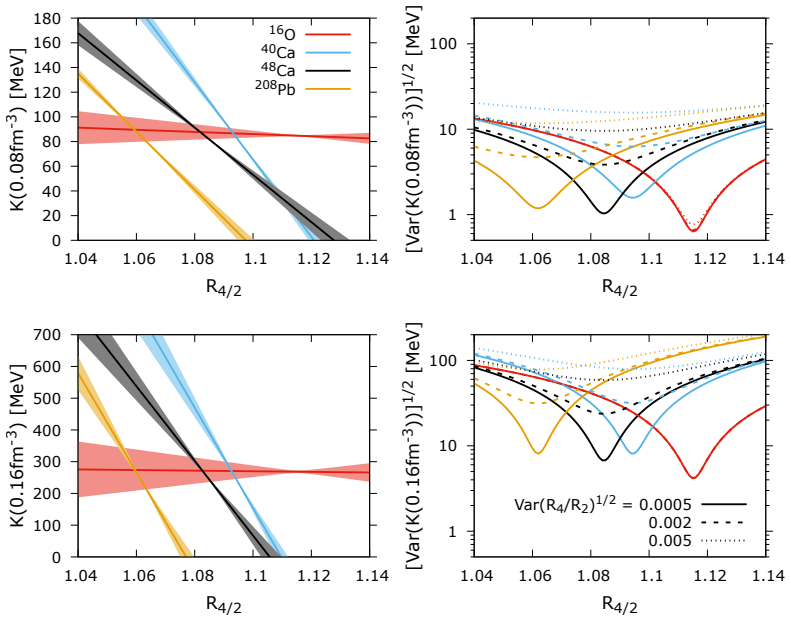
The paper establishes that the surface diffuseness of a nucleus—quantified by R4/2, the ratio of the fourth radial moment to the root-mean-square radius of the charge density—is largely set by the curvature of symmetric nuclear matter at subsaturation density, K(ρ) at ρ≈0.08 fm^-3, rather than by the compression modulus K0 at saturation density. Using charge densities computed from 100 Skyrme functionals, the authors find that the correlation between R4/2 and K(ρ) peaks at 0.07–0.09 fm^-3, with R4/2 more strongly anticorrelated with K than R2 is. They construct a linear estimator X̂ = α + β R2 + γ R4/2, fitted separately for each nucleus, and show that for 48Ca and 208Pb an experimental unce
What carries the argument
The ratio R4/2 = R4/R2, where R4 ≡ (⟨r^4⟩)^{1/4} and R2 ≡ (⟨r^2⟩)^{1/2} of the nuclear charge density, is the central observable. It is a measure of the surface thickness: in the Helm model of a homogeneous sphere folded with a Gaussian, R4/2 increases monotonically as the surface width grows relative to the core radius, interpolating between 1.0446 (sharp sphere) and 1.1362 (purely Gaussian). The quantitative workhorse is a multiple linear regression that expresses K(0.08 fm^-3) as a linear combination of R2 and R4/2 for a given nucleus, with coefficients determined from the 100 Skyrme functionals; the regression's covariance matrix supplies the uncertainty in the inferred curvature. A corr
Load-bearing premise
The 100 Skyrme functionals, plus the charge-form-factor prescription that converts point-proton densities to charge densities, span the space of real nuclear density distributions, so the fitted linear relation between R4/2 and K(0.08 fm^-3) remains valid outside that model set; the paper's own relativistic mean-field test shows this transferability is not yet established.
What would settle it
Measure R4/2 for 48Ca with uncertainty below 0.5% using high-precision electron scattering or muonic atom spectroscopy, and compare the K(0.08 fm^-3) inferred through the estimator with an independent determination from isoscalar giant monopole resonance data; a disagreement beyond the combined uncertainties would falsify the estimator's transferability. Alternatively, if adding a broad set of relativistic mean-field models to the fit destroys the correlation at 0.08 fm^-3, the central claim fails.
If this is right
- A sub-percent measurement of R4/2 from electron scattering or muonic atom data, combined with the precisely known R2, would constrain K(0.08 fm^-3) to 20 MeV or better for 48Ca and 208Pb.
- R4/2 can serve as a measured proxy for surface diffuseness, allowing soft and stiff energy density functionals to be discriminated by their predicted density tails.
- A constraint on K(0.08 fm^-3) of order 10 MeV would significantly narrow the low-density equation of state that determines neutron-star crust properties and the compression dynamics in heavy-ion collisions.
- For moderately neutron-rich nuclei, R4/2 correlates more strongly with K(ρ) than with the symmetry-energy parameters, so the same observable can isolate the isoscalar curvature without contamination from the symmetry energy.
Where Pith is reading between the lines
- The R4/2 ratio divides out the overall size, so many normalization and systematic uncertainties in the absolute radius may cancel; testing this cancellation explicitly could make the experimental extraction easier than the paper assumes.
- If the estimator were recalibrated on a model space that includes relativistic mean-field and ab initio densities, the same double-moment observable could become a nearly model-independent handle on low-density curvature—an opportunity the paper leaves implicit.
- The density where the correlation peaks (≈0.08 fm^-3) is close to the half-density crossing point of the calculated profiles; for very neutron-rich nuclei the crossing shifts and the symmetry energy may take over, suggesting the estimator's optimal density and observable should be chosen per nucleus.
- A direct differential test: measure R4/2 for 40Ca and 48Ca together; the paper predicts a more diffuse proton surface in 40Ca, consistent with existing empirical densities, so a precise ratio measurement would check the correlation without needing absolute form-factor normalization.
Editorial analysis
A structured set of objections, weighed in public.
Referee Report
Summary. The manuscript proposes that the fourth radial moment of the nuclear charge density, expressed through the ratio R_4/2 = R_4/R_2, is a practical observable for the curvature K(ρ) of the symmetric-matter energy per particle at sub-saturation densities. Using 100 Skyrme energy density functionals, the authors compute charge densities, the moments R_2 and R_4, and the density-dependent EoS parameters. They report strong Pearson and multiple correlations between K(ρ) and (R_2, R_4/2) near ρ ≈ 0.08 fm^-3, construct a linear estimator (Eq. 20), and estimate its uncertainty from the regression covariance and an assumed experimental error in R_4/2 (Eq. 21). The central claim is that a 0.5% measurement of R_4/2 in nuclei such as 48Ca or 208Pb would constrain K(0.08 fm^-3) to within 20 MeV or better. The estimator is validated in-sample (Fig. 6, full symbols) and compared with four relativistic mean-field models (open symbols), which show systematic deviations.
Significance. If the claim holds, the paper identifies a new experimental bridge between high-precision electron-scattering or muonic-atom determinations of higher radial moments and the nuclear EoS at subsaturation density. The statistical analysis is transparent: the authors provide explicit regression coefficients and a covariance matrix, propagate the dominant experimental uncertainty, and include an out-of-family RMF test, which is a strength even though it exposes the main weakness. The paper does not propose a new functional but a correlation-based estimator, so its value depends on the representativeness of the 100-Skyrme ensemble. The load-bearing assumption is that this ensemble spans the physically relevant model space; the RMF test shows that this assumption is not yet established.
major comments (3)
- [§4.5 (Fig. 6) and Eq. (21)] The headline uncertainty (<20 MeV, and 1–2 MeV in the optimistic limit) is computed only from the Skyrme regression covariance. Equation (21) contains no term for model-family mismatch. The out-of-sample RMF points in Fig. 6 (open symbols) show systematic offsets from the Skyrme-based estimator that are not captured by the quoted error bands. The statement that these RMF models reproduce empirical radii less accurately mitigates but does not quantify the problem; no radius-deviation threshold or model-mismatch estimate is given. Since the abstract and summary claim a practical constraint on K(0.08 fm^-3), the authors must either add a model-space systematic uncertainty (for example, calibrated on the RMF offset) or explicitly restrict the claim to the tested Skyrme functional space.
- [§4.3–§4.5, Eq. (20)] The estimator is trained and validated on the same 100 Skyrme functionals; the full symbols in Fig. 6 therefore demonstrate interpolation, not genuine prediction. The minimum uncertainty quoted in §4.4 and in the Summary (1–2 MeV) is the covariance of this in-sample fit. Please add a true out-of-sample check, such as leave-one-out or a holdout subset of the Skyrme ensemble, and report the resulting dispersion. This is particularly important because the linear functional form of Eq. (19) is an assumption; the residual scatter in Fig. 6 is characterized only as 'reasonable' and is not quantitatively compared with the fit's expected residual variance.
- [§4.5] Please specify whether the RMF densities were processed with the same charge form-factor prescription, Eqs. (3)–(4), used for the Skyrme functionals. If the RMF R_2 and R_4/2 values are taken from different conventions (for example, point-proton versus charge densities), part of the offset in Fig. 6 may be definitional rather than physical. If the same prescription was applied, state this explicitly. This clarification is necessary for interpreting the validation test.
minor comments (4)
- [Figure 2] The caption says 'Proton density profile', whereas the text and the vertical axis label refer to the charge density ρ_ch. Please make the caption consistent with the figure content.
- [§2.1] The 100 Skyrme interactions are described as 'representative', but no selection criterion is given. Please state whether all parameter sets from Ref. [15] satisfying some condition were used, or how the subset was chosen.
- [§4.4] The statement that 'a measurement of R_4/2 for any of these nuclei, regardless of its value, could give a prediction with an uncertainty of less than 20 MeV' is stronger than what Fig. 5 (right) shows, since the uncertainty depends on the actual R_4/2 value. Consider rephrasing to 'for the plotted range of R_4/2 values'.
- [Eq. (15)] The coefficient '9 t_3/24' in the expression for K(ρ) looks unusual; please double-check the algebra and notation, since a reader may otherwise suspect a typographical error in a central definition.
Circularity Check
The K(0.08)-from-R4/2 'prediction' is a within-Skyrme calibration; the Fig. 6 full-symbol validation is in-sample, and the RMF test shows family bias.
specific steps
-
fitted input called prediction
[Sec. 4.1, Eqs. (19)-(20); Sec. 4.5, Fig. 6]
"We determine these coefficients through a multivariate fit using the data sets {X(i), R(ν) 2 (i), R(ν) 4/2(i)} obtained from the Skyrme energy density functionals adopted in this work. ... Finally, Figure 6 serves as a validation test of the estimator defined in Eq. (20)."
Equation (20) is the inverse of the regression (19) whose coefficients were fit to the same 100 Skyrme triplets {K(0.08 fm^-3), R2, R4/2}. Thus the full-symbol agreement in Fig. 6 is an in-sample residual, not an independent confirmation. The quoted <20 MeV uncertainty (Eq. 21) is the fit covariance within this training manifold and does not include model-family mismatch. The open RMF symbols deviate from the diagonal, showing that the calibration is family-dependent; presenting the fitted mapping as a predictive constraint is therefore a fitted-input-called-prediction step.
full rationale
No load-bearing self-citation or definitional circularity is present: the Helm-model relation (Eq. 7) and the EoS definitions are standard, and the paper honestly labels the estimator as a fit. However, the central quantitative claim—that an R4/2 measurement to ~0.5% would constrain K(0.08 fm^-3) to <20 MeV—rests on Eq. (20), whose coefficients are obtained by regressing K(0.08 fm^-3) against R2 and R4/2 for the same 100 Skyrme models used in the 'validation' of Fig. 6. That validation is therefore in-sample by construction. The RMF models provide a genuine external check, and they do not follow the Skyrme-based estimator, so the claimed precision is conditioned on the Skyrme manifold being the relevant model space. This is a partial circularity: the prediction is the inverse of the fit, but the paper is transparent about the fit and explicitly frames the result as valid 'within the tested Skyrme functional space.' The remaining concern is model-space bias/correctness risk rather than definitional circularity.
Axiom & Free-Parameter Ledger
free parameters (2)
- Probe density ρ* =
0.08 fm^-3
- Regression coefficients (α, β, γ) per nucleus =
e.g., for 48Ca: α=2006.29 MeV, β=43.40 MeV/fm, γ=-1912.85 MeV
axioms (4)
- domain assumption The 100 Skyrme functionals surveyed (ref [15]) form a representative ensemble of the nuclear EDF space, and their spread in K(ρ), R2, R4/2 spans the physically plausible region.
- domain assumption K(ρ) of symmetric matter is the dominant EoS parameter controlling R4/2 in moderately neutron-rich nuclei.
- ad hoc to paper The linear regression form of Eq. (19) captures the relationship between K(ρ) and (R2, R4/2).
- domain assumption The charge form-factor prescription (Eq. 3), using standard proton/neutron Sachs form factors, correctly converts point-proton densities to charge densities.
read the original abstract
Recent experimental advances could soon allow the accurate extraction of not only the root-mean-square radius but also the fourth radial moment of the nuclear electric charge density distribution. The fourth radial moment of the nuclear density distribution, $R_4\equiv\sqrt[4]{\left<r^4\right>}$, provides a sensitive probe of the nuclear surface thickness, as it is more susceptible to the large-$r$ distributions than the root-mean-square radius ($R_2$). In this work, we examine the utility of $R_4$ for constraining the nuclear equation of state (EoS) at subsaturation densities, specifically for the proton distribution and within the framework of Skyrme energy density functionals. Using a statistical analysis based on predictions from one hundred Skyrme functional models, we demonstrate strong correlations between the energy per particle curvature $K(\rho)$ at $\rho = 0.08 \text{ fm}^{-3}$ and $R_4$ (or the ratio $R_{4/2}=R_4/R_2$) in representative nuclei such as $\text{}^{48}\text{Ca}$ and $\text{}^{208}\text{Pb}$. We establish that $R_{4/2}$, being sensitive to the density tail, serves as an efficient proxy for sub-saturation $K(\rho)$ within the tested Skyrme functional space. Knowledge of $R_{4/2}$ within 0.5\% precision or better, for example in $^{48}$Ca or $^{208}$Pb, could constrain the curvature of the energy per particle of symmetric matter at $0.08$ fm$^{-3}$ within 20 MeV or less.
Figures



Reference graph
Works this paper leans on
-
[1]
I. Sick, D. Trautmann, Proton root-mean-square radii and electron scattering, Phys. Rev. C 89 (1) (2014) 012201. arXiv:1407.1676, doi:10.1103/PhysRevC.89.012201
Pith/arXiv arXiv 2014
-
[2]
H. De Vries, C. De Jager, C. De Vries, Nuclear charge-density- distribution parameters from elastic electron scattering, Atomic Data and Nuclear Data Tables 36 (3) (1987) 495–536. doi:https://doi.org/10.1016/0092-640X(87)90013-1 . URL https://www.sciencedirect.com/science/article/ pii/0092640X87900131
arXiv 1987
-
[3]
D. Adhikari, et al., Accurate Determination of the Neutron Skin Thickness of 208Pb through Parity-Violation in Electron Scattering, Phys. Rev. Lett. 126 (17) (2021) 172502. arXiv: 2102.10767, doi:10.1103/PhysRevLett.126.172502
Pith/arXiv arXiv 2021
-
[4]
Adhikari, et al., Precision determination of the neutral weak form factor of48Ca, Phys
D. Adhikari, et al., Precision determination of the neutral weak form factor of48Ca, Phys. Rev. Lett. 129 (2022) 042501. doi:10.1103/PhysRevLett.129.042501. URL https: //link.aps.org/doi/10.1103/PhysRevLett.129.042501
-
[5]
Suda, Low-energy electron scattering for nucleons and exotic nuclei - ulq2 and scrit -, Nucl
T. Suda, Low-energy electron scattering for nucleons and exotic nuclei - ulq2 and scrit -, Nucl. Phys. A 1060 (2025) 123122. doi:https://doi.org/10.1016/j.nuclphysa.2025. 123122. URL https://www.sciencedirect.com/science/article/ pii/S0375947425001083
-
[6]
J. Liu, X. Liu, X. Wang, S. Wang, C. Xu, Z. Ren, Extraction of the second and fourth radial moments of nuclear charge density from the elastic electron-nucleus scattering, J. Phys. G 48 (12) (2021) 125105. arXiv:2108.11729, doi:10.1088/ 1361-6471/ac2cd5
Pith/arXiv arXiv 2021
-
[7]
P. G. Reinhard, W. Nazarewicz, R. F. Garcia Ruiz, Beyond the charge radius: the information content of the fourth radial moment, Phys. Rev. C 101 (2) (2020) 021301. arXiv:1911. 00699, doi:10.1103/PhysRevC.101.021301
-
[8]
T. Naito, G. Col` o, H. Liang, X. Roca-Maza, Second and fourth moments of the charge density and neutron-skin thickness of atomic nuclei, Phys. Rev. C 104 (2) (2021) 024316. arXiv:2101.07680, doi:10.1103/PhysRevC.104. 024316
Pith/arXiv arXiv 2021
-
[9]
H. H. Xie, J. Li, H. Liang, Extraction of higher-order radial moments of nuclear charge density from muonic atom spectroscopy, Phys. Rev. C 109 (2024) 034309. doi:10.1103/ PhysRevC.109.034309. URL https://link.aps.org/doi/10.1103/PhysRevC.109. 034309
- [10]
-
[11]
H. Kurasawa, T. Suda, T. Suzuki, The mean square radius of the neutron distribution and the skin thickness derived from electron scattering, Prog. Theor. and Exp. Phys. 2021 (1) (2020) 013D02. arXiv:https://academic.oup.com/ptep/ article-pdf/2021/1/013D02/36194161/ptaa177.pdf, doi: 10.1093/ptep/ptaa177. URL https://doi.org/10.1093/ptep/ptaa177
-
[12]
D. Andrae, Finite nuclear charge density distributions in electronic structure calculations for atoms and molecules, Physics Reports 336 (6) (2000) 413–525. doi:https://doi. org/10.1016/S0370-1573(00)00007-7 . URL https://www.sciencedirect.com/science/article/ pii/S0370157300000077
-
[13]
Blaizot, Nuclear compressibilities, Physics Reports 64 (4) (1980) 171–248
J. Blaizot, Nuclear compressibilities, Physics Reports 64 (4) (1980) 171–248. doi:https://doi.org/10.1016/ 0370-1573(80)90001-0 . URL https://www.sciencedirect.com/science/article/ pii/0370157380900010
arXiv 1980
-
[14]
M. Del Estal, M. Centelles, X. Vi˜ nas, Nuclear surface properties in relativistic effective field theory, Nuclear Physics A 650 (4) (1999) 443–468. doi:https://doi.org/ 10.1016/S0375-9474(99)00106-2 . URL https://www.sciencedirect.com/science/article/ pii/S0375947499001062
-
[15]
M. Dutra, O. Lourenco, J. S. Sa Martins, A. Delfino, J. R. Stone, P. D. Stevenson, Skyrme Interaction and Nuclear Matter Constraints, Phys. Rev. C 85 (2012) 035201. arXiv: 1202.3902, doi:10.1103/PhysRevC.85.035201
Pith/arXiv arXiv 2012
-
[16]
P. G. Reinhard, B. Schuetrumpf, J. A. Maruhn, The Axial Hartree–Fock + BCS Code SkyAx, Comput. Phys. Commun. 258 (2021) 107603. doi:10.1016/j.cpc.2020.107603
arXiv 2021
-
[17]
J. A. Maruhn, P.-G. Reinhard, P. D. Stevenson, J. R. Stone, M. R. Strayer, Dipole giant resonances in deformed heavy nuclei, Phys. Rev. C 71 (2005) 064328. doi:10.1103/ PhysRevC.71.064328. 12
2005
-
[18]
I. Angeli, K. P. Marinova, Table of experimental nuclear ground state charge radii: An update, Atom. Data Nucl. Data Tabl. 99 (1) (2013) 69–95. doi:10.1016/j.adt.2011.12.006
-
[19]
J. Friedrich, N. Voegler, The salient features of charge density distributions of medium and heavy even-even nuclei determined from a systematic analysis of elastic electron scattering form factors, Nucl. Phys. A 373 (1982) 192–224. doi:10.1016/0375-9474(82)90147-6
-
[20]
W. D. Myers, K.-H. Schmidt, An update on droplet-model charge distributions, Nucl. Phys. A 410 (1983) 61–73. doi: 10.1016/0375-9474(83)90401-3
-
[21]
P. Papakonstantinou, J. Margueron, F. Gulminelli, A. R. Raduta, Densities and energies of nuclei in dilute matter at zero temperature, Phys. Rev. C 88 (4) (2013) 045805. arXiv:1305.0282, doi:10.1103/PhysRevC.88.045805
Pith/arXiv arXiv 2013
-
[22]
X. Roca-Maza, N. Paar, Nuclear equation of state from ground and collective excited state properties of nuclei, Prog. Part. Nucl. Phys. 101 (2018) 96–176. arXiv:1804.06256, doi:10.1016/j.ppnp.2018.04.001
Pith/arXiv arXiv 2018
-
[23]
M. Centelles, X. Roca-Maza, X. Vi˜ nas, M. Warda, Nuclear symmetry energy probed by neutron skin thickness of nuclei, Phys. Rev. Lett. 102 (2009) 122502. doi:10.1103/ PhysRevLett.102.122502. URL https: //link.aps.org/doi/10.1103/PhysRevLett.102.122502
-
[24]
P. D. Allison, Multiple Regression: A Primer, Sage Publications, Thousand Oaks, CA, 1998
1998
-
[25]
R. J. Barlow, Statistics: A Guide to the Use of Statistical Methods in the Physical Sciences, 2nd Edition, John Wiley & Sons, Chichester, 1999
1999
-
[26]
Galassi, et al., GSL - GNU Scientific Library, accessed: December 30, 2024 (2021)
M. Galassi, et al., GSL - GNU Scientific Library, accessed: December 30, 2024 (2021). URL https://www.gnu.org/software/gsl/
2024
-
[27]
H. H. Xie, T. Naito, J. Li, H. Liang, Revisiting the extraction of charge radii of 40ca and 208pb with muonic atom spectroscopy, Physics Letters B 846 (2023) 138232. doi:https://doi.org/10.1016/j.physletb.2023.138232. URL https://www.sciencedirect.com/science/article/ pii/S037026932300566X
arXiv 2023
-
[28]
G. A. Lalazissis, J. Konig, P. Ring, A New parametrization for the Lagrangian density of relativistic mean field theory, Phys. Rev. C 55 (1997) 540–543. arXiv:nucl-th/9607039, doi:10.1103/PhysRevC.55.540
Pith/arXiv arXiv 1997
-
[29]
G. A. Lalazissis, S. Karatzikos, R. Fossion, D. Pena Arteaga, A. V. Afanasjev, P. Ring, The effective force NL3 revisited, Phys. Lett. B 671 (2009) 36–41. arXiv:0909.1432, doi: 10.1016/j.physletb.2008.11.070
Pith/arXiv arXiv 2009
-
[30]
Rashdan, Structure of exotic nuclei and superheavy elements in a relativistic shell model, Phys
M. Rashdan, Structure of exotic nuclei and superheavy elements in a relativistic shell model, Phys. Rev. C 63 (2001) 044303. doi:10.1103/PhysRevC.63.044303
-
[31]
M. Dutra, O. Louren¸ co, S. S. Avancini, B. V. Carlson, A. Delfino, D. P. Menezes, C. Providˆ encia, S. Typel, J. R. Stone, Relativistic Mean-Field Hadronic Models under Nuclear Matter Constraints, Phys. Rev. C 90 (5) (2014) 055203. arXiv:1405.3633, doi:10.1103/PhysRevC. 90.055203. 13
Pith/arXiv arXiv 2014
discussion (0)
Sign in with ORCID, Apple, or X to comment. Anyone can read and Pith papers without signing in.