REVIEW 3 major objections 4 minor 1 cited by
Polarization fractions and helicity-dependent CP asymmetries in $B_{(s)} \to \rho\rho, \rho K^\ast$ and $K^\ast K^\ast$ decays
T0 review · 3 major / 4 minor · reviewed 2026-08-01 · deepseek-v4-flash
Pith's one-line read A complete next-to-leading-order pQCD calculation for B decays to two vector mesons predicts polarization and helicity-dependent CP asymmetries that agree with data in almost all modes, but fails by a factor of roughly four in the longitudi
desk verdict A useful, honest pQCD benchmark paper that sharpens the B→VV polarization puzzle into precise targets, though the CP-asymmetry tension is less secure because a potentially relevant strong-phase source is assumed away. read the letter →
The pith
A machine-rendered reading of the paper's core claim, the machinery that carries it, and where it could break.
The reading
What carries the argument
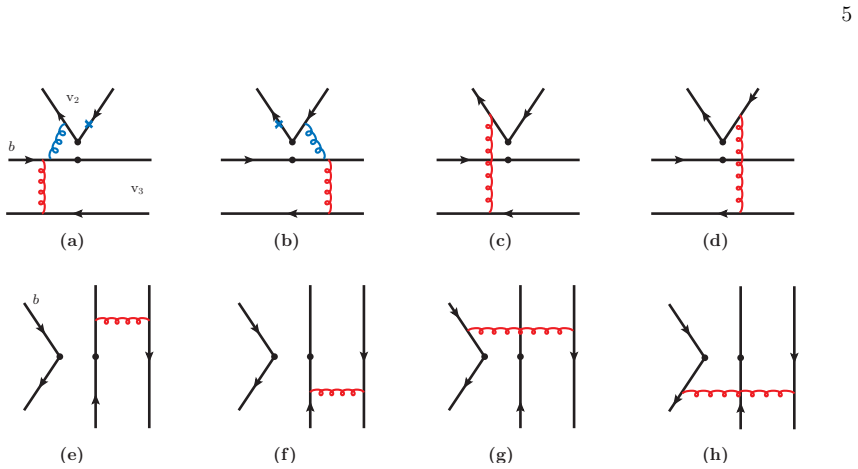
The central machinery is the pQCD factorization formula for the B→VV amplitude, a convolution of hard-scattering kernels with meson light-cone distribution amplitudes and Sudakov/threshold resummation factors, evaluated in the transversity basis of longitudinal, parallel, and perpendicular helicity amplitudes. Strong phases are generated by the interference of emission and annihilation topologies and by the on-shell charm-quark loop; the spectator Glauber phase is omitted. Two power corrections, proportional to the spectator-quark momentum fraction and the heavy-quark mass ratio, are included to fix the endpoint behavior. This machinery yields the full anatomy of branching fractions, polariz
What would settle it
A high-precision measurement of the longitudinal polarization fraction in the related decay B_s→K*^+K*^-: the paper predicts f0≈73%, so if the measured value comes out near 16%—similar to B_s→K*^0 Kbar*^0—it would confirm that penguin-dominated B_s modes generally have small longitudinal fractions and the discrepancy is systematic; if it remains near 70%, the anomaly is specific to the K*^0 Kbar*^0 final state and points to a U-spin-breaking or final-state-specific effect.
Extended reading notes
Core claim
The paper's central assertion is that a complete next-to-leading-order pQCD description of charmless two-body B decays into two vector mesons predicts polarization fractions and helicity-dependent CP asymmetries that are in good agreement with experiment for most modes, but deviates clearly in two penguin-dominated channels. For B_s→K*^0 Kbar*^0 the longitudinal polarization fraction is computed to be (60.4±5.4)%, while the measured value is (15.9±1.2)%; the resulting U-spin ratio, f0(B^0→K*^0 Kbar*^0)/f0(B_s→K*^0 Kbar*^0), is predicted to be 1.14±0.14, versus a measured 3.77±0.35, a deviation exceeding six standard deviations. For B^+→ρ^0 K*^+, the predicted direct CP asymmetry is (30.6_{-0
Load-bearing premise
The calculation assumes that the strong phases in the penguin-dominated decays come only from emission–annihilation interference and the on-shell charm quark loop, setting the Glauber-gluon contribution to the spectator amplitude to zero.
Editorial extensions
If this is right
- If the calculation is correct, the measured 16% longitudinal fraction in B_s→K*^0 Kbar*^0 cannot be accommodated by any current factorization-based approach, and the U-spin ratio of 3.77 rather than 1 implies U-spin breaking an order of magnitude larger than the expected O(m_s/Λ_QCD).
- The transverse helicity CP asymmetries provide a stronger test than branching fractions alone: the predicted sign flip in A⊥_CP for B^+→ρ^0 K*^+ means the sign and magnitude of strong phases in the penguin amplitudes need to be reconsidered.
- Because the predictions for B^0→K*^0 Kbar*^0 and B^+→ρ^0 K*^+ agree with experiment, the failures are channel-specific, isolating the spectator or annihilation dynamics in B_s→K*^0 Kbar*^0 and in the B^+→ρ^0 K*^+ penguin amplitudes.
- If the polarization in the related B_s→K*^+K*^- mode, predicted to have f0≈73%, follows the same pattern as B_s→K*^0 Kbar*^0, the discrepancy is broader; if it stays near 73%, the anomaly is specific to the K*^0 Kbar*^0 final state.
Reading between the lines
- The omitted Glauber-gluon phase is a natural place to look: if it shifts the direct CP asymmetry from 30% to 50% and flips the sign of the perpendicular component, the disagreement would dissolve without new physics; this can be tested by computing the Glauber phase explicitly for the penguin-dominated spectator amplitudes.
- A global fit that treats the spectator amplitude's strong phase as a free parameter could quantify how much phase is needed to bring both anomalies into agreement, and whether one universal phase fixes both or whether they require independent shifts.
- The B_s→K*^0 Kbar*^0 puzzle could be corroborated by measuring the same longitudinal fraction in B_s→ρ^0 ρ^0 or B_s→K*^-ρ^+, modes with similar penguin structure but different spectator quarks.
- Since the paper inherits its amplitudes from a previous global study, a natural extension is to let the size of the two power corrections float; the predictions likely depend sensitively on them, so an uncertainty estimate that treats them as pulls rather than fixed inputs would be more robust.
Signed reviews
Editorial analysis
A structured set of objections, weighed in public.
Referee Report
Summary. Using the kT-factorization pQCD framework with the amplitudes, NLO corrections, and input parameters inherited from the same group's Ref. [23], the paper computes branching fractions, polarization fractions, and helicity-dependent CP asymmetries for B_(s) -> rho rho, rho K*, K* K* decays. It compares each observable with PDG, HFLAV, LHCb, and Belle-II data, finding general agreement for branching fractions and for most longitudinal polarization fractions. Two headline tensions are identified: f0(Bs->K*0 Kbar*0) = (60.4 +/- 5.4)% versus LHCb (15.9 +/- 1.2)%, corresponding to a U-spin ratio U = 1.14 versus 3.77, and A_CP(B+ -> rho0 K*+) = 30.6% versus (50.7 +/- 6.4)%, with the predicted A^perp_CP = -15.1% opposite in sign to the measured +28.4 +/- 14.9%. The paper interprets these tensions as a polarization puzzle and as evidence that factorization-based approaches need additional non-factorizable contributions, possibly new physics.
Significance. If the numerical predictions are correct, the f0(Bs->K*0 Kbar*0) measurement is a striking challenge to all factorization-based approaches, not only to this pQCD implementation: Table III shows that QCDF, SCET, and FAT also predict a longitudinal fraction far above the LHCb value, making the U-spin ratio discrepancy a genuinely robust puzzle. The paper is also useful as a catalog of helicity-resolved predictions, and it reports the experimental comparisons honestly, including the transverse CP sign flip. However, the CP-asymmetry tension is less robust because it rests on an unquantified neglect of a strong-phase source (Section II), so the 3-4 sigma claim in Table IV is not yet a decisive falsification. The f_L(Bs) discrepancy could still support the paper's main conclusion even if the CP claim is softened.
major comments (3)
- [Section II, CP-violation paragraph; Table IV] The paper lists three sources of strong phases and then says that for the penguin-dominated channels under study 'we would not consider the third source of strong phase since it is make sense only for the color-suppressed decays'. This is an unsupported omission, and it is load-bearing for the claimed CP discrepancy. In Eq. (10), every A^lambda_CP depends on strong-phase differences; Table IV predicts A^perp_CP = -15.1% while LHCb finds +28.4 +/- 14.9%. A strong phase of order 10-20 degrees in the transverse amplitudes can move A_CP from 30.6% to 50.7% and can flip the sign of A^perp_CP. The quoted theoretical uncertainties in Table IV only reflect LCDA-parameter variation and do not include this source. Moreover, the sentence explicitly refers to B->rho0 K*0 and K*0 Kbar*0, while the CP discrepancy involves B+->rho0 K*+, whose tree topology is color-suppressed; under the paper's own log
- [Section III, opening paragraph; Tables I-IV] All amplitude expressions and all meson-LCDA input parameters are delegated to Ref. [23]: 'People can find the detail expressions ... in the comprehensive work [23]. The parameters choosing for meson LCDAs can also be found there.' The manuscript therefore contains no self-contained derivation of the numerical predictions, including the helicity-decomposed amplitudes that are the new focus of this paper. This is a serious reproducibility problem for the central quantitative claims. The authors should at least provide an appendix listing the key input parameters (B-meson inverse moment, Gegenbauer moments, hard-scale choices) and the relation between the helicity amplitudes used here and the topological amplitudes of Ref. [23], so that Tables I-IV can be independently checked.
- [Section III, paragraph after Table I; Tables III-IV] The quoted uncertainties are generated only by varying LCDA parameters, as stated explicitly ('the uncertainties ... are dominated by the first inverse moment of the B meson'). No variation of the renormalization/factorization scales, no variation of the two power-correction terms introduced in Section II, and no estimate of neglected final-state/Glauber phases are provided. Consequently, the statements that the U-spin ratio deviates 'by more than six standard deviations' (Table III) and that the CP asymmetry shows a '3-4 sigma' discrepancy (Table IV) overstate the significance of the comparison: they treat the data as the only source of uncertainty while the theory uncertainty is only partial. A short scan over hard scales and over the power-correction parameters is needed before either tension is promoted to a 'puzzle' or to evidence of new physics.
minor comments (4)
- [Throughout] The manuscript contains many typographical and grammatical errors: 'ougouing', 'facrtorizable', 'what we have seem', 'deduces totes', 'we are interesting here', and 'make sense only' should all be corrected. In addition, Table II entries such as the B+ -> rho0 rho+ row are difficult to read because of missing spacing in the numerical columns.
- [Table II] The LHCb row for B+ -> rho0 K*+ lists three numbers (49.1 +/- 8.7, 79.4 +/- 2.6, 72.0 +/- 2.9) but the table headings do not make clear whether these are f_+^0, f_-^0, f_0. A header or a note in the caption is needed.
- [Abstract and Table IV] The abstract quotes A0_CP(B+ -> rho0 K*+) = (66.4 +/- 8.3 +/- 2.9)%, while Table IV gives 66.4 +/- 8.4; the two presentations should be made consistent.
- [Eq. (7)] The transversity basis is introduced with A0, A_perp, A_parallel, but the text immediately before uses lambda = 0, perp, parallel. It would be clearer to define the ordering of the three components once, in one equation, and to use the same ordering in all tables.
Circularity Check
No significant circularity: the polarization fractions and helicity-dependent CP asymmetries are genuine pQCD outputs benchmarked against external LHCb/Belle-II/HFLAV/PDG data, not fitted inputs.
full rationale
The derivation is self-contained in the relevant sense: the target observables (f0, f_lambda, A_CP^lambda) are evaluated from the pQCD amplitudes via Eqs. (7)-(11), and the numerical inputs (Wilson coefficients, LCDAs, B-meson parameters) are inherited from the authors' previous comprehensive analysis [23] without being adjusted to the polarization/CP data compared here. The comparisons in Tables I-IV are against external LHCb [19,21], Belle-II [20], HFLAV [31], and PDG [30] measurements, which were not used to tune the constants reported here, so no fitted-input-called-prediction pattern is present. The only potentially load-bearing self-citation, Ref. [23], supplies the published amplitude decomposition and parameter choices; this is ordinary reuse of an independently published framework rather than an unverified theorem invoked to force the conclusion, and the paper explicitly reports the residual tensions (f0(Bs->K*0Kbar*0), A_CP(B+->rho0K*+)) as discrepancies rather than defining them away. The assumption to omit Glauber strong phases in penguin-dominated modes (Section II, 'CP-violation' paragraph: 'we would not consider the third source of strong phase since it is make sense only for the color-suppressed decays') is a stated physical limitation, not a definitional reduction: it does not equate any predicted observable to an input by construction, and the paper's quoted uncertainties do not conceal the omission. No circular step can be exhibited from the text.
Assumptions & free parameters
free parameters (2)
- B-meson LCDA first inverse moment (ω_b or 1/λ_B) =
not stated in this paper; value and error inherited from Ref. [23]
- Meson LCDA Gegenbauer moments (ρ, K*, ρ^0 at twist-2/3) =
not stated; chosen in Ref. [23]
assumptions (4)
- domain assumption kT factorization with Sudakov and threshold resummation reliably suppresses soft long-distance contributions
- domain assumption The full amplitude set (factorizable/spectator/annihilation emission, quark-loop and chromomagnetic penguin functions) is exactly as given in the same group's Ref. [23]; all parameters are as chosen there
- domain assumption Glauber-gluon strong phase is negligible for the penguin-dominated modes studied
- domain assumption U-spin breaking between the B0 and Bs K*0K̄*0 amplitudes is modest, O(ms/ΛQCD)
Cite this review
Pith. "Pith review of Polarization fractions and helicity-dependent CP asymmetries in $B_{(s)} \to \rho\rho, \rho K^\ast$ and $K^\ast K^\ast$ decays." pith.science (2026). https://pith.science/paper/2CZMWKNT
@misc{pith2026260722093,
  author       = {Pith},
  title        = {Pith review of: Polarization fractions and helicity-dependent CP asymmetries in $B_(s) \to \rho\rho, \rho K^\ast$ and $K^\ast K^\ast$ decays},
  year         = {2026},
  howpublished = {\url{https://pith.science/paper/2CZMWKNT}},
  note         = {Machine review of arXiv:2607.22093}
}
abstract
In this paper, we present a phenomenological analysis of $B_{(s)} \to \rho\rho, \rho K^\ast$ and $K^\ast K^\ast$ decays using state-of-the-art perturbative QCD (pQCD) calculations. Our study is primarily motivated by recent polarization measurements from the LHCb and Belle II collaborations, which have significantly improved the precision of polarization fractions and enabled the first full determination of polarization-dependent CP asymmetries. This work extends the comprehensive pQCD study of charmless two-body $B$ decays reported in our previous paper [Chin. Phys. C 46 (2022) 123103], with a particular focus on polarization observables, especially the CP asymmetries in each helicity state, which reflect distinct orbital angular momentum configurations between the two vector mesons. Our predictions for the branching ratios and longitudinal polarization fractions in the $B^0 \to K^{\ast 0} {\bar K}^{\ast 0}$ and $B^+ \to \rho^0 K^{\ast +}$ modes are in good agreement with the new experimental data. However, the calculated longitudinal polarization fraction for $B_s \to K^{\ast 0} {\bar K}^{\ast 0}$ is significantly larger than the LHCb measurement. Moreover, the predicted (helicity-dependent) CP asymmetries in $B^+ \to \rho^0 K^{\ast +}$ are about $30 \%$ smaller than the observed values. These discrepancies point to a rich interplay between different topological amplitudes, highlighting the need for further theoretical investigation to resolve the long-standing polarization puzzle in two-body $B$ decays into vector mesons.
Figures


Forward citations
Cited by 1 Pith paper
-
Anomalies in Hadronic $B \to VV$ Decays
Charmless B→VV decays under SU(3)_F show 5.2σ tension for ρ,K* modes and >7σ when ϕ and ω are included, while isospin-only ρK* fits remain acceptable.
Reference graph
Works this paper leans on
-
[23]
J. Chai, S. Cheng, Y. h. Ju, D. C. Yan, C. D. Lü and Z. J. Xiao, Chin. Phys. C46(2022) no.12, 123103
2022
-
[1]
Gambino, A
P. Gambino, A. S. Kronfeld, M. Rotondo, C. Schwanda, F. Bernlochner, A. Bharucha, C. Bozzi, M. Calvi, L. Cao and G. Ciezarek,et al.Eur. Phys. J. C80, no.10, 966 (2020)
2020
-
[2]
Cerriet al.,CERN Yellow Rep
A. Cerriet al.,CERN Yellow Rep. Monogr.7, 867-1158 (2019)
2019
-
[3]
Kouet al.[Belle-II], PTEP2019, 123C01 (2019) [erratum: PTEP2020, 029201 (2020)]
E. Kouet al.[Belle-II], PTEP2019, 123C01 (2019) [erratum: PTEP2020, 029201 (2020)]
2019
-
[4]
J. G. Korner and G. R. Goldstein, Phys. Lett. B89, 105-110 (1979)
1979
-
[5]
Wirbel, B
M. Wirbel, B. Stech and M. Bauer, Z. Phys. C29, 637 (1985)
1985
-
[6]
Bauer, B
M. Bauer, B. Stech and M. Wirbel, Z. Phys. C34, 103 (1987)
1987
-
[7]
A. Ali, G. Kramer, Y. Li, C. D. Lu, Y. L. Shen, W. Wang and Y. M. Wang, Phys. Rev. D76(2007), 074018
2007
Show all 32 references
-
[8]
C. H. Chen, Y. Y. Keum and H. n. Li, Phys. Rev. D66, 054013 (2002)
2002
-
[9]
H. n. Li and S. Mishima, Phys. Rev. D71, 054025 (2005)
2005
-
[10]
Z. T. Zou, A. Ali, C. D. Lu, X. Liu and Y. Li, Phys. Rev. D91(2015), 054033
2015
-
[11]
D. C. Yan, X. Liu and Z. J. Xiao, Nucl. Phys. B935(2018), 17-39
2018
-
[12]
Beneke, J
M. Beneke, J. Rohrer and D. Yang, Nucl. Phys. B774, 64-101 (2007)
2007
-
[13]
H. Y. Cheng and C. K. Chua, Phys. Rev. D80, 114008 (2009)
2009
-
[14]
C. Wang, S. H. Zhou, Y. Li and C. D. Lu, Phys. Rev. D96, no.7, 073004 (2017)
2017
-
[15]
D. C. Yan, H. n. Li, Z. Rui, Z. J. Xiao and Y. Li, Eur. Phys. J. C85, no.4, 444 (2025)
2025
-
[16]
Y. Li, D. C. Yan, Z. Rui and Z. J. Xiao, Eur. Phys. J. C81, no.9, 806 (2021)
2021
-
[17]
Colangelo, F
P. Colangelo, F. De Fazio and T. N. Pham, Phys. Lett. B597, 291-298 (2004)
2004
-
[18]
H. Y. Cheng, C. K. Chua and A. Soni, Phys. Rev. D71, 014030 (2005)
2005
-
[19]
Aaijet al.[LHCb], Phys
R. Aaijet al.[LHCb], Phys. Rev. Lett.136(2026) no.2, 021803
2026
-
[20]
Adachiet al.[Belle-II], Phys
I. Adachiet al.[Belle-II], Phys. Rev. D111, no.9, 092001 (2025)
2025
-
[21]
Aaijet al.[LHCb], Phys
R. Aaijet al.[LHCb], Phys. Rev. D113(2026) no.9, 092002
2026
-
[22]
Choudhury, S
D. Choudhury, S. Kumbhakar, A. Kundu and S. Nandi, Phys. Rev. D114, no.1, 015019 (2026)
2026
-
[24]
H. n. Li, Y. L. Shen and Y. M. Wang, Phys. Rev. D85, 074004 (2012)
2012
-
[25]
Cheng, Y
S. Cheng, Y. Y. Fan, X. Yu, C. D. Lü and Z. J. Xiao, Phys. Rev. D89, no.9, 094004 (2014)
2014
-
[26]
Beneke, G
M. Beneke, G. Buchalla, M. Neubert and C. T. Sachrajda, Nucl. Phys. B591, 313-418 (2000)
2000
-
[27]
Beneke, G
M. Beneke, G. Buchalla, M. Neubert and C. T. Sachrajda, Nucl. Phys. B606, 245-321 (2001)
2001
-
[28]
Beneke and M
M. Beneke and M. Neubert, Nucl. Phys. B675, 333-415 (2003)
2003
-
[29]
X. Liu, H. n. Li and Z. J. Xiao, Phys. Rev. D91, no.11, 114019 (2015)
2015
-
[30]
Takahashiet al.[Particle Data Group], Int
F. Takahashiet al.[Particle Data Group], Int. J. Mod. Phys. A 41, 2630011 (2026). 14
2026
-
[31]
Banerjeeet al.[Heavy Flavor Averaging Group (HFLAV)], Phys
S. Banerjeeet al.[Heavy Flavor Averaging Group (HFLAV)], Phys. Rev. D113, no.1, 012008 (2026)
2026
-
[32]
C. Wang, Q. A. Zhang, Y. Li and C. D. Lu, Eur. Phys. J. C77(2017) no.5, 333
2017
Reviewed August 1, 2026 · model on record in the stance chip above.
Discussion (0). Continue with ORCID to comment.