REVIEW 3 major objections 5 minor 65 references
A spectator model with single-gluon final-state interaction yields analytic expressions and nonzero values for all six leading-twist T-odd gluon TMDs in a tensor-polarized deuteron.
Reviewed by Pith at T0; open to challenge. T0 means a machine referee read the full paper against a public rubric. the ladder, T0–T4 →
T0 review · grok-4.5
2026-07-30 15:44 UTC pith:HNUK6YTS
load-bearing objection Solid first model baseline for six T-odd gluon TMDs of a tensor-polarized deuteron; analytics are usable, but the g1LT/g1TT numbers ride on a κ2 that the fit barely constrains. the 3 major comments →
T-odd transverse momentum dependent gluon distributions for tensor polarized deuteron in a spectator model
The pith
A machine-rendered reading of the paper's core claim, the machinery that carries it, and where it could break.
Core claim
Inside the stated spectator model with single-gluon final-state interaction and a continuous spectator-mass spectral function, all six leading-twist T-odd gluon TMDs of a tensor-polarized deuteron admit a universal integral representation whose coefficient functions are fully analytic, take nonzero numerical values at Q0 = 2 GeV, satisfy the positivity bounds, and approximately obey the g2-vanishing relations among f⊥1T, h1 and h⊥1T.
What carries the argument
The one-loop gluon-gluon correlator that includes a single soft-gluon exchange between spectator and outgoing parton; after Cutkosky cuts on the eikonal and spectator lines it collapses to the universal transverse-momentum integral of Eq. (33) whose analytic coefficients C[F]ijk are catalogued in Appendix A.
Load-bearing premise
The authors set the spectator-gluon-spectator vertex identical in Lorentz structure to the deuteron-gluon-spectator vertex, so that f-type and d-type T-odd TMDs differ only by a fixed color factor of 9/5.
What would settle it
A measurement or independent calculation of the relative normalization of f-type versus d-type T-odd gluon TMDs that deviates from the constant 9/5, or a finding that g1LT and g1TT stay large when the g2 form factor is suppressed, would falsify the model's central vertex identification.
If this is right
- The six T-odd gluon TMDs have magnitudes large enough to matter for polarized-deuteron measurements proposed at electron-ion colliders and fixed-target experiments.
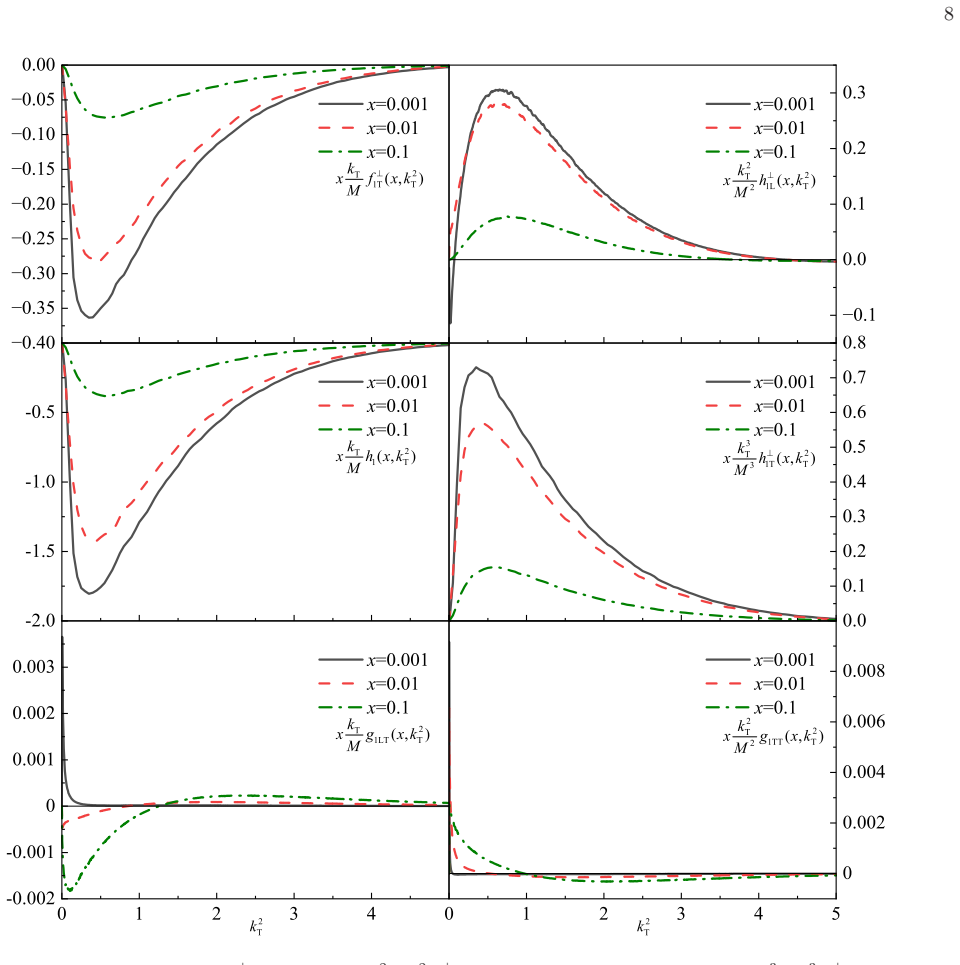
- When the g2 coupling is set to zero, three of the functions collapse to the model relations f⊥1T = (1/5)h1 = −(kT²/2M²)h⊥1T.
- The kT profiles are non-Gaussian, develop long tails, and acquire nodes at large kT, offering distinctive experimental signatures.
- All computed distributions satisfy the model-independent positivity bounds, so they can serve as consistent input for phenomenological TMD analyses.
Where Pith is reading between the lines
- Because g1LT and g1TT vanish identically without the g2 form factor, those two functions are the cleanest experimental handles on whether the assumed vertex structure is realistic.
- The same spectator-plus-spectral-function setup, already fixed by the unpolarized gluon PDF, can be reused without new parameters for higher-twist or quark T-odd TMDs in the deuteron.
- If data confirm the predicted sign pattern (negative f⊥1T, h1, g1TT; positive h⊥1L, h⊥1T, g1LT), the analytic forms supply ready-made functional ansätze for global extractions.
Editorial analysis
A structured set of objections, weighed in public.
Referee Report
Summary. The manuscript computes the six leading-twist T-odd gluon TMDs of a tensor-polarized deuteron (f⊥1T, h⊥1L, h1, h⊥1T, g1LT, g1TT) in a spectator model. An on-shell deuteron emits an off-shell gluon; the recoiling system is treated as an on-shell vector spectator whose mass is sampled from a spectral function ρ(MS) (Eq. 35). The T-odd phase is generated by single-gluon-exchange final-state interactions, implemented via Cutkosky cuts on the eikonal and spectator propagators (Eqs. 30-31). All six TMDs reduce to a universal integral structure (Eq. 33) with analytic coefficient functions collected in Appendix A. Numerical results at Q0 = 2 GeV use parameters inherited from the authors' earlier T-even fit to the nNNPDF1.0 unpolarized gluon f1(x), with a 100-replica uncertainty treatment and verification of the positivity bounds of Appendix B. Under the assumption that the spectator-gluon-spectator vertex equals the deuteron vertex, f-type and d-type TMDs differ only by the color factor 9/5 (Eq. 21). The derivation appears careful and internally consistent; my concerns concern the statistical security of the numerical claims and the scoping of the vertex-identification assumption.
Significance. This is, to my knowledge, the first complete leading-twist T-odd gluon TMD calculation for a spin-1 hadron with fully analytic results. Specific strengths: (i) the coefficient functions C[F]ijk are given in closed form (Appendix A, Eqs. A1-A46), allowing independent verification and reuse; (ii) the T-odd distributions are genuine outputs of the loop calculation — no parameter is fitted to them — so the signs and magnitudes are falsifiable model predictions; (iii) the model-independent positivity bounds (Appendix B) are checked and the replica-based uncertainty bands are shown. The results are directly relevant to tensor-polarized deuteron programs at EIC/JLEIC, COMPASS, NICA, and LHC-spin, where no baseline for these functions currently exists. The model dependence (spectral function, vertex identification) is intrinsic to this approach and is partly acknowledged.
major comments (3)
- [Sec. III / Fig. 2 / Table II] Sec. III, Fig. 2, Table II, and Eq. (33): the T-odd TMDs scale as gs κiκjκk — cubic in the vertex couplings — while the only external constraint on the κ's is the inherited T-even fit to f1(x), which is quadratic in κ's. Table II gives κ2 = 0.334 ± 0.303, consistent with zero at ~1.1σ, yet g1LT and g1TT vanish identically at κ2 = 0 (Sec. II, discussion of Eq. 34), and all central curves use replica 60, whose κ2 = 0.149 is less than half the ensemble mean. The sign statements in Sec. III ('xf⊥1T, xh1, xg1TT negative... over the full x range') therefore appear to be statements about replica 60 only, and their stability across the 100-replica ensemble is nowhere reported. Since sign flips of κ's across replicas propagate directly into sign flips of T-odd distributions, the authors should report, per panel of Fig. 2, the fraction of replicas with definite sign and whether the 68% bandcludes
- [Sec. II, Eqs. (20)-(21)] Eqs. (20)-(21), Sec. II: the identification Yf,d = Y of the spectator-gluon-spectator vertex with the deuteron-gluon-spectator vertex is load-bearing for two distinct outputs: (i) the f/d color-factor ratio 9/5, which converts all presented f-type numbers into d-type 'predictions', and (ii) the absolute normalization of every TMD, most sensitively g1LT and g1TT, which depend strongly on the g2 form factor. The assumption is stated as being 'for simplicity' and is not independently constrained; the conclusion defers a proper treatment to future work. This is acceptable as a model limitation, but the manuscript should scope its claims accordingly: an explicit caveat is needed where the numerical results are first presented (opening of Sec. III) and in the abstract, stating that d-type magnitudes and the g2-sensitive TMDs are conditional on this identification. A crude sensitivity estimate
- [Sec. III / Eq. (34)] Sec. III, paragraph following Fig. 2, and Eq. (34): the statement that xf⊥1T, xh1, and xh⊥1T 'approximately satisfy the relation in Eq. (34)' is presented as a consistency check, but the relations are exact only at κ2 = 0 and the check is performed only with replica 60, whose κ2 (0.149) is less than half the ensemble mean (0.334). As shown, the check is largely circular: of course a small-κ2 replica approximately satisfies the g2-vanishing relations. To make this a genuine verification, the authors should quantify the deviation (e.g., the ratio of the two sides of Eq. 34 as a function of x) and demonstrate how the violation grows with κ2 across the replica ensemble, or restrict the statement to the small-κ2 regime with a numerical bound on the correction.
minor comments (5)
- [Fig. 3] Fig. 3 caption vs. text: the caption states x = 0.001, 0.02, 0.1 while the text (Sec. III) states x = 10^{-3}, 10^{-2}, 10^{-1}. Please reconcile 0.02 vs 0.01.
- [Various] Typographical: 'Sec. III,.' (Sec. I); 'a implicit summation' (after Eq. 6); 'The final-state interaction required... are implemented' (abstract); 'for all values of x values considered' (Sec. III); 'play a increasingly dominant role' (Sec. I); 'mide-right' in both figure captions; Table II header 'Central column:mean values'.
- [Sec. III] The strong coupling is fixed to gs = sqrt(1.2 pi), i.e. alpha_s(Q0) = 0.3; please state alpha_s explicitly and comment briefly on the sensitivity of the moments to this choice, since all T-odd TMDs are linear in gs (Eq. 33).
- [Sec. IV] A short remark on TMD evolution from Q0 = 2 GeV to experimental scales would help readers assess the phenomenological reach of Figs. 2-3, even if evolution is left to future work.
- [Table II] For self-containedness, please summarize the quality of the inherited fit (chi^2, and the correlation of kappa_2 with kappa_1, kappa_3) from Ref. [29], which is currently only 'to appear'.
Circularity Check
Mild parameter inheritance from authors' prior T-even fit; T-odd analytic results are independent loop outputs, not circular.
specific steps
-
self citation load bearing
[Sec. III, Table II, citation [29]]
"The model parameters, previously determined from a fit to the nNNPDF1.0 parametrization for the integrated T-even gluon unpolarized TMD f1(x) at the low scale Q0 = 2 GeV in Ref. [29], are listed in Tab. II."
Numerical T-odd moments inherit the full parameter set (κ1,2,3, ΛS, spectral {A,B,a,b,C,D,σ}) from the authors' own prior T-even fit rather than from an external or re-fitted constraint. This is mild circularity of numerics only: the analytic T-odd expressions do not depend on that fit, and the fitted quantity (f1) is not the predicted quantity (T-odd TMDs).
full rationale
The paper's central content is a one-loop spectator-model calculation of six T-odd gluon TMDs (Cutkosky cuts on the eikonal and spectator lines, projection operators Eqs. 24–29, universal integral Eq. 33, full C[F]ijk in Appendix A). Those analytic expressions do not reduce to the inputs by construction: tree-level T-odd amplitudes vanish, and the imaginary phase is generated by the FSI diagram. Model parameters (κi, ΛS, spectral-function set) were fixed in the authors' prior T-even paper by fitting the integrated unpolarized f1(x) to nNNPDF1.0 and are reused unchanged (Sec. III, Tab. II, citation [29]). That is ordinary parameter inheritance and a self-citation, not a definitional loop: the fitted observable is T-even and quadratic in the couplings, while the T-odd TMDs are cubic loop outputs and were never fitted. The g2-vanishing relations (Eq. 34) and the f-/d-type color factor 9/5 (Eq. 21) are model-dependent consequences of stated simplifications (Yf,d=Y), not smuggled uniqueness theorems. Positivity bounds (Appendix B) are checked a posteriori, not imposed as inputs. No self-definitional identity, no 'prediction' that is the fit by construction, and no load-bearing uniqueness imported from the authors. Score 2 reflects one non-load-bearing self-citation for numerics; the derivation chain itself is self-contained.
Axiom & Free-Parameter Ledger
free parameters (4)
- κ1, κ2, κ3 (deuteron-gluon-spectator couplings) =
mean 0.713±0.604, 0.334±0.303, 15.56±6.06 (Table II)
- ΛS (form-factor cutoff) =
1.34±0.18 GeV (Table II)
- spectral-function parameters {A,B,a,b,C,D,σ} =
means in Table II (e.g. A=138±141, D=1.19±0.55, σ=0.683±0.226)
- gs (strong coupling at Q0) =
√(1.2 π) at Q0=2 GeV
axioms (6)
- domain assumption An on-shell deuteron can be represented as emitting a time-like off-shell gluon plus a single on-shell spectator whose mass is distributed by a spectral function ρ(MS).
- domain assumption Non-vanishing T-odd TMDs are generated solely by single soft-gluon exchange between spectator and outgoing gluon, evaluated with Cutkosky cuts on the eikonal and spectator lines.
- domain assumption The deuteron–gluon–spectator vertex admits the three-form-factor decomposition of Eq. (18) with exponential k² dependence (Eq. 19).
- ad hoc to paper Spectator–gluon–spectator vertices Yf and Yd are identical in Lorentz structure to the deuteron vertex, so f- and d-type TMDs differ only by the color factor 9/5.
- standard math Gauge-link path is future-pointing [+,+], yielding Weizsäcker–Williams (f-type) TMDs; past-pointing paths flip the sign of T-odd functions.
- domain assumption Model parameters determined by fitting T-even f1 to nNNPDF1.0 at Q0=2 GeV remain valid for T-odd observables at the same scale.
invented entities (1)
-
Continuous spectator-mass spectral function ρ(MS) of the mixed background-plus-Gaussian form (Eq. 35)
no independent evidence
read the original abstract
We present a model calculation of the T-odd transverse momentum dependent distribution functions (TMDs) for gluons inside a tensor polarized deuteron. The model is built on the assumption that an on-shell deuteron can emit a time-like off-shell gluon, with the residual system treated as a single on-shell spectator particle. The spectator mass is described via a spectral function, which allows it to take real values over a continuous range. The final-state interaction required to generate nonvanishing T-odd functions are implemented via single-gluon exchange between the spectator and the outgoing parton. We derive analytical expressions for six T-odd gluon TMDs, and present numerical results characterizing their dependence on the longitudinal momentum fraction $x$ and the transverse momentum $\bm{k}_T$.
Figures


Reference graph
Works this paper leans on
-
[1]
Here, gs is the strong coupling constant
The gluon-gluon correlator can be written as: Φij (x, kT ; S, T ) = 1 xP + 1 (2π)3 1 2 (1 − x) P + ǫµ′∗ (P, λ) ǫµ (P, λ) × Giβ∗ aa′ (k, k) Y ∗ µ′ν′β,a′b′ (P − k/2, k) × ǫ∗ν b (P − k, λS) ǫν′ b′ (P − k, λS) (gsnγ −f dac) × ∫ d4l (2π)4 −iX bde σ2νγ (P − k − l/2, l) l2 − m2 g −i l+ + iε × i ( −gσ1σ2 + (P − k − l)σ1 (P − k − l)σ2 /M2 S ) (P − k − l)2 − M 2 S ...
-
[2]
( A1), ( A3), ( A5), ( A8) C[h⊥ 1L] ijk = 4M 2(1 − x)(k2 T l2 T − (lT · kT )2)(k2 T + lT · kT )(k2 T (l2 T + lT · kT ) + lT · kT (M 2(1 − x)2 − M 2 S)) C[f ⊥ 1T ] ijk
Propeller function h⊥ 1L When the coupling constant κ2 is set to zero, or ijk = {111, 333, 113, 131, 311, 133, 313, 331}, we can obtain C[h⊥ 1L] ijk by using C[f ⊥ 1T ] ijk in Eqs. ( A1), ( A3), ( A5), ( A8) C[h⊥ 1L] ijk = 4M 2(1 − x)(k2 T l2 T − (lT · kT )2)(k2 T + lT · kT )(k2 T (l2 T + lT · kT ) + lT · kT (M 2(1 − x)2 − M 2 S)) C[f ⊥ 1T ] ijk . (A11) T...
-
[3]
is replaced by −iddac, where ddac is the symmetric SU(3) structure constant. The difference between correlators with future- pointing [+,+] and past-pointing [ −,−] color paths (and between [+, −] and [ −,+] paths) manifests as a sign flip of the + iε term in Eq. ( 17). Under this transformation, T-odd gluon TMDs change sign (i.e., [+,+]= −[−,−], [+,−]=−[−,...
-
[4]
(A10) 12
Sivers function f ⊥ 1T C[f ⊥ 1T ] 111 =3(1 − x) ( lT · kT + k2 T )( l2 T + 2M 2 S )[ lT · kT ( k2 T + M 2(x − 1)2 − M 2 S ) + k2 T l2 T ]( 4π3xk2 T M 4 S )−1 , (A1) C[f ⊥ 1T ] 222 = − 3 [ k2 T l2 T ( l2 T ( −2(x − 1)k2 T − M 2x(x − 1)2 + x(2x − 1)M 2 S ) + M 2 S ( ((x − 2)x + 2)k2 T + (x − 2)x ( M 2(x − 1)2 − M 2 S ))) + (lT · kT ) 2( 2l2 T ( (1 − 2x)k2 T...
-
[5]
LT polarized helicity function g1LT Since g1LT depends on the coupling constant κ2, the number of nonvanishing terms for g1LT are significantly smaller than those of vector polarized gluon TMDs. C[g1LT ] 222 =3 { k2 T l2 T ( l2 T ( M 2(x − 1)2 − M 2 S ) − M 2 S ( k2 T − M 2(x − 1)2 + M 2 S )) + (lT · kT )2 ( 2l2 T ( k2 T + M 2(x − 1)2 − 2M 2 S ) + M 2 S ( ...
-
[6]
( A1), ( A3), ( A5), ( A8) and the relation of Eq
Linearity function h1 When the coupling constant κ2 is set to zero, or ijk = {111, 333, 113, 131, 311, 133, 313, 331}, we can obtain C[h1] ijk by using C[f ⊥ 1T ] ijk in Eqs. ( A1), ( A3), ( A5), ( A8) and the relation of Eq. ( 34) C[h1] ijk = 5 C[f ⊥ 1T ] ijk . (A18) Then, C[h1] 222 = − 3 { k4 T l2 T ( M 2 S ( (x(3x − 7) + 10)k2 T + 3x ( 2xl2 T + M 2(x −...
-
[7]
( A1), ( A3), ( A5), ( A8) and the relation of Eq
Butterfly function h⊥ 1T When the coupling constant κ2 is set to zero, or ijk = {111, 333, 113, 131, 311, 133, 313, 331}, we can obtain C[h⊥ 1T ] ijk by using C[f ⊥ 1T ] ijk in Eqs. ( A1), ( A3), ( A5), ( A8) and the relation of Eq. ( 34) C[h⊥ 1T ] ijk = − 2M 2k2 T C[f ⊥ 1T ] ijk . (A25) Then, C[h⊥ 1T ] 222 =3M 2(1 − x) { k4 T l2 T ( k2 T ( 2l2 T + (x + 2)...
-
[8]
A. Metz and J. Zhou, Phys. Rev. D 84 (2011), 051503 doi:10.1103/PhysRevD.84.051503 [arXiv:1105.1991 [hep- ph]]
Pith/arXiv arXiv 2011
-
[9]
TT polarized worm-gear function g1T T When ijk = {312, 322, 332, 213, 223, 233}, we can obtain C[g1T T ] ijk by using C[g1LT ] ijk in Eqs. ( A34), ( A36), ( A38): C[g1T T ] {312,322,332} = 2M 2(x − 1) k2 T + M 2 S − M 2(1 − x)2 C[g1LT ] {312,322,332} , (A40) C[g1T T ] {213,223,233} = 2(k2 T + lT · kT )M 2(x − 1) k2 T ((kT + lT )2 − M 2(1 − x)2 + M 2 S) C[...
-
[10]
S. J. Brodsky, F. Fleuret, C. Hadjidakis and J. P. Lansberg, Phys. Rept. 522 (2013), 239-255 doi:10.1016/j.physrep.2012.10.001 [arXiv:1202.6585 [hep- ph]]
Pith/arXiv arXiv 2013
-
[11]
D. Boer and C. Pisano, Phys. Rev. D 86 (2012), 094007 doi:10.1103/PhysRevD.86.094007 [arXiv:1208.3642 [hep- ph]]
Pith/arXiv arXiv 2012
-
[12]
A. Signori, Few Body Syst. 57 (2016) no.8, 651-655 doi:10.1007/s00601-016-1102-4 [arXiv:1602.03405 [hep- ph]]
Pith/arXiv arXiv 2016
-
[13]
W. J. den Dunnen, J. P. Lansberg, C. Pisano and M. Schlegel, Phys. Rev. Lett. 112 (2014), 212001 doi:10.1103/PhysRevLett.112.212001 [arXiv:1401.7611 [hep-ph]]
Pith/arXiv arXiv 2014
-
[14]
D. Boer, M. Diehl, R. Milner, R. Venugopalan, W. Vogel- sang, D. Kaplan, H. Montgomery, S. Vigdor, A. Accardi and E. C. Aschenauer, et al. [arXiv:1108.1713 [nucl-th]]
-
[15]
C. Pisano, D. Boer, S. J. Brodsky, M. G. A. Buff- ing and P. J. Mulders, JHEP 10 (2013), 024 doi:10.1007/JHEP10(2013)024 [arXiv:1307.3417 [hep- ph]]
Pith/arXiv arXiv 2013
-
[16]
A. Dumitru, T. Lappi and V. Skokov, Phys. Rev. Lett. 115 (2015) no.25, 252301 doi:10.1103/PhysRevLett.115.252301 [arXiv:1508.04438 [hep-ph]]
Pith/arXiv arXiv 2015
-
[17]
corresponds to final-state interactions between the spectator and the outgoing gluon, with a future-pointing closed path ([+,+]). The gluon TMDs extracted from this correlator are called Weizs¨ acker- Williams (WW) gluon TMDs, or f -type gluon TMDs, 4 as the eikonal vertex Feynman rule involves the antisym- metric structure constants f dac of the color gau...
-
[18]
S. Abeyratne, A. Accardi, S. Ahmed, D. Barber, J. Bisog- nano, A. Bogacz, A. Castilla, P. Chevtsov, S. Cor- neliussen and W. Deconinck, et al. [arXiv:1209.0757 [physics.acc-ph]]
-
[19]
S. Abeyratne, D. Barber, A. Bogacz, P. Brindza, Y. Cai, A. Camsonne, A. Castilla, P. Chevtsov, E. Daly and Y. S. Derbenev, et al. [arXiv:1504.07961 [physics.acc- ph]]
-
[20]
J. Ball, J. M. Le Goff, A. Magnon, C. Marchand, G. Baum, F. Gautheron, N. Doshita, S. Goertz, J. Heck- mann and C. Hess, et al. Czech. J. Phys. 56 (2006), F295- F305
2006
-
[21]
R. Jakob, P. J. Mulders and J. Rodrigues, Nucl. Phys. A 626, 937-965 (1997) [arXiv:hep-ph/9704335 [hep-ph]]
Pith/arXiv arXiv 1997
-
[22]
S. J. Brodsky, D. S. Hwang and I. Schmidt, Phys. Lett. B 530, 99-107 (2002) [arXiv:hep-ph/0201296 [hep-ph]]
Pith/arXiv arXiv 2002
-
[23]
L. P. Gamberg, G. R. Goldstein and K. A. Oganessyan, Phys. Rev. D 67, 071504 (2003) [arXiv:hep-ph/0301018 [hep-ph]]
Pith/arXiv arXiv 2003
-
[24]
A. Bacchetta, A. Schaefer and J. J. Yang, Phys. Lett. B 578, 109-118 (2004) [arXiv:hep-ph/0309246 [hep-ph]]
Pith/arXiv arXiv 2004
-
[25]
A. Bacchetta, F. Conti and M. Radici, Phys. Rev. D 78 (2008). [arXiv:0807.0323 [hep-ph]]
Pith/arXiv arXiv 2008
-
[26]
A. Bacchetta, M. Radici, F. Conti and M. Guagnelli, Eur. Phys. J. A 45, 373-388 (2010) [arXiv:1003.1328 [hep-ph]]
Pith/arXiv arXiv 2010
-
[27]
Z. Lu and B. Q. Ma, Phys. Rev. D 70, 094044 (2004) [arXiv:hep-ph/0411043 [hep-ph]]
Pith/arXiv arXiv 2004
-
[28]
S. Meissner, A. Metz, M. Schlegel and K. Goeke, JHEP 08, 038 (2008) [arXiv:0805.3165 [hep-ph]]
Pith/arXiv arXiv 2008
-
[29]
Z. L. Ma, J. Q. Zhu and Z. Lu, Phys. Rev. D 101, no.11, 114005 (2020) [arXiv:1912.12816 [hep-ph]]
Pith/arXiv arXiv 2020
-
[30]
A. Bacchetta, L. P. Gamberg, G. R. Goldstein and A. Mukherjee, Phys. Lett. B 659, 234-243 (2008) [arXiv:0707.3372 [hep-ph]]
Pith/arXiv arXiv 2008
-
[31]
Z. Lu and B. Q. Ma, Phys. Rev. D 94, no.9, 094022 (2016) [arXiv:1611.00125 [hep-ph]]
Pith/arXiv arXiv 2016
-
[32]
A. Bacchetta, F. G. Celiberto, M. Radici and P. Taels, Eur. Phys. J. C 80 (2020). [arXiv:2005.02288 [hep-ph]]
Pith/arXiv arXiv 2020
-
[33]
A. Bacchetta, F. G. Celiberto and M. Radici, PoS EPS- HEP2021, 376 (2022) [arXiv:2111.01686 [hep-ph]]
Pith/arXiv arXiv 2022
-
[34]
A. Bacchetta, F. G. Celiberto and M. Radici, PoS P ANIC2021, 378 (2022) [arXiv:2111.03567 [hep-ph]]
Pith/arXiv arXiv 2022
-
[35]
A. Bacchetta, F. G. Celiberto and M. Radici, [arXiv:2402.17556 [hep-ph]]
- [36]
- [37]
-
[38]
X. Xie, D. Y. Chen and Z. Lu, to appear in Physical Review D, [arXiv:2603.15224 [hep-ph]]. 24
-
[39]
A. Bacchetta, R. Kundu, A. Metz and P. J. Mulders, Phys. Lett. B 506 (2001), 155-160 doi:10.1016/S0370- 2693(01)00388-4 [arXiv:hep-ph/0102278 [hep-ph]]
Pith/arXiv arXiv 2001
-
[40]
A. Bacchetta, R. Kundu, A. Metz and P. J. Mulders, Phys. Rev. D 65 (2002), 094021 doi:10.1103/PhysRevD.65.094021 [arXiv:hep- ph/0201091 [hep-ph]]
arXiv 2002
-
[41]
L. P. Gamberg, G. R. Goldstein and K. A. Oganessyan, Phys. Rev. D 68 (2003), 051501 doi:10.1103/PhysRevD.68.051501 [arXiv:hep- ph/0307139 [hep-ph]]
arXiv 2003
-
[42]
A. Bacchetta, A. Metz and J. J. Yang, Phys. Lett. B 574 (2003), 225-231 doi:10.1016/j.physletb.2003.09.005 [arXiv:hep-ph/0307282 [hep-ph]]
Pith/arXiv arXiv 2003
-
[43]
D. Amrath, A. Bacchetta and A. Metz, Phys. Rev. D 71 (2005), 114018 doi:10.1103/PhysRevD.71.114018 [arXiv:hep-ph/0504124 [hep-ph]]
Pith/arXiv arXiv 2005
-
[44]
Z. Lu and I. Schmidt, Phys. Lett. B 747 (2015), 357-364 doi:10.1016/j.physletb.2015.06.011 [arXiv:1501.04379 [hep-ph]]
Pith/arXiv arXiv 2015
-
[45]
Y. Yang, Z. Lu and I. Schmidt, Phys. Lett. B 761 (2016), 333-339 doi:10.1016/j.physletb.2016.08.053 [arXiv:1607.01638 [hep-ph]]
Pith/arXiv arXiv 2016
-
[46]
A. Bacchetta and P. J. Mulders, Phys. Rev. D 62 (2000), 114004 doi:10.1103/PhysRevD.62.114004 [arXiv:hep-ph/0007120 [hep-ph]]
Pith/arXiv arXiv 2000
-
[47]
P. J. Mulders and J. Rodrigues, Phys. Rev. D 63 (2001), 094021 doi:10.1103/PhysRevD.63.094021 [arXiv:hep-ph/0009343 [hep-ph]]
Pith/arXiv arXiv 2001
-
[48]
S. Meissner, A. Metz and K. Goeke, Phys. Rev. D 76 (2007), 034002 doi:10.1103/PhysRevD.76.034002 [arXiv:hep-ph/0703176 [hep-ph]]
Pith/arXiv arXiv 2007
-
[49]
D. Boer, S. Cotogno, T. van Daal, P. J. Mulders, A. Signori and Y. J. Zhou, JHEP 10 (2016), 013 doi:10.1007/JHEP10(2016)013 [arXiv:1607.01654 [hep- ph]]
Pith/arXiv arXiv 2016
-
[50]
M. G. A. Buffing, M. Diehl and T. Kasemets, JHEP 01 (2018), 044 doi:10.1007/JHEP01(2018)044 [arXiv:1708.03528 [hep-ph]]
Pith/arXiv arXiv 2018
-
[51]
D. Boer, P. J. Mulders, C. Pisano and J. Zhou, JHEP 08 (2016), 001 doi:10.1007/JHEP08(2016)001 [arXiv:1605.07934 [hep-ph]]
Pith/arXiv arXiv 2016
-
[52]
C. J. Bomhof, P. J. Mulders and F. Pijlman, Eur. Phys. J. C 47 (2006), 147-162 doi:10.1140/epjc/s2006-02554-2 [arXiv:hep-ph/0601171 [hep-ph]]
Pith/arXiv arXiv 2006
-
[53]
M. G. A. Buffing, A. Mukherjee and P. J. Mul- ders, Phys. Rev. D 88 (2013), 054027 doi:10.1103/PhysRevD.88.054027 [arXiv:1306.5897 [hep-ph]]
Pith/arXiv arXiv 2013
-
[54]
R. G. Arnold, C. E. Carlson and F. Gross, Phys. Rev. C 21 (1980), 1426 doi:10.1103/PhysRevC.21.1426
-
[55]
S. J. Brodsky and J. R. Hiller, Phys. Rev. D 46 (1992), 2141-2149 doi:10.1103/PhysRevD.46.2141
-
[56]
J. L. Zhang, Chin. Phys. C 49 (2025) no.4, 043104 doi:10.1088/1674-1137/adab61 [arXiv:2409.19525 [hep- ph]]
Pith/arXiv arXiv 2025
- [57]
-
[58]
J. Collins, Camb. Monogr. Part. Phys. Nucl. Phys. Cos- mol. 32 (2011), 1-624 Cambridge University Press, 2011, ISBN 978-1-009-40184-5, 978-1-009-40183-8, 978-1-009- 40182-1 doi:10.1017/9781009401845
-
[59]
S. Cotogno, T. van Daal and P. J. Mulders, JHEP 11 (2017), 185 doi:10.1007/JHEP11(2017)185 [arXiv:1709.07827 [hep-ph]]
Pith/arXiv arXiv 2017
-
[60]
J. Maxwell, D. Crabb, D. Day, W. Detmold, R. Jaffe, M. Jones, C. Keith, D. Keller, D. Meekins and R. Milner, et al. [arXiv:1803.11206 [nucl-ex]]
-
[61]
Keller [SpinQuest], [arXiv:2205.01249 [nucl-ex]]
D. Keller [SpinQuest], [arXiv:2205.01249 [nucl-ex]]
-
[62]
A. Arbuzov, A. Bacchetta, M. Butenschoen, F. G. Ce- liberto, U. D’Alesio, M. Deka, I. Denisenko, M. G. Echevarria, A. Efremov and N. Y. Ivanov, et al. Prog. Part. Nucl. Phys. 119 (2021), 103858 doi:10.1016/j.ppnp.2021.103858 [arXiv:2011.15005 [hep-ex]]
arXiv 2021
-
[63]
C. A. Aidala, A. Bacchetta, M. Boglione, G. Bozzi, V. Carassiti, M. Chiosso, R. Cimino, G. Ciullo, M. Con- talbrigo and U. D’Alesio, et al. [arXiv:1901.08002 [hep- ex]]
Pith/arXiv arXiv 1901
-
[64]
R. Abdul Khalek, A. Accardi, J. Adam, D. Adamiak, W. Akers, M. Albaladejo, A. Al-bataineh, M. G. Alexeev, F. Ameli and P. Antonioli, et al. Nucl. Phys. A 1026 (2022), 122447 doi:10.1016/j.nuclphysa.2022.122447 [arXiv:2103.05419 [physics.ins-det]]
arXiv 2022
-
[65]
D. P. Anderle, V. Bertone, X. Cao, L. Chang, N. Chang, G. Chen, X. Chen, Z. Chen, Z. Cui and L. Dai, et al. Front. Phys. (Beijing) 16 (2021) no.6, 64701 doi:10.1007/s11467-021-1062-0 [arXiv:2102.09222 [nucl - ex]]
Pith/arXiv arXiv 2021
discussion (0)
Sign in with ORCID, Apple, or X to comment. Anyone can read and Pith papers without signing in.