REVIEW 4 major objections 8 minor 70 references
Reframing the coupling force of adaptive resolution simulation in terms of the Liouville-type hierarchy for open systems
T0 review · 4 major / 8 minor · reviewed 2026-07-31 · grok-4.5
Pith's one-line read A large part of the AdResS thermodynamic force is the missing average force from the open-system Liouville hierarchy, given by a one-dimensional integral.
desk verdict Clean derivation of the open-boundary average force plus a practical minimal-box recipe for AdResS thermodynamic force; the F_th≈F_av claim near AT/Δ is useful but only partly stress-tested. read the letter →
The pith
A machine-rendered reading of the paper's core claim, the machinery that carries it, and where it could break.
The reading
What carries the argument
The average boundary force F^x_av(r_∂)=πρ(r_∂^{2}I_0-I_2) derived from the hierarchy source term Ψ_n; it supplies both the physical identification of the thermodynamic force and the parameter-independence statements used for simplification and validation.
What would settle it
Compute the iterated thermodynamic force and the integral F_av on the same grid for a supercritical Lennard-Jones fluid; if they disagree throughout the half of the Δ region nearest the AT/Δ boundary, or if particle-crossing fluctuations and the measured average force through that boundary deviate from a full-atomistic reference, the claim is false.
Extended reading notes
Core claim
Near the AT/Δ boundary the thermodynamic force of AdResS is the missing average force through the Δ/TR interface, F_th(x)=F^x_av(x_Δ/TR-x), where F^x_av is the explicit one-dimensional integral πρ(r_∂^{2}I_0-I_2) obtained by marginalising the open-system Liouville hierarchy for a simple atomistic fluid.
Load-bearing premise
The residual artifact force from excluded-volume overlap, thermostat residuals and thermodynamic mismatch must fade inside the transition region before it reaches the atomistic boundary; if it does not, the force-hierarchy identification fails.
Editorial extensions
If this is right
- The thermodynamic force near the open-system boundary is completely fixed by density, temperature, pair potential and distance to the outer interface.
- Force iteration can be performed in a minimal box with no atomistic region and reduced transverse dimensions, then transferred unchanged to a production run.
- Validation reduces to interfacial observables (one-body density, Maxwellian momenta, net crossing statistics, average force) that do not require a large AT domain.
- The same integral supplies an a-priori initial guess that already matches the converged force near the boundary.
Reading between the lines
- The same integral construction should extend, with only technical changes, to multi-site molecules or multi-component mixtures once the appropriate pair correlations are supplied.
- Because the force is independent of thermostat strength and capping radius near the boundary, one can systematically weaken or localize the thermostat without re-deriving the thermodynamic force.
- The derived potential of mean force offers a natural starting point for time-dependent or non-equilibrium AdResS reservoirs whose target density and temperature vary slowly.
Signed reviews
Editorial analysis
A structured set of objections, weighed in public.
Referee Report
Summary. The manuscript reinterprets the thermodynamic (coupling) force of adaptive resolution simulations (AdResS) through the Liouville-type hierarchy for open systems. Starting from the marginalized Liouville equation, the authors identify the average force through the open system's boundary (Eq. 7), and for a simple homogeneous fluid with a planar boundary reduce it to a one-dimensional integral, F^x_av(r_∂) = πρ(r_∂²I_0 − I_2) (Eqs. 23–25), with a corresponding potential (Eq. 27). They then argue that in AdResS the thermodynamic force must reintroduce precisely this missing average force through the Δ/TR interface, and hypothesize (Eq. 30) that F_th(x) = F^x_av(x_{Δ/TR} − x) on [x_{AT/Δ}, x_fade], up to a residual F̂(x;γ,r_cap) assumed to fade within Δ. This yields parameter-dependence predictions (Tab. II), a proposed 'minimal' AdResS setup without an AT region for computing F_th, and new interface-local validation criteria (boundary density, Maxwell-Boltzmann momenta, particle-crossing statistics, average force through AT/Δ). Simulations of supercritical LJ fluids at three states with three box setups show that converged F_th from minimal/no-AT/complete boxes collapse, agree with the a priori F_av near AT/Δ, and pass the proposed validations against a full-AT reference. The analytical derivation is transparent and, in my reading, correct: ρ⁽²⁾=ρ²g(r) is exact in the bulk, the angular integration in Eq. (22) is right, and Eq. (27) is consistent with F=+dV/dr_∂. The load-bearing,
Significance. If the central identification holds, the paper provides (i) a closed one-dimensional integral (Eq. 25) for the missing average force, derived without free parameters from g(r) and V, which can serve as an a priori initial guess for the thermodynamic-force iteration; (ii) testable parameter-independence predictions (Tab. II) with practical value — notably the demonstration that a 'minimal' AdResS box with no AT region suffices to compute the thermodynamic force and reproduce correct boundary statistics; and (iii) new validation criteria tied to the reservoir-coupling terms of the hierarchy rather than bulk AT-region observables. The work also supplies reproducible code: simulation scripts in a public MRMD fork with pinned commit, plus the GhostFace and MRMDAnalysis packages with pinned commits. The conceptual link it draws — the thermodynamic force as the mean-field reintroduction of the average force through the Δ/TR interface — is a useful reframing that clarifies which artifacts the force must and must not compensate. These are solid contributions to the AdResS/open-systems literature provided the empirical identification is properly controlled.
major comments (4)
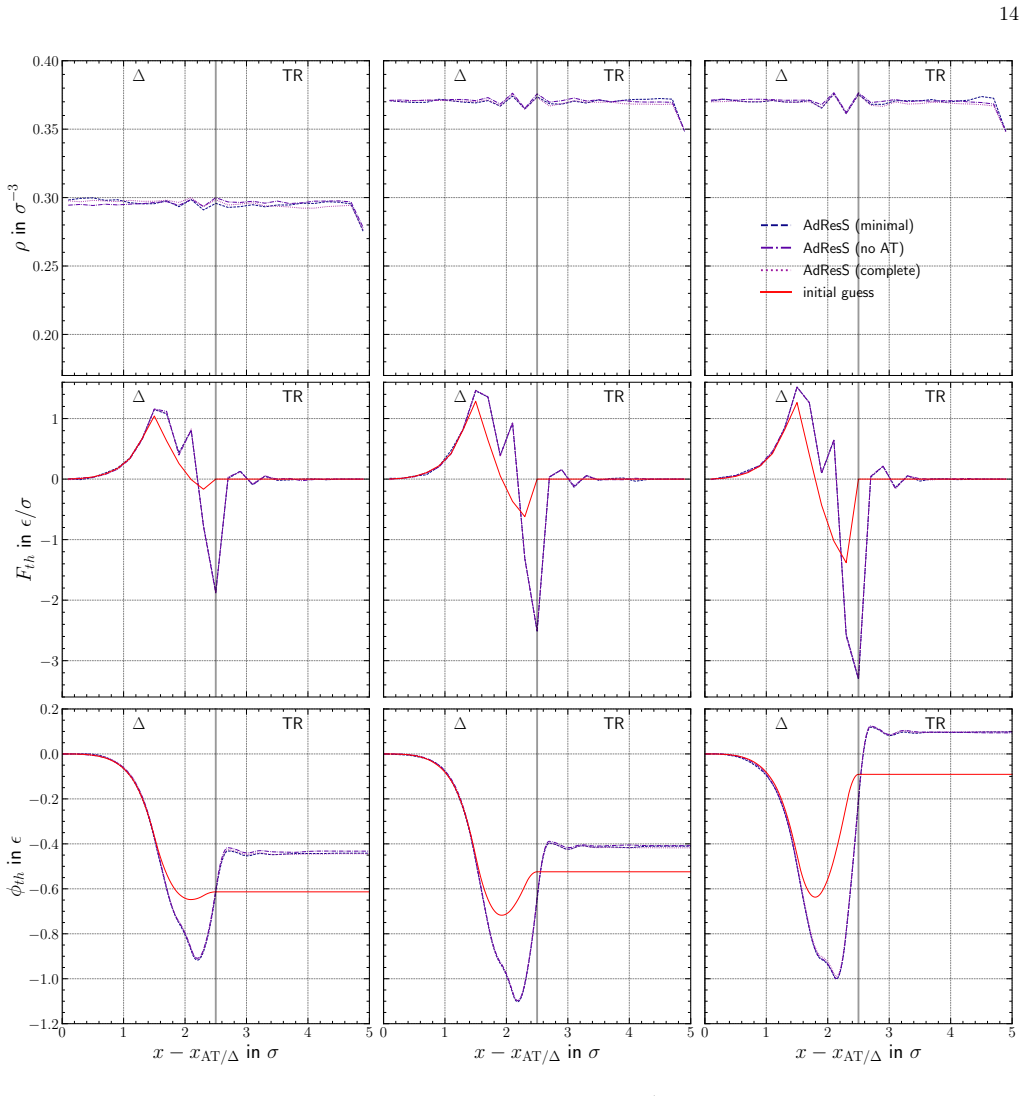
- [§IIIC, Eq. (30); §IVC, Fig. 6] Eq. (30), §IIIC and §IVC/Fig. 6: the central empirical claim F_th(x)=F_av(x_{Δ/TR}−x) near AT/Δ is supported by agreement between the converged iterated force and the a priori integral — but F_av (via Goldman's g(r)) was the iteration's initial guess F^0_th in Eq. (3). Near AT/Δ that guess already produces a flat density, so the correction −c∇ρ is small precisely where agreement is claimed, giving the iteration little mechanism to move away from F_av there. The decisive control — iterations started without the initial guess — is asserted in one sentence in §IVC ('converged to the same result') with no figure, no x-range, and no tolerance. This control exists (the runs were performed) and should be shown. Note that Fig. 6 does show the iteration moving substantially away from the initial guess within 1σ of Δ/TR, so the iteration is demonstrably not inert; a quantitative comparison of seed
- [§IVC, Figs. 5–6] Related to the above: no error norm is reported for the agreement in the region x_AT/Δ ≤ x ≤ x_fade. From Fig. 5, F_av at the AT/Δ boundary is ≲0.5 ϵ/σ versus a ~2 ϵ/σ peak near Δ/TR (L_Δ = r_cut forces F_av(x_AT/Δ)=0), so the agreement band lies where both functions are small and smoothly decaying; two such functions can agree 'very well' while hiding a residual F̂ comparable to the local force magnitude. Please report a relative residual |F_th−F_av|/|F_th| (or an L2 norm) over the claimed interval, and use it to give a quantitative estimate of x_fade, which currently is never determined from data.
- [§IVD, Fig. 7] §IVD (and the Conclusions): the statement that 'close to the AT/∆ boundary, the only artifact left to compensate is the missing average force' is stronger than what the validation shows. The three criteria in Fig. 7 (momentum distribution, rescaled crossing statistics, measured average force through AT/Δ against the full-AT reference) establish that the *combined* action of thermostat, capping, and F_th reproduces the correct boundary statistics, i.e. Eq. (28)/(11). They do not, by themselves, establish the decomposition Eq. (29) with F̂→0. This is genuinely independent, unseeded evidence for boundary consistency and should be credited as such — but the text should distinguish it from evidence for the identification F_th=F_av itself, which rests only on the seeded comparison in Fig. 6.
- [§IIID, Table II] §IIID and Table II: the parameter-independence predictions are a principal selling point, but coverage is limited to L_y,z and L_AT. Independence of γ is directly testable with the existing setup and is arguably the most consequential untested entry: the theory predicts it because F_av is momentum-independent, yet the simulations use a *global* Langevin thermostat with the rather strong γ=20τ⁻¹, and §IVD itself flags that the global thermostat may affect crossing statistics. One or two additional iteration runs at different γ (and/or r_cap) would substantially strengthen Tab. II and the claim that F̂(x;γ,r_cap) is what fades rather than something the thermostat is masking.
minor comments (8)
- [§IVA] §IVA: the three thermodynamic states are described as '(1) low density and low temperature, (2) high density and high temperature and (3) high density and high temperature'; state (2) should presumably read 'high density and low temperature' per Table IV.
- [Table IV, Appendix A] Table IV and Appendix A: densities are printed as '0.296σ³'/'0.370σ³'; the exponent should be −3 (σ⁻³) as elsewhere in the manuscript.
- [Table VI, §IVC, Appendix A] Table VI lists 'niter 7/10' and Appendix A states n_iter=10 with convergence at iteration 7; §IVC says the procedure was 'stopped once... sufficiently flat' at the 7th iteration. Please clarify whether iterations 8–10 were run and discarded, and state the actual numerical flatness tolerance used as the stopping criterion ('sufficiently flat' and 'prescribed tolerance' in §IIA are never quantified).
- [§IIIA, Appendix A] §IIIA, first paragraph: 'the conditional probability density in Eq. 7' should read 'Eq. (7)'; 'Morsali et. al' in Appendix A should be 'Morsali et al.'
- [Fig. 5] Fig. 5: the x-axis is shifted by x_AT/Δ while the caption text discusses distances 'greater than 1σ away from the Δ/TR interface'; since x_{Δ/TR}−x_{AT/Δ}=2.5σ, readers must mentally re-shift. Marking the 1σ-from-Δ/TR position or stating the offset explicitly would help.
- [Fig. 7, Appendix B] Fig. 7, second row: the rescaling of the crossing distributions for the minimal box uses the factor L1/L2=20/30 from Eq. (B19); this is stated only implicitly. Please state the applied factor and the number of snapshots/windows entering each distribution so the reader can assess statistical uncertainty of the rescaled curves.
- [Appendix B] Appendix B is a careful but lengthy derivation of the standard CLT rescaling of Gaussian distributions; it could be condensed substantially (the result Eq. (B19) is the only part used), improving readability without loss of rigor.
- [§IIID] §IIID, item on r_cap independence: the argument that g(r)=0 in the capped repulsive region renders the integral insensitive to r_cap is plausible but is an assumption about g(r) at the simulated states; a one-line reference to a measured g(r) inside r_cap (e.g., from the equilibration runs) would close it.
Circularity Check
Mostly non-circular: F_av is an independent integral; F_th is still the density-flattening iterate. Mild concern only that F_av was the iteration seed in the region where agreement is claimed.
-
fitted input called prediction
[§IIIC Eq. (30); §IVB–C and Fig. 6]
"F_th(x)=F^x_av(x_Δ/TR−x), for x_AT/Δ≤x≤x_fade≤x_Δ/TR. ... Using the a priori approximation to the thermodynamic force as initial guess, we performed the iterative procedure of Eq. (3). ... In the Δ region close to the AT/Δ boundary, the thermodynamic forces are indeed in very good agreement with the a priori calculated initial guess ... We observed that, compared to the thermodynamic force iterations carried out without initial guess, the initial guess spared only one iteration and converged to the same result."
Eq. (30) is the central identification claimed from the hierarchy. Empirically it is checked by comparing the converged iterate to the same F_av that was used as F^0_th. Near AT/Δ the seeded force already produces a flat density, so the correction −c∇ρ is small precisely where agreement is advertised; the match is therefore partly protected by the seed. The paper asserts a zero-seed control in one sentence with no figure, range, or tolerance, so that control does not fully break the dependence. This is a mild, local issue about the independence of the empirical check—not a definitional collapse of F_th into F_av.
full rationale
The load-bearing analytical chain (marginalized Liouville source term → conditional two-point density for a simple fluid → planar angular reduction → one-dimensional integral F^x_av = πρ(r_∂²I_0 − I_2)) is self-contained equilibrium statistical mechanics and does not define F_th. The thermodynamic force remains the standard iterative object F^{k+1}_th = F^k_th − c∇ρ^k; F_av enters only as an a-priori initial guess and as a post-hoc comparison target. Parameter-independence claims (no AT region, reduced L_y,z) are checked by running distinct box geometries to the same iterate and by full-AT interface diagnostics (Maxwell–Boltzmann momenta, rescaled crossing fluctuations, measured F_av through AT/Δ) that are not inputs to the force iteration. Self-citations to the authors’ prior Liouville-hierarchy and AdResS papers supply the frameworks being connected; they do not force Eq. (30). The only mild circularity-adjacent issue is empirical: agreement of converged F_th with F_av near AT/Δ is reported after seeding the iteration with F_av, in the band where F_av is already small and −c∇ρ has little room to move the force; the zero-seed control is asserted in one sentence without data. That weakens the strength of the empirical support for ˆF → 0 but does not make F_th = F_av by construction. Score 2.
Assumptions & free parameters
free parameters (4)
- convergence prefactor c (forcemod) =
2ε/ρ
- density bin width =
0.2σ
- force application region appmax =
r_AT/Δ + 4.5σ
- Langevin gamma and r_cap =
gamma=20 τ^{-1}, r_cap≈0.824σ
assumptions (6)
- domain assumption Global thermal equilibrium of the universe so that f^0_{k|i} factorizes into equilibrium one- and two-particle densities times Maxwellians (Eqs. 12–15).
- domain assumption Simple atomistic fluid: homogeneous isotropic ρ^{(1)}=ρ, ρ^{(2)}=ρ²g(r), pair potential V(r) only.
- domain assumption Open-system Liouville hierarchy reservoir models: influx f_in from independent reservoir single-particle density or grand-canonical form (Eqs. 9–10), and average force Ψ_n via conditional reservoir density (Eqs. 6–7).
- domain assumption Planar AT/Δ and Δ/TR interfaces with integration domain Ω^c=[x_∂,∞)×R², so only the normal component of F_av survives.
- ad hoc to paper ˆF fades by some x_fade in Δ so F_th(x)=F^x_av(x_Δ/TR−x) on [x_AT/Δ,x_fade] (Eq. 30).
- standard math Standard Liouville equation and marginalization to open subsystem; classical pair-force MD.
Cite this review
Pith. "Pith review of Reframing the coupling force of adaptive resolution simulation in terms of the Liouville-type hierarchy for open systems." pith.science (2026). https://pith.science/paper/OSJBV6SZ
@misc{pith2026260724574,
  author       = {Pith},
  title        = {Pith review of: Reframing the coupling force of adaptive resolution simulation in terms of the Liouville-type hierarchy for open systems},
  year         = {2026},
  howpublished = {\url{https://pith.science/paper/OSJBV6SZ}},
  note         = {Machine review of arXiv:2607.24574}
}
read the original abstract
In this work, we present a novel perspective on the coupling force employed to compensate the interface artifacts prevalent in adaptive resolution simulations (AdResS) of open many-particle systems. We show that a substantial part of this "thermodynamic force" can be framed in terms of the theoretical model of the Liouville-type hierarchy for open systems. The correspondence is made explicit for the case of a simple atomistic fluid, for which a one-dimensional integral expression is derived. This enables the analysis for dependencies of the thermodynamic force on important simulation parameters, which is taken to inspire both simplifications for the numerical calculation of the thermodynamic force and new criteria for its validation that are adequate to the interfacial nature of the problem. The theoretical claims are then verified in a simulation study of the atomistic supercritical Lennard-Jones fluid at different thermodynamic states.
Figures


Figures from the paper (4 more)



Reference graph
Works this paper leans on
-
[1]
the thermodynamic state represented byρandT,
-
[2]
the fluid model given byV,
-
[3]
Perhaps even more interesting are the properties that the thermodynamic force close to theAT/∆boundary does not depend on under the assumption of Eq
the distancer ∆/TR to the∆/TRinterface. Perhaps even more interesting are the properties that the thermodynamic force close to theAT/∆boundary does not depend on under the assumption of Eq. (30). Firstly, the expression in Eq. (25) was derived making use of infinite planar boundaries for the open system. This is well-reflected in the fact that, for the sl...
-
[4]
the box dimensionsLy andL z inyandzdirections,
-
[5]
the properties of theTRregion, such as its widthLTR,
-
[6]
the widthL ∆ of the∆region,
-
[7]
the widthL AT of theATregion,
-
[8]
the thermostat coupling parameterγ,
Show all 70 references
-
[9]
the capping radiusrcap. 10 E. Implications for the calculation of the thermodynamic force From the conclusions we drew in section IIID, we can derive the following simplifications for the calculation of the thermodynamic force: •Initial guess - if we know the thermodynamic sta...
-
[10]
boundary
Following our treatment of this function for the combined system and reservoir in Eqs. (13) and (14) we know that this requires the particles entering into the system to have the correct one-particle densityρ(xAT/∆) =ρ. •Maxwell-Boltzmann momentum distribution at theAT/∆bounda...
-
[11]
Praprotnik, L
M. Praprotnik, L. Delle Site, and K. Kremer, The Journal of Chemical Physics123, 224106 (2005)
2005
-
[12]
Praprotnik, L
M. Praprotnik, L. Delle Site, and K. Kremer, Annual Review of Physical Chemistry59, 545 (2008)
2008
-
[13]
Delle Site and M
L. Delle Site and M. Praprotnik, Physics Reports693, 1 (2017)
2017
-
[14]
Delle Site, C
L. Delle Site, C. Krekeler, J. Whittaker, A. Agarwal, R. Klein, and F. Höfling, Advanced Theory and Simulations2, 1900014 (2019)
2019
-
[15]
H. Wang, C. Hartmann, C. Schütte, and L. Delle Site, Physical Review X3, 011018 (2013)
2013
-
[16]
Gholami, F
A. Gholami, F. Höfling, R. Klein, and L. Delle Site, Advanced Theory and Simulations4, 2000303 (2021)
2021
-
[17]
Gholami, R
A. Gholami, R. Klein, and L. Delle Site, Advanced Theory and Simulations5, 2100212 (2022)
2022
-
[18]
Krekeler, A
C. Krekeler, A. Agarwal, C. Junghans, M. Praprotnik, and L. Delle Site, The Journal of Chemical Physics149, 024104 (2018)
2018
-
[19]
Poblete, M
S. Poblete, M. Praprotnik, K. Kremer, and L. Delle Site, The Journal of Chemical Physics132, 114101 (2010)
2010
-
[20]
Fritsch, S
S. Fritsch, S. Poblete, C. Junghans, G. Ciccotti, L. Delle Site, and K. Kremer, Physical Review Letters108, 170602 (2012)
2012
-
[21]
Delle Site and R
L. Delle Site and R. Klein, Journal of Mathematical Physics61, 083102 (2020)
2020
-
[22]
Klein and L
R. Klein and L. Delle Site, Journal of Physics A: Mathematical and Theoretical55, 155002 (2022)
2022
-
[23]
P. G. Bergmann and J. L. Lebowitz, Physical Review99, 578 (1955)
1955
-
[24]
J. L. Lebowitz and P. G. Bergmann, Annals of Physics1, 1 (1957)
1957
-
[25]
Agarwal, J
A. Agarwal, J. Zhu, C. Hartmann, H. Wang, and L. Delle Site, New Journal of Physics17, 083042 (2015)
2015
-
[26]
Ebrahimi Viand, F
R. Ebrahimi Viand, F. Höfling, R. Klein, and L. Delle Site, The Journal of Chemical Physics153, 101102 (2020)
2020
-
[27]
Klein, R
R. Klein, R. Ebrahimi Viand, F. Höfling, and L. Delle Site, Advanced Theory and Simulations4, 2100071 (2021)
2021
-
[28]
A. B. Poma and L. Delle Site, Physical Review Letters104, 250201 (2010)
2010
-
[29]
Panahian Jand, Z
S. Panahian Jand, Z. Nourbakhsh, and L. Delle Site, Frontiers in Chemistry10, 1072665 (2022)
2022
-
[30]
Panahian Jand, T
S. Panahian Jand, T. D. Kühne, and L. Delle Site, Advanced Theory and Simulations7, 2400833 (2024)
2024
-
[31]
Gholami, R
A. Gholami, R. Klein, and L. Delle Site, Physical Review Letters129, 230603 (2022)
2022
-
[32]
Donev, J
A. Donev, J. B. Bell, A. L. Garcia, and B. J. Alder, Multiscale Modeling & Simulation8, 871 (2010)
2010
-
[33]
Delgado-Buscalioni, J
R. Delgado-Buscalioni, J. Sablić, and M. Praprotnik, The European Physical Journal Special Topics224, 2331 (2015)
2015
-
[34]
Delle Site, M
L. Delle Site, M. Praprotnik, J. B. Bell, and R. Klein, Advanced Theory and Simulations3, 1900232 (2020)
2020
-
[35]
E. R. Smith and P. E. Theodorakis, Physical Chemistry Chemical Physics26, 724 (2024)
2024
-
[36]
M. Lah, N. Ntarakas, T. Potisk, P. Papež, and M. Praprotnik, The Journal of Chemical Physics162, 024103 (2025)
2025
-
[37]
Djurdjevac, A
A. Djurdjevac, A. Almgren, and J. Bell, Communications in Applied Mathematics and Computational Science20, 147 (2025)
2025
-
[38]
Braun, J
E. Braun, J. Gilmer, H. B. Mayes, D. L. Mobley, J. I. Monroe, S. Prasad, and D. M. Zuckerman, Living Journal of Computational Molecular Science1, 5957 (2019)
2019
-
[39]
Shadrack Jabes and C
B. Shadrack Jabes and C. Krekeler, Computation6, 23 (2018)
2018
-
[40]
Ciccotti and L
G. Ciccotti and L. Delle Site, Soft Matter15, 2114 (2019)
2019
-
[41]
Kreis, A
K. Kreis, A. C. Fogarty, K. Kremer, and R. Potestio, The European Physical Journal Special Topics224, 2289 (2015)
2015
-
[42]
Heidari, R
M. Heidari, R. Cortes-Huerto, D. Donadio, and R. Potestio, The European Physical Journal Special Topics225, 1505 (2016)
2016
-
[43]
J. H. Peters, R. Klein, and L. Delle Site, Physical Review E94, 023309 (2016). 19 Table III. General simulation parameters. Parameter Value σ1 ϵ1 m1 rcut 2.5σ rcap 0.824 174 64σ tstep 0.002τ gamma 20.0τ −1
2016
-
[44]
Thaler, M
S. Thaler, M. Praprotnik, and J. Zavadlav, The Journal of Chemical Physics153, 164118 (2020)
2020
-
[45]
Werder, J
T. Werder, J. H. Walther, and P. Koumoutsakos, Journal of Computational Physics205, 373 (2005)
2005
-
[46]
E. M. Kotsalis, J. H. Walther, and P. Koumoutsakos, Physical Review E76, 016709 (2007)
2007
-
[47]
N. G. van Kampen,Stochastic Processes in Physics and Chemistry, 3rd ed., North-Holland Personal Library (Elsevier, Amsterdam, Netherlands, 2007)
2007
-
[48]
Hansen and I
J.-P. Hansen and I. R. McDonald,Theory of Simple Liquids: with Applications to Soft Matter, 4th ed. (Academic Press, Amsterdam, Netherlands, 2013)
2013
-
[49]
M. E. Tuckerman,Statistical Mechanics: Theory and Molecular Simulation, 2nd ed., Oxford Graduate Texts (Oxford University Press, Oxford, United Kingdom, 2023)
2023
-
[50]
Eibl and J
S. Eibl and J. F. Hille, Multi Resolution Molecular Dynamics (2025), doi:10.5281/ZENODO.17698862
2025 doi
-
[51]
Smit, The Journal of Chemical Physics96, 8639 (1992)
B. Smit, The Journal of Chemical Physics96, 8639 (1992)
1992
-
[52]
Morsali, E
A. Morsali, E. K. Goharshadi, G. Ali Mansoori, and M. Abbaspour, Chemical Physics310, 11 (2005)
2005
-
[53]
Goldman, The Journal of Physical Chemistry83, 3033 (1979)
S. Goldman, The Journal of Physical Chemistry83, 3033 (1979)
1979
-
[54]
B. M. Reible, J. F. Hille, C. Hartmann, and L. Delle Site, Physical Review Research5, 023156 (2023)
2023
-
[55]
B. M. Reible, C. Hartmann, and L. Delle Site, Advances in Physics: X10, 2495151 (2025)
2025
-
[56]
B. M. Reible, N. Liebreich, C. Hartmann, and L. D. Site, A fast and rigorous numerical tool to measure length-scale artifacts in molecular simulations (2025), arXiv:2511.01442 [physics.comp-ph]
2025
-
[57]
Heidari, K
M. Heidari, K. Kremer, R. Potestio, and R. Cortes-Huerto, Entropy20, 222 (2018)
2018
-
[58]
Heidari, K
M. Heidari, K. Kremer, R. Potestio, and R. Cortes-Huerto, Molecular Physics116, 3301 (2018)
2018
-
[59]
Winkelmann and C
S. Winkelmann and C. Schütte,Stochastic Dynamics in Computational Biology, Frontiers in Applied Dynamical Systems: Reviews and Tutorials (Springer International Publishing, Cham, Switzerland, 2020)
2020
-
[60]
M. J. del Razo, D. Frömberg, A. V. Straube, C. Schütte, F. Höfling, and S. Winkelmann, Letters in Mathematical Physics 112, 49 (2022)
2022
-
[61]
del Razo and L
M. del Razo and L. Delle Site, SciPost Physics18, 001 (2025)
2025
-
[62]
M. P. Allen and D. J. Tildesley,Computer Simulation of Liquids, 2nd ed. (Oxford University Press, Oxford, United Kingdom, 2017)
2017
-
[63]
Frenkel and B
D. Frenkel and B. Smit,Understanding Molecular Simulation, 3rd ed. (Academic Press, London, United Kingdom, 2023)
2023
-
[64]
Leimkuhler and C
B. Leimkuhler and C. Matthews,Molecular Dynamics: With Deterministic and Stochastic Numerical Methods, Interdisci- plinary Applied Mathematics, Vol. 39 (Springer International Publishing, Cham, Switzerland, 2015)
2015
-
[65]
Bennett, B
L. Bennett, B. Melchers, and B. Proppe, Curta: A General-purpose High-Performance Computer at ZEDAT, Freie Uni- versität Berlin (2020)
2020
-
[66]
G. B. Arfken, H. J. Weber, and F. E. Harris,Mathematical Methods for Physicists, 7th ed. (Academic Press, Oxford, United Kingdom, 2012)
2012
-
[67]
L. E. Reichl,A Modern Course in Statistical Physics, 4th ed. (WILEY-VCH, Weinheim, Germany, 2016). Appendix A: Simulation details We performed molecular dynamics simulations of a fluid with truncated, shifted Lennard-Jones potential in reduced units (σ=ϵ=m= 1). This potential ...
2016
-
[68]
(23.56) on p
Relations between normal distributions The Gaussian normal distribution with meanµand standard deviationσis defined as (see Eq. (23.56) on p. 1155 of ref. [56]) f(x;µ, σ) = 1√ 2πσ 2 exp − (x−µ) 2 2σ2 , (B1) which is related to the standard Gaussian normal distribution ϕ(x) = 1...
-
[69]
400 of ref
Normal distributions from measurements From the central limit theorem (see appendix A.1.4.1 on p. 400 of ref. [57]), we know that the distribution fXN (x)of the sample meanX N = 1 N PN i=1 Yi forNindependent measurements of the identically distributed (IID) random variableY i ...
-
[70]
Each particle crossing from right to left is counted as+1(entering the open system) and each particle crossing from left to right is counted as −1(exiting the open system)
Distributions of particle crossings LetC L,∆τ a,k be the net number of particle crossings through a planeaparallel to theyz-plane with areaA=L 2 within a time intervalkwith duration∆τmeasured in an equilibrium molecular fluid. Each particle crossing from right to left is count...
Reviewed July 31, 2026 · model on record in the stance chip above.
Discussion (0). Continue with ORCID to comment.