REVIEW 3 major objections 5 minor 50 references
Collective states of multi-level emitters: The role of multi-level interferences
T0 review · 3 major / 5 minor · reviewed 2026-08-01 · deepseek-v4-flash
Pith's one-line read This paper claims that interference between near-resonant transitions in multi-level emitters suppresses superradiance when emitters are closer than about 0.01 of the excitation wavelength, a lower bound that two-level emitter models do not
desk verdict Useful multi-level master equation, but the superradiance-suppression threshold is not yet established because it sits exactly where the secular approximation is suspect. read the letter →
The pith
A machine-rendered reading of the paper's core claim, the machinery that carries it, and where it could break.
The reading
What carries the argument
The carrying object is the multi-level master equation (Eq. 6) with its correlated decay and dipole-dipole terms. Its dissipator contains rates that couple different transitions k and m of possibly different emitters, computed from the vacuum Green's tensor; the k-m parts are the multi-level interference terms. By comparing the full equation to the same equation with all k-m terms removed, the paper isolates the effect of inter-transition interference: the cross terms transfer population into symmetric Dicke states that contain the lower excited level, opening extra decay paths and reducing the superradiant burst.
What would settle it
Compute or measure the initial photon-emission rate for a three-emitter V-system as a function of emitter separation: if a superradiant burst is observed for separations below about 0.01 excitation wavelength, the claimed lower bound is wrong. The cleanest version is to solve the same model without the secular approximation and compare the initial emission rate in that regime.
Extended reading notes
Core claim
Starting from a Born-Markov master equation for N multi-level emitters, the authors keep all cross-transition terms, so that decay channels k and m can interfere through the shared vacuum. For a three-emitter V-system initialized in the fully excited state, they compare this full equation with a version where all k-m terms are set to zero. The full equation predicts that at small separations the initially empty states involving the lower excited level become populated, opening additional decay channels and slowing the overall relaxation to the ground state. Consequently, the initial photon-emission rate crosses the superradiance threshold at a finite separation: for distances below about 0.0
Load-bearing premise
The master equation relies on the secular approximation, which the paper itself cautions may be unjustified for near-resonant transitions; the predicted suppression comes precisely from those near-resonant cross terms, so an error there would move or erase the lower bound.
Editorial extensions
If this is right
- Two-level emitter models fail for arrays spaced below about 0.05 of the excitation wavelength when the emitters have near-resonant transitions, and are reliable at larger separations.
- A finite lower bound on emitter separation for superradiance exists for multi-level emitters, so superradiant bursts cannot be achieved by packing emitters arbitrarily close.
- Multi-level interference slows relaxation to the ground state and weakens the burst, changing photon-emission statistics and the total emitted energy.
- Molecular rotational transitions or atomic electronic transitions can realize the required regime at accessible distances: microns for molecules and nanometers for atoms.
- The derived master equation works for non-parallel transition dipoles, so it applies to molecular arrays where two-level treatments are not valid.
Reading between the lines
- Editorial inference: if the threshold survives a test without the secular approximation, the detuning between transitions becomes a control knob for superradiance, switching the burst on and off as levels are moved closer or farther apart.
- Editorial inference: the same cross-transition interference should also reshape subradiant states and the directional pattern of emitted light; these consequences are not computed in the paper.
- Editorial inference: a numerically exact solution of the emitters coupled to a structured continuum, without the secular approximation, is the natural next calculation to test the 0.01-wavelength threshold.
Signed reviews
Editorial analysis
A structured set of objections, weighed in public.
Referee Report
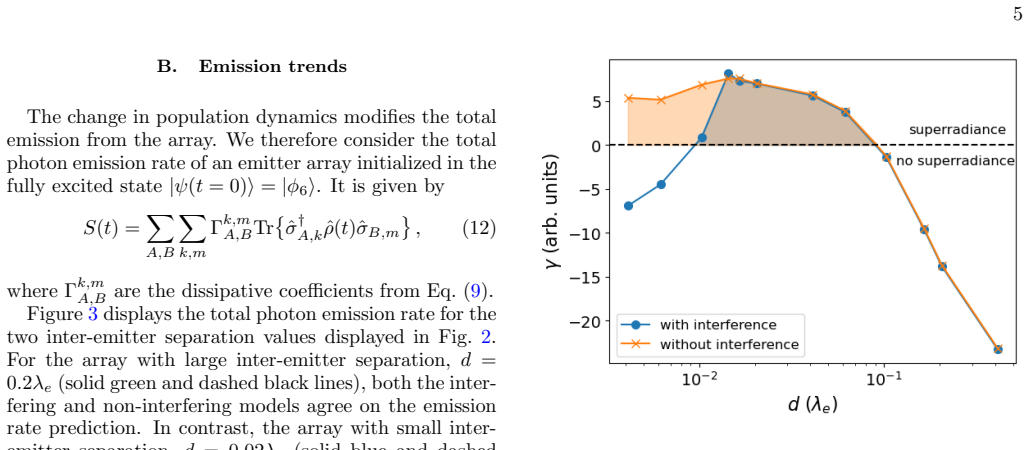
Summary. The paper derives a Born–Markov master equation for an array of multi-level emitters coupled to the quantized EM vacuum, retaining interference terms between different transitions (k≠m) in both the coherent dipole–dipole Hamiltonian (Eq. 7) and the dissipator (Eq. 8). The framework is applied to three identical V-type emitters whose parameters are taken from hydrogen 2s–4p spectroscopy (Appendix B). The full master equation is compared with a non-interfering variant in which all k≠m terms are set to zero. The central result (Sec. III B, Fig. 4) is that the initial emission-rate derivative γ=dS/dt(0) becomes negative for inter-emitter separations d≲0.01λ_e in the full model, whereas the non-interfering model still predicts a superradiant burst. This is interpreted as evidence that multi-level interference can set a lower bound on d for superradiance, a feature absent for two-level emitters. The paper also maps the interference regime in the (d, ΔE_e) plane and proposes atomic and molecular experimental candidates (Table I).
Significance. If correct, the predicted suppression of superradiance at ultra-small separations would be a genuinely new collective effect of multi-level emitters, relevant for dense arrays of atoms and molecules. Strengths of the manuscript: the master equation is derived from a first-principles quantization with no fitted parameters — the coefficients come from hydrogen spectroscopy and Clebsch–Gordon coefficients; the non-interfering baseline provides a clean diagnostic; the experimental candidates are concrete and falsifiable; and the numerical implementation (Newton-polynomial propagation) is appropriate for the small system studied. However, the central claim is conditional on the validity of Eq. (6) in the very regime where the authors themselves (Appendix A) caution that the secular approximation may fail. The present analysis does not resolve this tension, so the significance of the paper will be determined by whether the lower-bound prediction survives a dressed-state treatment or a non-secularized benchmark.
major comments (3)
- [Appendix A (Eqs. A7–A11) / Sec. III B (Fig. 4)] Appendix A (Eqs. A7–A11) / Sec. III B (Fig. 4): the ME is derived in the bare basis (H_sys as free Hamiltonian), with H_dd added a posteriori; the central prediction γ<0 for d<0.01λ_e comes from the k≠m dissipator cross terms, which this derivation keeps. But in this regime the derivation is not valid: at d=0.01λ_e, |Δ^{1,2}_{A,B}|≈γ/(kd)^3≈2.3 GHz (Appendix B) exceeds ΔE_e=1.367 GHz, so H_sys+H_dd eigenstates are strongly mixed and the dissipator must be constructed from dressed jump operators. Moreover, |ω_e1−ω_e2|≈10^3 Γ_eff, so the standard secular approximation would drop the k≠m dissipator terms entirely. The warning in Appendix A ("must be treated with caution...") concerns precisely these terms but is never quantified. The prediction is therefore not established; required is a dressed-state derivation (or a Redfield/non-secularized benchmark) for d≤0.05λ_e.
- [Abstract / Sec. III] Abstract and Sec. III: the abstract compares the results to 'two-level approximations', but the numerical baseline is a multi-level model with all k≠m terms set to zero (Sec. III: 'a ME in which interactions between transitions k≠m are suppressed'). This baseline retains both excited states and two independent decay channels; it is a diagnostic, not a two-level approximation. The claimed deviation from 'two-level emitter arrays' (Sec. I) is not directly demonstrated by any calculation reported here. Either include a genuine two-level truncation for comparison or rephrase the abstract/conclusions to describe the comparison against a non-interfering multi-level model.
- [Sec. IV / Sec. II] Sec. IV / Sec. II: 'Since no additional approximations were introduced beyond the standard ones needed to derive the master equation, our results may serve as a benchmark' conflicts with the Appendix A caveat that the secular approximation 'must be treated with caution' for near-resonant transitions. The central result lives in exactly the regime named in that caveat: if the secular approximation is unjustified there, Eq. (6) cannot serve as a benchmark. State the validity range of Eq. (6) explicitly and state its consequences for the central claim.
minor comments (5)
- [Sec. III B / Fig. 3] The text refers to the d=0.2λ_e curves as 'solid green and dashed black lines', while the Fig. 3 caption describes them as 'solid green' and 'dashed brown'. Please make the color references consistent.
- [Appendix B] In the definition γ^{A,B}_{i,j} = (4ω^3_{ij} d_{A,i} d_{B,k})/(3c^3), the index of the second dipole appears to be a typographical error; it should presumably read d_{B,j} to match the Green's-tensor expression in Eq. (9).
- [Sec. II] The sentence 'Working with the full equation limits us to small system sizes, while secular error accumulation prevents reliable access to long-time dynamics [35]' is ambiguous: is the accumulation due to the secular approximation made in deriving Eq. (6), or to the polynomial propagation? Please clarify and make sure the cited reference supports the intended claim.
- [Table I] The column 'Maximal distance' (10 nm, 16 nm, 7 μm, 22 μm) is not defined in the text. Presumably this is the separation below which the interference effects of Sec. III C become non-negligible; please define it and state how it is obtained from the model.
- [Sec. III C] The thresholds quoted in the text ('detunings larger than 3·10^{-4}...', 'ΔE_e ≤ 10^{-5} E_e') would be easier to interpret if the normalized detuning used in Fig. 5 were defined explicitly in the text or caption.
Circularity Check
No circularity: the central threshold is a numerical consequence of an externally parameterized master equation, not a fitted or self-referential input.
full rationale
The derivation chain is self-contained in the sense required by the circularity test. The master equation (Eq. 6) is derived in Appendix A from the standard Born-Markov and secular approximations; no parameter is fitted to the superradiance threshold. Transition frequencies, radiative shifts, and dipole moments are fixed by hydrogen spectroscopy and Clebsch-Gordan coefficients (Appendix B), and the Green's tensor is the free-space expression of Eq. (10). The 'non-interfering array' comparison is obtained by setting all k ≠ m terms to zero in Eq. (6), which is a diagnostic intervention that isolates the interference terms rather than a fit that forces the predicted difference. The claim that multi-level interference suppresses superradiance for d ≲ 0.01λ_e is read off the initial emission rate γ = dS/dt(0) from Eq. (12), so it is a model prediction with independent computational content. There are no self-citations by the present authors that carry a load-bearing argument. The Appendix A caveat that the secular approximation 'must be treated with caution' for near-resonant transitions is a validity concern about the model in the regime of interest, not evidence that a result reduces to its input by construction; the same caveat applies to the two-level baseline and does not make the comparison circular. No step was found in which a fitted parameter is renamed as a prediction, a prior result by these authors is invoked to forbid alternatives, or an ansatz is smuggled in via citation.
Assumptions & free parameters
free parameters (1)
- ΔE_e (excited-state splitting) =
1.367 GHz for hydrogen; scanned over 1e-6 to 1e-3 E_e in Fig. 5
assumptions (5)
- domain assumption Born-Markov approximation
- domain assumption Secular approximation (neglect double (de)excitation terms)
- domain assumption Replacement of ω_B,m by the average ω_km in ME coefficients
- domain assumption Superradiance criterion γ = dS/dt(t=0) > 0 from Ref. [29]
- standard math Free-space Green's tensor (Eq. 10)
Cite this review
Pith. "Pith review of Collective states of multi-level emitters: The role of multi-level interferences." pith.science (2026). https://pith.science/paper/66FZB4JX
@misc{pith2026260725547,
  author       = {Pith},
  title        = {Pith review of: Collective states of multi-level emitters: The role of multi-level interferences},
  year         = {2026},
  howpublished = {\url{https://pith.science/paper/66FZB4JX}},
  note         = {Machine review of arXiv:2607.25547}
}
read the original abstract
We explore how collective states of light and matter differ when the multi-level nature of the quantum emitters is fully taken into account. For closely spaced emitters, interferences between near-resonant transitions completely change the character of the collective states compared to two-level approximations. In particular, we find a lower bound on the emitter separation for superradiance to occur which does not exist for two-level emitters. By contrast, for larger separations between the emitters, the collective states resemble those obtained within the widely used two-level approximation of the emitters. Both regimes may be realized by molecules trapped in optical lattices. We therefore propose molecular candidates and describe experimental signatures of emerging multi-level interference.
Figures


Figures from the paper (2 more)

Reference graph
Works this paper leans on
-
[29]
S. J. Masson and A. Asenjo-Garcia, Nature Communica- tions13, 2285 (2022)
2022
-
[1]
R. H. Dicke, Phys. Rev.93, 99 (1954)
1954
-
[2]
Asenjo-Garcia, M
A. Asenjo-Garcia, M. Moreno-Cardoner, A. Albrecht, H. J. Kimble, and D. E. Chang, Phys. Rev. X7, 031024 (2017)
2017
-
[3]
Shahmoon, D
E. Shahmoon, D. S. Wild, M. D. Lukin, and S. F. Yelin, Phys. Rev. Lett.118, 113601 (2017)
2017
-
[4]
R. Holzinger and S. F. Yelin, Superradiant peak emis- sion rate and time in quantum emitter arrays (2025), arXiv:2504.09985 [quant-ph]
arXiv 2025
-
[5]
R. Holzinger and S. F. Yelin, Scaling of superradiant peak emission in spatially extended emitter arrays (2025), arXiv:2506.12649 [quant-ph]
arXiv 2025
-
[7]
Hosten, N
O. Hosten, N. J. Engelsen, R. Krishnakumar, and M. A. Kasevich, Nature529, 505 (2016)
2016
-
[8]
Colombo, E
S. Colombo, E. Pedrozo-Pe˜ nafiel, A. F. Adiyatullin, Z. Li, E. Mendez, C. Shu, and V. Vuleti´ c, Nature Physics18, 925 (2022)
2022
Show all 50 references
-
[9]
Ben-Maimon, Y
R. Ben-Maimon, Y. Solomons, and E. Shahmoon, Phys. Rev. A110, 033719 (2024)
2024
-
[10]
M. A. Norcia, J. R. K. Cline, J. A. Muniz, J. M. Robin- son, R. B. Hutson, A. Goban, G. E. Marti, J. Ye, and J. K. Thompson, Phys. Rev. X8, 021036 (2018)
2018
-
[11]
J. Rui, D. Wei, A. Rubio-Abadal, S. Hollerith, J. Zeiher, D. M. Stamper-Kurn, C. Gross, and I. Bloch, Nature 583, 369 (2020)
2020
-
[12]
Kersten, N
W. Kersten, N. de Zordo, O. Diekmann, E. S. Redchenko, A. N. Kanagin, A. Angerer, W. J. Munro, K. Nemoto, I. E. Mazets, S. Rotter, T. Pohl, and J. Schmiedmayer, Nature Physics22, 158 (2026)
2026
-
[13]
Cohen-Tannoudji, J
C. Cohen-Tannoudji, J. Dupont-Roc, and G. Grynberg, Atom-Photon Interactions: Basic Processes and Applica- tions(Wiley, New York, 1992)
1992
-
[14]
Gruner and D.-G
T. Gruner and D.-G. Welsch, Phys. Rev. A53, 1818 (1996)
1996
-
[15]
Asenjo-Garcia, J
A. Asenjo-Garcia, J. D. Hood, D. E. Chang, and H. J. Kimble, Phys. Rev. A95, 033818 (2017)
2017
-
[16]
S. J. Masson, J. P. Covey, S. Will, and A. Asenjo-Garcia, PRX Quantum5, 010344 (2024)
2024
-
[17]
W.-K. Mok, S. J. Masson, D. M. Stamper-Kurn, T. Zelevinsky, and A. Asenjo-Garcia, Phys. Rev. Res.7, L022015 (2025)
2025
-
[18]
Robicheaux, Phys
F. Robicheaux, Phys. Rev. A104, 063706 (2021)
2021
-
[19]
Q. Wu, Y. Zhang, H. Wu, S.-L. Su, K.-K. Liu, M. Oxbor- row, C.-X. Shan, and K. Mølmer, Science China Physics, Mechanics & Astronomy67, 260314 (2024)
2024
-
[20]
Yanes-Thomas, R
P. Yanes-Thomas, R. Guti´ errez-J´ auregui, P. Barberis- Blostein, D. Sahag´ un-S´ anchez, R. J´ auregui, and A. Kunold, Phys. Rev. Res.7, 013028 (2025)
2025
-
[21]
Konovalov, G
A. Konovalov, G. Morigi, and N. Piovella, Vacuum- induced interference in light scattering by multilevel atomic chains (2026), arXiv:2607.21073 [quant-ph]
2026 arXiv
-
[22]
D. A. Cardimona, M. G. Raymer, and C. R. Stroud, Jr., Journal of Physics B: Atomic and Molecular Physics15, 55 (1982)
1982
-
[23]
Ficek and S
Z. Ficek and S. Swain,Quantum Interference and Co- herence: Theory and Experiments(Springer-Verlag New York, 2005)
2005
-
[24]
Horbatsch and E
M. Horbatsch and E. A. Hessels, Phys. Rev. A82, 052519 (2010)
2010
-
[25]
A. A. Buchheit and G. Morigi, Phys. Rev. A94, 042111 (2016)
2016
-
[26]
Konovalov and G
A. Konovalov and G. Morigi, Phys. Rev. A102, 013724 (2020)
2020
-
[27]
Holman, X
A. Holman, X. Sun, B. Seo, J. Corn, Z. Zhu, Y. Xu, J. Wu, N. Yu, D. Filin, M. Safronova, and S. Will, A mid-infrared platform based on strontium tweezer arrays (2026), arXiv:2606.02560 [physics.atom-ph]
2026 arXiv
-
[28]
Pi˜ neiro Orioli and A
A. Pi˜ neiro Orioli and A. M. Rey, Phys. Rev. A101, 043816 (2020)
2020
-
[30]
S. J. Masson, I. Ferrier-Barbut, L. A. Orozco, A. Browaeys, and A. Asenjo-Garcia, Phys. Rev. Lett. 125, 263601 (2020)
2020
-
[31]
H. T. Dung, L. Kn¨ oll, and D.-G. Welsch, Phys. Rev. A 57, 3931 (1998)
1998
-
[32]
H. T. Dung, L. Kn¨ oll, and D.-G. Welsch, Phys. Rev. A 65, 043813 (2002)
2002
-
[33]
Pi˜ neiro Orioli, J
A. Pi˜ neiro Orioli, J. K. Thompson, and A. M. Rey, Phys. Rev. X12, 011054 (2022)
2022
-
[34]
Agarwal, A
S. Agarwal, A. Pi˜ neiro Orioli, J. K. Thompson, and A. M. Rey, Phys. Rev. Lett.133, 233003 (2024)
2024
-
[35]
Cattaneo, G
M. Cattaneo, G. L. Giorgi, S. Maniscalco, and R. Zam- brini, New J. Phys.21, 113045 (2019)
2019
-
[36]
Kolachevsky, A
N. Kolachevsky, A. Beyer, L. Maisenbacher, A. Matveev, R. Pohl, K. Khabarova, A. Grinin, T. Lamour, D. C. Yost, T. W. Haensch, and T. Udem, AIP Conference Pro- ceedings1936, 020015 (2018)
2018
-
[37]
Beyer, J
A. Beyer, J. Alnis, K. Khabarova, A. Matveev, C. G. Parthey, D. C. Yost, R. Pohl, T. Udem, T. W. H¨ ansch, and N. Kolachevsky, Annalen der Physik525(2013)
2013
-
[38]
Novotny and B
L. Novotny and B. Hecht,Principles of nano-optics, 2nd ed. (Cambridge University Press, 2012)
2012
-
[39]
Gross and S
M. Gross and S. Haroche, Physics Reports93, 301 (1982)
1982
-
[40]
R. I. Nepomechie, F. Ravanini, and D. Raveh, Advanced Quantum Technologies7, 2400057 (2024)
2024
-
[41]
D. A. Steck, Rubidium 87 D line data (2001)
2001
-
[42]
A., Margul` es, L., Pi- rali, O., Wlodarczak, G., Roy, P., Roueff, E., Gerin, M., Faure, A., and Hily-Blant, P., Astron
Bailleux, S., Martin-Drumel, M. A., Margul` es, L., Pi- rali, O., Wlodarczak, G., Roy, P., Roueff, E., Gerin, M., Faure, A., and Hily-Blant, P., Astron. Astrophys.538, A135 (2012)
2012
-
[43]
Hoeft and K
J. Hoeft and K. Nair, Zeitschrift f¨ ur Physik D Atoms, Molecules and Clusters8(1988)
1988
-
[44]
M. R. Tarbutt, Contemporary Physics59, 356 (2018)
2018
-
[45]
Jones, J
R. Jones, J. A. Needham, I. Lesanovsky, F. Intravaia, and B. Olmos, Phys. Rev. A97, 053841 (2018)
2018
-
[46]
Juergensen, M
S. Juergensen, M. Kessens, C. Berrezueta-Palacios, N. Severin, S. Ifland, J. P. Rabe, N. S. Mueller, and S. Re- 11 ich, ACS Nano17, 17350 (2023)
2023
-
[47]
Juergensen, J.-B
S. Juergensen, J.-B. Marceau, C. Mueller, E. B. Barros, P. Kusch, A. Setaro, E. Gaufr` es, and S. Reich, The Jour- nal of Physical Chemistry Letters16, 2393 (2025)
2025
-
[48]
Carmichael and K
H. Carmichael and K. Kim, Optics Communications179, 417 (2000)
2000
-
[49]
H. T. Dung, L. Kn¨ oll, and D.-G. Welsch, Phys. Rev. A 66, 063810 (2002)
2002
-
[50]
Vaaranta and M
A. Vaaranta and M. Cattaneo, Computer Physics Com- munications320, 109948 (2026)
2026
-
[51]
Kosloff, Annu
R. Kosloff, Annu. Rev. Phys. Chem.45, 145 (1994)
1994
Reviewed August 1, 2026 · model on record in the stance chip above.
Discussion (0). Continue with ORCID to comment.