REVIEW 4 major objections 4 minor 69 references
Two singlet-extended two-Higgs-doublet models that both fit the 95 GeV excesses can be told apart at 2σ by combining four-top production at the HL-LHC with di-Higgs measurements at ILC500.
Reviewed by Pith at T0; open to challenge. T0 means a machine referee read the full paper against a public rubric. the ladder, T0–T4 →
T0 review · deepseek-v4-flash
2026-08-01 01:48 UTC pith:32XITCRR
load-bearing objection Useful and credible follow-up, but the HL-LHC four-top analysis silently omits the singlet-like pseudoscalar from the final state, so those α4 limits are not yet reliable; the di-Higgs part stands. the 4 major comments →
The 95 GeV Excess in Models with Two Higgs Doublets plus One Singlet: Model Distinction via Four-top Final States and Triple Higgs Couplings
The pith
A machine-rendered reading of the paper's core claim, the machinery that carries it, and where it could break.
Core claim
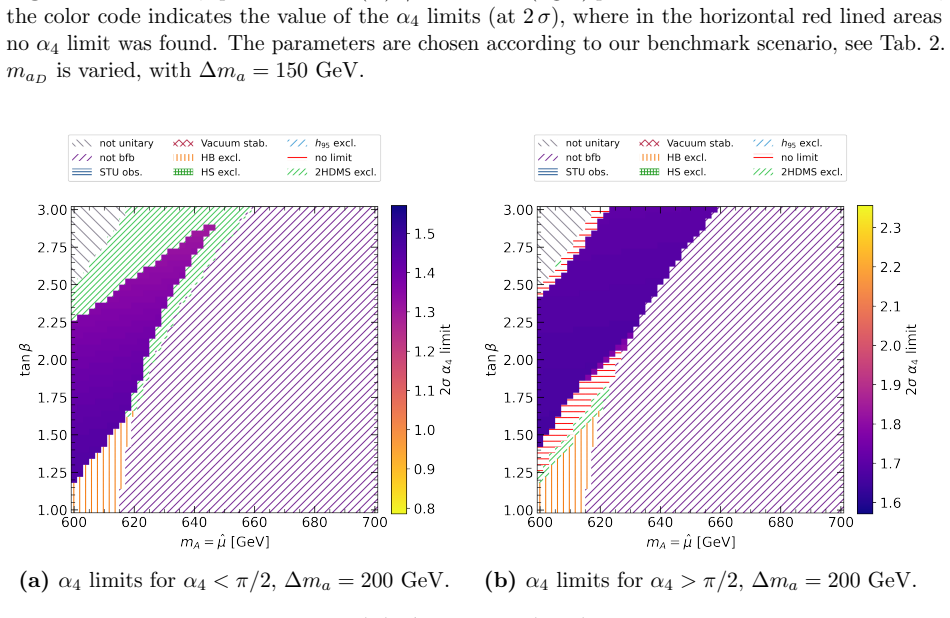
The central discovery is that the type II N2HDM and 2HDMS, in benchmark scenarios reproducing the 95 GeV γγ and bb excesses, can be distinguished at 2σ by combining four-top production at the HL-LHC and di-Higgs production at ILC500. The quantitative handle is the α4 limit: the smallest value of |π/2 − α4| for which the 2HDMS cross-section prediction differs from the N2HDM by at least 2σ. The limits approach the N2HDM limit for large pseudoscalar mass splittings and small vS, and the paper provides analytical expressions for the trilinear Higgs couplings that trace the difference to the additional cubic interactions µ12 and µS1 present in the 2HDMS potential.
What carries the argument
The central object is the 'α4 limit' defined in Eq. (72): the smallest value of |π/2 − α4| at which the 2HDMS and N2HDM cross-section predictions differ by at least 2σ, where α4 is the mixing angle between the doublet and singlet components of the two CP-odd states in the 2HDMS. The analytical engine is the derived set of trilinear Higgs couplings (Eqs. 44–45), which isolates the 2HDMS-specific contributions ∝ (m_a2^2 − m_a1^2)/(vS sin α4 cos α4) and shows how they vanish in the N2HDM limit yet grow with pseudoscalar mass splitting and with inverse vS.
Load-bearing premise
The four-top analysis assumes that only the heavy CP-even h3 and the doublet-like pseudoscalar aD contribute to the four-top final state, omitting the singlet-like pseudoscalar aS which for maS > 2mt (e.g., 500 GeV) can also produce four-top via ttaS → tttt; if this contribution is non-negligible, the quoted HL-LHC α4 limits are mis-estimated.
What would settle it
Compute the full pp → tttt cross-section in the 2HDMS at maS = 500 GeV including pp → ttaS with aS → tt, using the same benchmark parameters and cuts as the HL-LHC study; if the resulting α4 limit moves by more than the quoted 2σ band, the current four-top analysis is incomplete. Alternatively, a dedicated search for four-top events with invariant mass near maS at the HL-LHC would directly test the aS contribution.
If this is right
- Combining the four-top rate at the HL-LHC with the three di-Higgs channels at ILC500 yields 2σ α4 limits that, for pseudoscalar mass splittings of 100–200 GeV, cover most of the currently allowed benchmark plane (tan β ≲ 3, mA ∈ [600, 700] GeV).
- The discrimination power improves with the mass splitting ∆ma between the doublet- and singlet-like pseudoscalars: larger ∆ma gives α4 limits closer to π/2, and for ∆ma = 200 GeV the 2HDMS is distinguished in the entire allowed region except small slivers.
- At ILC500 the Zh95h95 channel provides the strongest individual constraint; the combination with Zh95h125 and Zh125h125 extends distinguishability to regions (e.g., large tan β) where four-top is less sensitive.
- The α4 limits degrade with increasing vS: for ∆ma = 25 GeV no 2σ limit survives beyond vS ≈ 150 GeV, while for ∆ma = 125 GeV limits persist up to vS ≈ 400 GeV.
Where Pith is reading between the lines
- The omission of the aS-mediated ttaS → tttt process in the four-top channel is testable: repeating the analysis with maS = 500 GeV and including this diagram is expected to shift the α4 limits on the α4 > π/2 side, where the aS coupling is largest.
- The α4-limit definition could be exported to other BSM scenarios; e.g., in a CP-violating 2HDMS the same observables would constrain a phase rather than an angle, and the four-top channel would become sensitive to CP-violating interference.
- The dependence on vS suggests a complementary probe: precision measurements of the Higgs self-coupling at the HL-LHC (via gg → hh) might already provide weaker but model-independent limits on the 2HDMS parameter space before ILC runs.
Editorial analysis
A structured set of objections, weighed in public.
Referee Report
Summary. The paper studies two singlet-extended two-Higgs-doublet models, the N2HDM and the 2HDMS, in type-II Yukawa realizations, using a benchmark that reproduces the 95 GeV γγ and bb excesses while keeping h2 as the 125 GeV SM-like Higgs. It derives compact analytic expressions for the trilinear Higgs couplings, introduces the "α4 limit" as the smallest deviation from the N2HDM limit that yields a 2σ distinction, and evaluates these limits in two complementary channels: four-top production at the HL-LHC and di-Higgs production at ILC500. The central quantitative outputs are the projected α4 limits in the mA–tanβ planes shown in Figs. 8–10 and Figs. 17–20.
Significance. If the projections hold, the paper offers a useful and fairly general strategy for distinguishing extended Higgs sectors that have identical CP-even phenomenology but different CP-odd sectors. The analytic THC expressions in Sec. 2.6 and the α4-limit concept are valuable beyond the specific 95 GeV benchmark. The numerical pipeline is based on public tools (SARAH/SPheno/MadGraph/HiggsTools) and the constraints are handled in a standard way. However, the quantitative α4 limits are conditional on several idealizations: an approximate rescaling of HL-LHC efficiencies, an optimistic ILD uncertainty model, and omission of the singlet-like pseudoscalar contribution to the four-top final state. These do not destroy the qualitative framework, but they do affect the central numerical claim.
major comments (4)
- [Sec. 3.1, Eq. (73)] The four-top BSM rate in Eq. (73) is written as the incoherent sum of pp→tt̄aD and pp→tt̄h3 only. Yet Eq. (75) gives c_{aS tt} ∝ cos α4/tanβ, and for the maS = 500 GeV scenarios used in Fig. 7 and Fig. 10, aS→tt is kinematically open. At the quoted α4 limits (|π/2 − α4| ≈ 0.25–0.30 rad), cos²α4 ≈ 0.06–0.09, which is non-negligible relative to sin²α4 ≈ 0.91–0.94; the tt̄aS production cross-section at 500 GeV is also larger than at 600 GeV. The aS term grows as α4 moves away from π/2, flattening the total four-top rate and shifting the α4 limits. No estimate of σ(pp→tt̄aS)BR(aS→tt) is given. At minimum the authors must quantify this contribution or justify its omission before the HL-LHC discrimination claim can be accepted.
- [Sec. 3.2, Eqs. (77)–(80)] The HL-LHC projections rescale efficiencies ϵs and ϵb from Ref. [51], which considered degenerate H/A states, to the benchmark with m_aD = 600 GeV and m_h3 = 650 GeV. The paper states that the analysis remains valid for |m_h3 − m_aD| ≤ 50 GeV, but no validation is provided. Efficiencies for a CP-even and a CP-odd scalar of different masses can differ in tt̄ϕ production and in the four-top selection. This enters directly into Δσs in Eq. (80) and therefore into all α4 limits in Figs. 8–10. A dedicated efficiency study, or at least a sensitivity scan over ϵs and ϵb, is needed.
- [App. B, Eqs. (136)–(137)] The di-Higgs uncertainty estimate relies on a constant 0.674 rescaling of the ILD uncertainty and on the assumption that all backgrounds bi remain unchanged in the BSM scenarios. Since the α4 limits in Sec. 4.3 are obtained from Eq. (99) with Δσ from Eq. (137), an optimistic uncertainty rescaling directly strengthens the quoted limits. The paper acknowledges this, but it would be useful to show how the limits change if the 0.674 factor is removed or if the background rates are varied within a plausible range; otherwise the ILC discrimination claim is conditional on a single ad hoc uncertainty model.
- [Sec. 2.9, Eq. (72)] The α4-limit definition assumes all free parameters are known perfectly and are identical between the two models, except for α4. This is acknowledged for the ILC part in Sec. 4.3, but the same assumption also underlies the HL-LHC α4 limits in Figs. 8–10. The 95 GeV excess constraints and future Higgs measurements will determine these parameters with finite uncertainties, which will degrade the 2σ distinction power. The abstract and conclusions should state more prominently that the quoted limits are idealized, not including parametric uncertainties.
minor comments (4)
- [Sec. 4.3] The text says "di-Higgs production at the ILC1000" in the opening sentence of Sec. 4.3, but the actual cross-sections and uncertainty estimates in this section are for ILC500 (√s = 500 GeV, L = 4 ab⁻¹). Please correct the inconsistency.
- [Throughout] There are multiple typos and minor wording issues, e.g., "containts", "asymmetricly", "we we", "distrinction", "scenarious", and "an good description". A careful proofread is needed.
- [Sec. 2.8.3] The phrase "the unbalanced uncertainty of CMS measurement" should be "asymmetric uncertainty". Also, it would help to state explicitly that the threshold χ²95 ≤ 3.523 corresponds to the 1σ region for three observables.
- [Sec. 4.2, Fig. 15] The text around Eq. (97)–(98) explains the near-cancellation in the N2HDM Zh1h1 rate. The notation ch1V V λh1h1h1 is clear, but a diagram or a one-line amplitude expansion would make the cancellation more transparent for the reader.
Circularity Check
No significant circularity: benchmark inputs are fitted, but the four-top and di-Higgs distinction observables are computed independently.
full rationale
The paper's central derivation is not circular. The benchmark parameters (ch1VV≈0.35, ch1bb/ch1tt≈0.8, ε=0.05, vS=120 GeV, Tab. 2) are fitted to the 95 GeV excesses, but they enter as inputs; the paper does not claim to predict those excesses. The quantitative results—four-top cross-sections, di-Higgs cross-sections, and the α4 limits defined in Eq. (72)—are computed from the Lagrangian via the THC expressions (44)-(45) and the coupling dependences (73)-(75), and they are not used to define the benchmark inputs. The α4 limit is a new projection measure, not a renamed fit. Constraints use public/external tools (HiggsTools, SPheno, EVADE, MadGraph) and experimental data; the self-citations [19], [22], [49] provide technical derivations or prior scans, but the central model-distinction claim does not reduce to those citations. No uniqueness theorem is invoked. One internal inconsistency is flagged per the review rule: Eq. (73) defines the BSM four-top rate as the incoherent sum of ttaD and tth3 only, while Eq. (75) gives the singlet-like pseudoscalar aS a non-zero top-quark coupling ∝ cosα4/tanβ; for maS=500 GeV, pp→ttaS→tttt is kinematically open and is omitted. This is a modeling/correctness issue, not a circular reduction: the α4 limit is not equivalent to an input by construction. Therefore no circular step is present; the score of 2 reflects only minor non-load-bearing self-citations in the constraint and tooling sections.
Axiom & Free-Parameter Ledger
free parameters (8)
- tan β =
1.5 (scanned in [1,3] and [2.5,3])
- c_{h1 VV} =
0.35
- c_{h1 bb}/c_{h1 tt} =
0.8
- ε =
0.05
- v_S =
120 GeV
- m_h3, m_H±, m_A, μhat =
650, 650, 600, 600 GeV (benchmark)
- m_aS / Δma =
varied (25-500 GeV depending on plane)
- α4 =
scanned in [π/4, 3π/4]
axioms (9)
- standard math Perturbative unitarity, boundedness-from-below, and vacuum stability constraints from Refs. [1,22,23-25] are correct and sufficient.
- domain assumption Z2/Z3 symmetry structure and type II Yukawa realization correctly define the N2HDM and 2HDMS scalar sectors.
- ad hoc to paper The benchmark scenario must describe the 95 GeV γγ and bb excesses within 1σ while h2 is the 125 GeV SM-like Higgs.
- domain assumption Narrow-width approximation is valid for computing 95 GeV signal strengths and four-top contributions from heavy Higgses.
- ad hoc to paper HL-LHC four-top efficiencies from Ref. [51], derived for degenerate H/A masses, remain valid for |m_h3 - m_aD| ≤ 50 GeV.
- ad hoc to paper ILD di-Higgs uncertainties can be rescaled by a constant 0.674 factor, with background rates unchanged in the BSM scenarios.
- ad hoc to paper All model parameters are known perfectly when computing α4 limits (no parametric uncertainties).
- domain assumption Only h3 and the doublet-like aD contribute to the four-top final state; the singlet-like aS contribution is neglected.
- domain assumption The propagator approximation D95 ≈ D125 is used to show cancellation of one class of Δλ terms in di-Higgs strahlung.
read the original abstract
We investigate the prospects for experimentally distinguishing the Next-to-Two-Higgs-Doublet Model (N2HDM) and the Two-Higgs-Doublet Model with a Complex Singlet (2HDMS) in the Yukawa type II realization. Both models can successfully accommodate the reported Higgs-boson excesses around 95 GeV while satisfying current theoretical and experimental constraints, leading to very similar predictions for the observed Higgs spectrum and signal strengths. We analyze how they can nevertheless be discriminated through observables sensitive to the scalar potential and the CP-odd sector. Analytical expressions for the trilinear Higgs couplings are derived, exhibiting characteristic contributions induced by the additional cubic interactions of the 2HDMS. We study the corresponding phenomenology in two complementary collider environments: four-top production at the High-Luminosity LHC, probing the different pseudoscalar sectors. In a second step we analyze Higgs pair production at a future high-energy $e^+e^-$ collider, providing direct sensitivity to the trilinear Higgs couplings. We quantify the potential to distinguish the two models by introducing the minimum deviation from the N2HDM limit required for a $2\sigma$ difference between the two models. Although our numerical analysis focuses on benchmark scenarios describing the 95 GeV excesses, the proposed approach provides a general framework for discriminating between singlet-extended Higgs sectors at future colliders.
Figures




Reference graph
Works this paper leans on
-
[1]
M. Muhlleitner, M. O. P. Sampaio, R. Santos, and J. Wittbrodt, The N2HDM under Theoretical and Experimental Scrutiny . JHEP 03 (2017) 094, arXiv:1612.01309 [hep-ph]
Pith/arXiv arXiv 2017
-
[2]
S. Baum and N. R. Shah, Two Higgs Doublets and a Complex Singlet: Disentangling the Decay Topologies and Associated Phenomenology. JHEP 12 (2018) 044, arXiv:1808.02667 [hep-ph]
Pith/arXiv arXiv 2018
-
[3]
Barate et al., Search for the standard model Higgs boson at LEP
LEP Working Group for Higgs boson searches, ALEPH, DELPHI, L3, OPAL Collaboration, R. Barate et al., Search for the standard model Higgs boson at LEP . Phys. Lett. B 565 (2003) 61–75, arXiv:hep-ex/0306033
Pith/arXiv arXiv 2003
-
[4]
CMS Collaboration, A. M. Sirunyan et al. , Search for a standard model-like Higgs boson in the mass range between 70 and 110 GeV in the diphoton final state in proton-proton collisions at √s = 8 and 13 TeV . Phys. Lett. B 793 (2019) 320–347, arXiv:1811.08459 [hep-ex]
Pith/arXiv arXiv 2019
-
[5]
CMS Collaboration, Search for a standard model-like Higgs boson in the mass range between 70 and 110 GeV in the diphoton final state in proton-proton collisions at√s = 13 TeV
-
[6]
ATLAS Collaboration, Search for diphoton resonances in the 66 to 110 GeV mass range using 140 fb −1 of 13 TeV pp collisions collected with the ATLAS detector
-
[7]
T. Biek¨ otter, S. Heinemeyer, and G. Weiglein,95.4 GeV diphoton excess at ATLAS and CMS. Phys. Rev. D 109 (2024) no. 3, 035005, arXiv:2306.03889 [hep-ph]
Pith/arXiv arXiv 2024
-
[8]
CMS Collaboration, A. Tumasyan et al. , Searches for additional Higgs bosons and for vector leptoquarks in τ τfinal states in proton-proton collisions at √s = 13 TeV . JHEP 07 (2023) 073, arXiv:2208.02717 [hep-ex]
Pith/arXiv arXiv 2023
-
[9]
CMS Collaboration, Search for dilepton resonances from decays of (pseudo)scalar bosons produced in association with a massive vector boson or top quark anti-top quark pair at√s = 13 TeV
-
[10]
T. Biek¨ otter, M. Chakraborti, and S. Heinemeyer, A 96 GeV Higgs boson in the N2HDM. Eur. Phys. J. C 80 (2020) no. 1, 2, arXiv:1903.11661 [hep-ph]
Pith/arXiv arXiv 2020
-
[11]
T. Biek¨ otter, M. Chakraborti, and S. Heinemeyer, “The ”96 GeV excess” at the ILC,” in International Workshop on Future Linear Colliders . 2, 2020. arXiv:2002.06904 [hep-ph]
Pith/arXiv arXiv 2020
-
[12]
T. Biek¨ otter, S. Heinemeyer, and G. Weiglein,The CMS di-photon excess at 95 GeV in view of the LHC Run 2 results . Phys. Lett. B 846 (2023) 138217, arXiv:2303.12018 [hep-ph]. 47
Pith/arXiv arXiv 2023
-
[13]
F. Domingo, S. Heinemeyer, S. Paßehr, and G. Weiglein, Decays of the neutral Higgs bosons into SM fermions and gauge bosons in the CP -violating NMSSM. Eur. Phys. J. C 78 (2018) no. 11, 942, arXiv:1807.06322 [hep-ph]
Pith/arXiv arXiv 2018
-
[14]
T. Biek¨ otter, A. Grohsjean, S. Heinemeyer, C. Schwanenberger, and G. Weiglein, Possible indications for new Higgs bosons in the reach of the LHC: N2HDM and NMSSM interpretations. Eur. Phys. J. C 82 (2022) no. 2, 178, arXiv:2109.01128 [hep-ph]
Pith/arXiv arXiv 2022
-
[15]
U. Ellwanger and C. Hugonie, Additional Higgs Bosons near 95 and 650 GeV in the NMSSM. Eur. Phys. J. C 83 (2023) no. 12, 1138, arXiv:2309.07838 [hep-ph]
Pith/arXiv arXiv 2023
-
[16]
T. Biek¨ otter, S. Heinemeyer, and C. Mu˜ noz,Precise prediction for the Higgs-boson masses in the µν SSM. Eur. Phys. J. C 78 (2018) no. 6, 504, arXiv:1712.07475 [hep-ph]
Pith/arXiv arXiv 2018
-
[17]
T. Biek¨ otter, S. Heinemeyer, and C. Mu˜ noz,Precise prediction for the Higgs-Boson masses in the µν SSM with three right-handed neutrino superfields . Eur. Phys. J. C 79 (2019) no. 8, 667, arXiv:1906.06173 [hep-ph]
Pith/arXiv arXiv 2019
-
[18]
D. Azevedo, T. Biek¨ otter, and P. M. Ferreira,2HDM interpretations of the CMS diphoton excess at 95 GeV . JHEP 11 (2023) 017, arXiv:2305.19716 [hep-ph]
Pith/arXiv arXiv 2023
-
[19]
S. Heinemeyer, C. Li, F. Lika, G. Moortgat-Pick, and S. Paasch, Phenomenology of a 96 GeV Higgs boson in the 2HDM with an additional singlet . Phys. Rev. D 106 (2022) no. 7, 075003, arXiv:2112.11958 [hep-ph]
Pith/arXiv arXiv 2022
-
[20]
An introduction to quantum field theory,
M. E. Peskin, “An introduction to quantum field theory,” Westview Press, 10, 1995
1995
-
[21]
J. F. Gunion and H. E. Haber, CP-conserving two-Higgs-doublet model: The approach to the decoupling limit . Physical Review D 67 (2003) no. 7, 075019. http://dx.doi.org/10.1103/PhysRevD.67.075019
-
[22]
Li, Phenomenology of extended Two-Higgs-Doublets models
C. Li, Phenomenology of extended Two-Higgs-Doublets models . Dissertation, U. Hamburg (main), Hamburg U., 2023
2023
-
[23]
W. G. Hollik, G. Weiglein, and J. Wittbrodt, Impact of vacuum stability constraints on the phenomenology of supersymmetric models . Journal of High Energy Physics 2019 (2019) no. 3, . https://doi.org/10.1007/JHEP03(2019)109
-
[24]
P. M. Ferreira, R. Santos, M. M¨ uhlleitner, G. Weiglein, and J. Wittbrodt, Vacuum instabilities in the N2HDM . Journal of High Energy Physics 2019 (2019) no. 9, . https://doi.org/10.1007/JHEP09(2019)006
-
[25]
Wittbrodt, https://gitlab.com/jonaswittbrodt/EVADE
J. Wittbrodt, https://gitlab.com/jonaswittbrodt/EVADE
-
[26]
ATLAS Collaboration, G. Aad et al. , Observation of a new particle in the search for the Standard Model Higgs boson with the ATLAS detector at the LHC . Phys. Lett. B 716 (2012) 1–29, arXiv:1207.7214 [hep-ex]. 48
Pith/arXiv arXiv 2012
-
[27]
CMS Collaboration, S. Chatrchyan et al., Observation of a New Boson at a Mass of 125 GeV with the CMS Experiment at the LHC . Phys. Lett. B 716 (2012) 30–61, arXiv:1207.7235 [hep-ex]
Pith/arXiv arXiv 2012
-
[28]
P. Bechtle, S. Heinemeyer, O. St ˚ al, T. Stefaniak, and G. Weiglein,HiggsSignals : Confronting arbitrary Higgs sectors with measurements at the Tevatron and the LHC . Eur. Phys. J. C 74 (2014) no. 2, 2711, arXiv:1305.1933 [hep-ph]
Pith/arXiv arXiv 2014
-
[29]
O. St ˚ al and T. Stefaniak,Constraining extended Higgs sectors with HiggsSignals . arXiv:1310.4039 [hep-ph]
-
[30]
Bechtle et al
P. Bechtle et al. , HiggsSignals-2: probing new physics with precision Higgs measurements in the LHC 13 TeV era . The European Physical Journal C (2021) , arXiv:1434-6052 [hep-ph]
2021
-
[31]
P. Bechtle, S. Heinemeyer, O. St ˚ al, T. Stefaniak, and G. Weiglein,Probing the Standard Model with Higgs signal rates from the Tevatron, the LHC and a future ILC . JHEP 11 (2014) 039, arXiv:1403.1582 [hep-ph]
Pith/arXiv arXiv 2014
-
[32]
H. Bahl, T. Biek¨ otter, S. Heinemeyer, C. Li, S. Paasch, G. Weiglein, and J. Wittbrodt, HiggsTools: BSM scalar phenomenology with new versions of HiggsBounds and HiggsSignals. Computer Physics Communications 291 (2023) 108803
2023
-
[33]
H. B. et al., HiggsTools, A toolbox for BSM scalar phenomenogy , https://gitlab.com/higgsbounds/higgstools
-
[34]
Collaboration and C
A. Collaboration and C. Collaboration, Combined Measurement of the Higgs Boson Mass in pp Collisions at √s = 7 and 8 TeV with the ATLAS and CMS Experiments . Phys. Rev. Lett. 114 (2015) 191803
2015
-
[35]
ATLAS, CMS Collaboration, G. Aad et al. , Measurements of the Higgs boson production and decay rates and constraints on its couplings from a combined ATLAS and CMS analysis of the LHC pp collision data at √s = 7 and 8 TeV . JHEP 08 (2016) 045, arXiv:1606.02266 [hep-ex]
Pith/arXiv arXiv 2016
-
[36]
Deciphering the nature of the Higgs sector , 2017
CERN, CERN Yellow Reports: Monographs, Vol 2 (2017): Handbook of LHC Higgs cross sections: 4. Deciphering the nature of the Higgs sector , 2017
2017
-
[37]
Bechtle, O
P. Bechtle, O. Brein, S. Heinemeyer, G. Weiglein, and K. Williams, HiggsBounds: Confronting arbitrary Higgs sectors with exclusion bounds from LEP and the Tevatron . Computer Physics Communications 181 (2010) no. 1, 138–167
2010
-
[38]
Bechtle, O
P. Bechtle, O. Brein, S. Heinemeyer, G. Weiglein, and K. Williams, HiggsBounds 2.0.0: Confronting neutral and charged Higgs sector predictions with exclusion bounds from LEP and the Tevatron . Computer Physics Communications 182 (2011) no. 12, 2605–2631
2011
-
[39]
P. Bechtle, O. Brein, S. Heinemeyer, O. St ˚ al, T. Stefaniak, G. Weiglein, and K. Williams, Recent Developments in HiggsBounds and a Preview of HiggsSignals , 2013. arXiv:1301.2345 [hep-ph]. 49
Pith/arXiv arXiv 2013
-
[40]
Bechtle, O
P. Bechtle, O. Brein, S. Heinemeyer, O. St ˚ al, T. Stefaniak, G. Weiglein, and K. E. Williams, HiggsBounds-4: improved tests of extended Higgs sectors against exclusion bounds from LEP, the Tevatron and the LHC . The European Physical Journal C 74 (2014) no. 3,
2014
-
[41]
Bechtle, S
P. Bechtle, S. Heinemeyer, O. St ˚ al, T. Stefaniak, and G. Weiglein,Applying exclusion likelihoods from LHC searches to extended Higgs sectors . The European Physical Journal C 75 (2015) no. 9,
2015
-
[42]
Bechtle, D
P. Bechtle, D. Dercks, S. Heinemeyer, T. Klingl, T. Stefaniak, G. Weiglein, and J. Wittbrodt, HiggsBounds-5: testing Higgs sectors in the LHC 13 TeV Era . The European Physical Journal C 80 (2020) no. 12,
2020
-
[43]
H. Bahl, V. M. Lozano, T. Stefaniak, and J. Wittbrodt, Testing exotic scalars with HiggsBounds. The European Physical Journal C 82 (2022) no. 7,
2022
-
[44]
Haller, A
J. Haller, A. Hoecker, R. Kogler, K. M¨ onig, T. Peiffer, and J. Stelzer, Update of the global electroweak fit and constraints on two-Higgs-doublet models . The European Physical Journal C 78 (2018) no. 8,
2018
-
[45]
M. E. Peskin and T. Takeuchi, Estimation of oblique electroweak corrections . Phys. Rev. D 46 (1992) 381–409
1992
-
[46]
Grimus, L
W. Grimus, L. Lavoura, O. Ogreid, and P. Osland, The oblique parameters in multi-Higgs-doublet models. Nuclear Physics B 801 (2008) no. 1–2, 81–96
2008
-
[47]
Porod, SPheno, a program for calculating supersymmetric spectra, SUSY particle decays and SUSY particle production at electron positron colliders
W. Porod, SPheno, a program for calculating supersymmetric spectra, SUSY particle decays and SUSY particle production at electron positron colliders . Computer Physics Communications 153 (2003) no. 2, 275–315
2003
-
[48]
Porod and F
W. Porod and F. Staub, SPheno 3.1: extensions including flavour, CP-phases and models beyond the MSSM . Computer Physics Communications 183 (2012) no. 11, 2458–2469
2012
-
[49]
Paasch, Phenomenology and Constraints in Singlet Extensions of Two Higgs Doublet Models
S. Paasch, Phenomenology and Constraints in Singlet Extensions of Two Higgs Doublet Models. Dissertation, Hamburg U., 2023
2023
-
[50]
H. Bahl, T. Biek¨ otter, S. Heinemeyer, C. Li, S. Paasch, G. Weiglein, and J. Wittbrodt, HiggsTools: BSM scalar phenomenology with new versions of HiggsBounds and HiggsSignals. Comput. Phys. Commun. 291 (2023) 108803, arXiv:2210.09332 [hep-ph]
Pith/arXiv arXiv 2023
-
[51]
N. Craig, J. Hajer, Y.-Y. Li, T. Liu, and H. Zhang, Heavy Higgs bosons at low tan β: from the LHC to 100 TeV . JHEP 01 (2017) 018, arXiv:1605.08744 [hep-ph]
Pith/arXiv arXiv 2017
-
[52]
arXiv:2203.07622 [physics.acc-ph]
ILC-Collaboration, The International Linear Collider: Report to Snowmass 2021 , 2023. arXiv:2203.07622 [physics.acc-ph]. 50
arXiv 2021
-
[53]
Roloff, U
P. Roloff, U. Schnoor, R. Simoniello, and B. Xu, Double Higgs boson production and Higgs self-coupling extraction at CLIC . The European Physical Journal C 80 (2020) no. 11,
2020
-
[54]
Linear Collider Collaboration, H. Abramowicz et al. , The Linear Collider Facility (LCF) at CERN . arXiv:2503.24049 [hep-ex]
-
[55]
T. C. S. Group, CEPC Technical Design Report – Accelerator, 2023. arXiv:2312.14363 [physics.acc-ph]
arXiv 2023
-
[56]
B. M. et al., FCC-ee: The Lepton Collider: Future Circular Collider Conceptual Design Report Volume 2. Future Circular Collider Tech. Rep. 2, CERN, Geneva, 2019
2019
-
[57]
G. M.-P. et al., Polarized positrons and electrons at the linear collider . Physics Reports 460 (2008) no. 4–5, 131–243
2008
-
[58]
Frederix, S
R. Frederix, S. Frixione, V. Hirschi, D. Pagani, H.-S. Shao, and M. Zaro, The automation of next-to-leading order electroweak calculations . Journal of High Energy Physics 2018 (2018) no. 7,
2018
-
[59]
Alwall, R
J. Alwall, R. Frederix, S. Frixione, V. Hirschi, F. Maltoni, O. Mattelaer, H.-S. Shao, T. Stelzer, P. Torrielli, and M. Zaro, The automated computation of tree-level and next-to-leading order differential cross sections, and their matching to parton shower simulations. Journal of High Energy Physics 2014 (2014) no. 7,
2014
-
[60]
S. Frixione, O. Mattelaer, M. Zaro, and X. Zhao, Lepton collisions in MadGraph5 aMC@NLO, 2021. arXiv:2108.10261 [hep-ph]
Pith/arXiv arXiv 2021
-
[61]
D. B. Franzosi, O. Mattelaer, R. Ruiz, and S. Shil, Automated predictions from polarized matrix elements . Journal of High Energy Physics 2020 (2020) no. 4,
2020
-
[62]
Staub, SARAH 4: A tool for (not only SUSY) model builders
F. Staub, SARAH 4: A tool for (not only SUSY) model builders . Computer Physics Communications 185 (2014) no. 6, 1773–1790
2014
- [63]
-
[64]
Staub, Automatic calculation of supersymmetric renormalization group equations and loop corrections
F. Staub, Automatic calculation of supersymmetric renormalization group equations and loop corrections. Computer Physics Communications 182 (2011) no. 3, 808–833
2011
-
[65]
C. F. Duerig, Measuring the Higgs Self-coupling at the International Linear Collider . Dissertation, Universit¨ at Hamburg, Hamburg, 2016. https://bib-pubdb1.desy.de/record/310520. Dissertation, Universit¨ at Hamburg, 2016
2016
-
[66]
T. I. Collaboration, International Large Detector: Interim Design Report , 2020. arXiv:2003.01116 [physics.ins-det]
Pith/arXiv arXiv 2020
-
[67]
C. F. D¨ urig,Measuring the Higgs Self-coupling at the International Linear Collider . Dissertation, Hamburg U., Hamburg, 2016. 51
2016
-
[68]
Particle Data Group Collaboration, R. L. Workman et al., Review of Particle Physics . PTEP 2022 (2022) 083C01
2022
-
[69]
Kurata, T
M. Kurata, T. Tanabe, J. Tian, and K. Fujii, The Higgs Self Coupling Analysis Using the Events containing H → W W∗ Decay, 2013. 52
2013
discussion (0)
Sign in with ORCID, Apple, or X to comment. Anyone can read and Pith papers without signing in.