REVIEW 3 major objections 4 minor 85 references
Bubble walls with many ripples open a resonant channel that can sharply increase the production of heavy particles during a first-order phase transition.
Reviewed by Pith at T0; open to challenge. T0 means a machine referee read the full paper against a public rubric. the ladder, T0–T4 →
T0 review · deepseek-v4-flash
2026-08-01 13:07 UTC pith:AQZHE2CR
load-bearing objection The resonant Δp_z=κ channel is real within the static periodic ansatz, but the physical bubble profile is chirped, so the sharp (2n+1) enhancement is not yet demonstrated. the 3 major comments →
Particle Production via Rippled Bubble Walls
The pith
A machine-rendered reading of the paper's core claim, the machinery that carries it, and where it could break.
Core claim
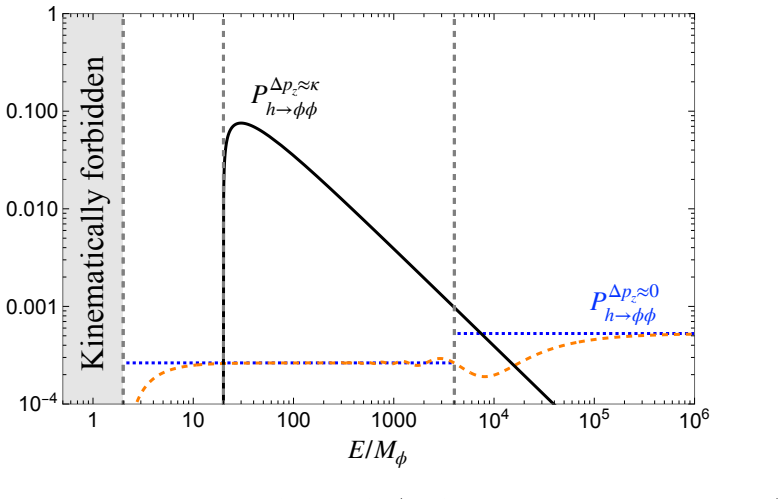
For a bubble-wall profile with n ripples of wavenumber κ, the h→φφ splitting amplitude factorizes into a single-ripple amplitude times a geometric interference sum. Constructive interference occurs whenever the momentum transfer Δp_z equals an integer multiple of κ; the new dominant channel sits at Δp_z=κ and gives the transition probability P≈(2n+1)V_h²/(512 E κ) √(1−2M_φ²/(Eκ)) for E>2M_φ²/κ (Eq. 2.29). The (2n+1) factor means that for n≳κM_φ/T_n² the resonant channel overtakes the smooth-wall contribution. The authors further show that such ripples arise naturally in a classically scale-invariant model, where the post-tunneling Higgs oscillations yield n_eff=O(10–100), and that the extra
What carries the argument
The rippled wall itself: a periodic profile ⟨h(z)⟩=v(1−cos κz)/2 across n periods, producing an interaction vertex that oscillates in space. The amplitude separates into a single-period integral times the geometric series Σ e^{ijΔp_z L}, so the squared amplitude acquires cos²((2n+1)πΔp_z/2κ) factors and, for n≫1, a δ(Δp_z−κ) resonance. This constructive-interference structure is what converts the ripple count n into a multiplicative enhancement of the production probability.
Load-bearing premise
The load-bearing premise is that the ripples imprinted on the bubble wall stay coherent long enough for incident particles to cross several periods; if plasma damping or backreaction erases the oscillatory structure before that, the (2n+1) resonant enhancement disappears and only the smooth-wall channel remains.
What would settle it
A numerical simulation of the post-nucleation scalar field in a supercooled transition that includes plasma friction and backreaction from produced particles, tracking the ripple amplitude over the time a relativistic particle takes to cross a few periods; if the oscillatory amplitude decays substantially within that time, the claimed resonant production is not realized.
If this is right
- For ripple numbers n≳κM_φ/T_n², the resonant Δp_z=κ channel dominates smooth-wall production when the incident energy satisfies E≳2M_φ²/κ, so heavy particles with masses far above the nucleation temperature can be produced much more abundantly than earlier estimates suggested.
- The produced particles exert an additional friction pressure on the wall, scaling as ΔP_φ^(2)≈nV_h²T_n²/(512π²), which in the parameter ranges considered remains below the leading-order plasma and NLO gauge-boson friction unless the gauge coupling is very small.
- In the relic-abundance formula (3.11), the ripple channel effectively replaces the smooth-wall abundance by a factor 1+3(2n+1)M_φ²/(8κγ_wT_n), which moves the dark-matter target to smaller portal couplings and enlarges the viable parameter space.
- The enhancement is peaked: production is most efficient when the incident energy sits on resonance, γ_wT_n~M_φ²/κ, and falls off adiabatically at larger Lorentz factors; hence the effect is tied to the specific supercooling history, not just to the final wall speed.
Where Pith is reading between the lines
- If the periodic wall profile is a stand-in for a general oscillatory Fourier component, the same resonant argument should apply to other processes sensitive to the wall background, such as fermion emission or vector production; the specific h→φφ vertex used here may underestimate or overestimate the total effect depending on the coupling structure.
- A natural observational handle is the relation Eκ~2M_φ² between the ripple scale, the incident particle energy, and the mass of the produced particle; the energy spectrum of the dark-matter candidates would act as a probe of the wall's internal structure.
- The paper assumes the ripples are coherent across the wall plane; if the oscillation phase varies from point to point on the wall, the n-period interference would degrade, and the enhancement would be closer to √n than to n—a testable requirement for lattice simulations of bubble expansion.
Editorial analysis
A structured set of objections, weighed in public.
Referee Report
Summary. The paper studies heavy-particle production from first-order phase-transition bubble walls whose profile is modulated by an oscillatory 'ripple' structure. In Sec. 2 the authors model the wall profile as a truncated cosine, Eq. (2.4), compute the h -> φφ splitting amplitude in the WKB approximation, and identify a new resonant contribution at longitudinal momentum transfer Δp_z = κ. The production probability for this channel scales as (2n+1), Eq. (2.29), leading to an enhancement over the smooth-wall result when the number of ripples n is large. Section 3 translates this into a friction pressure, Eq. (3.5), and a relic abundance, Eqs. (3.9)-(3.11), and Sec. 4 estimates n in a classically scale-invariant model, finding typical values n_eff ~ 10-100. The paper claims that, for sufficiently large n, the resonant channel can dominate production and significantly enhance the abundance of particles much heavier than the phase-transition scale.
Significance. If the resonant enhancement is realized in physical bubble walls, it would constitute a genuinely new production channel for superheavy particles in supercooled phase transitions, with implications for dark-matter relic abundances and wall friction. The paper's central scattering derivation is internally coherent: the resonant peak follows from the Fourier decomposition of the assumed periodic profile, and the geometric-series interpretation in Eq. (2.31) is instructive. The paper also gives a concrete model-based estimate of n_eff, and the abundance formulas contain no fitted parameters. The main weakness is that the enhancement is derived for an ideal static monochromatic ansatz, whereas the physical profile considered in Sec. 4 is chirped, time-dependent, and damped; the paper itself concedes in Sec. 5 that ripple survival is not established. The phenomenological claim therefore remains conditional on an assumption that is not demonstrated quantitatively.
major comments (3)
- [Sec. 2.2.2, Eq. (2.28)-(2.29) versus Sec. 4] The delta-function approximation (2.28) and the (2n+1) enhancement factor rely on the exact static periodic ansatz (2.4), with a single fundamental wavenumber κ over (n+1/2) periods. The physical profile discussed in Sec. 4 is different: the SO(1,3)-symmetric solution h2(τ) in Eq. (4.6) contains a Bessel-function envelope with amplitude decaying as τ^{-3/2} and frequency m, which in the wall rest frame corresponds to a position- and time-dependent local frequency, not a constant κ. Thus the resonant channel and the (2n+1) scaling in Eq. (2.29) are properties of the assumed profile, not consequences of the demonstrated field dynamics. To make the central claim load-bearing, the authors should either derive the production probability for the actual h2(τ) profile (or a realistic approximation to it) and show that a sharp resonance remains, or identify conditions under which Eq. (2.4) is a c
- [Sec. 5, ripple stability] The paper's phenomenological conclusions, Eqs. (3.9)-(3.11), require that the oscillatory structure remain coherent while an incident particle traverses several periods. Sec. 5 explicitly states: 'We have not taken account of the dynamical evolution of the ripple structure' and 'It is not a trivial issue whether the ripples survive during the phase transition.' Plasma damping and backreaction from produced particles could erase the ripples on timescales shorter than the traversal time d ≈ (2n+1)π/κ. Without a quantitative estimate of the damping rate or coherence time, the abundance enhancement shown in Fig. 3 and Eq. (3.11) is not established. This is a load-bearing gap for the central claim, not a mere caveat.
- [Footnote 2, Sec. 2.2.2] The paper reports an unexplained factor-of-1/8 difference from Ref. [10] in the n=0, Δp_z ≪ κ limit. Since the n=0 limit is the natural consistency check against the previous literature, and since Eq. (3.8) is claimed to agree with Ref. [10] only 'up to the prefactor', the source of this discrepancy (e.g., vertex normalization, Fourier convention, or a typographical error) should be identified. If it is a genuine difference in the matrix element, the impact on the absolute production rate should be assessed; if it is a convention issue, it should be stated explicitly.
minor comments (4)
- [Sec. 2.2.2, Eq. (2.25)] The approximation in Eq. (2.25) is stated without derivation or quantitative error bounds. Since it underlies the high-energy threshold behavior, a brief justification or a reference would improve clarity.
- [Fig. 2 and Fig. 3] The figures are informative, but the captions could specify the line styles and shaded regions more explicitly. In particular, Fig. 2's 'only analytic' label is unclear, and Fig. 3's black dashed/solid lines and red/gray regions would benefit from explicit color definitions in the caption.
- [Throughout] The notation h is used for the Higgs field, the Hubble parameter in Ω h^2, and the reduced Planck mass in Eq. (3.2); this is conventional but could be confusing in a few places. A notation summary would help.
- [Sec. 3.2, Eq. (3.11)] The derivation of Eq. (3.11) uses the exponentials e^{-M_φ/(T_n γ_w)} ≈ 1 - M_φ/(T_n γ_w) and e^{-M_φ^2/(T_n κ γ_w)} ≈ 1 - M_φ^2/(T_n κ γ_w). For the parameter choices shown in Fig. 3, one should verify that these linearizations are accurate; otherwise the displayed contours may be misleading in the suppressed regions.
Circularity Check
No significant circularity; the resonant channel is a forward consequence of the assumed periodic profile, and n_eff is estimated independently.
full rationale
The paper's central derivation is self-contained and does not reduce to its inputs by construction. The scattering calculation starts from the explicitly stated periodic wall ansatz in Eq. (2.4), computes the Fourier amplitude in Eq. (2.12), and obtains the resonant probability in Eq. (2.29) using the identity (2.27). The (2n+1) enhancement and the Δp_z=κ resonance follow directly from the number of periods and the wavenumber κ written into the input profile; no quantity in the final abundance is used to infer that profile. The effective ripple number n_eff is estimated separately in Sec. 4 from the SO(1,3) field equations (4.3)-(4.6) and the classically scale-invariant model, not fitted to P_{h→φφ} or Ω_φ. The self-citations in the reference list (e.g., Refs. [14,59,71,72,78]) are contextual and are not load-bearing for the resonance derivation; the framework builds on external work [9,10] and exact analytic solutions [66,67,86]. The skeptical concern that a realistic SO(1,3)-symmetric profile is chirped and time-dependent rather than a static periodic train is a robustness/validity caveat, not circularity. Indeed, Sec. 5 explicitly concedes: 'It is not a trivial issue whether the ripples survive during the phase transition.' That statement weighs on the phenomenological reach of the result, but it does not make the derivation circular: Eqs. (2.28)-(2.29) state what follows if the idealized profile is a good approximation. Therefore no circular step meeting the required evidentiary standard is present.
Axiom & Free-Parameter Ledger
free parameters (5)
- n (number of ripples) =
chosen in examples (e.g., n=100); estimated n_eff≈10-100 in one model
- κ (ripple wavenumber) =
κ=Mφ/10 in Fig. 2; κ=10 TeV in Fig. 3
- h0 (tunneling exit point) =
not fixed analytically; numerically determined in Sec. 4.2
- λ (portal coupling) =
scan parameter in Fig. 3
- Mφ (heavy scalar mass) =
scan parameter in Figs. 2 and 3
axioms (6)
- domain assumption The bubble wall is locally planar, with bubble radius much larger than the production region.
- domain assumption WKB approximation applies with κ≪p_z and negligible z-dependence of particle masses (Mφ≫λ⟨h⟩).
- domain assumption Incident h particles follow a thermal Boltzmann distribution in the plasma frame.
- ad hoc to paper Post-nucleation bubble expansion is SO(1,3)-symmetric and the scalar oscillations are not damped by plasma or backreaction while producing ripples.
- domain assumption The radiative-symmetry-breaking model of Sec. 4.2 provides a representative supercooled transition for estimating n_eff.
- domain assumption Produced φ particles free-stream; there is no subsequent thermalization, annihilation, or shell dynamics.
read the original abstract
We investigate non-thermal particle production during first-order phase transitions in the presence of ultra-relativistic thick bubble walls with non-trivial internal structure. Extending the framework of bubble-expansion particle production, we consider bubble walls containing multiple ripples and study how such spatial modulations affect the production of heavy particles coupled to the order parameter field. By modeling an oscillatory thick-wall profile, we derive the transition probability for particle splitting processes in the wall background, and identify a new contribution associated with momentum transfer from the wall microstructure. In addition to the conventional channel, we find an enhanced production mode arising from resonant momentum exchange with the ripples. For sufficiently large numbers of ripples, the new contribution can dominate the production rate and significantly increase the abundance of particles much heavier than the phase-transition scale. Our results demonstrate that the internal structure of expanding bubble walls can play an important role in particle production and should be taken into account when assessing the cosmological implications of strongly first-order phase transitions.
Figures



Reference graph
Works this paper leans on
-
[1]
Witten,Cosmic Separation of Phases,Phys
E. Witten,Cosmic Separation of Phases,Phys. Rev. D30(1984) 272
1984
-
[2]
C. J. Hogan,Gravitational radiation from cosmological phase transitions,Mon. Not. Roy. Astron. Soc.218(1986) 629
1986
-
[3]
Watkins and L
R. Watkins and L. M. Widrow,Aspects of Reheating in First Order Inflation, Nucl. Phys. B374(1992) 446
1992
-
[4]
A. Falkowski and J. M. No,Non-thermal Dark Matter Production from the Electroweak Phase Transition: Multi-TeV WIMPs and ’Baby-Zillas’,JHEP02 (2013) 034 [1211.5615]
Pith/arXiv arXiv 2013
-
[5]
A. Katz and A. Riotto,Baryogenesis and Gravitational Waves from Runaway Bubble Collisions,JCAP11(2016) 011 [1608.00583]
Pith/arXiv arXiv 2016
-
[6]
M. J. Baker, J. Kopp and A. J. Long,Filtered Dark Matter at a First Order Phase Transition,Phys. Rev. Lett.125(2020) 151102 [1912.02830]
Pith/arXiv arXiv 2020
-
[7]
D. Chway, T. H. Jung and C. S. Shin,Dark matter filtering-out effect during a first-order phase transition,Phys. Rev. D101(2020) 095019 [1912.04238]
Pith/arXiv arXiv 2020
-
[8]
I. Baldes, Y. Gouttenoire and F. Sala,String Fragmentation in Supercooled Confinement and Implications for Dark Matter,JHEP04(2021) 278 [2007.08440]
Pith/arXiv arXiv 2021
-
[9]
A. Azatov and M. Vanvlasselaer,Bubble wall velocity: heavy physics effects,JCAP 01(2021) 058 [2010.02590]
Pith/arXiv arXiv 2021
-
[10]
A. Azatov, M. Vanvlasselaer and W. Yin,Dark Matter production from relativistic bubble walls,JHEP03(2021) 288 [2101.05721]
Pith/arXiv arXiv 2021
-
[11]
I. Baldes, Y. Gouttenoire, F. Sala and G. Servant,Supercool composite Dark Matter beyond 100 TeV,JHEP07(2022) 084 [2110.13926]
Pith/arXiv arXiv 2022
-
[12]
A. Azatov, G. Barni, S. Chakraborty, M. Vanvlasselaer and W. Yin, Ultra-relativistic bubbles from the simplest Higgs portal and their cosmological consequences,JHEP10(2022) 017 [2207.02230]. 25
Pith/arXiv arXiv 2022
-
[13]
I. Baldes, Y. Gouttenoire and F. Sala,Hot and heavy dark matter from a weak scale phase transition,SciPost Phys.14(2023) 033 [2207.05096]
Pith/arXiv arXiv 2023
- [14]
-
[15]
I. Baldes, M. Dichtl, Y. Gouttenoire and F. Sala,Ultrahigh-Energy Particle Collisions and Heavy Dark Matter at Phase Transitions,Phys. Rev. Lett.134 (2025) 061001 [2306.15555]
Pith/arXiv arXiv 2025
-
[16]
H. Mansour and B. Shakya,Particle production from phase transition bubbles, Phys. Rev. D111(2025) 023520 [2308.13070]
Pith/arXiv arXiv 2025
-
[17]
Shakya,Aspects of particle production from bubble dynamics at a first order phase transition,Phys
B. Shakya,Aspects of particle production from bubble dynamics at a first order phase transition,Phys. Rev. D111(2025) 023521 [2308.16224]
Pith/arXiv arXiv 2025
-
[18]
Y. Gouttenoire, E. Kuflik and D. Liu,Heavy baryon dark matter from SU(N) confinement: Bubble wall velocity and boundary effects,Phys. Rev. D109(2024) 035002 [2311.00029]
Pith/arXiv arXiv 2024
-
[19]
G. F. Giudice, H. M. Lee, A. Pomarol and B. Shakya,Nonthermal heavy dark matter from a first-order phase transition,JHEP12(2024) 190 [2403.03252]
Pith/arXiv arXiv 2024
-
[20]
W.-Y. Ai, M. Fairbairn, K. Mimasu and T. You,Non-thermal production of heavy vector dark matter from relativistic bubble walls,JHEP05(2025) 225 [2406.20051]
arXiv 2025
-
[21]
K. Fujikura, S. Girmohanta, Y. Nakai and Z. Zhang,Cold darkogenesis: Dark matter and baryon asymmetry in light of the PTA signal,Phys. Lett. B858 (2024) 139045 [2406.12956]
Pith/arXiv arXiv 2024
-
[22]
I. Baldes, M. Dichtl, Y. Gouttenoire and F. Sala,Particle shells from relativistic bubble walls,JHEP07(2024) 231 [2403.05615]
Pith/arXiv arXiv 2024
-
[23]
H. An and H. Jiang,Particle productions during collisions of highly boosted bubble walls,2607.16398
-
[24]
A. Ghoshal, P. Pal and A. Strumia,Particle production from bubble collisions, 2607.15279. 26
-
[25]
V. A. Kuzmin, V. A. Rubakov and M. E. Shaposhnikov,On the Anomalous Electroweak Baryon Number Nonconservation in the Early Universe,Phys. Lett. B 155(1985) 36
1985
-
[26]
A. G. Cohen, D. B. Kaplan and A. E. Nelson,Progress in electroweak baryogenesis,Ann. Rev. Nucl. Part. Sci.43(1993) 27 [hep-ph/9302210]
Pith/arXiv arXiv 1993
-
[27]
V. A. Rubakov and M. E. Shaposhnikov,Electroweak baryon number nonconservation in the early universe and in high-energy collisions,Usp. Fiz. Nauk166(1996) 493 [hep-ph/9603208]
Pith/arXiv arXiv 1996
-
[28]
Trodden,Electroweak baryogenesis,Rev
M. Trodden,Electroweak baryogenesis,Rev. Mod. Phys.71(1999) 1463 [hep-ph/9803479]
Pith/arXiv arXiv 1999
-
[29]
A. Riotto and M. Trodden,Recent progress in baryogenesis,Ann. Rev. Nucl. Part. Sci.49(1999) 35 [hep-ph/9901362]
Pith/arXiv arXiv 1999
-
[30]
T. Konstandin and G. Servant,Natural Cold Baryogenesis from Strongly Interacting Electroweak Symmetry Breaking,JCAP07(2011) 024 [1104.4793]
Pith/arXiv arXiv 2011
-
[31]
D. E. Morrissey and M. J. Ramsey-Musolf,Electroweak baryogenesis,New J. Phys.14(2012) 125003 [1206.2942]
Pith/arXiv arXiv 2012
-
[32]
K. Fujikura, K. Harigaya, Y. Nakai and I. R. Wang,Electroweak-like baryogenesis with new chiral matter,JHEP07(2021) 224 [2103.05005]
Pith/arXiv arXiv 2021
-
[33]
A. Azatov, M. Vanvlasselaer and W. Yin,Baryogenesis via relativistic bubble walls,JHEP10(2021) 043 [2106.14913]
Pith/arXiv arXiv 2021
-
[34]
I. Baldes, S. Blasi, A. Mariotti, A. Sevrin and K. Turbang,Baryogenesis via relativistic bubble expansion,Phys. Rev. D104(2021) 115029 [2106.15602]
Pith/arXiv arXiv 2021
-
[35]
S. Girmohanta, Y. Nakai and Z. Zhang,Post-Sphaleron Darkogenesis,Phys. Rev. D112(2025) 075028 [2507.03747]
arXiv 2025
-
[36]
Sato,Production of Magnetized Black Holes and Wormholes by First Order Phase Transition in the Early Universe,Prog
K. Sato,Production of Magnetized Black Holes and Wormholes by First Order Phase Transition in the Early Universe,Prog. Theor. Phys.66(1981) 2287
1981
-
[37]
K. Sato, H. Kodama, M. Sasaki and K.-i. Maeda,Multiproduction of Universes by First Order Phase Transition of a Vacuum,Phys. Lett. B108(1982) 103. 27
1982
-
[38]
Izawa and K
M. Izawa and K. Sato,Cosmological First Order Phase Transition and Baryon - Monopole Problem,Prog. Theor. Phys.68(1982) 1574
1982
-
[39]
S. W. Hawking, I. G. Moss and J. M. Stewart,Bubble Collisions in the Very Early Universe,Phys. Rev. D26(1982) 2681
1982
-
[40]
Kodama, M
H. Kodama, M. Sasaki and K. Sato,Abundance of Primordial Holes Produced by Cosmological First Order Phase Transition,Prog. Theor. Phys.68(1982) 1979
1982
-
[41]
I. G. Moss,Singularity formation from colliding bubbles,Phys. Rev. D50(1994) 676
1994
-
[42]
M. Y. Khlopov, R. V. Konoplich, S. G. Rubin and A. S. Sakharov,Formation of black holes in first order phase transitions,hep-ph/9807343
-
[43]
K. Jedamzik and J. C. Niemeyer,Primordial black hole formation during first order phase transitions,Phys. Rev. D59(1999) 124014 [astro-ph/9901293]
Pith/arXiv arXiv 1999
-
[44]
Vachaspati,Magnetic fields from cosmological phase transitions,Phys
T. Vachaspati,Magnetic fields from cosmological phase transitions,Phys. Lett. B 265(1991) 258
1991
-
[45]
G. Baym, D. Bodeker and L. D. McLerran,Magnetic fields produced by phase transition bubbles in the electroweak phase transition,Phys. Rev. D53(1996) 662 [hep-ph/9507429]
Pith/arXiv arXiv 1996
-
[46]
G. Sigl, A. V. Olinto and K. Jedamzik,Primordial magnetic fields from cosmological first order phase transitions,Phys. Rev. D55(1997) 4582 [astro-ph/9610201]
Pith/arXiv arXiv 1997
-
[47]
J. Ahonen and K. Enqvist,Magnetic field generation in first order phase transition bubble collisions,Phys. Rev. D57(1998) 664 [hep-ph/9704334]
Pith/arXiv arXiv 1998
-
[48]
Kosowsky, M
A. Kosowsky, M. S. Turner and R. Watkins,Gravitational Radiation from Colliding Vacuum Bubbles,Phys. Rev. D45(1992) 4514
1992
-
[49]
Kosowsky, M
A. Kosowsky, M. S. Turner and R. Watkins,Gravitational Waves from First Order Cosmological Phase Transitions,Phys. Rev. Lett.69(1992) 2026
1992
-
[50]
A. Kosowsky and M. S. Turner,Gravitational radiation from colliding vacuum bubbles: envelope approximation to many bubble collisions,Phys. Rev. D47 (1993) 4372 [astro-ph/9211004]. 28
Pith/arXiv arXiv 1993
-
[51]
M. Kamionkowski, A. Kosowsky and M. S. Turner,Gravitational radiation from first order phase transitions,Phys. Rev. D49(1994) 2837 [astro-ph/9310044]
Pith/arXiv arXiv 1994
-
[52]
D. J. Weir,Gravitational waves from a first order electroweak phase transition: a brief review,Phil. Trans. Roy. Soc. Lond. A376(2018) 20170126 [1705.01783]
Pith/arXiv arXiv 2018
-
[53]
A. Mazumdar and G. White,Review of cosmic phase transitions: their significance and experimental signatures,Rept. Prog. Phys.82(2019) 076901 [1811.01948]
Pith/arXiv arXiv 2019
-
[54]
C. Caprini et al.,Detecting gravitational waves from cosmological phase transitions with LISA: an update,JCAP03(2020) 024 [1910.13125]
Pith/arXiv arXiv 2020
-
[55]
M. B. Hindmarsh, M. L¨ uben, J. Lumma and M. Pauly,Phase transitions in the early universe,SciPost Phys. Lect. Notes24(2021) 1 [2008.09136]
Pith/arXiv arXiv 2021
-
[56]
P. Athron, C. Bal´ azs, A. Fowlie, L. Morris and L. Wu,Cosmological phase transitions: From perturbative particle physics to gravitational waves,Prog. Part. Nucl. Phys.135(2024) 104094 [2305.02357]. [57]LISA Cosmology Working Groupcollaboration,Gravitational waves from first-order phase transitions in LISA: reconstruction pipeline and physics interpretati...
Pith/arXiv arXiv 2024
-
[58]
D. Bodeker and G. D. Moore,Electroweak Bubble Wall Speed Limit,JCAP05 (2017) 025 [1703.08215]
Pith/arXiv arXiv 2017
-
[59]
Y. Gouttenoire, R. Jinno and F. Sala,Friction pressure on relativistic bubble walls,JHEP05(2022) 004 [2112.07686]
Pith/arXiv arXiv 2022
-
[60]
A. J. Long and J. Turner,Thermal pressure on ultrarelativistic bubbles from a semiclassical formalism,JCAP11(2024) 024 [2407.18196]
Pith/arXiv arXiv 2024
-
[61]
A. Azatov, X. Nagels, M. Vanvlasselaer and W. Yin,Populating secluded dark sector with ultra-relativistic bubbles,JHEP11(2024) 129 [2406.12554]
Pith/arXiv arXiv 2024
-
[62]
M. Dine, R. G. Leigh, P. Y. Huet, A. D. Linde and D. A. Linde,Towards the theory of the electroweak phase transition,Phys. Rev. D46(1992) 550 [hep-ph/9203203]
Pith/arXiv arXiv 1992
-
[63]
D. Bodeker and G. D. Moore,Can electroweak bubble walls run away?,JCAP05 (2009) 009 [0903.4099]. 29
Pith/arXiv arXiv 2009
-
[64]
J. Ellis, M. Lewicki, J. M. No and V. Vaskonen,Gravitational wave energy budget in strongly supercooled phase transitions,JCAP06(2019) 024 [1903.09642]
Pith/arXiv arXiv 2019
-
[65]
A. Azatov, D. Barducci and F. Sgarlata,Gravitational traces of broken gauge symmetries,JCAP07(2020) 027 [1910.01124]
Pith/arXiv arXiv 2020
-
[66]
Fubini,A New Approach to Conformal Invariant Field Theories,Nuovo Cim
S. Fubini,A New Approach to Conformal Invariant Field Theories,Nuovo Cim. A 34(1976) 521
1976
-
[67]
L. N. Lipatov,Divergence of the perturbation-theory series and the quasi-classical theory,Sov. Phys. JETP45(1977) 216
1977
-
[68]
P. Creminelli, A. Nicolis and R. Rattazzi,Holography and the electroweak phase transition,JHEP03(2002) 051 [hep-th/0107141]
Pith/arXiv arXiv 2002
-
[69]
B. von Harling and G. Servant,QCD-induced Electroweak Phase Transition, JHEP01(2018) 159 [1711.11554]
Pith/arXiv arXiv 2018
-
[70]
P. Baratella, A. Pomarol and F. Rompineve,The Supercooled Universe,JHEP03 (2019) 100 [1812.06996]
Pith/arXiv arXiv 2019
-
[71]
K. Fujikura, Y. Nakai and M. Yamada,A more attractive scheme for radion stabilization and supercooled phase transition,JHEP02(2020) 111 [1910.07546]
Pith/arXiv arXiv 2020
-
[72]
K. Fujikura, S. Nakagawa, Y. Nakai, P. Sun and Y. Zhang,Conformal phase transition in supersymmetric QCD,JHEP07(2025) 215 [2503.22293]
Pith/arXiv arXiv 2025
-
[73]
P. Agrawal, G. R. Kane, V. Loladze and M. Reig,Supercooled confinement,JHEP 10(2025) 066 [2504.00199]
arXiv 2025
-
[74]
Witten,Cosmological Consequences of a Light Higgs Boson,Nucl
E. Witten,Cosmological Consequences of a Light Higgs Boson,Nucl. Phys. B177 (1981) 477
1981
-
[75]
S. Iso, N. Okada and Y. Orikasa,Classically conformalB − L extended Standard Model,Phys. Lett. B676(2009) 81 [0902.4050]
Pith/arXiv arXiv 2009
-
[76]
S. Iso, N. Okada and Y. Orikasa,The minimal B-L model naturally realized at TeV scale,Phys. Rev. D80(2009) 115007 [0909.0128]
Pith/arXiv arXiv 2009
-
[77]
T. Konstandin and G. Servant,Cosmological Consequences of Nearly Conformal Dynamics at the TeV scale,JCAP12(2011) 009 [1104.4791]. 30
Pith/arXiv arXiv 2011
-
[78]
R. Jinno and M. Takimoto,Probing a classically conformal B-L model with gravitational waves,Phys. Rev. D95(2017) 015020 [1604.05035]
Pith/arXiv arXiv 2017
-
[79]
J. Jaeckel, V. V. Khoze and M. Spannowsky,Hearing the signal of dark sectors with gravitational wave detectors,Phys. Rev. D94(2016) 103519 [1602.03901]
Pith/arXiv arXiv 2016
-
[80]
S. Iso, P. D. Serpico and K. Shimada,QCD-Electroweak First-Order Phase Transition in a Supercooled Universe,Phys. Rev. Lett.119(2017) 141301 [1704.04955]
Pith/arXiv arXiv 2017
-
[81]
C. Marzo, L. Marzola and V. Vaskonen,Phase transition and vacuum stability in the classically conformal B–L model,Eur. Phys. J. C79(2019) 601 [1811.11169]
Pith/arXiv arXiv 2019
discussion (0)
Sign in with ORCID, Apple, or X to comment. Anyone can read and Pith papers without signing in.