REVIEW 3 major objections 6 minor 204 references
Materials Behavior as Mechanism Ensembles: A Probabilistic Framework for Emergent Behaviors
T0 review · 3 major / 6 minor · reviewed 2026-07-30 · grok-4.5
Pith's one-line read Materials behavior is a probabilistic ensemble of competing unit mechanisms, not a deterministic map from structure to properties.
desk verdict Solid program statement that reframes fatigue as mechanism competition; the math is standard, the hard identification step is openly unsolved, and it deserves referee time as a perspective. read the letter →
The pith
A machine-rendered reading of the paper's core claim, the machinery that carries it, and where it could break.
The reading
What carries the argument
Three coupled conditional distributions—P({Oi}|St,M) for co-active mechanism sets, P(St+Δt|{Oi},St,M) for state transitions, and P(E|S0:t̃,M0:t̃) for macroscopic observables—together with coarse-graining operators that label unit mechanisms from lower-scale trajectories. They carry the argument by making the topology of mechanism dependencies a scientific unknown to be inferred, not a constitutive assumption.
What would settle it
Fuse multiscale simulations with multimodal fatigue experiments, learn the conditional probability of crack reversal, then test whether that landscape prospectively predicts when cracks heal or arrest under withheld microstructures and loads; failure to forecast those tails outside the training set would refute the central claim.
Extended reading notes
Core claim
Complex material phenomena are best understood and designed as conditional probabilistic superpositions of identifiable unit mechanisms. Emergent outcomes such as fatigue crack growth, arrest, and self-healing are set by joint distributions over co-active mechanisms, state transitions, and macroscopic observables, so damage tolerance becomes an inference and optimization problem over mechanism competition rather than a deterministic irreversible process.
Load-bearing premise
That unit mechanisms can be cleanly identified and labeled from lower-scale data, and that how they depend on each other can be learned from simulations and partial experiments well enough to predict and steer outcomes.
Editorial extensions
If this is right
- Damage tolerance can be reframed as Bayesian optimization of the probability of crack arrest or self-healing, not only of Paris-law growth rates.
- Multiscale simulation and multimodal characterization become complementary inputs to one shared probability landscape rather than separate validation exercises.
- The same conditional-probability logic ports to radiation damage, heterogeneous catalysis, and the subcritical transition to turbulence.
- Exceptional properties can be engineered by reshaping mechanism probabilities through grain-size gradients, boundary character, and residual stress.
- Community repositories of mechanism-labeled conditional probabilities become as central as conventional structure–property databases.
Reading between the lines
- If coarse-graining can be automated, scatter once dismissed as measurement noise becomes primary signal about the tails of mechanism competition.
- Closed-loop agentic simulation–experiment cycles would make materials design look more like adaptive control of a moving probability landscape than one-shot optimization.
- Treating mechanism-dependency topology as latent rather than prescribed would force reinterpretation of phenomenological constants (Paris C and m, rate-theory coefficients) as averages over static mechanism mixes.
Editorial analysis
A structured set of objections, weighed in public.
Referee Report
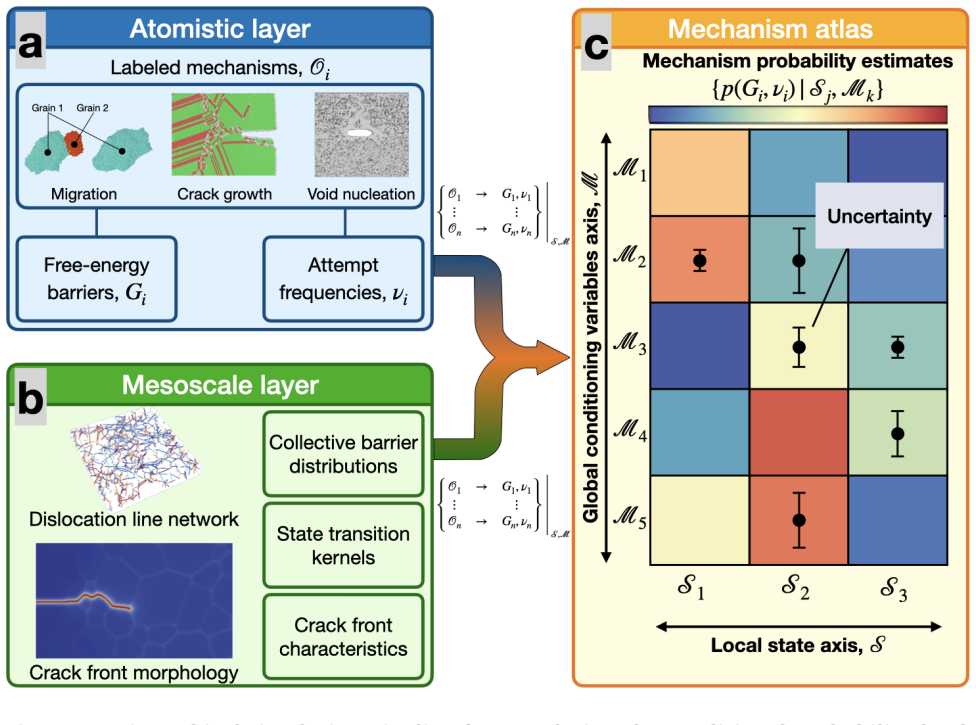
Summary. This perspective proposes that complex materials behavior, especially fatigue crack growth, arrest, and self-healing, be treated as conditional probabilistic ensembles of identifiable unit mechanisms rather than as deterministic structure–property maps or irreversible Paris-law advance. It introduces three coupled conditionals—P({Oi}|St,M), P(St+Δt|{Oi},St,M), and P(E|S0:t̃,M0:t̃)—links activation rates to transition-state theory and Poisson event counts, and shows that marginalization (Eq. 2) recovers a probabilistic generalization of the Paris law in which C and m are calibration averages. A pedagogical crack-tip example (O1–O3), a hierarchical simulation “mechanism atlas,” multimodal latent-space fusion, and Bayesian/closed-loop elicitation of rare outcomes (e.g. P(Δa<0)) are outlined, with Barr et al. nanoscale self-healing as the empirical anchor and brief extensions to radiation damage, catalysis, and subcritical turbulence.
Significance. If the program can be executed, it would reframe damage tolerance as inference and design over mechanism competition, giving a principled place for multiscale simulation, multimodal characterization, and ML inside a single conditional-probability language, and offering a portable template for other systems dominated by competing stochastic pathways. Strengths include an internally consistent formal skeleton (three conditionals, TST rates, Eq. 2 marginalization), explicit demotion of Paris constants to averages rather than circular refits, honest listing of open assumptions (identifiability, automated coarse-graining, continual updating), real experimental anchors (Barr et al.), and public code/data for the illustrative figures. As a perspective it does not claim new verified mechanics; its value is architectural and programmatic.
major comments (3)
- [§3.1–3.2, §6, §8] §3.1–3.2 and the control claims in §6: the load-bearing entry condition is that coarse-graining operators ci can extract labeled, dependency-preserving mechanism occurrences from lower-scale trajectories when couplings are non-local (the pile-up/solute regime flagged in the Introduction). The pedagogical example defines O1–O3 a priori rather than recovering them, and §8 correctly lists automated coarse-graining as open. The manuscript should state more sharply that every later stage (atlas, fusion, Bayesian elicitation of P(Δa<0|{Oi},S,M)) is conditional on operational ci success, and sketch at least one concrete falsifiable test (e.g. recovery of known reverse pathways from labeled MD/TEM streams) so the design ambition is not read as already actionable.
- [§3.2, Eqs. (1)–(2)] Eq. (1)–(2) and the Poisson/weak-dependence approximation: the text notes that event counts may be treated as Poisson “when dependencies are weak over Δt,” yet the rare reverse outcomes (arrest, self-healing) that motivate the framework are precisely those expected when state-mediated couplings are strong. Please clarify how the joint P({Oi}|St,M) and the super-basin picture are to be estimated when the Poisson factorization fails, and what that implies for the variance of Δa that is said to encode tail phenomena—otherwise Eq. 2’s practical use for P(Δa<0) remains underspecified.
- [Abstract, Highlights, §6] Abstract, Highlights, and §6 present “reframing damage tolerance as inference” and “eliciting” exceptional behavior in language that can be read as near-term capability. The body is clearer that this is forward-looking. Align front matter and §6 with the §1/§8 stance (what may become possible; fidelity for prospective control unproven) so the central claim is not oversold relative to the evidence shipped.
minor comments (6)
- [Figure 1] Figure 1 caption: “(g)-(f) crack regrowth events” appears to be a typo (likely (g)–(h)).
- [Nomenclature / §3] Nomenclature lists N both as fatigue cycles and as the index bound on {Oi}N_i=1; a brief disambiguation in the text would help.
- [§4.2] §4.2 heading “collective energy energies” is redundant; “collective energy barriers” matches the body.
- [§6.2] §6.2: “embedded fro instance” → “for instance”.
- [CRediT] CRediT lists “B.S.” among co-authors for writing; no B.S. appears in the author list—please correct.
- [Front matter] Graphical abstract is referenced but not described in text; a one-sentence pointer would help readers of the PDF-only version.
Circularity Check
No significant circularity: a perspective framework that defines conditional distributions and marginal expectations without fitting inputs and relabeling them as predictions.
full rationale
This is a forward-looking perspective, not a closed derivation that forces a numerical claim from its own fitted inputs. The three coupled conditionals P({Oi}|St,M), P(St+Δt|{Oi},St,M), and P(E|S0:t̃,M0:t̃) are postulated structure; Eq. 2 then defines the expected crack increment by marginalizing those distributions—standard probabilistic bookkeeping, not a self-definitional trick that smuggles the target into the premise. Paris-law C and m are explicitly demoted to calibration averages over mechanism/microstructure distributions rather than presented as first-principles outputs. The pedagogical O1–O3 set is labeled as illustrative and a priori, not recovered and then ‘predicted.’ Self-citations (Barr et al. healing observations; authors’ prior ML/fusion/AMD work; the DLIE cycle) supply experimental motivation and tooling context; none is a load-bearing uniqueness theorem that forbids alternatives or forces the central claim. Open assumptions (identifiability of ci, continual updating) are stated as open, which is the opposite of circular closure. Feasibility risks around coarse-graining are real but are correctness/operational concerns, not circularity. Score 0; steps empty.
Assumptions & free parameters
free parameters (3)
- Time discretization Δt (cycle or few-cycle step)
- Attempt frequencies ν0,i and site multiplicities Ni(S)
- Paris-law C, m (as calibration averages)
assumptions (7)
- domain assumption Emergent fatigue outcomes arise from conditional co-activation of scale-relative constituent mechanisms Oi rather than a single irreversible mechanism.
- ad hoc to paper Joint mechanism activation, state transitions, and macroscopic observables factor as the three conditional distributions in §3.1, with conditional dependencies to be inferred rather than prescribed by constitutive rules.
- domain assumption Thermally activated rates ṗOi=ν0,i Ni exp(−ΔGi/kBT) and, when dependencies are weak over Δt, Poisson event counts with mean λi=ṗOi Δt are adequate first approximations.
- ad hoc to paper Global variables M evolve more slowly than local state S; mechanisms are identifiable/labelable; Δt sits between event and macro-damage scales.
- ad hoc to paper Coarse-graining operators ci map lower-scale trajectories to mechanism occurrences Oi usable in the probabilistic model.
- domain assumption Multimodal experimental signals and heterogeneous simulations can be aligned in a shared latent representation that preserves mechanism identity well enough for quantitative inference of P(Oi|S,M).
- ad hoc to paper Once P(E|{Oi},S,M) is learned with sufficient fidelity, Bayesian optimization and microstructural engineering can raise probabilities of desired tails (e.g. P(Δa<0)).
invented entities (3)
-
Mechanism atlas
-
Discover–Learn–Interpret–Elicit (DLIE) cycle
-
Shared latent space for experiment–simulation fusion
Cite this review
Pith. "Pith review of Materials Behavior as Mechanism Ensembles: A Probabilistic Framework for Emergent Behaviors." pith.science (2026). https://pith.science/paper/27OMDK7U
@misc{pith2026260727163,
  author       = {Pith},
  title        = {Pith review of: Materials Behavior as Mechanism Ensembles: A Probabilistic Framework for Emergent Behaviors},
  year         = {2026},
  howpublished = {\url{https://pith.science/paper/27OMDK7U}},
  note         = {Machine review of arXiv:2607.27163}
}
read the original abstract
Materials behavior is often treated as a deterministic mapping from structure to properties, yet many important phenomena emerge from the conditional activation of multiple mechanisms across scales. This is especially evident in fatigue of metals, where crack growth is typically modeled as monotonic and irreversible process, despite evidence that local microstructure, loading history, and competing unit processes can shift the balance among propagation, arrest, and self-healing. Here we present a probabilistic framework that describes materials behavior as an ensemble of constituent mechanisms whose activation, interaction, and evolution determine emergent outcomes. The framework connects mechanism activation, state evolution, and macroscopic observables in a probabilistic way. In the case of fatigue crack propagation, it reframes damage tolerance as an inference problem over mechanism competition and provides a basis for integrating multiscale simulation, multimodal characterization, and machine learning. The same logic extends to other physical and chemical systems suggesting a portable framework for any system in which emergent behavior reflects mechanism competition under changing conditions. The broader ambition of this perspective review is a shift from correlating structure and performance after the fact to identifying, in advance, the conditions that make desired emergent behavior probable.
Figures


Figures from the paper (5 more)


Reference graph
Works this paper leans on
-
[1]
H. Risken, Fokker–Planck equation, in: The Fokker–Planck Equation: Methods of Solution and Applications, Springer, 1989, pp. 63–95. doi:10.1007/978-3-642-61544-3_4
-
[2]
R. Jordan, D. Kinderlehrer, F. Otto, The variational formulation of the Fokker–Planck equation, SIAM Journal on Mathematical Analysis 29 (1998) 1–17. doi:10.1137/S0036141096303359
-
[3]
M. Andersen, C. Panosetti, K. Reuter, A practical guide to surface kinetic Monte Carlo simula- tions, Frontiers in Chemistry 7 (2019) 202. doi:10.3389/fchem.2019.00202
arXiv 2019
-
[4]
Z. Shen, R. Wagoner, W. Clark, Dislocation and grain boundary interactions in metals, Acta Metallurgica 36 (1988) 3231–3242. doi:10.1016/0001-6160(88)90058-2
- [5]
-
[6]
Dingreville, D
R. Dingreville, D. Aksoy, D. Spearot, A primer on selecting grain boundary sets for comparison of interfacial fracture properties in molecular dynamics simulations, Scientific Reports 7 (2017)
2017
-
[7]
A. Pineau, D. McDowell, E. Busso, S. Antolovich, Failure of metals II: Fatigue, Acta Materialia 107 (2016) 484–507. doi:10.1016/j.actamat.2015.05.050
-
[8]
D. McDowell, Nonequilibrium statistical thermodynamics of thermally activated dislocation en- sembles: part 1: subsystem reactions under constrained local equilibrium, Journal of Materials Science 59 (2024) 5093–5125. doi:10.1007/s10853-023-09165-0
Show all 204 references
-
[9]
D. McDowell, Nonequilibrium statistical thermodynamics of thermally activated dislocation en- sembles: part 2—ensemble evolution toward correlation of enthalpy barriers, Journal of Materials Science 59 (2024) 5126–5160. doi:10.1007/s10853-023-09142-7
2024 doi
-
[10]
McDowell, Z.-K
D. McDowell, Z.-K. Liu, Hierarchical nonequilibrium thermodynamics of thermally activated dislocation plasticity of metals and alloys, International Journal of Plasticity (2025) 104303. doi:10.1016/j.ijplas.2025.104303. 28
2025
-
[11]
Brailsford, R
A. Brailsford, R. Bullough, The rate theory of swelling due to void growth in irradiated metals, Journal of Nuclear Materials 44 (1972) 121–135. doi:10.1016/0022-3115(72)90091-8
1972 doi
-
[12]
Mansur, Void swelling in metals and alloys under irradiation: an assessment of the theory, Nuclear Technology 40 (1978) 5–34
L. Mansur, Void swelling in metals and alloys under irradiation: an assessment of the theory, Nuclear Technology 40 (1978) 5–34. doi:10.13182/NT78-2
1978 doi
-
[13]
Johnson, Reaction kinetics in process of nucleation and growth, Transactions of the American Institute of Mining and Metallurgical Engineers 135 (1939) 416–458
W. Johnson, Reaction kinetics in process of nucleation and growth, Transactions of the American Institute of Mining and Metallurgical Engineers 135 (1939) 416–458
1939
-
[14]
Avrami, Kinetics of phase change
M. Avrami, Kinetics of phase change. I: General theory, The Journal of Chemical Physics 7 (1939) 1103–1112. doi:10.1063/1.1750380
1939 doi
-
[15]
Kolmogorov, On the statistical theory of metal crystallization, Izvestiya Akademii Nauk SSSR, Seriya Matematicheskaya (1937) 335–360
A. Kolmogorov, On the statistical theory of metal crystallization, Izvestiya Akademii Nauk SSSR, Seriya Matematicheskaya (1937) 335–360
1937
-
[16]
Suresh, Fatigue of Materials, Cambridge University Press, 1998
S. Suresh, Fatigue of Materials, Cambridge University Press, 1998. doi:10.1017/ CBO9780511806575
1998
-
[17]
Mettu, V
S. Mettu, V. Shivakumar, J. Beeck, F. Yeh, L. Williams, R. Forman, J. McMahon, J. Newman, NASGRO 3.0: A software for analyzing aging aircraft, in: The Second Joint NASA/FAA/DoD Conference on Aging Aircraft, Pt. 2, 1999
1999
-
[18]
McClung, M
R. McClung, M. Enright, Y.-D. Lee, J. Moody, J. Sobotka, V. Bhamidipati, S. Fitch, B. Guseman, J. Dubk, N. Howard, et al., Probabilistic integrity and risk assessment of turbine engines (2018). URL:https://rosap.ntl.bts.gov/view/dot/57705
2018
-
[19]
C. Barr, T. Duong, D. Bufford, Z. Milne, A. Molkeri, N. Heckman, D. Adams, A. Srivastava, K. Hattar, M. Demkowicz, et al., Autonomous healing of fatigue cracks via cold welding, Nature 620 (2023) 552–556. doi:10.1038/s41586-023-06223-0
2023 doi
-
[20]
Bufford, D
D. Bufford, D. Stauffer, W. Mook, S. Syed Asif, B. Boyce, K. Hattar, High cycle fatigue in the transmissionelectronmicroscope, NanoLetters16(2016)4946–4953.doi:10.1021/acs.nanolett. 6b01560
2016 doi
-
[21]
Pierron, C
O. Pierron, C. Abnet, C. Muhlstein, Methodology for low- and high-cycle fatigue characterization with kHz-frequency resonators, Sensors and Actuators A: Physical 128 (2006) 140–150. doi:10. 1016/j.sna.2006.01.013
2006
-
[22]
Montes de Oca Zapiain, M
D. Montes de Oca Zapiain, M. Wood, N. Lubbers, C. Pereyra, A. Thompson, D. Perez, Train- ing data selection for accuracy and transferability of interatomic potentials, npj Computational Materials 8 (2022) 189. doi:10.1038/s41524-022-00872-x
2022 doi
-
[23]
Galvelis, A
R. Galvelis, A. Varela-Rial, S. Doerr, R. Fino, P. Eastman, T. Markland, J. Chodera, G. De Fab- ritiis, NNP/MM: Accelerating molecular dynamics simulations with machine learning potentials and molecular mechanics, Journal of Chemical Information and Modeling 63 (2023) 5701–570...
2023 doi
-
[24]
McCabe, B
M. McCabe, B. Régaldo-Saint Blancard, L. Parker, R. Ohana, M. Cranmer, A. Bietti, M. Eick- enberg, S. Golkar, G. Krawezik, F. Lanusse, M. Pettee, T. Tesileanu, K. Cho, S. Ho, Multiple physics pretraining for physical surrogate models, arXiv:2310.02994 (2023). doi:10.48550/arXi...
-
[25]
J. Tsao, R. Abbott, D. Crowder, S. Desai, R. Dingreville, J. Fowler, A. Garland, P. Iyer, J. Mur- dock, S. Steinmetz, et al., AI for technoscientific discovery: A human-inspired architecture, Journal of Creativity 34 (2024) 100077. doi:10.1016/j.yjoc.2024.100077. 29
2024
-
[26]
Dingreville, R
R. Dingreville, R. Karnesky, G. Puel, J.-H. Schmitt, Review of the synergies between computa- tional modeling and experimental characterization of materials across length scales, Journal of Materials Science 51 (2016) 1178–1203. doi:10.1007/s10853-015-9551-6
2016 doi
-
[27]
Polák, V
J. Polák, V. Mazánová, M. Heczko, I. Kuběna, J. Man, Profiles of persistent slip markings and internal structure of underlying persistent slip bands, Fatigue & Fracture of Engineering Materials & Structures 40 (2017) 1101–1116. doi:10.1111/ffe.12567
2017 doi
-
[28]
Chowdhury, H
P. Chowdhury, H. Sehitoglu, Mechanisms of fatigue crack growth—a critical digest of theoretical developments, Fatigue & Fracture of Engineering Materials & Structures 39 (2016) 652–674. doi:10.1111/ffe.12392
2016 doi
-
[29]
Mughrabi, H
H. Mughrabi, H. Höppel, Cyclic deformation and fatigue properties of very fine-grained metals and alloys, International Journal of Fatigue 32 (2010) 1413–1427. doi:10.1016/j.ijfatigue. 2009.10.007
2010 doi
-
[30]
Padilla, B
H. Padilla, B. Boyce, A review of fatigue behavior in nanocrystalline metals, Experimental Mechanics 50 (2010) 5–23. doi:10.1007/s11340-009-9301-2
2010 doi
-
[31]
Furnish, D
T. Furnish, D. Bufford, F. Ren, A. Mehta, K. Hattar, B. Boyce, Evidence that abnormal grain growth precedes fatigue crack initiation in nanocrystalline Ni-Fe, Scripta Materialia 143 (2018) 15–19. doi:10.1016/j.scriptamat.2017.08.047
2018 doi
-
[32]
E. Chen, P. Hamilton, B. Boyce, R. Dingreville, The heterogeneous nature of mechanically accelerated grain growth, Journal of Materials Science 57 (2022) 21743–21755. doi:10.1007/ s10853-022-07974-3
2022
-
[33]
C. Qiu, M. Punke, Y. Tian, Y. Han, S. Wang, Y. Su, M. Salvalaglio, X. Pan, D. Srolovitz, J. Han, Grain boundaries are Brownian ratchets, Science 385 (2024) 980–985. doi:10.1126/science. adp1516
2024 doi
-
[34]
L. Lu, Q. Pan, K. Hattar, B. Boyce, Fatigue and fracture of nanostructured metals and alloys, MRS Bulletin 46 (2021) 258–264. doi:10.1557/s43577-021-00054-y
2021 doi
-
[35]
Farkas, M
D. Farkas, M. Willemann, B. Hyde, Atomistic mechanisms of fatigue in nanocrystalline metals, Physical Review Letters 94 (2005) 165502. doi:10.1103/PhysRevLett.94.165502
2005 doi
-
[36]
M. Jain, D. Vizoso, A. Hinojos, A. Barrios, K. Dorman, Y. Yang, D. Adams, K. Hattar, D. Medlin, O. Pierron, R. Dingreville, B. Boyce, Putting fatigue to rest via solute-pinned boundaries, Mate- rials Today 93 (2026) 103187. doi:10.1016/j.mattod.2026.103187
2026
-
[37]
Pineau, A
A. Pineau, A. Benzerga, T. Pardoen, Failure of metals III: Fracture and fatigue of nanostructured metallic materials, Acta Materialia 107 (2016) 508–544. doi:10.1016/j.actamat.2015.07.049
2016 doi
-
[38]
Payam, O
A. Payam, O. Payton, L. Picco, S. Moore, T. Martin, A. Warren, M. Mostafavi, D. Knowles, Development of fatigue testing system for in-situ observation of stainless steel 316 by HS-AFM & SEM, International Journal of Fatigue 127 (2019) 1–9. doi:10.1016/j.ijfatigue.2019.05.015
2019 doi
-
[39]
Stinville, M
J. Stinville, M. Charpagne, A. Cervellon, S. Hemery, F. Wang, P. Callahan, V. Valle, T. Pollock, On the origins of fatigue strength in crystalline metallic materials, Science 377 (2022) 1065–1071. doi:10.1126/science.abn0392
2022 doi
-
[40]
Yokota, J
H. Yokota, J. Kaneshiro, Y. Uesu, Optical second harmonic generation microscopy as a tool of materialdiagnosis, PhysicsResearchInternational2012(2012)704634.doi:10.1155/2012/704634. 30
2012 doi
-
[41]
Shafiei, T
F. Shafiei, T. Orzali, A. Vert, M.-A. Miri, P. Hung, M. Wong, A. Alù, G. Bersuker, M. Downer, Detection of subsurface, nanometer-scale crystallographic defects by nonlinear light scattering and localization, Advanced Optical Materials 9 (2021) 2002252. doi:10.1002/adom.202002252
2021 doi
-
[42]
Hristu, S
R. Hristu, S. Stanciu, D. Tranca, A. Matei, G. Stanciu, Nonlinear optical imaging of defects in cubic silicon carbide epilayers, Scientific Reports 4 (2014) 5258. doi:10.1038/srep05258
2014 doi
-
[43]
Bozhevolnyi, J
S. Bozhevolnyi, J. Beermann, V. Coello, Direct observation of localized second-harmonic enhancement in random metal nanostructures, Physical Review Letters 90 (2003) 197403. doi:10.1103/PhysRevLett.90.197403
2003 doi
-
[44]
Prylepa, C
A. Prylepa, C. Reitböck, M. Cobet, A. Jesacher, X. Jin, R. Adelung, M. Schatzl-Linder, G. Luck- eneder, K.-H. Stellnberger, T. Steck, J. Faderl, T. Stehrer, D. Stifter, Material characterisation with methods of nonlinear optics, Journal of Physics D: Applied Physics 51 (2018) ...
2018 doi
-
[45]
Rellaford, S
K. Rellaford, S. Averett, A. Farnsworth, D. Adams, S. Smith, D. Fullwood, J. Patterson, Charac- terization of mechanical deformation in aluminum by optical second harmonic generation, Mea- surement Science and Technology 32 (2021) 075202. doi:10.1088/1361-6501/abe668
2021 doi
-
[47]
G. Xu, M. Demkowicz, Healing of nanocracks by disclinations, Physical Review Letters 111 (2013) 145501. doi:10.1103/PhysRevLett.111.145501
2013 doi
-
[48]
Chakraborty, A
A. Chakraborty, A. Kohnert, A. Hunter, L. Capolungo, Role of interfaces on the mechanical response of accumulative roll bonded nanometallic laminates investigated via dislocation dy- namics simulations, Journal of Materials Science: Materials Theory 8 (2024) 3. doi:10.1186/ s4...
2024
-
[49]
Bieberdorf, M
N. Bieberdorf, M. Asta, L. Capolungo, Grain boundary effects in high-temperature liquid-metal dealloying: a multi-phase field study, npj Computational Materials 9 (2023) 127. doi:10.1038/ s41524-023-01076-7
2023
-
[50]
Miehe, F
C. Miehe, F. Welschinger, M. Hofacker, Thermodynamically consistent phase-field models of fracture: Variational principles and multi-field FE implementations, International Journal for Numerical Methods in Engineering 83 (2010) 1273–1311. doi:10.1002/nme.2861
2010 doi
-
[51]
Miehe, M
C. Miehe, M. Hofacker, F. Welschinger, A phase field model for rate-independent crack propaga- tion: Robust algorithmic implementation based on operator splits, Computer Methods in Applied Mechanics and Engineering 199 (2010) 2765–2778. doi:10.1016/j.cma.2010.04.011
2010 doi
-
[52]
F. Duda, A. Ciarbonetti, P. Sánchez, A. Huespe, A phase-field/gradient damage model for brittle fracture in elastic–plastic solids, International Journal of Plasticity 65 (2015) 269–296. doi:10. 1016/j.ijplas.2014.09.005
2015
-
[53]
Miehe, S
C. Miehe, S. Teichtmeister, F. Aldakheel, Phase-field modelling of ductile fracture: a variational gradient-extended plasticity-damage theory and its micromorphic regularization, Philosophical Transactions of the Royal Society A: Mathematical, Physical and Engineering Sciences...
2016
-
[54]
Svolos, H
L. Svolos, H. Mourad, G. Manzini, K. Garikipati, A fourth-order phase-field fracture model: Formulation and numerical solution using a continuous/discontinuous Galerkin method, Journal of the Mechanics and Physics of Solids 165 (2022) 104910. doi:10.1016/j.jmps.2022.104910
2022
-
[55]
Svolos, Q.-T
L. Svolos, Q.-T. Tran, I. Boureima, V. Anghel, K. Garikipati, H. Mourad, A phase-field fracture formulation for generalized standard materials: The interplay between thermome- chanics and damage, Journal of the Mechanics and Physics of Solids 201 (2025) 106154. doi:10.1016/j.j...
2025
-
[56]
Livingston, S
E. Livingston, S. Srivastava, J. Holber, H. Mourad, K. Garikipati, Inference of phase field frac- ture models, Journal of the Mechanics and Physics of Solids (2025) 106495. doi:10.2139/ssrn. 5668578
2025 doi
-
[57]
Koller, N
D. Koller, N. Friedman, Probabilistic Graphical Models: Principles and Techniques, MIT Press, 2009
2009
-
[58]
Kalidindi, A Bayesian framework for materials knowledge systems, MRS Communications 9 (2019) 518–531
S. Kalidindi, A Bayesian framework for materials knowledge systems, MRS Communications 9 (2019) 518–531. doi:10.1557/mrc.2019.56
2019 doi
-
[59]
Walker, J
E. Walker, J. Actor, C. Martinez, N. Trask, Flow-based parameterization for DAG and feature discovery in scientific multimodal data, Frontiers in Mechanical Engineering 10 (2024) 1408649. doi:10.3389/fmech.2024.1408649
2024
-
[60]
Robertson, A
A. Robertson, A. Venkatraman, A. Generale, S. Kalidindi, Probabilistic materials informatics, in: Physical Metallurgy, Elsevier, 2026, pp. 2783–2942. doi:10.1016/B978-0-443-21710-4.00023-9
2026 doi
-
[61]
W. Chen, M. Fuge, Beyond the known: Detecting novel feasible domains over an unbounded design space, Journal of Mechanical Design 139 (2017) 111405. doi:10.1115/1.4037306
2017 doi
-
[62]
Robertson, A
A. Robertson, A. Generale, C. Kelly, M. Buzzy, S. Kalidindi, MICRO2D: A large, statistically di- verse, heterogeneous microstructure dataset, Integrating Materials and Manufacturing Innovation 13 (2024) 120–154. doi:10.1007/s40192-023-00340-4
2024 doi
- [63]
-
[64]
Plimpton, D
S. Plimpton, D. Perez, A. Voter, Parallel algorithms for hyperdynamics and local hyperdynamics, The Journal of Chemical Physics 153 (2020). doi:10.1063/5.0014448
2020 doi
-
[65]
Zotov, B
N. Zotov, B. Grabowski, Entropy of kink pair formation on screw dislocations: an accelerated molecular dynamics study, Modelling and Simulation in Materials Science and Engineering 30 (2022) 065004. doi:10.1088/1361-651X/ac7ac9
2022 doi
-
[66]
Kästner, Umbrella sampling, Wiley Interdisciplinary Reviews: Computational Molecular Sci- ence 1 (2011) 932–942
J. Kästner, Umbrella sampling, Wiley Interdisciplinary Reviews: Computational Molecular Sci- ence 1 (2011) 932–942. doi:10.1002/wcms.66
2011 doi
-
[67]
Zamora, B
R. Zamora, B. Uberuaga, D. Perez, A. Voter, The modern temperature-accelerated dynamics approach, Annual Review of Chemical and Biomolecular Engineering 7 (2016) 87–110. doi:10. 1146/annurev-chembioeng-080615-033608
2016
-
[68]
Voter, M
A. Voter, M. Sørensen, Accelerating atomistic simulations of defect dynamics: hyperdynamics, parallel replica dynamics, and temperature-accelerated dynamics, MRS Online Proceedings Li- brary 538 (1998) 427–439. doi:10.1557/PROC-538-427. 32
1998 doi
-
[69]
D. Shaw, R. Dror, J. Salmon, J. Grossman, K. Mackenzie, J. Bank, C. Young, M. Deneroff, B. Batson, K. Bowers, et al., Millisecond-scale molecular dynamics simulations on Anton, in: ProceedingsoftheConferenceonHighPerformanceComputingNetworking, StorageandAnalysis, 2009, pp. 1–...
2009
-
[70]
Y. Zuo, C. Chen, X. Li, Z. Deng, Y. Chen, J. Behler, G. Csányi, A. Shapeev, A. Thompson, M. Wood, et al., Performance and cost assessment of machine learning interatomic potentials, The Journal of Physical Chemistry A 124 (2020) 731–745. doi:10.1021/acs.jpca.9b08723
2020 doi
-
[71]
Musil, A
F. Musil, A. Grisafi, A. Bartók, C. Ortner, G. Csányi, M. Ceriotti, Physics-inspired structural representations for molecules and materials, Chemical Reviews 121 (2021) 9759–9815. doi:10. 1021/acs.chemrev.1c00021
2021
-
[72]
doi:10.1016/j.jcp.2024.113073
J.Goff, C.Sievers, M.Wood, A.Thompson, Permutation-adaptedcompleteandindependentbasis for atomic cluster expansion descriptors, Journal of Computational Physics 510 (2024) 113073. doi:10.1016/j.jcp.2024.113073
2024
-
[73]
Choudhary, D
K. Choudhary, D. Wines, K. Li, K. Garrity, V. Gupta, A. Romero, J. Krogel, K. Saritas, A. Fuhr, P. Ganesh, et al., JARVIS-leaderboard: a large scale benchmark of materials design methods, npj Computational Materials 10 (2024) 93. doi:10.1038/s41524-024-01259-w
2024 doi
-
[74]
Rohskopf, C
A. Rohskopf, C. Sievers, N. Lubbers, M. Cusentino, J. Goff, J. Janssen, M. McCarthy, D. Montes Oca de Zapiain, S. Nikolov, K. Sargsyan, et al., FitSNAP: Atomistic machine learning with LAMMPS, Journal of Open Source Software 8 (2023) 5118. doi:10.21105/joss.05118
2023 doi
-
[75]
M. Wood, M. Cusentino, B. Wirth, A. Thompson, Data-driven material models for atomistic simulation, Physical Review B 99 (2019) 184305. doi:10.1103/PhysRevB.99.184305
2019 doi
-
[76]
Bartók, J
A. Bartók, J. Kermode, N. Bernstein, G. Csányi, Machine learning a general-purpose interatomic potential for silicon, Physical Review X 8 (2018) 041048. doi:10.1103/PhysRevX.8.041048
2018 doi
-
[77]
M. Daw, M. Chandross, Simple parameterization of embedded atom method potentials for FCC alloys, Acta Materialia 248 (2023) 118772. doi:10.1016/j.actamat.2023.118772
2023
-
[78]
Mendelev, M
M. Mendelev, M. Kramer, C. Becker, M. Asta, Analysis of semi-empirical interatomic potentials appropriate for simulation of crystalline and liquid Al and Cu, Philosophical Magazine 88 (2008) 1723–1750. doi:10.1080/14786430802206482
2008 doi
-
[79]
Sobie, N
C. Sobie, N. Bertin, L. Capolungo, Analysis of obstacle hardening models using dislocation dynamics: application to irradiation-induced defects, Metallurgical and Materials Transactions A 46 (2015) 3761–3772. doi:10.1007/s11661-015-2935-z
2015 doi
-
[80]
Sobie, L
C. Sobie, L. Capolungo, D. McDowell, E. Martinez, Scale transition using dislocation dynamics and the nudged elastic band method, Journal of the Mechanics and Physics of Solids 105 (2017) 161–178. doi:10.1016/j.jmps.2017.05.004
2017 doi
-
[81]
Sobie, L
C. Sobie, L. Capolungo, D. McDowell, E. Martinez, Thermal activation of dislocations in large scale obstacle bypass, Journal of the Mechanics and Physics of Solids 105 (2017) 150–160. doi:10. 1016/j.jmps.2017.05.003
2017
-
[82]
Capolungo, V
L. Capolungo, V. Taupin, GD3: Generalized discrete defect dynamics, Materials Theory 3 (2019) 1–21. doi:10.1186/s41313-018-0013-9
2019 doi
-
[83]
Montes de Oca Zapiain, J
D. Montes de Oca Zapiain, J. Stewart, R. Dingreville, Accelerating phase-field-based microstruc- ture evolution predictions via surrogate models trained by machine learning methods, npj Com- putational Materials 7 (2021) 3. doi:10.1038/s41524-020-00471-8. 33
2021 doi
-
[84]
Oommen, K
V. Oommen, K. Shukla, S. Goswami, R. Dingreville, G. Karniadakis, Learning two-phase mi- crostructure evolution using neural operators and autoencoder architectures, npj Computational Materials 8 (2022) 190. doi:10.1038/s41524-022-00876-7
2022 doi
-
[85]
Oommen, K
V. Oommen, K. Shukla, S. Desai, R. Dingreville, G. Karniadakis, Rethinking materials simula- tions: Blending direct numerical simulations with neural operators, npj Computational Materials 10 (2024) 145. doi:10.1038/s41524-024-01319-1
2024 doi
-
[86]
Dingreville, A
R. Dingreville, A. Robertson, V. Attari, M. Greenwood, N. Ofori-Opoku, M. Ramesh, P. Voorhees, Q. Zhang, Benchmarking machine learning strategies for phase-field problems, Modelling and Sim- ulation in Materials Science and Engineering 32 (2024) 065019. doi:10.1088/1361-651X/ad5f4a
2024 doi
-
[87]
Johansson, E
A. Johansson, E. Weinberg, C. Trott, M. McCarthy, S. Moore, LAMMPS-KOKKOS: Performance portable molecular dynamics across exascale architectures, in: Proceedings of the SC’25 Work- shops of the International Conference for High Performance Computing, Networking, Storage and An...
2025
-
[88]
J. Goff, C. Mullen, S. Yang, O. Starovoytov, M. Wood, Generalized representative structures for atomistic systems, Journal of Physics: Condensed Matter 37 (2024) 075901. doi:10.1088/ 1361-648X/ad9791
2024
-
[89]
Hudson, J
S. Hudson, J. Larson, J.-L. Navarro, S. Wild, libEnsemble: A library to coordinate the concurrent evaluation of dynamic ensembles of calculations, IEEE Transactions on Parallel and Distributed Systems 33 (2022) 977–988. doi:10.1109/TPDS.2021.3082815
2022
-
[90]
Hudson, J
S. Hudson, J. Larson, J.-L. Navarro, S. Wild, libEnsemble: A complete Python toolkit for dynamic ensembles of calculations, Journal of Open Source Software 8 (2023) 6031. doi:10.21105/joss. 06031
2023 doi
-
[91]
Bertin, L
N. Bertin, L. Capolungo, A FFT-based formulation for discrete dislocation dynamics in heteroge- neous media, Journal of Computational Physics 355 (2018) 366–384. doi:10.1016/j.jcp.2017. 11.020
2018 doi
-
[92]
Kohnert, L
A. Kohnert, L. Capolungo, Spectral discrete dislocation dynamics with anisotropic short range interactions, Computational Materials Science 189 (2021) 110243. doi:10.1016/j.commatsci. 2020.110243
2021
-
[93]
Bamney, L
D. Bamney, L. Capolungo, Assessing the predictive capabilities of precipitation strengthening models for deformation twinning in Mg alloys using phase-field simulations, Journal of Magnesium and Alloys 11 (2023) 4525–4541. doi:10.1016/j.jma.2023.07.008
2023 doi
-
[94]
Bulatov, F
V. Bulatov, F. Abraham, L. Kubin, B. Devincre, S. Yip, Connecting atomistic and mesoscale simulations of crystal plasticity, Nature 391 (1998) 669–672. doi:10.1038/35577
1998 doi
-
[95]
Dimiduk, C
D. Dimiduk, C. Woodward, R. LeSar, M. Uchic, Scale-free intermittent flow in crystal plasticity, Science 312 (2006) 1188–1190. doi:10.1126/science.1123889
2006 doi
-
[96]
Zaiser, Scale invariance in plastic flow of crystalline solids, Advances in Physics 55 (2006) 185–245
M. Zaiser, Scale invariance in plastic flow of crystalline solids, Advances in Physics 55 (2006) 185–245. doi:10.1080/00018730600583514
2006 doi
-
[97]
Sobie, L
C. Sobie, L. Capolungo, D. McDowell, E. Martinez, Modal analysis of dislocation vibration and reaction attempt frequency, Acta Materialia 134 (2017) 203–210. doi:10.1016/j.actamat.2017. 02.005. 34
2017 doi
-
[98]
Vizoso, R
D. Vizoso, R. Dingreville, Dataset of simulated vibrational density of states and X-ray diffraction profiles of mechanically deformed and disordered atomic structures in gold, iron, magnesium, and silicon, Data in Brief 55 (2024) 110689. doi:10.1016/j.dib.2024.110689
2024
-
[99]
Vizoso, R
D. Vizoso, R. Dingreville, Decoding diffraction and spectroscopy data with machine learning: A tutorial, Journal of Applied Physics 137 (2025). doi:10.1063/5.0255593
2025 doi
-
[100]
Vizoso, A
D. Vizoso, A. Baker, D. Medlin, S. House, R. Dingreville, A machine-learning approach to measure 3D sample properties from 2D transmission electron microscopy images, Measurement (2025) 119554. doi:10.1016/j.measurement.2025.119554
2025
-
[101]
M. Pinz, G. Weber, J. Stinville, T. Pollock, S. Ghosh, Data-driven Bayesian model-based predic- tion of fatigue crack nucleation in Ni-based superalloys, npj Computational Materials 8 (2022)
2022
-
[102]
Enakoutsa, Y
K. Enakoutsa, Y. Li, Hierarchical Bayesian inference for multiscale plasticity and dam- age with neural network surrogate models, Mathematics and Mechanics of Solids (2026) 10812865261428579. doi:10.1177/10812865261428579
2026 doi
-
[103]
doi:10.1038/s41524-022-00727-5
-
[104]
Duschatko, J
B. Duschatko, J. Vandermause, N. Molinari, B. Kozinsky, Uncertainty driven active learning of coarse grained free energy models, npj Computational Materials 10 (2024) 9. doi:10.1038/ s41524-023-01183-5
2024
-
[105]
Y. Tian, S. Bagchi, L. Myhill, G. Po, E. Martinez, Y. Lin, N. Mathew, D. Perez, Data-driven modeling of dislocation mobility from atomistics using physics-informed machine learning, npj computational materials 10 (2024) 219. doi:10.1038/s41524-024-01394-4
2024 doi
-
[106]
Hindmarsh, P
A. Hindmarsh, P. Brown, K. Grant, S. Lee, R. Serban, D. Shumaker, C. Woodward, SUNDIALS: Suite of nonlinear and differential/algebraic equation solvers, ACM Transactions on Mathematical Software 31 (2005) 363–396. doi:10.1145/1089014.1089020
2005
-
[107]
doi:10.1016/j.cma.2025.118434
J.Holber, K.Garikipati, Physics-anddata-drivenactivelearningofneuralnetworkrepresentations for free energy density functions of materials from statistical mechanics, Computer Methods in Applied Mechanics and Engineering 448 (2026) 118434. doi:10.1016/j.cma.2025.118434
2026
-
[108]
Reynolds, D
D. Reynolds, D. Gardner, C. Woodward, R. Chinomona, ARKODE: A flexible IVP solver in- frastructure for one-step methods, ACM Transactions on Mathematical Software 49 (2023). doi:10.1145/3594632
2023 doi
-
[109]
Gardner, D
D. Gardner, D. Reynolds, C. Woodward, C. Balos, Enabling new flexibility in the SUNDIALS suite of nonlinear and differential/algebraic equation solvers, ACM Transactions on Mathematical Software 48 (2022). doi:10.1145/3539801
2022 doi
-
[110]
Bertin, V
N. Bertin, V. Bulatov, F. Zhou, Learning dislocation dynamics mobility laws from large-scale MD simulations, npj Computational Materials 10 (2024) 192. doi:10.1038/s41524-024-01378-4
2024 doi
-
[111]
Herman, J
E. Herman, J. Stewart, R. Dingreville, A data-driven surrogate model to rapidly predict mi- crostructure morphology during physical vapor deposition, Applied Mathematical Modelling 88 (2020) 589–603. doi:10.1016/j.apm.2020.06.046
2020 doi
-
[112]
Teichert, A
G. Teichert, A. Natarajan, A. Van der Ven, K. Garikipati, Scale bridging materials physics: Active learning workflows and integrable deep neural networks for free energy function representations in alloys, Computer Methods in Applied Mechanics and Engineering 371 (2020) 113281...
2020
-
[113]
Teichert, A
G. Teichert, A. Natarajan, A. Van der Ven, K. Garikipati, Machine learning materials physics: Integrable deep neural networks enable scale bridging by learning free energy functions, Computer Methods in Applied Mechanics and Engineering 353 (2019) 201–216. doi:10.1016/j.cma.20...
2019 doi
- [114]
-
[115]
Shojaei, J
M. Shojaei, J. Holber, S. Das, G. Teichert, T. Mueller, L. Hung, V. Gavini, K. Garikipati, Bridging scales with machine learning: From first principles statistical mechanics to continuum phase field computations to study order–disorder transitions in lixcoo2, Journal of the Me...
2024
-
[116]
Chernatynskiy, S
A. Chernatynskiy, S. Phillpot, R. LeSar, Uncertainty quantification in multiscale simulation of materials: A prospective, Annual Review of Materials Research 43 (2013) 157–182. doi:10.1146/ annurev-matsci-071312-121708
2013
-
[117]
Zhang, K
X. Zhang, K. Garikipati, Label-free learning of elliptic partial differential equation solvers with generalizability across boundary value problems, Computer Methods in Applied Mechanics and Engineering 417 (2023) 116214. doi:10.1016/j.cma.2023.116214
2023
-
[118]
Trask, C
N. Trask, C. Martinez, T. Shilt, E. Walker, K. Lee, A. Garland, D. Adams, J. Curry, M. Dugger, S. Larson, et al., Unsupervised physics-informed disentanglement of multimodal materials data, Materials Today 80 (2024) 286–296. doi:10.1016/j.mattod.2024.09.005
2024 doi
-
[119]
McDowell, Simulation-assisted materials design for the concurrent design of materials and products, JOM 59 (2007) 21–25
D. McDowell, Simulation-assisted materials design for the concurrent design of materials and products, JOM 59 (2007) 21–25. doi:10.1007/s11837-007-0111-7
2007 doi
-
[120]
Curtarolo, G
S. Curtarolo, G. Hart, M. Nardelli, N. Mingo, S. Sanvito, O. Levy, The high-throughput highway to computational materials design, Nature Materials 12 (2013) 191–201. doi:10.1038/nmat3568
2013 doi
-
[121]
Walker, N
E. Walker, N. Trask, C. Martinez, K. Lee, J. Actor, S. Saha, T. Shilt, D. Vizoso, R. Dingreville, B. Boyce, Unsupervised physics-informed disentanglement of multimodal data, Foundations of Data Science 7 (2025) 418–445. doi:10.3934/fods.2024019
2025 doi
-
[122]
Swinburne, Coarse-graining and forecasting atomic material simulations with descriptors, Physical Review Letters 131 (2023) 236101
T. Swinburne, Coarse-graining and forecasting atomic material simulations with descriptors, Physical Review Letters 131 (2023) 236101. doi:10.1103/PhysRevLett.131.236101
2023 doi
-
[123]
Rosenbrock, E
C. Rosenbrock, E. Homer, G. Csányi, G. Hart, Discovering the building blocks of atomic systems using machine learning: application to grain boundaries, npj Computational Materials 3 (2017)
2017
-
[124]
doi:10.1038/s41524-017-0027-x
-
[125]
Smolyaninov, A
I. Smolyaninov, A. Zayats, C. Davis, Near-field second harmonic generation from a rough metal surface, Physical Review B 56 (1997) 9290. doi:10.1103/PhysRevB.56.9290
1997 doi
- [126]
- [127]
-
[128]
Rahman, R
M. Rahman, R. George, M. Elleithy, D. Leibovici, Z. Li, B. Bonev, C. White, J. Berner, R. Yeh, J. Kossaifi, et al., Pretraining codomain attention neural operators for solving multiphysics PDEs, in: Advances in Neural Information Processing Systems, volume 37, 2024, pp. 104035...
2024 doi
-
[129]
Robertson, S
A. Robertson, S. Kalidindi, Digital representation and quantification of discrete dislocation struc- tures, JOM 73 (2021) 2143–2158. doi:10.1007/s11837-021-04669-z. 36
2021 doi
-
[130]
McCabe, B
M. McCabe, B. Régaldo-Saint Blancard, L. Parker, R. Ohana, M. Cranmer, A. Bietti, M. Eicken- berg, S. Golkar, G. Krawezik, F. Lanusse, et al., Multiple physics pretraining for spatiotemporal surrogate models, in: Advances in Neural Information Processing Systems, volume 37, 20...
2024 doi
-
[131]
P. Xu, X. Zhu, D. Clifton, Multimodal learning with transformers: A survey, IEEE Transactions on Pattern Analysis and Machine Intelligence 45 (2023) 12113–12132. doi:10.1109/TPAMI.2023. 3275156
2023 doi
-
[132]
Vaswani, N
A. Vaswani, N. Shazeer, N. Parmar, J. Uszkoreit, L. Jones, A. Gomez, Ł. Kaiser, I. Polosukhin, Attention is all you need, in: Advances in Neural Information Processing Systems, volume 30,
-
[133]
Radford, J
A. Radford, J. Kim, C. Hallacy, A. Ramesh, G. Goh, S. Agarwal, G. Sastry, A. Askell, P. Mishkin, J. Clark, et al., Learning transferable visual models from natural language su- pervision, in: International Conference on Machine Learning, PMLR, 2021, pp. 8748–8763. doi:10.48550...
-
[134]
Z. Liu, Y. Lin, Y. Cao, H. Hu, Y. Wei, Z. Zhang, S. Lin, B. Guo, Swin transformer: Hierar- chical vision transformer using shifted windows, in: Proceedings of the IEEE/CVF International Conference on Computer Vision, 2021, pp. 10012–10022. doi:10.1109/ICCV48922.2021.00986
2021
-
[135]
Lipton, The mythos of model interpretability: In machine learning, the concept of interpretabil- ity is both important and slippery, Queue 16 (2018) 31–57
Z. Lipton, The mythos of model interpretability: In machine learning, the concept of interpretabil- ity is both important and slippery, Queue 16 (2018) 31–57. doi:10.1145/3236386.3241340
2018
- [136]
-
[137]
McCabe, P
M. McCabe, P. Mukhopadhyay, T. Marwah, B. Blancard, F. Rozet, C. Diaconu, L. Meyer, K. Wong, H. Sotoudeh, A. Bietti, I. Espejo, R. Fear, S. Golkar, T. Hehir, K. Hirashima, G. Krawezik, F. Lanusse, R. Morel, R. Ohana, L. Parker, M. Pettee, J. Shen, K. Cho, M. Cran- mer, S. Ho, ...
-
[138]
Horwath, X.-M
J. Horwath, X.-M. Lin, H. He, Q. Zhang, E. Dufresne, M. Chu, S. Sankaranarayanan, W. Chen, S. Narayanan, M. Cherukara, AI-NERD: Elucidation of relaxation dynamics beyond equilibrium through AI-informed X-ray photon correlation spectroscopy, Nature Communications 15 (2024)
2024
-
[139]
Musaelian, S
A. Musaelian, S. Batzner, A. Johansson, L. Sun, C. Owen, M. Kornbluth, B. Kozinsky, Learning local equivariant representations for large-scale atomistic dynamics, Nature Communications 14 (2023) 579. doi:10.1038/s41467-023-36329-y
2023 doi
-
[140]
Batatia, D
I. Batatia, D. Kovacs, G. Simm, C. Ortner, G. Csanyi, MACE: Higher order equivariant message passing neural networks for fast and accurate force fields, in: Advances in Neural Information Processing Systems, 2022. doi:10.52202/068431-0830
2022 doi
-
[141]
Murdoch, C
W. Murdoch, C. Singh, K. Kumbier, R. Abbasi-Asl, B. Yu, Definitions, methods, and applications in interpretable machine learning, Proceedings of the National Academy of Sciences 116 (2019) 22071–22080. doi:10.1073/pnas.1900654116
2019 doi
-
[142]
Kozinsky, A
B. Kozinsky, A. Musaelian, A. Johansson, S. Batzner, Scaling the leading accuracy of deep equiv- ariant models to biomolecular simulations of realistic size, in: Proceedings of the International Conference for High Performance Computing, Networking, Storage and Analysis, 2023,...
2023
-
[143]
Batzner, A
S. Batzner, A. Musaelian, L. Sun, M. Geiger, J. Mailoa, M. Kornbluth, N. Molinari, T. Smidt, B. Kozinsky, E(3)-equivariant graph neural networks for data-efficient and accurate interatomic potentials, Nature Communications 13 (2022) 2453. doi:10.1038/s41467-022-29939-5. 37
2022 doi
-
[144]
Desai, S
S. Desai, S. Addamane, J. Tsao, I. Brener, R. Dingreville, P. Iyer, Self-driving lab discovers princi- ples for steering spontaneous emission beyond conventional fourier optics, Nature Communications (2025). doi:10.1038/s41467-025-66916-0
2025 doi
-
[145]
Desai, S
S. Desai, S. Addamane, J. Tsao, I. Brener, L. Swiler, R. Dingreville, P. Iyer, AutoSciLab: A self- driving laboratory for interpretable scientific discovery, in: Proceedings of the AAAI Conference on Artificial Intelligence, volume 39, 2025, pp. 146–154. doi:10.1609/aaai.v39i1.31990
2025 doi
-
[146]
C. Tan, M. Descoteaux, M. Kotak, G. de Miranda Nascimento, S. Kavanagh, L. Zichi, M. Wang, A. Saluja, Y. Hu, T. Smidt, et al., High-performance training and inference for deep equivariant interatomic potentials, Digital Discovery 5 (2026) 1558–1567. doi:10.1039/D5DD00423C
2026 doi
-
[147]
Andrejevic, T
N. Andrejevic, T. Zhou, Q. Zhang, S. Narayanan, M. Cherukara, M. Chan, Data-driven discovery of dynamics from time-resolved coherent scattering, npj Computational Materials 10 (2024) 225. doi:10.1038/s41524-024-01365-9
2024 doi
-
[148]
Desai, A
S. Desai, A. Strachan, Parsimonious neural networks learn interpretable physical laws, Scientific Reports 11 (2021) 12761. doi:10.1038/s41598-021-92278-w
2021 doi
-
[149]
Z. Wang, X. Huan, K. Garikipati, Variational system identification of the partial differential equations governing microstructure evolution in materials: Inference over sparse and spatially unrelated data, Computer Methods in Applied Mechanics and Engineering 377 (2021) 113706...
2021
- [150]
-
[151]
Desai, P
S. Desai, P. Iyer, R. Dingreville, Learning interpretable surface elasticity properties from bulk properties via neural network equation learners, International Journal of Mechanical Sciences (2026) 111218. doi:10.1016/j.ijmecsci.2026.111218
2026
- [152]
-
[153]
Z. Wang, X. Huan, K. Garikipati, Variational system identification of the partial differential equations governing the physics of pattern-formation: Inference under varying fidelity and noise, Computer Methods in Applied Mechanics and Engineering 356 (2019) 44–74. doi:10.1016/...
2019 doi
- [154]
- [155]
- [156]
- [157]
- [158]
-
[159]
Sadybekov, V
A. Sadybekov, V. Katritch, Computational approaches streamlining drug discovery, Nature 616 (2023) 673–685. doi:10.1038/s41586-023-05905-z
2023 doi
-
[160]
Vriza, M
A. Vriza, M. Prince, T. Zhou, H. Chan, M. Cherukara, Operating advanced scientific instruments with AI agents that learn on the job, npj Computational Materials (2026). doi:10.21203/rs.3. rs-7706574/v1
2026 doi
- [161]
- [162]
- [163]
-
[164]
Shahriari, K
B. Shahriari, K. Swersky, Z. Wang, R. Adams, N. Freitas, Taking the human out of the loop: A review of Bayesian optimization (2016). doi:10.1109/JPROC.2015.2494218
2016
-
[165]
Greenhill, S
S. Greenhill, S. Rana, S. Gupta, P. Vellanki, S. Venkatesh, Bayesian optimization for adaptive experimental design: A review, IEEE Access 8 (2020). doi:10.1109/ACCESS.2020.2966228
2020
-
[166]
Prince, H
M. Prince, H. Chan, A. Vriza, T. Zhou, V. Sastry, Y. Luo, M. Dearing, R. Harder, R. Vasudevan, M. Cherukara, Opportunities for retrieval and tool augmented large language models in scientific facilities, npj Computational Materials 10 (2024) 251. doi:10.1038/s41524-024-01423-2
2024 doi
-
[167]
R. Lam, D. Allaire, K. Willcox, Multifidelity optimization using statistical surrogate modeling for non-hierarchical information sources, in: 56th AIAA/ASCE/AHS/ASC Structures, Structural Dynamics, and Materials Conference, 2015. doi:10.2514/6.2015-0143. 39
2015 doi
- [168]
- [169]
- [170]
-
[171]
Huang, T
D. Huang, T. Allen, W. Notz, R. Miller, Sequential kriging optimization using multiple fidelity evaluations, Structural and Multidisciplinary Optimization 32 (2006). doi:10.1007/ s00158-005-0587-0
2006
-
[172]
Gorodetsky, J
A. Gorodetsky, J. Jakeman, G. Geraci, MFNets: Data efficient all-at-once learning of multifidelity surrogates as directed networks of information sources, Computational Mechanics 68 (2021) 741–
2021
- [173]
-
[174]
X. Zeng, G. Geraci, A. Gorodetsky, J. Jakeman, R. Ghanem, Boosting efficiency and reducing graph reliance: Basis adaptation integration in Bayesian multi-fidelity networks, Computer Meth- ods in Applied Mechanics and Engineering 436 (2025) 117657. doi:10.1016/j.cma.2024.117657
2025
-
[175]
Swersky, J
K. Swersky, J. Snoek, R. Adams, Multi-task Bayesian optimization, in: Advances in Neural Information Processing Systems, 2013
2013
-
[176]
Folch, R
J. Folch, R. Lee, B. Shafei, D. Walz, C. Tsay, M. van der Wilk, R. Misener, Combining multi- fidelity modelling and asynchronous batch Bayesian optimization, Computers and Chemical En- gineering 172 (2023). doi:10.1016/j.compchemeng.2023.108194
2023
-
[177]
Ferran Pousa, S
A. Ferran Pousa, S. Jalas, M. Kirchen, A. Martinez de la Ossa, M. Thévenet, S. Hudson, J. Larson, A. Huebl, J.-L. Vay, R. Lehe, Bayesian optimization of laser-plasma accelerators assisted by reduced physical models, Physical Review Accelerators and Beams 26 (2023) 084601. doi:...
2023
-
[178]
Larson, M
J. Larson, M. Menickelly, J. O’Neal, S. Wild, Interpolation-based composite derivative-free opti- mization, 2026. URL:https://github.com/POptUS/IBCDFO. doi:10.11578/dc.20240627.2
2026 doi
-
[179]
J. Jakeman, PyApprox: A software package for sensitivity analysis, Bayesian inference, opti- mal experimental design, and multi-fidelity uncertainty quantification and surrogate modeling, Environmental Modelling & Software 170 (2023) 105825. doi:10.1016/j.envsoft.2023.105825
2023
-
[180]
Zheng, J.-S
W. Zheng, J.-S. Park, P. Kenesei, A. Ali, Z. Liu, I. Foster, N. Schwarz, R. Kettimuthu, A. Miceli, H. Sharma, Rapid detection of rare events from in situ X-ray diffraction data using machine learning, Journal of Applied Crystallography 57 (2024). doi:10.1107/S160057672400517X
2024 doi
-
[181]
X. Li, L. Lu, J. Li, X. Zhang, H. Gao, Mechanical properties and deformation mechanisms of gradient nanostructured metals and alloys, Nature Reviews Materials 5 (2020) 706–723. doi:10. 1038/s41578-020-0212-2
2020
-
[182]
Larson, S
J. Larson, S. Billups, Stochastic derivative-free optimization using a trust region framework, Com- putational Optimization and Applications 64 (2016) 619–645. doi:10.1007/s10589-016-9827-z
2016 doi
-
[183]
Zhang, K
X. Zhang, K. Hattar, Y. Chen, L. Shao, J. Li, C. Sun, K. Yu, N. Li, M. Taheri, H. Wang, et al., Radiation damage in nanostructured materials, Progress in Materials Science 96 (2018) 217–321. doi:10.1016/j.pmatsci.2018.03.002
2018 doi
-
[184]
A. Dunn, R. Dingreville, E. Martínez, L. Capolungo, Synchronous parallel spatially resolved stochastic cluster dynamics, Computational Materials Science 120 (2016) 43–52. doi:10.1016/j. commatsci.2016.04.013
2016 doi
-
[185]
Chard, I
K. Chard, I. Foster, S. Tuecke, Globus: Research data management as service and platform, in: Practice and Experience in Advanced Research Computing 2017: Sustainability, Success and Impact, 2017, pp. 1–5. doi:10.1145/3093338.3093367
2017
-
[186]
Schauermann, H.-J
S. Schauermann, H.-J. Freund, Model approach in heterogeneous catalysis: Kinetics and thermodynamics of surface reactions, Accounts of Chemical Research 48 (2015) 2775–2782. doi:10.1021/acs.accounts.5b00237
2015 doi
-
[187]
Kiani, I
D. Kiani, I. Wachs, Practical considerations for understanding surface reaction mechanisms in- volved in heterogeneous catalysis, ACS Catalysis 14 (2024) 16770–16784. doi:10.1021/acscatal. 4c05188
2024 doi
-
[188]
J. Li, Z. Wang, N. Zhang, T. Shi, E. Gilbert, G. Chen, G. Qian, Crack-tip plasticity mediated grain refinement and its resisting effect on the fatigue short crack growth, International Journal of Plasticity 181 (2024) 104102. doi:10.1016/j.ijplas.2024.104102. 40
2024
-
[189]
Greeley, Theoretical heterogeneous catalysis: Scaling relationships and computational catalyst design, Annual Review of Chemical and Biomolecular Engineering 7 (2016) 605–635
J. Greeley, Theoretical heterogeneous catalysis: Scaling relationships and computational catalyst design, Annual Review of Chemical and Biomolecular Engineering 7 (2016) 605–635. doi:10.1146/ annurev-chembioeng-080615-034413
2016
-
[190]
S. Dey, G. Dhal, Property and structure of various platinum catalysts for low-temperature carbon monoxide oxidations, Materials Today Chemistry 16 (2020) 100228. doi:10.1016/j.mtchem.2019. 100228
2020 doi
-
[191]
T. Cui, L. Li, C. Ye, X. Li, C. Liu, S. Zhu, W. Chen, D. Wang, Heterogeneous single atom environmental catalysis: Fundamentals, applications, and opportunities, Advanced Functional Materials 32 (2022) 2108381. doi:10.1002/adfm.202108381
2022 doi
-
[192]
Pineda, M
M. Pineda, M. Stamatakis, Kinetic Monte Carlo simulations for heterogeneous catalysis: Fundamentals, current status, and challenges, The Journal of Chemical Physics 156 (2022). doi:10.1063/5.0083251
2022 doi
-
[193]
D. Chen, C. Shang, Z.-P. Liu, Machine-learning atomic simulation for heterogeneous catalysis, npj Computational Materials 9 (2023) 2. doi:10.1038/s41524-022-00959-5
2023 doi
-
[194]
Bligaard, J
T. Bligaard, J. Nørskov, S. Dahl, J. Matthiesen, C. Christensen, J. Sehested, The Brønsted– Evans–Polanyi relation and the volcano curve in heterogeneous catalysis, Journal of Catalysis 224 (2004) 206–217. doi:10.1016/j.jcat.2004.02.034
2004 doi
-
[195]
Rangarajan, Learning catalytic kinetic models from data: Current and emerging methods, Current Opinion in Chemical Engineering 52 (2026) 101240
S. Rangarajan, Learning catalytic kinetic models from data: Current and emerging methods, Current Opinion in Chemical Engineering 52 (2026) 101240. doi:10.1016/j.coche.2026.101240
2026
-
[196]
Avila, D
M. Avila, D. Barkley, B. Hof, Transition to turbulence in pipe flow, Annual Review of Fluid Mechanics 55 (2023) 575–602. doi:10.1146/annurev-fluid-120720-025957
2023 doi
-
[197]
N. Zhao, F. Dong, Y.-H. Kang, L. Wu, Z. Tang, Research progress and future challenges of CO catalytic oxidation catalysts: Preparation, catalytic performance, reaction mechanism and anti-poisoning strategies, Journal of Materials Chemistry A (2026). doi:10.1039/D5TA09749E
2026 doi
-
[198]
Russakovsky, J
O. Russakovsky, J. Deng, H. Su, J. Krause, S. Satheesh, S. Ma, Z. Huang, A. Karpathy, A. Khosla, M. Bernstein, et al., ImageNet large scale visual recognition challenge, International Journal of Computer Vision 115 (2015) 211–252. doi:10.1007/s11263-015-0816-y
2015 doi
-
[199]
Horton, P
M. Horton, P. Huck, R. Yang, J. Munro, S. Dwaraknath, A. Ganose, R. Kingsbury, M. Wen, J. Shen, T. Mathis, et al., Accelerated data-driven materials science with the materials project, Nature Materials 24 (2025) 1522–1532. doi:10.1038/s41563-025-02272-0. 42
2025 doi
-
[200]
T. Mou, H. Pillai, S. Wang, M. Wan, X. Han, N. Schweitzer, F. Che, H. Xin, Bridging the complexity gap in computational heterogeneous catalysis with machine learning, Nature Catalysis 6 (2023) 122–136. doi:10.1038/s41929-023-00911-w
2023 doi
-
[203]
B. Yang, Y. Zhuang, G. Yalnız, V. Mukund, E. Marensi, B. Hof, Discontinuous transition to shear flow turbulence, Nature Physics (2026) 1–6. doi:10.1038/s41567-025-03166-3. 41
2026 doi
-
[758]
doi:10.1007/s00466-021-02042-0
- [2017]
-
[5945]
doi:10.1038/s41467-024-49381-z
-
[8332]
doi:10.1038/s41598-017-08637-z
Reviewed July 30, 2026 · model on record in the stance chip above.
Discussion (0). Continue with ORCID to comment.