REVIEW 4 major objections 4 minor 300 references
Back from the Future: Key-Value Cache Management by Counter-Causal Surprise
T0 review · 4 major / 4 minor · reviewed 2026-08-01 · deepseek-v4-flash
Pith's one-line read Tokens that later context predicts well are redundant and safe to evict from a language model's key-value cache.
desk verdict A promising training-free eviction heuristic, but the 'counter-causal surprise' score leaks the token's own information through cached future states, so the paper's mechanistic story needs rework. read the letter →
The pith
A machine-rendered reading of the paper's core claim, the machinery that carries it, and where it could break.
The reading
What carries the argument
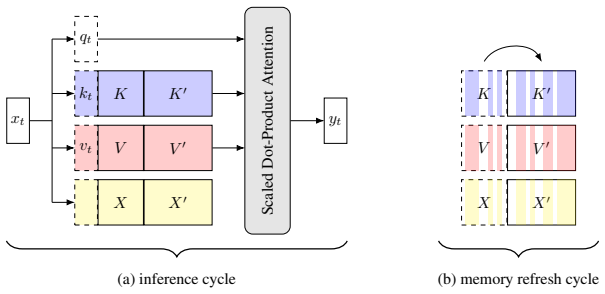
The central object is the counter-causal surprise score s_i = 1 - P(x_i | x_{i+1:t}), approximated by running the model's forward pass with an upper-triangular attention mask over the cached key and value tensors (re-using stored K/V with original RoPE positions) and taking the logit of x_i. The score ranks which KV pairs are redundant: low surprise means later context already carries the information. The fast variant restricts the pass to the last layer, storing penultimate activations, to cut refresh cost to O(n^2).
What would settle it
Construct a synthetic context with a unique but highly predictable fact (e.g., a name appearing once in a predictable phrase) required to answer a later question, then run the method at small cache size: if the fact token is evicted and the answer degrades compared to attention-based eviction, the redundancy premise fails for exact retrieval.
Extended reading notes
Core claim
The authors propose that if the present context predicts a past token well, the model need not remember that token to predict the future. They implement this as counter-causal surprise, computed by an upper-triangular attention mask over cached keys and values, reusing the existing cache in-distribution with no training. Tokens with high surprise are retained; low-surprise tokens are evicted. The central empirical finding is that this criterion preserves generation accuracy at fixed cache budgets on MATH500, AIME thinking-mode, LongHealth, Qasper, and LoCoMo, and in particular protects rarely-attended facts, where attention-based eviction fails.
Load-bearing premise
The load-bearing premise is that if later tokens can predict a past token well, then that past token carries no information the model will need later — but a token can be locally predictable and still be the only place a fact is stored for exact retrieval later.
Editorial extensions
If this is right
- A training-free scoring pass over the existing cache can serve as a principled eviction policy for any autoregressive transformer with a KV cache.
- Because surprise is computed from future context rather than accumulated attention, it does not suffer from the self-reinforcing retention bias of attention-based heavy-hitter methods.
- The last token in the cache always receives maximum surprise and is always retained, giving a built-in recency bias.
- The fast single-layer approximation provides most of the accuracy gain at 7-9x lower refresh latency, making the approach practical for long-context decode.
- For decode-heavy settings like thinking-mode reasoning, counter-causal eviction preserves reasoning coherence better than sliding window, importance, or H2O at high eviction pressure.
Reading between the lines
- A natural extension is to combine counter-causal scoring with phrase- or sentence-level eviction, which the paper itself flags, to protect tokens that are locally predictable but globally irreplaceable (e.g., names or numbers).
- The scoring could be applied as a post-hoc compression of already-generated prompts without re-running the model, since it reuses cached keys and values rather than requiring a fresh forward pass.
- The counter-causal logit might also serve as a signal for cache compression (merging redundant values) rather than only hard eviction.
- The method's weakness on exact retrieval suggests a hybrid policy that adds a retrieval-aware bonus for entity tokens, testable on fact-retrieval benchmarks.
Editorial analysis
A structured set of objections, weighed in public.
Referee Report
Summary. The paper proposes a training-free KV cache eviction scheme based on a counter-causal surprise score. For each cached token, the score is computed by running the model with an upper-triangular attention mask over the already-cached keys and values, so that each position attends only to later positions. Tokens with high surprise (poorly predicted by their future context) are retained; tokens with low surprise are evicted. A faster variant restricts the scoring pass to the last transformer layer. The method is evaluated on MATH500, AIME, LongHealth, Qasper, and LoCoMo with Qwen2.5-3B/7B/14B and LLaMA-3.1-8B, comparing against sliding-window, an attention-importance baseline, and a simplified H2O baseline. The authors report competitive or improved accuracy at fixed cache sizes, with a 7--9x refresh speedup for the fast variant. The central claim is that counter-causal surprise identifies tokens whose information is already contained in later context, avoiding the self-reinforcing attention bias of H2O/TOVA-style methods.
Significance. If the central claim were fully supported, the paper would contribute a simple, model-agnostic, training-free eviction signal that is fundamentally different from attention-based scores, with potential value in long-context and long-decoding settings. The idea of using the model's own predictive ability to estimate redundancy is appealing, and the authors provide reference code and report a careful efficiency analysis of the refresh overhead. However, the empirical validation is weakened by two factors: the scoring procedure appears to suffer from causal self-leakage that undermines the counter-causal interpretation, and the comparisons are against simplified or self-implemented baselines rather than the actual cited state-of-the-art methods. These issues are load-bearing for the paper's main claim, so the result, while potentially useful as a heuristic, is not yet established at the level claimed.
major comments (4)
- [§3.1, Eq. (5)] The score is not actually P(x_i | x_{i+1:t}) as claimed. The cached K/V for positions j>i were computed by the standard causal forward pass, so the hidden states at j already encode information about x_i through attention over earlier positions. When position i attends to those cached future representations, the predictor has direct access to x_i itself. Thus the logit does not measure whether the remaining cache can 'compensate for the absence of xi' — the future representations were constructed with xi present. The Limitations paragraph admits an approximation but does not identify this self-leakage or quantify its effect. Please either re-compute future hidden states with x_i masked out (or otherwise characterize the leakage) and compare rankings, or substantially revise the interpretation of the score and the claims that depend on it.
- [§4, Tables 2–3 and Fig. 5] The experimental comparison is against simplified versions of the cited methods. 'Importance' is described as 'a simplified version of the heavy-hitter oracle' and 'similar in spirit to TOVA'; 'Heavy-hitter' is implemented using 'the most recent keys as a proxy for queries'. The actual H2O and TOVA algorithms, and the layer-adaptive methods PyramidKV and Ada-KV, are not run or compared with published numbers. The abstract and conclusion claim 'competitive or improved performance over other state-of-the-art methods', but the evidence supports only a comparison with the authors' simplified baselines. Please compare against reference implementations of at least H2O and TOVA, and include PyramidKV/Ada-KV or justify their exclusion with direct experiments rather than an argument about shared attention bias.
- [§4.2, Table 2; §4.3, Table 3] All reported accuracies come from a single greedy rollout with no error bars or multiple seeds. Several differences are small (e.g., 0.744 vs 0.762 on Qwen2.5-7B in Table 2; 0.367 vs 0.333 in Table 3), so without variance estimates the reported ordering may not be statistically meaningful. Please provide repeated-run statistics or seed variance for at least one benchmark per setting, and apply the same to Figure 5.
- [Limitations] The manuscript itself acknowledges that 'some individual tokens may be easily predicted from nearby context causing counter-causal surprise to underestimate their importance on exact retrieval tasks and evict them from the cache.' This is a load-bearing limitation for the central claim, because the method's rationale is that low surprise implies redundancy for future prediction. LoCoMo, one of the key benchmarks, requires exact-phrase retrieval from long conversations, and the paper's own discussion of H2O failures shows that exact-retrieval failures are the main source of degradation. Please add an explicit exact-retrieval stress test or report the failure mode on LoCoMo, and qualify the central claim accordingly.
minor comments (4)
- [§3.1 / Algorithm] The text states that the last token is assigned maximum surprise and always retained, but the pseudocode in DOMEMREFRESH does not implement this exception explicitly (it simply takes the top-J of all scores). Clarify which behavior is used in experiments.
- [§3.1 / Algorithm] The pseudocode uses the probability notation '1 − P(X_t | X_{t+1:J+h})' while Section 3.1 says the implementation uses the logit directly. Make the pseudocode consistent with the implementation.
- [Figure 5] The figure appears multiple times with duplicated subfigures in the manuscript text. Please keep a single copy of the composite figure and refer to it in the text.
- [§4.3] The AIME dataset is cited to a 2026 arXiv paper, which may not be familiar. Provide the standard dataset source or a URL for reproducibility.
Circularity Check
No circularity found: the counter-causal surprise score is defined from the model's own cached representations and evaluated on external benchmarks; the core insight is a heuristic assumption, not a derived result that reduces to its inputs.
full rationale
The paper's eviction method is a heuristic whose score is defined directly from model quantities (Eq. 5: s_i = 1 - P(x_i | x_{i+1:t}), approximated by a counter-causal attention pass reusing cached K/V). This score is then used to select cache entries, and the method's quality is measured against external benchmarks (MATH500, AIME, LongHealth, Qasper, LoCoMo) relative to a full-cache baseline. No parameter is fitted to the evaluation data, and the eviction decision is not asserted to be correct by construction: the paper explicitly frames 'if the present is good at predicting the past, then we do not need to remember the past' as a motivating insight rather than a theorem, and the Limitations section concedes both that the counter-causal score is only an approximation and that predictable tokens may still be needed for exact retrieval. These are soundness/approximation concerns, not circularity. The paper does not rename an existing result, does not import a load-bearing uniqueness theorem from self-citations, and does not reduce any prediction to a fitted input. The main empirical claim is tested against external baselines and thus is not forced by the method's definitions.
Assumptions & free parameters
free parameters (3)
- cache size J =
512 (MATH500/AIME), 4096 (AIME), 4000-24000 sweeps (LongHealth/Qasper/LoCoMo)
- chunk size h =
256 (MATH500), 2048 (AIME), 25% of cache size elsewhere
- frozen system-prompt sink slots =
small number, not specified exactly
assumptions (3)
- domain assumption If a past token is predictable from future tokens, its KV pair is redundant for future prediction.
- domain assumption Reusing causally computed cached K/V with an upper-triangular mask approximates P(x_i | x_{i+1:t}).
- standard math Cached RoPE keys/values can be combined with freshly computed queries at original positions to produce valid counter-causal attention scores.
Cite this review
Pith. "Pith review of Back from the Future: Key-Value Cache Management by Counter-Causal Surprise." pith.science (2026). https://pith.science/paper/VQWOWQYN
@misc{pith2026260727600,
  author       = {Pith},
  title        = {Pith review of: Back from the Future: Key-Value Cache Management by Counter-Causal Surprise},
  year         = {2026},
  howpublished = {\url{https://pith.science/paper/VQWOWQYN}},
  note         = {Machine review of arXiv:2607.27600}
}
read the original abstract
Key-value (KV) cache management through compression and eviction strategies has emerged as an important research direction in recent years. Computational demands of large language models (LLMs) and their multi-modal variants during output generation can be partially alleviated by caching previous key and value calculations needed by subsequent scaled dot-product attention operations. However, this leads to another problem: the size of the resulting KV cache grows linearly with context length and quickly consumes all available GPU memory when either the prompt or the generated output are long. KV cache management periodically prunes entries from the cache thereby reducing its memory footprint while attempting to retain sufficient information for accurate generation. A by-product is faster inference speed. We propose a simple yet effective KV eviction scheme motivated by the insight that past tokens which can be well-predicted from more recent tokens are redundant and their associated keys and values can be removed from the cache. To score entries for eviction we run the model on the tokens in their original order, reusing the key and value representations already stored in the KV cache, and applying a counter-causal attention mask so that each position attends only to its future context. This is in-distribution, tied directly to the actual cache contents, and requires no additional training. To further reduce cost, we additionally propose a fast single-layer approximation that restricts the counter-causal pass to the last transformer layer, achieving a significant speedup per refresh cycle at marginal accuracy cost. We evaluate our strategy on various open-source LLMs and benchmark datasets showing competitive or improved performance over other state-of-the-art methods. Reference code is available at https://github.com/metacognitionai/counter_causal.
Figures


Figures from the paper (2 more)


Reference graph
Works this paper leans on
-
[1]
Chamin Hewa Koneputugodage and Yizhak Ben-Shabat and Dylan Campbell and Stephen Gould , title =
-
[2]
Stephen Gould , title =
-
[3]
Molloy and Stephen Gould , title =
Ming Xu and Timothy L. Molloy and Stephen Gould , title =
-
[4]
First AAAI Workshop on Optimal Transport and Structured Data Modeling (
Stephen Gould and Dylan Campbell and Yizhak Ben-Shabat and Chamin Hewa Koneputugodage and Zhiwei Xu , title =. First AAAI Workshop on Optimal Transport and Structured Data Modeling (
-
[5]
Yizhak Ben-Shabat and Chamin Hewa Koneputugodage and Stephen Gould , title =
-
[6]
Stephen Gould and Richard Hartley and Dylan Campbell , title =
-
[7]
Dylan Campbell and Liu Liu and Stephen Gould , title =
-
[8]
arXiv:1909.04866 , institution =
Stephen Gould and Richard Hartley and Dylan Campbell , title =. arXiv:1909.04866 , institution =
arXiv 1909
Show all 300 references
-
[9]
Visual Permutation Learning , journal = PAMI, year =
Rodrigo. Visual Permutation Learning , journal = PAMI, year =
-
[10]
Peter Anderson and Stephen Gould and Mark Johnson , title =
-
[11]
Anoop Cherian and Stephen Gould , title =
-
[12]
Anoop Cherian and Suvrit Sra and Stephen Gould and Richard Hartley , title =
-
[13]
Peter Anderson and Xiaodong He and Chris Buehler and Damien Teney and Mark Johnson and Stephen Gould and Lei Zhang , title =
-
[14]
Peter Anderson and Qi Wu and Damien Teney and Jake Bruce and Mark Johnson and Niko Sunderhauf and Ian Reid and Stephen Gould and Anton van den Hengel , title =
-
[15]
Jue Wang and Anoop Cherian and Fatih Porikli and Stephen Gould , title =
-
[16]
Neural Algebra of Classifiers , booktitle = WACV, year =
Rodrigo. Neural Algebra of Classifiers , booktitle = WACV, year =
-
[17]
Peter Anderson and Basura Fernando and Mark Johnson and Stephen Gould , title =
-
[18]
Alvarez and Stephen Gould , title =
Fatemeh Sadat Saleh and Mohammad Sadegh Aliakbarian and Mathieu Salzmann and Lars Petersson and Jose M. Alvarez and Stephen Gould , title =
-
[19]
Basura Fernando and Stephen Gould , title =
-
[20]
Anoop Cherian and Basura Fernando and Mehrtash Harandi and Stephen Gould , title =
-
[21]
Visual Permutation Learning , booktitle = CVPR, year =
Rodrigo. Visual Permutation Learning , booktitle = CVPR, year =
-
[22]
Basura Fernando and Hakan Bilen and Efstratios Gavves and Stephen Gould , title =
-
[23]
Alvarez , title =
Fatemehsadat Saleh and Mohammad Sadegh Ali Akbarian and Mathieu Salzmann and Lars Petersson and Stephen Gould and Jose M. Alvarez , title =
-
[24]
On Differentiating Parameterized Argmin and Argmax Problems with Application to Bi-level Optimization , eprint =
Stephen Gould and Basura Fernando and Anoop Cherian and Peter Anderson and Rodrigo. On Differentiating Parameterized Argmin and Argmax Problems with Application to Bi-level Optimization , eprint =
-
[25]
Bioimage Computing at ECCV , year =
Aisha Khan and Stephen Gould and Mathieu Salzmann , title =. Bioimage Computing at ECCV , year =
-
[26]
Basura Fernando and Peter Anderson and Marcus Hutter and Stephen Gould , title =
-
[27]
Hakan Bilen and Basura Fernando and Stratis Gavves and Andrea Vedaldi and Stephen Gould , title =
-
[28]
Communications of the ACM (CACM) , pages =
Stephen Gould and Xuming He , title =. Communications of the ACM (CACM) , pages =
-
[29]
Stephen Gould and Jiecheng Zhao and Xuming He and Yuhang Zhang , title =
-
[30]
Stephen Gould and Yuhang Zhang , title =
-
[31]
Kyoungup Park and Stephen Gould , title =
-
[32]
Digital Image Computing: Techniques and Applications (
Paul Rivera and Stephen Gould , title =. Digital Image Computing: Techniques and Applications (
-
[33]
Beyang Liu and Stephen Gould and Daphne Koller , title =
-
[34]
Stephen Gould and Tianshi Gao and Daphne Koller , title =
-
[35]
Stephen Gould and Rick Fulton and Daphne Koller , title =
-
[36]
Stephen Gould and Fernando Amat and Daphne Koller , title =
-
[37]
Le and Ashley Wellman and Andrew Y
Morgan Quigley and Siddharth Batra and Stephen Gould and Ellen Klingbeil and Quoc V. Le and Ashley Wellman and Andrew Y. Ng , title =
-
[38]
Geremy Heitz and Stephen Gould and Ashutosh Saxena and Daphne Koller , title =
-
[39]
Stephen Gould and Jim Rodgers and David Cohen and Gal Elidan and Daphne Koller , title =
-
[40]
Gal Elidan and Stephen Gould , title =
-
[41]
2008 , volume =
Gal Elidan and Stephen Gould , title =. 2008 , volume =
2008
-
[42]
Duchi and Stephen Gould and Daphne Koller , title =
John C. Duchi and Stephen Gould and Daphne Koller , title =
-
[43]
Ng and Daphne Koller , title =
Stephen Gould and Paul Baumstarck and Morgan Quigley and Andrew Y. Ng and Daphne Koller , title =. ECCV Workshop on Multi-camera and Multi-modal Sensor Fusion Algorithms and Applications (M2SFA2) , year =
-
[44]
Bradski and Paul Baumstarck and Sukwon Chung and Andrew Y
Stephen Gould and Joakim Arfvidsson and Adrian Kaehler and Benjamin Sapp and Marius Messner and Gary R. Bradski and Paul Baumstarck and Sukwon Chung and Andrew Y. Ng , title =
-
[45]
Beyond Benchmarks:
Jasper Dekoninck and Nikola Jovanovic and Tim Gehrunger and Kari Rognvaldsson and Ivo Petrov and Chenhao Sun and Martin Vechev , journal=. Beyond Benchmarks:
-
[46]
Vision Transformers Need Registers , author=
- [47]
- [48]
-
[49]
Guangxuan Xiao and Yuandong Tian and Beidi Chen and Song Han and Mike Lewis , title =
-
[50]
Model Tells You What to Discard: Adaptive KV Cache Compression for LLMs , author=
-
[51]
Li, Yuhong and Huang, Yingbing and Yang, Bowen and Venkitesh, Bharat and Locatelli, Acyr and Ye, Hanchen and Cai, Tianle and Lewis, Patrick and Chen, Deming , journal=
-
[52]
arXiv 2004.05150 , year=
Longformer: The Long-Document Transformer , author=. arXiv 2004.05150 , year=
2004 arXiv
-
[53]
and Ermon, Stefano and Rudra, Atri and R
Dao, Tri and Fu, Daniel Y. and Ermon, Stefano and Rudra, Atri and R. Flash
-
[54]
2023 , booktitle =
Kwon, Woosuk and Li, Zhuohan and Zhuang, Siyuan and Sheng, Ying and Zheng, Lianmin and Yu, Cody Hao and Gonzalez, Joseph and Zhang, Hao and Stoica, Ion , title =. 2023 , booktitle =
2023
-
[55]
and Li, Dongsheng and Lin, Chin-Yew and Yang, Yuqing and Qiu, Lili , title =
Jiang, Huiqiang and Li, Yucheng and Zhang, Chengruidong and Wu, Qianhui and Luo, Xufang and Ahn, Surin and Han, Zhenhua and Abdi, Amir H. and Li, Dongsheng and Lin, Chin-Yew and Yang, Yuqing and Qiu, Lili , title =
-
[56]
2019 , journal=
Generating Long Sequences with Sparse Transformers , author=. 2019 , journal=
2019
-
[57]
Low-Rank Approximation for Sparse Attention in Multi-Modal
Lin Song and Yukang Chen and Shuai Yang and Xiaohan Ding and Yixiao Ge and Ying-Cong Chen and Ying Shan , booktitle=CVPR, year=. Low-Rank Approximation for Sparse Attention in Multi-Modal
-
[58]
and Gardner, Matt
Dasigi, Pradeep and Lo, Kyle and Beltagy, Iz and Cohan, Arman and Smith, Noah A. and Gardner, Matt. A Dataset of Information-Seeking Questions and Answers Anchored in Research Papers. Proceedings of the Conference of the North American Chapter of the Association for Computatio...
2021
-
[59]
Measuring Mathematical Problem Solving With the
Dan Hendrycks and Collin Burns and Saurav Kadavath and Akul Arora and Steven Basart and Eric Tang and Dawn Song and Jacob Steinhardt , journal=NIPS, year=. Measuring Mathematical Problem Solving With the
-
[60]
Yushi Bai and Shangqing Tu and Jiajie Zhang and Hao Peng and Xiaozhi Wang and Xin Lv and Shulin Cao and Jiazheng Xu and Lei Hou and Yuxiao Dong and Jie Tang and Juanzi Li , journal=
-
[61]
arXiv preprint arXiv:2401.14490 , year=
Adams, Lisa and Busch, Felix and Han, Tianyu and Excoffier, Jean-Baptiste and Ortala, Matthieu and L. arXiv preprint arXiv:2401.14490 , year=
-
[62]
arxiv , year =
Maharana, Adyasha and Lee, Dong-Ho and Tulyakov, Sergey and Bansal, Mohit and Barbieri, Francesco and Fang, Yuwei , title =. arxiv , year =
-
[63]
arXiv:2506.06266 , year =
Cartridges: Lightweight and General-Purpose Long Context Representations via Self-Study , author =. arXiv:2506.06266 , year =
-
[64]
An Evolved Universal Transformer Memory , author=
-
[65]
H _2 O: Heavy-Hitter Oracle for Efficient Generative Inference of Large Language Models , author=
-
[66]
Amir Zandieh and Majid Daliri and Majid Hadian and Vahab Mirrokni , booktitle = ICLR, year =
-
[67]
T oken S kip: Controllable Chain-of-Thought Compression in LLM s
Xia, Heming and Leong, Chak Tou and Wang, Wenjie and Li, Yongqi and Li, Wenjie. T oken S kip: Controllable Chain-of-Thought Compression in LLM s. 2025
2025
-
[68]
Beyond Speedup: Utilizing KV Cache for Sampling and Reasoning , author =
-
[69]
Augmenting Self-Attention with Persistent Memory , author =
-
[70]
arXiv:2501.00663 , year =
Titans: Learning to Memorize at Test Time , author =. arXiv:2501.00663 , year =
-
[71]
Joshua Ainslie and James Lee-Thorp and Michiel de Jong and Yury Zemlyanskiy and Federico Lebrón and Sumit Sanghai , booktitle = EMNLP, year=
-
[72]
Hooper, Coleman and Kim, Sehoon and Mohammadzadeh, Hiva and Mahoney, Michael W and Shao, Yakun Sophia and Keutzer, Kurt and Gholami, Amir , journal=
-
[73]
Language Models are Few-Shot Learners , year =
Brown, Tom and Mann, Benjamin and Ryder, Nick and Subbiah, Melanie and Kaplan, Jared D and Dhariwal, Prafulla and Neelakantan, Arvind and Shyam, Pranav and Sastry, Girish and Askell, Amanda and Agarwal, Sandhini and Herbert-Voss, Ariel and Krueger, Gretchen and Henighan, Tom a...
-
[74]
Compressing Context to Enhance Inference Efficiency of Large Language Models , author=
-
[75]
Extending Context Window of Large Language Models via Semantic Compression
Fei, Weizhi and Niu, Xueyan and Zhou, Pingyi and Hou, Lu and Bai, Bo and Deng, Lei and Han, Wei. Extending Context Window of Large Language Models via Semantic Compression. 2024
2024
-
[76]
2012.06678 , archivePrefix=
Xin Huang and Ashish Khetan and Milan Cvitkovic and Zohar Karnin , year=. 2012.06678 , archivePrefix=
2012 arXiv
-
[77]
Revisiting Deep Learning Models for Tabular Data , author=
-
[78]
arXiv preprint arXiv:1807.03748 , year =
Representation learning with contrastive predictive coding , author =. arXiv preprint arXiv:1807.03748 , year =
-
[79]
Exploring simple siamese representation learning , author =
-
[80]
Bootstrap your own latent---a new approach to self-supervised learning , author =
-
[81]
2021 , volume =
Papamakarios, George and Nalisnick, Eric and Rezende, Danilo Jimenez and Mohamed, Shakir and Lakshminarayanan, Balaji , title =. 2021 , volume =
2021
-
[82]
2024 , eprint=
Lotus: Diffusion-based Visual Foundation Model for High-quality Dense Prediction , author=. 2024 , eprint=
2024
-
[83]
Depth Anything: Unleashing the Power of Large-Scale Unlabeled Data , author=
-
[84]
Yicong Hong , title =
-
[85]
Shuzhe Wang and Vincent Leroy and Yohann Cabon and Boris Chidlovskii and Jerome Revaud , booktitle = CVPR, year =
-
[86]
Grounding Image Matching in 3D with
Vincent Leroy and Yohann Cabon and Jerome Revaud , year=. Grounding Image Matching in 3D with. 2406.09756 , archivePrefix=
-
[87]
High-Resolution Image Synthesis with Latent Diffusion Models , author=
-
[88]
Segment Anything , author =
-
[89]
Caron, Mathilde and Touvron, Hugo and Misra, Ishan and J\'egou, Herv\'e and Mairal, Julien and Bojanowski, Piotr and Joulin, Armand , title =
-
[90]
Nicolas Carion and Alexander Kirillov and Francisco Massa and Gabriel Synnaeve and Nicolas Usunier and Sergey Zagoruyko , title =
-
[91]
and Long, Philip M
Bartlett, Peter L. and Long, Philip M. and Lugosi, Gábor and Tsigler, Alexander , title=. arXiv preprint arXiv:1906.11300 , year=
1906 arXiv
-
[92]
Alec Radford and Jong Wook Kim and Chris Hallacy and Aditya Ramesh and Gabriel Goh and Sandhini Agarwal and Girish Sastry and Amanda Askell and Pamela Mishkin and Jack Clark and Gretchen Krueger and Ilya Sutskever , title =
-
[93]
Junnan Li and Dongxu Li and Caiming Xiong and Steven Hoi , title =
-
[94]
Random Erasing Data Augmentation , author=
-
[95]
Batch Normalization: Accelerating Deep Network Training by Reducing Internal Covariate Shift , author=
-
[96]
3DV , year=
Joint Unsupervised Learning of Optical Flow and Egomotion with Bi-Level optimization , author=. 3DV , year=
-
[97]
3D Gaussian Splatting for Real-Time Radiance Field Rendering , journal =
Kerbl, Bernhard and Kopanas, Georgios and Leimk. 3D Gaussian Splatting for Real-Time Radiance Field Rendering , journal =
-
[98]
Srinivasan and Matthew Tancik and Jonathan T
Ben Mildenhall and Pratul P. Srinivasan and Matthew Tancik and Jonathan T. Barron and Ravi Ramamoorthi and Ren Ng , year=
-
[99]
Paul-Edouard Sarlin and Daniel DeTone and Tomasz Malisiewicz and Andrew Rabinovich , booktitle = CVPR, year =
-
[100]
Ho, Jonathan and Jain, Ajay and Abbeel, Pieter , title =
-
[101]
Deep Unsupervised Learning using Nonequilibrium Thermodynamics , author =
-
[102]
Park, Jeong Joon and Florence, Peter and Straub, Julian and Newcombe, Richard and Lovegrove, Steven , title =
-
[103]
Fixing Implicit Derivatives: Trust-Region Based Learning of Continuous Energy Functions , author =
-
[104]
Liu, Yanbin and Zhu, Linchao and Yamada, Makoto and Yang, Yi , booktitle=CVPR, title=
-
[105]
Efficient and Modular Implicit Differentiation , author=
-
[106]
Learning with Differentiable Perturbed Optimizers , author =
-
[107]
Deep Differentiable Logic Gate Networks , author =
-
[108]
Efficient and Modular Implicit Differentiation , author =
-
[109]
Fast Differentiable Sorting and Ranking , author =
-
[110]
Differentiation of Blackbox Combinatorial Solvers , author =
-
[111]
Optimizing Millions of Hyperparameters by Implicit Differentiation , author =
-
[112]
arXiv:1903.11240 , year =
Benyamin Ghojogh and Fakhri Karray and Mark Crowley , title =. arXiv:1903.11240 , year =
1903 arXiv
-
[113]
David Eberly , title =
-
[114]
Patrick Knobelreiter and Christian Reinbacher and Alexander Shekhovtsov and Thomas Pock , title =
-
[115]
and Ghodrati, Amir and Tuytelaars, Tinne , title =
Fernando, Basura and Gavves, Efstratios and Oramas, Jose M. and Ghodrati, Amir and Tuytelaars, Tinne , title =
-
[116]
Meta-Learning with Differentiable Convex Optimization , author =
-
[117]
2022 , volume=
Liu, Risheng and Gao, Jiaxin and Zhang, Jin and Meng, Deyu and Lin, Zhouchen , journal=PAMI, title=. 2022 , volume=
2022
-
[118]
, title =
Barron, Jonathan T. , title =
-
[119]
Decoupled Weight Decay Regularization , author =
-
[120]
Moursi , title =
Akshay Agrawal and Shane Barratt and Stephen Boyd and Enzo Busseti and Walaa M. Moursi , title =. arXiv:1904.09043 , institution =
1904 arXiv
-
[121]
Learning Energy Based Inpainting for Optical Flow , booktitle = ACCV, year =
Vogel, Christoph and Kn. Learning Energy Based Inpainting for Optical Flow , booktitle = ACCV, year =
-
[122]
Alexander Kirillov and Kaiming He and Piotr Dollar and Ross Girshick and Carsten Rother , title =
-
[123]
Chen, Tian Qi and Rubanova, Yulia and Bettencourt, Jesse and Duvenaud, David K , title =
-
[124]
Chao, Y. W. and Liu, Y. and Liu, X. and Zeng, H. and Deng, J. , title =
-
[125]
and Girshick, R
Gkioxari, G. and Girshick, R. and Dollar, P. and He, K. , title =
-
[126]
Gibson env: real-world perception for embodied agents , author=
-
[127]
Luo, Yue and Ren, Jimmy and Wang, Zhouxia and Sun, Wenxiu and Pan, Jinshan and Liu, Jianbo and Pang, Jiahao and Lin, Liang , title =
-
[128]
Jointly Discovering Visual Objects and Spoken Words from Raw Sensory Input , author =
-
[129]
Neural message passing for quantum chemistry , author =
-
[130]
Qi, Charles R and Su, Hao and Mo, Kaichun and Guibas, Leonidas J , booktitle = CVPR, year =
-
[131]
Learning Compact Neural Networks with Regularization , author =
-
[132]
Visual Genome: Connecting Language and Vision Using Crowdsourced Dense Image Annotations , author =
-
[133]
Kaiming He and Georgia Gkioxari and Piotr Dollar and Ross Girshick , booktitle = ICCV, year =. Mask
-
[134]
Semi-supervised classification with graph convolutional networks , author =
-
[135]
Hamid Rezatofighi and B G Kumar and Anton Milan and Ehsan Abbasnejad and Anthony Dick and Ian Reid , title =. Proc. of the
-
[136]
He, Kaiming and Zhang, Xiangyu and Ren, Shaoqing and Sun, Jian , title =
-
[137]
M. M. Bronstein and J. Bruna and Y. LeCun and A. Szlam and P. Vandergheynst , title =. IEEE Signal Processing Magazine , pages =
-
[138]
Journal of Chemical Theory and Computation , year =
Thermal Gradient Approach for the Quasi-harmonic Approximation and Its Application to Improved Treatment of Anisotropic Expansion , author =. Journal of Chemical Theory and Computation , year =
-
[139]
International Conference on Artificial Intelligence and Statistics , year =
Xavier Glorot and Yoshua Bengio , title =. International Conference on Artificial Intelligence and Statistics , year =
-
[140]
Kaiming He and Xiangyu Zhang and Shaoqing Ren and Jian Sun , title =
-
[141]
Kingma and Jimmy Ba , title =
Diederik P. Kingma and Jimmy Ba , title =
-
[142]
Journal of Machine Learning Research , year =
John Duchi and Elad Hazan and Yoram Singer , title =. Journal of Machine Learning Research , year =
-
[143]
Peter Young and Alice Lai and Micah Hodosh and Julia Hockenmaier , title =
-
[144]
Vaswani, Ashish and Shazeer, Noam and Parmar, Niki and Uszkoreit, Jakob and Jones, Llion and Gomez, Aidan N and Kaiser, ukasz and Polosukhin, Illia , title =
-
[145]
An Image is Worth 16x16 Words: Transformers for Image Recognition at Scale , author=
-
[146]
Zico , title =
Agrawal, Akshay and Amos, Brandon and Barratt, Shane and Boyd, Stephen and Diamond, Steven and Kolter, J. Zico , title =
-
[147]
CVPR Workshop on Negative Results in Computer Vision , year =
Imposing Hard Constraints on Deep Networks: Promises and Limitations , author =. CVPR Workshop on Negative Results in Computer Vision , year =
-
[148]
Task-based end-to-end model learning in stochastic optimization , author =
-
[149]
B Amos and J Z Kolter , booktitle = ICML, year =
-
[150]
Shih-En Wei and Varun Ramakrishna and Takeo Kanade and Yaser Sheikh , title =
-
[151]
Computational Optimization and Applications , Year =
On the solution of convex bilevel optimization problems , Author =. Computational Optimization and Applications , Year =
-
[152]
Efficient multiple hyperparameter learning for log-linear models , Author =
-
[153]
Generic Methods for Optimization-Based Modeling , Author =
-
[154]
Kegan G. G. Samuel and Marshall F. Tappen , booktitle = CVPR, year =. Learning Optimized
-
[155]
International Conference on Scale Space and Variational Methods in Computer Vision (SSVM) , Year =
Bilevel Optimization with Nonsmooth Lower Level Problems , Author =. International Conference on Scale Space and Variational Methods in Computer Vision (SSVM) , Year =
-
[156]
Computer Vision Winter Workshop (CVWW) , Year =
Continuous Hyper-parameter Learning for Support Vector Machines , Author =. Computer Vision Winter Workshop (CVWW) , Year =
-
[157]
2015 , pages =
Conditional Random Fields as Recurrent Neural Networks , author =. 2015 , pages =
2015
-
[158]
2015 , pages =
Learning deep structured models , author =. 2015 , pages =
2015
-
[159]
2015 , xdoi =
Geman, Donald and Geman, Stuart and Hallonquist, Neil and Younes, Laurent , title =. 2015 , xdoi =
2015
-
[160]
U-Net : Convolutional Networks for Biomedical Image Segmentation
Ronneberger, Olaf and Fischer, Philipp and Brox, Thomas. U-Net : Convolutional Networks for Biomedical Image Segmentation. 2015
2015
-
[161]
Maxout Networks , author =
-
[162]
2015 , pages =
Deep neural decision forests , author=. 2015 , pages =
2015
-
[163]
Fully convolutional networks for semantic segmentation , author=
-
[164]
Girshick, Ross , booktitle=ICCV, title=
-
[165]
Girshick, Ross and Donahue, Jeff and Darrell, Trevor and Malik, Jitendra , title =
-
[166]
Girshick and Jian Sun , title =
Shaoqing Ren and Kaiming He and Ross B. Girshick and Jian Sun , title =. CoRR , volume =
-
[167]
Learning to see by moving , author=
-
[168]
Going deeper with convolutions , author=
-
[169]
Aligning books and movies: Towards story-like visual explanations by watching movies and reading books , author=
-
[170]
Signal Processing Magazine, IEEE , volume =
Image inpainting: Overview and recent advances , author =. Signal Processing Magazine, IEEE , volume =
-
[171]
Berg , year =
Sahar Kazemzadeh and Vicente Ordonez and Mark Matten and Tamara L. Berg , year =. Refer
-
[172]
Auto-Encoding Variational Bayes , author =
-
[173]
Foundations and Trends in Machine Learning , author=
An Introduction to Variational Autoencoders , volume=. Foundations and Trends in Machine Learning , author=. 2019 , pages=
2019
-
[174]
2018 , publisher=
Reinforcement learning: An introduction , author=. 2018 , publisher=
2018
-
[175]
and Deselares, T
Alexe, B. and Deselares, T. and Ferrari, V. , title =
-
[176]
Cuturi, Marco , booktitle = NIPS, title =
-
[177]
2013 , eprint=
Playing Atari with Deep Reinforcement Learning , author=. 2013 , eprint=
2013
-
[178]
Deep Reinforcement Learning with Double
Hado van Hasselt and Arthur Guez and David Silver , booktitle = AAAI, year=. Deep Reinforcement Learning with Double
-
[179]
Xinlei Chen and Abhinav Shrivastava and Abhinav Gupta , title =
-
[180]
Uijlings, J. R. R. and van de Sande, K. E. A. and Gevers, T. and Smeulders, A. W. M. , title =
-
[181]
J. Yao, S. Fidler and R. Urtasun , title =
-
[182]
M Alvarez and Theo Gevers and Yann LeCun and Antonio M
J. M Alvarez and Theo Gevers and Yann LeCun and Antonio M. Lopez , title =
-
[183]
M Alvarez and Theo Gevers and Yann LeCun and Antonio M
J. M Alvarez and Theo Gevers and Yann LeCun and Antonio M. Lopez , title =. European Conf. on Computer Vision Workshop (
-
[184]
M Alvarez and Mathieu Salzmann and Nick Barnes , title =
J. M Alvarez and Mathieu Salzmann and Nick Barnes , title =
-
[185]
Daniel Kuettel and Matthieu Guillaumin and Vittorio Ferrari , title =
-
[186]
Efros , title =
Carl Doersch and Saurabh Singh and Abhinav Gupta and Josef Sivic and Alexei A. Efros , title =
-
[187]
A Primal-Dual Message-Passing Algorithm for Approximated Large Scale Structured Prediction , author =
-
[188]
Yuhang Zhang and Richard Hartley and John Mashford and Stewart Burn , title =
-
[189]
Lee, Y. J. and Grauman, K. , title =
-
[190]
Carreira and C
J. Carreira and C. Sminchisescu , title =
-
[191]
Li and J
F. Li and J. Carreira and C. Sminchisescu , title =
-
[192]
Radhakrishna Achanta and Appu Shaji and Kevin Smith and Aurelien Lucchi and Pascal Fua and Sabine Susstrunk , title =
-
[193]
Bleyer and C
M. Bleyer and C. Rhemann and C. Rother , title =
-
[194]
Philipp Krahenbuhl and Vladlen Koltun , title =
-
[195]
Zhang and L
H. Zhang and L. Quan , xauthor =. Partial Similarity Based Nonparametric Scene Parsing in Certain Environment , booktitle = CVPR, year =
-
[196]
Vicente and C
S. Vicente and C. Rother and V. Kolmogorov , xauthor =. Object Cosegmentation , booktitle = CVPR, year =
-
[197]
Learning to detect a salient object , author =
-
[198]
Zhang, Honghui and Xiao, Jianxiong and Quan, Long , title =
-
[199]
Graph Cut based Inference with Co-occurrence Statistics , booktitle = ECCV, year =
Lubor Ladicky and Chris Russell and Pushmeet Kohli and. Graph Cut based Inference with Co-occurrence Statistics , booktitle = ECCV, year =
-
[200]
Gehler and Christoph H
Sebastian Nowozin and Peter V. Gehler and Christoph H. Lampert , title =
-
[201]
Felzenszwalb and Olga Veksler , title =
Pedro F. Felzenszwalb and Olga Veksler , title =
-
[202]
Felzenszwalb and R
Pedro F. Felzenszwalb and R. Girshick and David McAllester , title =
-
[203]
Andrew Delong and Anton Osokin and Hossam Isack and Yuri Boykov , title =
-
[204]
Pawan Kumar , title =
Pushmeet Kohli and M. Pawan Kumar , title =
-
[205]
Yongsub Lim and Kyomin Jung and Pushmeet Kohli , title =
-
[206]
Yi Yang and Sam Hallman and Deva Ramanan and Charless Fowlkes , title =
-
[207]
Girshick and David McAllester and Deva Ramanan , title =
Pedro Felzenszwalb and Ross B. Girshick and David McAllester and Deva Ramanan , title =
-
[208]
Girshick and David McAllester , title =
Pedro Felzenszwalb and Ross B. Girshick and David McAllester , title =
-
[209]
Joseph Tighe and Svetlana Lazebnik , title =
-
[210]
Barnes and E
C. Barnes and E. Shechtman and A. Finkelstein and D. B. Goldman , xauthor =
-
[211]
Barnes and E
C. Barnes and E. Shechtman and D. B. Goldman and A. Finkelstein , xauthor =. The Generalized
-
[212]
Carlson, Andrew and Betteridge, Justin and Kisiel, Bryan and Settles, Burr and Hruschka Jr, Estevam R and Mitchell, Tom M , title =
-
[213]
Li-Jia Li and Richard Socher and Li Fei-Fei , title =. Proc. of the
-
[214]
Heitz and G
G. Heitz and G. Elidan and B. Packer and D. Koller , title =
-
[215]
Victor Lempitsky and Carsten Rother and Stefan Roth and Andrew Blake , title =
-
[216]
Hedau and D
V. Hedau and D. Hoiem and D.A. Forsyth , title =
-
[217]
Victor Lempitsky and Pushmeet Kohli and Carsten Rother and Toby Sharp , title =
-
[218]
Jizhou Gao and Yin Hu and Jinze Liu and Ruigang Yang , title =
-
[219]
Lim and P
J. Lim and P. Arbelaez and C. Gu and J. Malik , title =
-
[220]
Lampert , title =
Sebastian Nowozin and Christoph H. Lampert , title =
-
[221]
Carsten Rother and Pushmeet Kohli and Wei Feng and Jiaya Jia , title =
-
[222]
Hiroshi Ishikawa , title =
-
[223]
Beyond Pairwise Energies: Efficient Optimization for Higher-Order MRF s
Nikos Komodakis and Nikos Paragios. Beyond Pairwise Energies: Efficient Optimization for Higher-Order MRF s. 2009
2009
-
[224]
Lim and Pablo Arbelaez and Jitendra Malik
Chunhui Gu and Joseph J. Lim and Pablo Arbelaez and Jitendra Malik. Recognition using Regions. 2009
2009
-
[225]
Micusik and J
B. Micusik and J. Kosecka. Picewise Planar City Modeling from Street View Panoramic Sequences. 2009
2009
-
[226]
Liu and J
C. Liu and J. Yuen and A. Torralba. Nonparametric Scene Parsing: Label Transfer via Dense Scene Alignment. 2009
2009
-
[227]
Ariadna Quattoni and Antonio Torralba , title =
-
[228]
Russell and Antonio Torralba
Bryan C. Russell and Antonio Torralba. Building a database of 3 D scenes from user annotations
-
[229]
and Han, T
Wang, X. and Han, T. and Yan, S. , title =
-
[230]
Divvala and Derek Hoiem and James H
Santosh K. Divvala and Derek Hoiem and James H. Hays and Alexei A. Efros and Martial Hebert , title =
-
[231]
Associative hierarchical
Lubor Ladicky and Chris Russell and Pushmeet Kohli and. Associative hierarchical
-
[232]
Geremy Heitz and Gal Elidan and Ben Packer and Daphne Koller , title =
-
[233]
Long Zhu and Yuanhao Chen and Yuan Lin and Chenxi Lin and Alan Yuille , title =
-
[234]
Pushmeet Kohli and Lubor Ladicky and
-
[235]
Ramalingam and P
S. Ramalingam and P. Kohli and K. Alahari and. Exact Inference in Multi-label
-
[236]
and Zabih, R
Szeliski, R. and Zabih, R. and Scharstein, D. and Veksler, O. and Kolmogorov, V. and Agarwala, A. and Tappen, M. and Rother, C. , title =
-
[237]
Efros and Martial Hebert
Derek Hoiem and Alexei A. Efros and Martial Hebert. Putting Objects in Perspective. 2008
2008
-
[238]
Matrin Szummer and Pushmeet Kohli and Derek Hoiem , title =
-
[239]
A Dynamic Conditional Random Field Model for Joint Labeling of Object and Scene Classes
Christian Wojek and Bernt Schiele. A Dynamic Conditional Random Field Model for Joint Labeling of Object and Scene Classes. 2008
2008
-
[240]
Learning Spatial Context: Using Stuff to Find Things , author =
-
[241]
Efros and Martial Hebert
Derek Hoiem and Alexei A. Efros and Martial Hebert. Closing the Loop on Scene Interpretation. 2008
2008
-
[242]
and Zitnick, L
Parikh, D. and Zitnick, L. and Chen, T. , title =
-
[243]
Zhuowen Tu , title =
-
[244]
and Belongie, S
Galleguillos, C. and Belongie, S. , title =
-
[245]
Graph Cuts for Minimizing Higher Order Potentials , institution =
Pushmeet Kohli and Lubor Ladicky and. Graph Cuts for Minimizing Higher Order Potentials , institution =
-
[246]
Pawan Kumar and
Pushmeet Kohli and M. Pawan Kumar and. P3 & Beyond:
-
[247]
Dynamic Graph Cuts for Efficient Inference in Markov Random Fields , journal = PAMI, volume =
Pushmeet Kohli and. Dynamic Graph Cuts for Efficient Inference in Markov Random Fields , journal = PAMI, volume =
-
[248]
Li-Jia Li and Gang Wang and Li Fei-Fei , title =
-
[249]
Stein and Alexei A
Derek Hoiem and Andrew N. Stein and Alexei A. Efros and Martial Hebert. Recovering Occlusion Boundaries from a Single Image. 2007
2007
-
[250]
Efros and Martial Hebert
Derek Hoiem and Alexei A. Efros and Martial Hebert. Recovering surface layout from an image. 2007
2007
-
[251]
Andreas Opelt and Alex Pinz and Andrew Zisserman , title =
-
[252]
Ng , booktitle = CVPR, year =
Erick Delage and Honglak Lee and Andrew Y. Ng , booktitle = CVPR, year =. A dynamic
-
[253]
John Winn and Jamie Shotton , title =
-
[254]
and Sebe, Nicu and Djeraba, Chabane and Jain, Ramesh , title =
Lew, Michael S. and Sebe, Nicu and Djeraba, Chabane and Jain, Ramesh , title =. 2006 , pages =
2006
-
[255]
and Berg, T
Ponce, J. and Berg, T. and Everingham, M. and Forsyth, D. and Hebert, M. and Lazebnik, S. and Marszalek, M. and Schmid, C. and Russell, B. and Torralba, A. and Williams, C. and Zhang, J. and Zisserman, A. , title =. Toward Category-Level Object Recognition , pages =
-
[256]
David Thirde and Mark Borg and James Ferryman and Florent Fusier and Valery Valentin and Francois Bremond and Monique Thonnat , title =. Proc. of the International Conference on Computer Vision Systems (ICCVS) , year =
-
[257]
Winn and A
J. Winn and A. Criminisi and T. Minka , title =
-
[258]
Efros and Martial Hebert
Derek Hoiem and Alexei A. Efros and Martial Hebert. Geometric Context from a Single Image. 2005
2005
-
[259]
Fei-Fei and P
Li. Fei-Fei and P. Perona , title =
-
[260]
Levin and R
A. Levin and R. Szeliski , title =
-
[261]
Leibe and A
B. Leibe and A. Leonardis and B. Schiele , title =
-
[262]
Zemel and Miguel Carreira-Perpinan
Xuming He and Richard S. Zemel and Miguel Carreira-Perpinan. Multiscale conditional random fields for image labeling. 2004
2004
-
[263]
2004 , pages =
Paul Viola and Michael Jones , title =. 2004 , pages =
2004
-
[264]
Lowe , title =
David G. Lowe , title =
-
[265]
Kumar, M. P. and Torr, P. H. S. and Zisserman, A. Extending Pictorial Structures for Object Recognition
-
[266]
Robert Strandh and Jacques-Oliver Lapeyre , title =
-
[267]
Yuille and Song-Chun Zhu , title =
Zhuowen Tu and Xiangrong Chen and Alan L. Yuille and Song-Chun Zhu , title =
-
[268]
Feng Han and Song-Chun Zhu , title =
-
[269]
Aseem Agarwala and Mira Dontcheva and Maneesh Agrawala and Steven Drucker and Alex Colburn and Brian Curless and David Salesin and Michael Cohen , title =
-
[270]
Divulgaciones Matematica , volume =
Giovanni Mingari Scarpello and Daniele Ritelli , title =. Divulgaciones Matematica , volume =
-
[271]
and Pietikainen, M
Ojala, T. and Pietikainen, M. and Maenpaa, T. , title =
-
[272]
Jana Kosecka and Wei Zhang , title =
-
[273]
Boykov and Marie-Pierre Jolly , title =
Yuri Y. Boykov and Marie-Pierre Jolly , title =
-
[274]
Paul Viola and Michael Jones , title =
-
[275]
Antonio Criminisi and Ian Reid and Andrew Zisserman , title =
-
[276]
Yuri Boykov and Olga Veksler and Ramin Zabih , title =
-
[277]
Papageorgiou and Michael Oren and Tomaso Poggio , title =
Constantine P. Papageorgiou and Michael Oren and Tomaso Poggio , title =
-
[278]
Y. Le. Gradient-based learning applied to document recognition , journal =
-
[279]
Ng , title =
Yuval Netzer and Tao Wang and Adam Coates and Alessandro Bissacco and Bo Wu and Andrew Y. Ng , title =. NeurIPS Workshop on Deep Learning and Unsupervised Feature Learning , year =
-
[280]
Learning Multiple Layers of Features from Tiny Images , author =
-
[281]
Pattern Recognition , year=
Semantic-Aware Scene Recognition , author=. Pattern Recognition , year=
-
[282]
Pattern Recognition , volume =
Luren Yang and Fritz Albregtsen , title =. Pattern Recognition , volume =
-
[283]
D. G. Jones and J. Malik , title =
-
[284]
Pattern Recognition Letters , volume =
Long Quan and Roger Mohr , title =. Pattern Recognition Letters , volume =
-
[285]
Horn, Berthold K. P. , title =
-
[286]
Artificial intelligence , volume=
Determining optical flow , author=. Artificial intelligence , volume=. 1981 , publisher=
1981
-
[287]
Greig and Bruce T
Darryl M. Greig and Bruce T. Porteous and Allan H. Seheult , title =. Journal of the Royal Statistical Society , volume =
-
[288]
John Canny , title =
-
[289]
R. Y. Tsai , title =
-
[290]
and Hinton, Geoffrey E
Rumelhart, David E. and Hinton, Geoffrey E. and Williams, Ronald J. , title =. Nature , volume =
-
[291]
Franklin Crow , title =
-
[292]
Rodney Brooks , title =
-
[293]
Tang , title =
Gregory Y. Tang , title =
-
[294]
and Tenenbaum, J.M
Barrow, H.G. and Tenenbaum, J.M. , title =. Proc. of the IEEE , year =
-
[295]
Perceptual Organization , year =
Irving Biederman , title =. Perceptual Organization , year =
-
[296]
A. R. Hanson and E. M. Riseman , title =. Computer Vision Systems , pages =
-
[297]
An Analysis System for Scenes containing Objects with Substructures , booktitle =
-
[298]
The Psychology of Computer Vision , year =
David Waltz , title =. The Psychology of Computer Vision , year =
-
[299]
Robbins and S
H. Robbins and S. Monro , title =. Annals of Mathematical Statistics , volume =
-
[300]
Ng , title =
Ellen Klingbeil and Blake Carpenter and Olga Russakovsky and Andrew Y. Ng , title =
Reviewed August 1, 2026 · model on record in the stance chip above.
Discussion (0). Sign in to comment.