REVIEW 5 major objections 5 minor 50 references
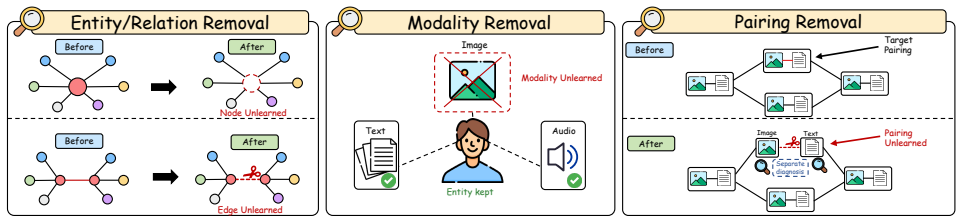
MMFGU claims that three families of multimodal federated graph unlearning requests—deleting an entity or relation, deleting a single modality, and revoking a cross-modal pairing—can be satisfied by one decoupling-based pipeline that removes
Reviewed by Pith at T0; open to challenge. T0 means a machine referee read the full paper against a public rubric. the ladder, T0–T4 →
T0 review · deepseek-v4-flash
2026-08-03 00:35 UTC pith:WBHUAO6X
load-bearing objection Genuinely new taxonomy and a solid pipeline, but the cross-client purge leaves target traces in untouched clients—the paper's own UR numbers point to it. the 5 major comments →
MMFGU: Multimodal Federated Graph Unlearning
The pith
A machine-rendered reading of the paper's core claim, the machinery that carries it, and where it could break.
Core claim
The paper's central claim is that successful multimodal federated graph unlearning can be reduced to a target-specific representation decoupling problem. Given an unlearning request, the requester constructs a set of target carriers—representations of the deleted node/relation, the deleted modality channel, or the deleted binding—then optimizes a local objective that makes each target carrier indistinguishable from a plausible mismatch in carrier space, while anchoring retained carriers, unrequested modalities, and boundary nodes to the frozen pre-unlearning model. Lightweight perturbation probes then identify and repair residual target traces in local fusion and neighborhood representations
What carries the argument
The load-bearing mechanism is target-specific representation decoupling, implemented through four coupled components. First, request mapping converts entity/relation, modality, and pairing deletions into a unified carrier set Ω_f (node-centered representations, modality channels, or bindings). Second, a contrastive decoupling loss L_dec drives each target carrier toward a plausible mismatch—constructed by masking, replacing, or swapping the target—while retention losses L_mm, L_uni, and L_bd anchor retained associations, unrequested modalities, and one-hop boundary nodes to the frozen model. Third, a perturbation probe pool P_r generates masked/replaced variants, selects high-discrepancy pro
Load-bearing premise
The claim that requested information is truly removed rests on membership-inference residual (UR) being an adequate proxy for behavioral indistinguishability from retraining; the paper defers stronger formal guarantees to future work.
What would settle it
Run an adaptive membership-inference attack, or a cross-modal linkage test, against the post-unlearning model; if the deleted target's representations can be re-identified from a remaining modality, a similar client's prototype, or a perturbed neighborhood, then the UR-based evidence is insufficient to support the unlearning claim.
If this is right
- If MMFGU works as reported, one unlearning pipeline replaces separate strategies for deleting users, interactions, modalities, and cross-modal pairings in federated graph systems.
- The low membership-inference residual on relation tasks suggests the aggregated global model behaves nearly indistinguishably from a retrained model on deleted targets—under the attack test used.
- The 41.5× speedup and compact communication cost (0.01 GB reported) make frequent, fine-grained deletion requests practical in deployed federated services.
- The plug-in experiments indicate that the decoupling, probe, and purge modules can improve existing unlearning backbones, not only the full MMFGU stack.
Where Pith is reading between the lines
- Inference — If the membership-inference residual is too weak a yardstick, the same carrier-and-prototype machinery could be repurposed as an audit signal: compact prototypes could be checked against stronger attack families (e.g., attribute inference or reconstruction) to decide when unlearning has actually happened.
- Inference — The selective-purge step shares compact prototypes across clients, which may leak distributional information about non-affected clients; a testable extension would quantify how much prototype similarity reveals about local subgraphs.
- Inference — The decoupling objective suggests a general recipe for targeted forgetting in any multimodal encoder—define carriers, anchor retained semantics to a frozen model, and probe for residuals—which may transfer beyond graphs to federated vision-language models.
Editorial analysis
A structured set of objections, weighed in public.
Referee Report
Summary. MMFGU proposes a framework for multimodal federated graph unlearning that handles three request families: entity/relation removal, modality removal, and pairing removal. The method maps requests to unified target carriers, applies local representation decoupling with retention constraints (Eqs. 11–13), exposes residual target traces with perturbation probes (Eqs. 14–16), and selectively purges affected clients via prototype-based screening (Eqs. 17–22). The authors evaluate on 12 datasets, comparing against 12 baselines, and report that MMFGU achieves the best retained utility on node and relation tasks, competitive unlearning (UR), and a 41.5× speedup over full retraining. The formal objective is stated in Eq. (7): deletion and retention behavioral distances bounded by epsilons with cost much less than retraining.
Significance. The framework is a well-motivated contribution to an emerging area. The unified carrier mapping across three request types is a useful abstraction, and the evaluation is unusually broad: 12 datasets, 12 baselines, ablations, and efficiency comparisons. The probe-guided residual exposure and selective client purge are interesting mechanisms. However, the paper's central claim—that MMFGU effectively removes requested information—is not fully established. The primary unlearning metric (UR) is a single MIA family, the evaluation for modality/pairing removal partially uses quantities that the training objective directly optimizes, and the aggregation in Eq. (22) leaves non-affected clients unchanged, allowing target influence inherited from the global model to persist. These issues require additional analysis and experiments before the claim can be accepted.
major comments (5)
- [Prototype-Guided Federated Purge, Eq. (22)] Eq. (22) aggregates the requester θ_r^-, affected clients {θ_k^-}_{k∈A_r}, and unchanged states {θ_o_j}_{j∉A_r∪{r}}. The selection A_r in Eqs. (19–20) uses prototype similarity of local carriers, but clients not in A_r have been trained from the same global model and can carry target influence in their parameters even if they have no local target carriers. Thus the aggregated θ^- can re-introduce the target. The empirical node result supports this concern: average UR for MMFGU is 2.01, whereas Retrain is 0.59 (Table 1). The paper needs to either (a) demonstrate via targeted attacks on non-affected clients that no residual remains, or (b) modify the aggregation to correct inherited traces, or (c) relax the claim to 'requester-local unlearning with propagation to prototype-related clients.'
- [Relation-Aware Target Decoupling, Eq. (11) and Fig. 3] Eq. (11) explicitly maximizes log p_{θ^-}(â|a), the probability that a requested carrier a maps to a mismatch â. Figure 3 evaluates Modality Removal by 'target-modality unlearning drop' and Pairing Removal by 'mismatched-association delta'—both are direct consequences of the same objective. This is a partial circularity: the metric rewards exactly what the loss minimizes, so the reported improvement over baselines does not by itself demonstrate that the information is unrecoverable. Independent tests (e.g., MIA on pairs, or nearest-neighbor retrieval of deleted items) are needed for these request types.
- [Experimental Setup, Eq. (23) and Table 1] The only unlearning-effectiveness measure with a claim to independence is UR in Eq. (23), based on one MIA family. Table 1 shows that on node tasks MMFGU's average UR=2.01 is far from Retrain's 0.59, so the deletion condition D_del ≤ ε_del in Eq. (7) is not empirically supported there. On relation tasks, MMFGU's UR=3.40 is lower than Retrain's 17.92; this sign inversion is not explained and suggests the metric may not be calibrated across tasks. The paper should report significance intervals, justify the choice of MIA, and relate UR to the formal objective.
- [Tables 1–2] Table 1 reports MMFGU Movies Acc as 51.77±0.34, while Table 2's Full MMFGU Movies is 51.43. Table 2 lacks significance tests; the differences between Full MMFGU and w/o local decouple are within 0.8pp on Movies. Without confidence intervals or paired tests, the claim that all components contribute to retained utility is not supported. Also, Table 1 has malformed entries (e.g., '0.31±0.7180.32±0.30' and '0.01±0.1396.21' appear to be concatenated values) that need correction.
- [Robustness Analysis, Fig. 6] Fig. 6 shows retained accuracy/Recall@5 across unlearning ratios, but unlearning effectiveness (UR or forget-set accuracy) is not reported there. At large ratios (e.g., 90%), the claim that MMFGU maintains the trade-off requires knowing whether it actually forgets; high utility could be achieved by failing to unlearn. Please report UR or a comparable metric in the robustness analysis.
minor comments (5)
- [Related Work] The Related Work section contains an orphaned paragraph describing 'DANCE' without any citation or connection to the proposal; this appears to be leftover text that should be removed or integrated.
- [Notation] Eq. (13) uses α, β, λ, while Fig. 7 reports α_dec, β_mm, λ_neg. Clarify the mapping between these symbols.
- [Table 3] Practical time for Retrain is 32.52s and MMFGU 0.78s, giving 41.7×, but the abstract says 41.5×; check rounding.
- [Full text end] Corrupted '/uni00000015/...' lines appear at the end of the full text; these should be cleaned before submission.
- [Eq. (10)] The same symbol τ is used as a temperature in Eq. (10) and as a threshold in Eq. (19). Use distinct symbols (e.g., τ_T and τ_p) throughout.
Circularity Check
MMFGU's modality- and pairing-removal effectiveness evidence largely restates its own decoupling objective; entity/relation UR, retained utility, and runtime claims remain independent.
specific steps
-
self definitional
[Methodology §3.2 (Eq. 11); Experiments Q1, 'Modality Removal and Pairing Removal Requests' (Fig. 3)]
"Tmis constructs ã by replacing an object with a retained-neighborhood alternative, masking/replacing the requested modality, or swapping one endpoint of a binding. ... Target representations are decoupled by Ldec = − 1/|Ωf_r| ∑_{a∈Ωf_r} log p_{θ^-_r}(ã|a). ... Desired outcomes are ... and a larger mismatched-association delta for Pairing Removal."
Eq. (11) maximizes the log-probability of the mismatch ã for each target carrier. The Pairing-Removal success metric is the 'mismatched-association delta'; Tables S1–S2 confirm this by showing 'unlearned true pairs become closer to random mismatches'. That is precisely the quantity Ldec is constructed to increase. Reporting a large delta as evidence of unlearning therefore restates the training objective; it does not independently measure whether requested information is gone.
-
self definitional
[Methodology §3.2 (Eq. 11); Experiments Q1, 'Modality Removal and Pairing Removal Requests' (Fig. 3)]
"Tmis constructs ã by ... masking/replacing the requested modality ... Ldec = − 1/|Ωf_r| ∑_{a∈Ωf_r} log p_{θ^-_r}(ã|a). ... Desired outcomes are a large target-modality unlearning drop with near-zero retained-accuracy change for Modality Removal ..."
The 'target-modality unlearning drop' is the behavioral effect that Eq. (11) explicitly trains: for a modality-removal request, ã is the same carrier with the requested modality masked/replaced, and the loss pushes z_{θ^-_r}(a) toward that masked carrier. Hence the metric rewards the exact change produced by the loss. The retained-utility part is still independent (Eq. 12 anchors unrequested modalities), but the claimed modality unlearning effectiveness is not.
full rationale
MMFGU is not wholly circular: the Node/Relation Removal claims are evaluated with the MIA-based UR metric (Eq. 23), which is not identical to Ldec and is honestly reported (MMFGU's node UR=2.01 is not the best and is far above Retrain's 0.59). Retained utility, ablations, robustness, and the 41.5× runtime comparison are also independent of the training objective. The circularity is concentrated in the Modality Removal and Pairing Removal evidence: the two headline metrics in Fig. 3 (target-modality forgetting drop and mismatched-association delta) are exactly the behaviors that Eq. (11) is designed to produce, so those particular 'unlearning effectiveness' results reduce to the loss by construction. The paper's own conclusion that 'stronger formal guarantees' are future work reinforces that the effectiveness claim rests on these proxy measurements. Cross-client residual concerns are correctness risks rather than circularity. No load-bearing self-citation or uniqueness-import pattern was found.
Axiom & Free-Parameter Ledger
free parameters (9)
- α (L_mm weight) =
tuned; sensitivity shown on Movies (Fig. 7)
- β (L_uni weight) =
tuned; sensitivity on Movies (Fig. 7)
- λ (L_bd weight) =
tuned
- λ_p (probe loss weight) =
tuned
- λ_pg (purge loss weight) =
tuned
- τ_p (prototype selection threshold) =
tuned; 0.85 hurts performance (Fig. 7)
- τ (temperature in Eq. 10) =
not specified
- B_p (perturbation sparsity budget) =
not specified
- M (Top-M probes) =
not specified
axioms (5)
- domain assumption The model can be decomposed into modality encoders, fusion, propagation, and head such that carrier representations z_θ(a) isolate target influence (Eq. 8).
- ad hoc to paper Prototype cosine similarity (Eq. 19) is sufficient to identify clients whose carriers are target-correlated.
- domain assumption MIA-based UR (Eq. 23) is a valid measure of unlearning effectiveness.
- domain assumption Aggregation in Eq. (22) of requester, purged clients, and unchanged states does not reintroduce target influence.
- standard math Standard federated graph learning protocol and GNN message passing are applicable; unlearning can operate on a frozen deployed model.
invented entities (2)
-
Unified target-carrier representation (Ω_f^r)
no independent evidence
-
Lightweight perturbation probes (P_r^*)
no independent evidence
read the original abstract
Multimodal federated graph learning enables clients to collaboratively train graph models over structural, textual, and visual signals without sharing private local data. However, the presence of heterogeneous multimodal content also makes unlearning requests more frequent and fine-grained: users may delete accounts or interactions, remove a particular image or text while retaining the associated entity, or revoke the learned correspondence between retained modalities or graph attributes. Existing federated graph unlearning mainly handles entity/relation or client removal and cannot directly satisfy these multimodal requests. They introduce three challenges: removing only the requested information without damaging retained content, preventing the target from being recovered through remaining modalities or graph neighborhoods, and stopping related traces on other clients from re-entering the global model after aggregation. To address them, we propose \textsc{\textbf{MMFGU}}, a multimodal federated graph unlearning framework built around target-specific representation decoupling. \textsc{MMFGU} maps heterogeneous requests into unified target carriers, decouples requested representations while anchoring retained semantics, exposes and repairs propagated residuals with lightweight probes, and selectively purges affected clients through compact prototype and response signals. Experiments show that \textsc{MMFGU} effectively removes requested information, preserves retained graph utility, and achieves a $\boldsymbol{41.5\times}$ speedup over full retraining.
Figures


Reference graph
Works this paper leans on
-
[1]
IEEE Transactions on Knowledge and Data Engineering , volume=
Deep learning on graphs: A survey , author=. IEEE Transactions on Knowledge and Data Engineering , volume=. 2020 , publisher=
2020
-
[2]
International conference on machine learning , pages=
Revisiting semi-supervised learning with graph embeddings , author=. International conference on machine learning , pages=. 2016 , organization=
2016
-
[3]
arXiv preprint arXiv:2302.08191 , year=
LightGCL: Simple yet effective graph contrastive learning for recommendation , author=. arXiv preprint arXiv:2302.08191 , year=
-
[4]
Yearbook of Medical Informatics , volume=
Advancing biomedicine with graph representation learning: recent progress, challenges, and future directions , author=. Yearbook of Medical Informatics , volume=. 2023 , publisher=
2023
-
[5]
Artificial intelligence and statistics , pages=
Communication-efficient learning of deep networks from decentralized data , author=. Artificial intelligence and statistics , pages=. 2017 , organization=
2017
-
[6]
2017 IEEE symposium on security and privacy (SP) , pages=
Membership inference attacks against machine learning models , author=. 2017 IEEE symposium on security and privacy (SP) , pages=. 2017 , organization=
2017
-
[7]
2021 IEEE symposium on security and privacy (SP) , pages=
Machine unlearning , author=. 2021 IEEE symposium on security and privacy (SP) , pages=. 2021 , organization=
2021
-
[8]
2021 IEEE/ACM 29th international symposium on quality of service (IWQOS) , pages=
Federaser: Enabling efficient client-level data removal from federated learning models , author=. 2021 IEEE/ACM 29th international symposium on quality of service (IWQOS) , pages=. 2021 , organization=
2021
-
[9]
Proceedings of the Computer Vision and Pattern Recognition Conference , pages=
Unlearning through knowledge overwriting: Reversible federated unlearning via selective sparse adapter , author=. Proceedings of the Computer Vision and Pattern Recognition Conference , pages=
-
[10]
Proceedings of the ACM on Web Conference 2025 , pages=
Subgraph federated unlearning , author=. Proceedings of the ACM on Web Conference 2025 , pages=
2025
-
[11]
IEEE Internet of Things Journal , volume=
Federated unlearning with momentum degradation , author=. IEEE Internet of Things Journal , volume=. 2023 , publisher=
2023
-
[12]
Nature communications , volume=
Communication-efficient federated learning via knowledge distillation , author=. Nature communications , volume=. 2022 , publisher=
2022
-
[13]
arXiv preprint arXiv:2412.20200 , year=
Federated unlearning with gradient descent and conflict mitigation , author=. arXiv preprint arXiv:2412.20200 , year=
-
[14]
Proceedings of the IEEE/CVF conference on computer vision and pattern recognition , pages=
Eternal sunshine of the spotless net: Selective forgetting in deep networks , author=. Proceedings of the IEEE/CVF conference on computer vision and pattern recognition , pages=
-
[15]
Proceedings of the IEEE/CVF conference on computer vision and pattern recognition , pages=
Deep unlearning via randomized conditionally independent hessians , author=. Proceedings of the IEEE/CVF conference on computer vision and pattern recognition , pages=
-
[16]
Algorithmic Learning Theory , pages=
Descent-to-delete: Gradient-based methods for machine unlearning , author=. Algorithmic Learning Theory , pages=. 2021 , organization=
2021
-
[17]
Proceedings of the 61st Annual Meeting of the Association for Computational Linguistics (Volume 1: Long Papers) , pages=
Knowledge unlearning for mitigating privacy risks in language models , author=. Proceedings of the 61st Annual Meeting of the Association for Computational Linguistics (Volume 1: Long Papers) , pages=
-
[18]
Proceedings of the IEEE/CVF Conference on Computer Vision and Pattern Recognition , pages=
Erm-ktp: Knowledge-level machine unlearning via knowledge transfer , author=. Proceedings of the IEEE/CVF Conference on Computer Vision and Pattern Recognition , pages=
-
[19]
arXiv preprint arXiv:2311.12047 , year=
Multidelete for multimodal machine unlearning , author=. arXiv preprint arXiv:2311.12047 , year=
-
[20]
Forty-third International Conference on Machine Learning , year=
OpenMAG: A Comprehensive Benchmark for Multimodal-Attributed Graph , author=. Forty-third International Conference on Machine Learning , year=
-
[21]
arXiv preprint arXiv:2601.22416 , year=
MM-OpenFGL: A Comprehensive Benchmark for Multimodal Federated Graph Learning , author=. arXiv preprint arXiv:2601.22416 , year=
-
[22]
Journal of statistical mechanics: theory and experiment , volume=
Fast unfolding of communities in large networks , author=. Journal of statistical mechanics: theory and experiment , volume=
-
[23]
IEEE Transactions on Neural Networks and Learning Systems , year=
Distill to delete: Unlearning in graph networks with knowledge distillation , author=. IEEE Transactions on Neural Networks and Learning Systems , year=
-
[24]
Proceedings of the AAAI Conference on Artificial Intelligence , volume=
Towards effective and general graph unlearning via mutual evolution , author=. Proceedings of the AAAI Conference on Artificial Intelligence , volume=
-
[25]
Proceedings of the 30th ACM SIGKDD Conference on Knowledge Discovery and Data Mining , pages=
Idea: A flexible framework of certified unlearning for graph neural networks , author=. Proceedings of the 30th ACM SIGKDD Conference on Knowledge Discovery and Data Mining , pages=
-
[26]
Proceedings of the AAAI Conference on Artificial Intelligence , volume=
PAGE: A Unified Approach for Federated Graph Unlearning , author=. Proceedings of the AAAI Conference on Artificial Intelligence , volume=
-
[27]
arXiv preprint arXiv:2605.11919 , year=
STAGE: Tackling Semantic Drift in Multimodal Federated Graph Learning , author=. arXiv preprint arXiv:2605.11919 , year=
-
[28]
arXiv preprint arXiv:2601.16519 , year=
DANCE: Dynamic, Available, Neighbor-gated Condensation for Federated Text-Attributed Graphs , author=. arXiv preprint arXiv:2601.16519 , year=
-
[29]
Justifying recommendations using distantly-labeled reviews and fine-grained aspects , author=. Proceedings of the 2019 conference on empirical methods in natural language processing and the 9th international joint conference on natural language processing (EMNLP-IJCNLP) , pages=
2019
-
[30]
Proceedings of the 64th Annual Meeting of the Association for Computational Linguistics (Volume 1: Long Papers) , pages=
Bridging language and items for retrieval and recommendation: Benchmarking LLMs as semantic encoders , author=. Proceedings of the 64th Annual Meeting of the Association for Computational Linguistics (Volume 1: Long Papers) , pages=
-
[31]
Thirty-fifth Conference on Neural Information Processing Systems Datasets and Benchmarks Track (Round 1) , year=
Redcaps: Web-curated image-text data created by the people, for the people , author=. Thirty-fifth Conference on Neural Information Processing Systems Datasets and Benchmarks Track (Round 1) , year=
-
[32]
Proceedings of the 12th ACM conference on recommender systems , pages=
Item recommendation on monotonic behavior chains , author=. Proceedings of the 12th ACM conference on recommender systems , pages=
-
[33]
Proceedings of the 57th Annual Meeting of the Association for Computational Linguistics , pages=
Fine-grained spoiler detection from large-scale review corpora , author=. Proceedings of the 57th Annual Meeting of the Association for Computational Linguistics , pages=
-
[34]
IEEE Transactions on Pattern Analysis and Machine Intelligence , year=
Ninerec: A benchmark dataset suite for evaluating transferable recommendation , author=. IEEE Transactions on Pattern Analysis and Machine Intelligence , year=
-
[35]
International Conference on Learning Representations , year =
Semi-Supervised Classification with Graph Convolutional Networks , author =. International Conference on Learning Representations , year =
-
[36]
Advances in Neural Information Processing Systems , volume =
Inductive Representation Learning on Large Graphs , author =. Advances in Neural Information Processing Systems , volume =
-
[37]
International Conference on Learning Representations , year =
Graph Attention Networks , author =. International Conference on Learning Representations , year =
-
[38]
Pei, Hongbin and Wei, Bingzhe and Chang, Kevin Chen-Chuan and Lei, Yu and Yang, Bo , booktitle =
-
[39]
Adaptive Universal Generalized
Chien, Eli and Peng, Jianhao and Li, Pan and Milenkovic, Olgica , booktitle =. Adaptive Universal Generalized
-
[40]
Advances in Neural Information Processing Systems , volume =
Beyond Homophily in Graph Neural Networks: Current Limitations and Effective Designs , author =. Advances in Neural Information Processing Systems , volume =
-
[41]
2022 , doi =
Federated Graph Machine Learning: A Survey of Concepts, Techniques, and Applications , author =. 2022 , doi =
2022
-
[42]
and Rong, Yu and Zhao, Peilin and Huang, Junzhou and Annavaram, Murali and Avestimehr, Salman , journal =
He, Chaoyang and Balasubramanian, Keshav and Ceyani, Emir and Yang, Carl and Xie, Han and Sun, Lichao and He, Lifang and Yang, Liangwei and Yu, Philip S. and Rong, Yu and Zhao, Peilin and Huang, Junzhou and Annavaram, Murali and Avestimehr, Salman , journal =
-
[43]
arXiv preprint arXiv:2507.16541 , year =
A Comprehensive Data-Centric Overview of Federated Graph Learning , author =. arXiv preprint arXiv:2507.16541 , year =
-
[44]
Advances in Neural Information Processing Systems , volume =
Subgraph Federated Learning with Missing Neighbor Generation , author =. Advances in Neural Information Processing Systems , volume =
-
[45]
Proceedings of the 40th International Conference on Machine Learning , series =
Personalized Subgraph Federated Learning , author =. Proceedings of the 40th International Conference on Machine Learning , series =
-
[46]
2023 , doi =
Li, Xunkai and Wu, Zhengyu and Zhang, Wentao and Zhu, Yinlin and Li, Rong-Hua and Wang, Guoren , journal =. 2023 , doi =
2023
-
[47]
Chen, Zekai and Li, Xunkai and Zhu, Yinlin and Li, Rong-Hua and Wang, Guoren , journal =
-
[48]
arXiv preprint arXiv:2503.19455 , year =
Data-Centric Federated Graph Learning with Large Language Models , author =. arXiv preprint arXiv:2503.19455 , year =
-
[49]
Wu, Zhengyu and Zhu, Yinlin and Li, Xunkai and Qiu, Ziang and Li, Rong-Hua and Wang, Guoren and Zhou, Chenghu , journal =
-
[50]
Advances in Neural Information Processing Systems , year =
Towards Effective Federated Graph Foundation Model via Mitigating Knowledge Entanglement , author =. Advances in Neural Information Processing Systems , year =
discussion (0)
Sign in with ORCID, Apple, or X to comment. Anyone can read and Pith papers without signing in.