REVIEW 1 major objections 5 minor 64 references
On the Origin of Beyond-Classical Advantage in the Parity-Permutation Problem
T0 review · 1 major / 5 minor · reviewed 2026-08-03 · deepseek-v4-flash
Pith's one-line read In the permutation-parity game, beating random guessing is possible exactly when the linear dimension of the elementary systems is at least n—entanglement is not the resource that matters.
desk verdict The headline iff theorem is overbroad — it needs a no-restriction effect-space assumption for the converse — but the upper bound and the explicit constructions are real contributions. read the letter →
The pith
A machine-rendered reading of the paper's core claim, the machinery that carries it, and where it could break.
The reading
What carries the argument
The load-bearing object is the linear dimension Ld_S, defined as the dimension of the vector space spanned by the unnormalized states of an elementary system. It differs from the operational dimension (how many states can be perfectly distinguished in one measurement), and the paper shows that this difference is what makes the parity game a sensitive probe. The proof mechanism is the symmetric group action on tensor products: for n > Ld_S, a pigeonhole-based transposition symmetry collapses the even and odd averaged states; for n ≤ Ld_S, a linearly independent permutation orbit keeps the two subspaces apart. The perfect-success constructions run on specific composition rules—minimal tensor p
What would settle it
Take a GPT with restricted effect space and n≤Ld_S but with operational dimension smaller than n. Construct the product state from n linearly independent states and check whether any allowed measurement can separate the even and odd averaged states; if no such effect exists, the claimed 'if and only if' fails for restricted-effect theories. Alternatively, search for distinct product states with n≤Ld_S whose permutation orbit is linearly dependent—that would break the constructive converse.
Extended reading notes
Core claim
The central claim, Theorem 1, is an if-and-only-if threshold. For any generalized probabilistic theory whose elementary system S has linear dimension Ld_S—the dimension of the real vector space spanned by its unnormalized states—the optimal success probability in the parity game P[n] exceeds 1/2 exactly when Ld_S ≥ n. The forward direction is a pigeonhole argument: if n > Ld_S, every term in a tensor-product decomposition of the n-particle state repeats at least one basis index, so a suitable transposition fixes each term while flipping parity, making the even and odd averaged states identical; no measurement can then do better than guessing. The converse is constructive: choose n linearly i
Load-bearing premise
The theorem's converse assumes that a separating measurement can always be found once the even and odd averaged states are distinct—and that distinct product states have a linearly independent permutation orbit; one of these steps is asserted with a missing citation, so the 'any GPT' claim is only as strong as that assumption.
Editorial extensions
If this is right
- In quantum theory, the threshold Ld=d² makes qubit systems advantageous only for n≤4; for n≥5 qubits, no entangled strategy can exceed 1/2.
- A probabilistic advantage can always be obtained with product-state preparations whenever Ld≥n, so entangled preparation is unnecessary for advantage (though it may still help achieve perfect success).
- The parity game P[n] functions as a dimension witness for physical theories: the condition n≤Ld_S tells exactly when parity information can be read out beyond the classical limit.
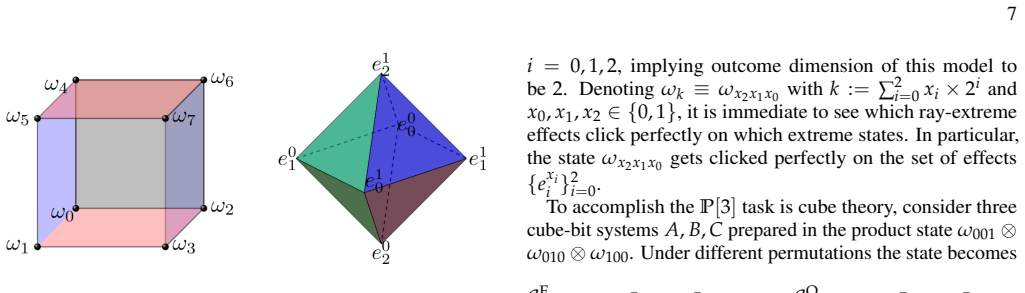
- Perfect success without entangled preparation or measurement is possible in hexagon and cube models, so entanglement is not even necessary in principle for solving P[3].
- Because product-state strategies are easier to prepare than entangled ones, these constructions offer a more accessible route to demonstrating the quantum advantage in near-term experiments.
Reading between the lines
- The converse in Theorem 1 relies on a step—distinct-index product states have a linearly independent permutation orbit—marked in the text with an empty citation bracket, so the theorem's generality is not fully self-contained; a counterexample to that lemma would shrink the threshold claim to the unrestricted-effect setting.
- Because the proof's converse uses separating functionals as measurements, restricted-effect GPTs (where operational dimension is smaller than linear dimension) are a natural test bed; if no allowed effect separates the even/odd orbits, the 'arbitrary GPT' wording exceeds the proof.
- The paper's threshold separates probabilistic advantage (d² ≥ n) from perfect success (d ≥ ⌈√n⌉) in quantum theory; exploiting this gap as a two-stage resource hierarchy—first dimension, then entanglement—is an implicit direction worth testing.
- The hexagon and cube constructions suggest that effect-space richness can substitute for state-space dimension; quantifying the trade-off between Ld and effect structure in other GPTs is a testable extension the paper leaves open.
Editorial analysis
A structured set of objections, weighed in public.
Referee Report
Summary. The paper studies the permutation-parity game P[n]: n particles are subject to a hidden permutation and the task is to guess its parity. It argues that the relevant resource is not entanglement but the linear dimension Ld_S of the elementary GPT state space. The central result, Theorem 1, states that a success probability strictly above 1/2 is achievable if and only if Ld_S ≥ n. The 'only if' direction is proven by a pigeonhole argument: when n > Ld_S, every product term in the state expansion has a repeated index, making even and odd permutation orbits coincide. The converse is based on choosing n linearly independent local states, forming a product state with distinct indices, and concluding that the even and odd mixtures are distinct and hence distinguishable. The paper also gives explicit quantum product-state strategies (7/8 for n=3, 11/18 for n=4), a perfect strategy in the minimal-tensor-product locally-quantum theory, and perfect strategies in hexagon and cube GPT models using product preparations and product measurements. The conclusion is that linear dimension, not entanglement, governs the onset of beyond-classical advantage in this task.
Significance. If the theorem is properly qualified, this is a clean and unifying result. It reproduces the classical threshold (d ≥ n), the quantum threshold (d² ≥ n), and explains why, e.g., five qubits cannot beat random guessing even with arbitrary entanglement. The pigeonhole lower bound is elegant and likely correct. The explicit product-state constructions for n=3 and n=4, and the hexagon/cube perfect protocols, are concrete and verifiable strengths. The paper also offers a clear operational interpretation: product preparations suffice for advantage, while entanglement is only needed for perfect success. These features make the paper potentially valuable for the GPT and quantum-foundations community.
major comments (1)
- [Section V, Theorem 1 (converse, final paragraph)] The step from 'ρe and ρo are distinct' to 'there exists a protocol with success > 1/2' requires that the admissible effect space of the chosen composite theory separates the two states. This is guaranteed if the elementary effect space is full, as defined in §III.A (E_S = {e : Ω_S → [0,1]}) and if the composition is between the minimal and maximal tensor products, but the proof does not state or justify this. The theorem is nevertheless phrased for 'any GPT' and 'any composition lying between the minimal and maximal tensor products.' Without the no-restriction/separating assumption the claim is overbroad: a restricted-effect square-bit whose only binary measurement is the x-coordinate has Ld_S = 3, yet the particular product state v1⊗v2⊗v3 cited in the stress test gives identical x-outcome distributions for the even and odd mixtures. (That specific example does not settle optimality beca
minor comments (5)
- [Section V, Theorem 1 proof] The set of permuted states S_n(ω) is asserted to be linearly independent with a missing citation '[ ]'. The lemma is true and easy to prove using dual functionals, but the placeholder should be replaced by a proof or a reference.
- [Table I] The column headers list '213' twice, once as E3 and once as O1. For S_3 the even permutations are 123, 312, 231, and the odd ones are 213, 132, 321. Please correct the typo; the table entries appear to assume 231 for the even column.
- [Section II.A, Proposition 1; Section II.B, Proposition 2] The phrases 'optimizing over θ1,θ2,η we have' and 'optimizing over α,θ1,θ2,η we have' assert global optimality without showing the optimization. A derivation (or an appendix with stationary equations and boundary checks) is needed to support the claimed maxima 7/8 and 1/2(1+√(2/3)).
- [Section III.B, Proposition 3] For the constructed effect h'_E, the proof verifies Tr[ρprod h'_E] ≥ 0 but does not explicitly verify the complementary condition Tr[ρprod h'_O] = 1 - Tr[ρprod h'_E] ≥ 0. This follows from the same inequality, but it should be stated so that h'_E and h'_O are both valid effects.
- [Section III.A] The definition says the effect space E_S 'comprises all linear functionals' mapping states to [0,1], which is the no-restriction hypothesis. Later examples (hexagon and cube) use explicit effect spaces that, if not full duals, would contradict this definition. Please clarify whether the examples are intended to satisfy no-restriction or whether the framework is meant to allow restricted effect spaces; this affects the scope of Theorem 1.
Circularity Check
No significant circularity: the central Ld_S threshold is derived from the state-space structure and the examples are explicit constructions, not fitted predictions.
full rationale
I walked the claimed derivation chain. Theorem 1's impossibility direction (n > Ld_S implies no advantage) follows from the pigeonhole principle on tensor decompositions, independent of measurement assumptions. The constructions in Propositions 1–5 are explicit: they optimize or choose states/effects and verify the required probabilities (e.g., Eq. (8) for 7/8, Eq. (29) for 11/18, Eq. (21) with β=2/9 for perfect local-quantum success, and the product effects in Propositions 4–5). None of these steps fits a parameter to the target success probability and then calls it a prediction. The self-citations ([17], [27]–[30], [36], [37], [57]–[60]) are contextual references to framework results, not load-bearing for the proof. The only notable issue is a correctness/scope gap, not circularity: the converse of Theorem 1 jumps from vector-space linear independence of ρe and ρo to 'there exists a protocol,' which requires an unstated no-restriction/separating-effect assumption on the composite effect space. For compositions with restricted effects (e.g., maximal tensor product), this step can fail, so the 'arbitrary GPT' claim is overbroad. This is an omitted assumption, not a circular reduction.
Assumptions & free parameters
free parameters (4)
- beta in minimal-tensor effect =
2/9
- optimized angles for 3-qubit product state =
theta1=2*pi/3, theta2=4*pi/3, eta=0
- optimized angles for 3-qubit biseparable state =
alpha=pi/12, theta1=15*pi/23, theta2=8*pi/23, eta=0
- four tetrahedron states for P[4] =
states in Eq. (27)
assumptions (3)
- domain assumption Effect space is unrestricted: every affine functional on the state space with values in [0,1] is an allowed effect (no-restriction).
- domain assumption Composite systems are locally tomographic and states live in the tensor-product vector space, with permutations acting by swapping tensor factors.
- standard math For linearly independent local states, the orbit under S_n of their product state is linearly independent.
Cite this review
Pith. "Pith review of On the Origin of Beyond-Classical Advantage in the Parity-Permutation Problem." pith.science (2026). https://pith.science/paper/Q5SKVHAE
@misc{pith2026260729073,
  author       = {Pith},
  title        = {Pith review of: On the Origin of Beyond-Classical Advantage in the Parity-Permutation Problem},
  year         = {2026},
  howpublished = {\url{https://pith.science/paper/Q5SKVHAE}},
  note         = {Machine review of arXiv:2607.29073}
}
abstract
We investigate the task of identifying the parity (odd vs even) of an unknown permutation applied to $n$ particles. Classically, using fewer than $n$ distinct labels per particle limits the success probability to random guessing, whereas quantum mechanics, exploiting entanglement in both preparation and measurement, accomplishes the task perfectly with as few as $\big\lceil \sqrt{n}\big\rceil$ levels per particle [\href{https://doi.org/10.1103/yhyv-xnwq}{PRL {\bf 135}, 260603 (2025)}]. We show that even without entangled preparation, quantum theory still offers a probabilistic advantage over classical strategies. Moreover, such product preparations yield perfect success in locally quantum theories, where elementary systems are quantum but their composition follows the minimal tensor product structure of generalized probabilistic theories (GPTs). We further identify GPT models that accomplish the task with certainty without requiring entanglement either at the preparation stage or at the measurement stage. Our central result establishes that the linear dimension of the elementary systems, rather than entanglement, is the fundamental resource governing the existence of probabilistic advantage in the permutation parity problem. In particular, below the required dimension threshold, no amount of entanglement can improve upon the random-guessing limit.
Figures

Reference graph
Works this paper leans on
-
[3]
Let {vi}LdS i=1 be a basis of the vector space RLdS
We first show that this occurs whenevern>Ld S. Let {vi}LdS i=1 be a basis of the vector space RLdS . Any state ω∈Ω S ⊗n can be written as, ω= LdS ∑ i1,...,i n=1 ai1i2···i n vi1 ⊗v i2 ⊗ · · ·vin wherea i1i2···i n ∈R∀i j ∈[Ld S ],j∈[n]. Since n>Ld S, the Pigeonhole principle implies that in every tensor product term there exist indices k̸=l such that ik =i ...
-
[4]
Theorem 1 establishes that a GPT exhibits a nontrivial ad- vantage in the parity-permutation problem if and only if its linear dimension satisfies n≤Ld S
This completes the proof. Theorem 1 establishes that a GPT exhibits a nontrivial ad- vantage in the parity-permutation problem if and only if its linear dimension satisfies n≤Ld S. The proof is construct- ive, providing explicit product-state strategies that achieve a success probability strictly greater than 1/2 whenever this con- dition is satisfied. Th...
2022
-
[1]
J. P. Dowling and G. J. Milburn, Quantum technology: the second quantum revolution, Phil. Trans. R. Soc. A.361, 1655–1674 (2003)
2003
-
[2]
This naturally raises the question: if we play the game with n>4 using qubits, can we obtain any advantage over the classical case? We address this question in the following theorem. V .P[n]GAME AND THE LINEAR DIMENSION While so far we have mostly analyzed theP[3] task, in this sec- tion we establish a generic result for having nontrivial success inP[n]in...
-
[5]
I. H. Deutsch, Harnessing the Power of the Second Quantum Revolution, PRX Quantum1, 020101 (2020)
2020
-
[6]
Aspect, The Second Quantum Revolution: From Basic Con- cepts to Quantum Technologies (2023)
A. Aspect, The Second Quantum Revolution: From Basic Con- cepts to Quantum Technologies (2023)
2023
-
[7]
P. W. Shor, Polynomial-Time Algorithms for Prime Factorization and Discrete Logarithms on a Quantum Computer, SIAM J. Comput.26, 1484–1509 (1997)
1997
-
[8]
Buhrman, R
H. Buhrman, R. Cleve, J. Watrous, and R. de Wolf, Quantum Fingerprinting, Phys. Rev. Lett.87, 167902 (2001)
2001
Show all 64 references
-
[9]
Buhrman, R
H. Buhrman, R. Cleve, S. Massar, and R. de Wolf, Nonlocality and communication complexity, Rev. Mod. Phys.82, 665 (2010)
2010
-
[10]
Zhong, F
X. Zhong, F. Xu, H.-K. Lo, and L. Qian, Efficient experimental quantum fingerprinting with channel multiplexing and simultan- eous detection, Nat. Commun.12, 4464 (2021)
2021
-
[11]
Huang et al, Quantum advantage in learning from experi- ments, Science376, 1182–1186 (2022)
H.-Y . Huang et al, Quantum advantage in learning from experi- ments, Science376, 1182–1186 (2022)
2022
-
[12]
Hinsche, M
M. Hinsche, M. Ioannou, A. Nietner, J. Haferkamp, Y . Quek, D. Hangleiter, J.-P. Seifert, J. Eisert, and R. Sweke, One T Gate Makes Distribution Learning Hard, Phys. Rev. Lett.130, 240602 (2023)
2023
-
[13]
D. R. Simon, On the Power of Quantum Computation, SIAM J. Comput.26, 1474–1483 (1997)
1997
-
[14]
Bernstein and U
E. Bernstein and U. Vazirani, Quantum Complexity Theory, SIAM J. Comput.26, 1411–1473 (1997)
1997
- [15]
-
[16]
Bravyi and A
S. Bravyi and A. Kitaev, Universal quantum computation with ideal clifford gates and noisy ancillas, Phys. Rev. A71, 022316 (2005)
2005
-
[17]
Knill, Quantum computing with realistically noisy devices, Nature434, 39–44 (2005)
E. Knill, Quantum computing with realistically noisy devices, Nature434, 39–44 (2005)
2005
-
[18]
E. T. Campbell, H. Anwar, and D. E. Browne, Magic-State Distillation in All Prime Dimensions Using Quantum Reed- Muller Codes, Phys. Rev. X2, 041021 (2012)
2012
-
[19]
Howard and E
M. Howard and E. Campbell, Application of a Resource Theory for Magic States to Fault-Tolerant Quantum Computing, Phys. Rev. Lett.118, 090501 (2017)
2017
-
[20]
S. R. Chowdhury, S. G. Naik, A. Chakraborty, R. K. Patra, S. B. Ghosh, P. Ghosal, M. Banik, and A. G. Maity, Gottesman- Knill limit on one-way communication complexity: Tracing the quantum advantage down to magic resources, Phys. Rev. A113, 042607 (2026)
2026
-
[21]
Diebra, S
A. Diebra, S. Llorens, D. González-Lociga, A. Rico, J. Cal- samiglia, M. Hillery, and E. Bagan, Quantum Advantage in Identifying the Parity of Permutations with Certainty, Phys. Rev. Lett.135, 260603 (2025)
2025
-
[22]
J. V . Korff and J. Kempe, Quantum Advantage in Transmitting a Permutation, Phys. Rev. Lett.93, 260502 (2004)
2004
-
[23]
Hayashi, T
A. Hayashi, T. Hashimoto, and M. Horibe, Extended quantum color coding, Phys. Rev. A71, 012326 (2005)
2005
-
[24]
M. Kläy, C. Randall, and D. Foulis, Tensor products and probab- ility weights, Int. J. Theo. Phys.26, 199–219 (1987)
1987
-
[25]
Coecke, D
B. Coecke, D. Moore, and A. Wilce, Operational Quantum Logic: 10 An Overview, inCurrent Research in Operational Quantum Logic(Springer Netherlands, 2000) p. 1–36
2000
-
[26]
Barnum, S
H. Barnum, S. Beigi, S. Boixo, M. B. Elliott, and S. Wehner, Local Quantum Measurement and No-Signaling Imply Quantum Correlations, Phys. Rev. Lett.104, 140401 (2010)
2010
-
[27]
A. Acín, R. Augusiak, D. Cavalcanti, C. Hadley, J. K. Korbicz, M. Lewenstein, L. Masanes, and M. Piani, Unified Framework for Correlations in Terms of Local Quantum Observables, Phys. Rev. Lett.104, 140404 (2010)
2010
-
[28]
de la Torre, L
G. de la Torre, L. Masanes, A. J. Short, and M. P. Müller, Deriv- ing Quantum Theory from Its Local Structure and Reversibility, Phys. Rev. Lett.109, 090403 (2012)
2012
-
[29]
Barnum and A
H. Barnum and A. Wilce, Local Tomography and the Jordan Structure of Quantum Theory, Found Phys44, 192–212 (2014)
2014
-
[30]
S. G. Naik, E. P. Lobo, S. Sen, R. K. Patra, M. Alimuddin, T. Guha, S. S. Bhattacharya, and M. Banik, Composition of Mul- tipartite Quantum Systems: Perspective from Timelike Paradigm, Phys. Rev. Lett.128, 140401 (2022)
2022
-
[31]
E. P. Lobo, S. G. Naik, S. Sen, R. K. Patra, M. Banik, and M. Al- imuddin, Certifying beyond quantumness of locally quantum no-signaling theories through a quantum-input bell test, Phys. Rev. A106, L040201 (2022)
2022
-
[32]
S. Sen, E. P. Lobo, R. K. Patra, S. G. Naik, A. Das Bhowmik, M. Alimuddin, and M. Banik, Timelike correlations and quantum tensor product structure, Phys. Rev. A106, 062406 (2022)
2022
-
[33]
R. K. Patra, S. G. Naik, E. P. Lobo, S. Sen, G. L. Sidhardh, M. Alimuddin, and M. Banik, Principle of Information Caus- ality Rationalizes Quantum Composition, Phys. Rev. Lett.130, 110202 (2023)
2023
-
[34]
Arai and M
H. Arai and M. Hayashi, Derivation of standard quantum theory via state discrimination, New J. Phys.26, 053046 (2024)
2024
-
[35]
Plávala, General probabilistic theories: An introduction, Physics Reports1033, 1–64 (2023)
M. Plávala, General probabilistic theories: An introduction, Physics Reports1033, 1–64 (2023)
2023
-
[36]
C. W. Helstrom, Quantum detection and estimation theory, J. Stat. Phys.1, 231–252 (1969)
1969
-
[37]
Vaidman, Y
L. Vaidman, Y . Aharonov, and D. Z. Albert, How to ascertain the values of σx, σy, and σz of a spin-1/2 particle, Phys. Rev. Lett. 58, 1385 (1987)
1987
-
[38]
Gisin, Entanglement 25 Years after Quantum Teleportation: Testing Joint Measurements in Quantum Networks, Entropy21, 325 (2019)
N. Gisin, Entanglement 25 Years after Quantum Teleportation: Testing Joint Measurements in Quantum Networks, Entropy21, 325 (2019)
2019
-
[39]
R. K. Patra, K. Agarwal, B. Paul, S. R. Chowdhury, S. G. Naik, and M. Banik, Quantum Incompatibility in Parallel versus Anti- parallel Spins, Phys. Rev. Lett.136, 110402 (2026)
2026
-
[40]
Agarwal, S
K. Agarwal, S. Gopalkrishna Naik, A. Chakraborty, G. Kar, R. K. Patra, S. Roy Chowdhury, and M. Banik, No Abso- lute Hierarchy of Quantum Complementarity, arXiv.2602.22792 10.48550/arXiv.2602.22792 (2026)
2026 doi
-
[41]
Mackey,The Mathematical F oundations of Quantum Mech- anics: A Lecture-note Volume, Advanced book program (W.A
G. Mackey,The Mathematical F oundations of Quantum Mech- anics: A Lecture-note Volume, Advanced book program (W.A. Benjamin, 1963)
1963
-
[42]
Ludwig, Attempt of an axiomatic foundation of quantum mechanics and more general theories, II, Commun
G. Ludwig, Attempt of an axiomatic foundation of quantum mechanics and more general theories, II, Commun. Math. Phys. 4, 331–348 (1967)
1967
-
[43]
Ludwig, Attempt of an axiomatic foundation of quantum mechanics and more general theories
G. Ludwig, Attempt of an axiomatic foundation of quantum mechanics and more general theories. III, Commun. Math. Phys. 9, 1–12 (1968)
1968
-
[44]
Davies, On the repeated measurement of continuous observ- ables in quantum mechanics, J
E. Davies, On the repeated measurement of continuous observ- ables in quantum mechanics, J. Func. Analysis6, 318–346 (1970)
1970
-
[45]
Hardy, Quantum Theory From Five Reasonable Axioms, arXiv , quant ph/0101012 (2001)
L. Hardy, Quantum Theory From Five Reasonable Axioms, arXiv , quant ph/0101012 (2001)
2001
-
[46]
Barrett, Information processing in generalized probabilistic theories, Phys
J. Barrett, Information processing in generalized probabilistic theories, Phys. Rev. A75, 032304 (2007)
2007
-
[47]
Barnum and A
H. Barnum and A. Wilce, Information Processing in Convex Operational Theories, Electron. Notes Theor. Comput. Sci.270, 3–15 (2011)
2011
-
[48]
Masanes and M
L. Masanes and M. P. Müller, A derivation of quantum theory from physical requirements, New J. Phys.13, 063001 (2011)
2011
-
[49]
Chiribella, G
G. Chiribella, G. M. D’Ariano, and P. Perinotti, Informational derivation of quantum theory, Phys. Rev. A84, 012311 (2011)
2011
-
[50]
Masanes, M
L. Masanes, M. P. Müller, D. Pérez-García, and R. Augusiak, Entanglement and the three-dimensionality of the bloch ball, J. Math. Phys.55, 122203 (2014)
2014
-
[51]
Hardy, Reformulating and Reconstructing Quantum Theory, [quant-ph] , arXiv:1104.2066 (2011)
L. Hardy, Reformulating and Reconstructing Quantum Theory, [quant-ph] , arXiv:1104.2066 (2011)
-
[52]
Chiribella, G
G. Chiribella, G. M. D’Ariano, and P. Perinotti, Probabilistic theories with purification, Phys. Rev. A81, 062348 (2010)
2010
-
[53]
Namioka and R
I. Namioka and R. Phelps, Tensor products of compact convex sets, Pacific J. Math.31, 469–480 (1969)
1969
-
[54]
G. P. Barker, Monotone norms and tensor products, Linear Mul- tilinear Algebra4, 191–199 (1976)
1976
-
[55]
Aubrun, L
G. Aubrun, L. Lami, C. Palazuelos, and M. Plávala, Entangleab- ility of cones, Geo. Func. Analysis31, 181–205 (2021)
2021
-
[56]
H. Arai, Y . Yoshida, and M. Hayashi, Perfect discrimination of non-orthogonal separable pure states on bipartite system in general probabilistic theory, J. Phys. A: Math. Theo.52, 465304 (2019)
2019
-
[57]
Janotta, C
P. Janotta, C. Gogolin, J. Barrett, and N. Brunner, Limits on nonlocal correlations from the structure of the local state space, New J. Phys.13, 063024 (2011)
2011
-
[58]
Massar and M
S. Massar and M. K. Patra, Information and communication in polygon theories, Phys. Rev. A89, 052124 (2014)
2014
-
[59]
Brunner, M
N. Brunner, M. Kaplan, A. Leverrier, and P. Skrzypczyk, Dimen- sion of physical systems, information processing, and thermody- namics, New Journal of Physics16, 123050 (2014)
2014
-
[60]
Banik, S
M. Banik, S. S. Bhattacharya, A. Mukherjee, A. Roy, A. Am- bainis, and A. Rai, Limited preparation contextuality in quantum theory and its relation to the cirel’son bound, Phys. Rev. A92, 030103(R) (2015)
2015
-
[61]
Banik, S
M. Banik, S. Saha, T. Guha, S. Agrawal, S. S. Bhattacharya, A. Roy, and A. S. Majumdar, Constraining the state space in any physical theory with the principle of information symmetry, Phys. Rev. A100, 060101(R) (2019)
2019
-
[62]
S. S. Bhattacharya, S. Saha, T. Guha, and M. Banik, Nonlocality without entanglement: Quantum theory and beyond, Phys. Rev. Res.2, 012068(R) (2020)
2020
-
[63]
S. Saha, S. S. Bhattacharya, T. Guha, S. Halder, and M. Banik, Advantage of Quantum Theory over Nonclassical Models of Communication, Annalen der Physik532, 2000334 (2020)
2020
-
[64]
C. H. Bennett, D. P. DiVincenzo, C. A. Fuchs, T. Mor, E. Rains, P. W. Shor, J. A. Smolin, and W. K. Wootters, Quantum nonloc- ality without entanglement, Phys. Rev. A59, 1070 (1999)
1999
Reviewed August 3, 2026 · model on record in the stance chip above.
Discussion (0). Continue with ORCID to comment.