REVIEW 3 major objections 4 minor 42 references
Runaway Electrons in Stellarators: Unlikely or Unavoidable?
T0 review · 3 major / 4 minor · reviewed 2026-08-03 · deepseek-v4-flash
Pith's one-line read A simulation study of stellarator temperature collapses finds that runaway electron generation is possible — especially with high initial current, a fast quench, and low final temperature — but avalanche multiplication is far weaker than in
desk verdict A credible pilot study showing stellarators could produce runaways under fast, cold, high-current collapses, but the quantitative thresholds rely on an equilibrium inconsistent with the imposed currents. read the letter →
The pith
A machine-rendered reading of the paper's core claim, the machinery that carries it, and where it could break.
The reading
What carries the argument
The central object is the generalized Faraday and Ampère laws written in flux-surface-averaged form valid for any toroidal configuration, implemented in the DREAM simulation code, together with a proposed avalanche-gain metric: the integral over minor radius of the enclosed current divided by the flux-surface-averaged metric factor ⟨gθθ/g⟩V′/a. The metric correlates linearly with the logarithm of the avalanche multiplication factor, letting one estimate and compare runaway avalanche strength across configurations without full simulation.
What would settle it
A direct falsifier would be a measurement of post-collapse runaway current in a stellarator with a known 5–10 MA plasma current and a thermal quench faster than about 5 ms: the paper predicts conversion fractions of tens of percent, so observing less than a few kiloamperes would contradict it.
Extended reading notes
Core claim
The central claim is that runaway electrons, long assumed negligible in stellarators because there is no externally driven current, can be generated in a radiative temperature collapse when the bootstrap or other plasma current is large. The authors implement a fluid model for stellarators in the DREAM code and demonstrate that the avalanche mechanism is exponentially sensitive to current but reduced by plasma shaping: an elongated stellarator produces more than a thousand times less avalanche runaway current than a circular tokamak with the same current and volume. They also propose a simple metric based on Ampère's law that predicts the logarithmic avalanche gain for any configuration, and
Load-bearing premise
The simulations hold the stellarator magnetic configuration fixed while scanning the plasma current, and do not enforce consistency between the current density and the plasma pressure; if self-consistent equilibria have different current profiles or poloidal flux, the quantitative runaway fractions could change.
Editorial extensions
If this is right
- If the claim is right, stellarator reactor designs should include runaway mitigation only in high-current, fast-quench scenarios, not as a general requirement.
- The avalanche-gain metric could become a design constraint in stellarator optimization, favouring configurations with low enclosed current and strong shaping.
- Thermal-quench time is the dominant lever: if quenches in large stellarators are slower than about 10 ms (as LHD data suggest), runaway currents stay below roughly 100 kA even at 10 MA initial current.
- The comparison with elongated tokamaks implies that tokamak disruption studies should separate the effect of elongation from geometry-specific effects.
Reading between the lines
- Our inference: If the avalanche-gain metric is robust, it could be used as a cheap screening tool for proposed stellarator reactor concepts long before full disruption simulations are run.
- Our inference: The strong dependence on thermal-quench time suggests that active control of impurity ingress (e.g., by ECRH) may be a more effective runaway mitigation strategy in stellarators than in tokamaks.
- Our inference: Since the paper fixes the magnetic equilibria while varying current, a self-consistent equilibrium scan might show the avalanche suppression to be even stronger, because high bootstrap current would also alter the rotational transform and shaping.
Editorial analysis
A structured set of objections, weighed in public.
Referee Report
Summary. This paper reports a pilot numerical study of runaway-electron generation during temperature collapse in a reactor-scale quasi-axisymmetric stellarator. The authors extend the DREAM disruption code to accept general stellarator equilibria from DESC, using flux-surface-averaged forms of Faraday's and Ampère's laws. They scan initial plasma current I_p = 0.1–10 MA, temperature decay time τ, post-collapse temperature T_fin, current-profile peak, and wall distance b/a, with prescribed exponential temperature decay and self-consistent current/flux evolution. They report conversion fractions up to ~100% for fast collapses; a 'two out of three' condition for significant runaway current; a threshold t_TQ < 9 ms for >1 MA runaway current; and a comparative study showing weaker avalanche multiplication in strongly shaped stellarator/elongated plasmas than in circular tokamak geometry. A metric for avalanche gain (Eq. 17) is proposed.
Significance. If the quantitative results are supported, this is a valuable and timely contribution: it opens a new line of inquiry for stellarator safety, provides a usable code extension, and gives a design-oriented metric. The authors are careful to validate the stellarator model against DREAM tokamak results and to state limitations. The qualitative conclusion that a fast, low-temperature, high-current collapse can produce significant runaway current is plausible and not circular. However, the central quantitative claims are currently not fully validated because the magnetic equilibrium is kept fixed while the plasma current is varied by two orders of magnitude, and because the text gives inconsistent t_TQ thresholds. The paper's value would be substantially increased by recomputing or reframing those thresholds with self-consistent equilibria, or by explicitly presenting the results as proof-of-principle trends rather than as device-specific predictions.
major comments (3)
- [Section III, Figs. 4–6 and Eq. (17)] The paper varies I_p from 0.1 to 10 MA while retaining a single fixed equilibrium; the text itself states 'the magnetic configuration is not consistent with the plasma current densities used' and that 'consistency between the plasma pressure and current density is not enforced.' This is a load-bearing issue for the quantitative thresholds. For a = 1.7 m and I_p = 10 MA, the poloidal field μ0 I/(2π a) ≈ 1.2 T, comparable to the confining field, so flux surfaces, rotational transform, and elongation would change substantially. Since the avalanche gain and the proposed metric in Eq. (17) depend on V' and ⟨g_θθ/g⟩, the conversion fractions in Figs. 4–6 and the comparisons in Figs. 7 and 11 could shift. Please recompute with self-consistent equilibria (e.g., DESC equilibria with consistent current and pressure profiles for each I_p) or restrict the quantitative claims to a fixed-background co
- [Section IV (Fig. 5 discussion and Fig. 6) vs. Section V] The t_TQ threshold for significant runaway generation is stated inconsistently: 't_TQ ≲ 2.8 ms' appears in the discussion of Fig. 5, 'If t_TQ < 9 ms ... (I_re ≳ 1 MA)' appears after Fig. 6, and 't_TQ ≲ 4.7 ms' appears in the Discussion. Because this threshold is one of the paper's main quantitative conclusions, the discrepancy must be resolved and tied to a precise definition of 'significant' (an I_re threshold) and to the parameter range (I_p, T_fin). Please correct the typographical/numerical inconsistency and state which figure supports each threshold.
- [Section IV (Fig. 7) and Section V] The conclusion that avalanche multiplication is weaker in stellarators than in tokamaks is based on a single 3D configuration compared with a circular and an elongated tokamak. The elongated tokamak is matched via Eq. (16), but the stellarator equilibrium is not consistent with the 10 MA current, and the matching criterion is a flux-surface average that may not capture the 3D variation. The simulated difference between the stellarator (780 A) and the elongated tokamak (540 A) is modest; the strong reduction is relative to the circular case. The claim should be stated more carefully as 'strongly shaped plasmas, including elongated tokamaks, have much weaker avalanche multiplication than circular tokamaks,' and ideally supported by a self-consistent comparison.
minor comments (4)
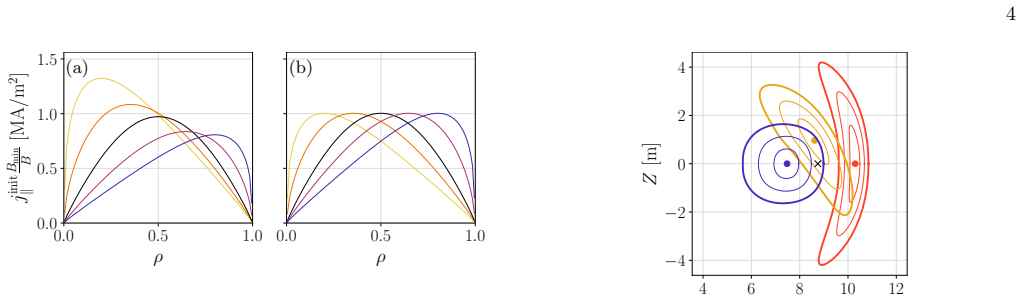
- [Fig. 8 caption] The caption lists 'I_p = 10 MA (black dotted), I_p = 5 MA (purple dashed), and I_p = 10 MA (red solid).' Given the text states I_p ∈ {1, 5, 10} MA, the red solid curve is presumably I_p = 1 MA. Please correct the duplicate 10 MA entry.
- [Fig. 5] The caption says 'different curves, of varying colours' without a legend or clear color mapping. A legend or explicit line-style/color table would help the reader identify I_p = 1, 5, 10 MA.
- [Eq. (17)] Please define the units of the metric explicitly. The numerator includes I(ρ) normalized to 1 MA, while the denominator has dimensions from ⟨g_θθ/g⟩ V'/a; stating the resulting units and the normalization of the integral would improve reproducibility.
- [References] Reference [33] points to a personal/public URL for the equilibrium. If possible, provide a permanent repository or DOI, or describe the equilibrium data in sufficient detail for reproduction.
Circularity Check
No circularity: the study's predictions are simulation outputs, and its avalanche metric is derived from Ampère's law and tested against independent simulations.
full rationale
The paper's central claims are produced by numerical simulations, not by fitting or by defining the answer into the inputs. The stellarator extension of DREAM is based on general forms of Faraday's and Ampère's laws taken from Strand & Houlberg (Ref. [29]), an external reference, and the equilibrium data come from the DESC solver (Ref. [30]), also external. The runaway-current scans over initial plasma current, thermal-quench time, and post-collapse temperature are forward simulations; the thresholds like t_TQ < 9 ms and the 'two out of three' conditions are read off the simulation output, not imposed as inputs. The avalanche-multiplication metric in Eq. (17) is derived from Ampère's law, Eq. (10), and then compared against avalanche-only simulations of the same configurations in Fig. 11. This is a validation correlation, not a construction: the metric is not fitted to the simulation results. The comparison between stellarator, circular, and elongated tokamak plasmas (Fig. 7) is a controlled numerical experiment using an explicit matching condition, Eq. (16), and does not presuppose the conclusion. The cited avalanche physics (Refs. [9, 31, 39]) and the poloidal-flux dependence (Ref. [42]) are external literature, not self-citations. The only self-citation of note is Ref. [18], by one of the authors, used for motivation and for providing a similar quasi-axisymmetric configuration; it is not load-bearing for the quantitative conclusions. The acknowledged inconsistency between the fixed magnetic equilibrium and the varied plasma current is a modeling limitation that affects realism and robustness, but it is not a circular step: the predictions are computed, not assumed. No step in the derivation reduces to its inputs by definition, and no fitted parameter is relabeled as a prediction.
Assumptions & free parameters
free parameters (5)
- post-collapse temperature T_fin =
scanned 1-100 eV
- temperature decay time tau =
scanned 0.02-2 ms
- initial plasma current I_p =
scanned 0.1-10 MA
- wall distance b/a =
scanned 1-1.5
- current density peak location rho_max =
scanned 0.25-0.75
assumptions (5)
- domain assumption j_parallel/B is approximately constant on a flux surface
- domain assumption Edge-wall inductance approximated by circular-limit formula
- domain assumption Temperature evolution is prescribed by an exponential decay
- domain assumption Elongation scaling 2/(κ+κ^-1) from Fülöp et al. extends to stellarator geometry
- domain assumption One quasi-axisymmetric configuration is representative of reactor-scale stellarators
Cite this review
Pith. "Pith review of Runaway Electrons in Stellarators: Unlikely or Unavoidable?." pith.science (2026). https://pith.science/paper/SNEPBWQL
@misc{pith2026260729523,
  author       = {Pith},
  title        = {Pith review of: Runaway Electrons in Stellarators: Unlikely or Unavoidable?},
  year         = {2026},
  howpublished = {\url{https://pith.science/paper/SNEPBWQL}},
  note         = {Machine review of arXiv:2607.29523}
}
read the original abstract
Generation of relativistic runaway electrons has historically not been considered a possible problem in stellarators, but this may not hold in reactor-scale stellarators despite the lack of an externally driven plasma current. The magnitude of the plasma current governs the exponential generation of runaways, and even if there is no externally driven plasma current, the bootstrap current could be considerable in reactor-relevant stellarators. In this paper, we present a pilot study on the generation of runaway electrons in stellarator temperature collapse scenarios. To reliably study runaway electrons in stellarators, we implemented a stellarator plasma model in the runaway electron simulation tool DREAM. The model is used to explore when runaway electrons can be generated with regard to combinations of initial plasma current, temperature decay time scale, and post-decay temperature. Special consideration is given to runaway generation through avalanche multiplication in stellarators, and how it compares to tokamaks. We find that significant runaway electron generation is possible also in stellarators, and demonstrate under which conditions it could be a concern. However, our findings support the conception that runaway electrons will be less of a concern in reactor-scale stellarators compared to tokamaks.
Figures


Figures from the paper (4 more)


Reference graph
Works this paper leans on
-
[1]
C. T. R. Wilson, The acceleration ofβ-particles in strong electric fields such as those of thunderclouds, Mathemat- ical Proceedings of the Cambridge Philosophical Society 22, 534 (1925)
1925
-
[2]
Dreicer, Electron and ion runaway in a fully ionized gas
H. Dreicer, Electron and ion runaway in a fully ionized gas. I, Physical Review115, 238 (1959)
1959
-
[3]
Dreicer, Electron and ion runaway in a fully ionized gas
H. Dreicer, Electron and ion runaway in a fully ionized gas. II, Physical Review117, 329 (1960)
1960
-
[4]
Helander, L.-G
P. Helander, L.-G. Eriksson, and F. Andersson, Runaway acceleration during magnetic reconnection in tokamaks, Plasma Physics and Controlled Fusion44, B247 (2002)
2002
-
[5]
A. H. Boozer, Theory of tokamak disruptions, Physics of Plasmas19, 058101 (2012)
2012
-
[6]
B. N. Breizman, P. Aleynikov, E. M. Hollmann, and M. Lehnen, Physics of runaway electrons in tokamaks, Nuclear Fusion59, 083001 (2019)
2019
-
[7]
Ratynskaia, M
S. Ratynskaia, M. Hoelzl, E. Nardon, P. Aleynikov, F. J. Artola, V. Bandaru, M. Beidler, B. Breizman, D. del Castillo-Negrete, M. De Angeli, V. Dimitriou, R. Ding, J. Eriksson, O. Ficker, R. S. Granetz, E. Hollmann, M. Hoppe, M. Houry, I. Jepu, H. R. Koslowski, C. Liu, J. R. Martin-Solis, G. Pautasso, Y. Peneliau, R. A. Pitts, G. I. Pokol, C. Reux, U. She...
2026
-
[8]
Rizzi, K
T. Rizzi, K. Paschalidis, S. Ratynskaia, P. Tolias, I. Ek- mark, M. Hoppe, R. A. Tinguely, A. Feyrer, and T. Looby, Thermal modeling of runaway electron induced damage in the SPARC tokamak, Plasma Physics and Controlled Fusion68, 065046 (2026)
2026
Show all 42 references
-
[9]
Rosenbluth and S
M. Rosenbluth and S. Putvinski, Theory for avalanche of runaway electrons in tokamaks, Nuclear Fusion37, 1355 (1997)
1997
-
[10]
Ekmark, M
I. Ekmark, M. Hoppe, T. F¨ ul¨ op, P. Jansson, L. Antons- son, O. Vallhagen, and I. Pusztai, Fluid and kinetic stud- ies of tokamak disruptions using bayesian optimization, Journal of Plasma Physics90, 905900306 (2024)
2024
-
[11]
A. Fil, L. Henden, S. Newton, M. Hoppe, and O. Vall- hagen, Disruption runaway electron generation and mit- igation in the spherical tokamak for energy production (step), Nuclear Fusion64, 106049 (2024)
2024
-
[12]
Ekmark, M
I. Ekmark, M. Hoppe, R. Tinguely, R. Sweeney, T. F¨ ul¨ op, and I. Pusztai, Runaway electron generation in disrup- tions mitigated by deuterium and noble gas injection in 10 SPARC, Journal of Plasma Physics91, E82 (2025)
2025
-
[13]
Sweeney, V
R. Sweeney, V. Riccardo, A. Braun, C. Clauser, A. J. Creely, T. Eich, I. Ekmark, A. Feyrer, C. Hansen, J. C. Hillesheim, T. Looby, S. Ratynskaia, R. Schramm, R. A. Tinguely, H. Wu, J. Boguski, M. D. Boyer, J. Carmichael, A. Carter, R. Datta, T. F¨ ul¨ op, R. Granetz, S. Guizzo...
2026
-
[14]
Helander, Theory of plasma confinement in non- axisymmetric magnetic fields, Reports on Progress in Physics77, 087001 (2014)
P. Helander, Theory of plasma confinement in non- axisymmetric magnetic fields, Reports on Progress in Physics77, 087001 (2014)
2014
-
[15]
A. H. Boozer, Stellarators as a fast path to fusion, Nu- clear Fusion61, 096024 (2021)
2021
-
[16]
Helander, C
P. Helander, C. D. Beidler, T. M. Bird, M. Drevlak, Y. Feng, R. Hatzky, F. Jenko, R. Kleiber, J. H. E. Proll, Y. Turkin, and P. Xanthopoulos, Stellarator and tokamak plasmas: a comparison, Plasma Physics and Controlled Fusion54, 124009 (2012)
2012
-
[17]
Helander, F
P. Helander, F. I. Parra, and S. L. Newton, Stellara- tor bootstrap current and plasma flow velocity at low collisionality, Journal of Plasma Physics83, 905830206 (2017)
2017
-
[18]
Landreman, S
M. Landreman, S. Buller, and M. Drevlak, Optimization of quasi-symmetric stellarators with self-consistent boot- strap current and energetic particle confinement, Physics of Plasmas29, 082501 (2022)
2022
-
[19]
Landreman and E
M. Landreman and E. Paul, Magnetic fields with precise quasisymmetry for plasma confinement, Physical Review Letters128, 035001 (2022)
2022
-
[20]
A. H. Boozer, Plasma equilibrium with rational magnetic surfaces, The Physics of Fluids24, 1999 (1981)
1999
-
[21]
Landreman and P
M. Landreman and P. J. Catto, Omnigenity as gener- alized quasisymmetry, Physics of Plasmas19, 056103 (2012)
2012
-
[22]
Najmabadi, A
F. Najmabadi, A. R. Raffray, S. I. Abdel-Khalik, L. Bromberg, L. Crosatti, L. El-Guebaly, P. R. Garabe- dian, A. A. Grossman, D. Henderson, A. Ibrahim, T. Ihli, T. B. Kaiser, B. Kiedrowski, L. P. Ku, J. F. Lyon, R. Maingi, S. Malang, C. Martin, T. K. Mau, B. Mer- rill, R. L. M...
2008
-
[23]
Gates, A
D. Gates, A. Boozer, T. Brown, J. Breslau, D. Curreli, M. Landreman, S. Lazerson, J. Lore, H. Mynick, G. Neil- son, N. Pomphrey, P. Xanthopoulos, and A. Zolfaghari, Recent advances in stellarator optimization, Nuclear Fu- sion57, 126064 (2017)
2017
-
[24]
Hegna, D
C. Hegna, D. Anderson, A. Bader, T. Bechtel, A. Bhat- tacharjee, M. Cole, M. Drevlak, J. Duff, B. Faber, S. Hudson, M. Kotschenreuther, T. Kruger, M. Landre- man, I. McKinney, E. Paul, M. Pueschel, J. Schmitt, P. Terry, A. Ware, M. Zarnstorff, and C. Zhu, Improv- ing the stell...
2022
-
[25]
Warmer, J
F. Warmer, J. Alguacil, D. Biek, T. Bogaarts, G. Bon- giov ` ı, V. Bykov, J. Catal´ an, R. Duligal, I. Fern´ andez- Berceruelo, S. Giambrone, C. Hume, M. Hrecinuc, R. Kembleton, J. Lion, T. Lyytinen, J. Noguer´ on Va- liente, I. Palermo, V. Queral, D. Rapisarda, W. Rutten, L. ...
2024
-
[26]
Aleynikov, P
P. Aleynikov, P. Helander, and H. M. Smith, Runaway electrons during a coil quench in stellarators, Physical Review Applied25, 024065 (2026)
2026
-
[27]
Dinklage, K
A. Dinklage, K. McCarthy, C. Suzuki, N. Tamura, T. Wegner, H. Yamada, J. Baldzuhn, K. Brunner, B. Buttensch¨ on, H. Damm, P. Drewelow, G. Fuchert, M. Hirsch, U. Hoefel, H. Kasahara, J. Knauer, D. Maier, J. Miyazawa, G. Motojima, T. Oishi, K. Rahbarnia, T. Sunn Pedersen, R. Sak...
2019
-
[28]
Hoppe, O
M. Hoppe, O. Embr´ eus, and T. F¨ ul¨ op, DREAM: A fluid-kinetic framework for tokamak disruption runaway electron simulations, Computer Physics Communications 268, 108098 (2021)
2021
-
[29]
P. I. Strand and W. A. Houlberg, Magnetic flux evolution in highly shaped plasmas, Physics of Plasmas8, 2782 (2001)
2001
-
[30]
D. W. Dudt and E. Kolemen, DESC: A stellarator equi- librium solver, Physics of Plasmas27, 102513 (2020)
2020
-
[31]
Hesslow, O
L. Hesslow, O. Embr´ eus, O. Vallhagen, and T. F¨ ul¨ op, Influence of massive material injection on avalanche run- away generation during tokamak disruptions, Nuclear Fu- sion59, 084004 (2019)
2019
-
[32]
Reiter, The data file AMJUEL: Additional atomic and molecular data for EIRENE (2020), documentation for the AMJUEL database
D. Reiter, The data file AMJUEL: Additional atomic and molecular data for EIRENE (2020), documentation for the AMJUEL database. URL: https://www.eirene.de/Documentation/amjuel.pdf
2020
-
[33]
The magnetic equilibrium can be found at https://sb0095.mycpanel.princeton.edu/QA/notes.html
-
[34]
Hesslow, L
L. Hesslow, L. Unnerfelt, O. Vallhagen, O. Embr´ eus, M. Hoppe, G. Papp, and T. F¨ ul¨ op, Evaluation of the Dreicer runaway generation rate in the presence of high- Zimpurities using a neural network, Journal of Plasma Physics85, 475850601 (2019)
2019
-
[35]
Smith and E
H. Smith and E. Verwichte, Hot tail runaway electron generation in tokamak disruptions, Physics of Plasmas 15, 072502 (2008)
2008
-
[36]
Vallhagen, O
O. Vallhagen, O. Embreus, I. Pusztai, L. Hesslow, and T. F¨ ul¨ op, Runaway dynamics in the DT phase of ITER operations in the presence of massive material injection, Journal of Plasma Physics86, 475860401 (2020)
2020
-
[37]
Mart ´ ın-Sol ´ ıs, A
J. Mart ´ ın-Sol ´ ıs, A. Loarte, and M. Lehnen, Formation and termination of runaway beams in ITER disruptions, Nuclear Fusion57, 066025 (2017)
2017
-
[38]
Lehnen, The ITER disruption mitigation system - design progress and design validation (2021), presented at Theory and Simulation of Disruptions Workshop, PPPL
M. Lehnen, The ITER disruption mitigation system - design progress and design validation (2021), presented at Theory and Simulation of Disruptions Workshop, PPPL. URL: https://tsdw.pppl.gov/Talks/2021/Lehnen.pdf
2021
-
[39]
F¨ ul¨ op, P
T. F¨ ul¨ op, P. Helander, O. Vallhagen, O. Embreus, L. Hesslow, P. Svensson, A. J. Creely, N. T. Howard, and P. Rodriguez-Fernandez, Effect of plasma elongation on current dynamics during tokamak disruptions, Journal of Plasma Physics86, 474860101 (2020)
2020
-
[40]
Bouvain, A
H. Bouvain, A. Dinklage, N. Tamura, K. Mukai, C. Suzuki, T. Tokuzawa, Y. Takemura, Y. Narushima, 11 K. Ida, M. Yoshinuma, H. Igami, H. Kasahara, K. Mc- Carthy, D. Medina Roque, and I. Garc ´ ıa-Cort´ es, Ad- ditional ECRH mitigates thermal quenches induced by tungsten TESPEL i...
2026
-
[41]
Bodner, N
G. Bodner, N. Eidietis, Z. Chen, P. Heinrich, J. Herfindal, S. Jachmich, G. Papp, J. Kim, M. Lehnen, U. Sheikh, I. Coffey, O. Ficker, S. Gerasimov, V. Kachkanov, C. Reux, S. Silburn, H. Sun, the ASDEX Upgrade Team, JET Contributors, and the EUROfusion Tokamak Ex- ploitation Te...
2025
-
[42]
Vallhagen, L
O. Vallhagen, L. Hanebring, F. Artola, M. Lehnen, E. Nardon, T. F¨ ul¨ op, M. Hoppe, S. Newton, and I. Pusz- tai, Runaway electron dynamics in ITER disruptions with shattered pellet injections, Nuclear Fusion64, 086033 (2024)
2024
Reviewed August 3, 2026 · model on record in the stance chip above.
Discussion (0). Continue with ORCID to comment.