REVIEW 1 major objections 4 minor 26 references
On the ideal stability of the sheared-flow Z pinch
T0 review · 1 major / 4 minor · reviewed 2026-08-04 · deepseek-v4-flash
Pith's one-line read Trans-Alfvénic sheared flow stabilizes the Z-pinch kink, but only by handing the ideal-MHD spectrum to new shear-driven instabilities; real stability rests on non-ideal physics.
desk verdict A serious spectral explanation of trans-Alfvénic kink stabilization; the stability boundaries need care at continuum extrema, but the qualitative result holds. read the letter →
The pith
A machine-rendered reading of the paper's core claim, the machinery that carries it, and where it could break.
The reading
What carries the argument
The load-bearing object is the analytic dispersion function chi(omega,k), built by integrating the linearized ideal-MHD equations from axis to wall and imposing conducting-wall boundary conditions; its zeros are the eigenfrequencies. The function is split into an adiabatic part (principal-value integration through resonant surfaces) and a resonant part (half-residue contributions), which together track how discrete modes emerge from and interact with the continuous spectrum. This splitting produces the marginal-stability skeleton in the (omega,k) plane and clarifies the role of the Doppler-shifted continuum. The spectral picture is organized by the Alfvén gap that shields m=1 modes from sub-
What would settle it
Compute the zero-contours of the analytic dispersion function with a regularization that properly handles continuum extrema (d omega*/dr = 0), for example by matched asymptotic expansions around the turning points, and check whether the marginal branches and the acoustic-kink growth rates survive unchanged. A direct eigenmode solver that resolves the continuum-edge singularities without the monotonic-frequency assumption, applied at Alfvénic Mach number 2, would either confirm the acoustic-kink instability or falsify the central claim if it shows a stable configuration.
Extended reading notes
Core claim
Within ideal magnetohydrodynamics, the paper shows that the m=1 kink instability of a Z-pinch is stabilized by trans-Alfvénic sheared flow through a specific spectral mechanism: the flow Doppler-shifts the Alfvén and slow-magnetosonic continuous spectrum into resonance with the discrete kink eigenvalue, producing continuum damping. This geometric picture explains the threshold for stabilization and why earlier growth-rate calculations appeared contradictory. Simultaneously, the trans-Alfvénic flow couples three families of acoustic waves—interior, exterior, and axis-localized—producing reflection modes and an acoustic kink that occur even in the absence of a magnetic field. These shear-drive
Load-bearing premise
The adiabatic/resonant decomposition assumes that each resonance frequency is monotonic in radius, with nonzero derivative, at every resonant surface; where the derivative vanishes at continuum extrema, the change-of-variables regularization breaks down and the computed marginal skeleton could shift.
Editorial extensions
If this is right
- The m=1 kink cannot be stabilized by sub-Alfvénic shear; the flow must cross the Alfvén speed across the pinch radius, giving a threshold that is independent of the flow profile's shape.
- Near-marginal m=0 interchange modes are stabilized by sub-Alfvénic sheared flow at all wavenumbers, but strongly super-marginal profiles resist stabilization.
- Trans-Alfvénic shear introduces reflection modes and an acoustic kink that dominate the ideal spectrum, so ideal MHD cannot predict a stable sheared-flow Z pinch.
- The stability of actual Z-pinch experiments therefore hinges on non-ideal physics—dissipation and finite orbit width—which the paper identifies as the next necessary step.
- The adiabatic/resonant splitting provides a spectral method that extends directly to sheared-flow screw pinches and other flowing magnetic equilibria.
Reading between the lines
- The earlier disagreement among ideal-MHD kink calculations is plausibly resolved by branch proliferation: at the continuum edge, marginal branches accumulate so densely that single-mode solvers can track a near-marginal branch and mistake it for the kink.
- If viscosity or resistivity at finite Reynolds and Lundquist numbers damps the reflection modes and the acoustic kink, the sheared-flow Z pinch may remain stable in practice despite being ideal-MHD unstable; the spectral framework here gives a concrete target for kinetic and two-fluid simulations.
- Because the reflection-mode mechanism is the cylindrical analogue of supersonic-jet screech, laboratory measurements of acoustic radiation from the shear layer could provide a direct test of the predicted instability.
- The breakdown of the regularization at continuum extrema is the most fragile part of the construction; a rigorous turning-point treatment would either confirm the marginal skeleton or reveal corrections to the stability boundaries.
Editorial analysis
A structured set of objections, weighed in public.
Referee Report
Summary. The paper develops a spectral-theoretic analysis of linearized ideal-MHD stability for a cylindrical Z pinch with radially sheared axial flow. Starting from the first-order ODE system of Bondeson et al., it defines an analytic dispersion function χ(ω,k) via a propagator and boundary conditions, then regularizes the singular integrals at the continuous spectrum using Plemelj/Hadamard prescriptions, splitting χ into adiabatic and resonant parts. Using zero-contours of the adiabatic part as a marginal-stability skeleton and seeding pseudo-arclength continuation to trace unstable branches, the paper argues: sub-Alfvénic shear can stabilize m=0 interchange for near-Kadomtsev profiles; the m=1 kink requires trans-Alfvénic shear to close the Alfvén gap; and at that threshold compressible shear-driven instabilities (reflection modes and an acoustic kink) appear and dominate the ideal spectrum, so that ideal MHD does not predict stability of the sheared-flow Z pinch.
Significance. If correct, the paper offers a mechanistic explanation for the long-standing discrepancy between single-mode kink-stabilization calculations and the persistent instability found by independent eigensystem analyses: the classical kink is stabilized only at the price of activating shear-driven compressible instabilities. The dispersion-function formalism, with its adiabatic/resonant split, is a useful tool for non-self-adjoint MHD spectral problems. The paper is careful in its derivations, includes WKB benchmarks, exact k=0 limits, and comparisons with known results for the static kink and wall stabilization. The central qualitative conclusions are consistent with prior numerical work (Refs. 12, 21) and with the jet-instability literature. The main technical risk is the unresolved treatment of continuum extrema in the regularization, which the paper itself acknowledges.
major comments (1)
- [Appendix A, Eqs. (A7)–(A14); Sec. IVB; Figs. 13, 15, 16] The regularization of the dispersion function breaks down at continuum extrema, which are also the points where the paper's numerical skeleton is most needed. Equation (A7) requires dω*_s/dr≠0, and Eq. (A14) requires d v0z/dr≠0; the text after Eq. (A7) explicitly concedes the breakdown. For the parabolic flow v0z=v0(r/rp)^2, v0z'(0)=0; for the isothermal Bennett m=1 equilibrium the Alfvén frequency is radially constant, so dω*_s/dr = k v0z'(r) vanishes at r=0. Marginal modes accumulate at exactly this continuum edge (Figs. 6, 16), and the Fig. 13 caption reports numerical artifacts there. At an extremum the singular integral of Eq. (A4) has branch-point rather than simple-pole behavior, so the Plemelj residue used in Eq. (A7) is not justified. Because the zero-contours of Re χ+ computed with ε=10^-5 seed all unstable branches (Sec. IVB), an unvalidated treatment at these points could shi
minor comments (4)
- [Sec. IIIC3, Eq. (40)] Solving the 2×2 system from Eqs. (37)–(38) with χ_adi(ω0)=0 and θ=arctan(χ'_res/χ'_adi) gives ω1 = -(1/2) sin2θ · χ_res/χ'_adi, not -sin2θ · χ_res/χ'_res as displayed. Since the authors state these formulas are not used for the large-growth-rate modes, this does not affect the numerical results, but the equation should be corrected or its derivation shown.
- [Sec. IVB; Fig. 13] No convergence study with respect to the regularization parameter ε is reported. A brief study showing that the zero-contours and the seeded unstable branches stabilize as ε→0 would substantially strengthen the method and address the artifacts acknowledged in the Fig. 13 caption.
- [Sec. IVD2] The statement that 'a count of unstable eigenvalues ... via the Nyquist method confirms that none exist there' is not verifiable from the text. Showing the Nyquist contour and the winding-number result in a figure or appendix would help.
- [Sec. IIID4 and Figs. 10–11] The identification of reflection-mode branches in the MHD case is made by visual comparison with the current-free WKB diagrams. A quantitative criterion, such as a projection of the eigenfunction onto the WKB branches or a comparison with the WKB-predicted intersection frequencies, would make the classification more robust.
Circularity Check
No circularity: the derivation is self-contained from linearized ideal MHD, with no fitted parameters, no ansatz smuggled in via self-citation, and no prediction equivalent to an input.
full rationale
The paper's central claims are derived directly from the stated linearized ideal-MHD equations (Eqs. 1-5), the boundary-value dispersion function χ(ω,k) (Eq. 13), and the analytic continuation/reigularization of the resonant integrals in Appendix A. No constant is fitted to the target claim, and no 'prediction' is constructed from a subset of the data it is meant to explain. The trans-Alfvénic stabilization threshold and the appearance of shear-driven instabilities follow from the same equations and equilibrium profiles, not from the conclusions themselves. Prior results (Refs. 12 and 21) are used as benchmarks or points of comparison, not as inputs to the derivation. The authors' own earlier papers (Refs. 7 and 25) appear only as background on Kadomtsev-pinch modeling and transport; they do not supply a load-bearing premise. The Krein-collision and Hamiltonian-index arguments are cited from external literature and are used to interpret, not to generate, the numerically computed dispersion branches. The most significant admitted weakness is in Appendix A: the change of variables in Eq. A5 requires dω*_s/dr ≠ 0, and the paper itself notes that the treatment breaks down at continuum extrema and that Fig. 13 shows numerical artifacts at the continuous-spectrum edge. That is a technical validity concern, not circularity: the regularization is not defined in terms of the target stability result, and a possible error there would weaken the numerical skeleton without making the derivation equivalent to its inputs. Overall, no step in the claimed derivation chain reduces to its own conclusion or to a self-citation.
Assumptions & free parameters
free parameters (4)
- Wall radius r_w/r_p =
4
- Flow amplitude v0 at pinch radius =
2 v_A* and 4 v_A*
- Shear-flow profile shape =
parabolic v0z = v0 (r/rp)^2
- Regularization parameter epsilon =
1e-5
assumptions (6)
- domain assumption Ideal MHD equations (Eqs. 1-4) with zero resistivity, viscosity, and no B0z
- domain assumption Equilibrium profiles: Bennett/polytropic/current-free with isothermal and uniform-density choices
- standard math The dispersion function chi(omega,k) defined via propagator and boundary conditions (Eq. 13) yields the eigenvalues
- ad hoc to paper Principal-value/Hadamard regularization of singular integrals through resonant surfaces is valid for the eigenvalue problem, assuming monotonic resonance frequency with d omega*/dr != 0
- standard math Krein signature and Hamiltonian-Hopf bifurcation apply to the ideal MHD operator with flow
- standard math WKB and Langer corrections describe mode families in the current-free limit
Cite this review
Pith. "Pith review of On the ideal stability of the sheared-flow Z pinch." pith.science (2026). https://pith.science/paper/QVLN2NLE
@misc{pith2026260800291,
  author       = {Pith},
  title        = {Pith review of: On the ideal stability of the sheared-flow Z pinch},
  year         = {2026},
  howpublished = {\url{https://pith.science/paper/QVLN2NLE}},
  note         = {Machine review of arXiv:2608.00291}
}
read the original abstract
Sheared-flow Z-pinch stability has been studied within ideal MHD primarily through growth rate calculations, which find that even trans-Alfv\'{e}nic sheared flows apparently fail to suppress the kink instability. Trans-Alfv\'{e}nic sheared flow does stabilize the MHD kink but also excites shear-driven instabilities characteristic of high-Reynolds-number supersonic flow. This distinction is evident from the dispersion relations underlying the growth rates, computed here as the analytic dispersion function in the complex-frequency plane. Regularization splits this function into adiabatic and resonant parts describing how discrete modes emerge from and interact with the continuous spectrum. The Doppler-shifted flow continuum interacts with the interchange and kink instabilities in distinct ways. For interchange, the continuum overlaps the instability branch at all wavenumbers, so even sub-Alfv\'{e}nic sheared flow stabilizes profiles modestly beyond the interchange threshold. The kink, by contrast, is shielded from the continuum by a frequency gap, and trans-Alfv\'{e}nic flow is required to Doppler-shift the continuum into resonance with it, giving a geometric picture of the stabilization threshold. But shear-driven instabilities arise at this same threshold, including reflection modes and an acoustic kink. It is these shear-driven modes, not the original MHD instabilities, that dominate the ideal-MHD spectrum in trans-Alfv\'{e}nic conditions. The ideal analysis thus describes the stabilization mechanism while showing that the stability of the sheared-flow Z pinch ultimately rests on non-ideal physics, including finite orbit width and dissipation.
Figures


Figures from the paper (13 more)




Reference graph
Works this paper leans on
-
[1]
Interchange/sausage modes (𝑚=0) The magnetic field of the Z pinch is concave towards high pressure, thereby driving interchange (or sausage) instability. However, compressional work by the magnetic field is stabi- lizing to the interchange, because the interchange instability is pressure-driven.41 In the absence of sheared axial flows, the stabilizing eff...
-
[2]
hard-core
Kink modes (𝑚=1) Unlike𝑚=0 modes, compressibility offers no stabilization to the kink mode. This makes the kink the most dangerous mode for confinement, and it is often the one that causes disruptions. This is not to say the kink mode is insensitive to the equilibrium profile. In fact, from the energy principle, the stability condition for𝑚≥1in the Z pinc...
-
[3]
7, determine the linear resonances of the Z-pinch equilibrium
Doppler-shifted resonances and continuous spectrum The zeros of the denominator𝐷, Eq. 7, determine the linear resonances of the Z-pinch equilibrium. Factoring out 𝜌2 0(𝛾𝑝 0+𝐵 2 0/𝜇0)≠0, the root-containing factors are 𝐷∼(˜𝜔 2−𝑚 2𝜔2 𝑎)(˜𝜔2−𝑚 2𝜔2 𝑚𝑠).(25) Therefore, resonance occurs at Doppler-shifted𝑚-multiples of the Alfvén and slow magnetosonic frequenci...
-
[4]
The key concept is spectral accessibility, meaning that for continuum damping to occur, the perturbation’s frequency spectrum must overlap with resonant surfaces in the plasma
Phase mixing and spectral accessibility ThissectionexaminesphasemixingbytheMHDcontinuum and its dependence on the perturbation’s spectral structure. The key concept is spectral accessibility, meaning that for continuum damping to occur, the perturbation’s frequency spectrum must overlap with resonant surfaces in the plasma. Considering a perturbation of r...
-
[5]
Alfvén gap
An “Alfvén gap” shields kink modes from the continuum Within the gap|𝜔|<𝑚𝜔 𝑎 there is no continuum damping. Thus, flow-shear stabilization differs qualitatively for𝑚=0 and|𝑚|>0 instabilities. While𝑚=0 modes are affected at long-wavelength by any magnitude of flow shear, this “Alfvén gap” inhibits continuum damping of𝑚=1 instabilities. For 𝑚=1 modes to be ...
-
[6]
These functions differ by residue contributions from poles approaching the real-𝑟 axis.47,48 The original ideal MHD system, Eqs
Adiabatic and resonant dispersion functions Consider the limitsIm(𝜔)→0 ± from above and below the real-𝜔axisanddefinefunctions 𝜒+(𝜔𝑟,𝑘)≡𝜒(𝜔 𝑟+𝑖0,𝑘) and 𝜒−(𝜔𝑟,𝑘)≡𝜒(𝜔 𝑟−𝑖0,𝑘). These functions differ by residue contributions from poles approaching the real-𝑟 axis.47,48 The original ideal MHD system, Eqs. 1-4, is real-valued, so these two limits𝜒± are complex...
-
[7]
improper
Embedded eigenvalues: mediating continuum interaction The roots of𝜒adi are the embedded eigenvalues, compo- nents of the discrete spectrum that lie within the continuous spectrum and whose eigenfunctions are singular on their res- onant surfaces. Unlike the continuum modes, which are in fact “improper” solutions of an associated inhomogeneous BVP (thereby...
-
[8]
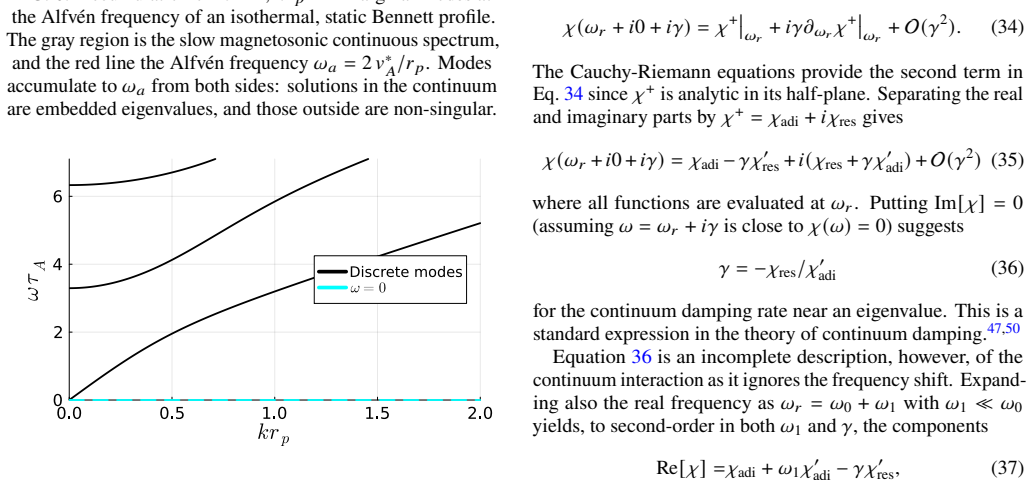
Continuum resonance: damping and excitation The embedded eigenvalues are marginally stable, but the continuum they inhabit mediates energy transfer with discrete modes. When an unstable mode’s frequency is near the contin- uum, resonant interaction can damp it by transferring energy Ideal stability of the sheared-flow Z pinch 8 1.8 1.9 2.0 2.1 2.2 𝜔𝜏𝐴 FIG...
Show all 26 references
-
[9]
They arise from the radial structure of the linearized acoustic problem in sheared flow, and are derived in Appendix C for a transonic current-free (®𝐵=0 ) flow
Three-family classification of marginal modes Threefamiliesofneutralmodesunderliecompressibleshear- driven instability. They arise from the radial structure of the linearized acoustic problem in sheared flow, and are derived in Appendix C for a transonic current-free (®𝐵=0 ) f...
-
[10]
In both cases, the radiation of sound to the exterior, via Family (ii), accompanies the instability
Summary of shear-driven instability modes Pairwise coupling between these families produces two in- stabilities: thereflection modefrom coupling of Families (i) and (ii), and theinterior kink and flute modesfrom coupling of Families (ii) and (iii). In both cases, the radiation...
-
[11]
Krein collisions and the Hamiltonian-Hopf bifurcation The mutual amplification of positive- and negative-energy waves is an instance of a general phenomenon in the spectral theory of Hamiltonian systems, known there as the Krein colli- sion, or Hamiltonian-Hopf bifurcation.56–...
-
[12]
Sound waves propagating co- flow in the subsonic core reflect radially at a sonic turning point
Reflection modes: coupling of Families (i) and (ii) Reflection modes, present for all𝑚, arise from the coupling of Family (i) with Family (ii). Sound waves propagating co- flow in the subsonic core reflect radially at a sonic turning point. The mode resonates with counter-flow...
-
[13]
current- free
Acoustic kink instability: Families (ii) and (iii) At the crossings in the(𝑘,𝜔) plane where Families (ii) and (iii) resonate (Fig. 11a), the axis localized mode couples to the exterior acoustic field. For𝑚=1 , this coupling converts the neutral axis sound wave into a kink inst...
-
[14]
Axisymmetric modes At both𝑣0 =2𝑣 ∗ 𝐴 (𝑀𝐴=1 ) and4𝑣∗ 𝐴 (𝑀𝐴=2 ), the inter- change instability is entirely eliminated at all wavenumbers with no such branch observed in Figures 13a and 13b. Because 𝑚=0 modes have no Alfvén spectral gap and the Bennett equilibrium is already clos...
-
[15]
Alfvén gap
Non-axisymmetric modes The𝑚=1 modesarefundamentallydifferentfromthe 𝑚=0 modes because the “Alfvén gap” in the continuum shields the MHD kink from continuum damping, so that trans-Alfvénic flow is required merely to access the stabilization mechanism. In doing so, this fast she...
2004
-
[16]
Isolation of singular integrals around resonant surfaces The propagator, Eq. 12, may be written as the limit𝑁→∞ of an ordered product of𝑁infinitesimal advances byΔ𝑟, L=lim 𝑁→∞ 1Ö 𝑛=𝑁 (𝐼+𝐿(𝑟 ∗ 𝑛)Δ𝑟)≡lim 𝑁→∞ 1Ö 𝑛=𝑁 L(𝑛+1)Δ𝑟 𝑛Δ𝑟 ,(A1) where[0,𝑟𝑤] is discretized byΔ𝑟 and𝑟∗ 𝑛∈[𝑛Δ𝑟,...
-
[17]
Each resonance ˜𝜔=𝑚𝜔𝑠 (with𝜔𝑠∈{±𝜔 𝑎,±𝜔𝑚𝑠})determinesthe radius𝑟 𝑐 of a resonant layer via 𝜔−𝑘𝑣 0𝑧(𝑟𝑐)=𝑚𝜔 𝑠(𝑟𝑐).(A3) Isolating the contribution to Eq
Regularization of simple poles (𝑚≠0) For𝑚≠0 , the linear resonances at𝜔=𝑘𝑣 0𝑧±𝑚𝜔 𝑎 and 𝜔=𝑘𝑣 0𝑧±𝑚𝜔𝑚𝑠 appearasfoursimplepolesin 𝜔-space. Each resonance ˜𝜔=𝑚𝜔𝑠 (with𝜔𝑠∈{±𝜔 𝑎,±𝜔𝑚𝑠})determinesthe radius𝑟 𝑐 of a resonant layer via 𝜔−𝑘𝑣 0𝑧(𝑟𝑐)=𝑚𝜔 𝑠(𝑟𝑐).(A3) Isolating the contribution...
-
[18]
Regularization of second-order poles (𝑚=0) With𝑚=0, a critical radius𝑟 𝑐 is determined via 𝜔=𝑘𝑣 0𝑧(𝑟𝑐).(A8) Isolating the integration through this resonance gives L𝑟𝑐+𝜖 𝑟𝑐−𝜖®𝑢ℓ = ∫ 𝑟𝑟 𝑟ℓ ®𝑔(𝑟) (𝜔−𝑘𝑣 0𝑧(𝑟)) 2𝑑𝑟(A9) where®𝑔(𝑟)again collects regular factors. The pole is second- o...
-
[19]
Write schematically the dispersion functions obtained by these prescriptions (Eqs
Adiabatic and resonant dispersion functions Let each pole encountered in the integration through the plasma be treated by the prescriptions of Sections A2 and A3. Write schematically the dispersion functions obtained by these prescriptions (Eqs. A7 and A14) as𝜒±≡𝜒 𝑃∓𝑖𝜒 𝑅 where...
-
[20]
Consider an axisymmetric radially sheared axial flow®𝑣=𝑣𝑧(𝑟)ˆ𝑧with axisymmetric perturbations®𝑣1(𝑟,𝑧,𝑡)
Axisymmetric perturbations and vortex stretching Axisymmetric perturbations are treated most simply from Rayleigh’s equation for the Stokes streamfunction. Consider an axisymmetric radially sheared axial flow®𝑣=𝑣𝑧(𝑟)ˆ𝑧with axisymmetric perturbations®𝑣1(𝑟,𝑧,𝑡) . Constraining th...
-
[21]
Three-dimensional perturbations and stability criterion For general perturbations of azimuthal mode number𝑚 and axial wavenumber𝑘, the incompressible eigenvalue problem is governed by the cylindrical Rayleigh equation of Ref. 65, (𝑢0−𝜁) 𝑑 𝑑𝑟 𝑟 𝜇2 𝑑(𝑟𝐺) 𝑑𝑟 −𝐺 −𝑟𝐺 𝑑𝑄 𝑑𝑟 =0,(B5) ...
-
[22]
6) to the current-free equilibrium𝐵0𝜃 =𝐵 0𝑧 =0 with uniform density and pressure (𝜌0 =𝑝 0 =1 ) and general azimuthal mode number𝑚
Reduced system for the current-free Z pinch Specialize the general operator𝐿 (Eq. 6) to the current-free equilibrium𝐵0𝜃 =𝐵 0𝑧 =0 with uniform density and pressure (𝜌0 =𝑝 0 =1 ) and general azimuthal mode number𝑚. Then 𝐹= ®𝑘· ®𝐵0=0 ,𝐶1=0 ,andthefirst-ordersystem 𝑑®𝑢/𝑑𝑟=𝐿®𝑢 with...
-
[23]
C2 into Eq
Second-order equation and WKB dispersion relation Eliminating𝑟𝜉𝑟 by substituting Eq. C2 into Eq. C1 yields a second-order equation for the total pressure perturbation, ˜𝜔2 𝑟 𝑑 𝑑𝑟 𝑟 ˜𝜔2 𝑑𝑃 𝑑𝑟 + ˜𝜔2 𝑐2𝑠 − 𝑘 2+ 𝑚2 𝑟 2 𝑃=0(C3) known as the Pridmore-Brown equation.66,67 Expanding t...
-
[24]
centrifu- gal
Mode trapping and quantization This section derives the quantization conditions underlying the three Families of Sec. IIID1, where Family (i) are interior acoustic modes propagating between the axis (or the “centrifu- gal” barrier for|𝑚|≥1 ) and a turning point, Family (ii) ar...
-
[25]
jet screech,
Reflection instability and jet screech Because the exterior family is Doppler-shifted by the shear flow to propagate forwards, the interior and exterior families may come into resonance, as discussed in Sec. IIIC. The sheared flow separates the modes by an evanescent barrier f...
-
[26]
Axis mode (Family iii) and acoustic kink Any regular axial flow satisfies𝑣𝑧 =𝑓(𝑟 2), so𝑣′ 0𝑧(0)=0 and the shear-coupling term in the Pridmore-Brown equation vanishes at𝑂(𝑟) near the axis. For|𝑚| ≥1 the near-axis equation is therefore Bessel’s equation 𝑃′′+ 1 𝑟𝑃′+ 𝑘 2 𝑟0− 𝑚2 𝑟 ...
Reviewed August 4, 2026 · model on record in the stance chip above.
Discussion (0). Continue with ORCID to comment.