REVIEW 4 minor 83 references
For off-shell Kerr spacetimes with a radial mass profile, a strict-convexity criterion fully classifies the possible horizon roots.
Reviewed by Pith at T0; open to challenge. T0 means a machine referee read the full paper against a public rubric. the ladder, T0–T4 →
T0 review · deepseek-v4-flash
2026-08-05 00:45 UTC pith:Y4MUPVJR
load-bearing objection A correct, narrow convexity theorem for off-shell Kerr with an honest FDM benchmark; worth a serious referee.
Convexity criterion and radial-profile response for off-shell Kerr geometries: a fuzzy-dark-matter profile as an analytic benchmark
The pith
A machine-rendered reading of the paper's core claim, the machinery that carries it, and where it could break.
Core claim
Within the one-function radial-Δ family, the paper's central claim is a convexity theorem: for any C² positive nondecreasing m(r) with m + r m' → m0 > 0 at r → 0+, m → M_ADM finite and r m' → 0 at infinity, and pointwise 2m' + r m'' < 1, the function H(r) = r − m(r) − r m'(r) is strictly increasing from a negative value to +∞, hence vanishes exactly once; consequently Δ'' = 2H' > 0 and Δ is strictly convex with a unique positive minimum. For a ≠ 0, the sign of that minimum decides between two simple positive roots, one double root, or no root; for a = 0 there is exactly one simple positive root after excluding the origin. The FDM-inspired profile satisfies the hypotheses whenever f_sol/(r_c/
What carries the argument
The load-bearing object is H(r) = r − m(r) − r m'(r), one half of Δ'(r). The proof hinges on the identity H'(r) = 1 − 2m'(r) − r m''(r): the pointwise bound makes H strictly increasing, and the central and asymptotic limits force it to cross zero exactly once. This single monotone-crossing argument carries all root-count, extremality, and completeness statements. For the response theory, the organizing device is the deformation μ(x; ε) = 1 + εh(x) with h → 0 at infinity; first-order coefficients for the outer horizon, extremal spin, static photon sphere, and critical impact parameters are expressed directly through local values of h and h', with the shadow area treated through an endpoint-re
Load-bearing premise
The fragile premise is that the mass profile has a finite ADM limit with r m'(r) → 0 at infinity while remaining monotone and satisfying the pointwise derivative bound; realistic profiles such as the untruncated NFW profile are logarithmically divergent and fall outside the theorem, leaving open the possibility of extra roots there.
What would settle it
Build a smooth, positive, nondecreasing C² mass function m(r) that satisfies m + r m' → m0 > 0 at r → 0+, m → finite M_ADM, r m' → 0 at infinity, and 2m' + r m'' < 1 everywhere, and compute H(r) = r − m − r m'. If H has more than one positive zero for some such m, the strict-convexity theorem is false; a numerical random search over such profiles, or an explicit counterexample with an admissible but sharply varying derivative, would settle it. The paper's own smooth-shell example rules out only the converse (monotonicity without the derivative bound), so it does not test this case.
If this is right
- For any profile inside the theorem's domain, horizon classification is exhaustive: two simple roots, one double root, or none (one positive root when a = 0), so a numerically missed secondary horizon cannot occur.
- The constant-mass replacement m(r) → M_ADM returns Kerr exactly and eliminates all radial-profile response; it is a reference baseline, not an approximation to a distributed environment.
- At first order in the environmental fraction, the outer horizon, extremal spin, and static photon sphere are determined by local values of h and h' at the unperturbed radii; the area-equivalent shadow radius follows with endpoint motion included.
- Spin-odd shadow displacement is not fixed by the mass profile alone: the slow-rotation comparison yields a displacement band at O(a), with half-widths around 0.017–0.043 M_ADM at f_sol = 0.1–0.2 and j_ADM = 0.2.
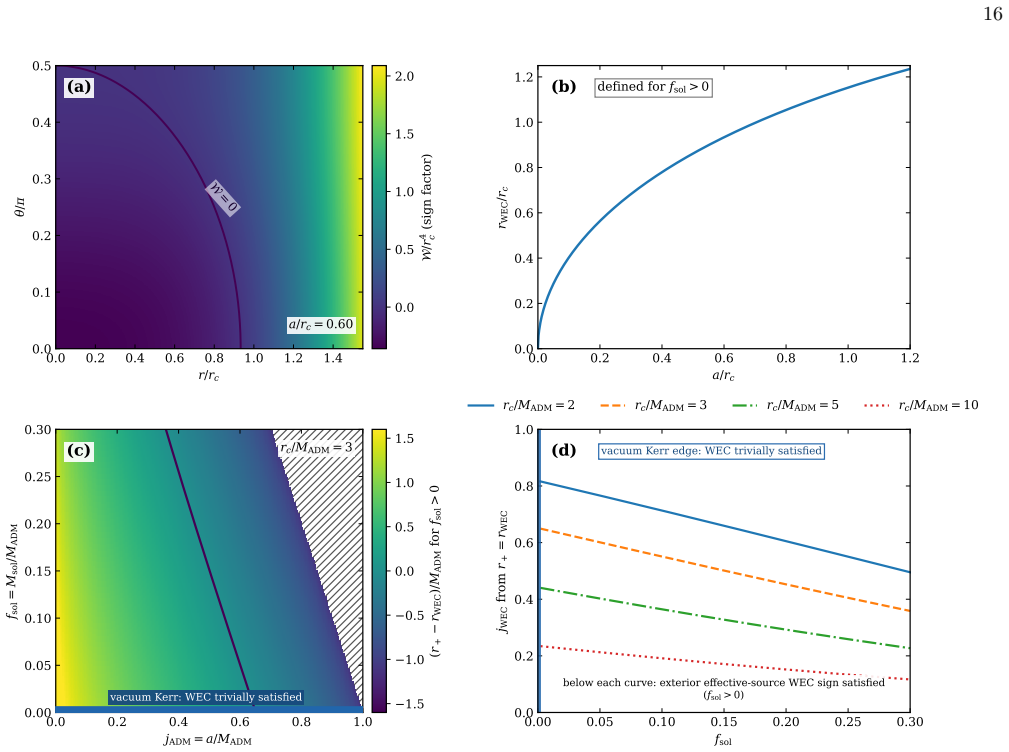
- In a physically scaled weak-field FDM example the true profile-gradient effect is below 10⁻²⁰; percent-level deviations at fixed ADM mass are charge-normalization effects, so the compact benchmark must not be read as a self-consistent rotating scalar-field solution.
Where Pith is reading between the lines
- Beyond the paper: the theorem's proof depends only on one-variable Δ and monotonicity of H, so the same root classification should transfer to other off-shell Kerr–Schild or regular rotating families satisfying the hypotheses, regardless of how the matter closure was chosen.
- Beyond the paper: the first-order response formulas are invertible in principle—measured horizon and shadow-area shifts as functions of environmental fraction could constrain m(r) near the photon sphere independently of the total ADM mass.
- Beyond the paper: applying the criterion to truncated NFW or Einasto profiles would map where extra-horizon branches appear once the infinite-mass failure of untruncated NFW is removed.
Editorial analysis
A structured set of objections, weighed in public.
Referee Report
Summary. The paper studies off-shell Kerr geometries specified by a radial mass function m(r) through Δ(r)=r²−2rm(r)+a². Its central result is a sufficient convexity theorem (Sec. V.A): for a positive, nondecreasing C² mass function satisfying the central limit m+r m′→m₀>0, the finite-ADM limits m→M_ADM and r m′→0, and the pointwise bound 2m′+r m″<1, the function H=r−m−r m′ is strictly increasing, so Δ is strictly convex and has a unique positive minimum. This yields a complete root trichotomy for a≠0 (two simple roots, one double root, or none) and exactly one physical positive root in the static case. The theorem is applied to an FDM-inspired compact profile with a closed-form mass integral, giving an analytic domain f_sol/(r_c/M_ADM)<0.691428 that covers the production box. The paper then derives first-order response formulas for horizons, the extremal branch, photon orbits, and the shadow under m/M_ADM=1+εh, and compares them with full-profile numerics and constant-mass Kerr. It also quantifies Newman–Janis completion dependence of spin-odd shadow displacements and repeatedly emphasizes that the geometry is an effective benchmark, not a self-consistent Einstein–Klein–Gordon solution.
Significance. If accepted, the convexity theorem is a clean and portable classification tool for horizon topology in the one-function radial-Δ family. The proof is self-contained and correct: H′>0 makes H strictly increasing, and the boundary limits fix exactly one zero, giving the stated root behavior. The paper’s strengths include its explicit scope mapping (the theorem is sufficient, not necessary, and the untruncated NFW profile is correctly placed outside the domain), the inclusion of counterexamples such as the smooth shell with four roots, extensive numerical audits (2976 all-branch and 1736 perturbative-error configurations with documented convergence), and symbolic consistency checks of the inverse metric, determinant, and Kretschmann scalar. The first-order response formulas are internally consistent with the unexpanded equations, and the numerical derivatives are reported with conservative error budgets. The authors are unusually careful to separate general off-shell results from profile-specific and completion-dependent claims, which makes the benchmark character of the FDM application clear.
minor comments (4)
- [Acknowledgments] Typo: “The authors gratefully acknowledges” should be “The authors gratefully acknowledge”.
- [Appendix B / CAS scripts] The text refers to an “accompanying open CAS script kretschmann_cas.wl” and a “distributed script”, but no URL, repository, or ancillary-file listing is given. If these scripts are intended to support the reproducibility claim, please provide access information or attach them.
- [Sec. V.A / Eq. (194)] The central-limit hypothesis is stated as a combined limit. It would help the reader to add one sentence noting that monotonicity plus this limit implies m(0+)=m₀ and r m′(r)→0, which is what justifies Δ(0+)=a² in the root trichotomy. The proof is sound, but this step is implicit.
- [Sec. II.B / Eq. (35)] In the physical scaling example, “rc = 3GMADM/c2 ≃6.38×10⁻⁷ pc” is notationally awkward; writing r_c = 3GM_ADM/c² would avoid confusion with the core-radius symbol and the exponent.
Circularity Check
No significant circularity: the convexity theorem, corollary, and response formulas are derived from stated assumptions via direct calculus, not from fitted parameters or self-citations.
full rationale
The central claim (Sec. V A) is self-contained: H'(r)=1-2m'-rm''>0 makes H strictly increasing; the central limit gives H(0+)=-m0<0 and the asymptotic conditions give H(r)->r-M_ADM>0, so H has exactly one zero and Delta is strictly convex. The root trichotomy then follows from the sign of Delta at the unique minimum; the static a=0 case is handled by excluding the coordinate factor root. None of these definitions or assumptions is stated in terms of the conclusion, and the theorem does not depend on the FDM profile. The FDM-inspired corollary is obtained by explicitly maximizing Q(y) for the closed-form profile, giving f_sol/(r_c/M_ADM)<0.691428; this is an analytic sufficient domain, not a fit. The first-order response identities in Sec. VII are ordinary Taylor coefficients of the same unexpanded horizon, extremal, photon-sphere, and shadow equations, with h(x) an arbitrary C^2 deformation satisfying h(infinity)=0; they are not fitted to the quantities they predict. The spin-odd shadow displacement is explicitly labeled completion-dependent and the slow-rotation family omega_kappa is presented as a diagnostic band, not as a unique prediction. The paper repeatedly states its limitations (not an Einstein-Klein-Gordon solution, compact profile not an unperturbed FDM core, constant-mass replacement only a Kerr reference, WEC is an effective-source sign diagnostic). The finite-ADM restriction explicitly excludes untruncated NFW (Table III), which is presented as a scope boundary, not as evidence for the theorem. References to prior work such as the FDM density profile [3,4] and source-based environments [12,13] are external inputs or contingent comparisons, not load-bearing self-citations; the bibliography contains no self-citations by the author set. Therefore the derivation chain is not circular within the explicitly stated ansatz; score 0.
Axiom & Free-Parameter Ledger
free parameters (4)
- fsol = Msol/MADM =
not fitted; explored as 0..0.30
- rc/MADM (core radius scale) =
rc/MADM in {2,3,5,10}
- rho_c (central density) =
related to Msol and rc via Eq. (30)
- m_phi (boson mass) =
10^-19 eV and 8.9x10^-17 eV in examples
axioms (4)
- domain assumption The Newman-Janis complexification prescription with m(r) evaluated at Re r (Sec. III) yields a valid effective metric with the stated asymptotic charges.
- domain assumption The null Hamilton-Jacobi equation separates with a Carter-like constant for the chosen rotating metric.
- domain assumption The FDM profile shape (Eq. 17) is a valid representation of the soliton core from fuzzy dark matter simulations.
- domain assumption The isolated-soliton scaling relations (Eqs. 33, 34) map physical FDM parameters to core radius and mass.
invented entities (1)
-
No new fundamental entities
no independent evidence
Cite this review
Pith. "Pith review of Convexity criterion and radial-profile response for off-shell Kerr geometries: a fuzzy-dark-matter profile as an analytic benchmark." pith.science (2026). https://pith.science/paper/Y4MUPVJR
@misc{pith2026260800519,
  author       = {Pith},
  title        = {Pith review of: Convexity criterion and radial-profile response for off-shell Kerr geometries: a fuzzy-dark-matter profile as an analytic benchmark},
  year         = {2026},
  howpublished = {\url{https://pith.science/paper/Y4MUPVJR}},
  note         = {Machine review of arXiv:2608.00519}
}
read the original abstract
We establish a sufficient one-minimum criterion for the off-shell Kerr family $\Delta(r) = r^2 - 2rm(r) + a^2$ with a positive, nondecreasing mass profile $m(r)$, showing that $1 - 2m'(r) - rm''(r) > 0$ ensures strict convexity and determines root counts for $\Delta$. Using a fuzzy-dark-matter-inspired benchmark satisfying this bound, we derive first-order responses for the outer horizon, extremal branch, photon sphere, and shadow functional under general deformations $m/M_{\text{ADM}} = 1 + \varepsilon h$. We demonstrate that static horizon and photon responses are profile-controlled, spin-odd shadow displacements are completion-dependent, and scale-consistent weak-field limits render local profile-gradient effects negligible ($\ll 10^{-20}$), confirming the strong-field box as a formal radial-profile benchmark rather than a self-consistent rotating scalar-field solution.
Figures



Reference graph
Works this paper leans on
-
[1]
percent accuracy
A stronger consistency condition is ε x(0) + h(x(0) + ) x(0) + −1 ≪x (0) + .(319) 28 For the extremal configuration, let xe = 1 +εx (1) e +O(ε 2).(320) Expansion of Eq. (233) yields x(1) e =h(1) +h ′(1).(321) Substitution into Eq. (234) gives j2 ext = 1 + 2εh(1) +O(ε 2),(322) and hence jext = 1 +εh(1) +O(ε 2).(323) The terms involvingh ′(1) cancel from th...
2048
-
[2]
Each sign-changing interval is then refined with Brent’s method
Horizon and extremality algorithms The dimensionless horizon function is b∆(x) =x 2 −2xµ(x) +j 2 ADM.(D6) Positive roots are first bracketed on a combined logarith- mic and linear radial grid. Each sign-changing interval is then refined with Brent’s method. Duplicate roots closer than the root tolerance are discarded, andallpositive roots are retained bef...
-
[3]
Perturbative coefficients The first-order corrections to the horizon, extremal spin, and static photon sphere are evaluated from the analytical expressions x(1) + = x(0) + h(x(0) + ) x(0) + −1 ,(D31) j(1) ext =h(1),(D32) and x(1) ph = 3 [h(3)−h ′(3)].(D33) For the shadow area radius, lets >0 denote a numerical step inf sol, distinct from the profile funct...
-
[4]
Photon-region and shadow algorithms For each subextremal configuration, the spherical-orbit impact parameters are evaluated from ξc(xp) = (x2 p +j 2 ADM) b∆′ −4x p b∆ jADM b∆′ ,(D13) ηc(xp) = 16x2 p b∆ ( b∆′)2 −(ξ c −j ADM)2.(D14) The initial radial scan begins immediately outside the outer horizon, xp,min =x +(1 +ϵ h),(D15) with ϵh = 10−6.(D16) The visib...
-
[5]
D. J. E. Marsh, Axion cosmology, Phys. Rep.643, 1 (2016), arXiv:1510.07633
Pith/arXiv arXiv 2016
-
[6]
Convergence test As a representative convergence test, consider fsol = 0.10,br c = 3, j ADM = 0.70, ι= 60 ◦. (D36) The outer horizon is x+ = 1.4756379397.(D37) 39 10−8 10−6 10−4 10−2 100 (xp − x + )/MADM −1.00 −0.75 −0.50 −0.25 0.00 0.25 0.50 0.75 1.00 normalized root function rc/MADM = 2, fsol = 0.30, j/jext = 0.999 Q/S Q00/S00 10−8 10−6 10−4 10−2 10...
work page 2000
-
[7]
W. Hu, R. Barkana, and A. Gruzinov, Fuzzy cold dark matter: The wave properties of ultralight particles, Phys. Rev. Lett.85, 1158 (2000), arXiv:astro-ph/0003365
Pith/arXiv arXiv 2000
-
[8]
P. J. E. Peebles, Fluid dark matter, Astrophys. J. Lett. 534, L127 (2000), arXiv:astro-ph/0002495
Pith/arXiv arXiv 2000
-
[9]
H.-Y. Schive, T. Chiueh, and T. Broadhurst, Cosmic structure as the quantum interference of a coherent dark wave, Nat. Phys.10, 496 (2014), arXiv:1406.6586
Pith/arXiv arXiv 2014
-
[10]
H.-Y. Schive, M.-H. Liao, T.-P. Woo, S.-K. Wong, T. Chi- ueh, T. Broadhurst, and W.-Y. P. Hwang, Understand- ing the core–halo relation of quantum wave dark mat- ter from three-dimensional simulations, Phys. Rev. Lett. 113, 261302 (2014), arXiv:1407.7762
Pith/arXiv arXiv 2014
-
[11]
V. Cardoso and P. Pani, Testing the nature of dark com- pact objects: A status report, Living Rev. Relativ.22, 4 (2019), arXiv:1904.05363
Pith/arXiv arXiv 2019
-
[12]
L. Hui, J. P. Ostriker, S. Tremaine, and E. Witten, Ul- tralight scalars as cosmological dark matter, Phys. Rev. D95, 043541 (2017), arXiv:1610.08297
Pith/arXiv arXiv 2017
-
[13]
L. Hui, Wave dark matter, Annu. Rev. Astron. Astro- phys.59, 247 (2021), arXiv:2101.11735
Pith/arXiv arXiv 2021
-
[14]
E. Y. Davies and P. Mocz, Fuzzy dark matter soliton cores around supermassive black holes, Mon. Not. R. As- tron. Soc.492, 5721 (2020), arXiv:1908.04790
Pith/arXiv arXiv 2020
-
[15]
V. Cardoso, T. Ikeda, R. Vicente, and M. Zilh˜ ao, Par- asitic black holes: The swallowing of a fuzzy dark matter soliton, Phys. Rev. D106, L121302 (2022), arXiv:2207.09469
Pith/arXiv arXiv 2022
-
[16]
E. Barausse, V. Cardoso, and P. Pani, Can environmental effects spoil precision gravitational-wave astrophysics?, Phys. Rev. D89, 104059 (2014), arXiv:1404.7149
Pith/arXiv arXiv 2014
-
[17]
K. Destounis and P. G. S. Fernandes, Environmentally induced chaos: Extreme-mass-ratio systems of rotating black holes in astrophysical environments, Phys. Rev. D 113, 044040 (2026), arXiv:2508.20191
arXiv 2026
-
[18]
S. Datta and C. Singha, Geometric properties of slowly rotating black holes embedded in matter environments, Phys. Rev. D113, 124052 (2026), arXiv:2602.10579
Pith/arXiv arXiv 2026
-
[19]
D. S. Fonseca, C. F. B. Macedo, M. M. Corrˆ ea, and D. Rubiera-Garcia, Matter environments around black holes: Geodesics, light rings, and ultracom- pact configurations, Phys. Rev. D113, 124039 (2026), arXiv:2512.22267
Pith/arXiv arXiv 2026
-
[20]
V. Cardoso, K. Destounis, F. Duque, R. Panosso Macedo, and A. Maselli, Black holes in galaxies: En- vironmental impact on gravitational-wave generation and propagation, Phys. Rev. D105, L061501 (2022), arXiv:2109.00005
Pith/arXiv arXiv 2022
-
[21]
Datta, Black holes immersed in dark matter: Energy condition and sound speed, Phys
S. Datta, Black holes immersed in dark matter: Energy condition and sound speed, Phys. Rev. D109, 104042 (2024), arXiv:2312.01277
Pith/arXiv arXiv 2024
-
[22]
P. G. S. Fernandes and V. Cardoso, Spinning black holes in astrophysical environments, Phys. Rev. Lett.135, 211403 (2025), arXiv:2507.04389. 41
arXiv 2025
-
[23]
S. P. Drake and P. Szekeres, Uniqueness of the Newman– Janis algorithm in generating the Kerr–Newman metric, Gen. Relativ. Gravit.32, 445 (2000)
work page 2000
-
[24]
Identifying the Event Horizons of Parametrically Deformed Black-Hole Metrics
D. Heumann and D. Psaltis, Identifying the event horizons of parametrically deformed black-hole metrics, Phys. Rev. D107, 044015 (2023), arXiv:2205.12994
work page internal anchor Pith review Pith/arXiv arXiv 2023
-
[25]
R. P. Kerr, Gravitational field of a spinning mass as an example of algebraically special metrics, Phys. Rev. Lett. 11, 237 (1963)
1963
-
[26]
J. B. Hartle, Slowly rotating relativistic stars. I. Equa- tions of structure, Astrophys. J.150, 1005 (1967)
work page 1967
-
[27]
J. B. Hartle and K. S. Thorne, Slowly rotating relativistic stars. II. Models for neutron stars and supermassive stars, Astrophys. J.153, 807 (1968)
1968
-
[28]
E. T. Newman and A. I. Janis, Note on the Kerr spinning- particle metric, J. Math. Phys.6, 915 (1965)
work page 1965
-
[29]
Chandrasekhar,The Mathematical Theory of Black Holes(Oxford University Press, Oxford, 1983)
S. Chandrasekhar,The Mathematical Theory of Black Holes(Oxford University Press, Oxford, 1983)
1983
-
[30]
C. Bambi and L. Modesto, Rotating regular black holes, Phys. Lett. B721, 329 (2013), arXiv:1302.6075
Pith/arXiv arXiv 2013
-
[31]
Azreg-A ¨ ınou, Generating rotating regular black hole solutions without complexification, Phys
M. Azreg-A ¨ ınou, Generating rotating regular black hole solutions without complexification, Phys. Rev. D90, 064041 (2014), arXiv:1405.2569
Pith/arXiv arXiv 2014
-
[32]
B. Toshmatov, B. Ahmedov, A. Abdujabbarov, and Z. Stuchl ´ ık, Rotating regular black hole solution, Phys. Rev. D89, 104017 (2014), arXiv:1404.6443
Pith/arXiv arXiv 2014
-
[33]
Carter, Hamilton–Jacobi and Schr¨ odinger separable solutions of Einstein’s equations, Commun
B. Carter, Hamilton–Jacobi and Schr¨ odinger separable solutions of Einstein’s equations, Commun. Math. Phys. 10, 280 (1968)
work page 1968
-
[34]
J. M. Bardeen, Timelike and null geodesics in the Kerr metric, inBlack Holes, edited by C. DeWitt and B. S. De- Witt (Gordon and Breach, New York, 1973), pp. 215– 239
work page 1973
-
[35]
Akiyamaet al.(Event Horizon Telescope Collabo- ration), First M87 Event Horizon Telescope results
K. Akiyamaet al.(Event Horizon Telescope Collabo- ration), First M87 Event Horizon Telescope results. I. The shadow of the supermassive black hole, Astrophys. J. Lett.875, L1 (2019), arXiv:1906.11238
Pith/arXiv arXiv 2019
-
[36]
R. M. Wald,General Relativity(University of Chicago Press, Chicago, 1984)
1984
-
[37]
Poisson,A Relativist’s Toolkit: The Mathematics of Black-Hole Mechanics(Cambridge University Press, Cambridge, 2004)
E. Poisson,A Relativist’s Toolkit: The Mathematics of Black-Hole Mechanics(Cambridge University Press, Cambridge, 2004)
2004
-
[38]
P. V. P. Cunha and C. A. R. Herdeiro, Shadows and strong gravitational lensing: A brief review, Gen. Rela- tiv. Gravit.50, 42 (2018), arXiv:1801.00860
Pith/arXiv arXiv 2018
-
[39]
S. E. Gralla, D. E. Holz, and R. M. Wald, Black hole shadows, photon rings, and lensing rings, Phys. Rev. D 100, 024018 (2019), arXiv:1906.00873
Pith/arXiv arXiv 2019
-
[40]
V. Perlick and O. Yu. Tsupko, Calculating black hole shadows: Review of analytical studies, Phys. Rep.947, 1 (2022), arXiv:2105.07101
Pith/arXiv arXiv 2022
-
[41]
C. Barcel´ o and M. Visser, Scalar fields, energy conditions, and traversable wormholes, Class. Quantum Grav.17, 3843 (2000), arXiv:gr-qc/0003025
Pith/arXiv arXiv 2000
-
[42]
Akiyamaet al.(Event Horizon Telescope Collabora- tion), First M87 Event Horizon Telescope results
K. Akiyamaet al.(Event Horizon Telescope Collabora- tion), First M87 Event Horizon Telescope results. VI. The shadow and mass of the central black hole, Astrophys. J. Lett.875, L6 (2019), arXiv:1906.11243
Pith/arXiv arXiv 2019
-
[43]
K. Akiyamaet al.(Event Horizon Telescope Collabora- tion), First Sagittarius A* Event Horizon Telescope re- sults. I. The shadow of the supermassive black hole in the center of the Milky Way, Astrophys. J. Lett.930, L12 (2022)
work page 2022
-
[44]
K. Akiyamaet al.(Event Horizon Telescope Collabora- tion), First Sagittarius A* Event Horizon Telescope re- sults. VI. Testing the black hole metric, Astrophys. J. Lett.930, L17 (2022), arXiv:2311.09484
Pith/arXiv arXiv 2022
-
[45]
S. W. Hawking and G. F. R. Ellis,The Large Scale Struc- ture of Space-Time(Cambridge University Press, Cam- bridge, 1973)
work page 1973
-
[46]
M. Visser,Lorentzian Wormholes: From Einstein to Hawking(American Institute of Physics, Woodbury, New York, 1996)
work page 1996
-
[47]
J. Veltmaat, J. C. Niemeyer, and B. Schwabe, Formation and structure of ultralight bosonic dark matter halos, Phys. Rev. D98, 043509 (2018), arXiv:1804.09647
Pith/arXiv arXiv 2018
-
[48]
L. M. Widrow and N. Kaiser, Using the Schr¨ odinger equation to simulate collisionless matter, Astrophys. J. Lett.416, L71 (1993)
work page 1993
-
[49]
T. Matos and L. A. Ure˜ na-L´ opez, Quintessence and scalar dark matter in the Universe, Class. Quantum Grav.17, L75 (2000), arXiv:astro-ph/0004332
Pith/arXiv arXiv 2000
-
[50]
V. H. Robles and T. Matos, Flat central density profile and constant dark matter surface density in galaxies from scalar field dark matter, Mon. Not. R. Astron. Soc.422, 282 (2012), arXiv:1201.3032
Pith/arXiv arXiv 2012
-
[51]
D. J. E. Marsh and A.-R. Pop, Axion dark matter, soli- tons and the cusp–core problem, Mon. Not. R. Astron. Soc.451, 2479 (2015), arXiv:1502.03456
Pith/arXiv arXiv 2015
-
[52]
P. Mocz, M. Vogelsberger, V. H. Robles, J. Zavala, M. Boylan-Kolchin, A. Fialkov, and L. Hernquist, Galaxy formation with BECDM. I. Turbulence and relaxation of idealized haloes, Mon. Not. R. Astron. Soc.471, 4559 (2017), arXiv:1705.05845
Pith/arXiv arXiv 2017
-
[53]
S. May and V. Springel, Structure formation in large- volume cosmological simulations of fuzzy dark matter: Impact of the non-linear dynamics, Mon. Not. R. Astron. Soc.506, 2603 (2021), arXiv:2101.01828
Pith/arXiv arXiv 2021
-
[54]
N. Bar, D. Blas, K. Blum, and S. Sibiryakov, Galactic rotation curves versus ultralight dark matter: Implica- tions of the soliton–host halo relation, Phys. Rev. D98, 083027 (2018), arXiv:1805.00122
Pith/arXiv arXiv 2018
-
[55]
B. Schwabe, J. C. Niemeyer, and J. F. Engels, Simula- tions of solitonic core mergers in ultralight axion dark matter cosmologies, Phys. Rev. D94, 043513 (2016), arXiv:1606.05151
Pith/arXiv arXiv 2016
-
[56]
D. G. Levkov, A. G. Panin, and I. I. Tkachev, Gravita- tional Bose–Einstein condensation in the kinetic regime, Phys. Rev. Lett.121, 151301 (2018), arXiv:1804.05857
Pith/arXiv arXiv 2018
-
[57]
B. Eggemeier and J. C. Niemeyer, Formation and mass growth of axion stars in axion miniclusters, Phys. Rev. D100, 063528 (2019), arXiv:1906.01348
Pith/arXiv arXiv 2019
-
[58]
Moczet al., First star-forming structures in fuzzy cosmic filaments, Phys
P. Moczet al., First star-forming structures in fuzzy cosmic filaments, Phys. Rev. Lett.123, 141301 (2019), arXiv:1910.01653
Pith/arXiv arXiv 2019
-
[59]
J. C. S. Neves and A. Saa, Regular rotating black holes and the weak energy condition, Phys. Lett. B734, 44 (2014), arXiv:1402.2694
Pith/arXiv arXiv 2014
-
[60]
H. Y. J. Chan, E. G. M. Ferreira, S. May, K. Hayashi, and M. Chiba, The diversity of core–halo structure in the fuzzy dark matter model, Mon. Not. R. Astron. Soc. 511, 943 (2022), arXiv:2110.11882
work page internal anchor Pith review Pith/arXiv arXiv 2022
-
[61]
M. G¨ urses and F. G¨ ursey, Lorentz covariant treatment of the Kerr–Schild geometry, J. Math. Phys.16, 2385 (1975)
work page 1975
-
[62]
Dymnikova, Spherically symmetric space-time with regular de Sitter center, Int
I. Dymnikova, Spherically symmetric space-time with regular de Sitter center, Int. J. Mod. Phys. D12, 1015 42 (2003), arXiv:gr-qc/0304110
Pith/arXiv arXiv 2003
-
[63]
S. A. Hayward, Formation and evaporation of nonsin- gular black holes, Phys. Rev. Lett.96, 031103 (2006), arXiv:gr-qc/0506126
Pith/arXiv arXiv 2006
-
[64]
V. P. Frolov, Notes on nonsingular models of black holes, Phys. Rev. D94, 104056 (2016), arXiv:1609.01758
Pith/arXiv arXiv 2016
-
[65]
V. P. Frolov and D. Kubizˇ n´ ak, Hidden symmetries of higher dimensional rotating black holes, Phys. Rev. Lett. 98, 011101 (2007), arXiv:gr-qc/0605058
work page internal anchor Pith review Pith/arXiv arXiv 2007
-
[66]
B. Toshmatov, Z. Stuchl ´ ık, and B. Ahmedov, Generic rotating regular black holes in general relativity coupled to nonlinear electrodynamics, Phys. Rev. D95, 084037 (2017), arXiv:1704.07300
Pith/arXiv arXiv 2017
-
[67]
P. Beltracchi and P. Gondolo, Physical interpretation of Newman–Janis rotating systems. I. A unique family of Kerr–Schild systems, Phys. Rev. D104, 124066 (2021), arXiv:2104.02255
Pith/arXiv arXiv 2021
-
[68]
Physical interpretation of Newman-Janis rotating systems. II. General systems
P. Beltracchi and P. Gondolo, Physical interpretation of Newman–Janis rotating systems. II. General systems, Phys. Rev. D104, 124067 (2021), arXiv:2108.02841
work page internal anchor Pith review Pith/arXiv arXiv 2021
-
[69]
A. Simpson and M. Visser, The eye of the storm: A regular Kerr black hole, J. Cosmol. Astropart. Phys.03 (2022) 011, arXiv:2111.12329
Pith/arXiv arXiv 2022
-
[70]
S. Benenti and M. Francaviglia, Remarks on certain sep- arability structures and their applications to general rel- ativity, Gen. Relativ. Gravit.10, 79 (1979)
work page 1979
-
[71]
A. Grenzebach, V. Perlick, and C. L¨ ammerzahl, Photon regions and shadows of Kerr–Newman–NUT black holes with a cosmological constant, Phys. Rev. D89, 124004 (2014), arXiv:1403.5234
Pith/arXiv arXiv 2014
-
[72]
P. Krtouˇ s, D. Kubizˇ n´ ak, D. N. Page, and V. P. Frolov, Killing–Yano tensors, rank-2 Killing tensors, and con- served quantities in higher dimensions, J. High Energy Phys.02(2007) 004, arXiv:hep-th/0612029
Pith/arXiv arXiv 2007
-
[73]
Closed conformal Killing-Yano tensor and Kerr-NUT-de Sitter spacetime uniqueness
T. Houri, T. Oota, and Y. Yasui, Closed conformal Killing–Yano tensor and Kerr–NUT–de Sitter space- time uniqueness, Phys. Lett. B656, 214 (2007), arXiv:0708.1368
work page internal anchor Pith review Pith/arXiv arXiv 2007
-
[74]
V. P. Frolov, P. Krtouˇ s, and D. Kubizˇ n´ ak, Black holes, hidden symmetries, and complete integrability, Living Rev. Relativ.20, 6 (2017), arXiv:1705.05482
Pith/arXiv arXiv 2017
-
[75]
Johannsen, Regular black hole metric with three constants of motion, Phys
T. Johannsen, Regular black hole metric with three constants of motion, Phys. Rev. D88, 044002 (2013), arXiv:1501.02809
Pith/arXiv arXiv 2013
-
[76]
R. A. Konoplya, L. Rezzolla, and A. Zhidenko, Gen- eral parametrization of axisymmetric black holes in met- ric theories of gravity, Phys. Rev. D93, 064015 (2016), arXiv:1602.02378
Pith/arXiv arXiv 2016
-
[77]
R. A. Konoplya, Shadow of a black hole surrounded by dark matter, Phys. Lett. B795, 1 (2019), arXiv:1905.00064
Pith/arXiv arXiv 2019
-
[78]
R. C. Pantig and A. ¨Ovg¨ un, Black hole in quantum wave dark matter, Fortschr. Phys.71, 2200164 (2023), arXiv:2210.00523
Pith/arXiv arXiv 2023
-
[79]
Z. Xu, X. Hou, and J. Wang, Kerr–anti-de Sitter/de Sitter black hole in perfect fluid dark matter back- ground, Class. Quantum Grav.35, 115003 (2018), arXiv:1711.04538
Pith/arXiv arXiv 2018
-
[80]
X. Hou, Z. Xu, and J. Wang, Rotating black hole shadow in perfect fluid dark matter, J. Cosmol. Astropart. Phys. 12(2018) 040, arXiv:1810.06381
Pith/arXiv arXiv 2018
discussion (0)
Sign in with ORCID, Apple, or X to comment. Anyone can read and Pith papers without signing in.