REVIEW 3 major objections 4 minor 69 references
Consistent and bound-preserving finite-volume WENO scheme for compressible two-/$N$-phase flows with Phase-Field mechanism
T0 review · 3 major / 4 minor · reviewed 2026-08-15 · deepseek-v4-flash
Pith's one-line read The paper claims to be the first WENO scheme for compressible multiphase flows that enforces consistency, conservation, equilibrium, and physical bound preservation simultaneously, and verifies this for two-phase and arbitrary-N-phase flow.
desk verdict A genuinely useful WENO reconstruction for compressible multiphase flows, with a crisp explanation of why WENO-JS misbehaves; the main blemish is that the headline applications run above the proven bound-preserving CFL. read the letter →
The pith
A machine-rendered reading of the paper's core claim, the machinery that carries it, and where it could break.
The reading
What carries the argument
The central object is the modified WENO weight $\omega^{(s)} = d^{(s)} / (d^{(s)} + \sum_{k \neq s} d^{(k)} (IS^{(s,k)})^2)$, where $IS^{(s,k)}$ is the ratio of the smoothness indicators of stencils $s$ and $k$ (set to 1 if both vanish). Because ratios are scale-invariant, the weights sense discontinuities in the phasic mass even when the phasic density is tiny. Around this weight formula, the scheme couples the reconstruction of $\alpha_p \rho_p$ and $\alpha_p$ using the same weights, applies a positivity limiter, rescales to make $\sum_p \alpha_p = 1$, re-limits interior states, and projects the full conservative state onto the energy bound; the conservation requirement is kept by reconstructing the cell polynomial so that its Gauss-Lobatto quadrature matches the cell average.
What would settle it
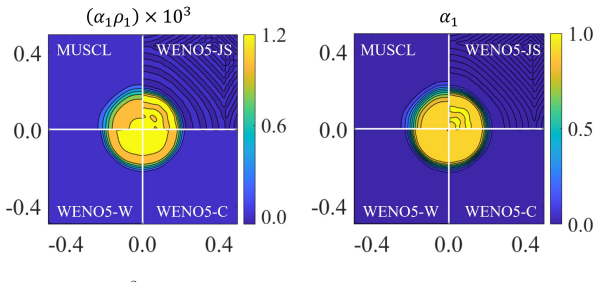
Run the two-phase air-water advection problem of Section 4.1.1 at $t=1$ and measure the consistency error $((\alpha_1 \rho_1)/\rho_1 - \alpha_1)$ and temperature; the paper's claim is that these are at round-off, so any systematic growth above machine precision would falsify the consistency claim. For the bound-preservation claim, run the shock-induced cavity collapse with the energy-bound projection removed at the theorem's stated $CFL \leq 1/12$ and at $CFL=0.2$: the paper predicts failure whenever the energy bound is skipped, so a completed simulation without the projection would contradict it.
Extended reading notes
Core claim
On its own terms, the paper's central discovery is a diagnosis and a fix. It shows that the standard WENO-JS weights fail for quantities like the phasic mass $g = a f + b$ because the smoothness indicators scale as $a^2$ and the epsilon-paranoia parameter effectively becomes $\epsilon/a^2$, which is not small when $a$ is a small density; hence non-smooth stencils are not deactivated and the mass oscillates. The fix replaces absolute smoothness with relative smoothness ratios between stencil pairs, making the weights scale-invariant, and then builds the reconstruction so that the volume fraction and the mass use the same weights, positivity and unity-sum steps, and an energy-bound projection, guaranteeing by construction that reconstructed face and interior states lie in the admissible set.
Load-bearing premise
The scheme's guarantee that the fully discrete solution stays in-bounds inherits the bound-preservation theorem from earlier work; the paper checks the reconstructed states are admissible but does not re-prove that theorem, and some demonstration runs use a larger CFL number than the theorem's sufficient condition.
Editorial extensions
If this is right
- WENO-JS should not be applied directly to phasic masses in low-density phases; the paper's two-phase advection tests show oscillations in mass and temperature that WENO-C removes to round-off.
- For N-phase flows with $N \geq 3$, a consistent WENO reconstruction need not produce fictitious phases, local voids, or overfilling; the five-phase and four-phase advection tests verify this.
- High-order WENO schemes can be made bound-preserving for compressible multiphase flows, which the paper argues is necessary because skipping the energy-bound step made the shock-induced collapse simulations fail.
- The modified weights can be adopted by other WENO variants (e.g., WENO-M, WENO-Z, TENO), since the analysis operates on the weight construction rather than on a particular variant.
- The scheme integrates with adaptive mesh refinement and with both the Allaire and Kapila five-equation models, giving it a wide operational range.
Reading between the lines
- The relative-smoothness weight formula suggests a general design principle: any WENO variant whose smoothness indicators are homogeneous of degree two will inherit the $\epsilon/a^2$ failure when applied to scaled quantities; replacement by ratios should be a drop-in fix for those variants too.
- The fact that the demonstration runs use $CFL=0.2$ while the sufficient bound-preservation condition from the earlier theorem is $CFL \leq 1/12$ hints that the theoretical CFL condition is conservative; if so, the practically stable range of WENO-C is wider than proven, but that remains open.
- The energy-bound projection, not merely mass positivity, appears to be what lets high-order schemes survive shock-interface impacts; the failure table suggests that low-order dissipative schemes can mask the missing bound, which points to a testing protocol for future high-order multiphase methods.
- WENO-CL, which preserves non-zero non-unity constant volume fractions, is positioned for miscible or reacting flows; one testable extension is to use the same limiter for mass-fraction transport in combustion models, where the sum-to-unity constraint is on mass fractions.
Signed reviews
Editorial analysis
A structured set of objections, weighed in public.
Referee Report
Summary. This manuscript proposes a finite-volume WENO reconstruction scheme, WENO-C, for compressible two-/N-phase flows with a Phase-Field mechanism. The paper first analyzes why the standard WENO-JS scheme produces errors in low-density phases, attributing the failure to the scaling of the smoothness indicators under affine transformations (Eq. 14). It then introduces modified WENO weights based on relative smoothness between stencil candidates (Eq. 15) and combines these with a coupled reconstruction of phasic masses and volume fractions, positivity limiters, volume-fraction normalization, and an energy-bound limiter (Section 3.4). The central claim is that WENO-C is the first WENO scheme satisfying consistency, conservation, equilibrium, and bound preservation for compressible multiphase flows, and, for N phases, consistency of reduction and volume-fraction summation to unity. Numerical tests verify these properties in advection, smooth and shock-interface problems, and applications to shock-induced cavity collapse and shock-vessel-bubble interaction, including an AMR variant. A variant, WENO-CL, is also presented for problems with non-zero non-unity constant volume fractions.
Significance. If the claims are correct, the paper is a valuable practical contribution: it provides a reconstruction procedure that algebraically enforces the coupled requirements that previous WENO implementations for multiphase flows satisfied only partially. The construction is transparent and largely self-contained: the consistency argument for the modified weights is explicit, the coupled mass/volume-fraction reconstruction is clearly motivated, and the positivity and summation steps are stated as algebraic operations rather than fitted parameters. The numerical tests are extensive and include round-off-level measurements of the targeted errors, which is a real strength. The main caveat is that the fully discrete bound-preservation property is not re-proved here but imported from the author's earlier theorem in [20]; the headline application runs are performed at CFL=0.2, above the sufficient CFL=1/12 quoted from [20], and no admissibility diagnostics are reported for those runs. Thus the strongest empirical demonstration of the central property is conditional on an unverified CFL assumption. This is a fixable gap rather than a flaw in the reconstruction itself.
major comments (3)
- [Section 4.2] The paragraph beginning "Following the analysis in [20]" states a sufficient CFL condition of CFL<=1/12 for bound preservation, but both application problems (shock-induced cavity collapse and shock-vessel-bubble interaction) are run at CFL=0.2, justified only by the remark that preliminary tests show the sufficient condition is more restrictive than necessary. Since the paper's central claim is a fully discrete bound-preservation property and the fully discrete theorem is imported from [20], the headline simulations are outside the proven regime. Please either rerun these problems at CFL<=1/12, or report time-resolved diagnostics (for example, the minimum of alpha_p rho_p, the minimum of the energy function psi(U) from Eq. (9), and the maximum overshoot in sum_p alpha_p) over the full runs at CFL=0.2, and qualify the bound-preservation claim accordingly. As written, the advertised bound-preserving behavior of the two application problems is not actually established.
- [Section 4] The admissible set U in Eq. (8) depends on user-prescribed phasic minimum pressures (P_min)_p, and the energy limiter in Eq. (21) is applied relative to those values, but the manuscript nowhere reports the values of (P_min)_p used in the numerical tests. Without this information the energy-constraint step is not precisely specified and the reported bound-preservation verifications cannot be reproduced. Please list the prescribed minimum pressures for each phase in the verification and application problems, or state clearly how they were chosen.
- [Section 3.4] The order-of-accuracy statement for WENO-C is argued informally: the text states that the positivity limiter does not influence the order in smooth regions, citing [66,67,68], and that Eq. (19) and Eq. (20) act only in interfacial regions, where the order drops to first order. This reasoning is plausible and the numerical convergence tests in Sections 4.1.4 and 4.1.5 support it, but the statement as written is not a proof. Please make the locality assumption explicit, or add a brief derivation showing that the operations in Eqs. (17)-(21) are inactive or reduce to identity in the smooth regions of the tested problems.
minor comments (4)
- [Section 1] The phrase "serves as the building blog for these variants" appears to be a typo; it should likely read "building block".
- [Section 3.4.1, Eq. (25)] In the consistent limiter formula, the case where all gradients S^{(alpha_p)}_{i+1/2} vanish simultaneously leads to a 0/0 ratio in the expressions for theta^{(alpha_p)}. The text should specify that the limiter is skipped (or set to a defined value such as 0) when the denominator is zero, since this case occurs in constant-volume-fraction regions.
- [Section 4.1.5] The air-helium shock tube is performed at CFL=0.4, which is also above the quoted sufficient CFL=1/12. If this test is intended as a demonstration of fully discrete bound preservation, it should either be run at a CFL within the proven regime or accompanied by admissibility diagnostics; otherwise, the CFL statement in Section 4.2 should be coordinated with the CFL values used in all tests.
- [References] Reference [35] contains a typo in the page range ("1—-36"), and the author name in reference [15] is formatted inconsistently. A careful proofreading pass over the reference list is recommended.
Circularity Check
No circularity: WENO-C properties are established by explicit construction, and the only external theorem cited is a stated prior bound-preservation result used under its own assumptions.
full rationale
The paper's derivation chain is self-contained. WENO-C is constructed from the relative-smoothness weights (Eq. 15), coupled mass and volume-fraction reconstruction (Eq. 16), positivity limiters (Eqs. 17-18), volume-fraction normalization (Eq. 19), and the energy-bound limiter (Eq. 21). Each claimed property is enforced directly by these equations and then verified numerically; there is no fitted parameter that is later renamed as a prediction. The main external dependence is the bound-preservation theorem of the author's earlier paper [20], which is invoked as a stated theorem: if reconstructed cell-face and cell-interior states lie in the admissible set U and the fluxes are bound-preserving, then the fully discrete scheme is bound-preserving under a suitable CFL condition. The present paper verifies the premises of that theorem for the WENO-C reconstruction, so the citation is real theorem use, not circularity. The admissibility of U_L, U_R, and U_C is proven by construction from Eq. (6) and the limiters, without assuming the conclusion. The numerical benchmarks include independently posed problems (e.g., air-helium shock tube, cavity collapse, shock-vessel-bubble interaction), and the paper reports agreement with prior external results. The use of CFL=0.2 in Section 4.2, above the sufficient CFL=1/12 stated from [20], is a correctness and validation concern rather than a circularity: it does not affect the derivation, but it means the strongest bound-preservation demonstrations lie outside the proven sufficient regime. Therefore no circular step can be exhibited.
Assumptions & free parameters
free parameters (3)
- Interface thickness parameter eta/dx =
1
- Mobility M =
0.5 * eta * max(|u|)
- Phasic minimum pressures (P_min)_p =
not stated
assumptions (3)
- domain assumption The admissible set U defined by Eq. (8) is convex, and the EOS of Eq. (7) with monotone e^(1)(P), e^(2)(P) ensures the bound-preserving theorem of [20] holds.
- domain assumption The HLL/HLLC approximate Riemann solvers and the numerical Phase-Field flux proposed in [20] are bound-preserving under the stated CFL condition.
- domain assumption The relative-smoothness weights in Eq. (15) preserve the formal order of accuracy of WENO in smooth regions.
Cite this review
Pith. "Pith review of Consistent and bound-preserving finite-volume WENO scheme for compressible two-/$N$-phase flows with Phase-Field mechanism." pith.science (2026). https://pith.science/paper/F5KX7WX2
@misc{pith2026260800746,
  author       = {Pith},
  title        = {Pith review of: Consistent and bound-preserving finite-volume WENO scheme for compressible two-/$N$-phase flows with Phase-Field mechanism},
  year         = {2026},
  howpublished = {\url{https://pith.science/paper/F5KX7WX2}},
  note         = {Machine review of arXiv:2608.00746}
}
abstract
In the present study, we propose a consistent and bound-preserving finite-volume WENO scheme that satisfies the requirements of consistency, conservation, equilibrium, and bound preservation for compressible multiphase flows with the Phase-Field mechanism. The proposed WENO scheme is developed based on a new calculation of WENO weights determined by relative smoothness between stencils and on a coupled reconstruction of the masses and volume fractions. Consistency of reduction and volume fraction summation to unity are considered during the development so that fictitious phases, local voids, or overfilling are not produced numerically when there are $N$ ($N \geqslant 1$) different immiscible phases. The proposed WENO scheme is applied to the consistent and conservative Phase-Field method with adaptive mesh refinement enabled. Various benchmark compressible two- and $N$-phase flows are performed to verify the properties of the proposed WENO scheme as well as its variant with the consistent limiter. We finally demonstrate the capability of the proposed WENO scheme in shock-induced cavity collapse and shock-vessel-bubble interaction problems, with discussion of the necessity of bound preservation for high-order schemes and comparison of different compressible multiphase flow models.
Figures


Figures from the paper (16 more)


Reference graph
Works this paper leans on
-
[20]
Z. Huang and E. Johnsen. Bound preservation for the consistent and conservative phase-field method for compressible single-, two-, andn-phase flows.J. Comput. Phys., 526:113783, 2025. 24
work page 2025
-
[64]
F. Zhang and J. Cheng. A bound-preserving and positivity-preserving finite volume weno scheme for solving five-equation model of two-medium flows.Commun, Nonlinear Sci. Numver. Simul., 114:106649, 2022
work page 2022
-
[1]
R. Abgrall. How to prevent pressure oscillations in multicomponent flow calculations: a quasi conser- vative approach.J. Comput. Phys., 125:150–160, 1996. 23
work page 1996
-
[2]
G. Allaire, S. Clerc, and S. Kokh. A five-equation model for the simulation of interfaces between compressible fluids.J. Comput. Phys., 181:577–616, 2002
work page 2002
-
[3]
Baumgart and Guillaume Blanquart
A. Baumgart and Guillaume Blanquart. Ensuring P sys = 1 in transport of species mass fractions.J. Comput. Phys., 513:113199, 2024
work page 2024
-
[4]
S.A. Beig and E. Johnsen. Maintaining interface equilibrium conditions in compressible multiphase flows using interface capturing.J. Comput. Phys., 302:548–566, 2015
work page 2015
- [5]
-
[6]
F. Boyer and S. Minjeaud. Hierarchy of consistent n-component cahn–hilliard systems.Math. Models Methods Appl. Sci., 24:2885–2928, 2014
work page 2014
Show all 69 references
-
[7]
Coralic and T
V. Coralic and T. Colonius. Finite-volume weno scheme for viscous compressible multicomponent flows. J. Comput. Phys., 274:95–121, 2014
2014
-
[8]
S. Dong. Multiphase flows of n immiscible incompressible fluids: A reduction-consistent and thermodynamically-consistent formulation and associated algorithm.J. Comput. Phys., 361:1–49, 2018
2018
-
[9]
Friess and S
M.B. Friess and S. Kokh. Simulation of sharp interface multi-material flows involving an arbitrary number of components through an extended five-equation model.J. Comput. Phys., 273:488–519, 2014
2014
-
[10]
L. Fu, X.Y. Hu, and N.A. Adams. A family of high-order targeted eno schemes for compressible-fluid simulations.J. Comput. Phys., 305:333–359, 2016
2016
-
[11]
Gibou, R
F. Gibou, R. Fedkiw, and S. Osher. A review of level-set methods and some recent applications.J. Comput. Phys., 353:82–109, 2018
2018
-
[12]
Gottlieb and C.-W
S. Gottlieb and C.-W. Shu. Total variation diminishing runge-kutta schemes.Math. Comput., 67:73–85, 1998
1998
-
[13]
A. Harten. The artificial compression method for computation of shocks and contact discontinuities. i. single conservation laws.Commun. Pure Appl. Math., 30:611–638, 1977
1977
-
[14]
A. Harten. The artificial compression method for computation of shocks and contact discontinuities. iii. self-adjusting hybrid schemes.Math Comput, 32:363–389, 1978
1978
-
[15]
Henrick, T.D
A.K. Henrick, T.D. Aslam, and Powers J.M. Mapped weighted essentially non-oscillatory schemes: Achieveing optimal order near critical points.J. Comput. Phys., 207:542–567, 2005
2005
-
[16]
Henry de Frahan, S
M.T. Henry de Frahan, S. Varadan, and E. Johnsen. A new limiting procedure for discontinuous galerkin methods applied to compressible multiphase flows with shocks and interfaces.J. Comput. Phys., 280:489–509, 2015
2015
-
[17]
Hirt and B.D
C.W. Hirt and B.D. Nichols. Volume of fluid (vof) method for the dynamics of free boundaries.J. Comput. Phys., 39:201–225, 1981
1981
-
[18]
Huang and E
Z. Huang and E. Johnsen. A consistent and conservative phase-field method for compressible multiphase flows with shocks.J. Comput. Phys., 488:112195, 2023
2023
-
[19]
Huang and E
Z. Huang and E. Johnsen. A consistent and conservative phase-field method for compressiblen- phase flows:Consistent LimiterandMultiphase Reduction-Consistent Formulation.J. Comput. Phys., 501:112801, 2024
2024
-
[21]
Huang, G
Z. Huang, G. Lin, and A.M. Ardekani. A consistent and conservative volume distribution algorithm and its applications to multiphase flows using phase-field models.Int. J. Multiphase Flow, 142:103727, 2021
2021
-
[22]
Huang, G
Z. Huang, G. Lin, and A.M. Ardekani. A consistent and conservative phase-field method for multiphase incompressible flows.J. Comput. Appl. Math., 408:114116, 2022
2022
-
[23]
Huang, W.J
Z. Huang, W.J. White, and E. Johnsen. Consistent and conservative phase-field method for compressible two- andn-phase flows with adaptive mesh refinement.J. Comput. Phys., 548:114569, 2026
2026
-
[24]
S.S. Jain, A. Mani, and P. Moin. A conservative diffuse-interface method for compressible two-phase flows.J. Comput. Phys., 418:109606, 2020
2020
-
[25]
Efficient implementation of weighted eno schemes.J
G-S Jiang and C-W Shu. Efficient implementation of weighted eno schemes.J. Comput. Phys., 126:202–228, 1996
1996
-
[26]
Johnsen and T
E. Johnsen and T. Colonius. Implementation of weno schemes in compressible multicomponent flow problems.J. Comput. Phys., 219:715–732, 2006
2006
-
[27]
Johnsen and F
E. Johnsen and F. Ham. Preventing numerical errors generated by interface-capturing schemes in compressible multi-material flows.J. Comput. Phys., 231:5705–5717, 2012
2012
-
[28]
Kapila, R
A.K. Kapila, R. Menikoff, J.B. Bdzil, S.F. Son, and D.S. Stewart. Two-phase modeling of deflagration- to-detonation transition in granular materials: Reduced equations.Phys. Fluids, 13:3002–3024, 2001
2001
-
[29]
Keller and M
J.B. Keller and M. Miksis. Bubble oscillations of large amplitude.J. Acouts. Soc. Am., 68:628–633, 1980
1980
-
[30]
Le M´ etayer, J
O. Le M´ etayer, J. Massoni, and R. Saurel. Modelling evaporation fronts with reactive riemann solvers. J. Comput. Phys., 205:567–610, 2005
2005
-
[31]
LeVeque.Finite Volume Methods for Hyperbolic Problems
R.J. LeVeque.Finite Volume Methods for Hyperbolic Problems. Cambridge University Press, NewYork, 2002
2002
-
[32]
Weighted essentially non-oscillatory schemes.J
X-D Liu, S Osher, and T Chan. Weighted essentially non-oscillatory schemes.J. Comput. Phys., 115:200––212, 1994
1994
-
[33]
Mart´ ın, E.M
M.P. Mart´ ın, E.M. Taylor, M. Wu, and V.G. Weirs. A bandwidth-optimized weno scheme for the effective direct numerical simulation of compressible turbulence.J. Comput. Phys., 220:270–289, 2006
2006
-
[34]
Massoni, R
J. Massoni, R. Saurel, B. Nkonga, and R. Abgrall. Some models and eulerian methods for interface problems between compressible fluids with heat transfer.Int. J. Heat Mass Transfer, 45:1287–1307, 2002
2002
-
[35]
Motheau and J
E. Motheau and J. Wakefield. Investigation of finite-volume methods to capture shocks and turbulence spectra in compressible flows.Communications in Applied Mathematics and Computational Science, 15:1—-36, 2020
2020
-
[36]
Movahed and E
P. Movahed and E. Johnsen. A solution-adaptive method for efficient compressible multifluid simula- tions, with application to the richtmyer–meshkov instability.J. Comput. Phys., 239:166–186, 2013
2013
-
[37]
Osher and A.J
S. Osher and A.J. Sethian. Fronts propagating with curvature-dependent speed: Algorithms based on hamilton-jacobi formulations.J. Comput. Phys., 79:12–49, 1988
1988
-
[38]
Owkes and O
M. Owkes and O. Desjardins. A mass and momentum conserving unsplit semi-lagrangian framework for simulating multiphase flows.J. Comput. Phys., 332:21–46, 2017
2017
-
[39]
Perigaud and R
G. Perigaud and R. Saurel. A compressible flow model with capillary effects.J. Comput. Phys., 209:139– 178, 2005. 25
2005
-
[40]
Petitpas, J
F. Petitpas, J. Massoni, R. Saurel, E. Lapebie, and L. Munier. Diffuse interface model for high speed cavitating underwater systems.Int. J. Multiphase Flow, 35:747–759, 2009
2009
-
[41]
Saurel and R
R. Saurel and R. Abgrall. A simple method for compressible multifluid flows.SIAM J. Sci. Comput., 21:1115–1145, 1999
1999
-
[42]
Saurel and C
R. Saurel and C. Pantano. Diffuse-interface capturing methods for compressible two-phase flows.Annu. Rev. Fluid Mech., 50:105–130, 2018
2018
-
[43]
Saurel, F
R. Saurel, F. Petitpas, and R. Abgrall. Modelling phase transition in metastable liquids: application to cavitating and flashing flows.J. Fluid Mech., 607:313–350, 2008
2008
-
[44]
Saurel, F
R. Saurel, F. Petitpas, and R.A. Berry. Simple and efficient relaxation methods for interfaces separating compressible fluids, cavitating flows and shocks in multiphase mixtures.J. Comput. Phys., 228:1678– 1712, 2009
2009
-
[45]
Scardovelli and S
R. Scardovelli and S. Zaleski. Direct numerical simulation of free-surface and interfacial flow.Annu. Rev. Fluid Mech., 31:567–603, 1999
1999
-
[46]
Schmidmayer, S.H
K. Schmidmayer, S.H. Bryngelson, and T. Colonius. An assessment of multicomponent flow models and interface capturing schems for spherical bubble dynamics.J. Comput. Phys., 402:109080, 2020
2020
-
[47]
Schmidmayer, F
K. Schmidmayer, F. Petitpas, E. Daniel, N. Favrie, and S. Gavrilyuk. A model and numerical method for compressible flows with capillary effects.J. Comput. Phys., 334:468–496, 2017
2017
-
[48]
Sethian and P
J.A. Sethian and P. Smereka. Level set method for fluid interfaces.Annu. Rev. Fluid Mech., 35:341–372, 2003
2003
-
[49]
C.-W. Shu. Total-variation-diminishing time discretizations.SIAM J. Sci. and Statist. Comput., 9:1073– 1084, 1988
1988
-
[50]
C.-W. Shu. Essentially non-oscillatory and weighted essentially non-oscillatory schemes for hyperbolic conservation laws.NASA/CR-97-206253, 1997
1997
-
[51]
C.-W. Shu. Essentially non-oscillatory and weighted essentially non-oscillatory schemes for hyperbolic conservation laws.Quarteroni, A. (eds) Advanced Numerical Approximation of Nonlinear Hyperbolic Equations, 1697:325—-432, 1998
1998
-
[52]
C.-W. Shu. High-order finite difference and finite volume weno schemes and discontinuous galerkin methods for cfd.International Journal of Computational Fluid Dynamics, 17:107–118, 2003
2003
-
[53]
C.-W. Shu. High order weno and dg methods for time-dependent convection-dominated pdes: A brief survey of several recent developments.J. Comput. Phys., 316:598–613, 2016
2016
-
[54]
C.-W. Shu. Essentially non-oscillatory and weighted essentially non-oscillatory schemes.Acta Numerica, 29:701–762, 2020
2020
-
[55]
Shukla, C
R.K. Shukla, C. Pantano, and J.B. Freund. An interface capturing method for the simulation of multi- phase compressible flows.J. Comput. Phys., 229:7411–7439, 2010
2010
-
[56]
Sussman, P
M. Sussman, P. Smereka, and S. Osher. A level set approach for computing solutions to incompressible two-phase flow.J. Comput. Phys., 114:146–159, 1994
1994
-
[57]
Titarev and E.F
V.A. Titarev and E.F. Toro. Finite-volume weno schemes for three-dimensional conservation laws.J. Comput. Phys., 201:238–260, 2004
2004
-
[58]
Tiwari, J.B
A. Tiwari, J.B. Freund, and C. Pantano. A diffuse interface model with immiscibility preservation.J. Comput. Phys., 252:290–309, 2013
2013
-
[59]
Toro.Riemann Solvers and Numerical Methods for Fluid Dynamics
E.F. Toro.Riemann Solvers and Numerical Methods for Fluid Dynamics. Springer-Verlag Berlin Hei- delberg, 2009. 26
2009
-
[60]
E.F. Toro, M. Spruce, and W. Speares. Restoration of the contact surface in the hll-riemann solver. Shock Waves, 4:25–34, 1994
1994
-
[61]
Tryggvason, B
G. Tryggvason, B. Bunner, A. Esmaeeli, D. Juric, N. Al-Rawahi, W. Tauber, J. Han, S. Nas, and Y.J. Jan. A front-tracking method for the computations of multiphase flow.J. Comput. Phys., 169:708–759, 2001
2001
-
[62]
Unverdi and G
S.O. Unverdi and G. Tryggvason. A front-tracking method for viscous, incompressible, multi-fluid flows. J. Comput. Phys., 100:25–37, 1992
1992
-
[63]
White, Z
W.J. White, Z. Huang, and E. Johnsen. A high-order discontinuous galerkin method for compressible interfacial flows with consistent and conservative phase fields.J. Comput. Phys., 527:113830, 2025
2025
-
[65]
Zhang and J
F. Zhang and J. Cheng. Analysis on physical-constraint-preserving high-order discontinuous galerkin method for solving kapila’s five-equation model.J. Comput. Phys., 492:112417, 2023
2023
-
[66]
X. Zhang. On positivity-preserving high order discontinuous galerkin schemes for compressible navier- stokes equations.J. Comput. Phys., 328:301–343, 2017
2017
-
[67]
Zhang and C.-W
X. Zhang and C.-W. Shu. On maximum-principle-satisfying high order schemes for scalar conservation laws.J. Comput. Phys., 229:3091–3120, 2010
2010
-
[68]
Zhang and C.-W
X. Zhang and C.-W. Shu. On positivity-preserving high order discontinuous galerkin schemes for com- pressible euler equations on rectangular meshes.J. Comput. Phys., 229:8918–8934, 2010
2010
-
[69]
Zhang and C.-W
X. Zhang and C.-W. Shu. Positivity-preserving high order finite difference weno schemes for compressible euler equations.J. Comput. Phys., 231:2245–2258, 2012. 27
2012
Reviewed August 15, 2026 · model on record in the stance chip above.
Discussion (0). Continue with ORCID to comment.