REVIEW 3 major objections 4 minor 18 references
Gram-Space: Structure-Preserving Codebook Compression for Memory-Efficient Neuro-Symbolic AI
T0 review · 3 major / 4 minor · reviewed 2026-08-06 · deepseek-v4-flash
Pith's one-line read This paper claims that a VSA codebook can be compressed losslessly into an orthonormal basis and coefficient matrix—cutting GPU memory up to 15.75x and latency up to 3.62x—because inner-product-based operations are invariant under orthonorm
desk verdict The invariance proof is fine, but the compression claim dissolves once you count the basis matrix U. read the letter →
The pith
A machine-rendered reading of the paper's core claim, the machinery that carries it, and where it could break.
The reading
What carries the argument
The Gram-Space representation (U, T): an orthonormal basis U of the codebook's column space together with the coefficient matrix T = U^T W. It carries the argument because orthonormal basis transforms preserve inner products exactly in exact arithmetic, so every matrix-space operator—similarity, probability vectorization, attention score—can be executed on the k-dimensional coordinates; only component-wise symbolic operators require the reconstruction x = U t, applied per-batch to active vectors. The paper also uses Householder QR rather than classical Gram-Schmidt to keep the basis numerically stable.
What would settle it
For the paper's own setting—M = 40, D = 256, k = M—count stored scalars: Dk + Mk = 11840 versus DM = 10240, so storing both U and T is larger. Measure peak GPU memory during inference with (U, T) both resident and compare it to the original W resident; if (U, T) does not reduce peak memory, the central compression claim is refuted.
Extended reading notes
Core claim
The central claim is that Gram-Space achieves lossless structure-preserving compression: for a codebook matrix W ∈ $R^{{D×M}}$, construct an orthonormal basis U ∈ $R^{{D×k}}$ spanning the column space of W and coefficients T = U^T W ∈ $R^{{k×M}}$. Since every vector and linear combination produced by matrix-space operators lies in span(U), ⟨A,B⟩ = ⟨U^T A, U^T B⟩, so dot-product similarity, probability-to-vector transforms, and attention computations are numerically equivalent in the compressed coordinates. Component-wise operations such as softmax and binding/unbinding are not invariant, so those stages reconstruct the few active vectors via x = U t. The paper reports that this reduces model-level GPU m
Load-bearing premise
The savings argument assumes the orthonormal basis U can be stored without offsetting the compression: with k = M the pair (U, T) costs O(DM + $M^{2}$), which is no smaller than storing the original codebook W, so the reported memory reduction must come from intermediate tensors or from excluding U from the count.
Editorial extensions
If this is right
- Model-level GPU memory usage falls by up to 15.75x across NVSA, LearnVRF, and ARLC, reducing the minimum GPU memory needed to run these workloads.
- End-to-end inference latency improves by 1.68x to 3.62x, with ARLC benefiting most because it repeatedly executes matrix-based codebook operations during rule exploration.
- Reconstructed codebooks match the originals exactly (similarity score 100%) and model accuracy on RAVEN and I-RAVEN is unchanged, so no retraining is needed.
- Matrix-space operators—similarity, probability vectorization, attention—produce numerically equivalent results in the compressed coordinates, not approximations.
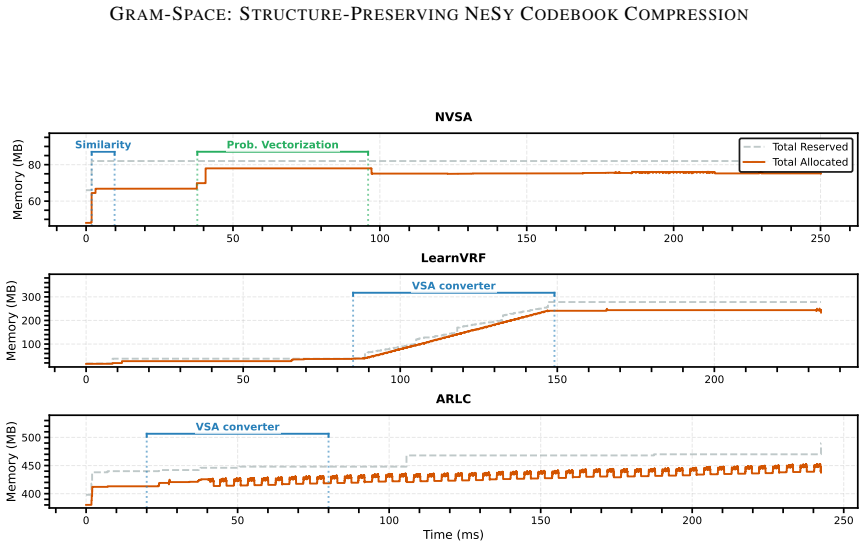
- After compression, the bottleneck shifts from allocation-heavy tensor materialization to matrix multiplication, so further gains would require reducing reconstruction-stage memory traffic.
Reading between the lines
- The same lossless change-of-basis argument applies to any frozen embedding table or codebook whose downstream operations are inner-product based—similarity search, attention key/value lookups, or nearest-neighbor classification could run in coefficient space and reconstruct only at nonlinear boundaries.
- A direct way to push the idea further is to exploit true low rank: if some codebook entries are linear combinations of others, k can be made smaller than M, and the storage tradeoff Dk + Mk versus DM improves beyond the full-rank case.
- The paper's own profiling suggests the headline savings come mainly from shrinking intermediate tensors in matrix-heavy stages rather than from the static codebook; caching and reusing reconstructed vectors across batches would target the remaining memory-bound reconstruction stage.
Signed reviews
Editorial analysis
A structured set of objections, weighed in public.
Referee Report
Summary. The paper proposes Gram-Space, a compression framework for vector-symbolic-architecture (VSA) codebooks used in neuro-symbolic reasoning. It constructs an orthonormal basis U for the column space of the codebook W, projects the codebook into coefficients T = U^T W, and runs matrix-space operators (similarity, probability vectorization, attention) directly in the coefficient space. Vectors are reconstructed via x = Ut before component-wise symbolic operators such as binding/unbinding. The paper proves an inner-product invariance result, claims storage of O(Dk+Mk) versus the original O(DM), and reports memory reductions up to 15.75x and latency speedups up to 3.62x on NVSA, LearnVRF, and ARLC.
Significance. The invariance statement, Eq. (2), is correct: for any A,B in span(U), <A,B> = <U^T A, U^T B>. This is a standard property of orthonormal bases and is proved directly from definitions, so the mathematical core is sound. If the storage claim were valid, the method would be a useful lossless, retraining-free compression for matrix-space VSA operators. However, the central storage claim does not survive accounting for the basis U. The reported empirical reductions appear to measure intermediate-tensor allocations rather than persistent codebook storage. The paper's main contribution, codebook compression, is therefore unsupported as stated.
major comments (3)
- [§3.1, Eq. (1)] The claimed storage O(Dk+Mk) omits that the representation is (U,T), not just T. With k=M, which is the setting used in all experiments, storage is O(DM+M^2), strictly larger than the original O(DM). The paper's condition 'k<<D' is not met: experiments set k=M=40 with D≥256, so D/k≥6.4 is a dimension ratio, not a storage compression ratio. If U is kept on-GPU for reconstruction, the codebook is not compressed; if U is dropped, the reconstruction x=Ut in §3.3 is impossible. The claimed memory reductions are therefore not supported as codebook compression.
- [§4.2, Fig. 5, Tables 1 and 4] The empirical reductions appear to conflate transient GPU memory with persistent codebook storage. Table 1 reports reductions in Empty©, MatMul, and Concat memory, which are consistent with performing matrix operations in a lower-dimensional coefficient space; that is a computational optimization, not a reduction in the codebook footprint. The abstract's 15.75x model-level memory reduction and Table 4's 51x compression ratio need a precise parameter-count statement. As written, they do not establish the central claim of codebook compression.
- [§3.3] The sentence 'the codebook is iteratively re-initialized to become fully orthogonal before basis construction' is a substantive modification of the codebook, not a compression step. No algorithm, ablation, or theoretical argument is given to show that this re-initialization preserves reasoning accuracy. Since VSA binding and unbinding rely on the statistical properties of random high-dimensional vectors, replacing them with an exactly orthogonal set may change rule semantics. This is load-bearing for the lossless-accuracy claim and needs to be addressed explicitly.
minor comments (4)
- [§3.1, §3.2] The definition of k is inconsistent: it is called the algebraic rank of the codebook in §3.2, but set to M in §3.1. Clarify whether k is rank or a configurable subspace dimension and how the two relate when D≥M.
- [Table 4] The 'Accuracy after reconstruction' in Table 4 appears to be a similarity score between original and reconstructed codebook, not task accuracy. The text claims no model accuracy loss on RAVEN and I-RAVEN, but no task-accuracy numbers are reported. Please provide them or qualify the claim.
- [Fig. 5(a)] The compression ratio in Fig. 5(a) should be clearly defined. As drawn, it appears to plot D/k rather than an actual storage ratio; these are not the same when U must be stored.
- [§3.1] The phrase 'we set k=M for maximal compression' is misleading. At k=M the coefficient matrix T has the same column dimension as W but the basis U adds M extra columns per original vector, so there is no coefficient-space dimension reduction relative to the full codebook.
Circularity Check
No significant circularity: the central correctness claim is a direct orthonormal-basis identity proved from definitions; the reported memory reduction concerns are accounting/validity issues, not circular reasoning.
full rationale
The paper's central derivation is Eq. (2): for an orthonormal basis U, events A,B in span(U), <A,B> = <U^T A, U^T B>. This is a standard theorem proved directly from the definition of an orthonormal transform; it does not assume the conclusion it is used to support. The surrounding claims about matrix-space operator equivalence are direct consequences of this identity, and no fitted constants, learned parameters, or externally tuned values are used to generate the correctness result. The paper's literature references are not self-citations of the authors in a load-bearing way; no uniqueness theorem is imported from prior work by the same authors, and no ansatz is smuggled in via citation. The memory-compression claim, however, has a serious validity concern: the stated storage O(Dk + Mk) with k=M gives O(DM+M^2), which is larger than the original O(DM), so the reported 15.75x reduction and 51x compression ratio appear to omit or undercount the storage of the basis U. That is an accounting or correctness problem, not a circularity problem: the derivation does not reduce to its inputs by definition or by self-citation. Therefore the appropriate circularity score is 0.
Assumptions & free parameters
free parameters (1)
- subspace dimension k =
k = M (40 for RAVEN); paper also allows k > M
assumptions (4)
- standard math Orthonormal basis transform preserves inner products for vectors in span(U) (Eq. 2).
- domain assumption All matrix-space intermediates are linear combinations of codebook columns, hence lie in span(U).
- ad hoc to paper The codebook can be iteratively re-initialized to become fully orthogonal before basis construction without changing reasoning accuracy.
- domain assumption Binding and unbinding and rule execution require reconstructing vectors in the original high-dimensional sparse domain.
Cite this review
Pith. "Pith review of Gram-Space: Structure-Preserving Codebook Compression for Memory-Efficient Neuro-Symbolic AI." pith.science (2026). https://pith.science/paper/QGWBQYRA
@misc{pith2026260801528,
  author       = {Pith},
  title        = {Pith review of: Gram-Space: Structure-Preserving Codebook Compression for Memory-Efficient Neuro-Symbolic AI},
  year         = {2026},
  howpublished = {\url{https://pith.science/paper/QGWBQYRA}},
  note         = {Machine review of arXiv:2608.01528}
}
read the original abstract
Vector symbolic architectures (VSA) are widely used for reasoning in neuro-symbolic (NeSy) AI, yet high-dimensional codebooks often create severe memory bottlenecks that limit scalability and deployment. In this paper, we propose Gram-Space, a compression framework that applies Gram-Schmidt orthogonalization to represent codebook vectors in a compact orthonormal coordinate system. Gram-Space preserves the dot-product structure required by matrix-based VSA operators, which supports numerically equivalent execution of matrix similarity, probability vectorization, and attention score computations. We provide a correctness analysis showing that inner products are preserved under the orthonormal basis representation. Using modern GPU hardware, we benchmark the Gram-Space framework on standard neuro-symbolic reasoning datasets. Experimental evaluations across state-of-the-art VSA models show that Gram-Space reduces model-level GPU memory usage by up to 15.75x and improves inference latency by up to 3.62x. Profiling results further indicate that Gram-Space reduces allocation-heavy overhead in codebook-associated stages and improves hardware utilization for NeSy workloads.
Figures


Figures from the paper (3 more)


Reference graph
Works this paper leans on
- [1]
-
[2]
Proceedings of the 26th annual international conference on machine learning , pages=
Online dictionary learning for sparse coding , author=. Proceedings of the 26th annual international conference on machine learning , pages=
-
[3]
IEEE Circuits and Systems Magazine , volume=
Classification using hyperdimensional computing: A review , author=. IEEE Circuits and Systems Magazine , volume=. 2020 , publisher=
work page 2020
-
[4]
Resonator networks, 1: An efficient solution for factoring high-dimensional, distributed representations of data structures , author=. Neural computation , volume=. 2020 , publisher=
work page 2020
-
[5]
Advances in neural information processing systems , volume=
Learning with holographic reduced representations , author=. Advances in neural information processing systems , volume=
-
[6]
2019 IEEE/ACM International Symposium on Low Power Electronics and Design (ISLPED) , pages=
CompHD: Efficient hyperdimensional computing using model compression , author=. 2019 IEEE/ACM International Symposium on Low Power Electronics and Design (ISLPED) , pages=. 2019 , organization=
work page 2019
-
[7]
2002 , publisher=
Accuracy and stability of numerical algorithms , author=. 2002 , publisher=
2002
-
[8]
Nature Machine Intelligence , volume=
A neuro-vector-symbolic architecture for solving Raven’s progressive matrices , author=. Nature Machine Intelligence , volume=. 2023 , publisher=
work page 2023
Show all 18 references
-
[9]
arXiv preprint arXiv:2401.16024 , year=
Probabilistic abduction for visual abstract reasoning via learning rules in vector-symbolic architectures , author=. arXiv preprint arXiv:2401.16024 , year=
-
[10]
2024 IEEE International Symposium on Performance Analysis of Systems and Software (ISPASS) , pages=
Towards cognitive ai systems: Workload and characterization of neuro-symbolic ai , author=. 2024 IEEE International Symposium on Performance Analysis of Systems and Software (ISPASS) , pages=. 2024 , organization=
2024
-
[11]
International Conference on Neural-Symbolic Learning and Reasoning , pages=
Towards learning abductive reasoning using vsa distributed representations , author=. International Conference on Neural-Symbolic Learning and Reasoning , pages=. 2024 , organization=
2024
-
[12]
Proceedings of the IEEE/CVF Conference on Computer Vision and Pattern Recognition (CVPR) , month =
Zhang, Chi and Gao, Feng and Jia, Baoxiong and Zhu, Yixin and Zhu, Song-Chun , title =. Proceedings of the IEEE/CVF Conference on Computer Vision and Pattern Recognition (CVPR) , month =
-
[13]
arXiv preprint arXiv:2406.11061 , year=
AI-RAVEN and I-RAVEN-Mesh: Two New Benchmarks for Abstract Visual Reasoning , author=. arXiv preprint arXiv:2406.11061 , year=
-
[14]
Advances in neural information processing systems , volume=
Attention is all you need , author=. Advances in neural information processing systems , volume=
-
[15]
Journal of Electrical and Computer Engineering , volume=
Spectral distortion in lossy compression of hyperspectral data , author=. Journal of Electrical and Computer Engineering , volume=. 2012 , publisher=
2012
-
[16]
2019 IEEE 27th Annual International Symposium on Field-Programmable Custom Computing Machines (FCCM) , pages=
Sparsehd: Algorithm-hardware co-optimization for efficient high-dimensional computing , author=. 2019 IEEE 27th Annual International Symposium on Field-Programmable Custom Computing Machines (FCCM) , pages=. 2019 , organization=
2019
-
[17]
arXiv preprint arXiv:2505.05413 , year=
DPQ-HD: Post-Training Compression for Ultra-Low Power Hyperdimensional Computing , author=. arXiv preprint arXiv:2505.05413 , year=
-
[18]
arXiv preprint arXiv:2405.09689 , year=
Generalized holographic reduced representations , author=. arXiv preprint arXiv:2405.09689 , year=
Reviewed August 6, 2026 · model on record in the stance chip above.
Discussion (0). Continue with ORCID to comment.