REVIEW 4 major objections 5 minor 75 references
Oraqle: An Empirical Analysis of Qubit Readout and Discriminators in Quantum Error Correction
T0 review · 4 major / 5 minor · reviewed 2026-08-04 · deepseek-v4-flash
Pith's one-line read Readout can be cut to 600 ns with almost no QEC penalty
desk verdict First real readout-to-logical-error-rate benchmark, with solid per-shot findings and careful methodology, but the QEC-level conclusions hinge on a simulator choice that is disclosed but not fully resolved. read the letter →
The pith
A machine-rendered reading of the paper's core claim, the machinery that carries it, and where it could break.
The reading
What carries the argument
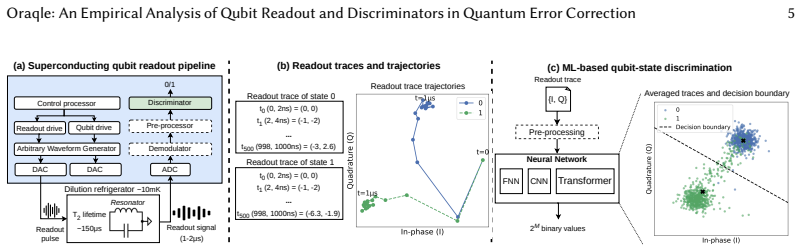
The key mechanism is the end-to-end pipeline: experimentally extracted (I,Q) readout traces feed a discriminator stage (six ML models plus a linear baseline), per-shot classification outputs are converted into duration-dependent measurement error rates, and those are injected into circuit-level QEC simulations across six codes and multiple noise models. The load-bearing identity is the information-gain rate over the readout window, which peaks near 0.3 microseconds and turns negative past about 1 microsecond, explaining why truncating at 600 ns costs so little. A second mechanism is the per-shot error taxonomy (near-boundary, T1 relaxation, leakage), which shows that 97.4 percent of residual
What would settle it
Measure readout fidelity versus duration on a second superconducting device with a slower resonator ring-up: if the fidelity plateau pushes past 800 ns, the specific 600 ns recommendation fails. Likewise, if a different simulator noise model shows that truncating from 1000 to 600 ns raises the logical error rate by more than a few percent at distance 5, the near-zero QEC cost claim collapses.
Extended reading notes
Core claim
The central discovery is an asymmetry: the readout window and the discriminator sit at the end of a chain, but their importance is opposite to their complexity. Most of the signal that separates |0> and |1> arrives within about 0.5 microseconds, so truncating the readout from 1000 to 600 ns raises per-shot error by about 10 percent yet leaves the logical error rate nearly unchanged at responsive code distances. Conversely, exchanging a multi-million-parameter discriminator for a few-thousand-parameter one changes the logical error rate by only a few percent, because roughly 99.8 percent of residual misclassifications come from low-SNR boundary ambiguity and mid-measurement T1 relaxation — ph
Load-bearing premise
The entire empirical basis is one five-qubit superconducting device's readout traces, and the QEC-level conclusions come from a simulator the authors chose after it disagreed with an independent simulator on the surface-code test; if other devices have slower resonator ring-up or a different noise model, the quantitative 600 ns advice may not hold.
Editorial extensions
If this is right
- Control-hardware engineers can default to about 600 ns readout windows, reclaiming roughly 40 percent of readout latency at negligible logical-error-rate cost in the tested regime.
- Discriminator designers can stop scaling model size: a few-thousand-parameter model already reaches the physical fidelity wall, and larger models only increase FPGA resource use.
- QEC architects should treat measurement duration as a performance lever only in near-threshold, measurement-limited regimes; elsewhere it is a latency win, not a fidelity win.
- Measurement-limited codes such as Bacon-Shor are particularly sensitive to readout quality, and improving readout fidelity alone can revive them.
- As hardware matures with all error rates reduced, the roughly 600 ns optimum becomes a first-class knob across more codes and distances, but only alongside better gates.
Reading between the lines
- The 0.3 microsecond information-gain peak likely reflects this dataset's resonator ring-up; on devices with slower ring-up the optimal truncation point may shift, so the quantitative 600 ns advice should be re-measured per device.
- If residual errors are set by physics rather than the model, readout-discriminator benchmarks should report per-shot error types (near-boundary vs. relaxation) instead of a single accuracy number, because only the boundary-shift portion is improvable.
- The conditional claim is directly testable: on a device near its code threshold, sweeping readout duration should produce a U-shaped logical-error-rate curve with a minimum near the fidelity plateau; on a device far below threshold, the curve should be flat.
Editorial analysis
A structured set of objections, weighed in public.
Referee Report
Summary. The paper introduces Oraqle, an end-to-end benchmarking framework that links raw IQ readout traces, ML-based qubit-state discriminators, and QEC simulators, and uses it to study how readout duration and discriminator choice affect logical error rates. The authors evaluate six discriminators on a single experimentally extracted 5-qubit dataset (Lienhard et al.), characterize readout-fidelity saturation and the timing of discriminative information, then feed the resulting per-shot flip-error curves into QEC simulations across six codes, two simulators, and current/future noise models. Three headline findings are claimed: measurement duration can be cut to roughly 600 ns at negligible QEC cost; QEC logical error rate is largely insensitive to discriminator complexity; and the impact of readout is conditional on the hardware regime, widening as devices improve.
Significance. If the findings hold, they are practically actionable: control-hardware engineers could shorten readout windows, and FPGA resource budgets could favor compact discriminators without sacrificing logical fidelity. The paper has substantial strengths: every discriminator is retrained at every duration, the linear baseline is refit at every truncation, HERQULES protocol choices are disclosed in detail, the readout-flip ablation in Appendices G and H cleanly identifies the cause of the 600 ns optimum, and the attempt to cross-validate with two independent simulators is commendable. The standardized, same-protocol comparison of six discriminators on identical traces is itself a useful contribution independent of the QEC-level claims. However, the QEC-level conclusions rest on ECCentric alone after that simulator diverged qualitatively from lattice-sim on the CNOT cross-check, and the headline that discriminator complexity barely matters is in tension with the paper's own Fig. 13. These issues are load-bearing for the central claims and require additional evidence or substantial qualification.
major comments (4)
- [§6.1 / App. F / Figs. 15–19] The QEC-level conclusions are generated exclusively with ECCentric after the paper's own cross-validation showed a qualitative divergence: on the surface-code CNOT, ECCentric gives LER ≈ 0.5 flat across duration and distance, while lattice-sim gives a U-shaped curve orders of magnitude lower. The six-code memory sweeps that carry the headline '~600 ns plateau' and the 'small-d only' conditionality are not replicated in lattice-sim. Because the two simulators disagree on whether the circuits are above threshold, the plateau and its regime dependence could be an ECCentric-specific artifact. This is not an internal inconsistency—the disclosure is honest—but it is a load-bearing gap. Please run the same six-code memory sweeps (Figs. 15–19) in lattice-sim, or another independent simulator, and report both; if lattice-sim shows duration dependence at larger d or a different plateau shape, the
- [§6.2 / Apps. G–H / §3.3 Stage 1] The ~600 ns optimum is traced to the trace-derived flip-error curve, but that curve is measured on a single 5-qubit device with T1 = 12–41 μs, while the QEC simulations use ibm_boston coherence (T1 = 284.95 μs, T2 = 322.68 μs). The balance between short-trace flip error and idle decoherence/backlog that creates the plateau is therefore specific to a pairing of a legacy readout dataset with a modern gate/coherence model. The general advice to cut readout to ~600 ns assumes this pairing is representative. Please add a robustness study that varies ring-up time, per-qubit SNR, and T1 within plausible ranges (or uses a second dataset if one becomes public), and qualify the quantitative advice accordingly.
- [Abstract / §6.1 / Takeaway #6] The claim that 'QEC logical error rate is largely insensitive to discriminator complexity' is difficult to reconcile with Fig. 13, where at d = 5, surface code, 1000 ns, the spread across discriminators reaches 69% (QubiCML 0.103 vs. MCMit-CNN 0.061), and Takeaway #6 itself says 'the discriminator still plays a clear role (up to 69%)'. If 'complexity' means parameter count only, the text should say so explicitly and distinguish it from discriminator family and preprocessing; as written, the abstract's headline overstates the insensitivity.
- [§6.1 / Figs. 13–14] The quantitative claims ('up to ~590% swing', '≤6% gap', '~2.4% average spread') are reported without confidence intervals or repeated-seed statistics. Since QEC simulations are stochastic and the d = 12 spread is attributed to sampling noise without error bars, the reader cannot assess whether the small-d effects are significant or whether the large-d flatness is real. Please report at least standard errors or multiple independent runs for the key LER comparisons.
minor comments (5)
- [§3.3 Stage 1] 'No other raw-trace dataset is publicly available' is a key limitation but appears only in the methodology. It should be restated in the abstract or conclusions so the conditionality of the quantitative readout guidance is visible to a reader who does not read the full methodology.
- [§4.1 / Fig. 6] The y-axis in Fig. 6(a) starts at 0.55, which exaggerates the plateau and decline. Please consider starting at 0 or annotating the computed relative drops, and specify how the 'up to ~40% relative drop' is calculated.
- [§5.2 / Table 5] The KLiNQ resource row is confusing without the footnote about per-qubit replication and the mixed student/larger-teacher assignment. State the total array-level parameter count and resource usage in the table caption or a footnote.
- [App. C / §5.1] The per-trace vs. demux-subsample protocol changes HERQULES' F5Q by ~0.02 at 1 μs and up to ~0.09 at 200 ns. This sensitivity should be mentioned in §5.1 where HERQULES is compared against other discriminators, not only in the appendix.
- [General] Minor typos: 'accross' (§3), 'This complexity propagates' (abstract, capitalization after semicolon), and 'thebest routeto' (§1).
Circularity Check
No significant circularity: the paper's findings are empirical measurements, sensitivity analyses, and disclosed simulator choices, not derivations that reduce to their own inputs.
full rationale
Oraqle's central claims are empirical and simulation-based rather than derived from a first-principles chain, so the circularity patterns enumerated do not apply. The ~600 ns readout optimum is traced to the measured per-shot flip error: Appendix G removes the readout flip and all duration dependence flattens; Appendix H shows that a fixed-fidelity (duration-independent) readout removes the optimum. These ablation experiments demonstrate that the conclusion is caused by the empirical trace-derived input, not by the simulator's construction or by a normalization choice. The discriminator-complexity result is likewise an empirical comparison on a single public dataset under identical protocols, using six discriminators including models not authored by this group (HERQULES, QubiCML, KLiNQ, Baseline FNN), so the leading position of the authors' MCMit-CNN is a measured outcome, not a fitted parameter renamed as a prediction. The QEC-level simulations do rely on ECCentric, a simulator authored by this group, after a disclosed divergence from lattice-sim in Appendix F. That is a modeling and validity concern, not circularity: the paper explicitly reports the divergence, states the reason for choosing ECCentric (broader noise-model coverage), and does not cite ECCentric as an external proof of the physical conclusions. Similarly, the Lienhard dataset and MCMit references are self-authored, but they are used as data and tooling, not as load-bearing citations that replace argument. The paper's own appendices (G, H) isolate which input causes the headline effect, which is the opposite of a self-referential reduction. Accordingly, no specific equation or fitted parameter reduces to another by construction, and no self-citation is doing hidden load-bearing work in the circularity sense. The honest finding is therefore 'no significant circularity', while correctness and generalization risks from single-device data and the ECCentric/lattice-sim discrepancy remain external-validity concerns, not circularity.
Assumptions & free parameters
free parameters (5)
- futuristic error scaling factor =
0.1 (all gate and readout errors divided by 10)
- futuristic coherence scaling =
3 (T1 and T2 multiplied by 3)
- low-coherence model T1 =
190 microseconds
- low-coherence model T2 =
130 microseconds
- decoder backlog penalty =
not quantified in text
assumptions (4)
- domain assumption Readout errors in QEC simulation are modeled as independent per-qubit flip probabilities equal to the measured per-qubit assignment fidelities.
- domain assumption The five-qubit Lienhard et al. dataset is representative of superconducting qubit readout in general, so the measured fidelity-vs-duration curves generalize to other devices.
- domain assumption ECCentric's noise model and decoder faithfully reproduce logical error rates in the regimes studied, despite its divergence from lattice-sim.
- ad hoc to paper Projected hardware models (errors/10 with T1/T2 tripled; T1/T2=190/130us with decoder backlog) capture plausible future device behavior.
Cite this review
Pith. "Pith review of Oraqle: An Empirical Analysis of Qubit Readout and Discriminators in Quantum Error Correction." pith.science (2026). https://pith.science/paper/DO66ZUN5
@misc{pith2026260801939,
  author       = {Pith},
  title        = {Pith review of: Oraqle: An Empirical Analysis of Qubit Readout and Discriminators in Quantum Error Correction},
  year         = {2026},
  howpublished = {\url{https://pith.science/paper/DO66ZUN5}},
  note         = {Machine review of arXiv:2608.01939}
}
read the original abstract
Quantum error correction (QEC) is the most promising route toward fault-tolerant quantum computing and, thus, useful quantum computers. QEC operates as a continuous measure-decode-correct cycle: ancilla qubits are read out, a decoder infers errors from the resulting syndromes, and corrections are applied before the next round begins. Within this loop, readout occupies a uniquely critical role, as it is the sole source of ground truth available to the decoder. Yet readout is also the slowest and most error-prone operation in the stack, with characteristics that vary across qubits and drift over time; This complexity propagates directly to the classical control hardware, and in particular to the FPGA-hosted machine-learning (ML) discriminator that must classify each analog signal into a binary syndrome outcome. Despite this central role, QEC performance has not yet been studied in depth from the perspective of readout characteristics, readout length, and their co-design with an ML discriminator. We introduce Oraqle, an end-to-end benchmarking framework that evaluates qubit-state readout and its impact on QEC performance across real experimentally extracted qubit-state-readout datasets, state-of-the-art ML discriminators, multiple QEC codes, and hardware regimes spanning current to projected devices. Our study reveals three asymmetric findings: The measurement duration can be significantly reduced with nearly no penalty to the logical error rate; The discriminator complexity barely affects the QEC performance, as residual errors are written into device physics rather than the model; and the impact of qubit-state readout on the logical error rate is conditional on where the hardware sits in the QEC landscape, a window that widens as devices mature.
Figures


Figures from the paper (20 more)


Reference graph
Works this paper leans on
-
[1]
Rohith Acharya, Steven Brebels, Alexander Grill, Jeroen Verjauw, Ts Ivanov, D Perez Lozano, Danny Wan, Jacques Van Damme, AM Vadiraj, Massimo Mongillo, et al. 2023. Multiplexed superconducting qubit control at millikelvin temperatures with a low-power cryo-CMOS multiplexer.Nature Electronics6, 11 (2023), 900–909
2023
-
[2]
Dave Bacon. 2006. Operator quantum error-correcting subsystems for self-correcting quantum memories.Physical Review A73, 1 (Jan. 2006). https://doi.org/10.1103/physreva.73.012340
-
[3]
F Battistel, C Chamberland, K Johar, R W J Overwater, F Sebastiano, L Skoric, Y Ueno, and M Usman. 2023. Real-time decoding for fault-tolerant quantum computing: progress, challenges and outlook.Nano Futures7, 3 (Aug. 2023), 032003. https://doi.org/10.1088/2399-1984/aceba6 , Vol. 1, No. 1, Article . Publication date: August 2026. 22 Giortamis et al
-
[4]
H. Bombin and M. A. Martin-Delgado. 2006. Topological Quantum Distillation.Physical Review Letters97, 18 (Oct. 2006). https://doi.org/10.1103/physrevlett.97.180501
-
[5]
Sergey Bravyi, Andrew W. Cross, Jay M. Gambetta, Dmitri Maslov, Patrick Rall, and Theodore J. Yoder. 2024. High- threshold and low-overhead fault-tolerant quantum memory.Nature627, 8005 (01 Mar 2024), 778–782. https://doi.org/ 10.1038/s41586-024-07107-7
-
[6]
Gambetta, Darío Gil, and Zaira Nazario
Sergey Bravyi, Oliver Dial, Jay M. Gambetta, Darío Gil, and Zaira Nazario. 2022. The future of quantum computing with superconducting qubits.Journal of Applied Physics132, 16 (10 2022), 160902. https://doi.org/10.1063/5.0082975 arXiv:https://pubs.aip.org/aip/jap/article-pdf/doi/10.1063/5.0082975/20034201/160902_1_5.0082975.pdf
-
[7]
Breuckmann and Jens Niklas Eberhardt
Nikolas P. Breuckmann and Jens Niklas Eberhardt. 2021. Quantum Low-Density Parity-Check Codes.PRX Quantum2 (Oct 2021), 040101. Issue 4. https://doi.org/10.1103/PRXQuantum.2.040101
-
[8]
Christopher Chamberland, Aleksander Kubica, Theodore J Yoder, and Guanyu Zhu. 2020. Triangular color codes on trivalent graphs with flag qubits.New Journal of Physics22, 2 (Feb. 2020), 023019. https://doi.org/10.1088/1367-2630/ ab68fd
Show all 75 references
-
[9]
Yoder, Jared B
Christopher Chamberland, Guanyu Zhu, Theodore J. Yoder, Jared B. Hertzberg, and Andrew W. Cross. 2020. Topological and Subsystem Codes on Low-Degree Graphs with Flag Qubits.Physical Review X10, 1 (Jan. 2020). https://doi.org/10. 1103/physrevx.10.011022
2020
-
[10]
Avimita Chatterjee and Swaroop Ghosh. 2024. Magic Mirror on the Wall, How to Benchmark Quantum Error Correction Codes, Overall? . In2024 IEEE International Conference on Quantum Computing and Engineering (QCE). IEEE Computer Society, Los Alamitos, CA, USA, 356–367. https://doi...
2024
-
[11]
Warren, Christian J
Liangyu Chen, Hang-Xi Li, Yong Lu, Christopher W. Warren, Christian J. Križan, Sandoko Kosen, Marcus Rommel, Shahnawaz Ahmed, Amr Osman, Janka Biznárová, Anita Fadavi Roudsari, Benjamin Lienhard, Marco Caputo, Kestutis Grigoras, Leif Grönberg, Joonas Govenius, Anton Frisk Kock...
-
[12]
Yu Chen, D. Sank, P. O’Malley, T. White, R. Barends, B. Chiaro, J. Kelly, E. Lucero, M. Mariantoni, A. Megrant, C. Neill, A. Vainsencher, J. Wenner, Y. Yin, A. N. Cleland, and John M. Martinis. 2012. Multiplexed dispersive readout of superconducting phase qubits.Applied Physic...
2012 doi
-
[13]
Eric Dennis, Alexei Kitaev, Andrew Landahl, and John Preskill. 2002. Topological quantum memory.J. Math. Phys.43, 9 (Sept. 2002), 4452–4505. https://doi.org/10.1063/1.1499754
2002 doi
-
[14]
Javier Duarte et al. 2018. Fast inference of deep neural networks in FPGAs for particle physics.JINST13, 07 (2018), P07027. https://doi.org/10.1088/1748-0221/13/07/P07027 arXiv:1804.06913 [physics.ins-det]
2018 arXiv
-
[15]
Regina Finsterhoelzl and Guido Burkard. 2022. Benchmarking quantum error-correcting codes on quasi-linear and central-spin processors.Quantum Science and Technology8, 1 (nov 2022), 015013. https://doi.org/10.1088/2058-9565/ aca21f
2022 doi
-
[16]
Fowler, Matteo Mariantoni, John M
Austin G. Fowler, Matteo Mariantoni, John M. Martinis, and Andrew N. Cleland. 2012. Surface codes: Towards practical large-scale quantum computation.Phys. Rev. A86 (Sep 2012), 032324. Issue 3. https://doi.org/10.1103/PhysRevA.86. 032324
2012 doi
-
[17]
Naik, Kasra Nowrouzi, David I
Neelay Fruitwala, Gang Huang, Yilun Xu, Abhi Rajagopala, Akel Hashim, Ravi K. Naik, Kasra Nowrouzi, David I. Santiago, and Irfan Siddiqi. 2024. Distributed Architecture for FPGA-based Superconducting Qubit Control. arXiv:2404.15260 [quant-ph] https://arxiv.org/abs/2404.15260
2024 arXiv
-
[18]
Craig Gidney. 2021. Stim: a fast stabilizer circuit simulator.Quantum5 (July 2021), 497. https://doi.org/10.22331/q- 2021-07-06-497
2021 doi
-
[19]
Craig Gidney and Martin Ekerå. 2021. How to factor 2048 bit RSA integers in 8 hours using 20 million noisy qubits. Quantum5 (April 2021), 433. https://doi.org/10.22331/q-2021-04-15-433
-
[20]
Emmanouil Giortamis, Felix Gust, Aleksandra Świerkowska, Sandra Stankovic, Innocenzo Fulginiti, Yanbin Chen, Xiaorang Guo, Benjamin Lienhard, Martin Schulz, and Pramod Bhatotia. 2026. MCMit: Mid-Circuit Measurement Error Mitigation. InProceedings of the 59th IEEE/ACM Internati...
2026 arXiv
-
[21]
Emmanouil Giortamis, Francisco Romão, Nathaniel Tornow, and Pramod Bhatotia. 2025. QOS: quantum operating system. InProceedings of the 19th USENIX Conference on Operating Systems Design and Implementation(Boston, MA, USA)(OSDI ’25). USENIX Association, USA, Article 24, 19 pages
2025
-
[22]
Emmanouil Giortamis, Francisco Romao, Nathaniel Tornow, Dmitry Lugovoy, and Pramod Bhatotia. 2025. Qonductor: A Cloud Orchestrator for Quantum Computing. InProceedings of the International Conference for High Performance Computing, Networking, Storage and Analysis (SC ’25). As...
2025
-
[23]
Google Quantum AI and Collaborators. 2025. Quantum error correction below the surface code threshold.Nature638, 8052 (01 Feb 2025), 920–926. https://doi.org/10.1038/s41586-024-08449-y
2025 doi
-
[24]
Dixit, Farah Fahim, Zhaxylyk Kudy- shev, Santiago Lopez, Ruichao Ma, Gabriel N
Giuseppe Di Guglielmo, Botao Du, Javier Campos, Alexandra Boltasseva, Akash V. Dixit, Farah Fahim, Zhaxylyk Kudy- shev, Santiago Lopez, Ruichao Ma, Gabriel N. Perdue, Nhan Tran, Omer Yesilyurt, and Daniel Bowring. 2025. End- to-end workflow for machine learning-based qubit rea...
2025 arXiv
-
[25]
Xiaorang Guo, Tigran Bunarjyan, Dai Liu, Benjamin Lienhard, and Martin Schulz. 2025. KLiNQ: Knowledge Distillation- Assisted Lightweight Neural Network for Qubit Readout on FPGA. arXiv:2503.03544 [quant-ph] https://arxiv.org/abs/ 2503.03544
2025
-
[26]
Nixon, Benjamin J
Robin Harper, Constance Lainé, Evan Hockings, Campbell McLauchlan, Georgia M. Nixon, Benjamin J. Brown, and Stephen D. Bartlett. 2026. Characterising the failure mechanisms of error-corrected quantum logic gates.Nature Communications17 (2026), 5039. https://doi.org/10.1038/s41...
2026 doi
-
[27]
Nixon, Benjamin J
Robin Harper, Constance Lainé, Evan Hockings, Campbell McLauchlan, Georgia M. Nixon, Benjamin J. Brown, and Stephen D. Bartlett. 2025. Characterising the failure mechanisms of error-corrected quantum logic gates. arXiv:2504.07258 [quant-ph] https://arxiv.org/abs/2504.07258
2025 arXiv
-
[28]
Johannes Heinsoo, Christian Kraglund Andersen, Ants Remm, Sebastian Krinner, Theodore Walter, Yves Salathé, Si- mone Gasparinetti, Jean-Claude Besse, Anton Potočnik, Andreas Wallraff, and Christopher Eichler. 2018. Rapid High-fidelity Multiplexed Readout of Superconducting Qub...
2018 doi
-
[29]
ibm-devices [n. d.]. IBM Quantum Cloud Compute Resources. https://quantum.ibm.com/services/resources. Accessed: 2025-20-08
2025
-
[30]
IQM Quantum Computers. 2024. IQM Garnet: 20-qubit Superconducting Quantum Computer. https://www.meetiqm. com/products/iqm-garnet. Accessed: 2026-06-17
2024
-
[31]
Mitsuki Katsuda, Kosuke Mitarai, and Keisuke Fujii. 2024. Simulation and performance analysis of quantum error correction with a rotated surface code under a realistic noise model.Phys. Rev. Res.6 (Jan 2024), 013024. Issue 1. https://doi.org/10.1103/PhysRevResearch.6.013024
2024 doi
-
[32]
Emanuel Knill and Raymond Laflamme. 1996. Concatenated Quantum Codes. arXiv:quant-ph/9608012 [quant-ph] https://arxiv.org/abs/quant-ph/9608012
1996 arXiv
-
[33]
Emanuel Knill and Raymond Laflamme. 1997. Theory of quantum error-correcting codes.Phys. Rev. A55 (Feb 1997), 900–911. Issue 2. https://doi.org/10.1103/PhysRevA.55.900
1997 doi
-
[34]
Krantz, M
P. Krantz, M. Kjaergaard, F. Yan, T. P. Orlando, S. Gustavsson, and W. D. Oliver. 2019. A quantum engineer’s guide to superconducting qubits.Applied Physics Reviews6, 2 (June 2019). https://doi.org/10.1063/1.5089550
2019 doi
-
[35]
Yaniv Kurman, Lior Ella, Ramon Szmuk, Oded Wertheim, Benedikt Dorschner, Sam Stanwyck, and Yonatan Co- hen. 2024. Benchmarking the ability of a controller to execute quantum error corrected non-Clifford circuits. arXiv:2311.07121 [quant-ph] https://arxiv.org/abs/2311.07121
2024 arXiv
-
[36]
Ang Li, Samuel Stein, Sriram Krishnamoorthy, and James Ang. 2022. QASMBench: A Low-Level Quantum Benchmark Suite for NISQ Evaluation and Simulation.ACM Transactions on Quantum Computing4 (07 2022). https://doi.org/10. 1145/3550488
2022
-
[37]
Govia, Cole R
Benjamin Lienhard, Antti Vepsäläinen, Luke C.G. Govia, Cole R. Hoffer, Jack Y. Qiu, Diego Ristè, Matthew Ware, David Kim, Roni Winik, Alexander Melville, Bethany Niedzielski, Jonilyn Yoder, Guilhem J. Ribeill, Thomas A. Ohki, Hari K. Krovi, Terry P. Orlando, Simon Gustavsson, ...
2022
-
[38]
Benjamin Lienhard, Antti Vepsalainen, Cole Hoffer, Luke Govia, Vilhelm Andersen Woltz, David Kim, Alexander Melville, Bethany Huffman, Jonilyn Yoder, Mollie Schwartz, Terry Orlando, and William Oliver. 2022. Reinforcement Learning assisted Pulse Shaping for Superconducting Qub...
2022
-
[39]
Jeanette Miriam Lorenz et al. 2025. Systematic benchmarking of quantum computers: status and recommendations. (3 2025). arXiv:2503.04905 [quant-ph]
2025 arXiv
-
[40]
Macklin, K
C. Macklin, K. O’Brien, D. Hover, M. E. Schwartz, V. Bolkhovsky, X. Zhang, W. D. Oliver, and I. Siddiqi. 2015. A near–quantum-limited Josephson traveling-wave parametric amplifier.Science350, 6258 (2015), 307–310. https: //doi.org/10.1126/science.aaa8525 arXiv:https://www.scie...
2015 doi
-
[41]
Gambetta, A
Easwar Magesan, Jay M. Gambetta, A. D. Córcoles, and Jerry M. Chow. 2015. Machine Learning for Discriminating Quantum Measurement Trajectories and Improving Readout.Phys. Rev. Lett.114 (May 2015), 200501. Issue 20. https: //doi.org/10.1103/PhysRevLett.114.200501
2015 doi
-
[42]
François Mallet, Florian R Ong, Agustin Palacios-Laloy, Francois Nguyen, Patrice Bertet, Denis Vion, and Daniel Esteve
-
[43]
Oliver, Benjamin Lienhard, and Swamit Tannu
Satvik Maurya, Chaithanya Naik Mude, William D. Oliver, Benjamin Lienhard, and Swamit Tannu. 2023. Scaling Qubit Readout with Hardware Efficient Machine Learning Architectures. InProceedings of the 50th Annual International Sym- posium on Computer Architecture(Orlando, FL, USA...
2023
-
[44]
Satvik Maurya and Swamit Tannu. 2025. Synchronization for Fault-Tolerant Quantum Computers. InProceedings of the 52nd Annual International Symposium on Computer Architecture (SIGARCH ’25). ACM, 1370–1385. https://doi.org/10. 1145/3695053.3730991
2025
-
[45]
McKay, Ian Hincks, Emily J
David C. McKay, Ian Hincks, Emily J. Pritchett, Malcolm Carroll, Luke C. G. Govia, and Seth T. Merkel. 2023. Bench- marking Quantum Processor Performance at Scale. arXiv:2311.05933 [quant-ph] https://arxiv.org/abs/2311.05933
2023 arXiv
-
[46]
Webb, Germain Forestier, and Mahsa Salehi
Navid Mohammadi Foumani, Lynn Miller, Chang Wei Tan, Geoffrey I. Webb, Germain Forestier, and Mahsa Salehi. 2024. Deep Learning for Time Series Classification and Extrinsic Regression: A Current Survey.ACM Comput. Surv.56, 9, Article 217 (April 2024), 45 pages. https://doi.org...
2024 doi
-
[47]
Mario Motta, Gavin O Jones, Julia E Rice, Tanvi P Gujarati, Rei Sakuma, Ieva Liepuoniute, Jeannette M Garcia, and Yu- ya Ohnishi. 2023. Quantum chemistry simulation of ground-and excited-state properties of the sulfonium cation on a superconducting quantum processor.Chemical S...
2023
-
[48]
Chaithanya Naik Mude, Satvik Maurya, Benjamin Lienhard, and Swamit Tannu. 2025. Efficient and Scalable Architec- tures for Multi-Level Superconducting Qubit Readout. arXiv:2405.08982 [quant-ph] https://arxiv.org/abs/2405.08982
2025 arXiv
-
[49]
Paul Nation, Abdullah Ash Saki, Sebastian Brandhofer, Luciano Bello, Shelly Garion, Matthew Treinish, and Ali Javadi- Abhari. 2025. Benchmarking the performance of quantum computing software for quantum circuit creation, manipu- lation and compilation.Nature Computational Scie...
2025 doi
-
[50]
Nielsen and Isaac L
Michael A. Nielsen and Isaac L. Chuang. 2010.Quantum Computation and Quantum Information: 10th Anniversary Edition. Cambridge University Press
2010
-
[51]
Tirthak Patel, Abhay Potharaju, Baolin Li, Rohan Basu Roy, and Devesh Tiwari. 2020. Experimental Evaluation of NISQ Quantum Computers: Error Measurement, Characterization, and Implications. InSC20: International Conference for High Performance Computing, Networking, Storage an...
2020 arXiv
-
[52]
John Preskill. 2018. Quantum Computing in the NISQ era and beyond.Quantum2 (Aug. 2018), 79. https://doi.org/10. 22331/q-2018-08-06-79
2018
-
[53]
Baczewski, and Robin Blume-Kohout
Timothy Proctor, Kevin Young, Andrew D. Baczewski, and Robin Blume-Kohout. 2024. Benchmarking quantum com- puters. arXiv:2407.08828 [quant-ph] https://arxiv.org/abs/2407.08828
2024
-
[54]
Rigetti Computing. 2024. Rigetti Computing Launches 84-Qubit Ankaa-3 System. https://investors.rigetti.com/news- releases/news-release-details/rigetti-computing-launches-84-qubit-ankaatm-3-system-achieves. Accessed: 2026-06- 17
2024
-
[55]
White, Simon Burton, and Earl Campbell
Joschka Roffe, David R. White, Simon Burton, and Earl Campbell. 2020. Decoding across the quantum low-density parity- check code landscape.Physical Review Research2, 4 (Dec. 2020). https://doi.org/10.1103/physrevresearch.2.043423
2020 doi
-
[56]
P.W. Shor. 1994. Algorithms for quantum computation: discrete logarithms and factoring. InProceedings 35th Annual Symposium on Foundations of Computer Science. 124–134. https://doi.org/10.1109/SFCS.1994.365700
1994
-
[57]
Peter W. Shor. 1995. Scheme for reducing decoherence in quantum computer memory.Phys. Rev. A52 (Oct 1995), R2493–R2496. Issue 4. https://doi.org/10.1103/PhysRevA.52.R2493
1995 doi
-
[58]
A. M. Steane. 1996. Error Correcting Codes in Quantum Theory.Phys. Rev. Lett.77 (Jul 1996), 793–797. Issue 5. https://doi.org/10.1103/PhysRevLett.77.793
1996 doi
-
[59]
Aleksandra Świerkowska, Jannik Pflieger, Emmanouil Giortamis, and Pramod Bhatotia. 2026. ECCentric: An Empirical Analysis of Quantum Error Correction Codes.Proc. ACM Meas. Anal. Comput. Syst.10, 2, Article 37 (May 2026), 33 pages. https://doi.org/10.1145/3805635
2026 doi
-
[60]
Tannu and Moinuddin K
Swamit S. Tannu and Moinuddin K. Qureshi. 2019. Mitigating Measurement Errors in Quantum Computers by Ex- ploiting State-Dependent Bias. InProceedings of the 52nd Annual IEEE/ACM International Symposium on Microar- chitecture(Columbus, OH, USA)(MICRO ’52). Association for Comp...
2019
-
[61]
Barbara M. Terhal. 2015. Quantum error correction for quantum memories.Rev. Mod. Phys.87 (Apr 2015), 307–346. Issue 2. https://doi.org/10.1103/RevModPhys.87.307
2015 doi
-
[62]
Ted Thorbeck, Zhihao Xiao, Archana Kamal, and Luke C. G. Govia. 2024. Readout-Induced Suppression and Enhance- ment of Superconducting Qubit Lifetimes.Phys. Rev. Lett.132 (Feb 2024), 090602. Issue 9. https://doi.org/10.1103/ PhysRevLett.132.090602
2024
-
[63]
Wuwei Tian, Liqiang Lu, Siwei Tan, Yun Liang, Tingting Li, Kaiwen Zhou, Xinghui Jia, and Jianwei Yin. 2025. ARTERY: Fast Quantum Feedback using Branch Prediction. InProceedings of the 52nd Annual International Sym- posium on Computer Architecture (ISCA ’25). Association for Co...
2025
-
[64]
Smith, Joshua Viszlai, Xin-Chuan Wu, Nikos Hardavellas, Margaret R
Teague Tomesh, Pranav Gokhale, Victory Omole, Gokul Subramanian Ravi, Kaitlin N. Smith, Joshua Viszlai, Xin-Chuan Wu, Nikos Hardavellas, Margaret R. Martonosi, and Frederic T. Chong. 2022. SupermarQ: A Scalable Quantum Bench- mark Suite . In2022 IEEE International Symposium on...
2022
-
[65]
Yu Tomita and Krysta M. Svore. 2014. Low-distance surface codes under realistic quantum noise.Physical Review A90, 6 (Dec. 2014). https://doi.org/10.1103/physreva.90.062320
2014 doi
-
[66]
Nathaniel Tornow, Emmanouil Giortamis, and Pramod Bhatotia. 2025. QVM: Quantum Gate Virtualization Machine. Proc. ACM Program. Lang.9, PLDI, Article 187 (June 2025), 26 pages. https://doi.org/10.1145/3729290
2025 doi
-
[67]
Vora, Yilun Xu, Akel Hashim, Neelay Fruitwala, Ho Nam Nguyen, Haoran Liao, Jan Balewski, Abhi Rajagopala, Kasra Nowrouzi, Qing Ji, K
Neel R. Vora, Yilun Xu, Akel Hashim, Neelay Fruitwala, Ho Nam Nguyen, Haoran Liao, Jan Balewski, Abhi Rajagopala, Kasra Nowrouzi, Qing Ji, K. Birgitta Whaley, Irfan Siddiqi, Phuc Nguyen, and Gang Huang. 2024. ML-Powered FPGA- based Real-Time Quantum State Discrimination Enabli...
2024 arXiv
-
[68]
Walter, P
T. Walter, P. Kurpiers, S. Gasparinetti, P. Magnard, A. Potočnik, Y. Salathé, M. Pechal, M. Mondal, M. Oppliger, C. Eichler, and A. Wallraff. 2017. Rapid High-Fidelity Single-Shot Dispersive Readout of Superconducting Qubits.Phys. Rev. Appl. 7 (May 2017), 054020. Issue 5. http...
2017 doi
-
[69]
W. K. Wootters and W. H. Zurek. 1982. A single quantum cannot be cloned.Nature299 (1982), 802–803. https: //doi.org/10.1038/299802a0
1982 doi
-
[70]
James R Wootton. 2020. Benchmarking near-term devices with quantum error correction.Quantum Science and Tech- nology5, 4 (jul 2020), 044004. https://doi.org/10.1088/2058-9565/aba038
2020 doi
-
[71]
Santiago, and Irfan Siddiqi
Yilun Xu, Gang Huang, Jan Balewski, Ravi Naik, Alexis Morvan, Bradley Mitchell, Kasra Nowrouzi, David I. Santiago, and Irfan Siddiqi. 2021. QubiC: An Open-Source FPGA-Based Control and Measurement System for Superconducting Quantum Information Processors.IEEE Transactions on Q...
2021
-
[72]
Yuchen Yang, Zhongtao Shen, Xing Zhu, Ziqi Wang, Gengyan Zhang, Jingwei Zhou, Xun Jiang, Chunqing Deng, and Shubin Liu. 2022. FPGA-based electronic system for the control and readout of superconducting quantum processors. Review of Scientific Instruments93, 7 (07 2022), 074701...
2022 doi
-
[73]
always go shorter
Yue Zhao. 2024. Benchmarking Machine Learning Models for Quantum Error Correction. arXiv:2311.11167 [quant-ph] https://arxiv.org/abs/2311.11167 , Vol. 1, No. 1, Article . Publication date: August 2026. 26 Giortamis et al. A Qubit-State Readout in the Dispersive Regime This app...
2024 arXiv
-
[2009]
Single-shot qubit readout in circuit quantum electrodynamics.Nature Physics5, 11 (2009), 791–795. , Vol. 1, No. 1, Article . Publication date: August 2026. 24 Giortamis et al
2009
-
[2023]
https://doi.org/10.1038/s41534-023-00689-6
Transmon qubit readout fidelity at the threshold for quantum error correction without a quantum-limited ampli- fier.npj Quantum Information9, 1 (16 Mar 2023), 26. https://doi.org/10.1038/s41534-023-00689-6
2023 doi
Reviewed August 4, 2026 · model on record in the stance chip above.
Discussion (0). Continue with ORCID to comment.