REVIEW 3 major objections 5 minor 36 references
Hybrid Kinetic-MHD Simulations of Drift-Orbit Effects on the Stability and Non-Linear Dynamics of Runaway Electron Beams
T0 review · 3 major / 5 minor · reviewed 2026-08-04 · deepseek-v4-flash
Pith's one-line read Higher-energy runaway electrons stabilize the tearing modes of a post-disruption tokamak, because drift-orbit displacement smears out the current sheets that drive the instability.
desk verdict A solid scenario-specific simulation study showing that finite-orbit-width effects stabilize runaway-electron-driven tearing modes with increasing energy; the mechanism is plausible and the diagnostics line up, but reproducibility is limited by no artifacts. read the letter →
The pith
A machine-rendered reading of the paper's core claim, the machinery that carries it, and where it could break.
The reading
What carries the argument
The mechanism is the relativistic guiding-center drift of the REs, dominated by curvature drift, which displaces their orbits from the magnetic flux surfaces by several centimetres at 20 MeV. This displacement produces a strong (1,0) component of the RE current, coupling (m,n) modes to (m±1,n) sidebands, and it broadens the resistive current sheet at the rational surface, which is identified as the stabilizing effect. The model self-consistently couples a full-f Monte-Carlo RE population to an extended-MHD fluid via the RE pressure and by excluding the kinetically evolved RE current from the Ohm's law.
What would settle it
Run a version of the simulation that keeps the ∇B drift and the RE magnetization current separately (breaking the cancellation) and compare the width of the (2,1) current layer and the (1,0) current component as functions of RE energy. If the layer does not broaden or the (1,0) component does not grow with energy, the proposed stabilisation mechanism is not supported. Alternatively, measure the (1,0) current perturbation in an experiment where the RE energy is scanned, and check that the predicted ordering with energy holds.
Extended reading notes
Core claim
The central claim is that finite-orbit-width (FOW) effects, caused mainly by the curvature drift of relativistic REs, stabilise the resistive tearing modes in a post-disruption tokamak. In the linear regime, the current layer at the (2,1) rational surface broadens with RE energy because orbits deviate from flux surfaces, reducing the growth rate toward the Ohmic value. In the nonlinear regime, the (2,1) island saturation amplitude, the Chirikov overlap parameter, and the radial diffusion coefficient all decrease as the RE energy is increased, meaning the magnetic field becomes less stochastic and RE transport is suppressed. These results are obtained with a hybrid kinetic-fluid model in whic
Load-bearing premise
The model assumes the ∇B drift contribution to the RE current is exactly canceled by the RE magnetization current, so finite-orbit-width effects on the fluid come only from curvature drift; if the cancellation is incomplete, the magnitude or sign of the energy-dependent stabilisation could change.
Editorial extensions
If this is right
- The linear growth rate and nonlinear saturation of the (2,1) tearing mode both decrease with RE energy, approaching the pure-Ohmic reference at high energy.
- A (1,0) equilibrium-current perturbation appears at high RE energies, generating (m±1,n) sidebands such as the (3,1) mode and enriching the mode spectrum.
- The Chirikov parameter, connection length, and radial diffusion coefficients all show reduced stochasticity and transport at higher RE energy.
- Fluid RE models that assume zero drift-orbit width overestimate the destabilising effect of REs and would mispredict the nonlinear evolution of a RE beam.
- RE beam termination strategies that rely on MHD-triggered stochastic losses may be delayed or weakened for high-energy beams, changing the expected heat loads.
Reading between the lines
- If the assumed cancellation between the ∇B drift and the RE magnetization current is not exact, the (1,0) perturbation and the current-sheet broadening could change in magnitude or sign, so the stabilisation should be tested against a model that keeps both drift terms.
- The clean energy dependence found here suggests an experimental probe: comparing MHD activity in RE beams with different mean energies, e.g., by varying the electric field during the current quench, should show weaker modes and less transport at higher energies.
- In a realistic broad energy distribution, low-energy REs would still destabilise while high-energy ones stabilise; the net effect would depend on the spectral weighting, so transport codes should retain the full energy resolution.
- The same orbit-width-smoothing principle should apply to other current-driven instabilities and rational surfaces, suggesting that kinetic orbit width is a generic spatial regularisation scale in post-disruption plasmas.
Editorial analysis
A structured set of objections, weighed in public.
Referee Report
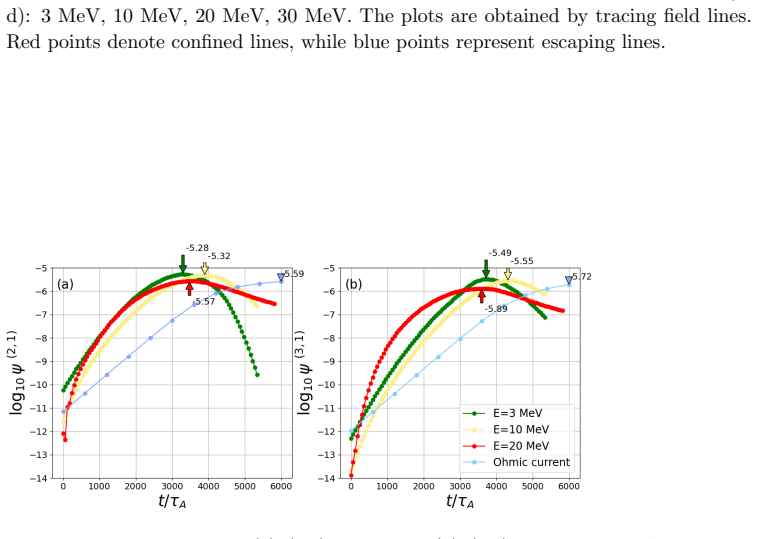
Summary. The paper presents hybrid kinetic-MHD simulations using the JOREK code to study finite-orbit-width (FOW) effects of runaway electrons (REs) on resistive tearing-mode stability and nonlinear dynamics. REs are treated kinetically via full-f relativistic guiding-center Monte Carlo markers coupled to extended MHD. The authors find that increasing RE energy first narrows then broadens the (2,1) current-sheet width (Fig. 3), reduces the linear growth rate (Fig. 4), lowers nonlinear island saturation amplitudes (Fig. 7), and decreases the Chirikov parameter, connection length, and radial diffusion coefficients (Figs. 8, 10, 11). The central claim is that FOW effects stabilize tearing modes by preventing narrow current sheets on rational surfaces, and that this stabilization dominates over enhanced poloidal mode coupling in the investigated scenario.
Significance. If correct, the result is significant because it shows that kinetic FOW effects can qualitatively reverse the destabilizing role of REs predicted by zero-orbit-width (fluid) models, with direct implications for predicting disruption current-quench evolution and benign termination. The study uses multiple complementary diagnostics (layer width, growth rate, Poincare plots, connection length, diffusion, Chirikov parameter) that are internally consistent. The non-monotonic layer width in Fig. 3 is a falsifiable signature that cannot be explained by pressure alone. However, the absence of numerical convergence information and of a zero-orbit-width control at matched pressure leaves the central attribution only partially demonstrated.
major comments (3)
- [§2, Eq. (3); §4, Figs. 4, 7, 10] The manuscript does not report the number of markers N, grid resolution, time step, or any convergence tests for the hybrid simulations. Since the central claim is a simulation outcome, the lack of these numerical details prevents the reader from assessing whether the observed trends (growth rate decrease, saturation reduction, diffusion decrease) are robust. Please provide the numerical parameters used and a convergence check (at least in marker number and resolution) for the key quantitative results.
- [§4.1, Figs. 3 and 4] The linear growth rate is shown to decrease monotonically with RE energy (Fig. 4), and this is attributed to FOW broadening of the current sheet. However, the RE pressure and the associated Grad-Shafranov shift also increase with energy (Fig. 1(a)), so the stabilizing trend could in part be an equilibrium (pressure/shift) effect rather than a direct FOW current-broadening effect. The 600 keV case in Fig. 3 provides a partial non-monotonic check for the layer width, but the growth rate for this case is not shown. Please provide a fluid-RE (zero orbit width) control at matched pressure, or at least the 600 keV growth rate, to demonstrate that the stabilization is specifically due to FOW broadening.
- [§4.3, Eq. (6) and Fig. 9] The radial diffusion coefficients are obtained by Gaussian fitting after excluding particles 'strongly affected by the magnetic island region or boundary transport', but the exclusion criterion is not defined quantitatively. The computed D values and the claimed decreasing trend with energy (Fig. 10f) may depend strongly on which particles are removed. Please specify the selection criterion, report the fraction of excluded particles for each energy, and show that the trend in D is robust to reasonable changes of the criterion.
minor comments (5)
- [§4.1, after Eq. (5)] The phrase 'enhanced toroidal mode coupling' describing the (2,1)->(3,1) sideband is a misnomer: the (1,0) equilibrium perturbation couples poloidal harmonics m to m±1 for the same toroidal number n. It should read 'poloidal mode coupling'.
- [Fig. 5 caption] Please clarify what is meant by 'ψ structures' - presumably the perturbed poloidal flux structures of the (2,1) and (3,1) components.
- [Eq. (5)] The quantity v_RE is used but not defined. Please define it in the text following the equation (e.g., the parallel RE velocity).
- [§4.3, Fig. 10(f)] The axis label and units of the diffusion coefficient D are not described in the text. Please specify the normalization (e.g., m^2/s) and the radial coordinate used.
- [General] The manuscript does not include a data availability statement or mention whether input files/scripts are available. Given the simulation-based nature of the work, a statement on data/code availability would improve reproducibility.
Circularity Check
No significant circularity: central claim emerges from self-consistent simulations, not from fitted inputs or definitional loops.
full rationale
The central claim that increasing runaway-electron energy stabilizes tearing modes via drift-orbit broadening is an emergent simulation result, not a fitted prediction. The model equations are stated in Section 2, and the stability conclusions are supported by multiple independent diagnostics: current-layer width (Fig. 3), linear growth rates (Fig. 4), mode-structure coupling (Fig. 5), saturation amplitudes (Fig. 7), connection lengths (Fig. 8), diffusion coefficients (Fig. 10), and the Chirikov parameter (Fig. 11). The only fitting in the paper is the Gaussian estimate of the radial diffusion coefficient D in Section 4.3, which is a post-hoc transport diagnostic and is not used as an input to derive the stabilization. The cited prior work [18,19] describes the numerical implementation of the hybrid model, but the paper re-derives the relevant equations and the new physics is obtained from the presented simulations, not imported by citation. The ∇B-cancellation assumption in Section 2 is a standard consistency relation between the particle drift current and the magnetization current, and at pitch=0.999 the ∇B drift is far smaller than the curvature drift, so the qualitative conclusion does not reduce to this assumption. No self-definitional, fitted-input, or renaming loop is present.
Assumptions & free parameters
free parameters (3)
- RE beam energy (scan values) =
0.6, 3, 10, 20, 30 MeV
- Pitch parameter =
0.999
- Plasma resistivity values =
multiple (see Fig. 4)
assumptions (4)
- domain assumption Relativistic guiding-center equations of Ref. [21] with fixed magnetic moment and pitch=0.999
- domain assumption Hybrid kinetic-fluid coupling via RE pressure terms in momentum equation and modified Ohm's law (Eqs. 2-4)
- domain assumption Force-free background equilibrium with J x B = P_r,parallel kappa
- ad hoc to paper Exact cancellation of grad-B drift by RE magnetization current
Cite this review
Pith. "Pith review of Hybrid Kinetic-MHD Simulations of Drift-Orbit Effects on the Stability and Non-Linear Dynamics of Runaway Electron Beams." pith.science (2026). https://pith.science/paper/SFHM75FI
@misc{pith2026260802121,
  author       = {Pith},
  title        = {Pith review of: Hybrid Kinetic-MHD Simulations of Drift-Orbit Effects on the Stability and Non-Linear Dynamics of Runaway Electron Beams},
  year         = {2026},
  howpublished = {\url{https://pith.science/paper/SFHM75FI}},
  note         = {Machine review of arXiv:2608.02121}
}
abstract
During tokamak disruptions, the Ohmic current may be replaced by a non-inductive runaway electron (RE) current, affecting resistive stability. Previous studies suggest that, in the linear phase, the presence of REs acts destabilizing for tearing modes (TM) compared to a scenario with Ohmic current. In the non-linear regime, this translates to larger saturation amplitudes. These results are based on the assumption of zero drift-orbit deviation from the magnetic flux surfaces corresponding to the low-energy limit. This work investigates the importance of this kinetic effect by studying the linear and non-linear TM dynamics in RE beams with different RE energies, providing a clear picture of finite-orbit-width (FOW) effects. We use a hybrid fluid-kinetic model in the 3D non-linear magnetohydrodynamic (MHD) code JOREK, treating REs kinetically with a full-f Monte Carlo approach in self-consistent interaction with the MHD mode dynamics. The study shows that the presence of REs modifies the characteristics of the instability in several ways. First, we find that the major-radial displacement of drift orbits from flux surfaces induces an $m=1$ perturbation to the equilibrium current, introducing additional mode coupling between $(m,n)$ instabilities and the $(m\pm1,n)$ sidebands. Second, we find that increasing RE energy has a stabilizing effect on the MHD modes because REs cannot support narrow current sheets on rational flux surfaces owing to the drift-orbit displacement. This counteracts the destabilizing effect that REs have on TMs in the low-energy limit. For the scenario investigated, the stabilizing effect dominates over the additional mode coupling, reducing the development of stochastic magnetic regions with increasing RE energy and thereby lowering radial particle transport. Overall, we find that FOW effects can substantially alter the MHD stability and non-linear dynamics of RE beams.
Figures


Figures from the paper (8 more)




Reference graph
Works this paper leans on
-
[1]
During the disruption process, the pre-disruption Ohmic current can be rapidly converted to RE current
Introduction Tokamak disruptions pose a critical challenge for the safe operation of future fusion devices, such as ITER, primarily due to the generation of runaway electron (RE) beams[2, 3]. During the disruption process, the pre-disruption Ohmic current can be rapidly converted to RE current. The presence of such a non-thermal current[4] fundamentally a...
-
[2]
Here, we briefly summarize the aspects relevant to the present study
Hybrid Kinetic-MHD Model The hybrid kinetic–MHD model used in this work has been developed and implemented in JOREK in[18, 19] where the detailed formulation and numerical implementation are described. Here, we briefly summarize the aspects relevant to the present study. The relativistic GC model follows the formulation described in [21]: ˙X= p∗ ∥ γrm0 B∗...
-
[3]
Finite-Orbit-Width Effects on the Plasma Equilibrium In the post-disruption phase, the plasma is typically characterized by low temperature and low pressure, and tends toward a force-free equilibrium (J×B≈0). However, when a significant population of high-energy REs is present, they can provide an effective pressure term, breaking the force-free assumptio...
-
[4]
Linear Properties In section 3, we notice that the FOW effects becomes non-negligible when RE energy reaches several MeV
Finite-Orbit-Width Effects on MHD Instability 4.1. Linear Properties In section 3, we notice that the FOW effects becomes non-negligible when RE energy reaches several MeV. In[13, 14], the differences between RE-driven MHD instability and the Ohmic current case are discussed, but neither of them includes the effect of the FOW effects of REs. In[14], an ex...
-
[5]
Conclusion In this work, we investigated the FOW effects of REs on resistive TM dynamics using the hybrid kinetic–MHD model implemented in JOREK. By treating runaway electrons kinetically through relativistic guiding-center equations while evolving the background plasma with reduced MHD equations, we analyzed both equilibrium modifications and instability...
-
[6]
Hoelzl M, Huijsmans G, Artola F, Nardon E, Becoulet M, Schwarz N, Cathey A, Pamela S, Aleynikova K, Antlitz F, Bandaru V, Bergstr¨ om H, Bhole A, Bogaarts T, Bonfiglio D, Cipolletta F, Driessen T, Edes L, Futatani S, Hao G, Hindenlang F, Holod I, Hu D, Hu S, Isernia N, Isliker H, Kim S, Kong M, Korving S, Kos L, Krebs I, Lee S, Liang Y, Liang Z, Liu S, Lu...
-
[7]
Salewski M, Spong D, Aleynikov P, Bilato R, Breizman B, Briguglio S, Cai H, Chen L, Chen W, Duarte V, Dumont R, Falessi M, Fitzgerald M, Fredrickson E, Garc ´ ıa-Mu˜ noz M, Gorelenkov N, Hayward-Schneider T, Heidbrink W, Hole M, Kazakov Y, Kiptily V, K¨ onies A, Kurki- Suonio T, Lauber P, Lazerson S, Lin Z, Mishchenko A, Moseev D, Muscatello C, Nocente M,...
-
[8]
Breizman B N, Aleynikov P, Hollmann E M and Lehnen M 2019Nuclear Fusion59083001 URL https://doi.org/10.1088/1741-4326/ab1822
Show all 36 references
-
[9]
Lvovskiy A, Paz-Soldan C, Eidietis N, Aleynikov P, Austin M, Dal Molin A, Liu Y, Moyer R, Nocente M, Shiraki D, Giacomelli L, Heidbrink W, Hollmann E, Rigamonti D, Spong D and Tar- docchi M 2020Nuclear Fusion60056008 URLhttps://doi.org/10.1088/1741-4326/ab78c7
-
[10]
Gill R 1993Nuclear Fusion331613 URLhttps://dx.doi.org/10.1088/0029-5515/33/11/I03
-
[11]
Bandyopadhyay I, Igochine V, Sauter O, Sabbagh S, Park J K, Nardon E, Villone F, Maraschek M, Pautasso G, Eidietis N, Jardin S, Humphreys D, Dubrov M, Artola F, de Baar M, Bard´ oczi L, Baylor L, Berkery J, Boozer A, Cannas B, Chen Z, Esposito B, Fanni A, Ferraro N, Fitzpatric...
-
[12]
Boozer A H 2012Physics of Plasmas19058101 ISSN 1070-664X URL https://doi.org/10.1063/1.3703327
-
[13]
Rosenbluth M and Putvinski S 1997Nuclear Fusion371355 URL https://dx.doi.org/10.1088/0029-5515/37/10/I03
-
[14]
Reux C, Paz-Soldan C, Aleynikov P, Bandaru V, Ficker O, Silburn S, Hoelzl M, Jachmich S, Eidietis N, Lehnen M, Sridhar S and contributors J 2021Phys. Rev. Lett.126(17) 175001 URL https://link.aps.org/doi/10.1103/PhysRevLett.126.175001
-
[15]
Paz-Soldan C, Reux C, Aleynikova K, Aleynikov P, Bandaru V, Beidler M, Eidietis N, Liu Y, Liu C, Lvovskiy A, Silburn S, Bardoczi L, Baylor L, Bykov I, Carnevale D, Del-Castillo Negrete D, Du X, Ficker O, Gerasimov S, Hoelzl M, Hollmann E, Jachmich S, Jardin S, Joffrin E, Lasni...
-
[16]
Bandaru V, Hoelzl M, Reux C, Ficker O, Silburn S, Lehnen M, Eidietis N, Team J and Contributors J 2021Plasma Physics and Controlled Fusion63035024 URL https://dx.doi.org/10.1088/1361-6587/abdbcf
-
[17]
Zimmermann C, Paz-Soldan C, Su G, Reux C, Battey A, Ficker O, Gerasimov S, Hansen C, Jachmich S, Lvovskiy A, Puchmayr J, Schoonheere N, Sheikh U, Stewart I, Szepesi G, 18 Contributors J and the EUROfusion Tokamak Exploitation Team 2026Nuclear Fusion66 056004 URLhttps://doi.org...
-
[18]
Helander P, Grasso D, Hastie R J and Perona A 2007 Physics of Plasmas14122102 ISSN 1070-664X (Preprint https://pubs.aip.org/aip/pop/article-pdf/doi/10.1063/1.2817016/16108426/122102 1 online.pdf) URLhttps://doi.org/10.1063/1.2817016
2007 doi
-
[19]
Liu C, Zhao C, Jardin S C, Bhattacharjee A, Brennan D P and Fer- raro N M 2020Physics of Plasmas27092507 ISSN 1070-664X (Preprint https://pubs.aip.org/aip/pop/article-pdf/doi/10.1063/5.0018559/15812756/092507 1 online.pdf) URLhttps://doi.org/10.1063/5.0018559
-
[20]
Bandaru V and Hoelzl M 2023Physics of Plasmas30092508 ISSN 1070-664X (Preprint https://pubs.aip.org/aip/pop/article-pdf/doi/10.1063/5.0165240/18125667/092508 1 5.0165240.pdf) URLhttps://doi.org/10.1063/5.0165240
-
[21]
Hoelzl M, Huijsmans G, Pamela S, B´ ecoulet M, Nardon E, Artola F, Nkonga B, Atanasiu C, Bandaru V, Bhole A, Bonfiglio D, Cathey A, Czarny O, Dvornova A, Feh´ er T, Fil A, Franck E, Futatani S, Gruca M, Guillard H, Haverkort J, Holod I, Hu D, Kim S, Korving S, Kos L, Krebs I, ...
-
[22]
Bandaru V, Hoelzl M, Artola F J, Vallhagen O, Lehnen M and Team J 2024Physics of Plasmas31082503 ISSN 1070-664X (Preprint https://pubs.aip.org/aip/pop/article-pdf/doi/10.1063/5.0213962/20093805/082503 1 5.0213962.pdf) URLhttps://doi.org/10.1063/5.0213962
-
[23]
Bergstr¨ om H, Liu S J, Bandaru V, Hoelzl M, Team J and Contributors J 2025Plasma Physics and Controlled Fusion67035004 URLhttps://dx.doi.org/10.1088/1361-6587/adaee7
-
[24]
Liu S, Liu T, Bergstr¨ om H, Zhang H and Hoelzl M 2026Journal of Plasma Physics92E3
-
[25]
Yu Q, G¨ unter S, Lackner K, Strumberger E and Igochine V 2019Nuclear Fusion59106053 URL https://doi.org/10.1088/1741-4326/ab3a6b
-
[26]
Tao X, Chan A A and Brizard A J 2007Physics of Plasmas14092107 ISSN 1070-664X (Preprint https://pubs.aip.org/aip/pop/article-pdf/doi/10.1063/1.2773702/13558067/092107 1 online.pdf) URLhttps://doi.org/10.1063/1.2773702
-
[27]
Sommariva C, Pau A, Silburn S, Reux C, Hoppe M, Buratti P, Ficker O, Morales R B, Fontana M, Sun H, Carvalho P, Sheena M, Gerasimov S, Szepesi G, Boboc A, Coffey I, Kiptily V, Sauter O, Pautasso G, Paz-Soldan C, Decker J and Contributors J 2024Nuclear Fusion64106050 URL https:...
-
[28]
S¨ arkim¨ aki K, Embreus O, Nardon E, F¨ ul¨ op T and contributors J 2020Nuclear Fusion60126050 URLhttps://dx.doi.org/10.1088/1741-4326/abb9e9
-
[29]
Myra J R and Catto P J 1992Physics of Fluids B: Plasma Physics4176–186 ISSN 0899-8221 (Preprinthttps://pubs.aip.org/aip/pfb/article-pdf/4/1/176/12512264/176 1 online.pdf) URLhttps://doi.org/10.1063/1.860431
-
[30]
Carbajal L, del Castillo-Negrete D and Martinell J J 2020 Physics of Plasmas27032502 ISSN 1070-664X (Preprint https://pubs.aip.org/aip/pop/article-pdf/doi/10.1063/1.5135588/13807911/032502 1 online.pdf) URLhttps://doi.org/10.1063/1.5135588
2020 doi
-
[31]
Rechester A B and Rosenbluth M N 1978Phys. Rev. Lett.40(1) 38–41 URL https://link.aps.org/doi/10.1103/PhysRevLett.40.38
-
[32]
S¨ arkim¨ aki K, Hirvijoki E, Decker J, Varje J and Kurki-Suonio T 2016Plasma Physics and Controlled Fusion58125017 URLhttps://dx.doi.org/10.1088/0741-3335/58/12/125017
-
[33]
Papp G, Drevlak M, Pokol G I and F¨ ul¨ op T 2015Journal of Plasma Physics81475810503 19
-
[34]
Moges H T, Antonenas Y, Anastassiou G, Skokos C and Kominis Y 2024Physics of Plasmas31 012302 ISSN 1070-664X URLhttps://doi.org/10.1063/5.0173642
-
[35]
Abdullaev S S, Jakubowski M, Lehnen M, Schmitz O and Unterberg B 2008Physics of Plasmas 15042508 ISSN 1070-664X URLhttps://doi.org/10.1063/1.2907163
-
[36]
Liu Y, ¨Ak¨ aslompolo S, Cavinato M, Koechl F, Kurki-Suonio T, Li L, Parail V, Saibene G, S¨ arkim¨ aki K, Sipil¨ a S and Varje J 2016Nuclear Fusion56066001 URL https://doi.org/10.1088/0029-5515/56/6/066001
Reviewed August 4, 2026 · model on record in the stance chip above.
Discussion (0). Continue with ORCID to comment.