REVIEW 4 major objections 5 minor 45 references
The Length of Martian Crater Rays and Their Relation to Lunar Cold Spots
T0 review · 4 major / 5 minor · reviewed 2026-08-04 · deepseek-v4-flash
Pith's one-line read Martian crater rays and lunar cold spots extend about ten times farther than lunar albedo rays from similar craters.
desk verdict Novel comparison with a real signal, but the factor-of-ten rests on five Martian craters and length metrics that are probably not the same across the three datasets. read the letter →
The pith
A machine-rendered reading of the paper's core claim, the machinery that carries it, and where it could break.
The reading
What carries the argument
The argument rides on the secondary-crater scaling law Rr = R1 * Rp^s, where Rr is ray length, Rp is primary crater radius, s is a power-law exponent, and R1 is a constant assembled from boulder size-frequency parameters, excavation depths, and impact-scaling constants. Originally formulated to explain lunar albedo rays, the law is re-fitted here to Martian rays and lunar cold spots; the fitted R1 and s are then solved to give the minimum excavation depth h. The thermal-inertia relation I = sqrt(kappa rho C) connects a porosity increase to a detectable drop in thermal inertia, which is how the rays become visible in infrared images.
What would settle it
Measure the full radial extent of thermal rays around a set of 50–100 fresh Martian craters and lunar cold spots using the same mapping criteria (e.g., same contrast threshold, same radial sampling), and fit the power law; if the fitted R1 for these thermal features converges to the lunar albedo value, the order-of-magnitude claim fails. Alternatively, if lunar cold spots are shown to arise from in-situ seismic dilation waves rather than secondary cratering, the proposed shared mechanism is falsified.
Extended reading notes
Core claim
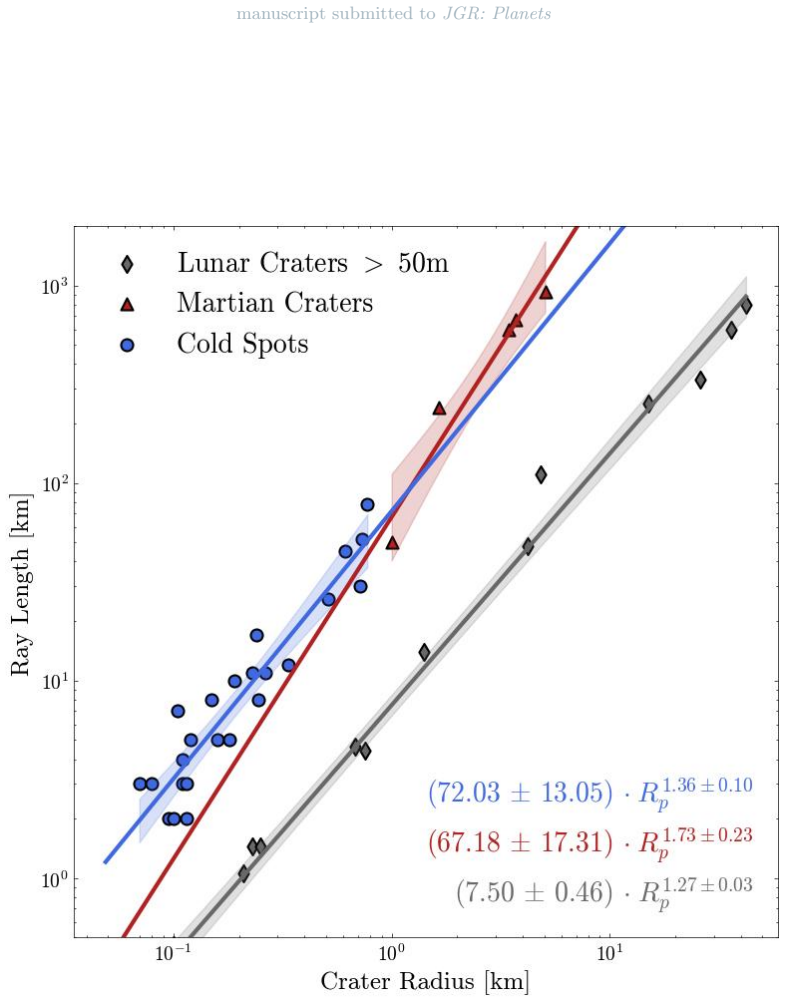
The paper's central discovery is that when crater-ray lengths are compared across three datasets—lunar albedo rays, Martian thermal rays, and lunar cold spots—the thermal features follow the same secondary-crater scaling power law as albedo rays but with a leading constant R1 that is more than ten times larger. Because the power-law exponent is nearly identical, the comparison locates the difference in the scale of the ray system, not in how ray length scales with crater size. Applying the model to Martian rays and cold spots yields minimum excavation depths of roughly one millimeter to five centimeters, far smaller than the roughly ten centimeters obtained for lunar albedo rays. The paper i
Load-bearing premise
The paper assumes that the ray-length measurements from the three published datasets are defined and made comparably, even though one dataset reports median ray lengths, others report visual extents, and they use different detection methods and crater size ranges; if the measurements are not equivalent, the tenfold difference may be an artifact of the comparison.
Editorial extensions
If this is right
- Ray length laws for optical and thermal rays are distinct; thermal rays persist far beyond the point where optical rays fade, so crater ejecta blankets are larger than previously inferred.
- Lunar cold spots can be explained by secondary cratering that disrupts a thin, weakly cemented surface layer, without invoking a separate exotic formation process.
- Impact-induced porosity changes must extend 10–100 times deeper than the depth of excavation, affecting thermal inertia at large distances from the primary crater.
- Future surveys of rayed craters on Mars and cold spots on the Moon should record ray lengths for the many craters already cataloged, since only a handful currently have measured lengths.
- Warm thermophysical rays, which have not yet been length-quantified, may follow the same scaling and could extend the thermal ray story further.
Reading between the lines
- The factor-of-ten difference could be inflated by comparing median ray lengths (Mars) with maximum visible extents (cold spots) from different instruments; a consistent re-measurement of a matched crater sample is the obvious next step.
- If the mechanism is truly porosity disruption by secondary impacts, then Mercury's rayed craters should also show long thermal rays, a prediction the paper gestures toward but does not test.
- The small sample (five Martian craters and thirteen cold spots) means the fitted R1 value could shift substantially with new measurements, which would revise but not necessarily overturn the order-of-magnitude conclusion.
Editorial analysis
A structured set of objections, weighed in public.
Referee Report
Summary. The paper compares crater ray lengths on Mars and the Moon by combining published measurements of lunar albedo rays (Elliott et al. 2018), Martian thermal rays (McEwen et al. 2005; Tornabene et al. 2006), and lunar cold spots (Bandfield et al. 2014). It fits a power law R_r = R_1 R_p^s to each dataset and reports that the leading constant R_1 for Martian rays and cold spots is an order of magnitude larger than for lunar albedo rays. The authors then apply the Elliott et al. (2018) secondary-cratering model to infer minimum excavation depths h and propose that Martian rays and lunar cold spots share a rarefaction-wave formation mechanism. The empirical comparison is presented as the central result, with the mechanism as a supporting hypothesis.
Significance. If the order-of-magnitude difference is real, the result is significant: thermal rays would be a much more extensive ejecta phenomenon than optical rays, and a common formation process for Martian rays and lunar cold spots would have implications for impact dynamics and surface evolution. A strength of the paper is that the empirical ray-length comparison is independent of the Elliott model, and the authors are transparent about the small sample sizes and the speculative nature of the mechanism. However, the central claim currently rests on an unverified equivalence of length metrics across three datasets, a very limited Martian sample, and a model-inferred excavation depth. These issues materially affect the confidence that can be placed in the headline result.
major comments (4)
- [Sec. 3, Fig. 4, Table 3] The central comparison treats 'ray length' as a single observable across three datasets. Table 3 lists Martian lengths as 'Median Ray Length [km]' for discrete streaks; Bandfield et al. (2014) cold spots are continuous thermal anomalies whose radial extents are not defined in this manuscript; and Elliott et al. (2018) lunar albedo rays are optically defined. These metrics may differ systematically (median vs. maximum, optical vs. thermal detection thresholds). A median-vs-maximum offset alone could shift R1 by a factor of ~2, and combining it with optical-vs-thermal sensitivity could plausibly produce the reported ~10x difference without any true physical difference in ejecta reach. The manuscript provides no demonstration that the three datasets use the same length metric, nor a sensitivity analysis varying the length definition. Until this is established, the order-of-magnitude gap in
- [Sec. 4, Eqs. (3)-(4), Fig. 5] The excavation depths h for Martian rays and cold spots are not independent measurements; they are solved from the fitted R1 and s values using the Elliott model. Statements such as 'excavation depths ... on the order of 1 mm to 5 cm' (Sec. 4) are therefore model inferences, not observed quantities. Interpreting these h values as physical depths and comparing them across bodies is circular, since any errors or systematic offsets in the ray-length fits propagate directly into h. The paper should reframe these h values as model predictions and seek independent validation (e.g., the few-centimeter thickness estimates for cold spots in Bandfield et al. 2014) rather than presenting them as derived constraints on the formation mechanism.
- [Sec. 5, Wiggins et al. (2019, 2022)] The proposed rarefaction-wave mechanism is extrapolated from primary hypervelocity impacts (10-20 km/s) to secondary impacts at <1 km/s without quantitative justification. The claim that porosity changes extend 10-100x the excavation depth is not derived for the secondary-impact regime; the supporting citations are for primary impacts, and the 'very conservative estimate' in Sec. 5 assumes an arbitrary factor of 2 crater radii. As this mechanism underpins the proposed connection between Martian rays and lunar cold spots, the extrapolation should either be backed by scaling arguments or explicitly labeled as a speculation (the paper does later call it a theoretical model, but the discussion reads as a stronger assertion).
- [Sec. 2.2, Table 3 and Fig. 3] The Martian ray fit relies on only five craters, with no reported uncertainties on individual ray lengths. Excluding the three 'probable' rayed craters changes the slope s by about 1.1x (Fig. 3), indicating that the fit is sensitive to dataset composition. The 95% confidence intervals in Fig. 4 are not described (e.g., whether they reflect measurement errors, fitting method, or bootstrap), so the reader cannot assess the robustness of the R1 and s values. Please include the probable craters in a sensitivity analysis, report the number of cold spots used from Bandfield et al. (2014), and specify the length uncertainties for all data points.
minor comments (5)
- [Sec. 1] Typo: 'sill appear bright' should be 'still appear bright'.
- [Appendix, Table 1] The table headings read 'T able 1' and 'T able 2' (formatting artifacts). Also, 'Mya' is used for Martian ray lifetimes; consider using 'Myr' or 'Ma' consistently.
- [Sec. 3] The number of lunar cold spots from Bandfield et al. (2014) used in the analysis is not stated. Please specify the sample size and the source of the length measurements.
- [Fig. 4] The method for computing the 95% confidence intervals is not described. State whether they are from least-squares fitting, bootstrap, or another procedure.
- [Fig. 7 and Sec. 4] The t-test comparing skin depth contours is mentioned without any test statistic, degrees of freedom, or p-value. Provide the details or remove the claim.
Circularity Check
Headline length comparison is empirical; the excavation-depth inversion is model-consistent by construction.
-
fitted input called prediction
[Section 4 (Excavation Depth and Depth of Disruption), Eqs. (2)-(4), Fig. 5]
"To calculate the value of the excavation depth, Eq. (2) was solved for the values of a,b, and h, by plugging in the calculated values of s and R1 shown in Fig. 4 for each fit. The results of this parameterization can be seen in Fig. 5 ... Fig. 5 shows that excavation depths for Martian crater rays and lunar cold spots are significantly smaller than those of albedo-based lunar rays."
R1 and s are least-squares fits to the measured ray lengths (Fig. 4); Eqs. (3)-(4) are then inverted to obtain h. Therefore h is not an independent measurement or prediction, but an algebraic function of the fitted R1 and s. The paper presents the resulting small h values as a physical finding and builds the rarefaction-wave/porosity mechanism on them (e.g., 'depth of material disruption would be twenty times our original excavation depth'), so the mechanism is made consistent with the fit by construction. The headline order-of-magnitude ray-length comparison, however, is an empirical fit comparison and does not depend on this inversion.
full rationale
The central claim that Martian crater rays and lunar cold spots extend an order of magnitude farther than lunar albedo rays is an empirical comparison: R1 and s are fitted directly to measured ray lengths from Elliott et al. (2018), Tornabene et al. (2006)/McEwen et al. (2005), and Bandfield et al. (2014), and the Elliott model only provides the power-law form, not the length values themselves. Thus the main result is not circular. The clearest circularity-adjacent step is the excavation-depth inversion in Section 4: h is solved from the very R1 and s values fitted in Fig. 4 using Eqs. (3)-(4), then used as if it were an independently meaningful physical depth supporting the proposed porosity/rarefaction mechanism. That inference is forced by the construction of the model and the fitted values, so it cannot serve as independent confirmation. The self-citations to Elliott et al. (2018) and Wiggins et al. (2019, 2022) are published models/simulations with external content; they are not invoked as uniqueness theorems and do not by themselves make the headline claim circular. The skeptic's concern about inconsistent ray-length metrics across datasets (median Martian ray length vs. continuous cold-spot extent) is a data-comparability and measurement-threshold issue, not a circularity issue, though it does affect how much weight the empirical R1 offset can bear.
Assumptions & free parameters
free parameters (7)
- R_1 for Martian rays =
Not stated numerically; ~10x lunar R_1 (Fig. 4)
- s for Martian rays =
Not stated numerically; changes by 1.1x when probable craters are included
- R_1 for lunar cold spots =
Not stated numerically; within error of Martian R_1 (Fig. 4)
- s for lunar cold spots =
Not stated numerically
- Excavation depth h =
~1 mm to 5 cm for Martian rays/cold spots; ~10 cm for lunar albedo rays
- Excavation probability P =
0.5 (tested 0.2–0.8)
- Crater-size dependence exponent c =
Scanned 0–1
assumptions (4)
- domain assumption Elliott et al. (2018) secondary cratering model (Eqs. 2–4) with dry-sand scaling constants (β=0.17, k=0.625) applies to Mars and lunar cold spots.
- ad hoc to paper The parameter h is reinterpreted as the minimum excavation depth for any visible ray, not specifically space-weathered skin depth.
- ad hoc to paper Rarefaction waves from secondary impacts at <1 km/s produce porosity changes extending 10–100x excavation depth.
- domain assumption Ray lengths from different catalogs are measured with comparable definitions.
Cite this review
Pith. "Pith review of The Length of Martian Crater Rays and Their Relation to Lunar Cold Spots." pith.science (2026). https://pith.science/paper/5KFILUJE
@misc{pith2026260802492,
  author       = {Pith},
  title        = {Pith review of: The Length of Martian Crater Rays and Their Relation to Lunar Cold Spots},
  year         = {2026},
  howpublished = {\url{https://pith.science/paper/5KFILUJE}},
  note         = {Machine review of arXiv:2608.02492}
}
read the original abstract
Impact-generated crater rays are well-documented on the Moon, with most appearing as high-albedo streaks extending radially from a crater's center. On Mars, however, crater rays are significantly rarer and discernible only through thermal imaging due to their lower thermal inertia compared to surrounding terrain. This study presents the first comparative analysis between the lengths of Martian and lunar crater rays, including lunar albedo rays and cold spots, which are ray-like thermal anomalies associated with many of the youngest lunar craters. Our findings indicate that both Martian crater rays and lunar cold spots extend significantly farther than lunar albedo rays, with lengths an order of magnitude greater for craters of equivalent diameter. Furthermore, we propose a connection between the formation mechanisms of Martian crater rays and lunar cold spots based on their thermal properties. By integrating thermal rays into existing ejecta models, we refine the understanding of crater-ray formation and suggest that Martian crater rays and lunar cold spots may share a similar formation mechanism via secondary cratering processes. Advancing knowledge of these features has implications for impact dynamics and surface evolution across planetary bodies.
Figures


Figures from the paper (5 more)


Reference graph
Works this paper leans on
-
[1]
Edgard G. Rivera-Valentín and Caleb I. Fassett and Brett W. Denevi and Heather M. Meyer and Catherine D. Neish and Gareth A. Morgan and Joshua T. S. Cahill and Angela M. Stickle and G. Wesley Patterson , title =. The Planetary Science Journal , abstract =. 2024 , month =. doi:10.3847/PSJ/ad320d , url =
-
[2]
Meteoritics & Planetary Science , volume =
Shuvalov, Valery , title =. Meteoritics & Planetary Science , volume =. doi:https://doi.org/10.1111/j.1945-5100.2011.01324.x , url =. https://onlinelibrary.wiley.com/doi/pdf/10.1111/j.1945-5100.2011.01324.x , abstract =
arXiv 1945
-
[3]
University of Chicago Press 1960 , year=
Photographic lunar atlas , author=. University of Chicago Press 1960 , year=
1960
-
[4]
Filippo Tusberti and Maurizio Pajola and Giovanni Munaretto and Luca Penasa and Alice Lucchetti and Joel Beccarelli and Costanza Rossi and Riccardo Pozzobon and Matteo Massironi , keywords =. Ice degradation and Boulder size frequency distribution analysis of the fresh Martian crater S1094b , journal =. 2024 , issn =. doi:https://doi.org/10.1016/j.icarus....
arXiv 2024
-
[5]
Encyclopedia of Atmospheric Sciences , publisher =
PLANETARY ATMOSPHERES | Mars , editor =. Encyclopedia of Atmospheric Sciences , publisher =. 2003 , isbn =. doi:https://doi.org/10.1016/B0-12-227090-8/00312-2 , url =
-
[6]
Bainbridge, K. T. , title =. U.S. Department of Energy , doi =. 1976 , month =
1976
-
[7]
H.J. Melosh , abstract =. Impact ejection, spallation, and the origin of meteorites , journal =. 1984 , issn =. doi:https://doi.org/10.1016/0019-1035(84)90026-5 , url =
-
[8]
Dark-ray and dark-floor craters on Ganymede, and the provenance of large impactors in the Jovian system. Icarus , keywords =. doi:10.1016/0019-1035(91)90181-R , adsurl =
Show all 45 references
-
[9]
and McEwen, Alfred S
Preblich, Brandon S. and McEwen, Alfred S. and Studer, Daniel M. , title =. Journal of Geophysical Research: Planets , volume =. doi:https://doi.org/10.1029/2006JE002817 , url =. https://agupubs.onlinelibrary.wiley.com/doi/pdf/10.1029/2006JE002817 , abstract =
-
[10]
Kreslavsky and Anastasia Yu
Mikhail A. Kreslavsky and Anastasia Yu. Zharkova and James W. Head and Maria I. Gritsevich , keywords =. Boulders on Mercury , journal =. 2021 , issn =. doi:https://doi.org/10.1016/j.icarus.2021.114628 , url =
2021
-
[11]
Lunar and Planetary Science Conference Proceedings , keywords =
Mixing of the lunar regolith. Lunar and Planetary Science Conference Proceedings , keywords =
-
[12]
LSU Master's Theses , year = 2017, month = dec, adsurl =
Boulder Distribution Analysis of Impact Craters in the Tharsis Region and Elysium Planitia, Mars. LSU Master's Theses , year = 2017, month = dec, adsurl =
2017
-
[13]
and Monnereau, Marc and Wieczorek, Mark and Garcia, Raphaël and Kurita, Kei , title =
Baratoux, David and Samuel, Henri and Michaut, Chloé and Toplis, Michael J. and Monnereau, Marc and Wieczorek, Mark and Garcia, Raphaël and Kurita, Kei , title =. Journal of Geophysical Research: Planets , volume =. doi:https://doi.org/10.1002/2014JE004642 , url =. https://agu...
-
[14]
L. V. Posiolova and P. Lognonné and W. B. Banerdt and J. Clinton and G. S. Collins and T. Kawamura and S. Ceylan and I. J. Daubar and B. Fernando and M. Froment and D. Giardini and M. C. Malin and K. Miljković and S. C. Stähler and Z. Xu and M. E. Banks and É. Beucler and B. A...
2022
-
[15]
and Genova, Antonio and Mazarico, Erwan and Nicholas, Joseph B
Goossens, Sander and Sabaka, Terence J. and Genova, Antonio and Mazarico, Erwan and Nicholas, Joseph B. and Neumann, Gregory A. , title =. Geophysical Research Letters , volume =. doi:https://doi.org/10.1002/2017GL074172 , url =. https://agupubs.onlinelibrary.wiley.com/doi/pdf...
-
[16]
Neish, C. D. and Blewett, D. T. and Harmon, J. K. and Coman, E. I. and Cahill, J. T. S. and Ernst, C. M. , title =. Journal of Geophysical Research: Planets , volume =. doi:https://doi.org/10.1002/jgre.20166 , url =. https://agupubs.onlinelibrary.wiley.com/doi/pdf/10.1002/jgre...
-
[17]
Icarus , year = 2004, month = jul, volume =
The origin of lunar crater rays. Icarus , year = 2004, month = jul, volume =. doi:10.1016/j.icarus.2004.02.013 , adsurl =
2004 doi
-
[18]
Schmidt and Kevin R
Robert M. Schmidt and Kevin R. Housen , abstract =. Some recent advances in the scaling of impact and explosion cratering , journal =. 1987 , note =. doi:https://doi.org/10.1016/0734-743X(87)90069-8 , url =
1987 doi
-
[19]
Krishna and P
N. Krishna and P. Senthil Kumar , keywords =. Impact spallation processes on the Moon: A case study from the size and shape analysis of ejecta boulders and secondary craters of Censorinus crater , journal =. 2016 , issn =. doi:https://doi.org/10.1016/j.icarus.2015.09.033 , url =
2016 doi
-
[20]
McEwen and Brandon S
Alfred S. McEwen and Brandon S. Preblich and Elizabeth P. Turtle and Natalia A. Artemieva and Matthew P. Golombek and Michelle Hurst and Randolph L. Kirk and Devon M. Burr and Philip R. Christensen , keywords =. The rayed crater Zunil and interpretations of small impact crater...
2005 doi
-
[21]
Lunar and Planetary Science Conference Proceedings , keywords =
Multiringed basins - illustrated by Orientale and associated features. Lunar and Planetary Science Conference Proceedings , keywords =
-
[22]
Elliott and Ya-Huei Huang and David A
Jacob R. Elliott and Ya-Huei Huang and David A. Minton and Andrew M. Freed , keywords =. The length of lunar crater rays explained using secondary crater scaling , journal =. 2018 , issn =. doi:https://doi.org/10.1016/j.icarus.2018.04.015 , url =
2018 doi
-
[23]
1963 , publisher =
The Measure of the Moon , author =. 1963 , publisher =
1963
-
[24]
1989 , publisher =
Impact Cratering , author =. 1989 , publisher =
1989
-
[25]
2010 , doi =
The Lunar Reconnaissance Orbiter Diviner Lunar Radiometer Experiment , journal =. 2010 , doi =
2010
-
[26]
AGU Fall Meeting Abstracts , year = 2021, volume =
New Lunar Cold Spots: The Thermophysical Properties of the Youngest Craters on the Moon. AGU Fall Meeting Abstracts , year = 2021, volume =
2021
-
[27]
and McKeown, Lauren E
Harris, Jennifer K. and McKeown, Lauren E. and Parenti, Carlotta and Tornabene, Livio L. and Grindrod, Peter M. , title =. Earth and Space Science , volume =. doi:https://doi.org/10.1029/2021EA001814 , url =. https://agupubs.onlinelibrary.wiley.com/doi/pdf/10.1029/2021EA001814...
-
[28]
Second Planetary Data Workshop , year = 2015, editor =
JMARS Easy Visualization and Analysis of Planetary Remote Sensing Data. Second Planetary Data Workshop , year = 2015, editor =
2015
-
[29]
and Bowling, Tim J
Wiggins, Sean and Johnson, Brandon C. and Bowling, Tim J. and Melosh, H. Jay and Silber, Elizabeth A. , title =. Journal of Geophysical Research: Planets , volume =. doi:https://doi.org/10.1029/2018JE005757 , url =. https://agupubs.onlinelibrary.wiley.com/doi/pdf/10.1029/2018J...
-
[30]
doi:10.5281/zenodo.3948793 , version =
matplotlib/matplotlib: REL: v3.3.0. doi:10.5281/zenodo.3948793 , version =
-
[31]
, journal=
Hunter, John D. , journal=. Matplotlib: A 2D Graphics Environment , year=
-
[32]
Keller and David S
Lindsay P. Keller and David S. McKay , abstract =. The nature and origin of rims on lunar soil grains , journal =. 1997 , issn =. doi:https://doi.org/10.1016/S0016-7037(97)00085-9 , url =
1997 doi
-
[33]
Journal of Geophysical Research: Planets , volume =
Wu, Yanxue and Li, Xiongyao and Yao, Wenqing and Wang, Shijie , title =. Journal of Geophysical Research: Planets , volume =. doi:https://doi.org/10.1002/2016JE005220 , url =. https://agupubs.onlinelibrary.wiley.com/doi/pdf/10.1002/2016JE005220 , abstract =
-
[34]
Stojic and Iris Weber and Andreas Morlok and Sergey G
Aleksandra N. Stojic and Iris Weber and Andreas Morlok and Sergey G. Pavlov and Harald Hiesinger and Maximilian P. Reitze and Alessandro Maturilli and Nico Schmedemann and Karin E. Bauch and Jan Hendrik Pasckert and Jörn Helbert , keywords =. Simulation of surface regolith gar...
2023
-
[35]
and Marchi, Simone , year =
Wiggins, Sean and Johnson, Brandon and Collins, Gareth and Melosh, H. and Marchi, Simone , year =. Widespread impact-generated porosity in early planetary crusts , volume =. Nature Communications , doi =
-
[36]
Putzig and Michael T
Nathaniel E. Putzig and Michael T. Mellon and Katherine A. Kretke and Raymond E. Arvidson , keywords =. Global thermal inertia and surface properties of Mars from the MGS mapping mission , journal =. 2005 , issn =. doi:https://doi.org/10.1016/j.icarus.2004.08.017 , url =
2005 doi
-
[37]
High-Resolution Thermal Inertia Mapping from the Mars Global Surveyor Thermal Emission Spectrometer , journal =
Michael T Mellon and Bruce M Jakosky and Hugh H Kieffer and Philip R Christensen , abstract =. High-Resolution Thermal Inertia Mapping from the Mars Global Surveyor Thermal Emission Spectrometer , journal =. 2000 , issn =. doi:https://doi.org/10.1006/icar.2000.6503 , url =
-
[38]
Launch of martian meteorites in oblique impacts , journal =
Natalia Artemieva and Boris Ivanov , keywords =. Launch of martian meteorites in oblique impacts , journal =. 2004 , issn =. doi:https://doi.org/10.1016/j.icarus.2004.05.003 , url =
2004 doi
-
[39]
and Costello, Emily S
Ghent, Rebecca R. and Costello, Emily S. and Parker, A. H. , title =. The Planetary Science Journal , abstract =. 2024 , month =. doi:10.3847/PSJ/ad293d , url =
2024 doi
-
[40]
AGU Fall Meeting Abstracts , year = 2019, volume =
An Updated Global Catalogue of Rayed Craters on Mars: Potential Sources for Martian Meteorites. AGU Fall Meeting Abstracts , year = 2019, volume =
2019
-
[41]
Frizzell and Christine M
Eric S. Frizzell and Christine M. Hartzell and Nicholas C. Schmerr , keywords =. Wave transmission through the megaregolith as a mechanism for lunar cold spot formation , journal =. 2025 , issn =. doi:https://doi.org/10.1016/j.icarus.2025.116461 , url =
2025
-
[42]
and Bandfield, Joshua L
Hayne, Paul O. and Bandfield, Joshua L. and Siegler, Matthew A. and Vasavada, Ashwin R. and Ghent, Rebecca R. and Williams, Jean-Pierre and Greenhagen, Benjamin T. and Aharonson, Oded and Elder, Catherine M. and Lucey, Paul G. and Paige, David A. , title =. Journal of Geophysi...
-
[43]
and Bandfield, J
Williams, J.-P. and Bandfield, J. L. and Paige, D. A. and Powell, T. M. and Greenhagen, B. T. and Taylor, S. and Hayne, P. O. and Speyerer, E. J. and Ghent, R. R. and Costello, E. S. , title =. Journal of Geophysical Research: Planets , volume =. doi:https://doi.org/10.1029/20...
-
[44]
Bandfield and Eugenie Song and Paul O
Joshua L. Bandfield and Eugenie Song and Paul O. Hayne and Brittany D. Brand and Rebecca R. Ghent and Ashwin R. Vasavada and David A. Paige , keywords =. Lunar cold spots: Granular flow features and extensive insulating materials surrounding young craters , journal =. 2014 , i...
2014 doi
-
[45]
and Moersch, Jeffrey E
Tornabene, Livio L. and Moersch, Jeffrey E. and McSween Jr., Harry Y. and McEwen, Alfred S. and Piatek, Jennifer L. and Milam, Keith A. and Christensen, Phillip R. , title =. Journal of Geophysical Research: Planets , volume =. doi:https://doi.org/10.1029/2005JE002600 , url =....
Reviewed August 4, 2026 · model on record in the stance chip above.
Discussion (0). Continue with ORCID to comment.