REVIEW 3 major objections 5 minor 26 references
PaQit: Energy-Runtime-Fidelity Co-Optimization for Neutral Atom Quantum Computers
T0 review · 3 major / 5 minor · reviewed 2026-08-15 · deepseek-v4-flash
Pith's one-line read On neutral-atom quantum computers, the energy- and runtime-optimal schedule is to pack identical circuit shots as densely as the target fidelity allows.
desk verdict A useful qualitative packing rule that collapses on an uncalibrated and likely mis-exponented fidelity model; the hardware data is the real contribution. read the letter →
The pith
A machine-rendered reading of the paper's core claim, the machinery that carries it, and where it could break.
The reading
What carries the argument
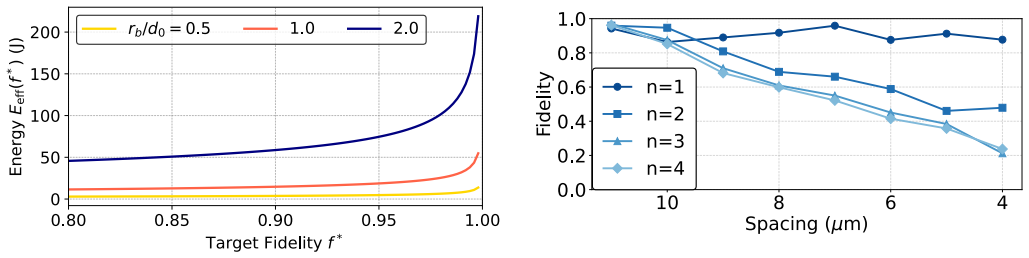
The central object is the exponential fidelity model $f(\eta)=f_{\max}\exp[-\kappa(r_b/d_0)^6\eta^3]$. Packing efficiency $\eta$ is the fraction of array qubits actively used; the blockade radius $r_b$ is the distance inside which two Rydberg atoms suppress each other's excitation. The model converts the $1/r^6$ van der Waals interaction between packed copies into a single analytic curve, and inverting it yields the maximum packing efficiency for a target fidelity. That number feeds the runtime formula $T_{\mathrm{eff}}=sn/(\eta N)\,t$ and the energy formula $E_{\mathrm{eff}}=T_{\mathrm{eff}}\,(P_0+\alpha(\eta N)^\beta)$, reducing the entire scheduling problem to a one-dimensional choice of $\eta$.
What would settle it
Measure the state-preparation fidelity of a fixed atom grid on real hardware across a sweep of nearest-neighbor spacings $d$ and plot $-\ln(f/f_{\max})$ against $d^{-6}$; the exponential model predicts a straight line through the origin, so a clearly nonlinear or intercept-shifted plot would falsify the packing optimization.
Extended reading notes
Core claim
The paper's central claim is that on neutral-atom computers, the energy- and runtime-optimal way to run a circuit is to execute as many identical shots as possible in parallel in the same atom array, and the only limit is the fidelity one is willing to accept. The quantitative core is Eq. (12): with packing efficiency $\eta$, fidelity is $f(\eta)=f_{\max}\exp[-\kappa(r_b/d_0)^6\eta^3]$, where $r_b$ is the Rydberg blockade radius and $d_0$ is the full-occupancy lattice spacing. Because the interaction between neighboring circuit instances falls as the sixth power of their separation, dense packing eventually costs accuracy, but the static-power-dominated energy budget makes extra parallelism otherwise nearly free. Inverting the fidelity formula gives the largest $\eta$ allowed by a fidelity target, which directly determines effective runtime and energy. The paper validates the qualitative relationship on simulated and real hardware, where fidelity degrades as spacing shrinks and levels off once spacing exceeds roughly ten micrometers.
Load-bearing premise
The load-bearing premise is that fidelity falls exponentially as $\kappa(r_b/d)^6$, with the proportionality constant $\kappa$ set to 1; the hardware data confirm only the direction of the effect, not this specific functional form.
Editorial extensions
If this is right
- In the static-power-dominated regime, dense packing of identical shots reduces both wall-clock time and total energy, so the energy-optimal schedule and the runtime-optimal schedule coincide.
- Packing efficiency falls only as $(-\ln f^*)^{1/3}$, but runtime and energy rise steeply as fidelity targets tighten, making low-fidelity requirements cheap and very strict requirements expensive.
- On weakly interacting hardware, small $r_b/d_0$, near-maximal packing costs almost nothing; on strongly interacting hardware, the same fidelity target forces a much sparser layout and much higher energy.
- Spacing, not raw atom count, is the dominant scheduling variable: once atoms are far enough apart to avoid crosstalk, adding more atoms to the array causes little additional fidelity loss.
- The scheduler operates purely at the software and control-layout level, requiring no hardware modifications and recomputing packing density when fidelity targets or calibration parameters change.
Reading between the lines
- Beyond the paper: the same packing rule should extend to partitioning the array into zones that run different circuits, each with its own spacing threshold, although the paper only analyzes batched identical shots.
- Beyond the paper: if near-term hardware has significant per-shot loading, measurement, or reset overhead, the energy benefit of dense packing shrinks; adding a serial overhead term to $E_{\mathrm{eff}}$ would make the model more predictive.
- Beyond the paper: the observed spacing threshold of about ten micrometers offers a direct calibration path—estimating $\kappa$ from a log-linear fit of fidelity versus $d^{-6}$ would upgrade the model from qualitative to quantitative, since the paper sets $\kappa=1$ without fitting.
- Beyond the paper: the fidelity-versus-spacing curve could be measured routinely on larger arrays during device calibration, turning packing efficiency into a continuously tunable knob for energy-aware scheduling in production workloads.
Signed reviews
Editorial analysis
A structured set of objections, weighed in public.
Referee Report
Summary. The paper proposes PaQit, a scheduling framework for neutral-atom quantum computers that selects qubit packing density to trade fidelity against runtime and energy. The authors introduce a power model P(n)=P0+αn^β, derive serial and parallel runtime/energy bounds, define a packing efficiency η, and posit an exponential fidelity law f(η)=fmax exp[-κ(rb/d0)^6 η^3]. They invert this law to compute the packing efficiency that meets a target fidelity and then evaluate PaQit via analytical curves, Bloqade simulations, real QuEra Aquila hardware executions, and Gemini noise-model simulations. The central claim is that maximizing concurrent circuit instances, subject to a fidelity constraint set by spatial packing, minimizes both runtime and energy in static-power-dominated neutral-atom systems.
Significance. If the fidelity model were quantitatively correct, PaQit would provide a practical and useful scheduling policy for Rydberg platforms. The time and energy algebra in Sec. IV is straightforward and sound, and the observation that static power dominates, so parallelism amortizes the dominant energy cost, is a valuable systems-level insight. The qualitative direction of the packing-fidelity trade-off is supported by both emulation and real hardware data. However, the central quantitative fidelity law, Eq. (12), is asserted without a derivation and is not fitted to data; moreover, the physical scaling exponent is likely wrong. Consequently, the numerical operating points, runtime/energy curves, and the claimed quantitative predictive power are not established. The work is a reasonable framework proposal but requires a corrected, validated fidelity model before its quantitative claims can be accepted.
major comments (3)
- [Sec. V.B, Eq. (12)] Equation (12) is asserted without derivation from the Rydberg Hamiltonian, and the stated justification is physically incomplete. For an atom driven near resonance, the leading correction to the π/2-pulse excitation probability from a small detuning δ is second order in δ/Ω, not first order. Since δ/Ω=(rb/d)^6, the per-pair infidelity should scale as (rb/d)^12, giving log f ∝ -(rb/d0)^12 η^6 rather than -(rb/d0)^6 η^3. Because Eq. (13) inverts Eq. (12) to produce PaQit's packing efficiencies, and Eqs. (14)-(15) and Figs. 3-5 depend on that inversion, the quantitative schedule is currently unsupported. The authors need either a careful derivation from the Rydberg dynamics or a quantitative fit to experimental fidelity data that can discriminate the exponent.
- [Sec. VI.B and VI.C] The constants κ=1.0 and fmax=1.0 are set by hand, and no quantitative comparison is made between Eq. (12) and the measured fidelity curves in Figs. 6 and 7. The real-hardware single-atom fidelity proxy is around 0.9, not 1.0, so fmax=1.0 is not hardware-grounded; the lack of a fit or uncertainty analysis for κ and fmax means the validation supports only the qualitative direction of the trade-off, not the claimed quantitative agreement. Since PaQit outputs numerical operating points, the paper needs a calibrated fidelity model with confidence intervals or at least a sensitivity analysis.
- [Sec. VII.A, Figs. 3-5] Figures 3-5 are direct plots of the assumed fidelity model with κ=1 and fmax=1, so they are consequences of the postulate rather than independent validation. The text in Sec. VII.A presents these trends as if they were confirmed by the experiments, but the experiments confirm only monotonic degradation with denser packing. A quantitative overlay of the model on the Figs. 6 and 7 data, or a statement that the analytical curves are illustrative only, is necessary to avoid circular support for the model.
minor comments (5)
- [Sec. VI.D] The introduction states that PaQit is available at a GitHub URL, while Sec. VI.D says the source code will be released upon publication; please make the availability statement consistent.
- [Sec. VI.D] There is a typo: "on real neutral-atom hardware,, we" should read "on real neutral-atom hardware, we".
- [Sec. V.C, Eq. (13)] Equation (13) requires ln(f*/fmax) < 0, which excludes f* = 1 when fmax = 1; the domain of validity of the inversion should be stated explicitly.
- [Sec. VI.A] The power-model parameters α and β are taken from non-peer-reviewed web sources; please either cite a peer-reviewed source or state clearly that α and β are illustrative estimates with unknown uncertainty.
- [Sec. VI.B] The fidelity proxy F = 1 - (1/p_ideal)(1/N)Σ|ρ_i - p_ideal| can exceed 1 or become negative for large deviations; please state its range and explain why it is an appropriate proxy for the qualitative packing trend.
Circularity Check
No significant circularity: PaQit's trade-off curves are explicit consequences of its stated fidelity model, and the hardware experiments provide independent qualitative validation.
full rationale
Walking the derivation chain: Section IV's runtime and energy bounds are algebraic consequences of the stated execution definitions and power model P(n)=P0+αn^β; no bound is defined in terms of a conclusion it is supposed to establish. Section V introduces f(η)=fmax exp[-κ(rb/d0)^6 η^3] as an explicit modeling assumption, not as a derived result, and Eq. (13) is its algebraic inversion; Eqs. (14)-(15) merely substitute that inverse into the Section IV bounds. Thus Figs. 3-5 are model outputs rather than independent empirical discoveries, but they are not circular: the paper does not define the fidelity model in terms of the runtime/energy curves and does not use those curves to infer the model. The hardware and Bloqade experiments (Figs. 6-8) are external checks that qualitatively confirm the assumed monotonic spacing-fidelity trend. The normalization κ=1.0 and fmax=1.0 in Sec. VI.B is an acknowledged simplification ('While simplified, these normalized parameters allow us to isolate and study the structural dependence of system behavior on packing and interaction strength independent of hardware-specific calibration'), which weakens quantitative validation but does not create a definitional circle. Self-citations [19],[20],[24],[25] support background and prior modeling tools, not the load-bearing derivation. No step reduces by construction to its inputs, so the appropriate finding is no significant circularity.
Assumptions & free parameters
free parameters (4)
- κ =
1.0
- fmax =
1.0
- α =
0.000308 kW/qubit
- β =
1
assumptions (5)
- domain assumption The total device power is P(n) = P0 + α n^β (Eq. 3), with static power strongly dominant (P0 >> α n^β) in current neutral-atom systems.
- standard math The pairwise interaction energy decays as C6/r^6 with blockade radius rb = (C6/sqrt(Omega^2+Delta^2))^(1/6) (Eqs. 9-10).
- ad hoc to paper The fidelity of a shot obeys f(η) = fmax exp[-κ (rb/d0)^6 η^3] (Eq. 12), i.e., exponential degradation with the cube of packing efficiency.
- standard math Average inter-shot spacing d = d0 η^{-1/2} for a 2D square lattice (Eq. 11).
- domain assumption Multiple identical circuit shots can be executed concurrently in a single physical array under a shared Hamiltonian (Sec II, 'Parallel Execution Opportunity').
Cite this review
Pith. "Pith review of PaQit: Energy-Runtime-Fidelity Co-Optimization for Neutral Atom Quantum Computers." pith.science (2026). https://pith.science/paper/GCNZNDIL
@misc{pith2026260802815,
  author       = {Pith},
  title        = {Pith review of: PaQit: Energy-Runtime-Fidelity Co-Optimization for Neutral Atom Quantum Computers},
  year         = {2026},
  howpublished = {\url{https://pith.science/paper/GCNZNDIL}},
  note         = {Machine review of arXiv:2608.02815}
}
read the original abstract
Neutral-atom quantum computers provide a scalable platform for large-scale quantum computation due to their all-optical control, room-temperature operation, and flexible lattice geometry. Although the favorable energy characteristics of these systems are well recognized, the relationship between system-level energy consumption, runtime, and computational fidelity remains poorly understood, limiting practical scheduling decisions. In this work, we develop a hardware-grounded analytical model that captures how energy and runtime scale with qubit utilization in neutral-atom systems. We introduce PaQit, a fidelity-aware qubit packing framework that integrates device-level Rydberg interaction physics with system-level scheduling to jointly optimize energy, runtime, and fidelity. By translating fidelity targets into packing decisions, PaQit identifies operating regimes that maximize parallelism while respecting interaction-driven crosstalk constraints. We validate the analytical framework using simulations of QuEra's analog Aquila system and digital Gemini system, as well as real hardware executions, demonstrating close agreement between the predicted trends and observed system behavior.
Figures


Figures from the paper (3 more)


Reference graph
Works this paper leans on
-
[1]
Quantum technologies need a quantum energy initiative,
A. Auff `eves, “Quantum technologies need a quantum energy initiative,” PRX Quantum, vol. 3, no. 2, p. 020101, 2022
work page 2022
-
[2]
Quantum computing just might save the planet,
P. Cooper, P. Ernst, D. Kiewell, and D. Pinner, “Quantum computing just might save the planet,”McKinsey & Company, 2022, https://www.mckinsey.com/capabilities/tech-and-ai/our- insights/quantum-computing-just-might-save-the-planet
work page 2022
-
[3]
N. Arora and P. Kumar, “Sustainable quantum computing: Opportunities and challenges of benchmarking carbon in the quantum computing lifecycle,”arXiv preprint arXiv:2408.05679, 2024
arXiv 2024
-
[4]
Is quantum computing green? an estimate for an energy-efficiency quantum advantage,
D. Jaschke and S. Montangero, “Is quantum computing green? an estimate for an energy-efficiency quantum advantage,”Quantum Science and Technology, vol. 8, no. 2, p. 025001, 2023
2023
-
[5]
The dual-pronged energy-saving potential of quantum com- puters,
Y . Boger, “The dual-pronged energy-saving potential of quantum com- puters,”26th June, 2023
work page 2023
-
[6]
How quantum computing could reshape energy use in high-performance computing,
——, “How quantum computing could reshape energy use in high-performance computing,” Feb 2025. [Online]. Avail- able: https://www.hpcwire.com/2025/02/03/how-quantum-computing- could-reshape-energy-use-in-high-performance-computing/
work page 2025
-
[7]
Quantum computing to greener calculations,
“Quantum computing to greener calculations,” Oct 2023, https://www.pasqal.com/blog/quantum-computing-rethinking-energy- consumption/
work page 2023
-
[8]
X. Deng, M. Schulz, and L. Schulz, “Power consumption and energy efficiency of quantum computing platforms in high performance com- puting integration,” inInternational Conference on Parallel Processing and Applied Mathematics. Springer, 2024, pp. 325–337
work page 2024
Show all 26 references
-
[9]
Routing-aware placement for zoned neutral atom-based quantum computing,
Y . Stade, W.-H. Lin, J. Cong, and R. Wille, “Routing-aware placement for zoned neutral atom-based quantum computing,” in2025 IEEE/ACM International Conference On Computer Aided Design (ICCAD). IEEE, 2025, pp. 1–9
2025
-
[10]
Scalable networking of neutral-atom qubits: Nanofiber-based approach for mul- tiprocessor fault-tolerant quantum computers,
S. Sunami, S. Tamiya, R. Inoue, H. Yamasaki, and A. Goban, “Scalable networking of neutral-atom qubits: Nanofiber-based approach for mul- tiprocessor fault-tolerant quantum computers,”PRX Quantum, vol. 6, no. 1, p. 010101, 2025
2025
-
[11]
Engineering quantum states with neutral atoms,
J. Balewski, M. Kornja ˇca, K. Klymko, S. Darbha, M. R. Hirsbrunner, P. L. Lopes, F. Liu, and D. Camps, “Engineering quantum states with neutral atoms,” in2024 IEEE International Conference on Quantum Computing and Engineering (QCE), vol. 1. IEEE, 2024, pp. 1221– 1227
2024
-
[12]
Quantum computing with neutral atoms,
D. S. Weiss and M. Saffman, “Quantum computing with neutral atoms,” Physics Today, vol. 70, no. 7, pp. 44–50, 2017
2017
-
[13]
Constant- overhead fault-tolerant quantum computation with reconfigurable atom arrays,
Q. Xu, J. P. Bonilla Ataides, C. A. Pattison, N. Raveendran, D. Bluvstein, J. Wurtz, B. Vasi ´c, M. D. Lukin, L. Jiang, and H. Zhou, “Constant- overhead fault-tolerant quantum computation with reconfigurable atom arrays,”Nature Physics, vol. 20, no. 7, pp. 1084–1090, 2024
2024
-
[14]
Aquila: Quera’s 256-qubit neutral-atom quantum computer (2023),
J. Wurtz, A. Bylinskii, B. Braverman, J. Amato-Grill, S. Cantu, F. Hu- ber, A. Lukin, F. Liu, P. Weinberg, J. Longet al., “Aquila: Quera’s 256-qubit neutral-atom quantum computer (2023),”arXiv preprint arXiv:2306.11727, vol. 60
2023 arXiv
-
[15]
Experimental demonstration of logical magic state distillation,
P. Sales Rodriguez, J. M. Robinson, P. N. Jepsen, Z. He, C. Duckering, C. Zhao, K.-H. Wu, J. Campo, K. Bagnall, M. Kwon, T. Karolyshyn, P. Weinberg, M. Cain, S. J. Evered, A. A. Geim, M. Kalinowski, S. H. Li, T. Manovitz, J. Amato-Grill, J. I. Basham, L. Bernstein, B. Braverma...
2025
-
[16]
Atomique: A quantum compiler for reconfigurable neutral atom arrays,
H. Wang, P. Liu, D. B. Tan, Y . Liu, J. Gu, D. Z. Pan, J. Cong, U. A. Acar, and S. Han, “Atomique: A quantum compiler for reconfigurable neutral atom arrays,” in2024 ACM/IEEE 51st Annual International Symposium on Computer Architecture (ISCA). IEEE, 2024, pp. 293–309
2024
-
[17]
A quantum processor based on coherent transport of entangled atom arrays,
D. Bluvstein, H. Levine, G. Semeghini, T. T. Wang, S. Ebadi, M. Kali- nowski, A. Keesling, N. Maskara, H. Pichler, M. Greineret al., “A quantum processor based on coherent transport of entangled atom arrays,”Nature, vol. 604, no. 7906, pp. 451–456, 2022
2022
-
[18]
Controlling quantum many-body dynamics in driven rydberg atom arrays,
D. Bluvstein, A. Omran, H. Levine, A. Keesling, G. Semeghini, S. Ebadi, T. T. Wang, A. A. Michailidis, N. Maskara, W. W. Hoet al., “Controlling quantum many-body dynamics in driven rydberg atom arrays,”Science, vol. 371, no. 6536, pp. 1355–1359, 2021
2021
-
[19]
Resq: A novel framework to implement residual neural networks on analog rydberg atom quantum computers,
N. S. DiBrita, J. Han, and T. Patel, “Resq: A novel framework to implement residual neural networks on analog rydberg atom quantum computers,”arXiv preprint arXiv:2506.21537, 2025
2025 arXiv
-
[20]
Recon: Reconfiguring analog rydberg atom quantum computers for quantum generative adversarial networks,
N. S. DiBrita, D. Leeds, Y . Huo, J. Ludmir, and T. Patel, “Recon: Reconfiguring analog rydberg atom quantum computers for quantum generative adversarial networks,” inProceedings of the 43rd IEEE/ACM International Conference on Computer-Aided Design, 2024, pp. 1–9
2024
-
[21]
Architectural mechanisms of a universal fault-tolerant quantum computer,
D. Bluvstein, A. A. Geim, S. H. Li, S. J. Evered, J. Ataides, G. Baranes, A. Gu, T. Manovitz, M. Xu, M. Kalinowskiet al., “Architectural mechanisms of a universal fault-tolerant quantum computer,”arXiv preprint arXiv:2506.20661, 2025
2025
-
[22]
Compilation for dynamically field- programmable qubit arrays with efficient and provably near-optimal scheduling,
D. B. Tan, W.-H. Lin, and J. Cong, “Compilation for dynamically field- programmable qubit arrays with efficient and provably near-optimal scheduling,” inProceedings of the 30th Asia and South Pacific Design Automation Conference, 2025, pp. 921–929
2025
-
[23]
Q- pilot: Field programmable qubit array compilation with flying ancillas,
H. Wang, D. B. Tan, P. Liu, Y . Liu, J. Gu, J. Cong, and S. Han, “Q- pilot: Field programmable qubit array compilation with flying ancillas,” inProceedings of the 61st ACM/IEEE Design Automation Conference, 2024, pp. 1–6
2024
-
[24]
Modeling and simulating rydberg atom quantum computers for hardware-software co- design with pachinqo,
J. Z. Ludmir, Y . Huo, N. S. DiBrita, and T. Patel, “Modeling and simulating rydberg atom quantum computers for hardware-software co- design with pachinqo,”ACM Conference on Measurement and Analysis of Computing Systems (SIGMETRICS), vol. 8, no. 3, pp. 1–25, 2024
2024
-
[25]
Parallax: A compiler for neutral atom quantum computers under hardware constraints,
J. Ludmir and T. Patel, “Parallax: A compiler for neutral atom quantum computers under hardware constraints,” inInternational Conference for High Performance Computing, Networking, Storage and Analysis (SC). IEEE, 2024, pp. 1–17
2024
-
[26]
Qubit mapping for reconfigurable atom arrays,
B. Tan, D. Bluvstein, M. D. Lukin, and J. Cong, “Qubit mapping for reconfigurable atom arrays,” inProceedings of the 41st IEEE/ACM International Conference on Computer-Aided Design, 2022, pp. 1–9
2022
Reviewed August 15, 2026 · model on record in the stance chip above.
Discussion (0). Continue with ORCID to comment.