REVIEW 2 major objections 5 minor 117 references
The Utility of Sparse Error Detection in Quantum Simulations
T0 review · 2 major / 5 minor · reviewed 2026-08-15 · deepseek-v4-flash
Pith's one-line read Under realistic near-term noise rates, adding a small number of error-detection layers to distance-two encoded quantum simulations of the Schwinger model reduces the systematic error of observables, with an optimal density beyond which no…
desk verdict A careful, honest simulation study showing sparse error detection helps for Schwinger-model observables under depolarizing noise; the main caveat is that coherent errors from non-FT rotations are never quantified. read the letter →
The pith
A machine-rendered reading of the paper's core claim, the machinery that carries it, and where it could break.
The reading
What carries the argument
The load-bearing object is the distance-two stabilizer code family [[N+2,N,2]], called Iceberg codes, in which N logical qubits are encoded into N+2 physical qubits and every codeword is a superposition of two complementary bit strings, so the stabilizers S_Z=$Z^{{⊗(N+2)}}$ and S_X=$X^{{⊗(N+2)}}$ detect any single-qubit error. The protocol intersperses fault-tolerant measurements of these stabilizers at sparse intervals during a Trotterized time evolution whose rotation gates are deliberately not fault-tolerant, and then postselects on both the stabilizer outcomes and conservation of electric charge in the final measurement. The encoding does the work: it enlarges the Hilbert space so that pairs of O(p) errors that would conspire to re-enter the codespace are pushed to an O($p^{2}$) floor, while the charge postselection removes O(p) charge-violating errors for free. The [[2^N,N,2]] Hypercube family is used as a comparison, with its transversal gates but higher shot-rejection rates.
What would settle it
Run the [[10,8,2]]-encoded L=4 Schwinger evolution on a device with all-to-all connectivity at a two-qubit error rate near p2=0.001, with 4 and 8 stabilizer layers and at least $10^{6}$ shots; the claim predicts the systematic error in the chiral condensate drops steadily with layer count and saturates near eight layers, so observing no improvement over unencoded charge-postselected results, or a rise in error as layers are added, would refute it.
Extended reading notes
Core claim
The central discovery is that sparse, non-fault-tolerant error detection has genuine utility for quantum simulation of gauge theories in the near term. Embedding the lattice Schwinger model into [[N+2,N,2]] Iceberg code blocks, where each logical qubit is a GHZ-type superposition spread across physical qubits, and inserting a small number of fault-tolerant stabilizer measurements during Trotter evolution, followed by postselection onto the charge-zero sector, systematically reduces the systematic error of local observables such as the chiral condensate and electric-field energy. The reduction is not monotone in the number of detection layers: for a fixed evolution time and error rate there is an optimal density of layers, and beyond it the error saturates at a code-dependent floor while the accepted ensemble continues to shrink. For the L=2 system, one or two layers at p2=0.003 already improve on unencoded charge-postselected results; for L=4, the recovered fraction of the systematic error follows fχ(t,nd)=A $e^{{-γt/n_d}}$+(C-A) and saturates near 0.55 for eight layers. The acceptance rate collapses onto a universal curve in the resource variable x=p2G_tot, with a floor-subtracted crossing at x*=6.23±0.16, which underpins extrapolations to larger systems.
Load-bearing premise
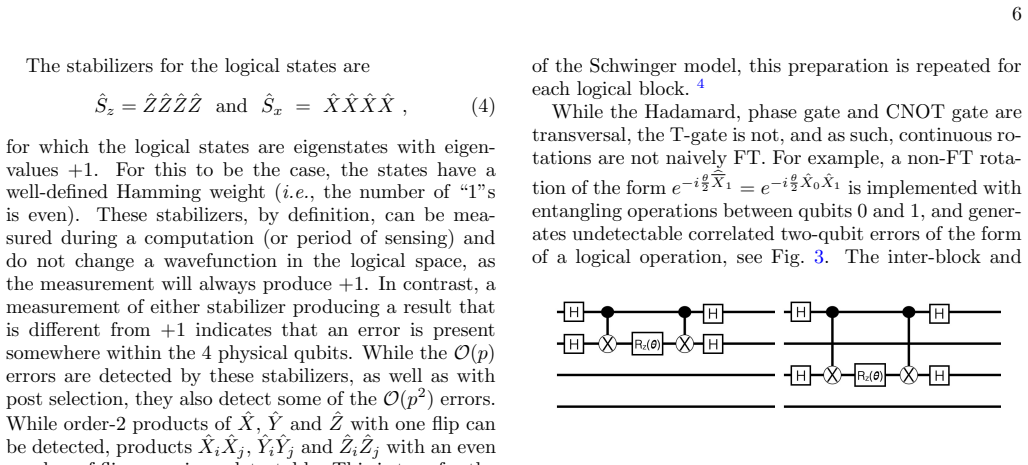
The whole benefit rests on the assumption that the non-fault-tolerant rotation gates used for time evolution spread errors only mildly, so that the undetectable errors they create do not outweigh what the stabilizer checks remove; this is tested only under depolarizing noise with no measurement errors and all-to-all connectivity.
Editorial extensions
If this is right
- For the small Schwinger-model systems studied, a single mid-circuit stabilizer layer plus final charge postselection reduces systematic error in the chiral condensate and electric-field energy compared with unencoded postselected evolution at p2=0.003.
- There is an optimal density of error-detection layers for a given evolution time and noise rate; beyond that density, accuracy saturates while the accepted ensemble continues to shrink.
- In fixed-shot-resource comparisons at L=4, the monolithic [[10,8,2]] block is best at low shot counts, while the [[6,4,2]]⊗[[6,4,2]] partition is favored at high shot counts.
- Hypercube encodings match Iceberg accuracy but reject more shots for the same evolution, so they underperform in resource-constrained scenarios.
- Extrapolations put the useful operating point for a 100-logical-qubit monolithic Iceberg simulation at two-qubit error rates near 10^-5 to 10^-6 depending on the number of Trotter steps.
Reading between the lines
- The universal acceptance curve in the resource variable x=p2G_tot suggests a practical rule of thumb: for monolithic Iceberg codes, plan around x*≈6.2 as the useful noise budget per evolution, independent of system size for N≥6.
- The optimal-layer saturation implies that pre-production tuning can fix the detection-layer density once for a given Hamiltonian, error rate, and target time, rather than requiring a per-observable optimization.
- Combining sparse error detection with standard error-mitigation techniques, which the paper explicitly leaves for future work, could push the useful time horizon further because detection removes leading-order errors that mitigation would otherwise have to extrapolate away.
- The same sparse-detection protocol should be testable in other charge-conserving lattice theories, where Gauss's law supplies a symmetry-based postselection that costs no extra gates.
Signed reviews
Editorial analysis
A structured set of objections, weighed in public.
Referee Report
Summary. This paper uses classical noisy simulation of small Schwinger-model instances to argue that sparse error detection in distance-2 codes can improve observable accuracy in near-term quantum simulations. The authors embed L=2 and L=4 staggered fermion systems into Iceberg codes [[N+2,N,2]] and compare with Hypercube codes [[2^N,N,2]], using depolarizing noise with p_2=0.001 and 0.003, fixed shot budgets, final charge-sector postselection, and a small number of mid-circuit stabilizer layers. They find that a modest number of error-detection layers reduces the systematic error in the chiral condensate and electric-field energy, that the improvement saturates as layers are added, that acceptance rates are predictable from gate counts and Hilbert-space dimensions, and that monolithic Iceberg encodings outperform Hypercube encodings in fixed-resource scenarios. They also provide gate-count scalings and extrapolated error-rate requirements for a 100-logical-qubit simulation.
Significance. Should the findings be robust, the paper provides a concrete, quantitative case for a 'sparse error detection' strategy: partial fault tolerance can be introduced with small overhead and without full FT rotation synthesis, improving observables in gauge-theory simulations. The main strengths are the level of detail (explicit circuits, noise parameters, shot budgets), the cross-size check in Fig. 14 where an L=2 fit predicts acceptance at L=4 and L=8, the injection-model cross-check of acceptance rates, and the honest enumeration of idealizations (no measurement errors, all-to-all connectivity, no post-processing mitigation). The paper does not claim a full error-correction threshold and explicitly identifies the non-FT rotation caveat, which helps the reader evaluate the scope. However, because the simulations are all depolarizing, the significance for real hardware remains conditional until coherent-error propagation in the non-FT gadgets is quantified.
major comments (2)
- [Section II.A, Appendix A] The central claim is tested only under a depolarizing noise model, and the paper's own text concedes that non-FT rotations 'generate undetectable correlated two-qubit errors of the form of a logical operation' and that non-FT gadgets are usable only 'provided the error propagation from non-FT gadgets is limited.' Appendix A only illustrates Pauli-error propagation through a CNOT; it provides no coefficient or bound for the specific rotation gadgets in Figs. 8 and 9. Since coherent errors such as over-rotations can propagate into weight-2 logical operators that commute with the stabilizers and survive charge postselection, the gains shown in Figs. 12, 20, and 22 could be reduced or reversed on real hardware. The authors should add an explicit robustness test, e.g., injecting a coherent rotation error of the form theta -> theta(1+epsilon) into one non-FT gadget and comparing the accepted-ensemble bias with the depolarizing baseline, or else provide an analytic bound on the undetectable logical-error amplitude from those gadgets.
- [Section IV.A, Eq. (15)] The paper claims an optimal density of error-detection layers, but the evidence is saturation of an empirical fit. Equation (15), f_chi = A exp(-gamma t/n_d) + (C-A), is asserted rather than derived and is stated to be invalid at late times; the fit parameters in Table I carry sizeable uncertainties (A=0.92(24), gamma=0.0133(46), C=0.545(7)), and the acceptance-rate cost is not folded into the same objective. The data support the statement 'improvement saturates', but they do not establish an operational optimum. Please either define an explicit cost function, such as the RMSE in Eq. (17), minimize it over n_d, or soften the optimality claim throughout the manuscript.
minor comments (5)
- [Section III.A] The noise model is described as isotropic depolarizing with p1 = p2/10 and p_rz = 0, but the exact depolarizing parameter used for single-qubit gates in qiskit's depolarizing_error is not stated; please specify the single-qubit depolarizing probability explicitly.
- [Fig. 27] The injection-model curve in Fig. 27(a) is only shown for N=8; the caption should state this and quantify how well the single-N curve represents the other lattice sizes shown.
- [Section V.1, Eq. (27)] The detection probabilities f1 ~ 0.90 - 0.15/k and f2 ~ 0.88 - 0.06/k are given without a stated range of validity in k and N; please specify the fitting range and the associated uncertainties.
- [Table II] The resource extrapolations quote p_shot,req and p_acc,req to two significant figures even though the underlying N>=20 points in Fig. 26 are labeled approximate; please present these as order-of-magnitude estimates or propagate the extrapolation uncertainty.
- [General] The manuscript would benefit from a code or data availability statement; the circuit diagrams are detailed, but exact reproduction of the qiskit simulations would be substantially easier with the scripts used to generate the noise model and gate counts.
Circularity Check
No circularity: the central accuracy improvements are obtained from direct noisy simulations against noiseless references, not from re-fitting target observables.
full rationale
The paper's central claims are self-contained numerical results. In Sections III through VI, systematic errors with and without sparse error detection are computed by running qiskit AerSimulator circuits under isotropic depolarizing noise and comparing the accepted-ensemble observables to a noiseless exact or Trotterized reference; no parameter is fitted to the target observable. The acceptance-rate scaling in Fig. 14 is a genuine prediction: beta_2 is fitted to L=2 data, beta_L for L=4 and L=8 is fixed by gate-count scaling, and the text states 'The data for L=4 (yellow) and L=8 (red) confirm the prediction.' The L=4 recovered-error analysis, defined in Eq. (14) and shown in Fig. 20, directly measures deviations from the unencoded postselected baseline rather than enforcing a desired answer. The only notable self-citation is in Section II.A, where Ref. [88] is cited as recent work motivating the use of non-FT rotations with syndrome extraction; this citation is not used to establish any quantitative result in the present paper, which rests on the simulations, so it does not raise the circularity score. Extrapolations to [[102,100,2]] in Section V.3 are explicitly labeled extrapolations from fitted universal curves and are not presented as predictions confirmed by new data. The paper's admitted restriction to depolarizing noise and the illustrative treatment of coherent error propagation in Appendix A is a scope or correctness limitation, not a circular dependency.
Assumptions & free parameters
free parameters (9)
- beta_2 =
0.050
- lambda_acceptance =
2.56e-3
- acceptance_floors =
f_L ~ 1e-3 to 1e-4 for L=2,3,4
- fit_A_gamma_C =
A=0.92(24), gamma=0.0133(46), C=0.545(7)
- Tacc_damping_params =
a, b, kappa fitted per N, not tabulated
- Tacc_power_law_exponent =
-1.06
- injection_detection_probabilities =
f1~0.90-0.15/k, f2~0.88-0.06/k, fbar2=0.95
- crossing_budget_xstar =
6.75 +/- 0.2 raw; 6.23 +/- 0.16 floor-subtracted
- noise_rates =
p2 = 0.001 and 0.003; p1 = p2/10
assumptions (7)
- standard math Stabilizer formalism and properties of distance-two quantum error-detecting codes
- domain assumption Axial-gauge Schwinger Hamiltonian and Jordan-Wigner qubit mapping
- domain assumption Isotropic depolarizing noise model with p1=p2/10, no measurement errors, error-free rz gates
- domain assumption All-to-all qubit connectivity
- domain assumption Non-fault-tolerant logical rotations have limited error propagation
- domain assumption Independent Poisson error process for injected faults
- domain assumption First-order Trotter time evolution is the simulation method
Cite this review
Pith. "Pith review of The Utility of Sparse Error Detection in Quantum Simulations." pith.science (2026). https://pith.science/paper/FAYB4AQJ
@misc{pith2026260802944,
  author       = {Pith},
  title        = {Pith review of: The Utility of Sparse Error Detection in Quantum Simulations},
  year         = {2026},
  howpublished = {\url{https://pith.science/paper/FAYB4AQJ}},
  note         = {Machine review of arXiv:2608.02944}
}
abstract
The recent success of error detecting codes points toward their potential application to fault-tolerant simulations of nature. In this work, we examine the utility of sparse error detection for simulating lattice gauge theories using quantum computers. In particular, we study the time evolution of the lattice Schwinger model embedded into the Iceberg code family, $[[N+2, N, 2]]$, as well as the Hypercube code family, $[[2^N, N, 2]]$. The lattice of electrons and positrons in the axial gauge is embedded into a single code block or into multiple code blocks, and this work finds that large codeblocks are advantageous in the absence of connectivity constraints. Noisy classical simulations with realistic near-term error rates, infrequent syndrome measurements and physics-aware postselection are found to improve observable estimation. Under realistic noise rates for near-term quantum computers, this work finds that sparse error detection in quantum simulations has the potential to improve accuracy of observable estimation. Additional rounds of error detection are found to systematically drive errors in observables to the noise floor set by the code. These findings suggest that incorporating minimal implementations of fault tolerance in the near-term will enhance the performance of quantum simulations in nuclear physics and high-energy physics.
Figures


Figures from the paper (28 more)


Reference graph
Works this paper leans on
-
[1]
The two-qubit gate count associated with a single Trotter step isG step
Resource Requirements and Scalings with System Size In this section, we detail the scalings of the encoded cir- cuits, which are split into two parts. The two-qubit gate count associated with a single Trotter step isG step. The “fixed” part of the circuit refers to the constant overhead that does not depend on the number of Trotter steps: the encoding, mi...
-
[2]
Injection model In each post-selected circuit, the acceptance rate curve S(x) is the fraction of shots retained after postselection at a fixed number of shots. To understand the structure and scaling of the encoded time evolution circuits better, we compute the probability that one-qubit and two-qubit 13 Note thats < p is strictly in the left half (i<L) a...
-
[3]
#$:&!&"&#&$ !
Extrapolations to Large-L Thex ⋆ crossing point, where the acceptance rate drops to 1%, is scale invariant information about a curve we find to be universal for all consideredN= [2,26] (see e.g., Fig 27). To extrapolatex ⋆ to 100 qubits, we take its universal value and add an extrapolated floor valueS floor(N= 100) back in resulting in a crossing at x⋆(10...
-
[4]
[[8,3,2]] The complete set of logical states is |¯0¯0¯0⟩= |00000000⟩+|11111111⟩√ 2 , |¯1¯0¯0⟩= |11110000⟩+|00001111⟩√ 2 , |¯0¯1¯0⟩= |11001100⟩+|00110011⟩√ 2 , |¯1¯1¯0⟩= |00111100⟩+|11000011⟩√ 2 , |¯0¯0¯1⟩= |10101010⟩+|01010101⟩√ 2 , |¯1¯0¯1⟩= |01011010⟩+|10100101⟩√ 2 , |¯0¯1¯1⟩= |01100110⟩+|10011001⟩√ 2 , |¯1¯1¯1⟩= |10010110⟩+|01101001⟩√ 2 .(F1) Examples ...
-
[5]
ˆX16.(F5) Lastly, the tower of transversal logical entangling gates is built from the single-qubit phase gates ˆRn = 1 0 0e iπ/2n ; (F6) note that ˆR1 = ˆSand ˆR2 = ˆT
[[16,4,2]] One choice for the logical operators is given by bX1 = ˆX9 ˆX10 ˆX11 ˆX12 ˆX13 ˆX14 ˆX15 ˆX16 , bX2 = ˆX5 ˆX6 ˆX7 ˆX8 ˆX13 ˆX14 ˆX15 ˆX16 , bX3 = ˆX3 ˆX4 ˆX7 ˆX8 ˆX11 ˆX12 ˆX15 ˆX16 , bX4 = ˆX2 ˆX4 ˆX6 ˆX8 ˆX10 ˆX12 ˆX14 ˆX16 ,(F3) and bZ1 = ˆZ1 ˆZ9 , bZ2 = ˆZ1 ˆZ5 , bZ3 = ˆZ1 ˆZ3 , bZ4 = ˆZ1 ˆZ2.(F4) The twelve stabilizers of the [[16,4,2]] co...
-
[6]
Comparison of gate counts: Hypercubic and Iceberg The two codes considered here areD= 3 : [[8,3,2]], D= 4 : [[16,4,2]]. Their minimum logical weights are asym- metric: [[8,3,2]] : (d X,dY,dZ) = (4,5,2),(F10) [[16,4,2]] : (d X,dY,dZ) = (8,9,2).(F11) Thus increasing the Hypercube dimension raises the pro- tection againstX-type logical faults but leavesd Z =...
-
[7]
Bravyi, A
S. Bravyi, A. W. Cross, J. M. Gambetta, D. Maslov, P. Rall, and T. J. Yoder, High-threshold and low- overhead fault-tolerant quantum memory, Nature627, 778–782 (2024)
2024
-
[8]
Google Quantum AI and Collaborators, Quantum er- ror correction below the surface code threshold, Nature 638, 920 (2025)
2025
Show all 117 references
-
[9]
Krinner, N
S. Krinner, N. Lacroix, A. Remm, A. Di Paolo, E. Genois, C. Leroux, C. Hellings, S. Lazar, F. Swiadek, J. Herrmann, G. J. Norris, C. K. Andersen, M. M¨ uller, A. Blais, C. Eichler, and A. Wallraff, Realizing repeated quantum error correction in a distance-three surface code, N...
2022 arXiv
-
[10]
Y. Zhao, Y. Ye, H.-L. Huang, Y. Zhang, D. Wu, H. Guan, Q. Zhu, Z. Wei, T. He, S. Cao,et al., Re- alization of an error-correcting surface code with super- conducting qubits, Phys. Rev. Lett.129, 030501 (2022), arXiv:2112.13505 [quant-ph]
2022 arXiv
-
[11]
B. W. Reichardt, D. Aasen, R. Chao, A. Chernoguzov, W. van Dam, J. P. Gaebler, D. Gresh, D. Lucchetti, M. Mills, S. A. Moses, B. Neyenhuis, A. Paetznick, A. Paz, P. E. Siegfried, M. P. da Silva, K. M. Svore, Z. Wang, and M. Zanner, Demonstration of quantum computation and erro...
2024 arXiv
-
[12]
Paetznick, M
A. Paetznick, M. P. da Silva, C. Ryan-Anderson, J. M. Bello-Rivas, J. P. C. I. au2, A. Chernoguzov, J. M. Dreiling, C. Foltz, F. Frachon, J. P. Gaebler, T. M. Gatterman, L. Grans-Samuelsson, D. Gresh, D. Hayes, N. Hewitt, C. Holliman, C. V. Horst, J. Johansen, D. Lucchetti, Y....
2024 arXiv
-
[13]
Paetznick, B
A. Paetznick, B. W. Reichardt, M. P. da Silva, C. Ryan- Anderson, D. Aasen, J. M. Bello-Rivas, J. P. Campora, R. Chao, A. Chernoguzov, W. van Dam, J. M. Dreiling, C. Foltz, F. Frachon, J. P. Gaebler, T. M. Gatterman, L. Grans-Samuelsson, D. Gresh, D. Hayes, N. Hewitt, C. Holli...
2026
-
[14]
Dasuet al., Computing with many encoded logical qubits beyond break-even, (2026), arXiv:2602.22211 [quant-ph]
S. Dasuet al., Computing with many encoded logical qubits beyond break-even, (2026), arXiv:2602.22211 [quant-ph]
2026
-
[15]
Postler, S
L. Postler, S. Heußen, I. Pogorelov, M. Rispler, T. Feld- ker, M. Meth, C. D. Marciniak, R. Stricker, M. Ring- bauer, R. Blatt, P. Schindler, M. M¨ uller, and T. Monz, Demonstration of fault-tolerant universal quantum gate operations, Nature605, 675 (2022), arXiv:2111.12654 [quant-ph]
2022 arXiv
-
[16]
Bluvstein, S
D. Bluvstein, S. J. Evered, A. O. Geim, S.-X. Li, H. Zhou, T. Manovitz, S. Ebadi, M. Cain, M. Kali- nowski, R. Dominici,et al., A logical quantum proces- sor based on reconfigurable atom arrays, Nature626, 58 (2024)
2024
-
[17]
P. S. Rodriguezet al., Experimental demonstration of logical magic state distillation, Nature645, 620 (2025), arXiv:2412.15165 [quant-ph]
2025
-
[18]
D. Bluvsteinet al., A fault-tolerant neutral-atom ar- chitecture for universal quantum computation, Nature 649, 39 (2026), [Erratum: Nature 650, E3 (2026)], arXiv:2506.20661 [quant-ph]
2026
-
[19]
B. W. Reichardt, A. Paetznick, D. Aasen, I. Basov, J. M. Bello-Rivas, P. Bonderson, R. Chao, W. van Dam, M. B. Hastings, R. V. Mishmash, A. Paz, M. P. da Silva, A. Sundaram, K. M. Svore, A. Vaschillo, Z. Wang, M. Zanner, W. B. Cairncross, C.-A. Chen, 29 D. Crow, H. Kim, J. M. ...
2025 arXiv
-
[20]
V. V. Sivak, A. Eickbusch, B. Royer, S. Singh, I. Tsiout- sios, S. Ganjam, A. Miano, B. L. Brock, A. Z. Ding, L. Frunzio, S. M. Girvin, R. J. Schoelkopf, and M. H. Devoret, Real-time quantum error correction beyond break-even, Nature616, 50 (2023), arXiv:2211.09116 [quant-ph]
2023 arXiv
-
[21]
Putterman, K
H. Putterman, K. Noh, C. T. Hann, G. S. MacCabe, S. Aghaeimeibodi, R. N. Patel, M. Lee, W. M. Jones, H. Moradinejad, R. Rodriguez,et al., Hardware-efficient quantum error correction via concatenated bosonic qubits, Nature638, 1125 (2025)
2025
-
[22]
R´ eglade, A
U. R´ eglade, A. Bocquet, R. Gautier, J. Cohen, A. Marquet, E. Albertinale, N. Pankratova, M. Hallen, F. Rautschke, L.-A. Sellem, P. Rouchon, A. Sarlette, M. Mirrahimi, P. Campagne-Ibarcq, R. Lescanne, S. Je- zouin, and Z. Leghtas, Quantum control of a cat qubit with bit-flip ...
2024 arXiv
-
[23]
P. W. Shor, Fault-tolerant quantum computation, in Proceedings of the 37th Annual Symposium on Foun- dations of Computer Science (FOCS ’96)(IEEE Com- puter Society Press, Burlington, VT, USA, 1996) pp. 56–65, preprint arXiv:quant-ph/9605011
1996 arXiv
-
[24]
Preskill, Reliable quantum computers, Proceedings of the Royal Society of London
J. Preskill, Reliable quantum computers, Proceedings of the Royal Society of London. Series A: Mathematical, Physical and Engineering Sciences454, 385–410 (1998)
1998
-
[25]
Gottesman,Stabilizer Codes and Quantum Error Correction, Ph.D
D. Gottesman,Stabilizer Codes and Quantum Error Correction, Ph.D. thesis, California Institute of Tech- nology (1997), arXiv:quant-ph/9705052
1997 arXiv
-
[27]
Gottesman, Fault-tolerant quantum computation with local gates, Journal of Modern Optics47, 333 (2000), arXiv:quant-ph/9903099
D. Gottesman, Fault-tolerant quantum computation with local gates, Journal of Modern Optics47, 333 (2000), arXiv:quant-ph/9903099
2000 arXiv
-
[28]
C. W. Baueret al., Quantum Simulation for High- Energy Physics, PRX Quantum4, 027001 (2023), arXiv:2204.03381 [quant-ph]
2023 arXiv
-
[29]
C. W. Bauer, Z. Davoudi, N. Klco, and M. J. Sav- age, Quantum simulation of fundamental particles and forces, Nat. Rev. Phys.5, 420 (2023), arXiv:2404.06298 [hep-ph]
2023 arXiv
-
[30]
Davoudiet al., Report of the Snowmass 2021 Topi- cal Group on Lattice Gauge Theory, inSnowmass 2021 (2022) arXiv:2209.10758 [hep-lat]
Z. Davoudiet al., Report of the Snowmass 2021 Topi- cal Group on Lattice Gauge Theory, inSnowmass 2021 (2022) arXiv:2209.10758 [hep-lat]
2022 arXiv
-
[31]
Becket al., Quantum Information Science and Tech- nology for Nuclear Physics
D. Becket al., Quantum Information Science and Tech- nology for Nuclear Physics. Input into U.S. Long-Range Planning, 2023 (2023) arXiv:2303.00113 [nucl-ex]
2023 arXiv
-
[32]
Glashow, Partial Symmetries of Weak Interactions, Nucl
S. Glashow, Partial Symmetries of Weak Interactions, Nucl. Phys.22, 579 (1961)
1961
-
[33]
P. W. Higgs, Broken Symmetries and the Masses of Gauge Bosons, Phys. Rev. Lett.13, 508 (1964)
1964
-
[34]
Weinberg, A Model of Leptons, Phys
S. Weinberg, A Model of Leptons, Phys. Rev. Lett.19, 1264 (1967)
1967
-
[35]
Salam, Weak and Electromagnetic Interactions, Conf
A. Salam, Weak and Electromagnetic Interactions, Conf. Proc. C680519, 367 (1968)
1968
-
[36]
Politzer, Reliable Perturbative Results for Strong In- teractions?, Phys
H. Politzer, Reliable Perturbative Results for Strong In- teractions?, Phys. Rev. Lett.30, 1346 (1973)
1973
-
[37]
D. J. Gross and F. Wilczek, Ultraviolet Behavior of Nonabelian Gauge Theories, Phys. Rev. Lett.30, 1343 (1973)
1973
-
[38]
K. G. Wilson, Confinement of Quarks, Phys. Rev. D10, 2445 (1974)
1974
-
[39]
J. B. Kogut and L. Susskind, Hamiltonian Formulation of Wilson’s Lattice Gauge Theories, Phys. Rev. D11, 395 (1975)
1975
-
[40]
Creutz, Confinement and the critical dimensionality of space-time, Phys
M. Creutz, Confinement and the critical dimensionality of space-time, Phys. Rev. Lett.43, 553 (1979)
1979
-
[41]
J. B. Kogut, An introduction to lattice gauge theory and spin systems, Rev. Mod. Phys.51, 659 (1979)
1979
-
[42]
Creutz, L
M. Creutz, L. Jacobs, and C. Rebbi, Experiments with a gauge invariant Ising system, Phys. Rev. Lett.42, 1390 (1979)
1979
-
[43]
Creutz, Monte carlo study of quantized SU(2) gauge theory, Phys
M. Creutz, Monte carlo study of quantized SU(2) gauge theory, Phys. Rev. D21, 2308 (1980)
1980
-
[44]
Lloyd, Universal quantum simulators, Science273, 1073 (1996)
S. Lloyd, Universal quantum simulators, Science273, 1073 (1996)
1996
-
[45]
D. B. Kaplan and J. R. Stryker, Gauss’s law, du- ality, and the Hamiltonian formulation of U(1) lat- tice gauge theory, Phys. Rev. D102, 094515 (2020), arXiv:1806.08797 [hep-lat]
2020 arXiv
-
[46]
J. R. Stryker, Oracles for Gauss’s law on digital quan- tum computers, Phys. Rev. A99, 042301 (2019), arXiv:1812.01617 [quant-ph]
2019 arXiv
-
[47]
Rajput, A
A. Rajput, A. Roggero, and N. Wiebe, Quantum error correction with gauge symmetries, npj Quantum Inf.9, 41 (2023), arXiv:2112.05186 [quant-ph]
2023 arXiv
-
[48]
Spagnoli, A
L. Spagnoli, A. Roggero, and N. Wiebe, Fault-tolerant simulation of Lattice Gauge Theories with gauge covari- ant codes, Quantum10, 1968 (2026), arXiv:2405.19293 [quant-ph]
2026
-
[49]
Cobos, J
J. Cobos, J. Fraxanet, C. Benito, F. di Marcanto- nio, P. Rivero, K. Kap´ as, M. A. Werner, ¨O. Leg- eza, A. Bermudez, and E. Rico, Real-Time Dynam- ics in a (2+1)-D Gauge Theory: The Stringy Nature on a Superconducting Quantum Simulator, (2025), arXiv:2507.08088 [quant-ph]
2025 arXiv
-
[50]
Pato and N
B. Pato and N. Klco, Trade-offs in Gauss’s law error correction for lattice gauge theory quantum simulations, (2026), arXiv:2602.22121 [quant-ph]
2026
-
[51]
Rothlin,Exploring the Connection between Gauge Theory and Quantum Error Correction via Quantum Reference Frames, Master’s thesis, ETH Zurich (2025)
E. Rothlin,Exploring the Connection between Gauge Theory and Quantum Error Correction via Quantum Reference Frames, Master’s thesis, ETH Zurich (2025)
2025
-
[52]
J. P. Lacambra, A. Chatwin-Davies, M. Honda, and P. A. Hoehn, Gauss law codes and vacuum codes from lattice gauge theories (2026), arXiv:2604.06087 [quant- ph]
2026 arXiv
-
[53]
Yao, Quantum error correction codes for truncated SU(2) lattice gauge theories, Phys
X. Yao, Quantum error correction codes for truncated SU(2) lattice gauge theories, Phys. Rev. D113, 114512 (2026), arXiv:2511.13721 [quant-ph]. 30
2026 arXiv
-
[54]
Z. P. Bradshaw, Approximate error correction for quan- tum simulations of SU(2) lattice gauge theories, (2026), arXiv:2603.26819 [quant-ph]
2026 arXiv
-
[55]
E. J. Gustafson and H. Lamm, Robustness of gauge dig- itization to quantum noise, (2023), arXiv:2301.10207 [hep-lat]
2023 arXiv
-
[56]
Carena, H
M. Carena, H. Lamm, Y.-Y. Li, and W. Liu, Quantum error thresholds for gauge-redundant digitizations of lat- tice field theories, Phys. Rev. D110, 054516 (2024)
2024
-
[57]
Aharonov and M
D. Aharonov and M. Ben-Or, Fault-Tolerant Quantum Computation with Constant Error Rate, SIAM J. Com- put.38, 1207 (2008), arXiv:quant-ph/9906129
2008 arXiv
-
[58]
A. Y. Kitaev, Quantum computations: algorithms and error correction, Russ. Math. Surv.52, 1191 (1997)
1997
-
[59]
Knill, R
E. Knill, R. Laflamme, and W. H. Zurek, Resilient quantum computation: error models and thresholds, Proc. R. Soc. Lond. A454, 365 (1998), arXiv:quant- ph/9702058
1998
-
[60]
Knill, Quantum computing with realistic noisy de- vices, Nature434, 39 (2005), arXiv:quant-ph/0410199
E. Knill, Quantum computing with realistic noisy de- vices, Nature434, 39 (2005), arXiv:quant-ph/0410199
2005 arXiv
-
[61]
Aliferis, D
P. Aliferis, D. Gottesman, and J. Preskill, Quan- tum accuracy threshold for concatenated distance-3 codes, Quant. Inf. Comput.6, 97 (2006), arXiv:quant- ph/0504218
2006
-
[62]
N. Ofek, A. Petrenko, R. Heeres, P. Reinhold, Z. Legh- tas, B. Vlastakis, Y. Liu, L. Frunzio, S. M. Girvin, L. Jiang, M. Mirrahimi, M. H. Devoret, and R. J. Schoelkopf, Extending the lifetime of a quantum bit with error correction in superconducting circuits, Na- ture536, 441 (2016)
2016
-
[63]
Chenet al.(Google Quantum AI), Exponential sup- pression of bit or phase flip errors with repetitive error correction, Nature595, 383 (2021), arXiv:2102.06132
Z. Chenet al.(Google Quantum AI), Exponential sup- pression of bit or phase flip errors with repetitive error correction, Nature595, 383 (2021), arXiv:2102.06132
2021 arXiv
-
[64]
Ryan-Anderson, J
C. Ryan-Anderson, J. G. Bohnet, K. Lee, D. Gresh, A. Hankin, J. P. Gaebler, D. Francois, A. Chernoguzov, D. Lucchetti, N. C. Brown, T. M. Gatterman, S. K. Halit, K. Gilmore, J. Gerber, B. Neyenhuis, D. Hayes, and R. P. Stutz, Realization of real-time fault-tolerant quantum err...
2021 arXiv
-
[65]
Vaidman, L
L. Vaidman, L. Goldenberg, and S. Wiesner, Error pre- vention scheme with four particles, Phys. Rev. A54, R1745 (1996), arXiv:quant-ph/9603031
1996 arXiv
-
[66]
Grassl, T
M. Grassl, T. Beth, and T. Pellizzari, Codes for the quantum erasure channel, Phys. Rev. A56, 33 (1997), arXiv:quant-ph/9610042
1997 arXiv
-
[67]
E. M. Rains, Quantum codes of minimum distance two, IEEE Trans. Inf. Theory45, 266 (1999), arXiv:quant- ph/9704043 [quant-ph]
1999
-
[68]
A. M. Steane, Simple quantum error-correcting codes, Phys. Rev. A54, 4741 (1996), arXiv:quant-ph/9605021
1996 arXiv
-
[69]
Gottesman, Theory of fault-tolerant quantum com- putation, Phys
D. Gottesman, Theory of fault-tolerant quantum com- putation, Phys. Rev. A57, 127 (1998), arXiv:quant- ph/9702029
1998
-
[70]
Viola, E
L. Viola, E. Knill, and S. Lloyd, Dynamical decoupling of open quantum systems, Phys. Rev. Lett.82, 2417 (1999), arXiv:quant-ph/9809071
1999 arXiv
-
[71]
R. C. Farrell, I. A. Chernyshev, S. J. M. Powell, N. A. Zemlevskiy, M. Illa, and M. J. Savage, Preparations for quantum simulations of quantum chromodynamics in 1+1 dimensions. I. axial gauge, Physical Review D107, 054512 (2023), arXiv:2207.01731 [quant-ph]
2023 arXiv
-
[72]
R. C. Farrell, I. A. Chernyshev, S. J. M. Powell, N. A. Zemlevskiy, M. Illa, and M. J. Savage, Prepa- rations for quantum simulations of quantum chromo- dynamics in 1+1 dimensions. II. single-baryonβ-decay in real time, Physical Review D107, 054513 (2023), arXiv:2209.10781 [quant-ph]
2023 arXiv
-
[73]
R. C. Farrell, M. Illa, A. N. Ciavarella, and M. J. Savage, Scalable Circuits for Preparing Ground States on Dig- ital Quantum Computers: The Schwinger Model Vac- uum on 100 Qubits, PRX Quantum5, 020315 (2024), arXiv:2308.04481 [quant-ph]
2024 arXiv
-
[74]
R. C. Farrell, M. Illa, A. N. Ciavarella, and M. J. Sav- age, Quantum simulations of hadron dynamics in the Schwinger model using 112 qubits, Phys. Rev. D109, 114510 (2024), arXiv:2401.08044 [quant-ph]
2024 arXiv
-
[75]
Chen, Y.-T
J.-W. Chen, Y.-T. Chen, G. Meher, B. M¨ uller, A. Sch¨ afer, and X. Yao, Thermalization of SU(2) Lat- tice Gauge Fields on Quantum Computers (2026), arXiv:2603.23948 [hep-lat]
2026 arXiv
-
[76]
Mezzacapo, E
A. Mezzacapo, E. Rico, C. Sab´ ın, I. L. Egusquiza, L. Lamata, and E. Solano, Non-abelian SU(2) lattice gauge theories in superconducting circuits, Physical Review Letters115, 240502 (2015), arXiv:1505.04720 [quant-ph]
2015 arXiv
-
[77]
Ciavarella, N
A. Ciavarella, N. Klco, and M. J. Savage, Trailhead for quantum simulation of SU(3) Yang-Mills lattice gauge theory in the local multiplet basis, Physical Review D 103, 094501 (2021), arXiv:2101.10227 [quant-ph]
2021 arXiv
-
[78]
Y. Y. Atas, J. Zhang, R. Lewis, A. Jahanpour, J. F. Haase, and C. A. Muschik, SU(2) hadrons on a quantum computer via a variational approach, Nature Communi- cations12, 6499 (2021), arXiv:2102.08920 [quant-ph]
2021 arXiv
-
[80]
A. N. Ciavarella and I. A. Chernyshev, Preparation of the SU(3) lattice Yang-Mills vacuum with variational quantum methods, Physical Review D105, 074504 (2022), arXiv:2112.09083 [quant-ph]
2022 arXiv
-
[81]
Y. Y. Atas, J. F. Haase, J. Zhang, V. Wei, S. M.-L. Pfaendler, R. Lewis, and C. A. Muschik, Simulating one-dimensional quantum chromodynamics on a quan- tum computer: Real-time evolutions of tetra- and pen- taquarks, Physical Review Research5, 033184 (2023), arXiv:2207.03473 [...
2023 arXiv
-
[82]
A. N. Ciavarella, Quantum simulation of lattice QCD with improved hamiltonians, Physical Review D108, 094513 (2023), arXiv:2307.05593 [hep-lat]
2023 arXiv
-
[83]
Calaj´ o, G
G. Calaj´ o, G. Magnifico, C. Edmunds, M. Ringbauer, S. Montangero, and P. Silvi, Digital quantum simula- tion of a (1+1)D SU(2) lattice gauge theory with ion qu- dits, PRX Quantum5, 040309 (2024), arXiv:2402.07987 [quant-ph]
2024 arXiv
-
[84]
Z. Li, M. Illa, and M. J. Savage, A framework for quantum simulations of energy-loss and hadronization in non-abelian gauge theories: SU(2) lattice gauge the- ory in 1+1D, arXiv preprint (2025), arXiv:2512.05210 [quant-ph]
2025 arXiv
-
[85]
A. T. Than, Y. Y. Atas, A. Chakraborty, J. Zhang, M. T. Diaz, K. Wen, X. Liu, R. Lewis, A. M. Green, C. A. Muschik, and N. M. Linke, The phase diagram of quantum chromodynamics in one dimension on a quantum computer, Nature Communications16, 10288 (2025), arXiv:2501.00579 [qua...
2025
-
[86]
Froland, D
H. Froland, D. M. Grabowska, and Z. Li, Simulat- ing Fully Gauge-Fixed SU(2) Hamiltonian Dynamics on Digital Quantum Computers (2025), arXiv:2512.22782 [quant-ph]
2025
-
[87]
C. V. Cogburn, S. Grieninger, and D. E. Kharzeev, Quantum Simulation of Nucleon-Antinucleon Interac- tion in Large-NQCD 2 on an IBM Quantum Nighthawk Processor (2026), arXiv:2606.02574 [quant-ph]
2026 arXiv
-
[88]
I. A. Chernyshev, R. C. Farrell, M. Illa, M. J. Savage, A. Maksymov, F. Tripier, M. A. Lopez-Ruiz, A. Ar- rasmith, Y. de Sereville, A. Brodutch, C. Girotto, A. Kaushik, and M. Roetteler, Pathfinding quantum simulations of neutrinoless double-βdecay, Nature Communications 10.10...
2026
-
[89]
Ilcic, R
F. Ilcic, R. Majumdar, E. Mathew, M. O. Ali, N. Earnest-Noble, and I. Raychowdhury, Observation of robust and coherent non-abelian hadron dynamics on noisy quantum processors (2026), arXiv:2602.18080 [hep-lat]
2026 arXiv
-
[90]
Froland and D
H. Froland and D. M. Grabowska, Measuring Non- Stabilizerness in an SU(2) Lattice Gauge Theory (2026), arXiv:2606.14842 [quant-ph]
2026
-
[92]
A Rahman, R
S. A Rahman, R. Lewis, E. Mendicelli, and S. Powell, Self-mitigating Trotter circuits for SU(2) lattice gauge theory on a quantum computer, Phys. Rev. D106, 074502 (2022), arXiv:2205.09247 [hep-lat]
2022 arXiv
-
[93]
van den Berg, Z
E. van den Berg, Z. K. Minev, A. Kandala, and K. Temme, Probabilistic error cancellation with sparse Pauli–Lindblad models on noisy quantum processors, Nat. Phys.19, 1116 (2023), arXiv:2201.09866 [quant- ph]
2023 arXiv
-
[94]
Frolandet al., Realizing Error Suppression in Par- tially Fault-Tolerant Quantum Simulations with IBM Quantum Computers, (2026), arXiv:2607.24947 [quant- ph]
H. Frolandet al., Realizing Error Suppression in Par- tially Fault-Tolerant Quantum Simulations with IBM Quantum Computers, (2026), arXiv:2607.24947 [quant- ph]
2026 arXiv
-
[95]
Zhong and T
D. Zhong and T. A. Brun, Protection of Exponential Operation using Stabilizer Codes in the Early Fault Tol- erance Era, (2026), arXiv:2602.13399 [quant-ph]
2026 arXiv
-
[96]
Gerhard and T
C. Gerhard and T. A. Brun, Weakly Fault-Tolerant Computation in a Quantum Error-Detecting Code, (2024), arXiv:2408.14828 [quant-ph]
2024 arXiv
-
[97]
Gottesman, Theory of fault-tolerant quantum computation, Physical Review A57, 127 (1998), arXiv:quant-ph/9702029
D. Gottesman, Theory of fault-tolerant quantum computation, Physical Review A57, 127 (1998), arXiv:quant-ph/9702029
1998 arXiv
-
[98]
Gottesman and I
D. Gottesman and I. L. Chuang, Demonstrating the viability of universal quantum computation using tele- portation and single-qubit operations, Nature402, 390 (1999), arXiv:quant-ph/9908010
1999 arXiv
-
[99]
X. Zhou, D. W. Leung, and I. L. Chuang, Methodology for quantum logic gate construction, Physical Review A 62, 052316 (2000), arXiv:quant-ph/0002039
2000 arXiv
-
[100]
Bravyi and A
S. Bravyi and A. Kitaev, Universal quantum computa- tion with ideal clifford gates and noisy ancillas, Physical Review A71, 022316 (2005), arXiv:quant-ph/0403025
2005 arXiv
-
[101]
Eastin and E
B. Eastin and E. Knill, Restrictions on transversal en- coded quantum gate sets, Physical Review Letters102, 110502 (2009), arXiv:0811.4262 [quant-ph]
2009 arXiv
-
[102]
Paetznick and B
A. Paetznick and B. W. Reichardt, Universal fault- tolerant quantum computation with only transversal gates and error correction, Physical Review Letters111, 090505 (2013), arXiv:1304.3709 [quant-ph]
2013 arXiv
-
[103]
J. T. Anderson, G. Duclos-Cianci, and D. Poulin, Fault- tolerant conversion between the steane and reed-muller quantum codes, Physical Review Letters113, 080501 (2014), arXiv:1403.2734 [quant-ph]
2014 arXiv
-
[104]
E. T. Campbell, B. M. Terhal, and C. Vuillot, Roads towards fault-tolerant universal quantum computation, Nature549, 172 (2017), arXiv:1612.07330 [quant-ph]
2017 arXiv
-
[105]
Bomb´ ın, Gauge color codes: optimal transver- sal gates and gauge fixing in topological stabilizer codes, New Journal of Physics17, 083002 (2015), arXiv:1311.0879 [quant-ph]
H. Bomb´ ın, Gauge color codes: optimal transver- sal gates and gauge fixing in topological stabilizer codes, New Journal of Physics17, 083002 (2015), arXiv:1311.0879 [quant-ph]
2015 arXiv
-
[106]
Kubica and M
A. Kubica and M. E. Beverland, Universal transversal gates with color codes: A simplified approach, Physical Review A91, 032330 (2015), arXiv:1410.0069 [quant- ph]
2015 arXiv
-
[107]
M. E. Beverland, A. Kubica, and K. M. Svore, Cost of universality: A comparative study of the overhead of state distillation and code switching with color codes, PRX Quantum2, 020341 (2021), arXiv:2101.02211 [quant-ph]
2021 arXiv
-
[108]
Pogorelovet al., Experimental fault-tolerant code switching, Nature Physics21, 298 (2025), arXiv:2403.13732 [quant-ph]
I. Pogorelovet al., Experimental fault-tolerant code switching, Nature Physics21, 298 (2025), arXiv:2403.13732 [quant-ph]
2025 arXiv
-
[109]
Javadi-Abhari, M
A. Javadi-Abhari, M. Treinish, K. Krsulich, C. J. Wood, J. Lishman, J. Gacon, S. Martiel, P. D. Nation, L. S. Bishop, A. W. Cross, B. R. Johnson, and J. M. Gambetta, Quantum computing with Qiskit (2024), arXiv:2405.08810 [quant-ph]
2024 arXiv
-
[110]
Urbanek, B
M. Urbanek, B. Nachman, V. R. Pascuzzi, A. He, C. W. Bauer, and W. A. de Jong, Mitigating depolarizing noise on quantum computers with noise-estimation circuits, Phys. Rev. Lett.127, 270502 (2021), arXiv:2103.08591 [quant-ph]
2021 arXiv
-
[111]
Li and S
Y. Li and S. C. Benjamin, Efficient Variational Quan- tum Simulator Incorporating Active Error Minimiza- tion, Phys. Rev. X7, 021050 (2017), arXiv:1611.09301 [quant-ph]
2017 arXiv
-
[112]
Temme, S
K. Temme, S. Bravyi, and J. M. Gambetta, Error Mit- igation for Short-Depth Quantum Circuits, Phys. Rev. Lett.119, 180509 (2017), arXiv:1612.02058 [quant-ph]
2017 arXiv
-
[113]
N. Klco, E. F. Dumitrescu, A. J. McCaskey, T. D. Morris, R. C. Pooser, M. Sanz, E. Solano, P. Lougov- ski, and M. J. Savage, Quantum-classical computation of Schwinger model dynamics using quantum comput- ers, Phys. Rev. A98, 032331 (2018), arXiv:1803.03326 [quant-ph]
2018 arXiv
-
[114]
Kandala, K
A. Kandala, K. Temme, A. D. Corcoles, A. Mezzacapo, J. M. Chow, and J. M. Gambetta, Error mitigation extends the computational reach of a noisy quantum processor, Nature567, 491 (2019), arXiv:1805.04492 [quant-ph]
2019 arXiv
-
[115]
Gottesman, Quantum fault tolerance in small exper- iments, (2016), arXiv:1610.03507 [quant-ph]
D. Gottesman, Quantum fault tolerance in small exper- iments, (2016), arXiv:1610.03507 [quant-ph]
2016 arXiv
-
[116]
N. M. Linke, M. Gutierrez, K. A. Landsman, C. Fig- gatt, S. Debnath, K. R. Brown, and C. Monroe, Fault- tolerant quantum error detection, Sci. Adv.3, e1701074 (2017), arXiv:1611.06946 [quant-ph]
2017 arXiv
-
[117]
Vuillot, Is error detection helpful on IBM 5Q chips?, Quant
C. Vuillot, Is error detection helpful on IBM 5Q chips?, Quant. Inf. Comput.18, 0949 (2018), arXiv:1705.08957 [quant-ph]. 32
2018 arXiv
-
[118]
Harper and S
R. Harper and S. T. Flammia, Fault-tolerant logical gates in the IBM quantum experience, Phys. Rev. Lett. 122, 080504 (2019), arXiv:1806.02359 [quant-ph]
2019 arXiv
-
[119]
Klco and M
N. Klco and M. J. Savage, Hierarchical qubit maps and hierarchically implemented quantum error correction, Phys. Rev. A104, 062425 (2021), arXiv:2109.01953 [quant-ph]
2021 arXiv
-
[120]
D. H. Menendez, A. Ray, and M. Vasmer, Imple- menting fault-tolerant non-Clifford gates using the [[8,3,2]] color code, Phys. Rev. A109, 062438 (2024), arXiv:2309.08663 [quant-ph]
2024 arXiv
Reviewed August 15, 2026 · model on record in the stance chip above.
Discussion (0). Continue with ORCID to comment.