REVIEW 3 major objections 5 minor 86 references
Generation-Resolved Signatures in QED Cascades: Diagnostics for Ultraintense Laser Parameters
T0 review · 3 major / 5 minor · reviewed 2026-08-05 · deepseek-v4-flash
Pith's one-line read By tracking individual cascade generations, this paper claims that the fraction of backward-emitted photons and the positron spectral-peak energy, measured after a laser–electron collision, can simultaneously determine the laser amplitude a
desk verdict Solid simulation proposal for a two-observable laser diagnostic; forward physics is consistent, but the inversion is only locally validated and needs a global noise test before the headline claim holds. read the letter →
The pith
A machine-rendered reading of the paper's core claim, the machinery that carries it, and where it could break.
The reading
What carries the argument
The machinery is a generation-resolved Monte Carlo model of shower-type QED cascades: particles are labeled by the number of nonlinear Breit-Wheeler steps since the seed electron, and nonlinear Compton and Breit-Wheeler events are sampled from spin- and polarization-resolved LCFA rates. The diagnostic uses the simulated observable map O = (Fr, epsilon_+^peak) as a function of p = (a0, tau); local inversion is achieved by intersecting iso-contours, with the Jacobian J = dO/dp used to propagate measurement errors into parameter uncertainties.
What would settle it
Run the same Monte Carlo with synthetic noise added to Fr and epsilon_+^peak at sigma_F = 0.01 and sigma_E = 0.01 GeV, reconstruct (a0, tau) at every grid point, and check whether the recovered values are unbiased and unique; if the scatter exceeds the linearized prediction or multiple intersections appear across the parameter space, the diagnostic as proposed would fail.
Extended reading notes
Core claim
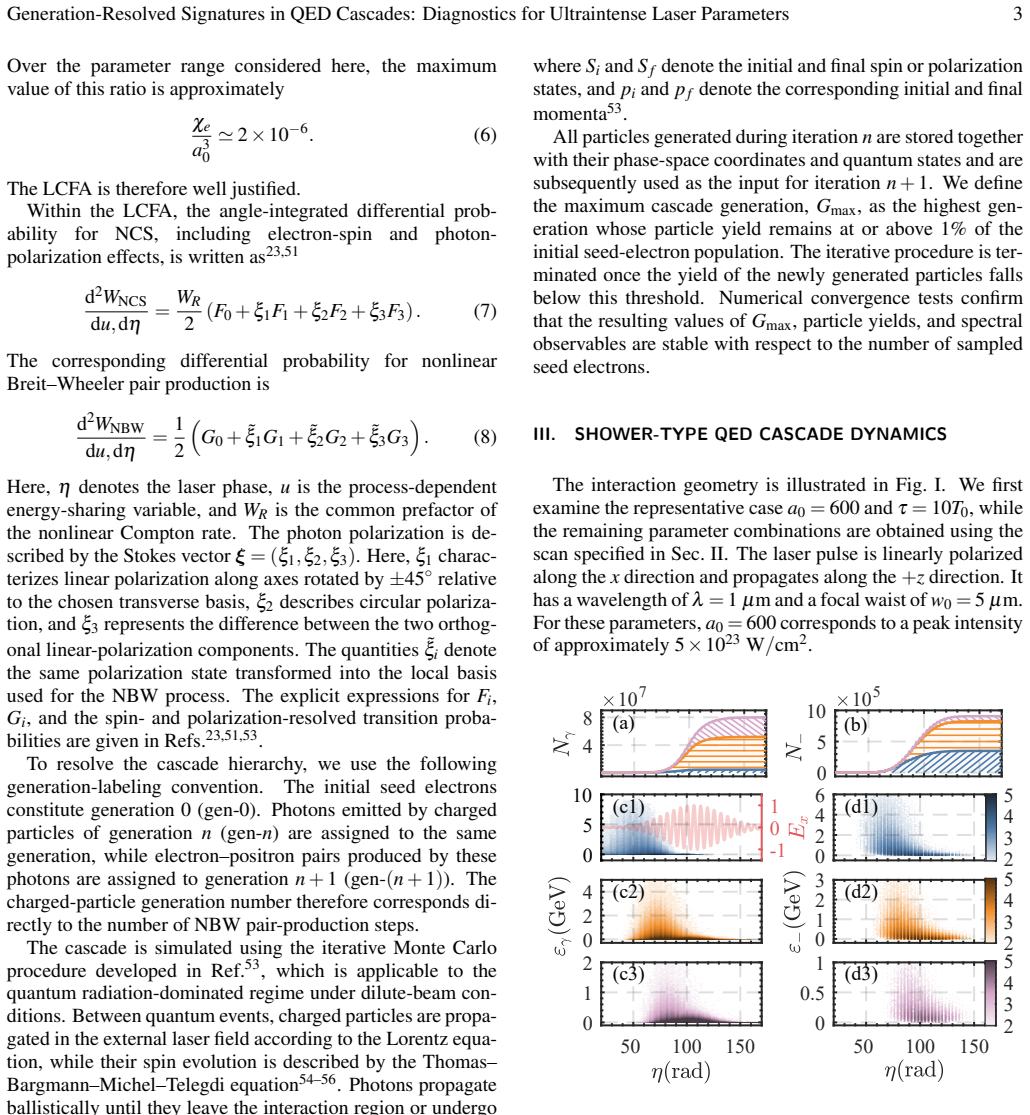
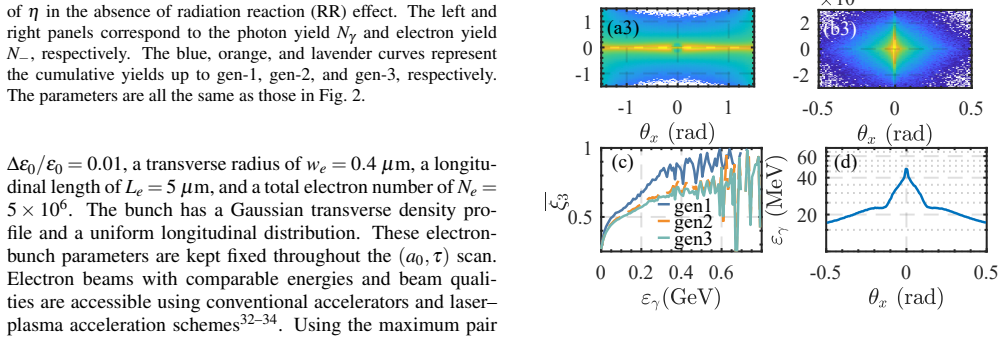
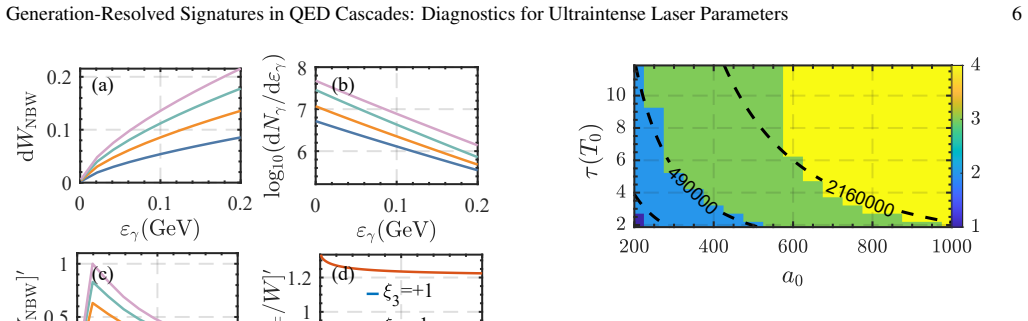
The central discovery is that generation-resolved, spin- and polarization-dependent Monte Carlo simulations of shower-type QED cascades show radiation reaction strongly suppresses high-generation yields, so the cascade is truncated early. The positron spectrum softens monotonically with increasing a0, and the average photon polarization xi3 increases with pulse duration tau because Breit-Wheeler pair production preferentially depletes photons with xi3 < 0. The diagnostic claim is that a measured pair (Fr, epsilon_+^peak) selects one iso-contour from each observable map, and their intersections provide candidate solutions for (a0, tau). Over most of the scanned parameter space the two contour
Load-bearing premise
The diagnostic assumes that the measured pair (Fr, epsilon_+^peak) corresponds to a locally unique, well-conditioned intersection of the two contour families, with uncorrelated Gaussian measurement errors of 0.01 in Fr and 0.01 GeV in the peak energy; the paper does not inject noise into synthetic data to verify reconstruction performance over the full parameter grid, and real detector acceptances or backgrounds could break this assumption.
Editorial extensions
If this is right
- If the diagnostic holds, a single post-interaction shot can constrain both a0 and tau to the precision shown in Fig. 10 without needing separate optical or atomic measurements.
- The scaling Fr ~ a0^2 tau makes the backward-photon fraction a proxy for total laser pulse energy, while epsilon_+^peak isolates the amplitude dependence, so the two observables complement each other.
- The generation-resolved framework can be applied to other cascade setups to separate the contributions of successive generations to spectra, angular distributions, and polarization signals.
- The demonstrated correlation between Gmax and a0^2 tau means the maximum generation number itself can be read as a coarse laser-energy indicator in experiments with particle counting.
Reading between the lines
- A natural next step is a full noise-injection study across the 17x21 parameter grid to map where the inversion is globally unique; the paper only tests local uniqueness via a linearized Jacobian.
- Adding the average photon polarization <xi3> as a third observable could break residual degeneracies where Fr and epsilon_+^peak contours are nearly parallel, since xi3 is primarily tau-sensitive.
- The diagnostic could be extended to unknown focal waist or electron-beam energy by including them in the parameter vector, provided additional observables are added.
- Because Fr is organized by a0^2 tau, a two-measurement strategy that varies the electron energy might separate intensity from pulse energy in existing facilities.
Editorial analysis
A structured set of objections, weighed in public.
Referee Report
Summary. This paper presents a generation-resolved Monte Carlo study of spin- and polarization-dependent QED cascades in head-on collisions of 10 GeV electron bunches with ultraintense laser pulses (a0 = 200–1000, τ = 2T0–12T0). It identifies two final-state observables—the backward-photon fraction F_r and the positron spectral peak energy ε_+^peak—that respond differently to a0 and τ, and proposes using intersections of their simulated iso-contours as a post-interaction laser diagnostic. The paper also reports an approximate a0^2τ dependence for the maximum cascade generation G_max and for F_r, and interprets the τ-dependence of the average photon polarization through polarization-selective NBW depletion. The manuscript includes an LCFA validity estimate, a plasma-field check, a 17×21 parameter scan, and a local Jacobian error-propagation analysis.
Significance. If the proposed inversion is robust, the paper offers a novel, post-interaction method to constrain laser amplitude and pulse duration in the strong-field QED regime, where conventional diagnostics become unreliable. Strengths include explicit LCFA validity quantification (Eq. (6)), an estimate showing plasma collective fields are negligible, a systematic parameter scan, and a clear physical interpretation of the generation-resolved signatures. The two-observable diagnostic idea is original and potentially useful for future ultraintense-laser experiments. However, the central claim is conditional on global uniqueness of the contour intersections and on the accuracy of the simulation-based calibration; neither is established in the present version. These issues are numerical and can be addressed with additional tests.
major comments (3)
- [Sec. V, Eq. (13)] The central claim that a measured pair (F_r, ε_+^peak) uniquely diagnoses (a0, τ) by contour intersection is supported only by local Jacobian linearization. The text admits degeneracies exist 'over most of the scanned parameter space' without specifying where, and no test injects synthetic noise into the observables and runs the full intersection inversion. If the F_r and ε_+^peak contour families become nearly parallel or intersect more than once in any region of the claimed a0=200–1000, τ=2T0–12T0 range, the inversion can yield multiple or biased solutions. Please provide a global uniqueness map and a noise-injection test over the full parameter grid, reporting success rate, bias, and number of solutions for representative measurement errors.
- [Sec. V, Eqs. (14)–(17)] The quantitative precision estimate in Fig. 10 is built on assumed independent Gaussian measurement uncertainties σ_F=0.01 and σ_E=0.01 GeV. The paper calls these benchmarks and acknowledges that systematic uncertainties from detector acceptance, backgrounds, and calibration may dominate, but the conclusion that the joint measurement 'can provide simultaneous local constraints' relies on them. No sensitivity analysis is given for correlated errors, larger σ_F, or systematic shifts. Please either restrict the claim to an ideal benchmark or add a robustness study showing how Fig. 10 changes under more realistic uncertainty models.
- [Sec. III and Sec. V] The observable maps used to build the diagnostic are generated by a single Monte Carlo implementation (Ref. 53) and are not benchmarked against an independent code or against experimental data in any overlapping regime. The LCFA validity estimate (Eq. (6)) checks one approximation but does not validate the full spin- and polarization-resolved rates or the shower algorithm. Because the proposed diagnostic is entirely calibrated by this simulation, model dependence is a central risk. At minimum, the authors should compare representative observables with an independent QED cascade code, or state clearly which model uncertainties enter the calibration and how they would affect the inferred (a0, τ).
minor comments (5)
- [Abstract] Typo: 'we shows' should be 'we show'.
- [Sec. II, Eq. (9)] The notation d^2W/(du,dη) is nonstandard; consider d^2W/(du dη) or a semicolon to separate differential arguments.
- [Sec. II and Sec. V] The 1% threshold defining G_max is a model-defined free parameter. The text should explicitly state whether the proposed diagnostics (F_r and ε_+^peak) are insensitive to this threshold, since G_max itself is threshold-dependent.
- [Sec. V] The text '10^3–10^3.5' appears as '103–103.5' due to formatting; fix superscript.
- [Sec. V, Fig. 9(c)] The contour values used for the intersection procedure should be labeled directly on the figure or in a legend, since the current panels make it hard to read which iso-contour corresponds to which observable value.
Circularity Check
No significant circularity: the diagnostic maps are forward-model outputs, not fits or self-referential definitions.
full rationale
The paper's central claim is that the simulated observables F_r and epsilon_+^peak, as functions of (a0, tau), can be inverted by contour intersection to infer laser parameters. This is a standard forward-model inverse problem: the observables are defined independently of the parameters (Eq. 11 and the positron peak energy as a spectral feature), and the maps in Figs. 8-9 are generated by Monte Carlo simulation with fixed input parameters, not by fitting F_r or epsilon_+^peak to a0 or tau. The a0^2 tau contours are explicitly overlays for guidance, and the paper acknowledges the correspondence is approximate. The local Jacobian error propagation (Eqs. 12-17) is a precision estimate using benchmark measurement uncertainties, not a fitted parameter renamed as a prediction. The only self-citation, Ref. 53 for the Monte Carlo procedure, supports the forward simulation but does not itself force the diagnostic conclusion, and it is not invoked as a uniqueness theorem. The paper honestly flags robustness limitations ("Over most of the scanned parameter space", benchmark rather than facility-specific uncertainties), which are validation concerns, not circularity. No step reduces by construction to its own input.
Assumptions & free parameters
free parameters (3)
- Gmax termination threshold =
1% of seed-electron population
- Assumed measurement uncertainty sigma_F =
0.01
- Assumed measurement uncertainty sigma_E =
0.01 GeV
assumptions (5)
- domain assumption Local constant field approximation is valid: chi_e / a0^3 << 1, with maximum value ~2e-6 over the scanned range
- domain assumption The laser field is a prescribed, non-depleted, linearly polarized Gaussian pulse with fixed waist w0=5 um and no aberrations; cascade back-reaction on the field is neglected
- domain assumption Plasma collective fields are negligible in the dilute-beam regime
- ad hoc to paper Uncorrelated Gaussian measurement errors for Fr and epsilon_+^peak
- standard math Spin and polarization-resolved transition probabilities from Refs. 23, 51, 53 are correct
Cite this review
Pith. "Pith review of Generation-Resolved Signatures in QED Cascades: Diagnostics for Ultraintense Laser Parameters." pith.science (2026). https://pith.science/paper/TNO26UNR
@misc{pith2026260803331,
  author       = {Pith},
  title        = {Pith review of: Generation-Resolved Signatures in QED Cascades: Diagnostics for Ultraintense Laser Parameters},
  year         = {2026},
  howpublished = {\url{https://pith.science/paper/TNO26UNR}},
  note         = {Machine review of arXiv:2608.03331}
}
abstract
We present a generation-resolved analysis of shower-type, spin- and polarization-dependent quantum electrodynamics (QED) cascades initiated by head-on collisions of ultraintense laser pulses ($a_0 = 200$--$1000$) with $10$~GeV electron bunches. Using a Monte Carlo model that tracks cascade evolution across distinct generations, we shows that radiation reaction strongly suppresses high-generation yields. The positron energy spectrum exhibits a systematic softening with increasing $a_0$, and the average photon polarization $\overline{\xi}_3$ increases with pulse duration $\tau$ due to polarization-selective depletion in nonlinear Breit--Wheeler pair production. We identify a scaling relation $a_0^2\tau$ that governs both the maximum cascade generation $G_{\max}$ and the fraction of backward-emitted photons $F_r$, thereby establishing experimentally accessible diagnostics for laser intensity and pulse duration using two observables: $F_r$ and the positron peak energy $\varepsilon_+^{\rm peak}$. These generation-dependent signatures suggest a potential shot-resolved, post-interaction approach for characterization of ultraintense laser parameters in the strong-field QED regime.
Figures


Figures from the paper (6 more)




Reference graph
Works this paper leans on
-
[1]
Blandford, R. D. and Znajek, R. L. , title =. Mon. Not. R. Astron. Soc. , volume =. 1977 , doi =
1977
-
[2]
Ford, A. L. and Keenan, B. D. and Medvedev, M. V. , title =. Phys. Rev. D , volume =. 2018 , doi =
2018
-
[3]
Timokhin, A. N. and Harding, A. K. , title =. Astrophys. J. , volume =. 2019 , doi =
2019
-
[4]
Coherent emission from
Cruz, F. Coherent emission from. Astrophys. J. Lett. , volume =. 2021 , doi =
2021
-
[5]
Bell, A. R. and Kirk, John G. , title =. Phys. Rev. Lett. , volume =. 2008 , doi =
2008
-
[6]
and King, B
Seipt, D. and King, B. , title =. Phys. Rev. A , volume =. 2020 , doi =
2020
-
[7]
and Del Sorbo, Dario and Thomas, Alec G
Seipt, Daniel and Ridgers, Christopher P. and Del Sorbo, Dario and Thomas, Alec G. R. , title =. New J. Phys. , volume =. 2021 , doi =
work page 2021
-
[8]
Slade-Lowther, C. and Del Sorbo, D. and Ridgers, C. P. , title =. New J. Phys. , volume =. 2019 , doi =
work page 2019
Show all 86 references
-
[9]
Song, Huai-Hang and Tamburini, Matteo , title =. Mon. Not. R. Astron. Soc. , volume =. 2024 , doi =
2024
-
[10]
and King, B
Sarri, G. and King, B. and Blackburn, T. and Ilderton, A. and Boogert, S. and Bulanov, S. S. and Bulanov, S. V. and Di Piazza, A. and Ji, L. and Karbstein, F. and Keitel, C. H. and Krajewska, K. and Malka, V. and Mangles, S. P. D. and Mathieu, F. and McKenna, P. and Meuren, S....
2025
-
[11]
1969 , doi =
Pulsar Electrodynamics , journal =. 1969 , doi =
1969
-
[12]
Medin, Zach and Lai, Dong , title =. Mon. Not. R. Astron. Soc. , volume =. 2010 , doi =
2010
-
[13]
, title =
Piran, T. , title =. Rev. Mod. Phys. , volume =. 2004 , doi =
2004
-
[14]
and Zhang, B
Kumar, P. and Zhang, B. , title =. Phys. Rep. , volume =. 2015 , doi =
2015
-
[15]
Ravasio, M. E. and Ghirlanda, G. and Ghisellini, G. , title =. Astron. Astrophys. , volume =. 2024 , doi =
2024
-
[16]
Qu, Kenan and Fisch, Nathaniel J , title =. Phys. Plasmas , volume =. 2024 , doi =
2024
-
[17]
, title =
Qu, Kenan and Griffith, Alec and Fisch, Nathaniel J. , title =. Phys. Rev. E , volume =. 2024 , doi =
2024
-
[18]
High Power Laser Part
Huang, Hairong and Zhang, Liangqi and Liu, Weiyuan and Yu, Tongpu and Luo, Wen , title =. High Power Laser Part. Beams , volume =. 2023 , doi =
2023
-
[19]
Sampath, Archana and Tamburini, Matteo , title =. Phys. Plasmas , volume =. 2018 , doi =
2018
-
[20]
Fedotov, A. M. and Narozhny, N. B. and Mourou, G. and Korn, G. , title =. Phys. Rev. Lett. , volume =. 2010 , doi =
2010
-
[21]
and Vranic, M
Grismayer, T. and Vranic, M. and Martins, J. L. and Fonseca, R. A. and Silva, L. O. , title =. Phys. Rev. E , volume =. 2017 , doi =
2017
-
[22]
and Blackburn, T
Gonoskov, A. and Blackburn, T. G. and Marklund, M. and Mourou, G. and Sergeev, A. and Bulanov, S. S. and Korn, G. , title =. Rep. Prog. Phys. , volume =. 2022 , doi =
2022
-
[23]
Vulcan 20-20 Upgrade , year =
-
[24]
Overview---Shanghai Superintense Ultrafast Laser Facility , year =
-
[25]
Exawatt Center for Extreme Light Studies (XCELS) , year =
-
[26]
Yoon, J. W. and Kim, Y. G. and Choi, I. and Sung, J. H. and Lee, H. W. and Lee, S. K. and Nam, C. H. , title =. Optica , volume =. 2021 , doi =
2021
-
[27]
and others , title =
Radier, C. and others , title =. High Power Laser Sci. Eng. , volume =. 2022 , doi =
2022
-
[28]
Li, A. X. and Qin, C. Y. and Zhang, H. and Li, S. and Fan, L. L. and Wang, Q. S. and Xu, T. J. and Wang, N. W. and Yu, L. H. and Xu, Y. and others , title =. High Power Laser Sci. Eng. , volume =. 2022 , doi =
2022
-
[29]
and Chaulagain, U
Jourdain, N. and Chaulagain, U. and Havl. The. Matter Radiat. Extremes , volume =. 2021 , doi =
2021
-
[30]
Papadopoulos, D. N. and Zou, J. P. and Le Blanc, C. and Ch. The. High Power Laser Sci. Eng. , volume =. 2016 , doi =
2016
-
[31]
and Oliveira, P
Buck, S. and Oliveira, P. and Angelides, T. and Galimberti, M. , title =. Photonics , volume =. 2024 , doi =
2024
-
[32]
and others , title =
Wang, X. and others , title =. Ultrafast Sci. , volume =. 2022 , doi =
2022
-
[33]
and Haefner, Constantin and Bromage, Jake and Butcher, Thomas and Chanteloup, Jean-Christophe F
Danson, Colin N. and Haefner, Constantin and Bromage, Jake and Butcher, Thomas and Chanteloup, Jean-Christophe F. and others , title =. High Power Laser Sci. Eng. , volume =. 2019 , doi =
2019
-
[34]
Mironov, A. A. and Narozhny, N. B. and Fedotov, A. M. , title =. Phys. Lett. A , volume =. 2014 , doi =
2014
-
[35]
Bulanov, S. S. and Schroeder, C. B. and Esarey, E. and Leemans, W. P. , title =. Phys. Rev. A , volume =. 2013 , doi =
2013
-
[36]
Extremely high-intensity laser interactions with fundamental quantum systems , journal =
Di Piazza, Antonino and M. Extremely high-intensity laser interactions with fundamental quantum systems , journal =. 2012 , doi =
2012
-
[37]
and Tamburini, M
Di Piazza, A. and Tamburini, M. and Meuren, S. and Keitel, C. H. , title =. Phys. Rev. A , volume =. 2018 , doi =
2018
-
[38]
and Lompre, L
L'huillier, A. and Lompre, L. A. and Mainfray, G. and Manus, C. , title =. Phys. Rev. A , volume =. 1983 , doi =
1983
-
[39]
and Salvail, J
Smeenk, C. and Salvail, J. Z. and Arissian, L. and Corkum, P. B. and Hebeisen, C. T. and Staudte, A. , title =. Opt. Express , volume =. 2011 , doi =
2011
-
[40]
Zhao, Song-Feng and Le, Anh-Thu and Jin, Cheng and Wang, Xu and Lin, C. D. , title =. Phys. Rev. A , volume =. 2016 , doi =
2016
-
[41]
Ciappina, M. F. and Popruzhenko, S. V. and Bulanov, S. V. and Ditmire, T. and Korn, G. and Weber, S. , title =. Phys. Rev. A , volume =. 2019 , doi =
2019
-
[42]
Ciappina, M. F. and Peganov, E. E. and Popruzhenko, S. , title =. Matter Radiat. Extremes , volume =. 2020 , doi =
2020
-
[43]
Pullen, M. G. and Wallace, W. C. and Laban, D. E. and Palmer, A. J. and Hanne, G. F. and Grum-Grzhimailo, A. N. and Bartschat, K. and Ivanov, I. and Kheifets, A. and Wells, D. and Quiney, H. M. and Tong, X. M. and Litvinyuk, I. V. and Sang, R. T. and Kielpinski, D. , title =. ...
2013
-
[44]
, title =
Gao, J. , title =. Appl. Phys. Lett. , volume =. 2006 , doi =
2006
-
[45]
Galkin, A. L. and Kalashnikov, M. P. and Klinkov, V. K. and Korobkin, V. V. and Romanovsky, M. Y. and Shiryaev, O. B. , title =. Phys. Plasmas , volume =. 2010 , doi =
2010
-
[46]
and Di Piazza, A
Har-Shemesh, O. and Di Piazza, A. , title =. Opt. Lett. , volume =. 2012 , doi =
2012
-
[47]
and Andreev, A
Kalashnikov, M. and Andreev, A. and Ivanov, K. and Galkin, A. and Korobkin, V. and Romanovsky, M. and Shiryaev, O. and Schnuerer, M. and Braenzel, J. and Trofimov, V. , title =. Laser Part. Beams , volume =. 2015 , doi =
2015
-
[48]
Vais, O. E. and Bochkarev, S. G. and Ter-Avetisyan, S. and Bychenkov, V. Y. , title =. Quantum Electron. , volume =. 2017 , doi =
2017
-
[49]
Ivanov, K. A. and Tsymbalov, I. N. and Vais, O. E. and Bochkarev, S. G. and Volkov, R. V. and Bychenkov, V. Y. and Savel'ev, A. B. , title =. Plasma Phys. Control. Fusion , volume =. 2018 , doi =
2018
-
[50]
Maier, A. R. and Delbos, N. M. and Eichner, T. and H. Decoding Sources of Energy Variability in a Laser-Plasma Accelerator , journal =. 2020 , doi =
2020
-
[51]
and Huault, M
Ravichandran, S. and Huault, M. and Lera, R. and He, C. Z. and Longman, A. and Fedosejevs, R. and Roso, L. and Hill, W. T. III , title =. Phys. Rev. A , volume =. 2023 , doi =
2023
-
[52]
Xie, Bo , title =. Appl. Phys. B , volume =. 2025 , doi =
2025
-
[53]
Matter Radiat
Xu, Shirui and Pan, Zhuo and Gao, Ying and Zhao, Jiarui and Chen, Shiyou and Mei, Zhusong and Chen, Xun and Peng, Ziyang and Liu, Xuan and Liang, Yulan and Xu, Tianqi and Song, Tan and Wu, Qingfan and Zhang, Yujia and Liu, Zhipeng and Zhang, Zihao and Chen, Haoran and Han, Qih...
2025
-
[54]
Perevalov, S. E. and Pukhov, A. M. and Starodubtsev, M. V. and Soloviev, A. A. , title =. Matter Radiat. Extremes , volume =. 2023 , doi =
2023
-
[55]
Aleksandrov, I. A. and Andreev, A. A. , title =. Phys. Rev. A , volume =. 2021 , doi =
2021
-
[56]
Lu, Z. W. and Hou, X. D. and Wan, F. and Salamin, Y. I. and Lv, C. and Zhang, B. and Wang, F. and Xu, Z. F. and Li, J. X. , title =. Matter Radiat. Extremes , volume =. 2023 , doi =
2023
-
[57]
and Walmsley, I
Iaconis, C. and Walmsley, I. A. , title =. Opt. Lett. , volume =. 1998 , doi =
1998
-
[58]
Radunsky, A. S. and Ivanov, A. A. and Zheltikov, A. M. , title =. Opt. Lett. , volume =. 2006 , doi =
2006
-
[59]
Itatani, J. and Qu. Attosecond Streak Camera , journal =. 2002 , doi =
2002
-
[60]
Mairesse, Y. and Qu. Frequency-resolved optical gating for complete reconstruction of attosecond bursts , journal =. 2005 , doi =
2005
-
[61]
and Wan, Feng and Keitel, Christoph H
Li, Yan-Fei and Shaisultanov, Rashid and Hatsagortsyan, Karen Z. and Wan, Feng and Keitel, Christoph H. and Li, Jian-Xing , title =. Phys. Rev. Lett. , volume =. 2019 , doi =
2019
-
[62]
Ridgers, C. P. and Kirk, J. G. and Duclous, R. and Blackburn, T. G. and Brady, C. S. and Bennett, K. and Arber, T. D. and Bell, A. R. , title =. J. Comput. Phys. , volume =. 2014 , doi =
2014
-
[63]
Elkina, N. V. and Fedotov, A. M. and Kostyukov, I. Y. and Legkov, M. V. and Narozhny, N. B. and Nerush, E. N. and Ruhl, H. , title =. Phys. Rev. ST Accel. Beams , volume =. 2011 , doi =
2011
-
[64]
Green, D. G. and Harvey, C. N. , title =. Comput. Phys. Commun. , volume =. 2015 , doi =
2015
-
[65]
McMaster, W. H. , title =. Rev. Mod. Phys. , volume =. 1961 , doi =
1961
-
[66]
Baier, V. N. and Katkov, V. M. and Fadin, V. S. , title =. 1973 , publisher =
1973
-
[67]
Thomas, L. H. , title =. Nature , volume =. 1926 , doi =
1926
-
[68]
Thomas, L. H. , title =. Philos. Mag. , volume =. 1927 , doi =
1927
-
[69]
and Michel, L
Bargmann, V. and Michel, L. and Telegdi, V. L. , title =. Phys. Rev. Lett. , volume =. 1959 , doi =
1959
-
[70]
Zhu, X. Z. and Li, B. Y. and Liu, F. and Li, J. L. and Bi, Z. W. and Ge, X. L. and Deng, H. Y. and Zhang, Z. Y. and Cui, P. L. and Lu, L. and Yan, W. C. and Yuan, X. H. and Chen, L. M. and Cao, Q. and Liu, Z. Y. and Sheng, Z. M. and Chen, M. and Zhang, J. , title =. Phys. Rev....
2023
-
[71]
and Willingale, L
Babjak, R. and Willingale, L. and Arefiev, A. and Vranic, M. , title =. Phys. Rev. Lett. , volume =. 2024 , doi =
2024
-
[72]
and Gorlova, D
Tsymbalov, I. and Gorlova, D. and Ivanov, K. and Starodubtseva, E. and Volkov, R. and Tsygvintsev, I. and Kochetkov, Y. and Korneev, P. and Polonski, A. and Savel'ev, A. , title =. Phys. Rev. Lett. , volume =. 2025 , doi =
2025
-
[73]
and Wan, F
Lv, C. and Wan, F. and Salamin, Y. I. and Zhao, Q. and Ababekri, M. and Xu, R. R. and Li, J. X. , title =. Adv. Sci. , volume =. 2025 , doi =
2025
-
[74]
2022 , issn =
Generation of arbitrarily polarized GeV lepton beams via nonlinear Breit-Wheeler process , journal =. 2022 , issn =. doi:10.1016/j.fmre.2021.11.022 , author =
2022 doi
-
[75]
DeLong and David N
Rick Trebino and Kenneth W. DeLong and David N. Fittinghoff and John N. Sweetser and Marco A. Krumb. Measuring ultrashort laser pulses in the time-frequency domain using frequency-resolved optical gating , journal =. 1997 , volume =
1997
-
[76]
Space--time characterization of ultrashort laser pulses: A perspective , journal =
Benjam. Space--time characterization of ultrashort laser pulses: A perspective , journal =. 2024 , volume =
2024
-
[77]
Di Piazza and M
A. Di Piazza and M. Tamburini and S. Meuren and C. H. Keitel , title =. Phys. Rev. A , year =
-
[78]
Samuele Montefiori and Matteo Tamburini , title =. Comput. Phys. Commun. , year =
-
[79]
High Power Laser Sci
Colin Nicholas Danson and Leonida Antonio Gizzi and David Hillier , title =. High Power Laser Sci. Eng. , year =
-
[80]
Fedotov and A
A. Fedotov and A. Ilderton and F. Karbstein and B. King and D. Seipt and H. Taya and G. Torgrimsson , title =. Phys. Rep. , year =
-
[81]
High Power Laser Sci
Efim Khazanov and Andrey Shaykin and Igor Kostyukov and Vladislav Ginzburg and Ivan Mukhin and Ivan Yakovlev and Alexander Soloviev and Ivan Kuznetsov and Sergey Mironov and Artem Korzhimanov and Denis Bulanov and Ilya Shaikin and Anton Kochetkov and Alexey Kuzmin and Mikhail ...
-
[82]
C. D. Arrowsmith and P. Simon and P. J. Bilbao and A. F. A. Bott and others , title =. Nat. Commun. , year =
-
[83]
High Power Laser Sci
Yutong Li and Liming Chen and Min Chen and Feng Liu and Yuqiu Gu and Bing Guo and Jianfei Hua and Taiwu Huang and Yuxin Leng and Fei Li and Lu Li and Ruxin Li and Chen Lin and Wei Lu and Zhihui Lyu and Wenjun Ma and Xiaonan Ning and Yujie Peng and Yang Wan and Jinguang Wang an...
-
[84]
Pouyez and T
M. Pouyez and T. Grismayer and M. Grech and C. Riconda , title =. Phys. Rev. Lett. , volume =. 2025 , doi =
2025
-
[85]
Borysov , collaboration =
O. Borysov , collaboration =. The Strong-Field. PoS , volume =. 2022 , doi =
2022
-
[86]
F. C. Salgado and others , title =. New J. Phys. , volume =. 2022 , doi =
2022
Reviewed August 5, 2026 · model on record in the stance chip above.
Discussion (0). Continue with ORCID to comment.