REVIEW 3 major objections 4 minor 27 references
Notes on phase structure and non-vanishing $\beta$ functions of one-unitary matrix model
T0 review · 3 major / 4 minor · reviewed 2026-08-05 · deepseek-v4-flash
Pith's one-line read The beta functions of the one-unitary matrix model never vanish together on critical lines, so its large-N transitions are third order.
desk verdict A solid n=2 beta-function calculation is over-advertised as an n≤3 result. read the letter →
The pith
A machine-rendered reading of the paper's core claim, the machinery that carries it, and where it could break.
The reading
What carries the argument
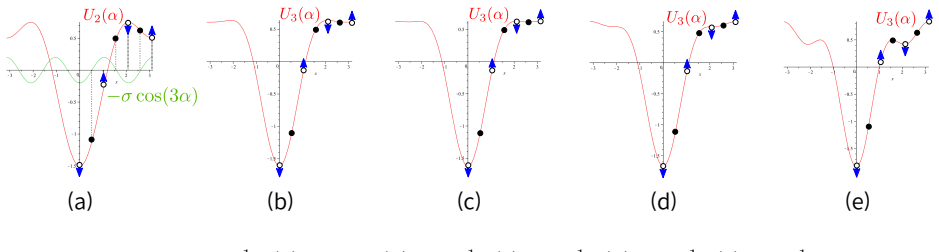
The load-bearing objects are the classical potential $U_n(\alpha)=-\cos\alpha-\sum_{k=2}^n\tau_k\cos k\alpha$ and the $\beta$-function vector. The potential's local extrema, located by $U'_n(\alpha)=\sin\alpha\times(\text{polynomial of degree }n-1\text{ in }\cos\alpha)$, determine the number and location of eigenvalue accumulations as $\lambda$ decreases; $\alpha=0$ and $\pi$ are always extrema, and at most $n-1$ further extrema lie inside $(0,\pi)$. The $\beta$ functions are built from the large-$N$ expectation values $w_k=\lim_{N\to\infty}N^{-1}\langle\sum_i\cos(k\alpha_i)\rangle$, the matrix $W_{k\ell}=\partial w_k/\partial\tau_\ell$, the scale relation $w_k=e^{-a^2\sigma_k}$, and $\beta_k=\sum
What would settle it
Solve the planar large-$N$ saddle-point equation for the eigenvalue density of the $n=3$ model in one of the five classified cases, say $\tau=1/3$, $\sigma=2/5$, and track the number of gaps as $\lambda$ is lowered; if the sequence or critical values differ from the paper's Fig. 10, the potential-shape method fails. Equivalently, evaluate $\beta_1$ and $\beta_2$ of the $n=2$ model along a numerically located critical line and look for a simultaneous zero; a common zero would overturn the third-order claim.
Extended reading notes
Core claim
The central claim is that the qualitative phase structure of the one-unitary matrix model is controlled by the shape of its classical potential. For $U_n(\alpha)=-\cos\alpha-\sum_{k=2}^n\tau_k\cos k\alpha$, the derivative $U'_n(\alpha)$ is $\sin\alpha$ times a polynomial in $\cos\alpha$ of degree $n-1$, so beyond the endpoints $\alpha=0,\pi$ there are at most $n-1$ internal extrema. As $\lambda$ decreases, eigenvalue repulsion weakens and eigenvalues accumulate around the local minima; the number of such accumulation regions is the number of gaps in the phase. For $n=2$, this logic reproduces the known diagram, including the three regimes $\tau>1/4$, $|\tau|\le 1/4$, $\tau<-1/4$ with gap seq
Load-bearing premise
The argument assumes that decreasing $\lambda$ simply lets eigenvalues accumulate around the local minima of the classical potential; if eigenvalue repulsion redistributes the density in a way not captured by the shape of $U_n$, the predicted gap sequences and phase boundaries are not established.
Editorial extensions
If this is right
- For $n=2$, the classical-potential reasoning reproduces the known phase diagram, including the three gap sequences and the triple point, without solving the full planar problem.
- For $n=3$, the method predicts five qualitatively different phase diagrams in the $(\tau,\sigma)$ plane; each has a 0-gap phase at large $\lambda$ and some show 1-, 2-, and 3-gap phases.
- The $n=1$ GWW result, a third-order transition with nonzero beta function at the critical point, extends to $n=2$: along critical lines the beta vector $(\beta_1,\beta_2)$ never vanishes.
- The observation is consistent with the susceptibility exponent and indicates that the large-$N$ transitions in these models are third order rather than second order.
Reading between the lines
- The authors do not spell out that, if the non-vanishing beta vector is generic, each critical line is crossed transversally by the RG flow rather than ending at a fixed point; reaching such a line therefore requires tuning a combination of couplings.
- The same local-minimum counting should extend to $n>3$ potentials, where the number of internal extrema grows with $n$; one would expect richer multi-gap phases, but the paper does not demonstrate this.
- Once the $n=3$ planar free energy is available, computing its beta functions would test whether the no-common-zero property survives beyond $n=2$; the authors' argument suggests it does.
Editorial analysis
A structured set of objections, weighed in public.
Referee Report
Summary. The manuscript studies the one-unitary matrix model with potential U_n = -cos α - sum_{k=2}^n τ_k cos kα. It proposes that the qualitative phase structure as λ decreases can be read off from the evolution of local minima of the classical potential. This is illustrated for n=1,2,3, with five parameter regions for n=3 and corresponding phase diagrams in Fig. 10. The paper then defines β functions through w_k = e^{-a^2 σ_k} and β_k = a dτ_k/da, computes them explicitly for n=1 and for n=2 in the 0-gap and 1-gap phases, and claims that the β-vector never vanishes on the critical lines. This is presented as a generalization of the n=1 GWW case and as evidence for third-order rather than second-order phase transitions.
Significance. If the n=3 phase diagrams and the non-vanishing-β statement were fully derived, the paper would offer a useful qualitative method and a concrete link between RG β-functions and the order of large-N transitions. The explicit n=1,2 calculations are a strength: free energies are given in closed form and the β functions follow from them without fitted parameters. However, as it stands, the advertised n≤3 result is not demonstrated: the beta-function computation stops at n=2, and the n=3 phase diagrams are inferences from the classical potential. Also, non-vanishing β at a transition line does not by itself determine whether the transition is second or third order. The central claims are therefore only partially supported.
major comments (3)
- [Sec. 2.2–2.3, Fig. 10] The n=3 phase diagrams are obtained from the deformation of U_3(α), not from the planar eigenvalue problem. For n=2 the same reasoning is backed by the exact solution in [13], but no such check is provided for n=3. The extrema of the classical potential determine where eigenvalue density can accumulate only if the density is sharply peaked; at finite λ the Vandermonde repulsion redistributes the density and can alter the number of cuts and the location of transition lines. In particular, the 0→1→3 and 0→2→3 sequences in Fig. 10 are not derived. A large-N solution (resolvent/spectral curve) or at least the n=3 free energy in each candidate phase is needed. This is load-bearing because the abstract announces phase structure for n≤3.
- [Sec. 3, Eqs. (3.1)–(3.5), Figs. 11–12] The β functions are computed only for n=1 and n=2. The n=3 case is never paired with w_3, W, or β_k. Eqs. (3.3)–(3.5) define the general object, but the non-vanishing-vector statement is asserted for the critical lines of Fig. 10 without calculation. Thus 'This generalizes the n=1 GWW case' (abstract) is not established beyond n=2. Please either carry out the n=3 computation (e.g., from F_{n=3} in the relevant gaps) or explicitly restrict the non-vanishing claim to n=1,2.
- [Sec. 3, after Eq. (3.8)] The step from a non-vanishing β vector to a third-order (not second-order) transition is not derived. Non-zero β at a critical line excludes an RG fixed point on that line, but the order of the transition is a statement about the free energy: third order means F and its first derivatives are continuous while some second derivative jumps. The paper neither computes these derivatives around the transitions nor proves that the behavior of β implies this pattern. For n=1 this follows from the exact F in Eq. (3.6); for n=2, F is given by Eq. (3.17), but the derivative analysis is absent. The link to the susceptibility exponent is named in the abstract, not shown. Please supply the free-energy derivative analysis or weaken the claim.
minor comments (4)
- [Sec. 2, Fig. 8] The Fig. 8 caption reads '(a) (a) (b) (c)'; this appears to be a typo and should probably be '(a) (b) (c)'.
- [Eq. (3.3)] The notation τ_1 ≡ λ is confusing because λ appears as the inverse coupling in Eq. (1.1). Please clarify the convention.
- [Eq. (2.8)] The expression 1 + 3σ(3σ − 1)/τ^2 would benefit from parentheses: 1 + [3σ(3σ − 1)]/τ^2, to avoid ambiguity.
- [Throughout] There are several typos and formatting issues: 'extrama' for 'extrema' (Sec. 2.1), 'determintant' near Eq. (1.1), 'behavio r' before Fig. 11, and inconsistent hyphenation in 'β functions'. A thorough proofread is recommended.
Circularity Check
No circular reduction found: beta functions are computed from exact free energies, and the n=3 generalization is an evidentiary extrapolation, not a circular step.
full rationale
The paper's derivation chain is not circular. The beta-function construction in Sec. 3 (Eqs. 3.1–3.5) is a definition: β_k ≡ a dτ_k/da = Σ W^{-1}_{kℓ} d_a w_ℓ with d_a w_k = 2w_k ln w_k. No fitted parameter is inserted, and the target conclusion (non-vanishing beta vector) is not an input to the definition. For n=1, β_1 follows from the exact Gross–Witten/Wadia free energy (Eq. 3.6), an external benchmark; the nonzero value at λ=2 is a computed fact, not a manufactured one. For n=2, w_1, w_2 are obtained from the 1-gap free energy (Eq. 3.17), which is taken from the authors' previous paper [13]. That is a legitimate citation to prior analytic work: [13] does not assume the non-vanishing beta-vector claim, and the beta functions are newly computed from that free energy, so the citation is independent support rather than a circularity. The figures 11–12 report a computed property of those beta functions, not a fit or a prediction forced by the inputs. The paper's central weakness is not circularity but an evidentiary gap: Sec. 2.2 gives only qualitative classical-potential phase diagrams for n=3 (Fig. 10), while Sec. 3 derives beta functions only for n=1,2. Thus the abstract's statement that the nowhere-vanishing beta-vector 'generalizes the n=1 GWW case' to n≤3 is an extrapolation, not a derivation. Similarly, the claim that non-vanishing beta functions 'tell us' third-order rather than second-order transitions is an inference not grounded in the discontinuity structure of the free energy. These are unsupported claims, but they are not cases where a result is equivalent to its inputs by construction. No ansatz is smuggled in via citation, no uniqueness theorem is imported from the authors, and no known result is merely renamed.
Assumptions & free parameters
assumptions (4)
- domain assumption The large-N eigenvalue distribution's phase structure is correctly reflected by the number and depth ordering of local minima of the classical potential W(α) as λ decreases.
- ad hoc to paper The beta functions β_k = a dτ_k/da defined through w_k = e^{-a^2 σ_k} and W^{-1} are the appropriate RG beta functions for the model.
- ad hoc to paper Non-vanishing of the beta-function vector on critical lines implies the transition is third order rather than second order.
- domain assumption The n=2 free energy F^{(1)} (eq. 3.17) from the authors' previous paper [13] is correct.
Cite this review
Pith. "Pith review of Notes on phase structure and non-vanishing $\beta$ functions of one-unitary matrix model." pith.science (2026). https://pith.science/paper/ZQ6S3WX4
@misc{pith2026260803366,
  author       = {Pith},
  title        = {Pith review of: Notes on phase structure and non-vanishing $\beta$ functions of one-unitary matrix model},
  year         = {2026},
  howpublished = {\url{https://pith.science/paper/ZQ6S3WX4}},
  note         = {Machine review of arXiv:2608.03366}
}
abstract
Unitary matrix models, among other things, play an important role in representing the irregular conformal block and hence LEEA of some asymptotically free susy gauge theories. Here, we develop a method of how to determine the qualitative structure of phase diagram by the deformation of classical potential, and illustrate this by the examples that contain term up to $\cos n\alpha$, $n \leq 3$. We point out that a set of $\beta$ functions on critical ``lines" is nowhere a vanishing vector. This generalizes the $n =1$ GWW case and tells us the third order (rather than second order) phase transition in conformity with the range of values for the susceptibility exponent.
Figures


Figures from the paper (8 more)




Reference graph
Works this paper leans on
-
[13]
Phases and triple(multiple) point: critical phenomena around the AD singularity
Hiroshi Itoyama and Reiji Yoshioka, “Phases and triple (multiple ) point: Criti- cal phenomena around the AD singularity,” Nucl. Phys. B 1010, 116765 (2025), arXiv:2411.10747
work page Pith review arXiv 2025
-
[1]
Madan Lal Mehta, Random matrices, volume 142, (Elsevier, 2004)
work page 2004
-
[2]
H. Itoyama and T. Oota, “Method of Generating q-Expansion Co efficients for Conformal Block and N=2 Nekrasov Function by beta-Deformed Matrix Model,” N ucl. Phys. B 838, 298–330 (2010), arXiv:1003.2929
work page Pith review arXiv 2010
-
[3]
Conformal blocks a s Dotsenko-Fateev Integral Discriminants,
A. Mironov, A. Morozov, and Sh. Shakirov, “Conformal blocks a s Dotsenko-Fateev Integral Discriminants,” Int. J. Mod. Phys. A 25, 3173–3207 (2010), arXiv:1001.0563
arXiv 2010
-
[4]
Massive Scaling Limit of beta-Deformed Matrix Model of Selberg Type
H. Itoyama, T. Oota, and N. Yonezawa, “Massive Scaling Limit of b eta-Deformed Ma- trix Model of Selberg Type,” Phys. Rev. D 82, 085031 (2010), arXiv:1008.1861
work page Pith review arXiv 2010
-
[5]
H. Itoyama, T. Oota, and Katsuya Yano, “Discrete Painlev´ e sy stem and the double scaling limit of the matrix model for irregular conformal block and gau ge theory,” Phys. Lett. B 789, 605–609 (2019), arXiv:1805.05057. 12
work page Pith review arXiv 2019
-
[6]
H. Itoyama, T. Oota, and Katsuya Yano, “Discrete Painlev´ e sy stem for the partition function of Nf = 2 SU (2) supersymmetric gauge theory and its double scaling limit,” J. Phys. A 52(41), 415401 (2019), arXiv:1812.00811
work page Pith review arXiv 2019
-
[7]
Discrete Painlev´ e sy stem associated with Unitary matrix model,
H. Itoyama, T. Oota, and Katsuya Yano, “Discrete Painlev´ e sy stem associated with Unitary matrix model,” J. Phys. Conf. Ser. 1194(1), 012050 (2019)
work page 2019
Show all 27 references
-
[8]
Multicritical points of unitary matrix model with logarithmic potential identified with Argyres–Douglas points,
H. Itoyama, T. Oota, and Katsuya Yano, “Multicritical points of unitary matrix model with logarithmic potential identified with Argyres–Douglas points,” In t. J. Mod. Phys. A 35(24), 2050146 (2020), arXiv:1909.10770
2020 arXiv
-
[9]
Theory space of one unitary ma trix model and its critical behavior associated with Argyres–Douglas theory,
H. Itoyama and Katsuya Yano, “Theory space of one unitary ma trix model and its critical behavior associated with Argyres–Douglas theory,” Int. J . Mod. Phys. A 36(30), 2150227 (2021), arXiv:2103.11428
2021 arXiv
-
[10]
Construction of irreg ular conformal/W block and flavor mass relations of N = 2 SUSY gauge theory from the An−1 quiver matrix model,
H. Itoyama, T. Oota, and R. Yoshioka, “Construction of irreg ular conformal/W block and flavor mass relations of N = 2 SUSY gauge theory from the An−1 quiver matrix model,” Phys. Lett. B 841, 137938 (2023), arXiv:2210.16738
2023 arXiv
-
[11]
A-D hypersurface of su(n) N = 2 supersym- metric gauge theory with Nf = 2 n − 2 flavors,
H. Itoyama, T. Oota, and R. Yoshioka, “A-D hypersurface of su(n) N = 2 supersym- metric gauge theory with Nf = 2 n − 2 flavors,” Int. J. Mod. Phys. A 38(02), 2350017 (2023), arXiv:2212.06590
2023 arXiv
-
[12]
Large Order Behav ior Near the AD Point: The Case of N = 2, su(2), Nf = 2,
C.-T. Chan, H. Itoyama, and R. Yoshioka, “Large Order Behav ior Near the AD Point: The Case of N = 2, su(2), Nf = 2,” PTEP 2024(4), 041B01 (2024), arXiv:2402.03670
2024 arXiv
-
[14]
Electric - magnetic duality, monopole c ondensation, and confinement in N=2 supersymmetric Yang-Mills theory,
N. Seiberg and E. Witten, “Electric - magnetic duality, monopole c ondensation, and confinement in N=2 supersymmetric Yang-Mills theory,” Nucl. Phys. B 426, 19–52, [Erratum: Nucl.Phys.B 430, 485–486 (1994)] (1994), hep-th/940 7087
1994
-
[15]
Seiberg-Witten prepotential from instanto n counting,
N. A. Nekrasov, “Seiberg-Witten prepotential from instanto n counting,” Adv. Theor. Math. Phys. 7(5), 831–864 (2003), hep-th/0206161. 13
2003 arXiv
-
[16]
Liouville Correlation F unctions from Four- dimensional Gauge Theories,
L. F. Alday, D. Gaiotto, and Y. Tachikawa, “Liouville Correlation F unctions from Four- dimensional Gauge Theories,” Lett. Math. Phys. 91, 167–197 (2010), arXiv:0906.3219
2010 arXiv
-
[17]
Toda Theories, Matrix Models, Topo logical Strings, and N=2 Gauge Systems,
R. Dijkgraaf and C. Vafa, “Toda Theories, Matrix Models, Topo logical Strings, and N=2 Gauge Systems,” (2009), arXiv:0909.2453
2009 arXiv
-
[18]
The Quiver Matrix Mod el and 2d-4d Con- formal Connection,
H. Itoyama, K. Maruyoshi, and T. Oota, “The Quiver Matrix Mod el and 2d-4d Con- formal Connection,” Prog. Theor. Phys. 123, 957–987 (2010), arXiv:0911.4244
2010 arXiv
-
[19]
Developments of theory of effec tive prepotential from extended Seiberg–Witten system and matrix models,
H. Itoyama and R. Yoshioka, “Developments of theory of effec tive prepotential from extended Seiberg–Witten system and matrix models,” PTEP 2015(11), 11B103 (2015), arXiv:1507.00260
2015 arXiv
-
[20]
Developments of supersymmetric gauge theory by matrices,
H. Itoyama, “Developments of supersymmetric gauge theory by matrices,” Nippon But- suri Gakkai-Shi 71(9), 607–616 (2016)
2016
-
[21]
A slow review of the AGT correspondence,
B. Le Floch, “A slow review of the AGT correspondence,” J. Phys . A 55(35), 353002 (2022), arXiv:2006.14025
2022 arXiv
-
[22]
New phenomena in SU(3) supe rsymmetric gauge theory,
P. C. Argyres and M. R. Douglas, “New phenomena in SU(3) supe rsymmetric gauge theory,” Nucl. Phys. B 448, 93–126 (1995), hep-th/9505062
1995 arXiv
-
[23]
New N =2 superconformal field theories in four-dimensions,
P. C. Argyres, M. R. Plesser, N. Seiberg, and E. Witten, “New N =2 superconformal field theories in four-dimensions,” Nucl. Phys. B 461, 71–84 (1996), hep-th/9511154
1996 arXiv
-
[24]
Renormalization group flow n ear the superconfor- mal points in N=2 supersymmetric gauge theories,
Takahiro Kubota and Naoto Yokoi, “Renormalization group flow n ear the superconfor- mal points in N=2 supersymmetric gauge theories,” Prog. Theor. Ph ys. 100, 423–436 (1998), hep-th/9712054
1998 arXiv
-
[25]
Possible third-order phase transit ion in the large- N lattice gauge theory,
D. J. Gross and E. Witten, “Possible third-order phase transit ion in the large- N lattice gauge theory,” Physical Review D 21(2), 446 (1980)
1980
-
[26]
N = ∞ phase transition in a class of exactly soluble model lattice gauge theories,
S. R. Wadia, “ N = ∞ phase transition in a class of exactly soluble model lattice gauge theories,” Physics Letters B 93(4), 403–410 (1980)
1980
-
[27]
Phase Structure of Unitary Matrix Models,
G. Mandal, “Phase Structure of Unitary Matrix Models,” Mod. Ph ys. Lett. A 5, 1147– 1158 (1990). 14
1990
Reviewed August 5, 2026 · model on record in the stance chip above.
Discussion (0). Sign in to comment.