REVIEW 4 major objections 5 minor 40 references
New gravitational instanton: shadow of an extra dimension
T0 review · 4 major / 5 minor · reviewed 2026-08-05 · deepseek-v4-flash
Pith's one-line read The paper argues that a five-dimensional warped Kerr-like brane-world solution gives rise, under complexification, to an exact self-dual gravitational instanton on the brane.
desk verdict The claimed conformal Kähler instanton fails because the Kähler form is already closed, forcing any conformal factor to be constant. read the letter →
The pith
A machine-rendered reading of the paper's core claim, the machinery that carries it, and where it could break.
The reading
What carries the argument
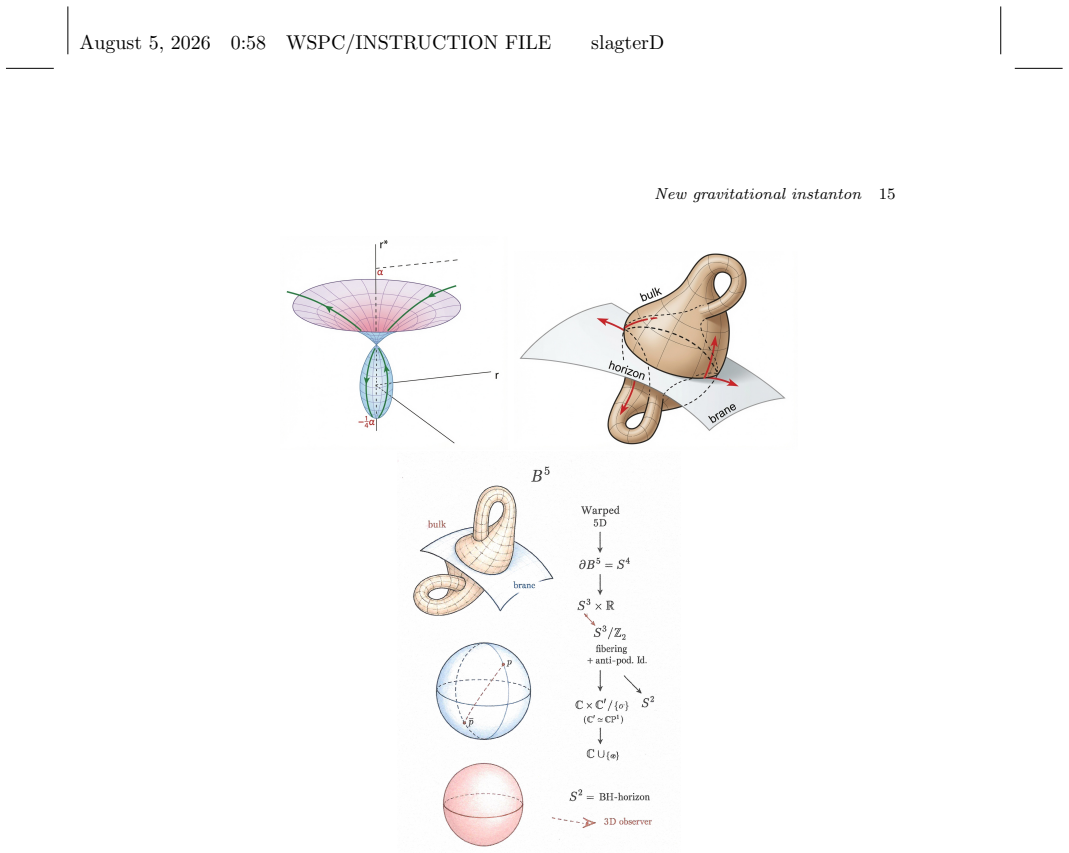
The central object is the conformal Kähler form K on the effective Euclidean manifold. K is built from a Kähler potential κ obtained by integrating the metric function N² twice, and is made closed by a conformal factor Ω, so that d(Ω²K)=0. The metric function itself is controlled by the first-order equation rN∂_rN + N² = (k+1)/2 (r−a)^k, the analogue of the first-order self-duality equation in Eguchi-Hanson. A double cover of S³ via stereographic projection onto CP¹×CP¹, together with the Z₂/Klein-surface identification, supplies the topology S³×R/Z₂, while the complex transformation of Eq. (60) makes self-duality manifest and the decoupling of Nφ lets angular momentum be transformed away lo
What would settle it
Compute d(Ω²K) directly for the effective metric (54) with κ from (53) on S³×R/Z₂ and check whether any smooth positive Ω satisfies the closure condition; alternatively, extract the self-dual part of the Weyl tensor in the chiral tetrad formalism and test whether the self-dual curvature equations of the paper hold. A concrete failure to find such an Ω, or a nonzero anti-self-dual curvature component, would falsify the instanton claim.
Extended reading notes
Core claim
The central claim is that the complexified effective four-dimensional metric extracted from the five-dimensional conformally invariant Kerr-like brane-world solution is a gravitational instanton. After Wick rotation and the complex transformation of Eq. (60), the metric (54) is written as a locally conformally Kähler manifold with Kähler potential κ of Eq. (53) and two-form K of Eq. (56); the paper asserts that d(Ω²K)=0 for a suitable conformal factor Ω. The metric function N comes from the first-order equation (9) with integer parameter k, making the solution exact and placing its self-duality in the same formal setting as the Eguchi-Hanson and Fubini-Study instantons. The topology is S³×R/
Load-bearing premise
The load-bearing premise is that a smooth global conformal factor Ω exists on the Klein-bottle quotient S³×R/Z₂ that makes the two-form Ω²K closed; the paper asserts this 'by suitable choice of Ω' but gives no existence, regularity, or compatibility proof, and without it the conformal Kähler and self-duality claims collapse.
Editorial extensions
If this is right
- The effective four-dimensional metric is an exact self-dual Euclidean solution, placing it in the same family as the Eguchi-Hanson and Fubini-Study instantons rather than in the standard quartic axisymmetric family.
- With the Klein-bottle topology S³×R/Z₂, Hawking evaporation can be described as a topological transition with antipodal identification, so the radiation state remains pure and no cut-and-paste construction is needed.
- The central singularity of the Kerr-like interior is removable after complexification, so the black hole interior can be regular while the quintic root locations track the evaporation path in the complex plane.
- Because Nφ decouples, angular momentum is locally a coordinate artifact: an internal observer can choose a frame with no rotation, while an external observer sees a Kerr-like geometry.
- The integer parameter k in the first-order metric equation ties the solution to quantized structure, and the same instanton can mediate the nucleation of primordial black holes from the Euclidean vacuum.
Reading between the lines
- A direct computation of the self-dual part of the Weyl tensor in the chiral tetrad formalism described in the paper would settle the instanton claim; the paper sketches the formalism but does not exhibit the calculation.
- The Klein-bottle fibration suggests a U(1) monopole-like quantization of the horizon; computing the first Chern class of the fibration over S² would predict discrete area or angular-momentum levels that could be observationally tested.
- If the angular-momentum decoupling is more than a coordinate choice, a detector measuring frame dragging outside a brane black hole would see a profile different from Kerr, which would distinguish this model from classical general relativity.
- The identification of the observed 'little red dots' with instanton-nucleated primordial black holes is speculative in the paper; deriving a production rate from the Euclidean action would make that claim testable against number counts.
Signed reviews
Editorial analysis
A structured set of objections, weighed in public.
Referee Report
Summary. The paper claims to construct a new exact gravitational instanton in a five-dimensional warped Randall-Sundrum brane-world model. Starting from a previously obtained Kerr-like solution (Eq. (8)), the author takes the effective four-dimensional Euclidean metric (Eq. (54)) and proposes that it is locally conformally Kähler, with Kähler potential κ in Eq. (53) and a two-form K in Eq. (56). The central mathematical step is the assertion that a conformal factor Ω can be chosen so that d(Ω²K)=0, which is then used to conclude self-duality and hence the gravitational-instanton property. The paper also introduces a global topology S³×R/Z₂ with Klein-bottle identifications and uses this to motivate a picture of Hawking radiation remaining in a pure state. The main advertised results are the instanton interpretation and the connection between the quintic singular structure and black-hole evaporation.
Significance. If the construction were correct, it would provide a new self-dual Euclidean solution in a brane-world setting and offer an interesting bridge between gravitational instantons, black-hole evaporation, and the antipodal-identification proposal of 't Hooft. The author is to be credited for making the attempt concrete: the metric, the first-order equation (9), and the complex transformation (60) are written explicitly, which is more than a purely verbal proposal. However, the central assertion on which the instanton claim rests—the existence of a nonconstant conformal factor making the effective metric conformally Kähler—is not only unproved; it is false for the stated two-form K. Since this step is the sole basis for self-duality, the advertised result is not established. No machine-checkable derivation, completeness proof, or finite-action computation is supplied. The paper therefore does not meet the standards for a claim of a new gravitational instanton.
major comments (4)
- [Sec. 4.2, Eq. (56)] The decisive step is Eq. (56), where K is written as ∂ξ∂ξ̄κ1 dξ∧dξ̄ + ∂χ∂χ̄κ2 dχ∧dχ̄. Each term is the ∂∂̄ of a function, hence dK=0, assuming the κi are the stated local potentials. The conformal Kähler condition d(Ω²K)=0 then reduces to 2Ω dΩ∧K=0. On the open dense set where the coefficients of K are nonzero, K is nondegenerate; therefore dΩ=0 there, and by continuity Ω is constant. A constant conformal factor cannot absorb the r² term or the dilaton factor ω² in Eq. (54). Thus no nonconstant Ω of the type invoked can exist. If, on the other hand, K is not closed because the κi are not genuine local potentials, then the paper never formulates or solves the equation for Ω; the statement 'by suitable choice of Ω' is unsubstantiated. In either branch, the claimed conformal Kähler structure—and with it the self-duality conclusion—collapses.
- [Sec. 2, Eq. (11)] Eq. (11) reads N² = 4/z² ∫ z(z−a)³ dz = 0. As written this is internally inconsistent: for k=3 and C1=0, Eq. (8) gives N² = C2[(t−t0)⁴+C3]/r² · (r−a)⁴(4r+a)/5, which is not identically zero and does not equal the displayed indefinite integral. The subsequent appeal to Cauchy's theorem and to removable singularities rests on this ill-defined identity. The first-order equation (9) itself is quoted from previous work rather than derived here; that is acceptable for background, but the new regularity argument based on Eq. (11) is not.
- [Sec. 4.2, Eqs. (53) and (57)] The Kähler potential κ in Eq. (53) is said to be obtained by twice integrating N², but the actual relation between this κ and the metric components of Eq. (54) is not demonstrated. The integration constants α1 and α2 are arbitrary and no condition fixes them so that the physical metric (54) is reproduced. Moreover, Eq. (56) introduces a second potential κ2 for the (z,φ) block, but neither its explicit form nor the relation ∂χ∂χ̄κ2 = r² is proved. The conformal Kähler structure is therefore not actually constructed; it is only asserted.
- [Sec. 4.1 and Secs. 4.2–4.3] No completeness, regularity, or finite-action check is supplied for the claimed manifold S³×R/Z₂. The paper asserts that the Klein-bottle topology and dianalytic transitions are physically admissible, but it does not verify that the metric and conformal factor extend smoothly across the antipodal identifications, nor that the apparent singularities at r=a are removable. For a gravitational instanton these are load-bearing properties, not decoration. The manuscript itself is internally inconsistent on this point: the Introduction says 'We conjecture that this effective geometry represents a gravitational instanton', while §4.2 states 'We have proven that our solution is a gravitational instanton.' The gap is never resolved.
minor comments (5)
- [Eq. (8) and subsequent text] Eq. (8) displays N² with an explicit (t−t0)⁴ + C3 dependence, but all later equations, e.g. (34), (50), (54), treat N as a function of r only. Clarify the stationary limit or justify the omission of the time dependence.
- [Sec. 4.2, Eqs. (52) and (54)] The notation for conformal factors is confusing: Ω_k is introduced in Eq. (52), Ω appears in Eq. (56), and ω is the dilaton/warp factor in Eq. (54). The relations among ω, Ω, and Ω_k are never stated.
- [Throughout] There are numerous typos and LaTeX artifacts, e.g., 'Khler' for 'Kähler', 'Pcard-Fuchs' for 'Picard–Fuchs' in ref. 35, 'Jans' for Janis, and missing accent in 'Pleba´ nski'. The matrix in Eq. (25) is not typeset correctly.
- [Eq. (42)] Eq. (42) contains the expression ∂C(U)/∂C, which appears to be a typo for ∂C(r*)/∂r* or similar. The chain-rule factors in Eqs. (40)–(43) should be re-derived and displayed consistently.
- [Fig. 4] Fig. 4 is referenced but the connection between the plotted Klein bottle and the metric (36) is not explained. The caption should state what curves are plotted and how they relate to the claimed topology.
Circularity Check
The instanton claim is imposed by construction: κ is the double integral of the metric function N² and Ω is asserted to force d(Ω²K)=0; self-duality is never independently demonstrated.
-
self definitional
[Section 4.2, Eqs. (38)-(40), (53), (56)]
"ds^2_{2D}=N(r)^2 dτ^2 + 1/N(r)^2 dr^2 = ∂_ξ∂_{\bar ξ}κ dξ∧d\bar ξ ... dC/dr=1/N^2, d^2J/dC^2=4N(C)^2 ... We observed that N^2(r) is twice integrable, with κ=r^2(1/25 r^3-1/4 r^2+2/3 r-1)-1/5 ln r+α_1 r+α_2 ... Finally we arrive at our 2-form ... \tilde K=Ω(r)^2K=Ω(r)^2[∂_ξ∂_{\bar ξ}κ_1 dξ∧d\bar ξ+∂_χ∂_{\bar χ}κ_2 dχ∧d\bar χ]"
The 'Kähler form' of the first block is manufactured by defining κ as a double antiderivative of N² (Eq. 40 and Eq. 53). Any two-dimensional metric of the form N²dτ²+N^{-2}dr² can be written as ∂∂̄κ in these coordinates, so this step is a coordinate rewriting of the ansatz, not an independent geometric property. The 4D Kähler form is then assembled from this κ and a second block in Eq. (56), so the claimed conformal-Kähler structure does not follow from the field equations; it is built into the definitions of κ and K.
-
fitted input called prediction
[Section 4.2, immediately after Eq. (56); conclusion repeated in Section 6]
"We isolated the r^2-term and absorbed it in the conformal factor. Further, by suitable choice of Ω, we can obtain d(Ω^2K)=0. Remember that we still have the dilaton factor ∼ω^2 in front of ¯g_{μν}. We have proven that our solution is a gravitational instanton, comparable with the FS."
The condition d(Ω²K)=0 is exactly the conformal-Kähler criterion, and it is the sole evidence offered for the instanton/self-duality claim. Ω is not constructed or solved for; it is declared 'suitable' after having been used to 'absorb' the r² and dilaton factors. Moreover, each term in Eq. (56) is ∂∂̄ of a function, so K is d-closed; then d(Ω²K)=2Ω dΩ∧K, which forces dΩ=0 wherever K is nondegenerate. Thus the only allowed Ω is constant and cannot perform the nonconstant rescaling the argument requires. The paper therefore assumes the existence of the very conformal factor that the conclusion depends on, rather than deriving the instanton from the field equations.
full rationale
The central derivation chain is: solve (6)-(7) for N² and ω; use N² to define a Kähler potential κ by Eq. (40)/(53); form K by Eq. (56); assert a 'suitable' conformal factor Ω makes d(Ω²K)=0; then declare the metric a gravitational instanton. The first step is a rewriting of the 2D metric in Kähler coordinates, and the last step is an existence assertion for Ω that is both unproved and, as written, inconsistent because a closed nondegenerate K forces Ω constant. No independent verification of self-duality (e.g., a Plebański curvature computation or Weyl-tensor check) is provided. The comparison with Eguchi-Hanson and Fubini-Study is qualitative; the EH/FS self-duality is established by their known metrics and curvature, while here the analogous property is imposed by the choice of κ and Ω. The paper also relies on the author's own prior solutions (refs. 1-5) for the starting exact solution, but the main circularity is the definitional/fitted character of the conformal-Kähler step, not the self-citations per se. Score 8: the claimed result is substantially forced by the construction rather than derived from independent equations.
Assumptions & free parameters
free parameters (5)
- integer parameter k =
integer, e.g., k=3 in the quintic case; not determined by field equations
- constants (a, b_i, t0, C_i) =
arbitrary integration constants; C1 controls the quintic roots
- Kähler integration constants α1, α2 =
unspecified
- fine-tuned cosmological relation Lambda_eff =
Lambda_eff = (3/(8 3sqrt(18))) kappa5^{4/3} b5^2 kappa4^2 b4^2 Lambda5
- arbitrary function F_d(t) in N_phi =
unspecified
assumptions (5)
- domain assumption Five-dimensional Randall-Sundrum brane-world with conformal dilaton Lagrangian (1) and metric ansatz (2) is the correct physical setting.
- ad hoc to paper The effective four-dimensional geometry can be written in locally conformally Kähler form, i.e., Ω exists with d(Ω^2 K)=0.
- ad hoc to paper Antipodal identification on S^3 x R / Z2 with Klein bottle topology and dianalytic structure is physically admissible.
- standard math Calabi's theorem on Kähler immersions and the Euclidean section obtained by Wick rotation are applicable.
- domain assumption The field equations reduce to the quoted first-order equation (9) and the spin component decouples, as claimed from earlier work.
invented entities (2)
-
Klein bottle hypersurface topology S^3 x R / Z2 with dianalytic transitions
-
centrix located on the Klein bottle rather than on a torus
Cite this review
Pith. "Pith review of New gravitational instanton: shadow of an extra dimension." pith.science (2026). https://pith.science/paper/BRT3IBGG
@misc{pith2026260803536,
  author       = {Pith},
  title        = {Pith review of: New gravitational instanton: shadow of an extra dimension},
  year         = {2026},
  howpublished = {\url{https://pith.science/paper/BRT3IBGG}},
  note         = {Machine review of arXiv:2608.03536}
}
abstract
We present an exact gravitational instanton solution on a five-dimensional, conformally invariant, Kerr-like warped Riemannian brane-world manifold. The geometry can be described as the K\"ahler manifold $\mathbb{C}^1\times\mathbb{C}^1\times \mathbb{R}$. By applying a double cover of $S^3$ through stereographic projection onto $\mathbb{C}P^1\times \mathbb{C}P^1$ of the effective four-dimensional manifold, together with the Klein surface construction, we exploit the underlying $\mathbb{Z}_2$ symmetry. The instanton is then obtained by fibering over the antipodal $S^2$. The metric is determined by a first-order differential equation containing an integer parameter, while the equation governing the angular momentum component decouples from the remaining field equations. Finally, we show that our solution admits an analytic complex transformation to a locally conformally related K\"ahler manifold possessing a K\"ahler potential, thereby making the self-dual structure manifest.
Figures


Figures from the paper (2 more)

Reference graph
Works this paper leans on
- [5]
-
[1]
R. J. Slagter, Quantum Black Holes in Conformal Dilaton Higgs Gravity on Warped Spacetimes, Universe9, 383 (2023)
work page 2023
-
[2]
R. J. Slagter, Black Holes and Cosmic Strings Revisited; Amazon Publishing: Seattle, W A, USA, (2024). August 5, 2026 0:58 WSPC/INSTRUCTION FILE slagterD New gravitational instanton23
work page 2024
-
[3]
R. J. Slagter, Everything You Need to Know About Black Holes: Shadow of an Extra Dimension, Cambridge Scholar Publ.: Newcastle upon Tyne, UK, (2025)
work page 2025
-
[4]
R. J. Slagter, Primordial Black Holes and Instantons: Shadow of an Extra Dimension, Universe12, 26 (2026)
work page 2026
-
[6]
J. B. Griffiths and J. Podolsky, A New Look at the Pleba´ nski-Demia´ nski family of Solutions, arXiv: gr-qc/0511091v1
-
[7]
Calabi, M´ etriques K¨ ahl´ eriennes et fibr´ es holomorphes, Ann
E. Calabi, M´ etriques K¨ ahl´ eriennes et fibr´ es holomorphes, Ann. Sc. de l’E.N.S. 4e s´ erie, tome12, 269, (1979)
work page 1979
-
[8]
S. Aksteiner and L. Anderson, Gravitational Instantons and Special Geometry, arXiv: gr-qc/21121186
Show all 40 references
-
[9]
Krasnov, Formulations of General Relativity; Cambridge Monograms of Math
K. Krasnov, Formulations of General Relativity; Cambridge Monograms of Math. Phys., Cambridge, UK, (2020)
2020
-
[10]
Randall and R
L. Randall and R. Sundrum, A Large Mass Hierarchy from a Small Extra Dimension, Phys. Rev. Lett.,83, 3370 (1999)
1999
-
[11]
Randall and Sundrum, An Alternative to Compactification, Phys
L. Randall and Sundrum, An Alternative to Compactification, Phys. Rev. Lett.,83, 4690 (1999)
1999
-
[12]
Shiromizu, K
T. Shiromizu, K. Maeda and M. Sasaki, M., The Einstein Equations on the 3-Brane World, Phys. Rev. D62, 024012 (2000)
2000
-
[13]
t Hooft, Black Hole Unitarity and Antipodal Entanglement, Found
’G. t Hooft, Black Hole Unitarity and Antipodal Entanglement, Found. Phys.46, 1185, (2016)
2016
-
[14]
Janis , E
A. Janis , E. T. Newman and J. Winicour, Reality of the Schwarzschild Singularity, Phys. Rev. Lett.,20, 878 (1968)
1968
-
[15]
E. T. Newman and A. I. Janis, Note on the Kerr Spinning Particle Metric, J. Math. Phys.,6, 915 (1965)
1965
-
[16]
Eguchi and A
T. Eguchi and A. J. Hanson, Self-Dual Solutions to Euclidean Gravity, Ann. Phys. 120, 82 (1979)
1979
-
[17]
’t Hooft, The Quantum Black Hole as a Theoretical Lab, a Pedagogical Treatment of a New Approach, arXiv: gr-qc/190210469 (2019)
G. ’t Hooft, The Quantum Black Hole as a Theoretical Lab, a Pedagogical Treatment of a New Approach, arXiv: gr-qc/190210469 (2019)
2019
-
[18]
’t Hooft, The Black Hole Firewall Transformation and Realism in Quantum Me- chanics, Universe,7, 298, (2021)
G. ’t Hooft, The Black Hole Firewall Transformation and Realism in Quantum Me- chanics, Universe,7, 298, (2021)
2021
-
[19]
’t Hooft, Local Conformal Symmetry: The Missing Symmetry Component for Space and Time, Int
G. ’t Hooft, Local Conformal Symmetry: The Missing Symmetry Component for Space and Time, Int. J. of Mod. Phys. D.,24, 1543001, (2015)
2015
-
[20]
’t Hooft, Quantum Gravity without Spacetime Singularities or Horizons, arXiv: gr-qc/09093426 (2009)
G. ’t Hooft, Quantum Gravity without Spacetime Singularities or Horizons, arXiv: gr-qc/09093426 (2009)
2009
-
[21]
’t Hooft, The Conformal Constraint in Canonical Quantum Gravity, arXiv: gr- qc/1011006 (2010)
G. ’t Hooft, The Conformal Constraint in Canonical Quantum Gravity, arXiv: gr- qc/1011006 (2010)
2010
-
[22]
R. J. Slagter and S. Pan, A New Fate of of a warped 5D FLR W Model with aU(1) Scalar Gauge Field, Found. Phys.46, 1075 (2016)
2016
-
[23]
F. J. Ernst, New Formulation of the Axially Symmetric Gravitational Field Problem, Physical Review,167, 1175 (1968)
1968
-
[24]
E. J. Flaherty, Hermitian and K¨ ahlerian Geometry in Relativity, Lecture notes in Physics, Springer, Berlin (1976)
1976
-
[25]
Eguchi, P
T. Eguchi, P. B. Gilkey and A. J.Hanson, Gravitation, Gauge Theories and Differ- ential Geometry, Phys. Rep.66, 213 (1980)
1980
-
[26]
Ornea, and M
L. Ornea, and M. Verbitsky, Principles of Locally Conformally K¨ ahler Geometry, Birkhauser (2024), arXiv: 220807188 (2022)
2024
-
[27]
Aksteiner and B
S. Aksteiner and B. Araneda, K¨ ahler Geometry of Black Holes and Gravitational Instantons, Phys. Rev. Lett.130, 161502 (2022). August 5, 2026 0:58 WSPC/INSTRUCTION FILE slagterD 24Slagter, R. J
2022
-
[28]
J. F. Pleba´ nski, On the Separation of Einsteinian Substructure, J. Math. Phys.,18, 2511 (1977)
1977
-
[29]
J. H. Kim, Newman-Jans Algorithm from Taub-Nut Instantons, Phys. Rev. Lett. 136, 231401 (2026), arXiv gr-qc/241219611, (2024)
2026
-
[30]
E. T. Newman, On a Classical, Geometric Origin of Magnetic Moments, Spin-Angular Momentum and the Dirac Gyromagnetic Ratio, Phys. Rev. D65, 10 (2002), arXiv: gr-qc/0201055 (2002)
2002 arXiv
-
[31]
Lynden-Bell, A Magic Electromagnetic Field, in Stellar Astrophysical Fluid Dy- namics, Cambridge Univ Press, 369 (2003), arXiv: astro-ph/0207064 (2002)
D. Lynden-Bell, A Magic Electromagnetic Field, in Stellar Astrophysical Fluid Dy- namics, Cambridge Univ Press, 369 (2003), arXiv: astro-ph/0207064 (2002)
2003 arXiv
-
[32]
J. B. Griffiths, P. Krtous and J. Podolsky, J., Interpreting the C-Metric, Class. Quan- tum Grav.23, 6745 (2006). arXiv: gr-qc/0609056
2006 arXiv
-
[33]
Arkani-Hamed, Y
N. Arkani-Hamed, Y. Huang and D. O’Connell, Kerr Black holes as Elementary Particles, JHEP, 01, (2019)
2019
-
[34]
D. S. Freed, and K. K. Uhlenbeck, Instantons and Four-Manifolds, Springer: New York, NY, USA, (1984)
1984
-
[35]
Fr´ e and A
P. Fr´ e and A. S. Sorin, Axial symmetric K¨ ahler manifolds, the D-map of inflation potentials and the Pcard-Fuchs equation, Prog. of Phys.62, 26 (2012). ,arXiv:hep- th/13105278
2012
-
[36]
D. D. Joyce, Riemannian Holonomy Groups and Calibrated Geometry. Oxford Grad. Texts, Oxford Univ. Press, (2007) Candelas, P., De La Ossa, X. C., Green, P. S. and Parkes, L.,A pair of Calabi-Yau manifolds as an Exactly Soluble Superconformal Theory, Nucl. Phys.B59, 21 (1991)
2007
-
[37]
R. J. Slagter, Alternative for Black Hole Paradoxes, Int. J. Mod. Phys. A.37, 2250176-1 (2022)
2022
-
[38]
Candelas, X
P. Candelas, X. E. De La Ossa, P. Green and L. Parkes, A Pair of Calabi-Yau Man- ifolds as an Exactly Soluble Superconformal Theory, Nucl. Phys.,B358, 21 (1991)
1991
-
[39]
Toth, Finite M¨ obius Groups, Minimal Immersions of Spheres and Moduli, Springer, (2002)
G. Toth, Finite M¨ obius Groups, Minimal Immersions of Spheres and Moduli, Springer, (2002)
2002
-
[40]
Deser, R
S. Deser, R. Jackiw and G. ’t Hooft, Three-Dimensional Einstein Gravity: Dynamics of Flat Space, Ann. Phys.152, 220 (1992)
1992
Reviewed August 5, 2026 · model on record in the stance chip above.
Discussion (0). Continue with ORCID to comment.