REVIEW 1 major objections 3 minor 80 references
A new perspective on non-commutative deformations of field and gauge theories
T0 review · 1 major / 3 minor · reviewed 2026-08-08 · deepseek-v4-flash
Pith's one-line read Drinfel'd-twist deformations built from active symmetries are gauge-invariant under a weak unimodularity condition, and planar diagrams keep their undeformed internal structure with the twist only on external legs.
desk verdict A careful, genuinely useful construction paper on twist-deformed gauge theories; the active-picture star product, R-unimodularity condition, and planar equivalence theorem are new and the proofs hold up, though the advertised N=4 scope is narrowed by the off-shell linear SUSY assumption that the paper itself acknowledges. read the letter →
The pith
A machine-rendered reading of the paper's core claim, the machinery that carries it, and where it could break.
The reading
What carries the argument
The central object is the Drinfel'd twist $F=f^\alpha\otimes f_\alpha$, an element of the universal enveloping algebra of the symmetry algebra of the undeformed theory, together with its active-transformation image $\hat F$, in which a generator $X$ acts through the Weyl-Lie derivative $L^W_{-X}$ on fields. The star product is defined by $\Phi_1\hat{\star}\Phi_2=\mu(\hat F(\Phi_1\otimes\Phi_2))$, and associativity follows from the twist cocycle condition. The load-bearing identity connects cyclicity under integration to the element $V=m(S\otimes 1)F^{-1}$: integration by parts gives $\int d^dx\, W_1\hat{\star}W_2=\int d^dx\, W_1 S(\hat V^{-1})W_2$, so requiring $\int W_1\hat{\star}W_2=\int W_2\hat{\star}W_1$ is exactly the R-unimodularity condition $S(\hat V)=\hat V$. The planar equivalence theorem is carried by the twisted propagator $\Delta^{\hat{\star}}_F(x,y)=\hat V_y\Delta_F(x-y)$ and by Ward-identity invariance of the undeformed propagator under the symmetry algebra; together these give $\hat F_{xy}\Delta^{\hat{\star}}_F(x,y)=\Delta_F(x-y)$, so internal contractions reduce to the undeformed propagator and the inverse opposite twist $\hat{\bar F}^{(k)}_{op}$ survives only on external legs. Here 'opposite' means the two tensor factors are exchanged, $F_{op}=\tau F$.
What would settle it
Take a gauge theory deformed by a non-F-unimodular but R-unimodular twist, for example the equivalent abelian twist $F'=e^{2\xi\,a\otimes b}$ with commuting translations $a,b$, and compute a one-loop planar four-point amplitude; the planar equivalence theorem predicts it equals the undeformed planar amplitude dressed by the inverse opposite twist on the external legs, so finding any twist insertion on an internal propagator or vertex would falsify the theorem.
Extended reading notes
Core claim
On the paper's own terms, the central discovery is that the obstacles to twist-deforming gauge theories disappear once the Drinfel'd twist is constructed from symmetries of the seed theory and evaluated on active field transformations. In that picture the star product is $\Phi_1\hat{\star}\Phi_2=\mu(\hat F(\Phi_1\otimes\Phi_2))$, where $\hat F$ is the twist acting on fields only; active transformations commute with partial derivatives, so $\partial_\mu(\Phi_1\hat{\star}\Phi_2)=\partial_\mu\Phi_1\hat{\star}\Phi_2+\Phi_1\hat{\star}\partial_\mu\Phi_2$. This makes it straightforward to write covariant derivatives $D_\mu\Phi=\partial_\mu\Phi-iA_\mu\hat{\star}\Phi$ and field strengths $F_{\mu\nu}=\partial_\mu A_\nu-\partial_\nu A_\mu-i[A_\mu\hat{\star},A_\nu]$ with the correct star-gauge transformation laws. The paper proves that gauge invariance of the deformed action is equivalent to cyclicity of the star product under integration, and that cyclicity is equivalent to the R-unimodularity condition $S(V)=V$; the earlier F-unimodularity condition $V=1$ is sufficient but stronger than necessary and is not invariant under equivalent twists. It then proves the planar equivalence theorem, showing that planar diagrams of the deformed theory are the undeformed diagrams dressed by the inverse opposite twist on external legs, so the twist never enters the internal propagators or vertices of planar diagrams.
Load-bearing premise
The load-bearing premise is that every symmetry generator used in a twist acts linearly and off-shell on the fields, which requires keeping auxiliary fields and not gauge-fixing; for N=4 super Yang-Mills this rules out twists that need more than two supercharges to be realized at the same time, because no off-shell N=4 superspace formulation exists.
Editorial extensions
If this is right
- All previously known twist deformations of gauge theories, such as the Groenewold-Moyal, dipole, angular-dipole, and scale-twist constructions, are recast in this active-transformation language, and the family of admissible twists is enlarged because R-unimodularity is invariant under twist equivalence.
- Twist deformations of N=4 super Yang-Mills can be constructed for every twist built from symmetries that are linearly and off-shell realized, which covers abelian, almost abelian, and unimodular extended Jordanian twists that require at most two copies of supersymmetry.
- Planar correlation functions of deformed theories reduce to undeformed planar diagrams with the inverse opposite twist acting on external legs, extending the planar equivalence theorem from Groenewold-Moyal and Poincaré twists to conformal, internal, and supersymmetric twists.
- The R-unimodularity condition matches the unimodularity condition on classical r-matrices already required for type II supergravity backgrounds of homogeneous Yang-Baxter deformations, so the gauge-side consistency condition and the string-side consistency condition coincide.
Reading between the lines
- Beyond the paper: since UV/IR mixing is a non-planar phenomenon in Moyal-type theories, the planar equivalence theorem suggests that the planar sector of every R-unimodular twist deformation is free of UV/IR mixing; this inference goes beyond the paper's explicit planar restriction.
- Beyond the paper: a concrete testable extension would be to compare one-loop planar correlators of a non-F-unimodular but R-unimodular twist against the paper's dressing formula, isolating the effect of the weakened cyclicity condition in a finite calculation.
- Beyond the paper: because the construction keeps spacetime coordinates commutative and places the non-commutativity in field space, mapping these theories to genuinely non-commutative spacetimes such as κ-Minkowski would require converting active transformations back into passive ones; the paper lists this as future work, and the conversion is a natural next problem.
- Beyond the paper: the same active-transformation viewpoint, together with a suitable unimodularity condition, may supply the missing gauge-theory construction for q-deformations of N=4 super Yang-Mills that would be dual to η-deformed $AdS_5\times S^5$; the paper only raises this as a possibility.
Editorial analysis
A structured set of objections, weighed in public.
Referee Report
Summary. Borsato and Meier construct non-commutative deformations of field and gauge theories via Drinfel'd twists built from symmetry generators of the undeformed theory, realised as active transformations on fields. The active picture ensures that partial derivatives satisfy the ordinary Leibniz rule, which simplifies the definition of star-covariant derivatives. The authors show that cyclicity under integration is equivalent to the R-unimodularity condition S(V)=V, which is weaker than the F-unimodularity condition used in earlier literature, and they prove a planar equivalence theorem: planar Feynman diagrams of the deformed theory have undeformed internal structure, with the twist acting only on external legs. The paper also classifies possible twists, with particular attention to N=4 super Yang-Mills and homogeneous Yang-Baxter deformations of AdS5 x S5. The central technical derivations in Sections 3.1.1, 4.4 and 5.2 appear internally consistent, but the advertised scope for N=4 is limited by the off-shell linear supersymmetry assumption of Section 2.3.
Significance. If the results hold, the paper makes several useful contributions: it clarifies the minimal unimodularity condition required for gauge-invariant star deformations, provides a clean formulation of twist deformations that bypasses the usual Leibniz-rule obstructions, and extends the planar equivalence theorem to a broad class of twists. The proof of the planar equivalence theorem is detailed and carefully structured, and the paper correctly identifies the role of the R-unimodularity condition in preserving cyclicity. The classification section offers a useful map of possible twists. The main limitation is that the off-shell linear realisation assumption restricts the supersymmetric twists to those involving at most N=2 supercharges, so the rank-6 extended Jordanian deformations that would be needed for the full AdS/CFT application are not covered; this limitation is acknowledged by the authors in Section 5.2.5 but is not matched in the Introduction's claims.
major comments (1)
- [Section 1; see also Sections 2.3, 5.2.5, 6.2.3] The Introduction states that the paper 'provide[s] the method to construct all the non-commutative deformations of N=4 super Yang-Mills with twists that are built out of linearly-realised symmetries.' This is stronger than what the construction delivers. Since Section 2.3 assumes that every supercharge used in the twist is linearly and off-shell realized (eq. (2.16)), and since N=4 super Yang-Mills has no off-shell superspace, only supercharges belonging to an N≤2 off-shell subalgebra can be used. In particular, the rank-6 extended Jordanian r-matrices of Section 6.2.3, which require the full N=4 algebra, are excluded from the construction even though they are among the homogeneous Yang-Baxter deformations that motivate the AdS/CFT application. The authors do acknowledge this in Section 5.2.5, but the Introduction and the abstract-level claims should carry the same qualification; otherwise the advertised scope is misleading. Please rephrase the claim to specify 'twists built out of symmetry generators that can be linearly and off-shell realised, which for N=4 SYM restricts to at most N=2 supercharges.'
minor comments (3)
- [Section 3.2/3.3] The notational difference between the hatted star product (3.34), defined using \hat{F}, and the standard star product (3.38) with the inverse twist in the Lie-derivative picture is a common source of confusion; please add a short paragraph early in Section 3.3 that explicitly states the dictionary between the two conventions, including the role of the antipode in (3.42).
- [Section 4.4, Eq. (4.21)] In the chain of equalities in Eq. (4.21), the object S(\hat{V}^{-1}) is introduced without definition; since (3.3) defines V^{-1} directly, please spell out that S(\hat{V}^{-1}) is the antipode of the operator \hat{V}^{-1} and state which identity from Appendix C is used.
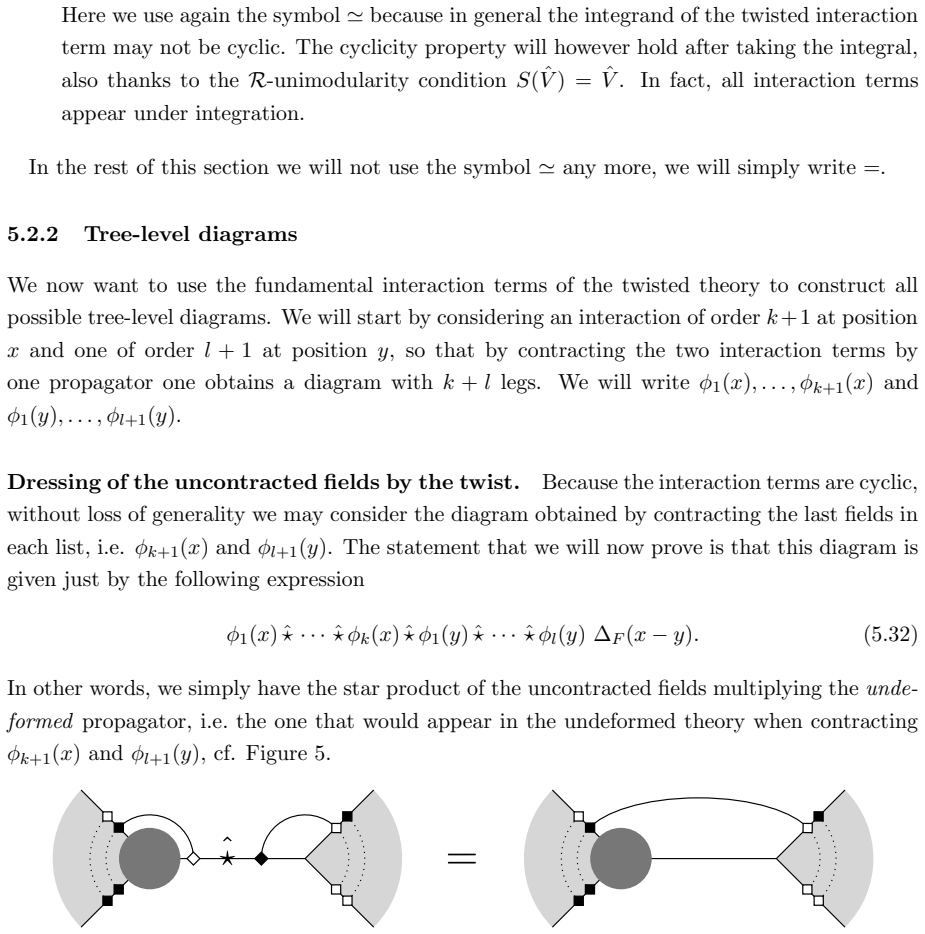
- [Section 5.2.2, Eq. (5.32)] The notation in Eq. (5.32) uses ϕ_1(x) and ϕ_1(y) for fields in two different vertices, which is confusing; please rename the second set of fields (e.g., ψ_i(y)) to avoid the clash.
Circularity Check
Central claims (R-unimodularity equals cyclicity under integration, and the planar equivalence theorem) are proven internally from stated definitions and assumptions; self-citations provide background but do not carry the argument.
full rationale
This is a construction paper whose central results are derived, not assumed, and no circular step reduces a claim to its own input. (1) The R-unimodularity condition is introduced algebraically in Section 3.1.1 from the requirement that the Drinfel'd element be trivial, u_F = 1, giving S(V) = V (eqs 3.13-3.14), with V defined purely from the twist, V = m(S⊗1)F^{-1} (eq 3.16). Cyclicity under integration is defined independently in Section 4.4 (eq 4.20) and then proven equivalent to S(V̂) = V̂ (eqs 4.21-4.23) using the integration-by-parts identity (B.13) and the symmetry-invariance of the seed Lagrangian. The two notions are not conflated: the equivalence is a theorem with a displayed proof. (2) The planar equivalence theorem is proven in Section 5.2 from the twist axioms, the R-unimodularity condition, and the Ward-identity invariance of the undeformed propagator (eqs 5.13-5.15, 5.20); the theorem's conclusion, that planar diagrams retain the undeformed internal structure with the twist acting only on external legs (eq 5.53), is not among the proof's inputs. The derivation is self-contained and follows the proof strategy of [52] rather than importing its conclusion. (3) There are no fitted parameters renamed as predictions; the construction is exact and the examples (abelian equivalent twist of eq 3.25, extended Jordanian twist of eqs 3.31-3.32) concretely demonstrate cases where F-unimodularity fails yet R-unimodularity holds. (4) Self-citations exist but are not load-bearing: [52] (Meier & van Tongeren) supplies the Poincaré-level planar equivalence starting point, [64] (Borsato & Meier) the scale-symmetry twist comparison, and [72], [74] (Borsato-Wulff, Borsato-Driezen) the r-matrix classifications used in the explicitly 'rough' Section 6, which disclaims completeness. These are independently published, checkable classifications and the paper proves its own generalisations; none of the cited results replaces a proof needed for the central claims.
Assumptions & free parameters
assumptions (5)
- domain assumption The symmetries used to construct the twist are exact symmetries of the undeformed seed action, classically and at the quantum level, i.e. without anomalies.
- domain assumption Supercharges entering the twists act linearly and off-shell on the undeformed field content, Q Phi = Q^A_B Phi^B, with auxiliary fields retained and gauge degrees of freedom not fixed.
- standard math Standard Hopf algebra and Drinfel'd twist machinery: cocycle condition (3.1), counit normalization, the correspondence between r-matrices and twist equivalence classes, and the equivalence relation (3.5).
- domain assumption The free propagator is invariant under every symmetry generator used in the twist, implemented via Weyl-Lie derivatives carrying classical scaling weights.
- domain assumption Integrals of total derivatives vanish, and only planar diagrams are considered.
Cite this review
Pith. "Pith review of A new perspective on non-commutative deformations of field and gauge theories." pith.science (2026). https://pith.science/paper/4KVB7VOJ
@misc{pith2026260804097,
  author       = {Pith},
  title        = {Pith review of: A new perspective on non-commutative deformations of field and gauge theories},
  year         = {2026},
  howpublished = {\url{https://pith.science/paper/4KVB7VOJ}},
  note         = {Machine review of arXiv:2608.04097}
}
abstract
We construct non-commutative deformations of field and gauge theories based on star-products implemented by Drinfel'd twists. We are able to encompass a large family of twists, including those built out of conformal symmetries and supersymmetries. The main idea behind our construction is to work with twists constructed from symmetries of the undeformed theory, that are realised as active symmetry transformations. We argue that our construction amounts to a reformulation of known deformations of gauge theories, and that it significantly extends the range of applicable examples. To ensure consistency with gauge invariance, we also identify a unimodularity condition that is weaker than the one that is normally employed in the literature, so that we can apply twists that would otherwise be left out. Finally, we also prove a planar equivalence theorem stating that the Feynman diagrams of the deformed theories retain an undeformed internal structure, with the twist acting only on their external legs. All these results are important to identify and work with deformations of $\mathcal N=4$ super Yang-Mills that are proposed to be dual to homogeneous Yang-Baxter deformations of the $AdS_5\times S^5$ superstring, but the applicability of our construction and results goes beyond that.
Figures


Figures from the paper (5 more)



Reference graph
Works this paper leans on
-
[17]
Noncommutative D=4 gravity coupled to fermions
P. Aschieri and L. Castellani,“Noncommutative D=4 gravity coupled to fermions”, JHEP 0906, 086 (2009),arxiv:0902.3817
arXiv 2009
- [54]
-
[1]
Quantum field theory on noncommutative spaces
R. J. Szabo,“Quantum field theory on noncommutative spaces”,Phys. Rept. 378, 207 (2003), hep-th/0109162
arXiv 2003
-
[2]
M. R. Douglas and N. A. Nekrasov,“Noncommutative field theory”, Rev. Mod. Phys. 73, 977 (2001),hep-th/0106048
arXiv 2001
-
[3]
Noncommutative Geometry of Gravity, Strings and Fields: A Panoramic Overview
R. J. Szabo,“Noncommutative Geometry of Gravity, Strings and Fields: A Panoramic Overview”, arxiv:2511.22672
-
[4]
Gauge theories on quantum spaces
K. Hersent, P. Mathieu and J.-C. Wallet,“Gauge theories on quantum spaces”, Phys. Rept. 1014, 1 (2023),arxiv:2210.11890
arXiv 2023
-
[5]
Introduction to noncommutative field and gauge theory
P. Vitale, M. Adamo, R. Dekhil and D. Fern´ andez-Silvestre,“Introduction to noncommutative field and gauge theory”,PoS QG-MMSchools, 007 (2024),arxiv:2309.17369
work page Pith review arXiv 2024
-
[6]
Noncommutative Gauge Theories: Yang-Mills extensions and beyond - An overview
J.-C. Wallet,“Noncommutative Gauge Theories: Yang-Mills extensions and beyond - An overview”,arxiv:2510.19112
Show all 80 references
-
[7]
Quantized space-time
H. S. Snyder,“Quantized space-time”,Phys. Rev. 71, 38 (1947)
1947
-
[8]
Noncommutative perturbative dynamics
S. Minwalla, M. Van Raamsdonk and N. Seiberg,“Noncommutative perturbative dynamics”, JHEP 0002, 020 (2000),hep-th/9912072
2000 arXiv
-
[9]
Braided symmetries in noncommutative field theory
G. Giotopoulos and R. J. Szabo,“Braided symmetries in noncommutative field theory”, J. Phys. A 55, 353001 (2022),arxiv:2112.00541
2022 arXiv
-
[10]
On constant quasi-classical solutions of the Yang-Baxter quantum equation
V. Drinfel’d,“On constant quasi-classical solutions of the Yang-Baxter quantum equation ”, Sov. Math. Dokl. 28, 667 (1983)
1983
-
[11]
Noncommutative geometry and gravity
P. Aschieri, M. Dimitrijevic, F. Meyer and J. Wess,“Noncommutative geometry and gravity”, Class. Quant. Grav. 23, 1883 (2006),hep-th/0510059
2006 arXiv
-
[12]
A Twisted look on kappa-Minkowski: U(1) gauge theory
M. Dimitrijevic and L. Jonke,“A Twisted look on kappa-Minkowski: U(1) gauge theory”, JHEP 1112, 080 (2011),arxiv:1107.3475
2011 arXiv
-
[13]
Quantum mechanics as a statistical theory
J. E. Moyal,“Quantum mechanics as a statistical theory”,Proc. Cambridge Phil. Soc. 45, 99 (1949)
1949
-
[14]
On the Principles of elementary quantum mechanics
H. J. Groenewold,“On the Principles of elementary quantum mechanics”,Physica 12, 405 (1946)
1946
-
[15]
Integrability in dipole-deformedN= 4super Yang–Mills
M. Guica, F. Levkovich-Maslyuk and K. Zarembo,“Integrability in dipole-deformedN= 4super Yang–Mills”,J. Phys. A A50, 394001 (2017),arxiv:1706.07957
2017 arXiv
-
[16]
Quadratic Twist-Noncommutative Gauge Theory
T. Meier and S. J. van Tongeren,“Quadratic Twist-Noncommutative Gauge Theory”, Phys. Rev. Lett. 131, 121603 (2023),arxiv:2301.08757
2023 arXiv
-
[18]
A Gravity theory on noncommutative spaces
P. Aschieri, C. Blohmann, M. Dimitrijevic, F. Meyer, P. Schupp and J. Wess,“A Gravity theory on noncommutative spaces”,Class. Quant. Grav. 22, 3511 (2005),hep-th/0504183
2005 arXiv
-
[19]
Differential calculus and gauge transformations on a deformed space
J. Wess,“Differential calculus and gauge transformations on a deformed space”, Gen. Rel. Grav. 39, 1121 (2007),hep-th/0607251
2007 arXiv
-
[20]
Gauge Theory on Twistedκ-Minkowski: Old Problems and Possible Solutions
M. Dimitrijevic, L. Jonke and A. Pachol,“Gauge Theory on Twistedκ-Minkowski: Old Problems and Possible Solutions”,SIGMA 10, 063 (2014),arxiv:1403.1857
2014 arXiv
-
[21]
Review of AdS/CFT Integrability: An Overview
N. Beisert et al.,“Review of AdS/CFT Integrability: An Overview”,Lett. Math. Phys. 99, 3 (2012), arxiv:1012.3982
2012 arXiv
-
[22]
Hidden symmetries of the AdS 5×S5 superstring
I. Bena, J. Polchinski and R. Roiban,“Hidden symmetries of the AdS 5×S5 superstring”, Phys. Rev. D D69, 046002 (2004),hep-th/0305116. 67
2004 arXiv
-
[23]
The Bethe ansatz for N=4 superYang-Mills
J. A. Minahan and K. Zarembo,“The Bethe ansatz for N=4 superYang-Mills”, JHEP 0303, 013 (2003),hep-th/0212208
2003 arXiv
-
[24]
The su(2|2)dynamic S-matrix
N. Beisert,“The su(2|2)dynamic S-matrix”,Adv.Theor.Math.Phys. 12, 945 (2008), hep-th/0511082
2008 arXiv
-
[25]
Thermodynamic Bethe Ansatz for planar AdS/CFT: A Proposal
D. Bombardelli, D. Fioravanti and R. Tateo,“Thermodynamic Bethe Ansatz for planar AdS/CFT: A Proposal”,J. Phys. A A42, 375401 (2009),arxiv:0902.3930
2009 arXiv
-
[26]
Thermodynamic Bethe Ansatz for the AdS(5) x S(5) Mirror Model
G. Arutyunov and S. Frolov,“Thermodynamic Bethe Ansatz for the AdS(5) x S(5) Mirror Model”, JHEP 0905, 068 (2009),arxiv:0903.0141
2009 arXiv
-
[27]
Exact Spectrum of Anomalous Dimensions of Planar N=4 Supersymmetric Yang-Mills Theory
N. Gromov, V. Kazakov and P. Vieira,“Exact Spectrum of Anomalous Dimensions of Planar N=4 Supersymmetric Yang-Mills Theory”,Phys. Rev. Lett. 103, 131601 (2009),arxiv:0901.3753
2009 arXiv
-
[28]
Quantum Spectral Curve for PlanarN= 4 Super-Yang-Mills Theory
N. Gromov, V. Kazakov, S. Leurent and D. Volin,“Quantum Spectral Curve for PlanarN= 4 Super-Yang-Mills Theory”,Phys. Rev. Lett. 112, 011602 (2014),arxiv:1305.1939
2014 arXiv
-
[29]
Yang-Baxter sigma models and dS/AdS T duality
C. Klimcik,“Yang-Baxter sigma models and dS/AdS T duality”,JHEP 0212, 051 (2002), hep-th/0210095
2002 arXiv
-
[30]
On integrability of the Yang-Baxter sigma-model
C. Klimcik,“On integrability of the Yang-Baxter sigma-model”,J. Math. Phys. 50, 043508 (2009), arxiv:0802.3518
2009 arXiv
-
[31]
An integrable deformation of the AdS 5×S5 superstring action
F. Delduc, M. Magro and B. Vicedo,“An integrable deformation of the AdS 5×S5 superstring action”,Phys.Rev.Lett. 112, 051601 (2014),arxiv:1309.5850
2014 arXiv
-
[32]
Jordanian deformations of theAdS 5xS5 superstring
I. Kawaguchi, T. Matsumoto and K. Yoshida,“Jordanian deformations of theAdS 5xS5 superstring”,JHEP 1404, 153 (2014),arxiv:1401.4855
2014 arXiv
-
[33]
Integrability of classical strings dual for noncommutative gauge theories
T. Matsumoto and K. Yoshida,“Integrability of classical strings dual for noncommutative gauge theories”,JHEP 1406, 163 (2014),arxiv:1404.3657
2014 arXiv
-
[34]
Yang–Baxter sigma models based on the CYBE
T. Matsumoto and K. Yoshida,“Yang–Baxter sigma models based on the CYBE”, Nucl. Phys. B B893, 287 (2015),arxiv:1501.03665
2015 arXiv
-
[35]
On classical Yang-Baxter based deformations of the AdS 5 ×S 5 superstring
S. J. van Tongeren,“On classical Yang-Baxter based deformations of the AdS 5 ×S 5 superstring”, JHEP 1506, 048 (2015),arxiv:1504.05516
2015 arXiv
-
[36]
Beauty and the twist: The Bethe ansatz for twisted N=4 SYM
N. Beisert and R. Roiban,“Beauty and the twist: The Bethe ansatz for twisted N=4 SYM”, JHEP 0508, 039 (2005),hep-th/0505187
2005 arXiv
-
[37]
Integrability of theAdS 5 ×S 5 superstring and its deformations
S. J. van Tongeren,“Integrability of theAdS 5 ×S 5 superstring and its deformations”, J.Phys. A47, 433001 (2014),arxiv:1310.4854
2014 arXiv
-
[38]
Jordanian deformation of the non-compact andsl 2-invariant XXX−1/2 spin-chain
R. Borsato and M. G. Fern´ andez,“Jordanian deformation of the non-compact andsl 2-invariant XXX−1/2 spin-chain”,JHEP 2508, 074 (2025),arxiv:2503.24223
2025 arXiv
-
[39]
Jordanian spin chains for twisted strings in AdS5×S5
S. Driezen and A. Molines,“Jordanian spin chains for twisted strings in AdS5×S5”, Phys. Rev. D 112, 106001 (2025),arxiv:2507.13911
2025
-
[40]
Integrability for the spectrum of Jordanian AdS/CFT
S. Driezen, F. Levkovich-Maslyuk and A. Molines,“Integrability for the spectrum of Jordanian AdS/CFT”,JHEP 2604, 052 (2026),arxiv:2511.11521
2026
-
[41]
Groenewold-Moyal twists, integrable spin-chains and AdS/CFT
R. Borsato and M. Garc ´ ıa Fern´ andez,“Groenewold-Moyal twists, integrable spin-chains and AdS/CFT”,arxiv:2604.07291
-
[42]
On Yang–Baxter models, twist operators, and boundary conditions
S. J. Van Tongeren,“On Yang–Baxter models, twist operators, and boundary conditions”, J. Phys. A 51, 305401 (2018),arxiv:1804.05680
2018 arXiv
-
[43]
Homogeneous Yang-Baxter deformations as undeformed yet twisted models
R. Borsato, S. Driezen and J. L. Miramontes,“Homogeneous Yang-Baxter deformations as undeformed yet twisted models”,JHEP 2204, 053 (2022),arxiv:2112.12025. 68
2022 arXiv
-
[44]
Deforming field theories withU(1)×U(1)global symmetry and their gravity duals
O. Lunin and J. M. Maldacena,“Deforming field theories withU(1)×U(1)global symmetry and their gravity duals”,JHEP 0505, 033 (2005),hep-th/0502086
2005 arXiv
-
[45]
Exactly marginal operators and duality in four-dimensional N=1 supersymmetric gauge theory
R. G. Leigh and M. J. Strassler,“Exactly marginal operators and duality in four-dimensional N=1 supersymmetric gauge theory”,Nucl. Phys. B 447, 95 (1995),hep-th/9503121
1995 arXiv
-
[46]
Large N limit of noncommutative gauge theories
J. M. Maldacena and J. G. Russo,“Large N limit of noncommutative gauge theories”, JHEP 9909, 025 (1999),hep-th/9908134
1999 arXiv
-
[47]
Noncommutative Yang-Mills and the AdS / CFT correspondence
A. Hashimoto and N. Itzhaki,“Noncommutative Yang-Mills and the AdS / CFT correspondence”, Phys. Lett. B B465, 142 (1999),hep-th/9907166
1999 arXiv
-
[48]
Yang–Baxter deformations, AdS/CFT, and twist-noncommutative gauge theory
S. J. van Tongeren,“Yang–Baxter deformations, AdS/CFT, and twist-noncommutative gauge theory”,Nucl. Phys. B B904, 148 (2016),arxiv:1506.01023
2016 arXiv
-
[49]
Almost abelian twists and AdS/CFT
S. J. van Tongeren,“Almost abelian twists and AdS/CFT”,Phys. Lett. B B765, 344 (2017), arxiv:1610.05677
2017 arXiv
-
[50]
Yang-Baxterσ-models, conformal twists, and noncommutative Yang-Mills theory
T. Araujo, I. Bakhmatov, E. O. Colg´ ain, J. Sakamoto, M. M. Sheikh-Jabbari and K. Yoshida, “Yang-Baxterσ-models, conformal twists, and noncommutative Yang-Mills theory”, Phys. Rev. D D95, 105006 (2017),arxiv:1702.02861
2017 arXiv
-
[51]
Conformal twists, Yang–Baxterσ-models & holographic noncommutativity
T. Araujo, I. Bakhmatov, E. ´O. Colg´ ain, J.-i. Sakamoto, M. M. Sheikh-Jabbari and K. Yoshida, “Conformal twists, Yang–Baxterσ-models & holographic noncommutativity”, J. Phys. A 51, 235401 (2018),arxiv:1705.02063
2018 arXiv
-
[52]
Gauge theory on twist-noncommutative spaces
T. Meier and S. J. van Tongeren,“Gauge theory on twist-noncommutative spaces”, JHEP 2312, 045 (2023),arxiv:2305.15470
2023 arXiv
-
[53]
Divergencies in a field theory on quantum space
T. Filk,“Divergencies in a field theory on quantum space”,Physics Letters B 376, 53 (1996), https://www.sciencedirect.com/science/article/pii/037026939600024X
1996
-
[55]
Harmonic superspace
A. S. Galperin, E. A. Ivanov, V. I. Ogievetsky and E. S. Sokatchev,“Harmonic superspace”, Cambridge University Press (2007)
2007
-
[56]
Constant quasiclassical solutions of the Yang–Baxter quantum equation
V. G. Drinfeld,“Constant quasiclassical solutions of the Yang–Baxter quantum equation ”, in: “Doklady Akademii Nauk”, 531–535p
-
[57]
Bialgebra actions, twists, and universal deformation formulas
A. Giaquinto and J. J. Zhang,“Bialgebra actions, twists, and universal deformation formulas”, J. Pure Appl. Algebra 128, 133 (1998),hep-th/9411140
1998 arXiv
-
[58]
Twist Deformations of Quantum Integrable Spin Chains
P. Kulish,“Twist Deformations of Quantum Integrable Spin Chains”, in:“Noncommutative Spacetimes: Symmetries in Noncommutative Geometry and Field Theory”, Springer Berlin Heidelberg (2009), Berlin, Heidelberg, 167–190p, https://doi.org/10.1007/978-3-540-89793-4 9
2009 doi
-
[59]
Chains of extended Jordanian twists for Lie superalgebras
V. N. Tolstoy,“Chains of extended Jordanian twists for Lie superalgebras”,math/0402433, https://arxiv.org/abs/math/0402433
-
[60]
Hopf algebras and the quantum Yang-Baxter equation
V. G. Drinfeld,“Hopf algebras and the quantum Yang-Baxter equation”, Sov. Math. Dokl. 32, 254 (1985)
1985
-
[61]
Twisted gauge theories
P. Aschieri, M. Dimitrijevic, F. Meyer, S. Schraml and J. Wess,“Twisted gauge theories”, Lett. Math. Phys. 78, 61 (2006),hep-th/0603024
2006 arXiv
-
[62]
Twist to close
D. V. Vassilevich,“Twist to close”,Mod. Phys. Lett. A 21, 1279 (2006),hep-th/0602185
2006 arXiv
-
[63]
Deformation quantization of Poisson manifolds. 1
M. Kontsevich,“Deformation quantization of Poisson manifolds. 1.”, Lett. Math. Phys. 66, 157 (2003),q-alg/9709040. 69
2003 arXiv
-
[64]
Non-commutative deformations of gauge theories via Drinfel’d twists of the scale symmetry
R. Borsato and T. Meier,“Non-commutative deformations of gauge theories via Drinfel’d twists of the scale symmetry”,arxiv:2512.04162
-
[65]
Noncommutative spacetimes: Symmetries in noncommutative geometry and field theory
P. Aschieri, M. Dimitrijevic, P. Kulish, F. Lizzi and J. Wess,“Noncommutative spacetimes: Symmetries in noncommutative geometry and field theory”
-
[66]
Abelian Yang–Baxter deformations and TsT transformations
D. Osten and S. J. van Tongeren,“Abelian Yang–Baxter deformations and TsT transformations”, Nucl. Phys. B B915, 184 (2017),arxiv:1608.08504
2017 arXiv
-
[67]
Space-time noncommutative field theories and unitarity
J. Gomis and T. Mehen,“Space-time noncommutative field theories and unitarity”, Nucl. Phys. B 591, 265 (2000),hep-th/0005129
2000 arXiv
-
[68]
Space-time noncommutativity and causality
N. Seiberg, L. Susskind and N. Toumbas,“Space-time noncommutativity and causality”, JHEP 0006, 044 (2000),hep-th/0005015
2000 arXiv
-
[69]
Integrable Spin Chains in Twisted Maximally Supersymmetric Yang-Mills Theory
T. Meier and S. J. van Tongeren,“Integrable Spin Chains in Twisted Maximally Supersymmetric Yang-Mills Theory”,Phys. Rev. Lett. 136, 051601 (2026),arxiv:2507.18626
2026
-
[70]
Noncommutative superspace, N = 1/2 supersymmetry, field theory and string theory
N. Seiberg,“Noncommutative superspace, N = 1/2 supersymmetry, field theory and string theory”, JHEP 0306, 010 (2003),hep-th/0305248
2003 arXiv
-
[71]
New twisted quantum deformations of D=4 super-Poincare algebra
A. Borowiec, J. Lukierski and V. N. Tolstoy,“New twisted quantum deformations of D=4 super-Poincare algebra”,arxiv:0803.4167, in:“7th International Workshop on Supersymmetries and Quantum Symmetries”, 205–216p
-
[72]
Target space supergeometry ofηandλ-deformed strings
R. Borsato and L. Wulff,“Target space supergeometry ofηandλ-deformed strings”, JHEP 1610, 045 (2016),arxiv:1608.03570
2016 arXiv
-
[73]
Unimodular jordanian deformations of integrable superstrings
S. J. van Tongeren,“Unimodular jordanian deformations of integrable superstrings”, SciPost Phys. 7, 011 (2019),arxiv:1904.08892
2019 arXiv
-
[74]
All Jordanian deformations of theAdS 5 ×S 5 superstring
R. Borsato and S. Driezen,“All Jordanian deformations of theAdS 5 ×S 5 superstring”, SciPost Phys. 14, 160 (2023),arxiv:2212.11269
2023 arXiv
-
[75]
Trivial solutions of generalized supergravity vs non-abelian T-duality anomaly
L. Wulff,“Trivial solutions of generalized supergravity vs non-abelian T-duality anomaly”, Phys. Lett. B781, 417 (2018),arxiv:1803.07391
2018 arXiv
-
[76]
Relaxing unimodularity for Yang-Baxter deformed strings
S. Hronek and L. Wulff,“Relaxing unimodularity for Yang-Baxter deformed strings”, JHEP 2010, 065 (2020),arxiv:2007.15663
2020 arXiv
-
[77]
Observables of noncommutative gauge theories
D. J. Gross, A. Hashimoto and N. Itzhaki,“Observables of noncommutative gauge theories”, Adv. Theor. Math. Phys. 4, 893 (2000),hep-th/0008075
2000 arXiv
-
[78]
Introduction to doubly special relativity
J. Kowalski-Glikman,“Introduction to doubly special relativity”,Lect. Notes Phys. 669, 131 (2005), hep-th/0405273
2005 arXiv
-
[79]
Supergravity backgrounds of theη-deformed AdS 2 ×S 2 ×T 6 and AdS5 ×S 5 superstrings
B. Hoare and F. K. Seibold,“Supergravity backgrounds of theη-deformed AdS 2 ×S 2 ×T 6 and AdS5 ×S 5 superstrings”,JHEP 1901, 125 (2019),arxiv:1811.07841
2019 arXiv
-
[80]
Supergravity
D. Z. Freedman and A. Van Proeyen,“Supergravity”, Cambridge Univ. Press (2012), Cambridge, UK. 70
2012
Reviewed August 8, 2026 · model on record in the stance chip above.
Discussion (0). Continue with ORCID to comment.