REVIEW 4 major objections 5 minor 35 references
The two-particle-irreducible vertex of the two-dimensional lattice $\phi^4$ model across the Ising transition
T0 review · 4 major / 5 minor · reviewed 2026-08-15 · deepseek-v4-flash
Pith's one-line read By stripping the crossed-channel ladders from Monte Carlo vertex data, the fully irreducible vertex of the two-dimensional phi^4 lattice model reduces to a local contact that reproduces the exact self-energy to within one-tenth of a…
desk verdict A serious, well-documented Monte Carlo reconstruction of the 2PI vertex for 2D phi^4 gives the first full channel-resolved map and a sensible local-contact picture, but the 'pure contact' claim overreaches a 4-sigma tail and the 0.1% self-energy test is partly blind to it. read the letter →
The pith
A machine-rendered reading of the paper's core claim, the machinery that carries it, and where it could break.
The reading
What carries the argument
The central object is the fully irreducible vertex $\Lambda$, the part of the two-particle vertex that cannot be torn apart by cutting two particle lines, defined through the parquet equation $\Lambda=\Gamma_{\mathrm{ph}}+\Gamma_{\mathrm{pp}}+\Gamma_{\overline{\mathrm{ph}}}-2F$. Because the field is real and the interaction is a single on-site $\phi^4$ term, the connected four-point function is fully crossing symmetric, so the three channels reduce to one function evaluated at three different momentum transfers and the parquet loop collapses to an iteration over the transfer momentum alone. The argument is carried by the observation that $\Lambda$ behaves as a contact: the effective value $\lambda_{\mathrm{eff}}=N^{-2}\sum_{Q,k,p}\Lambda(k,p;Q)$ alone, fed into the Schwinger–Dyson sunset diagram, reproduces the Monte Carlo self-energy to better than a tenth of a percent. The instability analysis runs through the symmetrized Bethe–Salpeter kernel $K=\chi_0^{1/2}\Gamma\chi_0^{1/2}$, whose leading eigenvalues in the $C_{4v}$ sectors track the ferromagnetic, nematic, and diagonal-nematic channels.
What would settle it
Run higher-statistics Monte Carlo at $L=32$ or $L=64$ near $\beta\simeq0.685$ and measure $\Lambda(r_1)/\Lambda(r_0)$: if the ratio settles at a nonzero value of order 2–3 percent rather than falling toward zero, the pure-contact picture is wrong. A complementary check is to include a short-range tail of that size in the parquet closure and test whether the resulting self-energy shifts by more than the claimed one-tenth of a percent.
Extended reading notes
Core claim
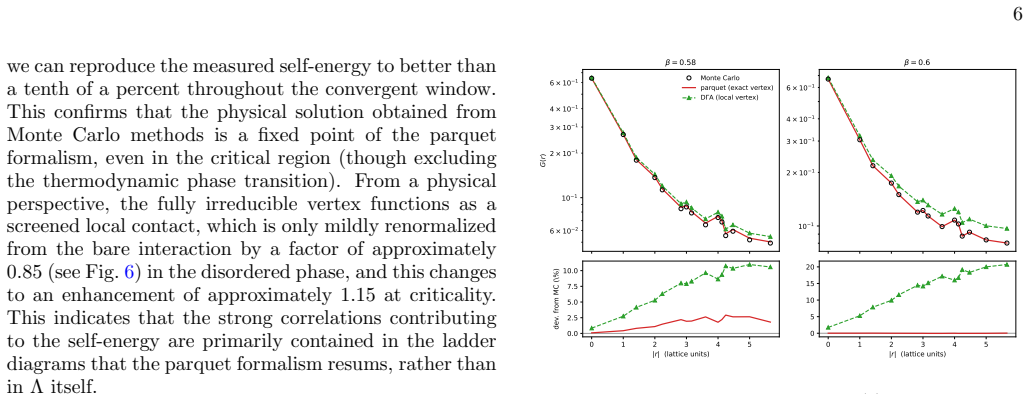
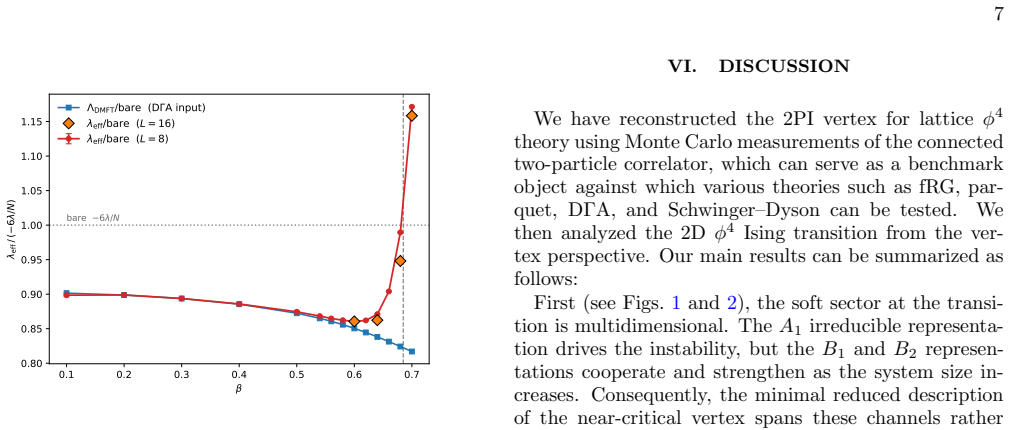
On its own terms, the paper claims that the fully irreducible vertex $\Lambda$, defined by the parquet equation $\Lambda = \Gamma_{\mathrm{ph}} + \Gamma_{\mathrm{pp}} + \Gamma_{\overline{\mathrm{ph}}} - 2F$, is a local contact: after the crossed-channel ladders are removed from the Monte Carlo-reconstructed 2PI vertex, the relative-coordinate weight at one lattice spacing is only 0.2% to 3% of the on-site value, and at $L=16$, $\beta=0.68$ the ratio $\Lambda(r_1)/\Lambda(r_0)=0.0250\pm0.0064$ is read as a pure contact within four standard deviations. Inserting the effective contact $\lambda_{\mathrm{eff}}=N^{-2}\sum_{Q,k,p}\Lambda(k,p;Q)$ into the parquet and Schwinger–Dyson equations while holding the propagator at its Monte Carlo value reproduces the measured self-energy to better than one-tenth of a percent across the convergent window, which the paper presents as a first-principles benchmark of D$\Gamma$A. Away from criticality the fully self-consistent single-site D$\Gamma$A vertex agrees with $\lambda_{\mathrm{eff}}$ within a few percent, while near criticality the measured contact is enhanced by about 15% relative to the bare interaction rather than screened. The paper also claims that the critical soft sector is multidimensional—$A_1$, $B_1$, and $B_2$ all grow with system size—and that in the critical region the physical solution of the parquet equations becomes a repulsive fixed point driven initially by a single order-parameter mode.
Load-bearing premise
The claim that the fully irreducible vertex is exactly a local contact rests on treating the nearest-neighbor weight $\Lambda(r_1)/\Lambda(r_0)=0.0250\pm0.0064$ measured at the critical point as zero; if that few-percent tail is real, the contact-only parquet closure is an approximation rather than an exact benchmark.
Editorial extensions
If this is right
- If the fully irreducible vertex really is a contact, the dynamical vertex approximation D$\Gamma$A is validated as a near-exact closure for local observables in the disordered phase of $\phi^4$ lattice field theory.
- The measured vertex becomes a controlled benchmark: parquet-type two-particle theories can be tested against it on the disordered side of the transition, and the boundary of their validity is located where the correlation length exceeds one lattice spacing.
- A faithful minimal description of the near-critical vertex must include the $B_1$ and $B_2$ stress-tensor channels alongside the $A_1$ energy channel, and the $B_1/B_2$ eigenvalue ratio locks to a finite value as the lattice grows, reflecting emergent rotational symmetry.
- Parquet self-consistency loses convergence below the thermodynamic transition because the physical fixed point becomes repulsive; the loss is a finite-size effect whose onset drifts toward $\beta_c$ as the system size increases.
- In the ordered phase the zero-transfer eigenvalue collapses because the ferromagnetic weight condenses into the order parameter, while finite-momentum fluctuations persist well into the ordered phase.
Reading between the lines
- If the roughly 2.5% nearest-neighbor weight seen in $\Lambda$ at criticality is a real remnant rather than noise, the contact-only parquet closure could still reproduce the self-energy to 0.1% only because that tail contributes negligibly to the sunset diagram; a testable extension is to include a short-range tail and compute when the benchmark breaks.
- The same Monte-Carlo-reconstruction route could be applied to $O(N)$ models, where the $N=2$ quasi-long-range-ordered phase would be a sharper test of the contact picture because a gapless Goldstone sector may feed nonlocal weight into the fully irreducible vertex.
- The finding that Dyson feedback destabilizes the self-consistent iteration before the fixed-propagator map does suggests that any self-consistent closure whose ladder eigenvalue approaches unity may lose convergence before the physical transition, independent of the specific parquet equations.
- Because the center-of-mass structure of the 2PI vertex lives almost entirely in the ladders, the locality of the fully irreducible vertex is what makes local approximations viable; whether this persists in fermionic systems with multivalued Luttinger–Ward functionals remains an open question.
Signed reviews
Editorial analysis
A structured set of objections, weighed in public.
Referee Report
Summary. This paper uses Monte Carlo measurements of the connected two-particle correlator of the two-dimensional lattice phi^4 model to reconstruct the two-particle-irreducible vertex Gamma(k,p;q) by Bethe-Salpeter inversion. The vertex is decomposed into C_4v irreducible representations, its leading eigenvalues are tracked across the Ising transition, and the fully irreducible vertex Lambda is obtained by stripping crossed-channel ladders via the parquet equation. The central claims are that Lambda is a local contact, that inserting its effective value lambda_eff into the parquet and Schwinger-Dyson equations reproduces the Monte Carlo self-energy to better than 0.1%, and that this provides a benchmark for DGammaA. The paper also analyzes the stability of the parquet self-consistency in the critical region, identifying a repulsive fixed point and a single soft A_1 mode at the onset of the convergence wall.
Significance. The paper is valuable as one of the first direct, channel-resolved reconstructions of the 2PI vertex and the fully irreducible vertex for a lattice phi^4 theory, and it provides a concrete numerical comparison with DGammaA. The appendices document the technical machinery--null-space projection, threshold selection, bootstrap errors, and finite-size checks--in unusual detail, and the data/code availability statement is a strength. If the contact claim is established, the result would be a useful benchmark for parquet, fRG, and DGammaA communities. The DGammaA comparison via an independent single-site impurity calculation is a genuine strength of the paper.
major comments (4)
- [Section V, Fig. 3 inset] The statement that Lambda(r1)/Lambda(r0)=0.0250 +/- 0.0064 at L=16, beta=0.68 is a "pure contact term within 4 sigma" is statistically misleading. The measured ratio is approximately 3.9 sigma from zero, so the data are evidence for a small nearest-neighbor tail, not evidence for an exact contact. The same applies to the beta=0.64 value, which is about 2.7 sigma from zero. The paper should either weaken the claim to "consistent with a contact at the present resolution" or provide a quantitative bound on the tail's contribution to the observables used in the benchmark.
- [Section V, Appendix D, Eq. (D4)] The reported 0.1% agreement of the contact parquet closure with the Monte Carlo self-energy does not test the contact-only assumption for k-resolved quantities. The effective coupling lambda_eff = N^{-2} sum_{Q,k,p} Lambda(k,p;Q) is a Brillouin-zone average; any r != 0 Fourier component of Lambda sums to zero in this average, so lambda_eff contains only the on-site part of Lambda. The local self-energy <Sigma(k)>_k is consequently insensitive to a tail with zero total momentum sum. The k-resolved agreement of 4 x 10^{-4} quoted in Appendix D is obtained with the measured full F, not with the contact Lambda. Thus the numerical evidence does not establish that a residual short-range tail is harmless for the parquet closure; it establishes only that the on-site part of Lambda is sufficient for the local self-energy.
- [Section V, Appendix F] The paper's own Appendix F states that lambda_eff is orthogonal to the noisy tail and that extracting a range xi_Lambda from the tail is not meaningful on current statistics. This is an important limitation that should be stated in the main text when the "pure contact" conclusion is drawn. Given this, the abstract's assertion that the vertex is "a local contact" overstates the evidence; the supported statement is that the fully irreducible vertex is contact-dominated at the achieved resolution.
- [Abstract and Section V] The DGammaA comparison in Figs. 4-6 is a genuine independent test, and the agreement of Lambda_DMFT with lambda_eff away from criticality is a positive result. However, the "first-principles benchmark" language is too strong for the 0.1% self-energy claim because that claim uses lambda_eff and G from the same Monte Carlo dataset; it is a same-data closure check rather than an out-of-sample prediction. The paper should distinguish the independent DGammaA benchmark from the internal consistency check and rephrase the abstract accordingly.
minor comments (5)
- [Fig. 2 caption] The caption text "Gamma X M" should read "Gamma, X, and M" for clarity.
- [Section V] The ratios Lambda(r1)/Lambda(r0) are reported with "within 1 sigma/3 sigma/4 sigma" phrasing; consider reporting p-values or confidence intervals instead, since these statements are not standard evidence for a zero value.
- [Appendix D] The notation for the two particle-hole channels, Gamma_ph and Gamma_ph with an overbar, is easy to confuse; using an explicit overline or a different symbol consistently would improve readability.
- [Section V] The sentence "It is worth noting that the term Q=0 predominantly contributes to this summation; however, it exceeds lambda_eff by an unacceptable 2-3% when beta >= 0.6" is unclear and should be expanded or moved to an appendix.
- [Fig. 3 and Section V] The Fig. 3 inset is described in the text for L=8, while the nearby discussion in Section V reports L=16 ratios; please clarify which dataset is shown in the inset.
Circularity Check
No significant circularity; the effective contact is measured, not fitted, and the DΓA comparison is an independent single-site benchmark.
full rationale
Walking the claimed derivation chain, I find no load-bearing step that reduces to its own inputs by construction. The 2PI vertex Γ is obtained by the BSE inversion Γ = χ_0^{-1} - χ^{-1} from Monte Carlo susceptibilities (Eq. 3), a different observable from the one-particle self-energy. The fully irreducible vertex Λ is then constructed from the same measured channels through the parquet equation (Eq. 5), which is a non-tautological reduction. The effective contact λ_eff is defined as the Brillouin-zone sum λ_eff = N^{-2}Σ_{Q,k,p} Λ(k,p;Q), i.e. it is a directly measured integral of Λ, not a parameter fitted to the self-energy. Inserting this measured λ_eff at the measured G and solving the parquet–Schwinger–Dyson equations gives a self-energy matching Monte Carlo to under 0.1%; nothing in the iteration algebra forces that agreement, and it can fail, as the bare-vertex and DΓA runs in Fig. 4 show. The DΓA comparison itself is an external single-site impurity calculation (App. E, Fig. 6), independent of the lattice Monte Carlo vertex, and is therefore a genuine benchmark. The skeptical objection concerning Λ(r_1)/Λ(r_0) = 0.0250±0.0064 at β=0.68 is a statistical-interpretation concern, not circularity: the paper explicitly concedes that a short-ranged low-amplitude tail may develop at larger L and that λ_eff is an effective contact that averages over any such tail. A tail with small or zero momentum sum being invisible to λ_eff means the self-energy check is not a sharp test of locality, but that is a limitation of evidence, not a circular reduction. There are also no load-bearing self-citations: the references include standard parquet, DMFT, and fRG literature, and the cited stabilization work [25] is not by the present author. The paper is self-contained, and its central benchmark is the measured λ_eff compared with an independently computed single-site vertex.
Assumptions & free parameters
free parameters (4)
- lambda_eff (effective contact of the fully irreducible vertex) =
about 0.85 to 1.15 times the bare vertex -6*lambda/N across beta from 0.3 to 0.7
- Power-law tail exponent a =
a=2.4, 2.0, 1.8 at beta=0.64, 0.66, 0.68 for L=16
- Pseudo-inverse truncation threshold tau =
10^-6, stable over the range 10^-6 to 10^-4
- Limiting eigenvalue ratio lambda_B1 / lambda_B2 =
about 1.2 by linear 1/L extrapolation from values 2.08, 1.63, 1.44 at L=8, 16, 32
assumptions (6)
- domain assumption Bethe-Salpeter inversion Gamma = chi_0^-1 - chi^-1 is exact on the physical subspace after projection of the null space and truncation.
- domain assumption The Brower-Tamayo cluster algorithm and ALPSCore implementation yield unbiased estimates of the connected four-point correlator.
- standard math For a finite Euclidean lattice the Luttinger-Ward functional is unique, making chi positive definite and all channel vertices invertible.
- domain assumption The connected four-point function is fully crossing symmetric, so the three parquet channels reduce to one function evaluated at three transfers.
- ad hoc to paper The unresolved tail of Lambda is negligible for the sunset self-energy, so Lambda can be replaced by the contact lambda_eff.
- domain assumption The second-moment crossing beta_c about 0.685 identifies the thermodynamic transition used to label the critical region.
Cite this review
Pith. "Pith review of The two-particle-irreducible vertex of the two-dimensional lattice $\phi^4$ model across the Ising transition." pith.science (2026). https://pith.science/paper/MM7P2X7Q
@misc{pith2026260804497,
  author       = {Pith},
  title        = {Pith review of: The two-particle-irreducible vertex of the two-dimensional lattice $\phi^4$ model across the Ising transition},
  year         = {2026},
  howpublished = {\url{https://pith.science/paper/MM7P2X7Q}},
  note         = {Machine review of arXiv:2608.04497}
}
abstract
We reconstruct the 2PI vertex $\Gamma(k,p;q)$ from Monte Carlo measurements of the connected two-particle correlator for the two-dimensional single-component $\phi^4$ lattice field theory and follow it across the Ising transition. Resolving the vertex in the irreducible representations of the point group $C_{4v}$, we find that the instability is driven by the $A_1$ (ferromagnetic) channel at zero transfer, whose leading eigenvalue of the symmetrized Bethe--Salpeter kernel approaches unity. Substantial $B_1$ (nematic) and $B_2$ (diagonal nematic) contributions cooperate with $A_1$ across all system sizes, highlighting that the soft sector is multidimensional. In real space, the vertex is short-ranged away from criticality while it develops a power-law tail at the critical point. In the ordered phase, the $q=0$ eigenvalue collapses because the ferromagnetic weight has condensed into the (one-particle-reducible) order parameter (or collective coordinate for a finite system), although finite-momentum fluctuations persist. By stripping the crossed-channel ladders, we obtain the fully irreducible vertex, which is a local contact -- to a very good approximation. Inserted into the parquet and Schwinger--Dyson equations, this contact reproduces the Monte Carlo self-energy with an accuracy better than one-tenth of a percent. This provides a first-principles benchmark of the dynamical local-vertex approximation (D$\Gamma$A). Additionally, we demonstrate that in the critical region, the physical solution of the parquet equations behaves as a repulsive fixed point, driven initially by a single order-parameter mode.
Figures


Figures from the paper (5 more)



Reference graph
Works this paper leans on
-
[1]
A. A. Abrikosov, L. P. Gorkov, and I. E. Dzyaloshinskii, Methods of Quantum Field Theory in Statistical Physics (Dover Publications, Mineola, NY, 1963)
work page 1963
-
[2]
In the (1/n!)V n con- vention the bare amputated quartic vertex isV 4 = 24λ; the symmetric transform turns the on-siteλ P xϕ4 x into a momentum-conserving vertexV mom 4 = 24λ/N. Two-particle correlator and particle–hole vertex.With ρq(k) =ϕ ∗ kϕk+q the measured connected correlator and its non-interacting counterpart are χ(k,p;q) =⟨ρ q(k)ρq(p)∗⟩−⟨ρ q(k)⟩⟨...
-
[3]
There is also a factor 1 4 between the amputated bare vertexV 4 = 24λand the contact measured in our normalization, and this places the ampu- tated tree vertex atF tree =−V 4/4 =−6λ/N. This fixes the normalization convention used throughout the paper in which the local contactλ eff =N −2P Q,k,p Λ(k,p;Q) and the bare parquet input (−6λ/N) are quoted. Appen...
-
[4]
A. L. Fetter and J. D. Walecka,Quantum Theory of Many-Particle Systems(McGraw–Hill, New York, 1971)
1971
-
[5]
J. W. Negele and H. Orland,Quantum Many-Particle Systems(Addison–Wesley, Redwood City, CA, 1988)
work page 1988
-
[6]
E. E. Salpeter and H. A. Bethe, A Relativistic Equation for Bound-State Problems, Phys. Rev.84, 1232 (1951)
1951
-
[7]
Onsager, Crystal Statistics
L. Onsager, Crystal Statistics. I. A Two-Dimensional Model with an Order-Disorder Transition, Phys. Rev.65, 117 (1944)
1944
-
[8]
I. T. Diatlov, V. V. Sudakov, and K. A. Ter-Martirosian, Asymptotic meson-meson scattering theory, Sov. Phys. JETP5, 631 (1957)
work page 1957
Show all 35 references
-
[9]
De Dominicis and P
C. De Dominicis and P. C. Martin, Stationary Entropy Principle and Renormalization in Normal and Superfluid Systems. I. Algebraic Formulation, J. Math. Phys.5, 14 (1964)
1964
-
[10]
N. E. Bickers and S. R. White, Conserving approxima- tions for strongly fluctuating electron systems. II. Nu- merical results and parquet extension, Phys. Rev. B43, 8044 (1991)
1991
-
[11]
Berges,n-particle irreducible effective action tech- niques for gauge theories, Phys
J. Berges,n-particle irreducible effective action tech- niques for gauge theories, Phys. Rev. D70, 105010 (2004)
2004
-
[12]
M. E. Carrington, The 4PI effective action forϕ 4theory, The European Physical Journal C - Particles and Fields 35, 383 (2004)
2004
-
[13]
C. D. Roberts and A. G. Williams, Dyson-Schwinger equations and their application to hadronic physics, Progress in Particle and Nuclear Physics33, 477 (1994)
1994
-
[14]
Metzner, M
W. Metzner, M. Salmhofer, C. Honerkamp, V. Meden, and K. Sch¨ onhammer, Functional renormalization group approach to correlated fermion systems, Rev. Mod. Phys. 84, 299 (2012)
2012
-
[15]
Berges, N
J. Berges, N. Tetradis, and C. Wetterich, Non- perturbative renormalization flow in quantum field the- ory and statistical physics, Physics Reports363, 223 (2002), renormalization group theory in the new millen- nium. IV
2002
-
[16]
Rohringer, H
G. Rohringer, H. Hafermann, A. Toschi, A. A. Katanin, A. E. Antipov, M. I. Katsnelson, A. I. Lichtenstein, A. N. Rubtsov, and K. Held, Diagrammatic routes to nonlocal correlations beyond dynamical mean field theory, Rev. Mod. Phys.90, 025003 (2018)
2018
-
[17]
R. C. Brower and P. Tamayo, Embedded Dynamics for ϕ4 Theory, Phys. Rev. Lett.62, 1087 (1989)
1989
-
[18]
Baym and L
G. Baym and L. P. Kadanoff, Conservation Laws and Correlation Functions, Phys. Rev.124, 287 (1961)
1961
-
[19]
Baym, Self-Consistent Approximations in Many-Body Systems, Phys
G. Baym, Self-Consistent Approximations in Many-Body Systems, Phys. Rev.127, 1391 (1962)
1962
-
[20]
A. I. Guerrero, D. A. Stariolo, and N. G. Almarza, Ne- matic phase in theJ 1-J2 square-lattice Ising model in an external field, Phys. Rev. E91, 052123 (2015)
2015
-
[21]
Lin and M
L. Lin and M. Lindsey, Variational structure of Luttinger- Ward formalism and bold diagrammatic expansion for Euclidean lattice field theory, Proc. Natl. Acad. Sci. U.S.A.115, 2282 (2018)
2018
-
[22]
Kozik, M
E. Kozik, M. Ferrero, and A. Georges, Nonexistence of the Luttinger-Ward Functional and Misleading Conver- gence of Skeleton Diagrammatic Series for Hubbard-Like Models, Phys. Rev. Lett.114, 156402 (2015)
2015
-
[23]
Sch¨ afer, S
T. Sch¨ afer, S. Ciuchi, M. Wallerberger, P. Thunstr¨ om, O. Gunnarsson, G. Sangiovanni, G. Rohringer, and A. Toschi, Nonperturbative landscape of the Mott- Hubbard transition: Multiple divergence lines around the critical endpoint, Phys. Rev. B94, 235108 (2016)
2016
-
[24]
Gunnarsson, T
O. Gunnarsson, T. Sch¨ afer, J. P. F. LeBlanc, J. Merino, G. Sangiovanni, G. Rohringer, and A. Toschi, Parquet decomposition calculations of the electronic self-energy, Phys. Rev. B93, 245102 (2016)
2016
-
[25]
Gunnarsson, G
O. Gunnarsson, G. Rohringer, T. Sch¨ afer, G. Sangio- vanni, and A. Toschi, Breakdown of Traditional Many- Body Theories for Correlated Electrons, Phys. Rev. Lett. 119, 056402 (2017)
2017
-
[26]
Toschi, A
A. Toschi, A. A. Katanin, and K. Held, Dynamical ver- tex approximation: A step beyond dynamical mean-field theory, Phys. Rev. B75, 045118 (2007)
2007
-
[27]
H. Eßl, S. Rohshap, M. Gievers, M. Wallerberger, A. Toschi, and A. Kauch, Stabilizing the parquet problem (2026), arXiv:2606.04936 [cond-mat.str-el]
2026 arXiv
-
[28]
H. F. Walker and P. Ni, Anderson Acceleration for Fixed- Point Iterations, SIAM Journal on Numerical Analysis 49, 1715 (2011), https://doi.org/10.1137/10078356X
2011 doi
-
[29]
Fang and Y
H.-r. Fang and Y. Saad, Two classes of multise- cant methods for nonlinear acceleration, Numerical Linear Algebra with Applications16, 197 (2009), https://onlinelibrary.wiley.com/doi/pdf/10.1002/nla.617
2009 doi
-
[30]
Knoll and D
D. Knoll and D. Keyes, Jacobian-free Newton–Krylov methods: a survey of approaches and applications, Jour- nal of Computational Physics193, 357 (2004)
2004
-
[31]
Gaenko, A
A. Gaenko, A. E. Antipov, G. Carcassi, T. Chen, X. Chen, Q. Dong, L. Gamper, J. Gukelberger, R. Igarashi, S. Iskakov, M. K¨ onz, J. P. F. LeBlanc, R. Levy, P. N. Ma, J. E. Paki, H. Shinaoka, S. Todo, M. Troyer, and E. Gull, Updated core libraries of the ALPS project, Computer ...
2017
-
[32]
Wallerberger, S
M. Wallerberger, S. Iskakov, A. Gaenko, J. Kleinhenz, I. Krivenko, R. Levy, J. Li, H. Shinaoka, S. Todo, T. Chen, X. Chen, J. P. F. LeBlanc, J. E. Paki, H. Ter- letska, M. Troyer, and E. Gull,Updated Core Libraries of the ALPS Project, Tech. Rep. arXiv:1811.08331 (arXiv, 2018)
2018 arXiv
-
[33]
C. J. Eckhardt, P. Kappl, A. Kauch, and K. Held, A functional-analysis derivation of the parquet equation, SciPost Phys.15, 203 (2023)
2023
-
[34]
N. E. Bickers and D. J. Scalapino, Critical behavior of electronic parquet solutions, Phys. Rev. B46, 8050 (1992)
1992
-
[35]
Cooper, B
F. Cooper, B. Freedman, and D. Preston, Solvingϕ 4 1,2 field theory with Monte Carlo, Nuclear Physics B210, 210 (1982)
1982
Reviewed August 15, 2026 · model on record in the stance chip above.
Discussion (0). Continue with ORCID to comment.