REVIEW 1 major objections 5 minor 39 references
Constructive realization of self-referential prediction limits in quantum control: Resource bounds and G\"odel-safe architectures
T0 review · 1 major / 5 minor · reviewed 2026-08-06 · deepseek-v4-flash
Pith's one-line read No deterministic, deadline-bounded predictor can correctly forecast the single-shot outcome of every programmable quantum experiment: the paper constructs, for any predictor, a reversible experiment that contradicts its own forecast.
desk verdict A useful constructive translation of Wolpert's no-self-prediction result into quantum control, but the central self-reference identity is asserted, not proved. read the letter →
The pith
A machine-rendered reading of the paper's core claim, the machinery that carries it, and where it could break.
The reading
What carries the argument
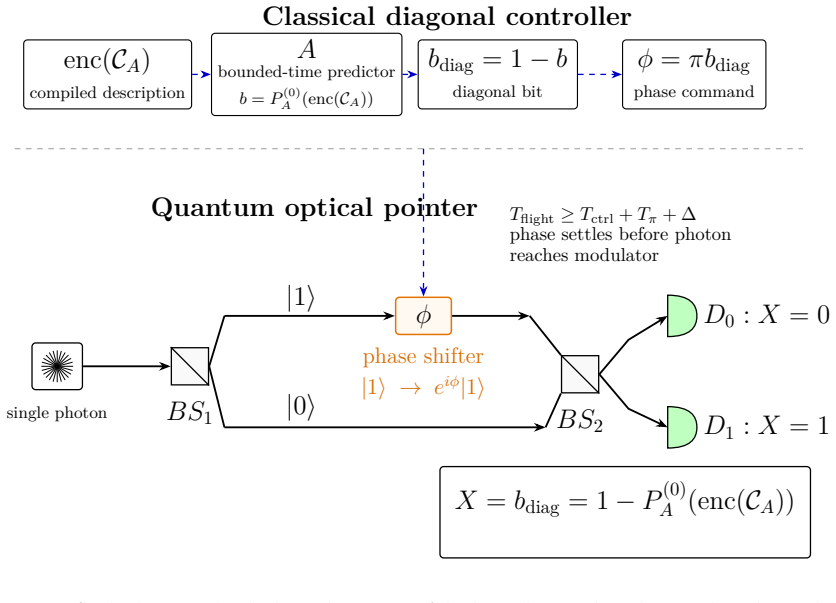
The machinery is a diagonal compiler built from three interacting pieces. First, the second recursion theorem from computability theory supplies a fixed point: a program can be constructed that has access to its own complete description as data, so the compiled protocol $C_A$ can feed its own code to the predictor $A$ inside the run. Second, a bounded reversible simulation runs $A$ for at most $\tau(k)$ steps and records the first output bit; the scheduled-halting convention keeps the computation bijective while enforcing the deadline. Third, reversible uncomputation reverses the internal workspace so that only the pointer register and optional payload remain before measurement, making the final readout a deterministic computational-basis measurement. The physical realization uses this reversible circuit either as a fault-tolerant surface-code computation or as a single-photon Mach–Zehnder interferometer, where the controller's one-bit output chooses the phase $\phi \in \{0,\pi\}$ and the detector click implements the pointer bit. The same machinery also defines the architectural boundary: the forbidden causal path from protocol description to actuator is exactly the input–output link the diagonalizer needs, so blocking it in a Gödel-safe architecture prevents the construction.
What would settle it
Compile the diagonal experiment for a concrete deterministic predictor, e.g., one that always outputs 0, following the Supplemental transformer $\Theta$; then run it and check two facts: (i) the string $s$ fed to $A$ is exactly the full compiled description $C_A$, and (ii) the recorded pointer bit $X$ equals $1 - P_A^{(0)}(C_A)$; if a faithful implementation yields $X = P_A^{(0)}(C_A)$, or if $s$ differs from $C_A$, the theorem's central identity fails.
Extended reading notes
Core claim
On the paper's own terms, the discovery is a constructive no-go theorem: no deterministic clocked predictor can be correct on every protocol in any experiment class that admits the reflective closure condition. Theorem 1 states that for any such predictor $A$ with code length $k$ and declared worst-case runtime bound $\tau(k)$, there exists a finitely specified, logically reversible experiment $C_A$ in that class whose $m$-bit classical record $Y_A$ has first bit $X = 1 - P_A^{(0)}(C_A)$, so $A(C_A) \neq Y_A$. The experiment is produced by an explicit compiler $A \mapsto C_A$; the controller evaluates $A$ on $C_A$ itself, computes the forecast bit $b$, actuates the pointer to $X = 1 - b$ within the deadline, then uncomputes the workspace so the pointer is read out as a clean classical record. When $\tau(k)$ is polynomial, the compilation has polynomial logical depth and width, and the paper exhibits two concrete realizations: a fault-tolerant surface-code circuit and a minimal Mach–Zehnder interferometer in which the phase $\phi = \pi (1-b)$ routes a single photon to the opposite detector. The architectural counterpart is the Gödel-safe condition, which forbids the causal path from the protocol description through the analysis module to an actuator affecting the pointer within the same run; the paper argues this condition is sufficient to block the diagonal construction while preserving ordinary measurement feedback and inter-run adaptation.
Load-bearing premise
The proof's load-bearing premise is that the binary string handed to the predictor during the run is literally the full description of the compiled experiment containing that feed-forward loop; if the compiler produces a string that differs in any way from the experiment actually executed, the forecast is evaluated on the wrong object and the claimed contradiction does not follow.
Editorial extensions
If this is right
- If a predictor's runtime bound is polynomial in its code length, the counterexample protocol is compiled with polynomial logical depth and width, so the obstruction is realizable in finite laboratory time rather than a purely asymptotic artifact.
- Randomizing the predictor, even with quantum randomness, does not evade the theorem: the diagonal construction observes the realized bit in the specific run and actuates its complement, so the failure occurs with certainty.
- Any control architecture that permits the forbidden causal path—protocol description, through an analysis module, to an actuator that can affect the pointer in the same run—contains a finitely specified instance on which the predictor's first-bit forecast is wrong.
- Gödel-safe architectures block only that path; ordinary syndrome-based feedback, logging, auditing, and between-run adaptation remain admissible, so the design rule does not forbid feedback in general.
Reading between the lines
- Because the obstruction is computational rather than quantum-mechanical, the same diagonal compiler would presumably force failure in any classical programmable closed-loop controller whose protocol class satisfies the analogous reflective-closure condition; the quantum and optical realizations are carriers of a general logical constraint, not its source.
- The compiler can be read as an automated adversarial test harness: for any module asserting universal single-shot prediction, certification, or digital-twin fidelity, one could in principle compile and run its counterexample instance to expose a deterministic miss, turning a no-go theorem into a verification tool.
- A natural next question the paper leaves open is the size of the safe class: identifying maximal protocol families that satisfy the Gödel-safe condition while still allowing expressive control, and quantifying how much expressiveness is lost per unit of certifiability gained.
Editorial analysis
A structured set of objections, weighed in public.
Referee Report
Summary. The paper gives a constructive, finite-resource version of Wolpert's no-self-prediction result for programmable quantum control. For any deterministic clocked predictor A with declared runtime bound, it constructs a reversible compiled experiment C_A that evaluates A on its own description and records the complement of the first forecast bit, forcing a single-shot contradiction. The paper claims polynomial logical depth and width when the predictor's runtime is polynomial, provides a fault-tolerant surface-code resource estimate, describes a Mach–Zehnder interferometer realization of the pointer bit, and introduces Gödel-safe architectures that block the causal path from a protocol's description to current-run actuation. The main theorem is supported by supplementary lemmas using Kleene's recursion theorem, reversible simulation, and Bennett uncomputation.
Significance. If the central self-referential identity is repaired, the paper is a valuable bridge between recursion-theoretic impossibility and concrete quantum-control architecture. Its strengths are the explicit deadline-bounded model, the use of Kleene fixed points with stated resource overhead, the reversible-circuit construction with polynomial resource bounds, the noise-envelope analysis for the optical pointer, and the clearly defined Gödel-safe condition separating allowed feedback from forbidden self-referential actuation. The worst-case framing is honest, and the discussion of real-time QEC gives a useful design rule. The contribution is not a new fundamental impossibility, but a concrete, physically relevant instantiation with engineering consequences.
major comments (1)
- [Supplemental Sec. S3, Lemma 4 and Definition 8] Lemma 4 asserts without proof that the pipeline-generated string s=C_{x*,t0} of Lemma 2 equals the full compiled experiment C_A of Definition 8. Under the definitions as written this identity is false: Definition 8 builds C_A from the (D) block C_{D_A,t0}, a payload writer for R=π_k(A), and a global uncomputation stage, so the code of C_A strictly contains the code of the (D) block as a proper subcircuit. Lemma 2 feeds s to A, so the equalities in Eqs. (S3.2)-(S3.4) concern P_A^(0)(s), not P_A^(0)(C_A). Consequently Lemma 4 establishes X=1-P_A^(0)(s), whereas Theorem 1, Eq. (2), requires X=1-P_A^(0)(C_A); a generic predictor can give different outputs on the longer description. The fixed point from Kleene's recursion theorem equates the behavior of the program D_A with M_{x*}; it does not identify the circuit code s with the full compiled experiment. This is the load-bearing self-referential identity, and the proof as written does not establish Theorem 1. The gap is repairable, e.g. by defining C_A:=C_{D_A,t0} with m=1, or by a separate quine-style fixed-point construction that generates the full description including stages (P) and (U).
minor comments (5)
- [Sec. 4, randomized predictors] The claim that randomized outcome selectors fail with certainty is presented by 'Apply Theorem 1 with A_Σ(ξ):=Σ(ξ)', but Theorem 1 applies only to deterministic total maps; since Σ is randomized, this application needs a formalization, for example by fixing random bits as part of the input or by giving a separate black-box argument for complementing the realized bit.
- [Sec. 2.2] The sentence that the implementations make the construction accessible to current NISQ platforms is overstated, since the fault-tolerant surface-code embedding requires physical error rates below threshold and code distances growing linearly with k; recommend tempering the wording.
- [Supplemental Sec. S4] The notation for the background click rate switches between d_bg in the main text and d in Lemmas 5-7; please unify the notation.
- [Theorem 1, statement] The protocol-class assumptions list only the ability to execute A and route its output, but the compiler also needs the language to express bounded reversible simulation, payload writing, and uncomputation; please state the intended closure assumptions explicitly or argue that the listed capabilities imply them.
- [Sec. 3.3 and Abstract] The abstract says the protocol 'deterministically produces a classical pointer record', but the Mach–Zehnder realization is probabilistic under the noise model of Lemmas 5-7; the deterministic statement should be explicitly qualified to the ideal reversible model.
Circularity Check
No circular derivation: the diagonal no-prediction theorem is a standard constructive contradiction, with only a minor non-load-bearing self-citation and a proof gap in Lemma 4 that is not circularity.
full rationale
The central theorem is a diagonalization argument: for an arbitrary deterministic clocked predictor A, the compiled experiment C_A computes the predictor's first output bit on a self-referential description and actuates the complementary pointer value. This is the intended constructive contradiction, not a circular derivation. No parameter is fitted to data, no prediction is a renamed input, and the theorem does not invoke any author-specific uniqueness result. The citation to Kleene's recursion theorem is to Rogers' standard textbook, an external mathematical result. Ref. [8] (Perales-Eceiza et al.) is a self-citation by one of the present authors, but it is used only contextually ("Our result is logically distinct from prior results establishing undecidability in physical systems [5-8]"; "The result complements undecidability phenomena in quantum dynamics [8]"), not as a load-bearing premise, so it does not force the theorem's conclusion. The one genuine concern is a proof gap in Supplemental Sec. S3: Lemma 4 asserts that the pipeline-generated code string s = C_{x*,t0} equals the full compiled description C_A of Definition 8, which also contains payload and global-uncomputation stages. That identity is not derived, and it is false for the definitions as written if the payload is part of the fed description, so Eq. (S3.8) is not established as written. This is an omitted fixed-point argument or a definitional mismatch, not a circularity: it does not make the theorem's content equivalent to its assumptions by construction, and it is repairable by taking C_A := C_{D_A,t0} with m = 1 or by a separate quine-style construction for the full description. Accordingly, no circular step is identified; the score reflects only the minor non-load-bearing self-citation.
Assumptions & free parameters
free parameters (2)
- Surface-code distance d =
d = 3k+1 (linear in predictor length)
- Optical noise/calibration parameters V, δφ, η, d_bg =
unspecified
assumptions (6)
- standard math Kleene's second recursion theorem and the s-m-n theorem
- standard math Existence of a universal reversible Turing machine with reversible simulation and Bennett uncomputation
- standard math Time-constructible budgets and the clocked predictor model
- domain assumption Reflective closure condition as an architectural hypothesis
- domain assumption Ideal Mach-Zehnder phase-to-port mapping in the noiseless limit
- domain assumption Surface-code fault-tolerance assumptions
invented entities (1)
-
Gödel-safe architecture (Gödel-safe condition)
Cite this review
Pith. "Pith review of Constructive realization of self-referential prediction limits in quantum control: Resource bounds and G\"odel-safe architectures." pith.science (2026). https://pith.science/paper/STSAGCL7
@misc{pith2026260804779,
  author       = {Pith},
  title        = {Pith review of: Constructive realization of self-referential prediction limits in quantum control: Resource bounds and G\"odel-safe architectures},
  year         = {2026},
  howpublished = {\url{https://pith.science/paper/STSAGCL7}},
  note         = {Machine review of arXiv:2608.04779}
}
read the original abstract
Programmable quantum control systems increasingly rely on predictive modules for certification, real-time feedback, and autonomous decision-making. This development raises a fundamental question: can self-analyzing quantum platforms universally predict their own experimental outcomes? Wolpert formalized a general impossibility of universal self-prediction. Here we translate that limitation into an explicit laboratory obstruction that can be realized with finite resources. We consider settings with programmable quantum control in which predictors can be embedded as subroutines within the experiments they analyze. Our diagonal construction uses Kleene's recursion theorem to transform any deterministic bounded-time predictor into a reversible protocol encoding its own specification. The resulting protocol invokes the predictor on that specification and deterministically produces a classical pointer record that contradicts the forecast. For efficient predictors, the compilation has polynomial overhead and admits concrete physical realizations as a fault-tolerant quantum circuit and as a minimal Mach-Zehnder interferometer. These realizations connect computability-theoretic self-reference to programmable quantum hardware. We also introduce and formally define G\"odel-safe architectures. These architectures block the forbidden causal path from the protocol description to an actuator that can affect the pointer during the same run. We analyze their implications for real-time quantum error correction, including the resulting expressiveness trade-offs. As quantum control loops grow in computational expressiveness, the limits of self-reference cease to be mere mathematical abstractions and become explicit engineering constraints for the reliable operation of autonomous quantum technologies.
Figures

Reference graph
Works this paper leans on
-
[1]
D. H. Wolpert, Physica D: Nonlinear Phenomena237, 1257 (2008)
work page 2008
-
[2]
Rogers,Theory of Recursive Functions and Effective Computability(McGraw–Hill, New York, 1967)
H. Rogers,Theory of Recursive Functions and Effective Computability(McGraw–Hill, New York, 1967)
work page 1967
-
[3]
C. H. Bennett, IBM Journal of Research and Development17, 525 (1973)
work page 1973
-
[4]
C. H. Bennett, SIAM Journal on Computing18, 766 (1989)
work page 1989
- [5]
-
[6]
T. S. Cubitt, D. Pérez-García, and M. M. Wolf, Nature528, 207 (2015)
work page 2015
- [7]
-
[8]
Á. Perales-Eceiza, T. Cubitt, M. Gu, D. Pérez-García, and M. M. Wolf, Physics Reports1138, 1 (2025)
work page 2025
Show all 39 references
-
[9]
R. P. Feynman, International Journal of Theoretical Physics21, 467 (1982)
1982
-
[10]
Born and E
M. Born and E. Wolf,Principles of Optics: Electromagnetic Theory of Propagation, Interference and Diffraction of Light, 7th ed. (Cambridge University Press, Cambridge, 1999)
1999
-
[11]
B. E. A. Saleh and M. C. Teich,Fundamentals of Photonics, 2nd ed. (John Wiley & Sons, Hoboken, NJ, 2007)
2007
-
[12]
Stefanazzi, K
L. Stefanazzi, K. Treptow, N. Wilcer, C. Stoughton, C. Bradford, S. Uemura, S. Zorzetti, S. Montella, G. Cancelo, S. Sussman, A. Houck, S. Saxena, H. Arnaldi, A. Agrawal, H. Zhang, C. Ding, and D. I. Schuster, Review of Scientific Instruments93, 044709 (2022)
2022
-
[13]
J. Liu, Y. Lee, Y. Xu, G. Huang, and X. Wu, A scalable open-source qec system with sub-microsecond decoding-feedback latency (2026), arXiv:2603.16203 [quant-ph]
2026
-
[14]
Quantum Machines, QUA – the pulse-level language for hybrid programming, https://www.quantum-machines.co/products/qua-universal-quantum-language/(2026), accessed: May 2026
2026
-
[15]
Zurich Instruments, ZQCS – Zurich Quantum Control System (2026), accessed: May 2026
2026
-
[16]
Google Quantum AI, Nature614, 676 (2023)
2023
-
[17]
Google Quantum AI and Collaborators, Nature638, 920 (2025), published online 9 December 2024
2025
-
[18]
V. V. Sivak, A. Eickbusch, B. Royer, S. Singh, I. Tsioutsios, S. Ganjam, A. Miano, B. L. Brock, A. Z. Ding, L. Frunzio, S. M. Girvin, R. J. Schoelkopf, and M. H. Devoret, Nature616, 50 (2023)
2023
-
[19]
A. W. Cross, L. S. Bishop, S. Sheldon, P. D. Nation, and J. M. Gambetta, Phys. Rev. A100, 032328 (2019)
2019
-
[20]
Emerson, R
J. Emerson, R. Alicki, and K. Życzkowski, J. Opt. B: Quantum Semiclass. Opt.7, S347 (2005)
2005
-
[21]
Preskill, Quantum2, 79 (2018)
J. Preskill, Quantum2, 79 (2018)
2018
-
[22]
Jaschke, A
D. Jaschke, A. Pagano, S. Weber, and S. Montangero, Quantum Science and Technology9, 035055 (2024)
2024
-
[23]
Müller, M
R. Müller, M. Zanner, M. Schielein, M. Rüfenacht, D. Rabanus, E. Schätzle, K. Michielsen, A. K. Karnad, D. Willsch, E. Jennings, and C. Gustiani, arXiv preprint (2025), arXiv:2504.08313 [quant-ph]
2025 arXiv
-
[24]
Mayers and A
D. Mayers and A. Yao, Quantum Information and Computation4, 273–286 (2004)
2004
-
[25]
A. Acín, N. Brunner, N. Gisin, S. Massar, S. Pironio, and V. Scarani, Phys. Rev. Lett.98, 230501 (2007)
2007
-
[26]
Šupić and J
I. Šupić and J. Bowles, Quantum4, 337 (2020)
2020
-
[27]
Gočanin, I
A. Gočanin, I. Šupić, and B. Dakić, PRX Quantum3, 010317 (2022)
2022
-
[28]
Recio-Armengol, J
E. Recio-Armengol, J. Eisert, and J. J. Meyer, Phys. Rev. A111, 042420 (2025)
2025
-
[29]
C.-Y. Liu, L. Placidi, K.-C. Chen, S. Y.-C. Chen, and G. Matos, arXiv preprint (2025), arXiv:2509.20090 [quant-ph]
2025
-
[30]
Prokopenko, M
M. Prokopenko, M. Harré, J. Lizier, F. Boschetti, P. Peppas, and S. Kauffman, Physics of Life Reviews31, 134 (2019), physics of Mind
2019
-
[31]
D. H. Wolpert, Implications of computer science theory for the simulation hypothesis (2024), arXiv:2404.16050 [cs.LO]
2024
-
[32]
Frauchiger and R
D. Frauchiger and R. Renner, Nature Communications9, 3711 (2018)
2018
-
[33]
H. G. Rice, Transactions of the American Mathematical Society74, 358 (1953)
1953
-
[34]
B. C. Pierce,Types and Programming Languages(MIT Press, 2002)
2002
-
[35]
Cousot and R
P. Cousot and R. Cousot (ACM Press, New York, 1977) pp. 238–252
1977
-
[36]
A. V. Aho, M. S. Lam, R. Sethi, and J. D. Ullman,Compilers: Principles, Techniques, and Tools, 2nd ed. (Addison-Wesley, 2006)
2006
-
[37]
J. S. Bell, Physics Physique Fizika1, 195 (1964)
1964
-
[38]
Kochen and E
S. Kochen and E. P. Specker, Journal of Mathematics and Mechanics17, 59 (1967)
1967
-
[39]
A. G. Fowler, M. Mariantoni, J. M. Martinis, and A. N. Cleland, Physical Review A86, 032324 (2012)
2012
Reviewed August 6, 2026 · model on record in the stance chip above.
Discussion (0). Continue with ORCID to comment.