REVIEW 3 major objections 5 minor 44 references
GVC-RT: Towards Real-Time Generative Video Compression at Ultra-Low Bitrates
T0 review · 3 major / 5 minor · reviewed 2026-08-06 · deepseek-v4-flash
Pith's one-line read GVC-RT moves tokenization and generative alignment out of the inference path, achieving real-time 1080p generative compression at ultra-low bitrates without sacrificing perceptual quality.
desk verdict Real-time generative video compression that mostly delivers, but the key loss term is never defined and the abstract numbers don't match the table. read the letter →
The pith
A machine-rendered reading of the paper's core claim, the machinery that carries it, and where it could break.
The reading
What carries the argument
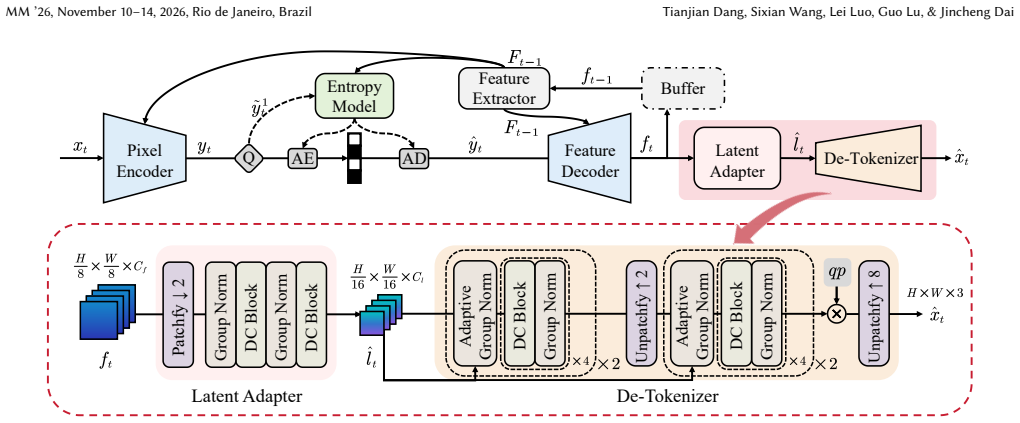
The machinery is an asymmetric encoder-decoder whose generative alignment happens only during training. The pretrained LFQ tokenizer (lookup-free quantization, a tokenizer that maps pixels into binary codes without a learned codebook) supplies the generative latent space; the paper uses its continuous pre-quantization latent as the supervision target, not the hard binary tokens, to avoid sign-flip flicker across frames. A cosine-similarity loss (Eq. 4) plus a marginal loss steers the fast DCVC-RT-derived encoder's compressed latents onto this latent manifold, and a distilled, depth-wise separable de-tokenizer on a 1/8-resolution latent replaces the heavy LFQ decoder. The load-bearing mechanism is the assumption that this soft regression is sufficient to keep the lightweight decoder on the generative manifold without any inference-time alignment module.
What would settle it
Recompute the BD-rate savings between GVC-RT and GLC-Video from the average LPIPS and DISTS values in Table 1: the abstract's stated 12.4% (DISTS) and 48.8% (LPIPS) savings do not obviously follow from the tabulated averages (-80.7 vs -57.3 LPIPS, -91.6 vs -90.0 DISTS). Separately, re-running the released model on an RTX 4090 and measuring 1080p encode/decode fps and rate-perceptual curves at the claimed bitrates would settle the real-time and quality claims.
Extended reading notes
Core claim
Generative video compression need not tokenize the input at inference time. GVC-RT builds on a pretrained lookup-free quantization (LFQ) tokenizer and uses a lightweight DCVC-RT-style encoder to turn each frame into a latent that is quantized, entropy-coded, and then decoded by a fast feature decoder. During training, the decoded latent is supervised to match the continuous pre-quantization latent of the frozen LFQ tokenizer through a cosine-similarity loss and a marginal loss that pushes dimensions away from ambiguous zero regions; this is the alignment that normally requires a diffusion model at decode time. The final reconstruction comes from a distilled lightweight de-tokenizer that operates on a 1/8-resolution latent using depth-wise separable convolutions. The paper's central claim is that this training-only soft alignment places the compressed latents on the LFQ generative manifold, so the heavy tokenizer, feature-alignment diffusion, and large de-tokenizer can all be removed from the deployed codec, yielding 123.1 fps encoding and 55.1 fps decoding at 1080p on an RTX 4090 while improving perceptual quality over GLC-Video on LPIPS, DISTS, FID, and FloLPIPS across UVG, MCL-JCV, and HEVC-B.
Load-bearing premise
The load-bearing premise is that a fast encoder trained with a cosine-similarity loss against the continuous pre-quantization latent of a frozen LFQ tokenizer will push its compressed latents onto the generative manifold that the lightweight de-tokenizer knows; if that supervision proves insufficient, the decoder has no generative prior to fall back on and the perceptual gains disappear.
Editorial extensions
If this is right
- Generative video compression can run on a single consumer RTX 4090 at 1080p, with encoding at 123.1 fps and decoding at 55.1 fps, roughly 14 times faster than GLC-Video's 3.9 fps decoding.
- At bitrates below 0.02 bpp, the model reports better perceptual quality than the prior generative state of the art on LPIPS, DISTS, FID, and FloLPIPS across the UVG, MCL-JCV, and HEVC-B benchmarks.
- Removing tokenization and diffusion from the decoder avoids the structural delay of multi-frame parallel decoding, so the method suits low-latency streaming where DiffVC-RT's parallel decoding cannot be used.
- The encoder side of the deployed codec runs at the same 123.1 fps as the real-time non-generative codec DCVC-RT, so the generative prior adds perceptual benefit without slowing the encoder.
- The training-only alignment means the expensive generative modules are paid for once at training time; the deployed system has no tokenizer or diffusion model at runtime.
Reading between the lines
- If the soft-alignment trick generalizes, the same training-only latent alignment could be applied to other quantized tokenizers (VQ, FSQ, or MAGVIT-style latents) and other fast NVC backbones, decoupling the choice of generative prior from the runtime codec.
- The method's perceptual ceiling is capped by the frozen LFQ tokenizer's generative capacity; swapping in a stronger tokenizer should improve quality at unchanged speed, making the tokenizer the natural next target for improvement.
- A testable extension is to replace the single scalar cosine weight $w_{cos}$ with per-dimension weights derived from the masking sensitivity in the paper's Fig. 7, which could specifically improve the extreme low-bitrate regime below 0.005 bpp where quality still degrades.
- The paper's reported encoding speed matches DCVC-RT exactly, so the marginal cost of going generative appears to sit almost entirely in the distilled decoder; profiling the decoder on lower-end GPUs would show how far the real-time claim extends beyond the RTX 4090.
Editorial analysis
A structured set of objections, weighed in public.
Referee Report
Summary. The paper introduces GVC-RT, a generative video compression framework designed for real-time operation at ultra-low bitrates. It builds on a pretrained lookup-free quantization (LFQ) tokenizer and uses a lightweight DCVC-RT-based encoder to compress video directly, bypassing explicit tokenization at inference. The decoder uses a distilled lightweight de-tokenizer, and the alignment between compressed latents and the LFQ generative space is enforced only during training via a cosine-similarity loss against the continuous pre-quantization LFQ latent. The authors report 123.1 fps encoding and 55.1 fps decoding on an RTX 4090 for 1080p video, with improved perceptual quality over previous generative codecs, notably GLC-Video.
Significance. If the reported performance holds, GVC-RT would be a meaningful step toward practical deployment of generative video compression on consumer hardware, combining real-time speed with perceptual superiority at ultra-low bitrates. The paper makes several engineering contributions: a careful module-wise bottleneck analysis, a three-stage progressive training strategy, a latent-to-image distillation approach for the de-tokenizer, and extensive comparisons on standard datasets. The release of code is a further strength that supports reproducibility. However, the central mechanism—soft alignment to the LFQ latent distribution—is incompletely specified, and the headline numbers against GLC-Video are not directly traceable to the tabulated results. These issues make the paper's main claims conditional in their current form.
major comments (3)
- [Section 4.2, Eq. (8); Section 5; Table 2] L_margin is referenced in Eq. (8) and in the Stage II objective, and the ablation in Table 2 shows that removing it changes LPIPS BD-rate by 143.1% (and DISTS by 250.9%), yet no formula is ever given for it. The two prose descriptions are also in tension: Section 4.2 says it 'pushes each dimension of \hat{l} away from the semantically ambiguous intermediate regions,' whereas Section 5 says the strategy 'pushes' uncertain dimensions to near-zero magnitudes. A margin loss that moves values away from zero cannot simultaneously move uncertain values toward zero unless additional terms or weighting are involved. Because the perceptual gains of the whole framework are attributed in large part to this term, the paper must either define L_margin precisely or clearly attribute the near-zero-shrinkage behavior to a different mechanism (e.g., the cosine loss or the rate term).
- [Abstract vs Table 1] The abstract states that GVC-RT outperforms GLC-Video with average BD-rate savings of 12.4% and 48.8% for DISTS and LPIPS. Table 1, however, reports BD-rate against VTM-17.0 only: GLC-Video is listed at -90.0 DISTS and -57.3 LPIPS, while GVC-RT is at -91.6 and -80.7. These numbers do not yield 12.4% and 48.8% savings relative to GLC-Video under any standard BD-rate interpretation. The paper should either add a table or curve that directly computes BD-rate versus GLC-Video or restate the abstract with numbers that are traceable to the reported data.
- [Section 3.4, Eq. (4)] The load-bearing assumption of the paper is that minimizing cosine distance between the decompressed latent \hat{l}_t and the pre-quantization LFQ latent l_t 'naturally projects the latent \hat{l}_t into the LFQ generative manifold' (Section 3.4). This assertion is not supported by direct evidence in the manuscript. The subsequent perceptual improvements could also arise from the de-tokenizer being trained to accept off-manifold inputs, in which case the generative-prior interpretation is misleading. I ask the authors to provide a concrete empirical test, such as a t-SNE or UMAP comparison of the learned \hat{l} distribution versus the LFQ l distribution, or a quantitative measure of manifold proximity (e.g., distance to the nearest LFQ codebook vector), and to temper the claim if such evidence is not available.
minor comments (5)
- [Section 7 vs Section 6] The conclusion states that GVC-RT delivers 1080p real-time processing on an NVIDIA RTX 3090 GPU, but the experiments in Section 6.2 and Figure 1 report speeds on an RTX 4090; please correct the inconsistent GPU model.
- [Table 2] The row 'w/o L_margin (Stage II & III)' lists DISTS BD-rate of 250.9%, which is even larger than the LPIPS degradation; the text only says 'removing L_margin also impairs perceptual quality'—please state these numbers explicitly and explain why the effect is so large, especially since the loss is undefined.
- [Figure 3] The GVC-OSD baseline used for the bottleneck analysis is not described in Section 3.1; specify its tokenizer, diffusion alignment, and configuration so the module-wise latency numbers are reproducible.
- [Section 6.2] The qualitative comparison in Figure 9 only shows H.266/VVC, DCVC-RT, and GVC-RT; since the main comparison is against GLC-Video, include a GLC-Video example or explain its absence.
- [Section 4.2] In Eq. (8), the notation \hat{l} is used without a time subscript, whereas elsewhere in the paper the decompressed latent is \hat{l}_t; please make the notation consistent.
Circularity Check
No significant circularity: the generative target and baselines are external, and the perceptual claim, while resting on an underspecified margin loss, is not derived from its own inputs.
full rationale
GVC-RT's derivation chain is not circular. The generative target is the frozen Open-MAGVIT2 LFQ tokenizer, an external pretrained model whose latent space and de-tokenizer are not defined by this paper; the lightweight decoder is trained against that fixed target in Stage I and then supervised toward the same target in Stages II and III. The claimed speed gains come from measured module-level replacements (bypassing tokenization, removing inference-time alignment diffusion, distilling the de-tokenizer) and are benchmarked against external baselines such as VTM-17.0, HM-16.25, DCVC-RT, and GLC-Video. Loss weights w_cos, w_margin, and w_adv are training hyperparameters, not fitted quantities later renamed as predictions, and no equation in the paper defines a claimed output in terms of that same output. The only self-citations involving current authors (FVC, DVC) appear as historical related work and are not load-bearing. The two genuine concerns are not circularity: the load-bearing soft-LFQ alignment assertion in Section 3.4 that the network 'naturally projects the latent into the LFQ generative manifold' is stated without proof, and L_margin in Eq. (8) is never given a formula, so the mechanism behind the largest ablation swing is not independently checkable. Likewise, the abstract's BD-rate savings of 12.4% DISTS and 48.8% LPIPS do not match Table 1's averages, but this is a reporting inconsistency rather than a reduction of a prediction to its inputs. Because the central claims are measured against external, frozen components and external baselines, the paper is self-contained in the sense relevant to circularity.
Assumptions & free parameters
free parameters (5)
- w_cos (cosine alignment weight) =
0.2
- w_margin (marginal loss weight) =
0.02
- w_adv (adversarial loss weight) =
0.1
- lambda interpolation for rate-distortion tradeoff =
0.08 to 0.9 (qp index 0-9)
- LFQ latent dimension C_l =
18
assumptions (4)
- domain assumption The pretrained LFQ tokenizer provides a latent space aligned with human perception that is a valid supervision target for a different codec's latent space.
- ad hoc to paper Cosine similarity regression onto the continuous pre-quantization latent transfers the discrete tokenizer's generative manifold to the student decoder.
- domain assumption Teacher-student distillation preserves the generative capability of the heavy de-tokenizer in a much smaller network.
- domain assumption The temporal context propagation of DCVC-RT remains stable when the decoded feature is passed through a generative de-tokenizer instead of a pixel reconstruction network.
Cite this review
Pith. "Pith review of GVC-RT: Towards Real-Time Generative Video Compression at Ultra-Low Bitrates." pith.science (2026). https://pith.science/paper/FTFUXSJ3
@misc{pith2026260804891,
  author       = {Pith},
  title        = {Pith review of: GVC-RT: Towards Real-Time Generative Video Compression at Ultra-Low Bitrates},
  year         = {2026},
  howpublished = {\url{https://pith.science/paper/FTFUXSJ3}},
  note         = {Machine review of arXiv:2608.04891}
}
read the original abstract
Recent generative video codecs (GVCs) have achieved impressive reconstruction fidelity at ultra-low bitrates (< 0.02 bits per pixel) by compressing the tokens from generative tokenizers. However, existing GVCs generally require considerable computation time and model complexity, which hinder their deployment on compute-limited devices and in real-time applications. To bridge this gap, we systematically identify the computational bottlenecks and propose GVC-RT, which redesigns the generative latent coding framework to realize real-time video coding without sacrificing compression performance. Specifically, built on a pretrained lookup-free quantization (LFQ) tokenizer, GVC-RT adopts an asymmetric architecture that directly learns to match the LFQ latent distribution, while generative-space alignment is enforced via a regularization loss term only during training. In this manner, we bypass heavy tokenization and entirely remove the complex feature-alignment process at inference time. Moreover, we further introduce a lightweight de-tokenizer architecture to resolve the final latency bottleneck during decoding. Experimental results demonstrate that GVC-RT outperforms the previous SOTA model, GLC-Video, with average BD-rate savings of 12.4% and 48.8% in terms of DISTS and LPIPS, while achieving encoding/decoding speeds of 123.1/55.1 fps for 1080p video. The code is at https://github.com/semcomm/GVC-RT.
Figures


Figures from the paper (6 more)


Reference graph
Works this paper leans on
-
[1]
2001.Calculation of A verage PSNR Differences between RD- Curves
Gisle Bjøntegaard. 2001.Calculation of A verage PSNR Differences between RD- Curves. Technical Report VCEG-M33. ITU-T Video Coding Experts Group (VCEG), Austin, Texas, USA
work page 2001
-
[2]
2013.Common Test Conditions and Software Reference Configura- tions
Frank Bossen. 2013.Common Test Conditions and Software Reference Configura- tions. Technical Report JCTVC-L1100. Joint Collaborative Team on Video Coding (JCT-VC), Geneva, Switzerland
work page 2013
-
[3]
Benjamin Bross, Ye-Kui Wang, Yan Ye, Shan Liu, Jianle Chen, Gary J Sullivan, and Jens-Rainer Ohm. 2021. Overview of the versatile video coding (VVC) standard and its applications.IEEE Transactions on Circuits and Systems for Video Technology31, 10 (2021), 3736–3764
work page 2021
-
[4]
Francois Chollet. 2017. Xception: Deep Learning With Depthwise Separable Convolutions. InProceedings of the IEEE Conference on Computer Vision and Pattern Recognition (CVPR)(Honolulu, HI, USA). IEEE, Piscataway, NJ, USA, 1251–1258. doi:10.1109/CVPR.2017.195
- [5]
-
[6]
Keyan Ding, Kede Ma, Shiqi Wang, and Eero P Simoncelli. 2022. Image quality assessment: Unifying structure and texture similarity.IEEE Transactions on Pattern Analysis and Machine Intelligence44, 5 (2022), 2567–2581. doi:10.1109/ TPAMI.2020.3045810
arXiv 2022
-
[7]
Martin Heusel, Hubert Ramsauer, Thomas Unterthiner, Bernhard Nessler, and Sepp Hochreiter. 2017. GANs trained by a two time-scale update rule converge to a local nash equilibrium. InProceedings of the 31st International Conference on Neural Information Processing Systems(Long Beach, CA, USA). Curran Associates, Inc., Red Hook, NY, USA, 6629–6640
work page 2017
-
[8]
Jonathan Ho, Ajay Jain, and Pieter Abbeel. 2020. Denoising diffusion probabilistic models.Advances in Neural Information Processing Systems33 (2020), 6840–6851
2020
Show all 44 references
-
[9]
Zhihao Hu, Guo Lu, and Dong Xu. 2021. FVC: A new framework towards deep video compression in feature space. InProceedings of the IEEE/CVF Conference on Computer Vision and Pattern Recognition(Nashville, TN, USA). IEEE, Piscataway, NJ, USA, 1502–1511. doi:10.1109/CVPR46437.2021.00155
2021
-
[10]
Phillip Isola, Jun-Yan Zhu, Tinghui Zhou, and Alexei A. Efros. 2017. Image-to- Image Translation with Conditional Adversarial Networks. InProceedings of the IEEE Conference on Computer Vision and Pattern Recognition (CVPR)(Honolulu, HI, USA). IEEE, Piscataway, NJ, USA, 1125–11...
2017 doi
-
[11]
Zhaoyang Jia, Bin Li, Jiahao Li, Wenxuan Xie, Linfeng Qi, Houqiang Li, and Yan Lu. 2025. Towards practical real-time neural video compression. InProceedings of the IEEE/CVF Conference on Computer Vision and Pattern Recognition (CVPR) (Nashville, TN, USA). IEEE, Piscataway, NJ,...
2025
-
[12]
Joint Video Experts Team (JVET). 2022. HEVC Reference Software HM-16.25. Retrieved August 1, 2026 from https://vcgit.hhi.fraunhofer.de/jvet/HM/-/tags/ HM-16.25
2022
-
[13]
Joint Video Experts Team (JVET), Fraunhofer HHI. 2022. VVC Reference Software VTM-17.0. Retrieved August 1, 2026 from https://vcgit.hhi.fraunhofer.de/jvet/ VVCSoftware_VTM/-/tags/VTM-17.0
2022
-
[14]
Jiahao Li, Bin Li, and Yan Lu. 2021. Deep contextual video compression.Advances in Neural Information Processing Systems34 (2021), 18114–18125
2021
-
[15]
Jiahao Li, Bin Li, and Yan Lu. 2023. Neural video compression with diverse contexts. InProceedings of the IEEE/CVF Conference on Computer Vision and Pattern Recognition(Vancouver, BC, Canada). IEEE, Piscataway, NJ, USA, 22616– 22626. doi:10.1109/CVPR52729.2023.02166
2023
-
[16]
Jiahao Li, Bin Li, and Yan Lu. 2024. Neural video compression with feature modulation. InProceedings of the IEEE/CVF Conference on Computer Vision and Pattern Recognition(Seattle, WA, USA). IEEE, Piscataway, NJ, USA, 26099–26108. doi:10.1109/CVPR52733.2024.02466
2024
-
[17]
Xingchen Li, Junzhe Zhang, Junqi Shi, Ming Lu, and Zhan Ma. 2026. YODA: Yet Another One-step Diffusion-based Video Compressor. IEEE Transactions on Circuits and Systems for Video Technology, Early Access. doi:10.1109/TCSVT. 2026.3714453
2026
-
[18]
Guo Lu, Wanli Ouyang, Dong Xu, Xiaoyun Zhang, Chunlei Cai, and Zhiyong Gao
-
[19]
Ming Lu, Zhihao Duan, Fengqing Zhu, and Zhan Ma. 2024. Deep hierarchical video compression. InProceedings of the AAAI Conference on Artificial Intelligence (Vancouver, BC, Canada), Vol. 38. Association for the Advancement of Artificial Intelligence, Washington, DC, USA, 8859–8...
2024 doi
-
[20]
Zhuoyan Luo, Fengyuan Shi, Yixiao Ge, Yujiu Yang, Limin Wang, and Ying Shan. 2024. Open-MAGVIT2: An Open-Source Project Toward Democratizing Auto-Regressive Visual Generation. arXiv:2409.04410 [cs.CV]
2024 arXiv
-
[21]
Wenzhuo Ma and Zhenzhong Chen. 2025. Diffusion-based perceptual neural video compression with temporal diffusion information reuse.ACM Transactions on Multimedia Computing, Communications, and Applications21, 12, Article 345 (2025), 22 pages. doi:10.1145/3761815
2025 doi
-
[22]
Wenzhuo Ma and Zhenzhong Chen. 2025. DiffVC-OSD: One-Step Diffusion- based Perceptual Neural Video Compression Framework. In2025 International Conference on Visual Communications and Image Processing (VCIP)(Klagenfurt, Austria). IEEE, Piscataway, NJ, USA, 1–5. doi:10.1109/VCIP...
2025
-
[23]
Wenzhuo Ma and Zhenzhong Chen. 2026. DiffVC-RT: Towards Prac- tical Real-Time Diffusion-based Perceptual Neural Video Compression. arXiv:2601.20564 [cs.CV]
2026
-
[24]
Qi Mao, Hao Cheng, Tinghan Yang, Libiao Jin, and Siwei Ma. 2026. Genera- tive Neural Video Compression via Video Diffusion Prior. InProceedings of the IEEE/CVF Conference on Computer Vision and Pattern Recognition (CVPR)(Denver, CO, USA). IEEE, Piscataway, NJ, USA, 43239–43248
2026
-
[25]
Fabian Mentzer, David Minnen, Eirikur Agustsson, and Michael Tschannen
-
[26]
Alexandre Mercat, Marko Viitanen, and Jarno Vanne. 2020. UVG dataset: 50/120fps 4K sequences for video codec analysis and development. InProceedings of the 11th ACM Multimedia Systems Conference(Istanbul, Turkey). Association for Computing Machinery, New York, NY, USA, 297–302...
2020 doi
-
[27]
Linfeng Qi, Zhaoyang Jia, Jiahao Li, Bin Li, Houqiang Li, and Yan Lu. 2025. Generative latent coding for ultra-low bitrate image and video compression. IEEE Transactions on Circuits and Systems for Video Technology35, 10 (2025), 10500–10515. doi:10.1109/TCSVT.2025.3571944
2025
-
[28]
Karen Simonyan and Andrew Zisserman. 2015. Very deep convolutional networks for large-scale image recognition. InInternational Conference on Learning Repre- sentations (ICLR)(San Diego, CA, USA). International Conference on Learning Representations, San Diego, CA, USA, 14 pages
2015
-
[29]
Patrick von Platen, Suraj Patil, Anton Lozhkov, Pedro Cuenca, Nathan Lambert, Kashif Rasul, Mishig Davaadorj, Dhruv Nair, Sayak Paul, William Berman, Yiyi Xu, Steven Liu, and Thomas Wolf. 2022. Diffusers: State-of-the-art diffusion models. GitHub repository. Retrieved August 3...
2022
-
[30]
Haiqiang Wang, Weihao Gan, Sudeng Hu, Joe Yuchieh Lin, Lina Jin, Longguang Song, Ping Wang, Ioannis Katsavounidis, Anne Aaron, and C-C Jay Kuo. 2016. MCL-JCV: A JND-based H.264/AVC Video Quality Assessment Dataset. In2016 IEEE International Conference on Image Processing (ICIP...
2016
-
[31]
Zhou Wang, Eero P Simoncelli, and Alan C Bovik. 2003. Multiscale structural similarity for image quality assessment. InConference Record of the Thirty-Seventh Asilomar Conference on Signals, Systems and Computers(Pacific Grove, CA, USA), Vol. 2. IEEE, Piscataway, NJ, USA, 1398...
2003 arXiv
-
[32]
Naifu Xue, Zhaoyang Jia, Jiahao Li, Bin Li, Zihan Zheng, Yuan Zhang, and Yan Lu. 2026. Single-step Diffusion-based Video Coding with Semantic-Temporal Guidance. InProceedings of the IEEE/CVF Conference on Computer Vision and Pattern Recognition (CVPR)(Denver, CO, USA). IEEE, P...
2026
-
[33]
Tianfan Xue, Baian Chen, Jiajun Wu, Donglai Wei, and William T. Freeman
-
[34]
Tianfan Xue, Baian Chen, Jiajun Wu, Donglai Wei, and William T Freeman. 2019. Video enhancement with task-oriented flow.International Journal of Computer Vision127, 8 (2019), 1106–1125
2019
-
[35]
Ren Yang, Radu Timofte, and Luc Van Gool. 2022. Perceptual Learned Video Compression with Recurrent Conditional GAN. InProceedings of the International Joint Conference on Artificial Intelligence(Vienna, Austria). International Joint MM ’26, November 10–14, 2026, Rio de Janeir...
2022
-
[36]
Retrieved April 2, 2026 from https://github.com/anchen1011/toflow/blob/master/data/original_vimeo_ links.txt
Original Vimeo Links for the Vimeo-90K Dataset. Retrieved April 2, 2026 from https://github.com/anchen1011/toflow/blob/master/data/original_vimeo_ links.txt
2026
-
[37]
Richard Zhang, Phillip Isola, Alexei A Efros, Eli Shechtman, and Oliver Wang
-
[38]
Tianyu Zhang, Dong Liu, and Chang Wen Chen. 2026. Ultra-Low Bitrate Percep- tual Image Compression with Shallow Encoder. InProceedings of the IEEE/CVF Conference on Computer Vision and Pattern Recognition (CVPR)(Denver, CO, USA). IEEE, Piscataway, NJ, USA, 12118–12128
2026
-
[40]
Lijun Yu, Jose Lezama, Nitesh Bharadwaj Gundavarapu, Luca Versari, Kihyuk Sohn, David Minnen, Yong Cheng, Agrim Gupta, Xiuye Gu, Alexander G Haupt- mann, Boqing Gong, Ming-Hsuan Yang, Irfan Essa, David A Ross, and Lu Jiang
-
[41]
In The Twelfth International Conference on Learning Representations(Vienna, Aus- tria)
Language Model Beats Diffusion - Tokenizer is key to visual generation. In The Twelfth International Conference on Learning Representations(Vienna, Aus- tria). OpenReview.net, Amherst, MA, USA, 19 pages. Retrieved August 3, 2026 from https://openreview.net/forum?id=gzqrANCF4g
2026
-
[1544]
doi:10.24963/ijcai.2022/214
2022 doi
-
[2018]
In Proceedings of the IEEE/CVF Conference on Computer Vision and Pattern Recognition (Salt Lake City, UT, USA)
The unreasonable effectiveness of deep features as a perceptual metric. In Proceedings of the IEEE/CVF Conference on Computer Vision and Pattern Recognition (Salt Lake City, UT, USA). IEEE, Piscataway, NJ, USA, 586–595. doi:10.1109/CVPR. 2018.00068
-
[2019]
InProceedings of the IEEE/CVF Conference on Computer Vision and Pattern Recognition (CVPR) (Long Beach, CA, USA)
DVC: An End-To-End Deep Video Compression Framework. InProceedings of the IEEE/CVF Conference on Computer Vision and Pattern Recognition (CVPR) (Long Beach, CA, USA). IEEE, Piscataway, NJ, USA, 11006–11015. doi:10.1109/ CVPR.2019.01126
-
[2024]
InThe Twelfth In- ternational Conference on Learning Representations(Vienna, Austria)
Finite Scalar Quantization: VQ-VAE Made Simple. InThe Twelfth In- ternational Conference on Learning Representations(Vienna, Austria). Open- Review.net, Amherst, MA, USA, 12 pages. Retrieved August 3, 2026 from https://openreview.net/forum?id=8ishA3LxN8
2026
Reviewed August 6, 2026 · model on record in the stance chip above.
Discussion (0). Sign in to comment.