REVIEW 3 major objections 6 minor 72 references
Beyond Full-Model Rollback: AuroSFT for Adapter-State Multi-Task Fine-Tuning
T0 review · 3 major / 6 minor · reviewed 2026-08-08 · deepseek-v4-flash
Pith's one-line read AuroSFT carries overfitting-aware multi-task scheduling in a compact, mergeable adapter state and reports 61.36% average accuracy versus 59.85% for full-model rollback mSFT, winning on all five backbones.
desk verdict Useful adapter-state extension of mSFT, but the headline 1.51-point gain rests on a comparison row whose protocol isn't established. read the letter →
The pith
A machine-rendered reading of the paper's core claim, the machinery that carries it, and where it could break.
The reading
What carries the argument
The central object is the weight-transformed low-rank adapter state, applied to the frozen projections with $\Delta W = \frac{\alpha}{r} B \sigma(A^\top)^\top$, where $\sigma$ combines a tanh self-projection path and a learnable B-spline path. Because the nonlinearity transforms the weight factor before the input is applied, the adapted layer remains linear in its input, so the update can be folded back into $W_0$ at deployment. The mSFT-style iterative scheduler—active-task roll-out, detection of each task's earliest validation peak, exclusion, and rollback to the peak checkpoint—operates entirely on this adapter state rather than on full-model snapshots.
What would settle it
An independent reproduction of Table 3 under the stated adapter-only protocol, with the mSFT baseline replaced by a full-model mSFT run at the same per-task epoch budget as AuroSFT, would settle whether the 61.36% versus 59.85% ordering is due to the adapter state or to unequal training budgets.
Extended reading notes
Core claim
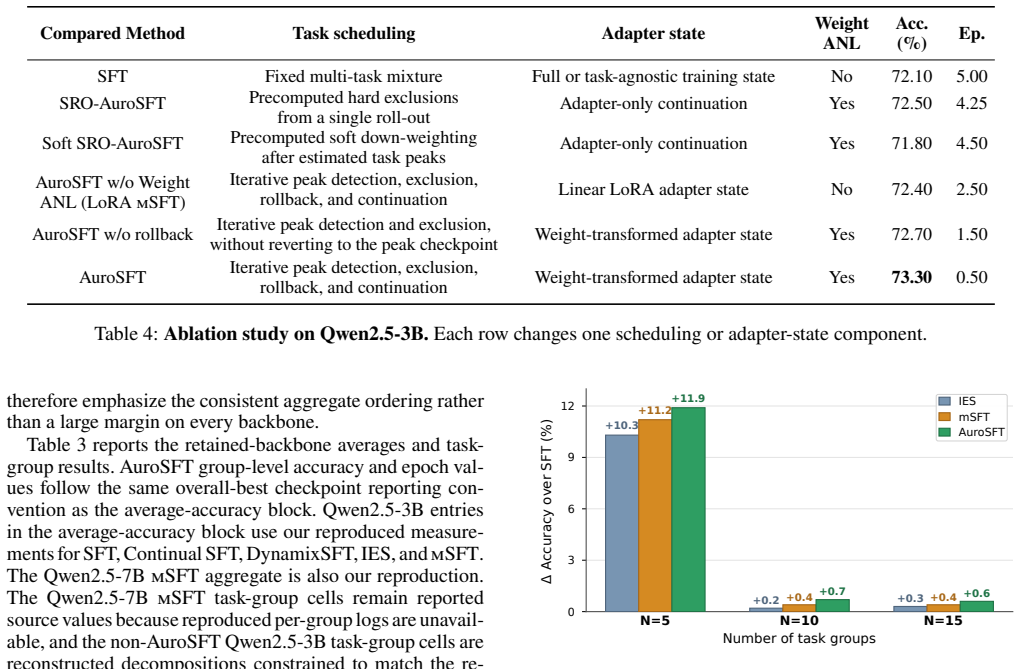
The central discovery is that the carried state of mSFT can be re-expressed as a mergeable nonlinear low-rank adapter $\{A, B, \mathrm{ANL}\}$ with update $\Delta W = \frac{\alpha}{r} B \bar A$, where $\bar A = \sigma(A^\top)^\top$ and the nonlinear layer acts on the low-rank weight factor rather than on the input representation. This keeps the adapted layer linear in the input, rank-bounded by $r$, and exactly mergeable into the frozen projection after training. Empirically, AuroSFT obtains 61.36% average accuracy over ten benchmarks across five backbones versus 59.85% for the mSFT comparison row, higher on all five backbones; the Qwen2.5-3B ablation shows 73.30% for the full design versus 72.40% without Weight ANL and 72.70% without rollback.
Load-bearing premise
The comparison assumes that the mSFT reference row and the AuroSFT runs use the same backbone set, training budget, and evaluation protocol, so the 1.51-point gain reflects the adapter state rather than a difference in compute or protocol.
Editorial extensions
If this is right
- Task-wise overfitting-aware scheduling no longer requires storing a sequence of full backbones; a merged adapter state suffices for both rollback and deployment.
- The reported 1.51-point average gain and the all-five-backbone ordering, if reproducible, imply that adapter-state continuation can match or exceed full-model rollback on lightweight backbones.
- The ablation ordering implies that iterative peak detection with rollback is worth more than a single static roll-out or a softened down-weighting schedule.
- Removing the weight transform costs 0.9 points (73.30% to 72.40%) and removing rollback costs 0.6 points (73.30% to 72.70%), so both the nonlinear weight transform and the checkpointed adapter state are active ingredients, not only parameter-efficient substitutes.
- The 0.484% tensor footprint of the rollback state on Qwen2.5-3B suggests that checkpoint storage and stage-transition costs drop by roughly two orders of magnitude.
Reading between the lines
- A testable extension, not in the paper: run full-model mSFT at AuroSFT's epoch budget (about 0.25 to 2.5 epochs) to see whether the 1.51-point margin shrinks; if it does, the strength of the claim depends on the matched-budget assumption.
- Because the update stays linear in the input, the same weight-transformed adapter state could carry schedulers for other frozen layers such as convolutions or attention projections without new rollback machinery; the paper does not explore this.
- The paper's Eq. (6) decomposition—peak-checkpoint gain plus post-exclusion forgetting—could be turned into a per-task diagnostic that chooses between hard exclusion and soft down-weighting based on whether the forgetting term is negative; the paper only uses the identity to frame its analysis.
Editorial analysis
A structured set of objections, weighed in public.
Referee Report
Summary. The paper introduces AuroSFT, a parameter-efficient reformulation of mSFT for multi-task supervised fine-tuning. Instead of storing and restoring full-model checkpoints at task-wise validation peaks, AuroSFT freezes the pretrained backbone and carries the scheduler state in low-rank adapters with a nonlinear weight transform, so that the update remains input-linear, rank-bounded, and exactly mergeable into the frozen projection. The central empirical claim is that, under the retained-backbone comparison protocol, AuroSFT reaches 61.36% average accuracy across five backbones versus 59.85% for the reported/reproduced mSFT reference row, and is higher on all five backbones. Matched Qwen2.5-3B ablations are used to isolate the contributions of iterative scheduling, adapter-state rollback, and the nonlinear weight transform.
Significance. The state-space reformulation is conceptually clean and technically sound: Eq. (2)-(3) indeed define a rank-bounded, input-linear, mergeable adapter update, and Algorithm 1 makes explicit that only the adapter state is checkpointed and restored. The formal development is not circular; Eq. (6) is an accounting identity and Eq. (3) is a parameterization definition. If the empirical comparison is validated, the work would be a useful contribution to parameter-efficient fine-tuning and dynamic multi-task scheduling, with practical storage and deployment benefits. Strengths include the explicit mathematical formulation, the matched Qwen2.5-3B ablation study, and the provision of an anonymous code repository. However, the headline empirical result currently depends on an underspecified baseline protocol, so the central claim is not yet established as stated.
major comments (3)
- [Experiments: Table 3 and "Reporting convention"] The central empirical claim rests on a comparison between AuroSFT and an mSFT reference row whose training configuration is not specified. Table 3 reports mSFT peak epochs up to 9.75 while AuroSFT peaks at 0.25-2.50, and Table 4's "AuroSFT w/o Weight ANL (LoRA mSFT)" row scores 72.40 on Qwen2.5-3B whereas the Table 3 mSFT row scores 73.10 on the same backbone. If the mSFT row is full-model fine-tuning or uses a substantially larger compute budget, the headline 1.51-point average gain and the all-five-backbones ordering are not attributable to the adapter state. Please specify for the mSFT row whether it is full-model or adapter-based, the number of trainable parameters, the optimizer budget (steps/epochs), and whether the numbers are rerun under the same evaluation protocol as AuroSFT.
- [Experiments: "Reporting convention" paragraph] Some mSFT task-group cells are not direct measurements: the Qwen2.5-7B mSFT task-group cells are reported source values, and the non-AuroSFT Qwen2.5-3B task-group cells are reconstructed decompositions constrained to match reproduced overall averages. Because the task-group layout is used to present group-level results, the provenance of each cell should be explicit, and reconstructed cells should be replaced by measured values or clearly marked as constraints rather than measurements. Without this, the group-level rows of Table 3 are not a reliable basis for fine-grained comparisons, even if the average-accuracy rows are based on reproduced aggregates.
- [Main Results and Discussion and Limitations] No variance or multi-seed results are reported. The Qwen2.5-7B margin is 0.05 points (77.50 vs 77.45), which is within plausible run-to-run noise, and the aggregate 1.51-point gain could shift if the baseline were matched and resampled. The paper's own limitation statement acknowledges that "stronger causal evidence requires matched multi-seed studies and profiling." Please provide at least 3-5 seeds for the key AuroSFT and mSFT rows, or support the headline differences with error bars or a significance test. This is load-bearing because the paper's central claim is an empirical ordering.
minor comments (6)
- [Method, Eq. (4)] Please specify the dimensions and shapes of H, W_s, and S(Z), and clarify the "row-wise convention" used in the implementation; currently the sizes of the ANL matrices are ambiguous.
- [Algorithm 1 and Experimental Setup] The stage budget C is an input to the scheduler but its value is never reported for any backbone or task group; please state the chosen values in the experimental setup.
- [Figure 3] Please describe how the number of task groups (N=5, 10, 15) is constructed from the ten benchmark families, and how the matched evaluation is defined for each group count.
- [Figure 6] Panel (b) appears to use a logarithmic y-axis; please state this explicitly in the caption so that the relative-size comparison is interpretable.
- [Abstract and Reporting convention] The phrase "reported/reproduced mSFT reference row" is imprecise; please mark at first use which entries were reproduced by the authors and which were taken from the original mSFT paper.
- [Table 3] For the Base rows, the "Ep." column shows a dash; please state in the caption that no training occurs for the Base rows, to avoid confusion about the peak-epoch convention.
Circularity Check
No significant circularity: the derivation chain is self-contained, with explicit definitions and an openly labeled accounting identity.
full rationale
Walking the derivation chain, none of the load-bearing steps reduces to its own inputs. Equations (2)--(4) define the weight-transformed adapter parameterization; the claims of input-linearity, rank boundedness, and mergeability follow directly from the stated construction (delta-W = (alpha/r) B A-bar), not from a circular fit. Equation (6) is explicitly introduced as an 'accounting identity' and is not used to derive the empirical gains; it only names two interpretive brackets. The scheduler is inherited from mSFT, and the paper repeatedly disclaims redesigning the scheduler, so the novel claim is confined to the adapter-state object. The empirical headline (61.36% vs 59.85%, all-five-backbones ordering) compares measured accuracies; no fitted parameter is renamed as a prediction, and the ablations are component-removal measurements rather than derived consequences. Citations to mSFT and AuroRA are to non-overlapping author groups, so there is no self-citation chain, and no uniqueness or ansatz is smuggled in through a same-author citation. The reporting-convention paragraph discloses that some non-AuroSFT cells are reproduced, reconstructed, or source-reported; that is a transparency issue about the comparison protocol's provenance, not circularity of the paper's derivation. Any concern that the mSFT reference row may not match AuroSFT's compute or adapter protocol is an experimental-validity or fairness risk, which is outside the circularity analysis.
Assumptions & free parameters
free parameters (5)
- rank r =
8
- alpha =
16
- learning rate =
1e-5
- stage budget C =
not reported
- ANL hyperparameters (H, W_s, B-spline bases) =
not reported
assumptions (4)
- domain assumption Task-wise validation peaks indicate per-task overfitting, and rolling back to the peak checkpoint improves final multi-task accuracy.
- domain assumption The retained-backbone comparison protocol is shared by AuroSFT and the mSFT reference row.
- domain assumption Held-out evaluation sets used for peak detection are also valid for reporting final accuracy.
- standard math Matrix multiplication and rank bounds: rank(B * A_bar) <= r.
Cite this review
Pith. "Pith review of Beyond Full-Model Rollback: AuroSFT for Adapter-State Multi-Task Fine-Tuning." pith.science (2026). https://pith.science/paper/RH23C3KT
@misc{pith2026260805250,
  author       = {Pith},
  title        = {Pith review of: Beyond Full-Model Rollback: AuroSFT for Adapter-State Multi-Task Fine-Tuning},
  year         = {2026},
  howpublished = {\url{https://pith.science/paper/RH23C3KT}},
  note         = {Machine review of arXiv:2608.05250}
}
read the original abstract
Multi-task supervised fine-tuning (SFT) often casts a heterogeneous data mixture as a single optimization problem, even though different tasks may reach their best generalization at different times. msft exposes this mismatch through task-wise roll-out, exclusion, and rollback, but its original formulation materializes the scheduler state as full-model checkpoints, making stage transitions costly to store, restore, and deploy. This paper introduces AuroSFT, a parameter-efficient framework that recasts the carried state of overfitting-aware multi-task SFT as a compact, mergeable adapter state. AuroSFT freezes the pretrained backbone, trains only injected adapters, rolls back adapter checkpoints at task-wise peaks, and continues on the remaining active mixture. At the layer level, each adapter applies an AuroRA-inspired adaptive nonlinear layer to a low-rank weight factor rather than to the sample representation. The resulting update remains linear in the input, rank-bounded, and exactly mergeable into the frozen projection. Under the retained-backbone comparison protocol, AuroSFT achieves 61.36% average accuracy, compared with 59.85% for the corresponding msft reference row, and obtains higher accuracy on all five backbones. Our code is available at the anonymous repository: https://anonymous.4open.science/r/AuroSFT-80D1.
Figures


Figures from the paper (4 more)


Reference graph
Works this paper leans on
-
[1]
Communication, Simulation, and Intelligent Agents: Implications of Personal Intelligent Machines for Medical Education
Clancey, William J. Communication, Simulation, and Intelligent Agents: Implications of Personal Intelligent Machines for Medical Education. Proceedings of the Eighth International Joint Conference on Artificial Intelligence (IJCAI-83)
-
[2]
Classification Problem Solving
Clancey, William J. Classification Problem Solving. Proceedings of the Fourth National Conference on Artificial Intelligence
-
[3]
, title =
Robinson, Arthur L. , title =. 1980 , doi =. https://science.sciencemag.org/content/208/4447/1019.full.pdf , journal =
1980
-
[4]
New Ways to Make Microcircuits Smaller---Duplicate Entry
Robinson, Arthur L. New Ways to Make Microcircuits Smaller---Duplicate Entry. Science
-
[5]
Clancey and Glenn Rennels , abstract =
Diane Warner Hasling and William J. Clancey and Glenn Rennels , abstract =. Strategic explanations for a diagnostic consultation system , journal =. 1984 , issn =. doi:https://doi.org/10.1016/S0020-7373(84)80003-6 , url =
-
[6]
and Rennels, Glenn R
Hasling, Diane Warner and Clancey, William J. and Rennels, Glenn R. and Test, Thomas. Strategic Explanations in Consultation---Duplicate. The International Journal of Man-Machine Studies
-
[7]
Poligon: A System for Parallel Problem Solving
Rice, James. Poligon: A System for Parallel Problem Solving
-
[8]
Transfer of Rule-Based Expertise through a Tutorial Dialogue
Clancey, William J. Transfer of Rule-Based Expertise through a Tutorial Dialogue
Show all 72 references
-
[9]
The Engineering of Qualitative Models
Clancey, William J. The Engineering of Qualitative Models
-
[10]
2023 , eprint=
Attention Is All You Need , author=. 2023 , eprint=
2023
-
[11]
Pluto: The 'Other' Red Planet
NASA. Pluto: The 'Other' Red Planet
-
[12]
Attention is All you Need , url =
Vaswani, Ashish and Shazeer, Noam and Parmar, Niki and Uszkoreit, Jakob and Jones, Llion and Gomez, Aidan N and Kaiser, ukasz and Polosukhin, Illia , booktitle =. Attention is All you Need , url =
-
[13]
2020 , eprint=
Scaling Laws for Neural Language Models , author=. 2020 , eprint=
2020
-
[14]
arXiv preprint arXiv:2504.07139 , year=
Artificial intelligence index report 2025 , author=. arXiv preprint arXiv:2504.07139 , year=
2025
-
[15]
arXiv preprint arXiv:2406.11704 , year=
Nemotron-4 340b technical report , author=. arXiv preprint arXiv:2406.11704 , year=
-
[16]
5-coder technical report , author=
Qwen2. 5-coder technical report , author=. arXiv preprint arXiv:2409.12186 , year=
-
[17]
arXiv preprint arXiv:2407.21783 , year=
The llama 3 herd of models , author=. arXiv preprint arXiv:2407.21783 , year=
-
[18]
arXiv preprint arXiv:2512.13607 , year=
Nemotron-cascade: Scaling cascaded reinforcement learning for general-purpose reasoning models , author=. arXiv preprint arXiv:2512.13607 , year=
-
[19]
An Empirical Study of Catastrophic Forgetting in Large Language Models During Continual Fine-Tuning , year=
Luo, Yun and Yang, Zhen and Meng, Fandong and Li, Yafu and Zhou, Jie and Zhang, Yue , journal=. An Empirical Study of Catastrophic Forgetting in Large Language Models During Continual Fine-Tuning , year=
-
[20]
arXiv preprint arXiv:2506.10910 , year=
Magistral , author=. arXiv preprint arXiv:2506.10910 , year=
-
[21]
OLM o: Accelerating the Science of Language Models
Groeneveld, Dirk and Beltagy, Iz and Walsh, Evan and Bhagia, Akshita and Kinney, Rodney and Tafjord, Oyvind and Jha, Ananya and Ivison, Hamish and Magnusson, Ian and Wang, Yizhong and Arora, Shane and Atkinson, David and Authur, Russell and Chandu, Khyathi and Cohan, Arman and...
2024
-
[22]
Smith and Hannaneh Hajishirzi , booktitle=
Evan Pete Walsh and Luca Soldaini and Dirk Groeneveld and Kyle Lo and Shane Arora and Akshita Bhagia and Yuling Gu and Shengyi Huang and Matt Jordan and Nathan Lambert and Dustin Schwenk and Oyvind Tafjord and Taira Anderson and David Atkinson and Faeze Brahman and Christopher...
2025
-
[23]
arXiv preprint arXiv:2512.13961 , year=
Olmo 3 , author=. arXiv preprint arXiv:2512.13961 , year=
-
[24]
arXiv preprint arXiv:2412.19437 , year=
Deepseek-v3 technical report , author=. arXiv preprint arXiv:2412.19437 , year=
-
[25]
arXiv preprint arXiv:2501.12948 , year=
Deepseek-r1: Incentivizing reasoning capability in llms via reinforcement learning , author=. arXiv preprint arXiv:2501.12948 , year=
-
[26]
2025 , eprint=
Qwen2.5 Technical Report , author=. 2025 , eprint=
2025
-
[27]
arXiv preprint arXiv:2508.12116 , year=
DynamixSFT: Dynamic Mixture Optimization of Instruction Tuning Collections , author=. arXiv preprint arXiv:2508.12116 , year=
-
[28]
2024 , eprint=
Nemotron-4 340B Technical Report , author=. 2024 , eprint=
2024
-
[29]
, booktitle =
Vapnik, V. , booktitle =. Principles of Risk Minimization for Learning Theory , url =
-
[30]
Journal of Machine Learning Research , year =
Ting Hu and Yunwen Lei , title =. Journal of Machine Learning Research , year =
-
[31]
Automatic early stopping using cross validation: quantifying the criteria , journal =
Lutz Prechelt , keywords =. Automatic early stopping using cross validation: quantifying the criteria , journal =. 1998 , issn =. doi:https://doi.org/10.1016/S0893-6080(98)00010-0 , url =
1998 doi
-
[32]
Revisiting Scaling Laws for Language Models: The Role of Data Quality and Training Strategies
Chen, Zhengyu and Wang, Siqi and Xiao, Teng and Wang, Yudong and Chen, Shiqi and Cai, Xunliang and He, Junxian and Wang, Jingang. Revisiting Scaling Laws for Language Models: The Role of Data Quality and Training Strategies. Proceedings of the 63rd Annual Meeting of the Associ...
2025 doi
-
[33]
2025 , eprint=
Scaling Behaviors of LLM Reinforcement Learning Post-Training: An Empirical Study in Mathematical Reasoning , author=. 2025 , eprint=
2025
-
[34]
2026 , eprint=
Generative Visual Code Mobile World Models , author=. 2026 , eprint=
2026
-
[35]
The Thirteenth International Conference on Learning Representations , year=
Instance-dependent Early Stopping , author=. The Thirteenth International Conference on Learning Representations , year=
-
[36]
Dynamic Data Mixing Maximizes Instruction Tuning for Mixture-of-Experts
Zhu, Tong and Dong, Daize and Qu, Xiaoye and Ruan, Jiacheng and Chen, Wenliang and Cheng, Yu. Dynamic Data Mixing Maximizes Instruction Tuning for Mixture-of-Experts. Proceedings of the 2025 Conference of the Nations of the Americas Chapter of the Association for Computational...
2025 doi
-
[37]
How Abilities in Large Language Models are Affected by Supervised Fine-tuning Data Composition
Dong, Guanting and Yuan, Hongyi and Lu, Keming and Li, Chengpeng and Xue, Mingfeng and Liu, Dayiheng and Wang, Wei and Yuan, Zheng and Zhou, Chang and Zhou, Jingren. How Abilities in Large Language Models are Affected by Supervised Fine-tuning Data Composition. Proceedings of ...
2024 doi
-
[38]
2025 , eprint=
DaMo: Data Mixing Optimizer in Fine-tuning Multimodal LLMs for Mobile Phone Agents , author=. 2025 , eprint=
2025
-
[39]
2026 , url=
Weixuan Wang and Minghao Wu and Barry Haddow and Alexandra Birch , booktitle=. 2026 , url=
2026
-
[40]
From Quantity to Quality: Boosting LLM Performance with Self-Guided Data Selection for Instruction Tuning
Li, Ming and Zhang, Yong and Li, Zhitao and Chen, Jiuhai and Chen, Lichang and Cheng, Ning and Wang, Jianzong and Zhou, Tianyi and Xiao, Jing. From Quantity to Quality: Boosting LLM Performance with Self-Guided Data Selection for Instruction Tuning. Proceedings of the 2024 Con...
2024 doi
-
[41]
Advances in Neural Information Processing Systems , editor =
Language Models are Few-Shot Learners , author =. Advances in Neural Information Processing Systems , editor =. 2020 , address =
2020
-
[42]
Proceedings of the 2022 Conference on Empirical Methods in Natural Language Processing , pages=
Fine-tuned language models are continual learners , author=. Proceedings of the 2022 Conference on Empirical Methods in Natural Language Processing , pages=
2022
-
[43]
C ommonsense QA : A Question Answering Challenge Targeting Commonsense Knowledge
Talmor, Alon and Herzig, Jonathan and Lourie, Nicholas and Berant, Jonathan. C ommonsense QA : A Question Answering Challenge Targeting Commonsense Knowledge. Proceedings of the 2019 Conference of the North A merican Chapter of the Association for Computational Linguistics: Hu...
2019 doi
-
[44]
Can a Suit of Armor Conduct Electricity? A New Dataset for Open Book Question Answering
Mihaylov, Todor and Clark, Peter and Khot, Tushar and Sabharwal, Ashish. Can a Suit of Armor Conduct Electricity? A New Dataset for Open Book Question Answering. Proceedings of the 2018 Conference on Empirical Methods in Natural Language Processing. 2018. doi:10.18653/v1/D18-1260
2018 doi
-
[45]
Program Induction by Rationale Generation: Learning to Solve and Explain Algebraic Word Problems
Ling, Wang and Yogatama, Dani and Dyer, Chris and Blunsom, Phil. Program Induction by Rationale Generation: Learning to Solve and Explain Algebraic Word Problems. Proceedings of the 55th Annual Meeting of the Association for Computational Linguistics (Volume 1: Long Papers). 2...
2017 doi
-
[46]
2021 , eprint=
Training Verifiers to Solve Math Word Problems , author=. 2021 , eprint=
2021
-
[47]
and Gardner, Matt
Welbl, Johannes and Liu, Nelson F. and Gardner, Matt. Crowdsourcing Multiple Choice Science Questions. Proceedings of the 3rd Workshop on Noisy User-generated Text. 2017. doi:10.18653/v1/W17-4413
2017 doi
-
[48]
2018 , eprint=
Think you have Solved Question Answering? Try ARC, the AI2 Reasoning Challenge , author=. 2018 , eprint=
2018
-
[49]
H ella S wag: Can a Machine Really Finish Your Sentence?
Zellers, Rowan and Holtzman, Ari and Bisk, Yonatan and Farhadi, Ali and Choi, Yejin. H ella S wag: Can a Machine Really Finish Your Sentence?. Proceedings of the 57th Annual Meeting of the Association for Computational Linguistics. 2019. doi:10.18653/v1/P19-1472
2019 doi
-
[50]
Proceedings of the AAAI Conference on Artificial Intelligence , volume=
WinoGrande: An Adversarial Winograd Schema Challenge at Scale , author=. Proceedings of the AAAI Conference on Artificial Intelligence , volume=
-
[51]
B ool Q : Exploring the Surprising Difficulty of Natural Yes/No Questions
Clark, Christopher and Lee, Kenton and Chang, Ming-Wei and Kwiatkowski, Tom and Collins, Michael and Toutanova, Kristina. B ool Q : Exploring the Surprising Difficulty of Natural Yes/No Questions. Proceedings of the 2019 Conference of the North A merican Chapter of the Associa...
2019 doi
-
[52]
Proceedings of the Conference on Health, Inference, and Learning , pages =
MedMCQA: A Large-scale Multi-Subject Multi-Choice Dataset for Medical domain Question Answering , author =. Proceedings of the Conference on Health, Inference, and Learning , pages =. 2022 , editor =
2022
-
[53]
arXiv preprint arXiv:2411.15124 , year=
Tulu 3: Pushing frontiers in open language model post-training , author=. arXiv preprint arXiv:2411.15124 , year=
-
[54]
Proceedings of the 2022 conference on empirical methods in natural language processing , pages=
Super-naturalinstructions: Generalization via declarative instructions on 1600+ nlp tasks , author=. Proceedings of the 2022 conference on empirical methods in natural language processing , pages=
2022
-
[55]
arXiv preprint arXiv:2508.11953 , year=
Data mixing optimization for supervised fine-tuning of large language models , author=. arXiv preprint arXiv:2508.11953 , year=
-
[56]
International conference on machine learning , pages=
Gradnorm: Gradient normalization for adaptive loss balancing in deep multitask networks , author=. International conference on machine learning , pages=. 2018 , organization=
2018
-
[57]
Advances in neural information processing systems , volume=
Gradient surgery for multi-task learning , author=. Advances in neural information processing systems , volume=
-
[58]
Advances in neural information processing systems , volume=
Conflict-averse gradient descent for multi-task learning , author=. Advances in neural information processing systems , volume=
-
[59]
Advances in Neural Information Processing Systems , volume=
Famo: Fast adaptive multitask optimization , author=. Advances in Neural Information Processing Systems , volume=
-
[60]
Proceedings of the 2024 Conference on Empirical Methods in Natural Language Processing , pages=
Coba: Convergence balancer for multitask finetuning of large language models , author=. Proceedings of the 2024 Conference on Empirical Methods in Natural Language Processing , pages=
2024
-
[61]
arXiv preprint arXiv:2410.05248 , year=
Sftmix: Elevating language model instruction tuning with mixup recipe , author=. arXiv preprint arXiv:2410.05248 , year=
-
[62]
arXiv preprint arXiv:2603.21606 , year=
mSFT: Addressing Dataset Mixtures Overfitting Heterogeneously in Multi-task SFT , author=. arXiv preprint arXiv:2603.21606 , year=
-
[63]
arXiv preprint arXiv:2505.18738 , year=
AuroRA: Breaking Low-Rank Bottleneck of LoRA with Nonlinear Mapping , author=. arXiv preprint arXiv:2505.18738 , year=
-
[64]
arXiv preprint arXiv:2106.09685 , year=
LoRA: Low-Rank Adaptation of Large Language Models , author=. arXiv preprint arXiv:2106.09685 , year=
-
[65]
Proceedings of the 36th International Conference on Machine Learning , year=
Parameter-Efficient Transfer Learning for NLP , author=. Proceedings of the 36th International Conference on Machine Learning , year=
-
[66]
arXiv preprint arXiv:2101.00190 , year=
Prefix-Tuning: Optimizing Continuous Prompts for Generation , author=. arXiv preprint arXiv:2101.00190 , year=
-
[67]
Proceedings of the 2021 Conference on Empirical Methods in Natural Language Processing , year=
The Power of Scale for Parameter-Efficient Prompt Tuning , author=. Proceedings of the 2021 Conference on Empirical Methods in Natural Language Processing , year=
2021
-
[68]
arXiv preprint arXiv:2305.14314 , year=
QLoRA: Efficient Finetuning of Quantized LLMs , author=. arXiv preprint arXiv:2305.14314 , year=
-
[69]
arXiv preprint arXiv:2303.10512 , year=
AdaLoRA: Adaptive Budget Allocation for Parameter-Efficient Fine-Tuning , author=. arXiv preprint arXiv:2303.10512 , year=
-
[70]
arXiv preprint arXiv:2308.10792 , year=
Instruction Tuning for Large Language Models: A Survey , author=. arXiv preprint arXiv:2308.10792 , year=
-
[71]
arXiv preprint arXiv:2402.09353 , year=
DoRA: Weight-Decomposed Low-Rank Adaptation , author=. arXiv preprint arXiv:2402.09353 , year=
-
[72]
arXiv preprint arXiv:2407.05000 , year=
LoRA-GA: Low-Rank Adaptation with Gradient Approximation , author=. arXiv preprint arXiv:2407.05000 , year=
Reviewed August 8, 2026 · model on record in the stance chip above.
Discussion (0). Continue with ORCID to comment.