REVIEW 3 major objections 5 minor 70 references
Coherent End-to-End Search for Generic Extreme-Mass-Ratio Inspirals
T0 review · 3 major / 5 minor · reviewed 2026-08-07 · deepseek-v4-flash
Pith's one-line read A coherent hierarchical search over the full 14-dimensional EMRI parameter space succeeds without source-targeted priors by letting high-likelihood secondary maxima guide adaptive prior contraction, recovering two test signals with…
desk verdict A genuinely new coherent EMRI search strategy with clean math, but the broad-prior end-to-end claim outruns the evidence: the fiducial ν0 is tuned to each injection and the peak-pattern heuristic is shown on only two SNR-50 cases. read the letter →
The pith
A machine-rendered reading of the paper's core claim, the machinery that carries it, and where it could break.
The reading
What carries the argument
The load-bearing mechanism is the peak pattern—the empirical property that the highest-likelihood secondary maxima of an EMRI likelihood become progressively concentrated around the primary maximum, because partial matches to different waveform harmonics create ever-denser peaks as the template approaches the true parameters. The paper deploys this pattern through three coupled devices: a reduced-dimensional profile likelihood in which distance is maximized analytically, the time-independent extrinsic parameters are separated from the phase-coupled parameters by a linear decomposition, and the initial orbital frequency $\nu_0$ is handled by a fast Fourier-based lag search; a seven-dimensional likelihood for global localization combined with an eight-dimensional likelihood for refinement; and local-best particle-swarm optimization that collects candidate peaks across independent runs. The peak pattern supplies the criterion for what to keep at each contraction step, the profile likelihoods make those steps computationally tractable, and the particle-swarm runs supply the ensemble of peaks whose coordinate envelope defines the next prior.
What would settle it
Run the pipeline on a population sample—say dozens to hundreds of EMRI injections spanning the broad priors with independent noise realizations—and count how often the hierarchical contraction's final region contains the true parameters and the end-to-end fitting factor stays above a threshold such as 0.95; a single injected source whose high-likelihood peaks cluster around a remote secondary maximum, so that the contracted prior excludes the truth, would refute the central claim.
Extended reading notes
Core claim
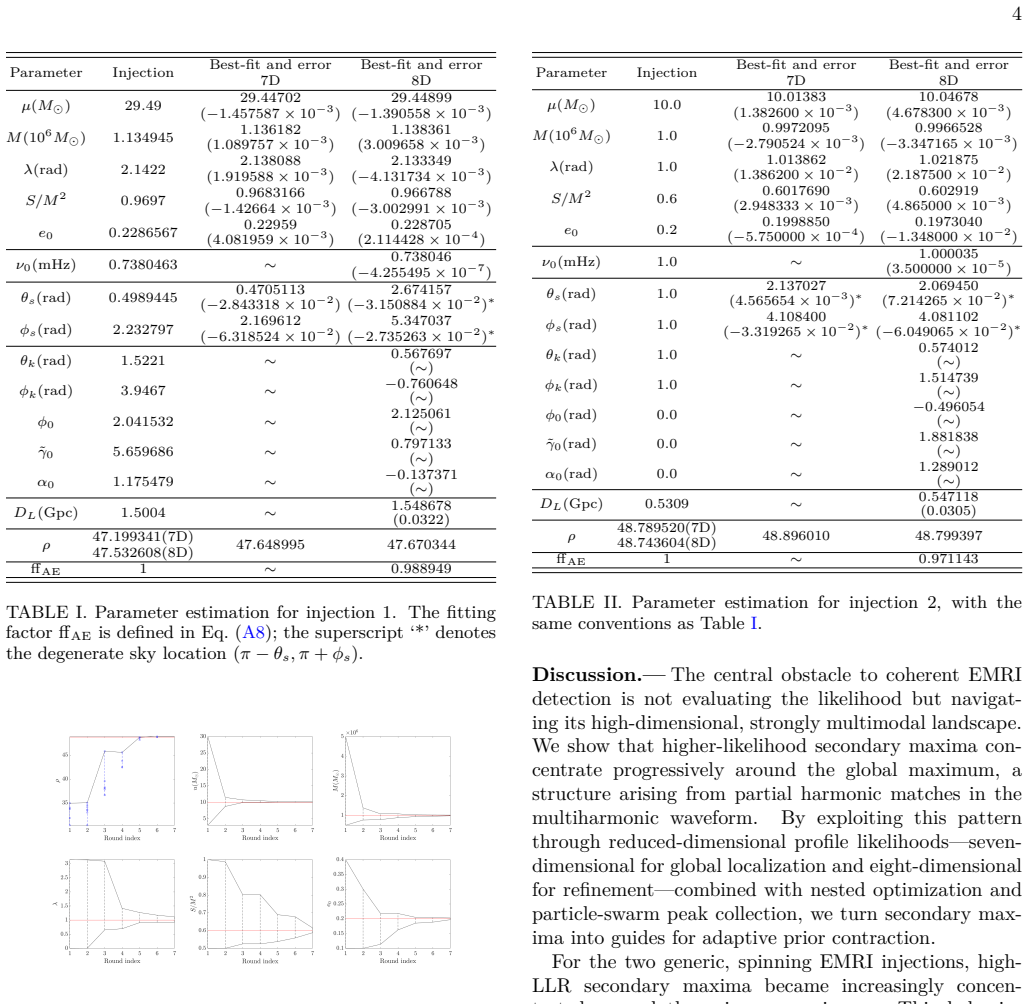
The paper's central claim is that a fully coherent matched-filtering search of the complete 14-dimensional EMRI parameter space can succeed over astrophysically broad priors, provided the search treats the likelihood's secondary maxima as guides rather than obstacles. The authors characterize the likelihood landscape of a multiharmonic EMRI waveform: harmonics carry different signal-to-noise ratios, so templates far from the true parameters match only the loudest harmonics, while templates nearer the peak match progressively more of them; consequently, the highest-log-likelihood-ratio secondary maxima concentrate around the global maximum. They convert this concentration into an iterative contraction scheme: each stage runs independent local-best particle-swarm searches over a seven-dimensional profile likelihood, in which extrinsic parameters are profiled out, distance is maximized analytically, and the initial orbital frequency is replaced by a time-lag shift evaluated efficiently in the Fourier domain, and the collected peaks above a rising threshold define the next, smaller prior. A final eight-dimensional search treats the initial orbital frequency as free and removes the lag-induced bias. On two injected generic, spinning analytical-kludge signals of 0.5-year duration with target SNR 50 in stationary Gaussian LISA noise, the hierarchy converges in eight and six stages and returns maximum-likelihood estimates with fitting factors 0.989 and 0.971, fractional errors of $10^{-3}$ to $10^{-2}$ in the phase-evolution parameters, distance errors of about 3%, and absolute sky-location errors below 0.1 radian after accounting for the known sky degeneracy.
Load-bearing premise
The whole contraction rests on the empirical claim that higher-likelihood secondary peaks gather increasingly tightly around the true peak; if a sufficiently loud wrong peak cluster ever sits far from the truth, the contracted prior can enclose it and exclude the real signal—and this claim is supported only by two injections and a qualitative harmonic argument, not by proof or a population study.
Editorial extensions
If this is right
- If the peak pattern holds for realistic sources, coherent matched filtering can be run over population-scale priors on all 14 parameters, not just over source-targeted or Schwarzschild-restricted models.
- The 7D lag-shift likelihood consistently reveals the peak structure in the two demonstrations, indicating that global localization can be achieved before the expensive 8D refinement stage is launched.
- The hierarchy converged to the true parameters from both a boundary-near and a central injection, suggesting the contraction is not tuned to a particular corner of the prior.
- The reported cost is high—about two months for a half-year search on the current CPU pipeline—but the paper identifies GPU acceleration as a direct route to runs on the order of a week.
- Because the structure of the method is not tied to the specific waveform family, the paper states it should transfer from analytical-kludge templates to faster and more accurate FEW templates with computational adaptation.
Reading between the lines
- The peak-pattern assumption, if valid beyond two injections, implies a general design principle for multimodal phase-coherent searches: the risk that a contracted prior excludes the true peak can be reduced by collecting more high-likelihood peaks, because the probability that every collected peak cluster misses the truth falls as the peak count grows.
- A natural testable extension the paper does not pursue is to turn the hierarchy into a detection statistic: the number and concentration of high-likelihood peaks above threshold in noise alone versus signal-plus-noise could provide a false-alarm estimate for the search.
- The fiducial-$\nu_0$ fine-tuning problem—how much earlier the template starts than the true signal—is acknowledged as unresolved for a fully blind search, and a population-informed choice of this lag is an obvious follow-up that the current demonstration sidesteps.
Editorial analysis
A structured set of objections, weighed in public.
Referee Report
Summary. The manuscript presents a hierarchical, coherent search pipeline for generic (spinning, eccentric, inclined) extreme-mass-ratio inspirals in LISA-like data. The central technical contribution is a reduced-dimensional profile likelihood: an 8D likelihood over phase-evolution and detector-delay parameters, and a 7D likelihood that removes the initial orbital frequency ν0 by replacing it with a time-lag maximization. The search uses particle-swarm optimization to collect secondary maxima and iteratively contracts the prior volume, exploiting a claimed 'peak pattern' in which high-likelihood secondary maxima cluster progressively around the global maximum. Two half-year analytical-kludge injections at SNR ≈ 50 in stationary Gaussian LISA noise are recovered with fitting factors of 0.989 and 0.971 and small parameter errors. The paper claims this is the first end-to-end coherent parameter estimation for generic EMRIs over astrophysically broad priors.
Significance. If the central claim is correct, this would be a substantial advance for EMRI data analysis: it would demonstrate that coherent matched filtering can navigate the multimodal 14D likelihood landscape of generic EMRIs without source-targeted priors, at least for the tested SNR and waveform model. The reduced-dimensionality derivation (Eqs. 1-14) is mathematically clean, the use of nested optimization and the treatment of extrinsic parameters are standard and sound, and the paper is careful to document computational costs and implementation details. However, the paper's broad-prior claim rests on two injections and a hand-tuned control parameter, and a key load-bearing assumption about ν0 is explicitly acknowledged to be non-general. The work is therefore best viewed as a promising proof-of-principle that requires substantially more validation and a revision of its headline claim.
major comments (3)
- [D.1/D.4, Eqs. (10)-(13)] The headline claim of 'astrophysically broad priors' is not supported for the initial orbital frequency ν0. In the 7D likelihood, ν0 is not searched; instead a fiducial value is fixed at 10^4 lags (≈2 days at 15 s cadence) before the true value for both injections, and the lag maximization n* absorbs only small offsets. For a source whose true ν0 differs from the fiducial value by weeks or more, the template's phase trajectory—computed from the fiducial ν0—will no longer match the signal even after the optimal time shift, because the chirp rate and higher-order frequency evolution differ. The manuscript itself states (D.1) that this fiducial choice is 'not sufficiently general for arbitrary EMRI sources' and (D.4) that a blind choice 'poses a challenge for a fully blind search.' The final 8D search also uses a ν0 interval derived from the 7D lag estimate, which is narrow (several weeks). The demonstrations therefore assume ν0 known to about two days, not the broad prior listed in Table V. The authors should either add a ν0-search stage (e.g., an outer grid or a preliminary ν0 localization) and demonstrate it, or revise the abstract and introduction to state the actual effective prior on ν0.
- [Supplemental B2, Figs. 10-11] The 'peak pattern'—that high-LLR secondary maxima concentrate progressively around the global maximum—is the central premise justifying every prior-contraction step, yet it is asserted as a general property and supported only by a qualitative harmonic-SNR argument and two injections, both at SNR ≈ 50, in the same stationary Gaussian noise model. No proof is provided, and no failure-rate study over source parameters, sky positions, SNRs, or noise realizations is presented. The paper's own language ('general global characteristic', 'it proves to be general') goes beyond what two examples can establish. A systematic validation, e.g., 20-50 injections drawn from the prior, with varying SNR and multiple noise realizations, quantifying how often the contracted range encloses the true parameters and how the landmark LLR converges, is needed to support the claimed generality.
- [Supplemental D.3, Table VI] The LLR threshold ρthreshold is a control parameter that determines which secondary peaks are retained for the next prior contraction. Table VI shows that the threshold is chosen by hand, with different values for each iteration and each injection (e.g., 30, 30, 32, 38.5, 37, 46.4, 46.8 for injection 1). The success of the hierarchy depends on this choice, yet the manuscript gives no selection rule and no sensitivity study. If the results change substantially when the threshold is varied by a few units, the method is not robust; if they do not, that robustness should be demonstrated. A documented, reproducible criterion for setting ρthreshold, or a study of the method's performance under threshold perturbations, is required.
minor comments (5)
- [D.1 vs D.4] The wording describing the fiducial ν0 offset is inconsistent: D.1 says '10^4 lags ahead of its true value' while D.4 says '10,000 lags before its true value', and the intended sign (earlier vs later in time) is ambiguous until one reads the backward-integration description. Please clarify the time ordering of the fiducial frequency relative to the true signal.
- [Tables I-II] The notation for the degenerate sky location (π−θs, π+ϕs) is indicated with an asterisk, but the relative errors are computed against the degenerate value rather than the injected value, which is confusing. A better presentation would report the minimal sky error after accounting for the known degeneracy, as the text claims.
- [Figs. 1-2 and D.5] The decreases in landmark LLR between some iterations (e.g., injection 1 between iterations 4 and 5) are attributed to PSO stochasticity, but the text does not quantify how often independent runs fail to find the previous landmark. Reporting the number of runs that recovered the landmark maximum at each stage would give readers a clearer sense of the method's reproducibility.
- [Table IV] The computational cost (≈3×10^6 CPU hours, ~2 months per search) is presented as a limitation, and GPU acceleration is deferred to future work. This should be stated more prominently in the main text, not only in the Supplemental Material, because it affects the practical significance of the 'end-to-end' claim for LISA data over several years.
- [Introduction] The reference list is extensive but the Introduction's claim of being 'the first coherent search for a generic, spinning EMRI across the complete 14-dimensional parameter space' should be carefully calibrated against the ν0 limitation discussed above; as written, the claim overstates what is demonstrated.
Circularity Check
The broad-prior end-to-end claim is partially undermined: the fiducial ν0 is initialized from the true value for both injections, and the peak-pattern premise is validated with the same injections used as the demonstrations.
-
fitted input called prediction
[Supplemental Sec. D.4; methodology '7D' (Eqs. 10–13)]
"For illustration, we set the fiducialν0 to 10, 000 lags before its true value for both injections in the 7D likelihood, meaning the detector captures the signal about 2 days after operation start (at a 15‑second cadence). ... This poses a challenge for a fully blind search."
In the 7D likelihood, ν0 is removed from the search parameters and instead recovered through a time-lag maximization over n (Eqs. 10–13). The template phase trajectory is generated from the fixed fiducial ν0, so the lag search only works for small offsets. Setting the fiducial ν0 to about 2 days before the true value makes the effective prior on ν0 a narrow, injection-informed window rather than the broad astrophysical prior claimed in the abstract and Table V. The reported recovery of ν0 with relative error 10^-7 to 10^-5 therefore builds knowledge of the true source into the setup; the paper itself concedes that this choice is not sufficiently general for arbitrary EMRI sources.
-
other
[Supplemental Sec. B2 and Sec. D5]
"Based on this property, a general global characteristic of the distribution of secondary peaks relative to the primary peak can be summarized: high‑LLR secondary peaks tend to cluster increasingly tightly around the primary peak ... In summary, the hierarchical search strategy proves effective at each iteration for both injections, confirming the generality of the peak pattern."
The peak-clustering property is the load-bearing premise for every prior-contraction step in the hierarchical search. It is introduced as a 'general global characteristic' rather than derived, and its only empirical support is the same two injections whose successful recovery is presented as the demonstration of the method. Thus the evidence for the premise and the evidence for the method's success are the same experiment; no independent failure-rate study, analytic proof, or out-of-sample test is provided. The hierarchical search therefore validates the peak pattern using results that already presuppose it.
full rationale
The likelihood algebra itself is self-contained: the profile likelihoods in Eqs. (1)–(14), the amplitude maximization, and the nested optimization follow from the stated Gaussian-noise likelihood and waveform decomposition, and the self-citations to Refs. [40,41] are for an optimization technique rather than for the central physical claim. However, the headline claim of an end-to-end search over 'astrophysically broad priors' is partially circular. The 7D search that provides global localization requires a fiducial ν0, and for both injections that fiducial is placed within about 2 days of the true value, an input that would not be available in a blind search; the paper explicitly acknowledges this as 'a challenge for a fully blind search.' Additionally, the key peak-clustering assumption is asserted and then confirmed on the same two injections used to demonstrate success, so the demonstration does not independently test the assumption. These issues affect the broad-prior end-to-end claim and the ν0 recovery, but the remaining parameter recovery, sky localization, fitting factors, and 8D refinement are not forced by construction. Overall, this is partial circularity rather than a fully forced derivation.
Assumptions & free parameters
free parameters (4)
- LLR threshold rho_threshold per iteration =
Injection 1: 30, 30, 32, 38.5, 37, 46.4, 46.8; Injection 2: 20, 31, 38.5, 40, 40
- Fiducial nu0 offset =
10^4 lags ahead of the true value (about 2 days at 15 s cadence)
- PSO settings =
Np = 40, Niter = 10000, c1 = c2 = 2, inertia 0.9 to 0.4, Vmax = 0.5
- Harmonic truncation =
Top 10 harmonics with n = 2, 3
assumptions (6)
- domain assumption The analytical-kludge waveform is a sufficient proxy for real EMRI signals for testing the search method.
- domain assumption Noise is stationary, Gaussian, with known PSD (LISA SciRDv1), and only A/E TDI channels are used.
- domain assumption First-generation TDI with equal, constant arm lengths is adequate.
- ad hoc to paper High-LLR secondary maxima concentrate around the global maximum (the peak pattern).
- domain assumption The top-10 harmonic truncation does not remove information needed for the search.
- ad hoc to paper The fiducial nu0 can be chosen near the true value in a search.
Cite this review
Pith. "Pith review of Coherent End-to-End Search for Generic Extreme-Mass-Ratio Inspirals." pith.science (2026). https://pith.science/paper/BNPKWRR5
@misc{pith2026260805974,
  author       = {Pith},
  title        = {Pith review of: Coherent End-to-End Search for Generic Extreme-Mass-Ratio Inspirals},
  year         = {2026},
  howpublished = {\url{https://pith.science/paper/BNPKWRR5}},
  note         = {Machine review of arXiv:2608.05974}
}
abstract
Extreme-mass-ratio inspirals (EMRIs) encode more than $10^5$ strong-field orbital cycles and are key targets for space-borne gravitational-wave interferometers, yet coherent recovery of generic systems over astrophysically broad priors remains unresolved. Successive Mock LISA, LISA, and Taiji Data Challenges (MLDCs, LDCs, and TDCs) have not yet produced a complete, generally reliable solution for blind EMRI detection and parameter recovery across such priors. The central obstacle is a needle-in-a-haystack likelihood: six phase-evolution parameters span a vast domain, producing an exceptionally narrow global maximum amid numerous secondary maxima. We show that higher-likelihood secondary maxima concentrate progressively around the global maximum and can therefore guide an adaptive contraction of the search volume. We exploit this structure through a reduced-dimensional profile likelihood and a coherent hierarchical strategy to search for EMRI signals across the full 14-dimensional parameter space. This enables the first end-to-end coherent parameter estimation for generic EMRIs with astrophysically broad priors. In stationary Gaussian LISA noise, the search recovers two half-year analytical-kludge signals with signal-to-noise ratios near 50, yielding fitting factors of 0.989 and 0.971, fractional errors of $10^{-3}$--$10^{-2}$ in the phase-evolution parameters and near $3\%$ in the distance, and error of less than $0.1$ radian in the sky location. The method turns secondary maxima into guides for a coherent hierarchical search.
Figures


Figures from the paper (14 more)


Reference graph
Works this paper leans on
-
[1]
P. Amaro-Seoane, Living Rev. Rel. 21 (2018) no.1, 4 doi:10.1007/s41114-018-0013-8 [arXiv:1205.5240 [astro- ph.CO]]
arXiv 2018
-
[2]
J. R. Gair, L. Barack, T. Creighton, C. Cutler, S. L. Lar- son, E. S. Phinney and M. Vallisneri, Class. Quant. Grav. 21, S1595-S1606 (2004)
work page 2004
-
[3]
L.BarackandC.Cutler, Phys.Rev.D 69, 082005(2004)
work page 2004
-
[4]
Q. Cui, W. B. Han and Z. Pan, [arXiv:2502.00856 [astro- ph.HE]]
-
[5]
C. P. L. Berry, S. A. Hughes, C. F. Sopuerta, A. J. K. Chua, A. Heffernan, K. Holley-Bockelmann, D. P. Mihaylov, M. C. Miller and A. Sesana, Bull. Am. Astron. Soc.51 (2019), 42 [arXiv:1903.03686 [astro- ph.HE]]
arXiv 2019
- [6]
-
[7]
H. M. Fan, Y. M. Hu, E. Barausse, A. Sesana, J. d. Zhang, X. Zhang, T. G. Zi and J. Mei, Phys. Rev. D 102, no.6, 063016 (2020)
work page 2020
-
[8]
A. J. K. Chua, S. Hee, W. J. Handley, E. Higson, C. J. Moore, J. R. Gair, M. P. Hobson and A. N. Lasenby, Mon. Not. Roy. Astron. Soc.478, no.1, 28-40 (2018)
work page 2018
Show all 70 references
-
[9]
S. Yang, S. Xin, C. Zhang and W. Han, MDPI Proc.17 (2019) no.1, 11 doi:10.3390/proceedings2019017011
2019 doi
-
[10]
S. Xin, W. B. Han and S. C. Yang, Phys. Rev. D100 (2019) no.8, 084055
2019
-
[11]
P. Shen, W. B. Han, C. Zhang, S. C. Yang, X. Y. Zhong, Y. Jiang and Q. Cui, Phys. Rev. D108, no.6, 064015 (2023)
2023
-
[12]
P. Shen, Q. Cui and W. B. Han, Phys. Rev. D 111 (2025) no.2, 024004 doi:10.1103/PhysRevD.111.024004 [arXiv:2501.07264 [gr-qc]]
2025 arXiv
-
[13]
T. G. Zi, J. D. Zhang, H. M. Fan, X. T. Zhang, Y. M. Hu, C.ShiandJ.Mei, Phys.Rev.D 104, no.6, 064008(2021)
2021
-
[14]
L.BarackandC.Cutler, Phys.Rev.D 75(2007), 042003
2007
-
[15]
Speri, S
L. Speri, S. Barsanti, A. Maselli, T. P. Sotiriou, N. War- burton, M. van de Meent, A. J. K. Chua, O. Burke and J. Gair, Phys. Rev. D 113 (2026) no.2, 023036 doi:10.1103/cnhz-6zlk [arXiv:2406.07607 [gr-qc]]
2026
-
[16]
X. Zou, X. Zhong, W. B. Han and S. D. Mohanty, Phys. Rev. D 112 (2025) no.8, 084075 doi:10.1103/ng1f-ml7m [arXiv:2506.21955 [gr-qc]]
2025
-
[17]
S. Long, Z. w. Xia, H. Gong, Z. Cao, Q. Pan and J. Jing, [arXiv:2605.05362 [gr-qc]]
-
[18]
Destounis, A
K. Destounis, A. Kulathingal, K. D. Kokkotas and G. O. Papadopoulos, Phys. Rev. D 107 (2023) no.8, 084027
2023
-
[19]
C. Feng, Y. Tang and Y. L. Wu, Phys. Rev. D113 (2026) no.2, 023016 doi:10.1103/3qmb-lgvt [arXiv:2506.02937 [astro-ph.GA]]
2026 arXiv
- [20]
-
[21]
W. R. Hu and Y. L. Wu, Natl. Sci. Rev.4, no.5, 685-686 (2017)
2017
-
[22]
Luo et al
J. Luo et al. [TianQin], Class. Quant. Grav. 33, no.3, 035010 (2016) doi:10.1088/0264-9381/33/3/035010
2016 doi
-
[23]
Shen, W.-B
P. Shen, W.-B. Han and W.-X. Zhong, Sci. China Phys. Mech. Astron. 69, 230412 (2026) doi:10.1007/s11433- 025-2850-5
2026 doi
-
[24]
Babak, J
S. Babak, J. G. Baker, M. J. Benacquista, N. J. Cor- nish, J. Crowder, S. L. Larson, E. Plagnol, E. K. Porter, M. Vallisneri and A. Vecchio,et al. Class. Quant. Grav. 25, 184026 (2008)
2008
-
[25]
Babak et al
S. Babak et al. [Mock LISA Data Challenge Task Force], Class. Quant. Grav.27, 084009 (2010)
2010
-
[26]
Baghi [LDC Working Group], [arXiv:2204.12142 [gr- qc]]
Q. Baghi [LDC Working Group], [arXiv:2204.12142 [gr- qc]]
-
[27]
M. Du, P. Wang, Z. Luo, W. B. Han, X. Zhang, X. Chen, Z. Cao, Y. Zhang, H. Wang and X. Peng, et al. Sci. China Phys. Mech. Astron. 69 (2026) no.4, 249501 doi:10.1007/s11433-025-2870-8 [arXiv:2505.16500 [gr-qc]]
2026
-
[28]
J. R. Gair, I. Mandel and L. Wen, Class. Quant. Grav. 25 (2008), 184031 doi:10.1088/0264-9381/25/18/184031 [arXiv:0804.1084 [gr-qc]]
2008 arXiv
-
[29]
Y. Wang, Y. Shang, S. Babak, Phys. Rev. D86, 104050 (2012)
2012
-
[30]
Babak, J
S. Babak, J. R. Gair and E. K. Porter, Class. Quant. Grav. 26, 135004 (2009)
2009
-
[31]
N. J. Cornish, Class. Quant. Grav.28, 094016 (2011)
2011
-
[32]
A. Ali, N. Christensen, R. Meyer and C. Rover, Class. Quant. Grav. 29, 145014 (2012)
2012
-
[33]
A. J. K. Chua and C. J. Cutler, Phys. Rev. D106, no.12, 124046 (2022)
2022
-
[34]
A. J. K. Chua, Phys. Rev. D106 (2022) no.10, 104051
2022
-
[35]
C. Q. Ye, H. M. Fan, A. Torres-Orjuela, J. d. Zhang and Y. M. Hu, Phys. Rev. D109 (2024) no.12, 124034
2024
-
[36]
Speri, R
L. Speri, R. Tenorio, C. Chapman-Bird and D. Gerosa, Phys. Rev. D113 (2026) no.2, 024061 doi:10.1103/dh3j- ksfl [arXiv:2510.20891 [gr-qc]]
2026
-
[37]
T. X. Wang, Y. Wang, A. Torres-Orjuela, Y. R. Lin, H. M. Fan, V. Vázquez-Aceves and Y. M. Hu, Phys. Rev. D 114 (2026) no.2, 023005 doi:10.1103/3hx6-7zyb [arXiv:2601.22464 [astro-ph.HE]]
2026 arXiv
-
[38]
S. H. Strub, L. Speri and D. Giardini, [arXiv:2505.17814 [gr-qc]]
-
[39]
P. S. Cole, J. Alvey, L. Speri, C. Weniger, U. Bhardwaj, D. Gerosa and G. Bertone, [arXiv:2505.16795 [gr-qc]]
-
[40]
X. B. Zou, S. D. Mohanty, H. G. Luo and Y. X. Liu, Universe 10, no.2, 96 (2024). 6
2024
-
[41]
X. B. Zou, S. D. Mohanty, H. G. Luo and Y. X. Liu, Universe 10, no.4, 171 (2024)
2024
-
[42]
X. T. Zhang, C. Messenger, N. Korsakova, M. L. Chan, Y. M. Hu and J. d. Zhang, Phys. Rev. D105, no.12, 123027 (2022)
2022
-
[43]
T. Zhao, Y. Zhou, R. Shi, Z. Cao and Z. Ren, Phys. Rev. D 109, no.8, 084054 (2024)
2024
-
[44]
Q. Yun, W. B. Han, Y. Y. Guo, H. Wang and M. Du, Sci. China Phys. Mech. Astron.68 (2025) no.1, 210413
2025
-
[45]
Liang, C
B. Liang, C. Liu, H. Song, Z. Lyu, M. Du, P. Xu, Z. Luo, S. He, H. Gu and T. Zhao,et al. [arXiv:2508.00348 [gr- qc]]
-
[46]
Liang, C
B. Liang, C. Liu, H. Song, Z. Lyu, M. Du, P. Xu, Z. Luo, S. He, H. Gu and T. Zhao,et al. Research 8 (2026), 1055 doi:10.34133/research.1055
2026 doi
-
[47]
1942–1948
J.KennedyandR.C.Eberhart, Particleswarmoptimiza- tion, in Proceedings International Conference on Neural Networks (IEEE, Perth, 1995), pp. 1942–1948
1995
-
[48]
Bratton and J
D. Bratton and J. Kennedy, ”Defining a Standard for Particle Swarm Optimization,” 2007 IEEE Swarm Intel- ligence Symposium, Honolulu, HI, USA, 2007, pp. 120- 127, doi: 10.1109/SIS.2007.368035
2007
-
[49]
Tinto and S
M. Tinto and S. V. Dhurandhar, Living Rev. Rel.8, 4 (2005)
2005
-
[50]
Babak, A
S. Babak, A. Petiteau, https://lisa- ldc.lal.in2p3.fr/static/data/pdf/LDC-manual-002.pdf
-
[51]
Jaranowski, A
P. Jaranowski, A. Krolak and B. F. Schutz, Phys. Rev. D 58 (1998), 063001 doi:10.1103/PhysRevD.58.063001 [arXiv:gr-qc/9804014 [gr-qc]]
1998 arXiv
-
[52]
Mead (1965)
Nelder, John A.; R. Mead (1965). Computer Journal. 7 (4): 308–313
1965
-
[53]
M. L. Katz, A. J. K. Chua, L. Speri, N. Warburton and S. A. Hughes, Phys. Rev. D104, no.6, 064047 (2021)
2021
-
[54]
Jiang and W
Y. Jiang and W. B. Han, Phys. Rev. D113 (2026) no.2, 024001 doi:10.1103/kkmt-fbjb [arXiv:2507.15363 [gr-qc]]
2026 arXiv
-
[55]
Barack and A
L. Barack and A. Pound, Rept. Prog. Phys. 82 (2019) no.1, 016904 doi:10.1088/1361-6633/aae552 [arXiv:1805.10385 [gr-qc]]
2019 arXiv
-
[56]
Petiteau, G
A. Petiteau, G. Auger, H. Halloin, O. Jeannin, E. Plagnol, S. Pireaux, T. Regimbau and J. Y. Vinet, Phys. Rev. D77, 023002 (2008) 7 Supplemental Material A: Model In this section, we depict the TDI [ 49] that suppress the laser frequency noise, the power spectral density (PSD)...
2008
-
[57]
Each laser link connects two spacecraft, identified by the triplet {s,l,r }, where s, l, and r denote the sender, the link, and the receiver, respectively
TDI The space-based gravitational-wave detector consists of three spacecraft arranged in a triangular formation. Each laser link connects two spacecraft, identified by the triplet {s,l,r }, where s, l, and r denote the sender, the link, and the receiver, respectively. The unit...
-
[58]
PSD The theoretical PSD model for LISA employed in this work follows the formulation given in [ 50]. Because the A andE channels exhibit identical power spectral densities, we introduce a common notation Sn(f ) for their noise spectra in the following analysis: Sn(f ) = 8 sin ...
-
[59]
For data analysis pur- poses, the phenomenological ”kluge” waveform has been developed to leverage its advantage of rapid computa- tion
W aveform Accurately modeling EMRI waveforms is challenging and computationally demanding when employing black hole perturbation theory [ 54] or self-force methods [ 55], which are required to account for relativistic orbital evo- lution and radiation reaction. For data analys...
-
[60]
Particle Swarm Optimization PSO is a point-based global optimization method be- longing to the evolutionary algorithm family. It employs Np particles to explore and exploit the parameter space of a high-dimensional, multimodal fitness function f (x) over Niter iterations, aimi...
-
[61]
3, the low‑SNR harmonics are easily sub- merged in the noise background and thus missed during matched filtering
F ull Hierarchical-Search Construction Considering that EMRI waveforms comprise multiple harmonics (e.g., 25 in the LDC‑ 1.2 Radler dataset and more in realistic scenarios), each with a distinct SNR as shown in Fig. 3, the low‑SNR harmonics are easily sub- merged in the noise ...
-
[62]
extend all eight neighboring regions if the landmark peak is located at position ‘a’
-
[63]
extend the neighboring regions labeled {5, 7, 8} or simply {8} if the landmark peak is located at posi- tion ‘b’
-
[64]
The right panel demonstrates that the landmark sec- ondary peak (i.e., the one with the highest LLR) moves closer to the primary peak as the hierarchical search pro- gresses
extend the neighboring regions labeled {2, 3, 5, 7, 8} if the landmark peak is located at position ‘c’ . The right panel demonstrates that the landmark sec- ondary peak (i.e., the one with the highest LLR) moves closer to the primary peak as the hierarchical search pro- gresse...
-
[65]
Their spectrum of TDI channels A and E for the noisy data and the noiseless signal are shown in Fig
Injection and search range In this paper, we inject two signals into stationary Gaussian noise generated by LISACode [56], with a dura- tion of 0.5-year, a cadence of 15 seconds, and an SNR of 50—to test the validity of the hierarchical search strate- gies. Their spectrum of T...
-
[66]
The signal morphology exhibits a sharp 6D peak for the 8D likelihood and a sharp 5D peak for the 7D likelihood
7D versus 8D We have constructed the 7D and 8D likelihoods in the reduced-dimensionality-likelihood discussion in the main text. The signal morphology exhibits a sharp 6D peak for the 8D likelihood and a sharp 5D peak for the 7D likelihood. Owing to its lower dimensionality, t...
-
[67]
To tune the hierarchical search, the threshold is chosen such that a sufficient number of secondary peaks are retained to ren- der the peak pattern clearly discernible
T uning the ρthreshold for a real hierarchical search During each iteration, we select high-LLR peaks from the GW-induced peaks by applying a threshold ρthreshold, retaining only those with ρ > ρthreshold. To tune the hierarchical search, the threshold is chosen such that a su...
2008
-
[68]
Note that the 7D likelihood reveals the peak pattern more stably and clearly, since the peak morphology simplifies as its dimensionality decreases to 5D
Choosing the proper fiducial ν0 For illustration, we set the fiducialν0 to 10, 000 lags be- fore its true value for both injections in the 7D likelihood, meaning the detector captures the signal about 2 days af- ter operation start (at a 15‑second cadence). Note that the 7D li...
-
[69]
10 and Fig
The peak pattern More detailed illustrations of the hierarchical searches for the two injections are provided in Fig. 10 and Fig. 11, respectively. Each row corresponds to one iteration. The first column displays the peak histogram, showing the distinction between low-LLR and ...
-
[70]
E is visualized
Illustration of nonlocal degeneracy The nonlocal degeneracy around the same three repre- sentative peaks as in Sec. E is visualized. For each repre- sentative peak, we select all peaks whose LLR differs from that peak by less than 0.01 over the entire wide search range. The re...
Reviewed August 7, 2026 · model on record in the stance chip above.
Discussion (0). Sign in to comment.