REVIEW 3 major objections 3 minor 273 references
A Six-Dimensional Taxonomy of Post-Training Adaptation Techniques with Applications in AI Governance
T0 review · 3 major / 3 minor · reviewed 2026-08-07 · deepseek-v4-flash
Pith's one-line read Six coordinates can describe any post-training AI adaptation, the paper claims, with a table mapping 48 techniques.
desk verdict A serious, well-organized taxonomy that deserves peer review, but the six-axis completeness claim is asserted rather than tested and should be re-scoped before publication. read the letter →
The pith
A machine-rendered reading of the paper's core claim, the machinery that carries it, and where it could break.
The reading
What carries the argument
The central object is the six-element profile $(d_1,d_2,d_3,d_4,d_5,d_6)$, where each $d_i$ is a category value on a conceptually independent axis. D1–D5 are characterizing dimensions describing the declared intervention; D6 (Model Type) is a modulating dimension that filters feasible D1–D5 combinations and resolves model-type conflation—prompt engineering is meaningless for a random forest, and classical domain adaptation is largely superseded at the LLM tier by continued pre-training and parameter-efficient fine-tuning. Table 8 is the load-bearing artifact: it assigns 48 techniques their profiles in one place, making direct comparison across any axis possible. Supporting machinery includes the saturation criterion for admitting new rows, relation types (umbrella, sub-technique, bridge or hybrid, supersession, complementarity), and an ordered composition operator $\oplus$ for documenting layered deployment stacks such as RLVR $\oplus$ RLHF $\oplus$ PEFT $\oplus$ RAG $\oplus$ PE.
What would settle it
Find two adaptation interventions with identical six-dimensional profiles that nevertheless carry materially different change-control obligations in a concrete deployment—for instance, a version-persistent RAG corpus update and a version-persistent prompt update share D1=Context Injection, D4=Version-Persistent, and D5=Input/Output-Space yet may be treated differently by an auditor. If such a distinction cannot be expressed within the six dimensions, the claim that the taxonomy captures all practically meaningful distinctions fails.
Extended reading notes
Core claim
This paper proposes a six-dimensional characterization taxonomy for machine learning model adaptation. Each practical post-training technique receives a profile $(d_1,d_2,d_3,d_4,d_5,d_6)$ on six dimensions: D1 Mechanism (what changes), D2 Goal (why adapt), D3 Data Requirements (what data is needed), D4 Persistence (how long the change lasts), D5 Scope (how much of the model structure is affected), and D6 Model Type (what model is being adapted). Dimensions D1–D5 describe the declared intervention as a canonical profile, while D6 acts as a modulating filter that constrains which D1–D5 combinations are feasible for a given model class, from traditional machine learning through deep learning, foundation models, large language models, and multimodal large language models. The primary artifact is the centerpiece Table 8, which maps all 48 techniques to their six-dimensional profiles, complemented by a governance mapping that connects the technical dimensions to documentation considerations under the NIST AI RMF, the EU AI Act, the EU MDR/IVDR, and the FDA PCCP. The taxonomy is intended to distinguish commonly conflated terms such as fine-tuning, retrieval augmentation, and prompting, and to expose relationships among techniques including inheritance, supersession, hybridization, and layered deployment stacks.
Load-bearing premise
The completeness claim rests on the assumption that six dimensions are jointly sufficient to capture every practically meaningful distinction between adaptation techniques; if a real deployment needs a seventh axis—for example, whether the operator has white-box or black-box access to the model—then the 48-technique inventory and the sufficiency claim would be incomplete.
Editorial extensions
If this is right
- Change-log entries such as 'the model was fine-tuned on recent hospital data' can be replaced by an explicit profile covering mechanism, goal, data, persistence, scope, and model type, making re-validation and rollback decisions auditable.
- Compute-based regulatory thresholds, such as the EU AI Act's GPAI FLOP proxy, can be seen as incomplete because D1 separates gradient-based parameter updates from low-compute interventions like knowledge editing and activation steering that also alter behavior.
- Previously conflated techniques—full fine-tuning, partial fine-tuning, PEFT, prompting, and retrieval augmentation—separate cleanly because they differ on at least one of the six dimensions.
- Layered LLM deployments can be documented as ordered stacks, with each layer's profile recorded separately even when the layers are served as a single system.
- The taxonomy frames open problems—evaluation, reproducibility, persistent inference-time adaptation, unlearning, multimodal adaptation, and governance-aware post-training workflows—as concrete targets for future work.
Reading between the lines
- One extension the authors do not pursue: the six-coordinate notation could be embedded in automated deployment pipelines so that every model change emits a profile record feeding audit logs and monitoring dashboards.
- A testable extension would be to compare whether six-dimensional profiles predict regulatory review outcomes better than current proxies such as FLOP thresholds or textual change descriptions; the paper does not run that empirical comparison.
- The authors flag that an access-regime descriptor (white-box, grey-box, black-box) may be needed as a future overlay; if so, the taxonomy would become seven-dimensional, which suggests the completeness claim is contingent on that boundary.
- Agentic systems that fine-tune their own sub-models or accumulate long-term memory blur the line between inference-time orchestration and persistent adaptation, and may require a meta-adaptation axis beyond the current D2 and D4 categories.
Editorial analysis
A structured set of objections, weighed in public.
Referee Report
Summary. The paper proposes a six-dimensional taxonomy of post-training model adaptation techniques, organized by Mechanism (D1), Goal (D2), Data Requirements (D3), Persistence (D4), Scope (D5), and Model Type (D6), with D6 acting as a modulating filter. The primary artifact is Table 8, which assigns 48 techniques to six-dimensional profiles, complemented by a governance mapping to NIST AI RMF, the EU AI Act, EU MDR/IVDR, and FDA PCCP. The survey also introduces a composition operator for layered adaptation stacks, distinguishes terminologically conflated techniques (e.g., fine-tuning, prompting, retrieval augmentation), and identifies open challenges. The central claim is that this taxonomy provides a complete and practically useful vocabulary for describing and documenting model modifications in technical and regulatory contexts, while the authors explicitly disclaim that the taxonomy itself determines regulatory consequences.
Significance. If validated, this taxonomy would be a genuinely useful organizational contribution: it consolidates a fragmented literature across technique families and model types, and its governance mapping addresses a real regulatory need for precise change-description language. Strengths of the paper include a transparent methodology appendix (Appendix A), an honest exploratory analysis that reports a near-zero silhouette and explicitly disavows validation (Section 3.10), and a publicly available repository. The six-dimensional framework is internally consistent, and the distinction between characterizing dimensions and a modulating model-type dimension is a useful conceptual move. However, the significance is conditional on the unresolved validation and completeness issues described below; as written, the value is primarily as a proposed vocabulary rather than an empirically established or independently verified taxonomy.
major comments (3)
- [Appendix A.6] The saturation criterion stated in Appendix A.6 cannot certify completeness of the six-dimensional characterization: a candidate is judged to require a new row only when its D1–D6 profile is unrepresented, and a new dimension category only when it cannot be characterized by an existing value 'on some dimension,' where the dimensions are exactly the six chosen in advance even though the category structure was developed jointly with the corpus. This procedure can verify coverage of the collected corpus, but it cannot detect a seventh practically meaningful axis. The paper itself flags access regime (white-box, grey-box, black-box) as a possible future overlay in Section 6.3, and Section 4.1 and Section 5.1 already treat API-only access as narrowing feasible adaptation choices, implying that two deployments with identical D1–D6 profiles but different access regimes can carry different governance consequences. The abstract's claim that the taxonomy 'assigns every technique a coordinate' and the implied completeness of Table 8 are therefore stronger than what A.6 establishes; please either add an independent validation (e.g., coding of held-out candidate techniques by external raters against the six dimensions) or explicitly reframe the claim as corpus-relative completeness.
- [Section 3.10 / Appendix D] The exploratory structural consistency analysis reports a near-zero mean silhouette score and states that it does not independently validate the taxonomy; this is honest, but it leaves the paper's central usefulness claim without empirical support. The classification process in Section A.7 was conducted by the authors with consensus discussion, with no inter-rater reliability measure, no user study, and no task-based evaluation of whether practitioners can use the six-element profiles to document or compare adaptations. Since the paper's contribution is explicitly practical ('The resulting vocabulary can support technical documentation, model-change tracking, and governance analysis'), I recommend adding a modest validity study, such as expert or practitioner elicitation with agreement metrics and a documentation-comparison task, or alternatively fully scoping the contribution as a proposed vocabulary rather than a demonstrated operational tool. This is load-bearing because the abstract and introduction present the taxonomy as the primary contribution, and the only quantitative evidence currently provided is explicitly non-validating.
- [Section 3.8 / Table 8] The count of 48 techniques rests on the criterion of an 'independently selectable adaptation decision unit' with a 'materially distinct six-dimensional profile,' but the paper does not provide a public list of candidate paradigms that were evaluated and rejected under this criterion, nor the disposition of each candidate against the A.6 criteria. Section A.7 further notes that the category structure was extended 'where the literature demanded,' which makes the final count and the claimed saturation difficult to audit independently. Please include in the supplement a candidate ledger listing evaluated candidates, the row or reason for inclusion, and the justification for exclusion where applicable; this would make the 48-technique inventory reproducible and would convert the saturation claim from a narrative assertion into a checkable artifact.
minor comments (3)
- [Table 8, rows 2–3] Rows 2 and 3 both carry the label 'FT' with different profiles (whole-model versus partial); please disambiguate the row names (e.g., 'Full FT' and 'Partial FT') in the table itself to prevent misreading.
- [Section 1.1] The phrase 'Multimodal Instruction Tuning' appears in the abstract and introduction but is not consistently capitalized (also appearing as 'Multimodal Instr. Tuning' in Table 8); please standardize the term at first use.
- [Section 4.1] Several abbreviations (e.g., APO, CE) are used in the main text and defined only in the abbreviation list; please define them at first occurrence in the body for readers who do not skip to the list.
Circularity Check
Minor self-referential saturation criterion; no load-bearing circularity in the taxonomy itself.
-
self definitional
[Appendix A.6 (Saturation Criterion and Stopping Rule); cf. Sections 1.3 and 3.10]
"A candidate required a new row when its D1–D6 profile, i.e., the combination of category values across all six dimensions, was not already represented, and it constituted an independently selectable adaptation decision unit. A candidate required a new dimension category when it could not be characterized by any existing value on some dimension. Saturation was defined as the point at which no further candidate required either. The category structure was developed jointly with the corpus rather than fixed in advance, and was extended where the literature demanded."
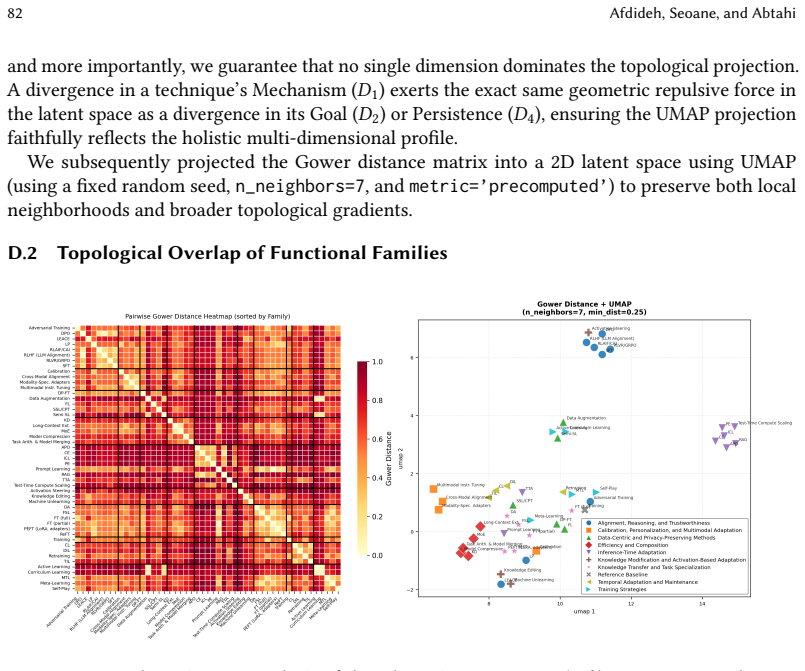
Saturation is defined relative to the paper's own D1–D6 categories, and those categories were themselves developed jointly with the same corpus, so 'saturation reached' cannot certify that the six dimensions are sufficient for all practically meaningful distinctions; the rule can only confirm that the corpus fits the scheme built from it. This is a definitional loop rather than an empirical validation. The paper mitigates it by stating 'The 48-technique count is the saturation count under the D1–D6 criterion, not a claim that no further techniques exist' and by noting that deployment-layer controls and an access-regime descriptor (Section 6.3) are outside or proposed extensions of the framework, so the loop is a scope limitation, not a fabricated prediction.
full rationale
The paper is a survey/taxonomy, not a derivation with fitted parameters or predictions; its centerpiece Table 8 is a literature-based classification. The central structure (six dimensions and 48 profiles) is supported by extensive external citations (LoRA, RLHF, RAG, NIST, EU AI Act, FDA PCCP), and the one self-citation (AEGIS [14]) is offered as a prospective consumer, not as evidence for the taxonomy. The sole self-referential element is the saturation rule in Appendix A.6: saturation is defined in terms of the paper's own D1–D6 profile space, and the category structure was developed jointly with the corpus. That makes 'saturation' a coverage criterion for the constructed scheme rather than an independent proof that six dimensions exhaust all practically meaningful distinctions. The paper explicitly disclaims this: 'The 48-technique count is the saturation count under the D1–D6 criterion, not a claim that no further techniques exist,' and Section 3.10 says the structural analysis 'does not independently validate the taxonomy.' Accordingly, the circularity is minor and does not undermine the taxonomy's independent content.
Assumptions & free parameters
assumptions (4)
- domain assumption The six dimensions (mechanism, goal, data, persistence, scope, model type) are jointly sufficient to capture practically meaningful differences between adaptation techniques.
- domain assumption The canonical profiles assigned in Table 8 are accurate representations of typical practice for each technique.
- domain assumption The regulatory interpretations of NIST AI RMF, EU AI Act, EU MDR/IVDR, and FDA PCCP are correctly mapped to the taxonomy dimensions.
- domain assumption The snowball sampling and saturation procedure reached a complete set of practically relevant techniques.
Cite this review
Pith. "Pith review of A Six-Dimensional Taxonomy of Post-Training Adaptation Techniques with Applications in AI Governance." pith.science (2026). https://pith.science/paper/L55WHLSY
@misc{pith2026260806246,
  author       = {Pith},
  title        = {Pith review of: A Six-Dimensional Taxonomy of Post-Training Adaptation Techniques with Applications in AI Governance},
  year         = {2026},
  howpublished = {\url{https://pith.science/paper/L55WHLSY}},
  note         = {Machine review of arXiv:2608.06246}
}
read the original abstract
Post-training adaptation has become central to modern machine learning practice and includes techniques such as retraining, fine-tuning, parameter-efficient adaptation, alignment, retrieval augmentation, model editing, unlearning, calibration, and Multimodal Instruction Tuning. However, the literature remains fragmented across technique families, model classes, and deployment contexts, making it difficult to compare methods or describe how a trained model has been modified. This survey synthesizes the post-training adaptation literature and introduces a six-dimensional taxonomy organized by mechanism, goal, data requirement, persistence, structural scope, and model type. The taxonomy distinguishes commonly conflated terms such as fine-tuning, retrieval augmentation, and prompting, and shows how adaptation strategies evolve from traditional machine learning through deep learning, foundation models, large language models, and multimodal large language models. It also maps relationships among techniques, including inheritance, supersession, hybridization, and layered deployment stacks. The resulting vocabulary can support technical documentation, model-change tracking, and governance analysis. The survey concludes by identifying open challenges in evaluation, reproducibility, persistent inference-time adaptation, unlearning, multimodal adaptation, and governance-aware post-training workflows.
Figures


Reference graph
Works this paper leans on
-
[1]
[n. d.]. Art. 17 GDPR – Right to erasure (‘right to be forgotten’). https://gdpr-info.eu/art-17-gdpr/
-
[2]
2023. NIST AI 100-1 – Artificial Intelligence Risk Management Framework (AI RMF 1.0).National Institute of Standards and Technology, U.S. Department of Commerce(Jan. 2023). doi:10.6028/NIST.AI.100-1
-
[3]
2024. Regulation (EU) 2024/1689 of the European Parliament and of the Council of 13 June 2024 laying down harmonised rules on artificial intelligence and amending Regulations (EC) No 300/2008, (EU) No 167/2013, (EU) No 168/2013, (EU) 2018/858, (EU) 2018/1139 and (EU) 2019/2144 and Directives 2014/90/EU, (EU) 2016/797 and (EU) 2020/1828 (Artificial Intelli...
2024
-
[4]
Context Engineering - LLM Memory and Retrieval for AI Agents | Weaviate
2025. Context Engineering - LLM Memory and Retrieval for AI Agents | Weaviate. https://weaviate.io/blog/context- engineering
2025
-
[5]
Context Engineering Guide: Techniques for AI Agents | LlamaIndex
2025. Context Engineering Guide: Techniques for AI Agents | LlamaIndex. https://www.llamaindex.ai/blog/context- engineering-what-it-is-and-techniques-to-consider
2025
-
[6]
Context engineering: Why it’s Replacing Prompt Engineering for Enterprise AI Success
2025. Context engineering: Why it’s Replacing Prompt Engineering for Enterprise AI Success. https://www.gartner. com/en/articles/context-engineering
2025
-
[7]
Effective context engineering for AI agents
2025. Effective context engineering for AI agents. https://www.anthropic.com/engineering/effective-context- engineering-for-ai-agents
2025
-
[8]
Lead the Shift to Context Engineering as Prompt Engineering Fades
2025. Lead the Shift to Context Engineering as Prompt Engineering Fades. https://www.gartner.com/en/documents/ 6781234
2025
Show all 273 references
-
[9]
arcee-ai/mergekit
2026. arcee-ai/mergekit. https://github.com/arcee-ai/mergekit
2026
-
[10]
modelscope/ms-swift
2026. modelscope/ms-swift. original-date: 2023-08-01T15:06:39Z. https://github.com/modelscope/ms-swift
2026
-
[11]
PEFT·Hugging Face
2026. PEFT·Hugging Face. https://huggingface.co/docs/peft/index
2026
-
[12]
TRL - Transformers Reinforcement Learning·Hugging Face
2026. TRL - Transformers Reinforcement Learning·Hugging Face. https://huggingface.co/docs/trl/index
2026
-
[13]
zjunlp/EasyEdit
2026. zjunlp/EasyEdit. original-date: 2023-05-09T07:48:02Z. https://github.com/zjunlp/EasyEdit
2026
-
[14]
Fardin Afdideh, Mehdi Astaraki, Fernando Seoane, and Farhad Abtahi. 2026. AEGIS: An Operational Infrastructure for Post-Market Governance of Adaptive Medical AI Under US and EU Regulatory Frameworks. doi:10.21203/rs.3.rs- 9199100/v1
2026 doi
-
[15]
Armen Aghajanyan, Sonal Gupta, and Luke Zettlemoyer. 2021. Intrinsic Dimensionality Explains the Effectiveness of Language Model Fine-Tuning. InProceedings of the 59th Annual Meeting of the Association for Computational A Six-Dimensional Taxonomy of Post-Training Adaptation Te...
2021
- [16]
-
[17]
context engineering
Andrej Karpathy [@karpathy]. 2025. +1 for "context engineering" over "prompt engineering". https://x.com/karpathy/ status/1937902205765607626
2025
-
[18]
Antreas Antoniou, Harrison Edwards, and Amos Storkey. 2018. How to train your MAML. https://openreview.net/ forum?id=HJGven05Y7
2018
-
[19]
Akari Asai, Zeqiu Wu, Yizhong Wang, Avirup Sil, and Hannaneh Hajishirzi. 2023. Self-RAG: Learning to Retrieve, Generate, and Critique through Self-Reflection. https://openreview.net/forum?id=hSyW5go0v8
2023
-
[20]
Chloe Autio, Reva Schwartz, Jesse Dunietz, Shomik Jain, Martin Stanley, Elham Tabassi, Patrick Hall, and Kamie Roberts. 2024. Artificial Intelligence Risk Management Framework: Generative Artificial Intelligence Profile.National Institute of Standards and Technology (NIST)(Jul...
2024 doi
- [21]
-
[22]
Mohammad Gheshlaghi Azar, Zhaohan Daniel Guo, Bilal Piot, Remi Munos, Mark Rowland, Michal Valko, and Daniele Calandriello. 2024. A General Theoretical Paradigm to Understand Learning from Human Preferences. In Proceedings of The 27th International Conference on Artificial Int...
2024
-
[23]
Bowman, Zac Hatfield-Dodds, Ben Mann, Dario Amodei, Nicholas Joseph, Sam McCandlish, Tom Brown, and Jared Kaplan
Yuntao Bai, Saurav Kadavath, Sandipan Kundu, Amanda Askell, Jackson Kernion, Andy Jones, Anna Chen, Anna Goldie, Azalia Mirhoseini, Cameron McKinnon, Carol Chen, Catherine Olsson, Christopher Olah, Danny Hernandez, Dawn Drain, Deep Ganguli, Dustin Li, Eli Tran-Johnson, Ethan P...
-
[24]
Nora Belrose, David Schneider-Joseph, Shauli Ravfogel, Ryan Cotterell, Edward Raff, and Stella Biderman. 2023. LEACE: Perfect linear concept erasure in closed form. InAdvances in Neural Information Processing Systems, A. Oh, T. Naumann, A. Globerson, K. Saenko, M. Hardt, and S...
2023
-
[25]
Elad Ben Zaken, Yoav Goldberg, and Shauli Ravfogel. 2022. BitFit: Simple Parameter-efficient Fine-tuning for Transformer-based Masked Language-models. InProceedings of the 60th Annual Meeting of the Association for Computational Linguistics (Volume 2: Short Papers), Smaranda M...
2022 doi
-
[26]
Yoshua Bengio, Jérôme Louradour, Ronan Collobert, and Jason Weston. 2009. Curriculum learning. InProceedings of the 26th Annual International Conference on Machine Learning (ICML ’09). Association for Computing Machinery, New York, NY, USA, 41–48. doi:10.1145/1553374.1553380
2009
-
[27]
Yoshua Bengio, Mehdi Mirza, Ian Goodfellow, Aaron Courville, and Xia Da. 2014. An Empirical Investigation of Catastrophic Forgeting in Gradient-Based Neural Networks. https://openreview.net/forum?id=oXSw7laxwUpln
2014
-
[28]
David Berthelot, Nicholas Carlini, Ian Goodfellow, Nicolas Papernot, Avital Oliver, and Colin A Raffel. 2019. MixMatch: A Holistic Approach to Semi-Supervised Learning. InAdvances in Neural Information Processing Systems, Vol. 32. Cur- ran Associates, Inc. https://proceedings....
2019
- [29]
-
[30]
Gilles Blanchard, Gyemin Lee, and Clayton Scott. 2011. Generalizing from several related classification tasks to a new unlabeled sample. InProceedings of the 25th International Conference on Neural Information Processing Systems (NIPS’11). Curran Associates Inc., Red Hook, NY,...
2011
-
[31]
Hudson, Ehsan Adeli, Russ Altman, Simran Arora, Sydney von Arx, Michael S
Rishi Bommasani, Drew A. Hudson, Ehsan Adeli, Russ Altman, Simran Arora, Sydney von Arx, Michael S. Bernstein, Jeannette Bohg, Antoine Bosselut, Emma Brunskill, Erik Brynjolfsson, Shyamal Buch, Dallas Card, Rodrigo Castellon, Niladri Chatterji, Annie Chen, Kathleen Creel, Jare...
-
[32]
Sebastian Borgeaud, Arthur Mensch, Jordan Hoffmann, Trevor Cai, Eliza Rutherford, Katie Millican, George Bm Van Den Driessche, Jean-Baptiste Lespiau, Bogdan Damoc, Aidan Clark, Diego De Las Casas, Aurelia Guy, Jacob Menick, Roman Ring, Tom Hennigan, Saffron Huang, Loren Maggio...
2022
-
[33]
Choquette-Choo, Hengrui Jia, Adelin Travers, Baiwu Zhang, David Lie, and Nicolas Papernot
Lucas Bourtoule, Varun Chandrasekaran, Christopher A. Choquette-Choo, Hengrui Jia, Adelin Travers, Baiwu Zhang, David Lie, and Nicolas Papernot. 2021. Machine Unlearning. In2021 IEEE Symposium on Security and Privacy (SP). 141–159. ISSN: 2375-1207. doi:10.1109/SP40001.2021.00019
2021
-
[34]
Tom B. Brown, Benjamin Mann, Nick Ryder, Melanie Subbiah, Jared Kaplan, Prafulla Dhariwal, Arvind Neelakantan, Pranav Shyam, Girish Sastry, Amanda Askell, Sandhini Agarwal, Ariel Herbert-Voss, Gretchen Krueger, Tom Henighan, Rewon Child, Aditya Ramesh, Daniel M. Ziegler, Jeffr...
2020
-
[35]
Buehler and Markus J
Eric L. Buehler and Markus J. Buehler. 2024. X-LoRA: Mixture of low-rank adapter experts, a flexible framework for large language models with applications in protein mechanics and molecular design.APL Mach. Learn.2, 2 (May 2024), 026119. doi:10.1063/5.0203126
2024 doi
-
[36]
Yinzhi Cao and Junfeng Yang. 2015. Towards Making Systems Forget with Machine Unlearning. In2015 IEEE Symposium on Security and Privacy. 463–480. doi:10.1109/SP.2015.35
2015 doi
-
[37]
Rich Caruana. 1997. Multitask Learning.Machine Learning28, 1 (July 1997), 41–75. doi:10.1023/A:1007379606734
1997 doi
-
[38]
Sungmin Cha, Sungjun Cho, Dasol Hwang, and Moontae Lee. 2024. Towards Robust and Parameter-Efficient Knowledge Unlearning for LLMs. https://openreview.net/forum?id=1ExfUpmIW4
2024
-
[39]
Haoxian Chen, Hanyang Zhao, Henry Lam, David Yao, and Wenpin Tang. 2024. MallowsPO: Fine-Tune Your LLM with Preference Dispersions. https://openreview.net/forum?id=d8cnezVcaW
2024
- [40]
-
[41]
Yan-Lun Chen, Yi-Ru Wei, Chia-Yi Hsu, Chia-Mu Yu, Chun-Ying Huang, Ying-Dar Lin, Yu-Sung Wu, and Wei-Bin Lee
-
[42]
Zixiang Chen, Yihe Deng, Huizhuo Yuan, Kaixuan Ji, and Quanquan Gu. 2024. Self-play fine-tuning converts weak language models to strong language models. InProceedings of the 41st International Conference on Machine Learning (ICML’24, Vol. 235). JMLR.org, Vienna, Austria, 6621–6642
2024
-
[43]
Christiano, Jan Leike, Tom B
Paul F. Christiano, Jan Leike, Tom B. Brown, Miljan Martic, Shane Legg, and Dario Amodei. 2017. Deep reinforcement learning from human preferences. InProceedings of the 31st International Conference on Neural Information Processing Systems (NIPS’17). Curran Associates Inc., Re...
2017 doi
-
[44]
Collins, Karel G
Gary S. Collins, Karel G. M. Moons, Paula Dhiman, Richard D. Riley, Andrew L. Beam, Ben Van Calster, Marzyeh Ghassemi, Xiaoxuan Liu, Johannes B. Reitsma, Maarten van Smeden, Anne-Laure Boulesteix, Jennifer Catherine Camaradou, Leo Anthony Celi, Spiros Denaxas, Alastair K. Denn...
2024
-
[45]
Cubuk, Barret Zoph, Dandelion Mané, Vijay Vasudevan, and Quoc V
Ekin D. Cubuk, Barret Zoph, Dandelion Mané, Vijay Vasudevan, and Quoc V. Le. 2019. AutoAugment: Learning Augmentation Strategies From Data. In2019 IEEE/CVF Conference on Computer Vision and Pattern Recognition (CVPR). 113–123. ISSN: 2575-7075. doi:10.1109/CVPR.2019.00020
2019
- [46]
-
[47]
Damai Dai, Li Dong, Yaru Hao, Zhifang Sui, Baobao Chang, and Furu Wei. 2022. Knowledge Neurons in Pretrained Transformers. InProceedings of the 60th Annual Meeting of the Association for Computational Linguistics (Volume 1: Long Papers), Smaranda Muresan, Preslav Nakov, and Al...
2022 doi
-
[48]
Amitava Das, Vinija Jain, and Aman Chadha. 2025. TRACEALIGN - Tracing the Drift: Attributing Alignment Failures to Training-Time Belief Sources in LLMs. (Oct. 2025). https://openreview.net/forum?id=6mzS7NAiui
2025
-
[49]
MohammadReza Davari and Eugene Belilovsky. 2025. Model Breadcrumbs: Scaling Multi-task Model Merging with Sparse Masks. InComputer Vision – ECCV 2024, Aleš Leonardis, Elisa Ricci, Stefan Roth, Olga Russakovsky, Torsten Sattler, and Gül Varol (Eds.). Springer Nature Switzerland...
2025 doi
-
[50]
Nicola De Cao, Wilker Aziz, and Ivan Titov. 2021. Editing Factual Knowledge in Language Models. InProceedings of the 2021 Conference on Empirical Methods in Natural Language Processing, Marie-Francine Moens, Xuanjing Huang, Lucia Specia, and Scott Wen-tau Yih (Eds.). Associati...
2021 doi
- [51]
-
[52]
Tim Dettmers, Artidoro Pagnoni, Ari Holtzman, and Luke Zettlemoyer. 2023. QLoRA: Efficient Finetuning of Quantized LLMs. InAdvances in Neural Information Processing Systems, A. Oh, T. Naumann, A. Globerson, K. Saenko, M. Hardt, and S. Levine (Eds.), Vol. 36. Curran Associates,...
2023
- [53]
- [54]
-
[55]
Denis Moreira dos Reis, Peter Flach, Stan Matwin, and Gustavo Batista. 2016. Fast Unsupervised Online Drift Detection Using Incremental Kolmogorov-Smirnov Test. InProceedings of the 22nd ACM SIGKDD International Conference on Knowledge Discovery and Data Mining (KDD ’16). Asso...
2016
-
[56]
Shihan Dou, Enyu Zhou, Yan Liu, Songyang Gao, Wei Shen, Limao Xiong, Yuhao Zhou, Xiao Wang, Zhiheng Xi, Xiaoran Fan, Shiliang Pu, Jiang Zhu, Rui Zheng, Tao Gui, Qi Zhang, and Xuanjing Huang. 2024. LoRAMoE: Alleviating World Knowledge Forgetting in Large Language Models via MoE...
2024
- [57]
-
[58]
Kawin Ethayarajh, Winnie Xu, Niklas Muennighoff, Dan Jurafsky, and Douwe Kiela. 2024. Model alignment as prospect theoretic optimization. InProceedings of the 41st International Conference on Machine Learning (ICML’24, Vol. 235). JMLR.org, Vienna, Austria, 12634–12651
2024
-
[59]
European Parliament and of the Council. 2017. Regulation (EU) 2017/745 of the European Parliament and of the Council of 5 April 2017 on medical devices, amending Directive 2001/83/EC, Regulation (EC) No 178/2002 and Regulation (EC) No 1223/2009 and repealing Council Directives...
2017
-
[60]
European Parliament and of the Council. 2017. Regulation (EU) 2017/746 of the European Parliament and of the Council of 5 April 2017 on in vitro diagnostic medical devices and repealing Directive 98/79/EC and Commission Decision 2010/227/EU (Text with EEA relevance. ). http://...
2017
-
[61]
Eoin Farrell, Yeu-Tong Lau, and Arthur Conmy. 2024. Applying Sparse Autoencoders to Unlearn Knowledge in Language Models. (Oct. 2024). https://openreview.net/forum?id=ZtvRqm6oBu
2024
-
[62]
Feng, Varun Gangal, Jason Wei, Sarath Chandar, Soroush Vosoughi, Teruko Mitamura, and Eduard Hovy
Steven Y. Feng, Varun Gangal, Jason Wei, Sarath Chandar, Soroush Vosoughi, Teruko Mitamura, and Eduard Hovy
-
[63]
Chelsea Finn, Pieter Abbeel, and Sergey Levine. 2017. Model-agnostic meta-learning for fast adaptation of deep networks. InProceedings of the 34th International Conference on Machine Learning - Volume 70 (ICML’17). JMLR.org, Sydney, NSW, Australia, 1126–1135. https://dl.acm.or...
2017
- [64]
-
[65]
João Gama, Indr ˙e Žliobait ˙e, Albert Bifet, Mykola Pechenizkiy, and Abdelhamid Bouchachia. 2014. A survey on concept drift adaptation.ACM Comput. Surv.46, 4 (March 2014), 44:1–44:37. doi:10.1145/2523813
2014 doi
-
[66]
Yaroslav Ganin, Evgeniya Ustinova, Hana Ajakan, Pascal Germain, Hugo Larochelle, François Laviolette, Mario Marchand, and Victor Lempitsky. 2016. Domain-adversarial training of neural networks.J. Mach. Learn. Res.17, 1 (Jan. 2016), 2096–2030. https://dl.acm.org/doi/10.5555/294...
2016
- [67]
-
[68]
Vahid Garousi, Michael Felderer, and Mika V. Mäntylä. 2019. Guidelines for including grey literature and conducting multivocal literature reviews in software engineering.Information and Software Technology106 (Feb. 2019), 101–121. doi:10.1016/j.infsof.2018.09.006
2019 doi
-
[69]
Mor Geva, Roei Schuster, Jonathan Berant, and Omer Levy. 2021. Transformer Feed-Forward Layers Are Key-Value Memories. InProceedings of the 2021 Conference on Empirical Methods in Natural Language Processing, Marie-Francine Moens, Xuanjing Huang, Lucia Specia, and Scott Wen-ta...
2021 doi
-
[70]
Stephen Gilbert, Matthew Fenech, Martin Hirsch, Shubhanan Upadhyay, Andrea Biasiucci, and Johannes Starlinger
-
[71]
Antonio Ginart, Melody Guan, Gregory Valiant, and James Zou. 2019. Making AI Forget You: Data Deletion in Machine Learning. InAdvances in Neural Information Processing Systems, Vol. 32. Curran Associates, Inc. https: //proceedings.neurips.cc/paper/2019/hash/cb79f8fa58b91d3af6c...
2019
-
[72]
Maybank, and Dacheng Tao
Jianping Gou, Baosheng Yu, Stephen J. Maybank, and Dacheng Tao. 2021. Knowledge Distillation: A Survey.Int J Comput Vis129, 6 (June 2021), 1789–1819. doi:10.1007/s11263-021-01453-z
2021 doi
-
[73]
2021), e30545
Algorithm Change Protocols in the Regulation of Adaptive Machine Learning–Based Medical Devices.J Med Internet Res23, 10 (Oct. 2021), e30545. doi:10.2196/30545
2021 doi
-
[74]
Daya Guo, Dejian Yang, Haowei Zhang, Junxiao Song, Peiyi Wang, Qihao Zhu, Runxin Xu, Ruoyu Zhang, Shirong Ma, Xiao Bi, Xiaokang Zhang, Xingkai Yu, Yu Wu, Z. F. Wu, Zhibin Gou, Zhihong Shao, Zhuoshu Li, Ziyi Gao, Aixin Liu, Bing Xue, Bingxuan Wang, Bochao Wu, Bei Feng, Chengda ...
2025
-
[75]
Wei Guo, Fuzhen Zhuang, Xiao Zhang, Yiqi Tong, and Jin Dong. 2024. A comprehensive survey of federated transfer learning: challenges, methods and applications.Front. Comput. Sci.18, 6 (July 2024), 186356. doi:10.1007/s11704-024- 40065-x A Six-Dimensional Taxonomy of Post-Train...
2024 doi
-
[76]
Weinberger
Chuan Guo, Geoff Pleiss, Yu Sun, and Kilian Q. Weinberger. 2017. On calibration of modern neural networks. In Proceedings of the 34th International Conference on Machine Learning - Volume 70 (ICML’17). JMLR.org, Sydney, NSW, Australia, 1321–1330. https://dl.acm.org/doi/10.5555...
2017
-
[77]
Suchin Gururangan, Ana Marasović, Swabha Swayamdipta, Kyle Lo, Iz Beltagy, Doug Downey, and Noah A. Smith
-
[78]
Bernal Jiménez Gutiérrez, Yiheng Shu, Yu Gu, Michihiro Yasunaga, and Yu Su. 2024. HippoRAG: neurobiologically inspired long-term memory for large language models. InProceedings of the 38th International Conference on Neural Information Processing Systems (NIPS ’24, Vol. 37). C...
2024
-
[79]
Akshat Gupta, Anurag Rao, and Gopala Anumanchipalli. 2024. Model Editing at Scale leads to Gradual and Cat- astrophic Forgetting. InFindings of the Association for Computational Linguistics: ACL 2024, Lun-Wei Ku, Andre Martins, and Vivek Srikumar (Eds.). Association for Comput...
2024 doi
-
[80]
Jialong Han, Si Zhang, and Ke Zhang. 2025. Dual Decomposition of Weights and Singular Value Low Rank Adaptation. https://arxiv.org/abs/2505.14367v2
2025 arXiv
- [81]
- [82]
-
[83]
Philipp Hacker and Matthias Holweg. 2026. The regulation of fine-tuning: Federated compliance for modified general-purpose AI models.Computer Law & Security Review60 (April 2026), 106234. doi:10.1016/j.clsr.2025.106234
2026
- [84]
-
[85]
Steven C. H. Hoi, Doyen Sahoo, Jing Lu, and Peilin Zhao. 2021. Online learning: A comprehensive survey.Neurocom- puting459 (Oct. 2021), 249–289. doi:10.1016/j.neucom.2021.04.112
2021 doi
-
[86]
Jiwoo Hong, Noah Lee, and James Thorne. 2024. ORPO: Monolithic Preference Optimization without Reference Model. InProceedings of the 2024 Conference on Empirical Methods in Natural Language Processing, Yaser Al-Onaizan, Mohit Bansal, and Yun-Nung Chen (Eds.). Association for C...
2024 doi
-
[87]
Soufiane Hayou, Nikhil Ghosh, and Bin Yu. 2024. LoRA+: efficient low rank adaptation of large models. InProceedings of the 41st International Conference on Machine Learning (ICML’24, Vol. 235). JMLR.org, Vienna, Austria, 17783–17806
2024
-
[88]
Neil Houlsby, Andrei Giurgiu, Stanislaw Jastrzebski, Bruna Morrone, Quentin De Laroussilhe, Andrea Gesmundo, Mona Attariyan, and Sylvain Gelly. 2019. Parameter-Efficient Transfer Learning for NLP. InProceedings of the 36th International Conference on Machine Learning (Proceedi...
2019
-
[89]
Cheng-Hsun Hsueh, Paul Kuo-Ming Huang, Tzu-Han Lin, Che Wei Liao, Hung-Chieh Fang, Chao-Wei Huang, and Yun-Nung Chen. 2024. Editing the Mind of Giants: An In-Depth Exploration of Pitfalls of Knowledge Editing in Large Language Models. InFindings of the Association for Computat...
2024 doi
-
[90]
Hu, Yelong Shen, Phillip Wallis, Zeyuan Allen-Zhu, Yuanzhi Li, Shean Wang, Lu Wang, and Weizhu Chen
Edward J. Hu, Yelong Shen, Phillip Wallis, Zeyuan Allen-Zhu, Yuanzhi Li, Shean Wang, Lu Wang, and Weizhu Chen. 2022. LoRA: Low-Rank Adaptation of Large Language Models. https://www.microsoft.com/en-us/research/ publication/lora-low-rank-adaptation-of-large-language-models/
2022
-
[91]
Timothy Hospedales, Antreas Antoniou, Paul Micaelli, and Amos Storkey. 2022. Meta-Learning in Neural Networks: A Survey.IEEE Transactions on Pattern Analysis & Machine Intelligence44, 09 (Sept. 2022), 5149–5169. doi:10.1109/ TPAMI.2021.3079209
2022
- [92]
-
[93]
Shengyuan Hu, Yiwei Fu, Steven Wu, and Virginia Smith. 2024. Unlearning or Obfuscating? Jogging the Memory of Unlearned LLMs via Benign Relearning. https://openreview.net/forum?id=fMNRYBvcQN
2024
-
[94]
Chengsong Huang, Qian Liu, Bill Yuchen Lin, Tianyu Pang, Chao Du, and Min Lin. 2024. LoraHub: Efficient Cross-Task Generalization via Dynamic LoRA Composition. https://openreview.net/forum?id=TrloAXEJ2B
2024
-
[95]
Jikun Hu, Dongsheng Guo, Yuli Liu, Qingyao Ai, Lixuan Wang, Xuebing Sun, Qilei Zhang, Quan Zhou, and Cheng Luo. 2025. PEPE: Long-context Extension for Large Language Models via Periodic Extrapolation Positional Encodings. InFindings of the Association for Computational Linguis...
2025 doi
-
[96]
Chawla, Jian Pei, Jianfeng Gao, Michael Backes, Philip S
Yue Huang, Chujie Gao, Siyuan Wu, Haoran Wang, Xiangqi Wang, Yujun Zhou, Yanbo Wang, Jiayi Ye, Jiawen Shi, Qihui Zhang, Yuan Li, Han Bao, Zhaoyi Liu, Tianrui Guan, Dongping Chen, Ruoxi Chen, Kehan Guo, Andy Zou, Bryan Hooi Kuen-Yew, Caiming Xiong, Elias Stengel-Eskin, Hongyang...
-
[97]
Dang Huu-Tien, Tin Pham, Hoang Thanh-Tung, and Naoya Inoue. 2025. On effects of steering latent representation for large language model unlearning. InProceedings of the Thirty-Ninth AAAI Conference on Artificial Intelligence and Thirty-Seventh Conference on Innovative Applicat...
2025 doi
-
[98]
Nam Hyeon-Woo, Moon Ye-Bin, and Tae-Hyun Oh. 2021. FedPara: Low-rank Hadamard Product for Communication- Efficient Federated Learning. https://openreview.net/forum?id=d71n4ftoCBy
2021
-
[99]
Chenyu Huang, Peng Ye, Tao Chen, Tong He, Xiangyu Yue, and Wanli Ouyang. 2024. EMR-MERGING: tuning-free high-performance model merging. InProceedings of the 38th International Conference on Neural Information Processing 34 Afdideh, Seoane, and Abtahi Systems (NIPS ’24, Vol. 37...
2024
- [100]
- [101]
-
[102]
Nicolas Jourdan, Tom Bayer, Tobias Biegel, and Joachim Metternich. 2023. Handling concept drift in deep learning applications for process monitoring.Procedia CIRP120 (Jan. 2023), 33–38. doi:10.1016/j.procir.2023.08.007
2023 doi
-
[103]
Daume Iii and D
H. Daume Iii and D. Marcu. 2006. Domain Adaptation for Statistical Classifiers.Journal of Artificial Intelligence Research26 (June 2006), 101–126. doi:10.1613/jair.1872
2006 doi
-
[104]
Damjan Kalajdzievski. 2023. A Rank Stabilization Scaling Factor for Fine-Tuning with LoRA. https://arxiv.org/abs/ 2312.03732v1
2023 arXiv
-
[105]
Vladimir Karpukhin, Barlas Oguz, Sewon Min, Patrick Lewis, Ledell Wu, Sergey Edunov, Danqi Chen, and Wen-tau Yih. 2020. Dense Passage Retrieval for Open-Domain Question Answering. InProceedings of the 2020 Conference on Empirical Methods in Natural Language Processing (EMNLP),...
2020 doi
-
[106]
Joshi, Hanna Moazam, Heather Miller, Matei Zaharia, and Christopher Potts
Omar Khattab, Arnav Singhvi, Paridhi Maheshwari, Zhiyuan Zhang, Keshav Santhanam, Sri Vardhamanan, Saiful Haq, Ashutosh Sharma, Thomas T. Joshi, Hanna Moazam, Heather Miller, Matei Zaharia, and Christopher Potts. 2024. DSPy: Compiling Declarative Language Model Calls into Self...
-
[107]
Brendan McMahan
Peter Kairouz and H. Brendan McMahan. 2021. Advances and Open Problems in Federated Learning.Foundations and Trends in Machine Learning14, 1-2 (June 2021), 1–210. doi:10.1561/2200000083
2021 doi
-
[108]
Rusu, Kieran Milan, John Quan, Tiago Ramalho, Agnieszka Grabska-Barwinska, Demis Hassabis, Claudia Clopath, Dharshan Kumaran, and Raia Hadsell
James Kirkpatrick, Razvan Pascanu, Neil Rabinowitz, Joel Veness, Guillaume Desjardins, Andrei A. Rusu, Kieran Milan, John Quan, Tiago Ramalho, Agnieszka Grabska-Barwinska, Demis Hassabis, Claudia Clopath, Dharshan Kumaran, and Raia Hadsell. 2017. Overcoming catastrophic forget...
2017 doi
-
[109]
Wouter Kool, Herke van Hoof, and Max Welling. 2019. Buy 4 REINFORCE Samples, Get a Baseline for Free! (April 2019). https://openreview.net/forum?id=r1lgTGL5DE
2019
-
[110]
Dawid Jan Kopiczko, Tijmen Blankevoort, and Yuki M. Asano. 2023. VeRA: Vector-based Random Matrix Adaptation. https://openreview.net/forum?id=NjNfLdxr3A
2023
-
[111]
Been Kim, Martin Wattenberg, Justin Gilmer, Carrie Cai, James Wexler, Fernanda Viegas, and Rory Sayres. 2018. Interpretability Beyond Feature Attribution: Quantitative Testing with Concept Activation Vectors (TCAV). In Proceedings of the 35th International Conference on Machin...
2018
-
[112]
Frangi, Antonio R
Karim Lekadir, Alejandro F. Frangi, Antonio R. Porras, Ben Glocker, Celia Cintas, Curtis P. Langlotz, Eva Weicken, Folkert W. Asselbergs, Fred Prior, Gary S. Collins, Georgios Kaissis, Gianna Tsakou, Irène Buvat, Jayashree Kalpathy- Cramer, John Mongan, Julia A. Schnabel, Kais...
2025
-
[113]
Brian Lester, Rami Al-Rfou, and Noah Constant. 2021. The Power of Scale for Parameter-Efficient Prompt Tuning. InProceedings of the 2021 Conference on Empirical Methods in Natural Language Processing, Marie-Francine Moens, Xuanjing Huang, Lucia Specia, and Scott Wen-tau Yih (E...
2021 doi
-
[114]
Patrick Lewis, Ethan Perez, Aleksandra Piktus, Fabio Petroni, Vladimir Karpukhin, Naman Goyal, Heinrich Küttler, Mike Lewis, Wen-tau Yih, Tim Rocktäschel, Sebastian Riedel, and Douwe Kiela. 2020. Retrieval-augmented generation for knowledge-intensive NLP tasks. InProceedings o...
2020
-
[115]
Harrison Lee, Samrat Phatale, Hassan Mansoor, Thomas Mesnard, Johan Ferret, Kellie Ren Lu, Colton Bishop, Ethan Hall, Victor Carbune, Abhinav Rastogi, and Sushant Prakash. 2024. RLAIF vs. RLHF: Scaling Reinforcement Learning from Human Feedback with AI Feedback. InProceedings ...
2024
-
[116]
Junnan Li, Dongxu Li, Silvio Savarese, and Steven Hoi. 2023. BLIP-2: Bootstrapping Language-Image Pre-training with Frozen Image Encoders and Large Language Models. InProceedings of the 40th International Conference on Machine Learning (Proceedings of Machine Learning Research...
2023
-
[117]
Kenneth Li, Oam Patel, Fernanda Viégas, Hanspeter Pfister, and Martin Wattenberg. 2023. Inference-time intervention: eliciting truthful answers from a language model. InProceedings of the 37th International Conference on Neural Information Processing Systems (NIPS ’23). Curran...
2023
-
[118]
Nathaniel Li, Alexander Pan, Anjali Gopal, Summer Yue, Daniel Berrios, Alice Gatti, Justin D. Li, Ann-Kathrin Dombrowski, Shashwat Goel, Gabriel Mukobi, Nathan Helm-Burger, Rassin Lababidi, Lennart Justen, Andrew Bo Liu, Michael Chen, Isabelle Barrass, Oliver Zhang, Xiaoyuan Z...
2024
-
[119]
Dawei Li, Bohan Jiang, Liangjie Huang, Alimohammad Beigi, Chengshuai Zhao, Zhen Tan, Amrita Bhattacharjee, Yuxuan Jiang, Canyu Chen, Tianhao Wu, Kai Shu, Lu Cheng, and Huan Liu. 2025. From Generation to Judgment: Opportunities and Challenges of LLM-as-a-judge. InProceedings of...
2025
-
[120]
Weston, and Mike Lewis
Xian Li, Ping Yu, Chunting Zhou, Timo Schick, Omer Levy, Luke Zettlemoyer, Jason E. Weston, and Mike Lewis
-
[121]
Xiang Lisa Li and Percy Liang. 2021. Prefix-Tuning: Optimizing Continuous Prompts for Generation. InProceedings of the 59th Annual Meeting of the Association for Computational Linguistics and the 11th International Joint Conference on Natural Language Processing (Volume 1: Lon...
2021 doi
- [122]
-
[123]
Xiaopeng Li, Shasha Li, Shezheng Song, Jing Yang, Jun Ma, and Jie Yu. 2024. PMET: precise model editing in a transformer. InProceedings of the Thirty-Eighth AAAI Conference on Artificial Intelligence and Thirty-Sixth Conference on Innovative Applications of Artificial Intellig...
2024 doi
-
[124]
Haotian Liu, Chunyuan Li, Qingyang Wu, and Yong Jae Lee. 2023. Visual Instruction Tuning. InAdvances in Neural Information Processing Systems, A. Oh, T. Naumann, A. Globerson, K. Saenko, M. Hardt, and S. Levine (Eds.), Vol. 36. Curran Associates, Inc., 34892–34916. https://pro...
2023
-
[125]
Haokun Liu, Derek Tam, Mohammed Muqeeth, Jay Mohta, Tenghao Huang, Mohit Bansal, and Colin Raffel. 2022. Few-shot parameter-efficient fine-tuning is better and cheaper than in-context learning. InProceedings of the 36th 36 Afdideh, Seoane, and Abtahi International Conference o...
2022
-
[126]
Pengfei Liu, Weizhe Yuan, Jinlan Fu, Zhengbao Jiang, Hiroaki Hayashi, and Graham Neubig. 2023. Pre-train, Prompt, and Predict: A Systematic Survey of Prompting Methods in Natural Language Processing.ACM Comput. Surv.55, 9 (Jan. 2023), 195:1–195:35. doi:10.1145/3560815
2023 doi
-
[127]
Shih-Yang Liu, Chien-Yi Wang, Hongxu Yin, Pavlo Molchanov, Yu-Chiang Frank Wang, Kwang-Ting Cheng, and Min-Hung Chen. 2024. DoRA: weight-decomposed low-rank adaptation. InProceedings of the 41st International Conference on Machine Learning (ICML’24, Vol. 235). JMLR.org, Vienna...
2024
-
[128]
Hunter Lightman, Vineet Kosaraju, Yuri Burda, Harrison Edwards, Bowen Baker, Teddy Lee, Jan Leike, John Schulman, Ilya Sutskever, and Karl Cobbe. 2024. Let’s Verify Step by Step. InInternational Conference on Learning Representations (ICLR). https://openreview.net/forum?id=v8L0pN6EOi
2024
-
[129]
Jie Lu, Anjin Liu, Fan Dong, Feng Gu, João Gama, and Guangquan Zhang. 2019. Learning under Concept Drift: A Review.IEEE Transactions on Knowledge and Data Engineering31, 12 (Dec. 2019), 2346–2363. doi:10.1109/TKDE.2018. 2876857
2019 doi
-
[130]
Pengqian Lu, Jie Lu, Anjin Liu, and Guangquan Zhang. 2025. Early concept drift detection via prediction uncertainty. In Proceedings of the Thirty-Ninth AAAI Conference on Artificial Intelligence and Thirty-Seventh Conference on Innovative Applications of Artificial Intelligenc...
2025 doi
-
[131]
Luu, and Markus J
Wei Lu, Rachel K. Luu, and Markus J. Buehler. 2025. Fine-tuning large language models for domain adaptation: exploration of training strategies, scaling, model merging and synergistic capabilities.npj Comput Mater11, 1 (March 2025), 84. doi:10.1038/s41524-025-01564-y
2025 doi
- [132]
-
[133]
Lin Long, Rui Wang, Ruixuan Xiao, Junbo Zhao, Xiao Ding, Gang Chen, and Haobo Wang. 2024. On LLMs-Driven Synthetic Data Generation, Curation, and Evaluation: A Survey. InFindings of the Association for Computational Linguistics: ACL 2024, Lun-Wei Ku, Andre Martins, and Vivek S...
2024 doi
-
[134]
Aleksander Madry, Aleksandar Makelov, Ludwig Schmidt, Dimitris Tsipras, and Adrian Vladu. 2018. Towards Deep Learning Models Resistant to Adversarial Attacks. https://openreview.net/forum?id=rJzIBfZAb
2018
-
[135]
Michael Matena and Colin Raffel. 2022. Merging models with fisher-weighted averaging. InProceedings of the 36th International Conference on Neural Information Processing Systems (NIPS ’22). Curran Associates Inc., Red Hook, NY, USA, 17703–17716
2022
-
[136]
Michael McCloskey and Neal J. Cohen. 1989. Catastrophic Interference in Connectionist Networks: The Sequential Learning Problem. Psychology of Learning and Motivation, Vol. 24. Academic Press, 109–165. doi:10.1016/S0079- 7421(08)60536-8
1989 doi
-
[137]
Brendan McMahan, Eider Moore, Daniel Ramage, Seth Hampson, and Blaise Aguera y Arcas. 2017. Communication- Efficient Learning of Deep Networks from Decentralized Data. InProceedings of the 20th International Conference on Artificial Intelligence and Statistics (Proceedings of ...
2017
-
[138]
Shumin Ma, Zhiri Yuan, Qi Wu, Yiyan Huang, Xixu Hu, Cheuk Hang Leung, Dongdong Wang, and Zhixiang Huang
-
[139]
Fanxu Meng, Zhaohui Wang, and Muhan Zhang. 2024. PiSSA: Principal Singular Values and Singular Vectors Adaptation of Large Language Models. https://openreview.net/forum?id=6ZBHIEtdP4
2024
-
[140]
Kevin Meng, David Bau, Alex Andonian, and Yonatan Belinkov. 2022. Locating and Editing Factual Associations in GPT. InAdvances in Neural Information Processing Systems, S. Koyejo, S. Mohamed, A. Agarwal, D. Belgrave, K. Cho, and A. Oh (Eds.), Vol. 35. Curran Associates, Inc., ...
2022
-
[141]
Kevin Meng, Arnab Sen Sharma, Alex Andonian, Yonatan Belinkov, and David Bau. 2023. Mass-Editing Memory in a Transformer
2023
-
[142]
Yu Meng, Mengzhou Xia, and Danqi Chen. 2024. SimPO: Simple Preference Optimization with a Reference- Free Reward. https://openreview.net/forum?id=3Tzcot1LKb&referrer=%5Bthe%20profile%20of%20Danqi%20Chen% 5D(%2Fprofile%3Fid%3D~Danqi_Chen1)
2024
-
[143]
Tomas Mikolov, Wen-tau Yih, and Geoffrey Zweig. 2013. Linguistic Regularities in Continuous Space Word Repre- sentations. InProceedings of the 2013 Conference of the North American Chapter of the Association for Computational A Six-Dimensional Taxonomy of Post-Training Adaptat...
2013
-
[144]
Viraj Mehta, Abhinav Komanduri, Rishabh Singh Bhadouriya, Vilina Mehta, Michael David Johnson, Priyanka Shrestha, Margaret Nikolov, Bhav Jain, Nigam Shah, and Kevin Schulman. 2025. Evaluating transparency in AI/ML model characteristics for FDA-reviewed medical devices.npj Digi...
2025 doi
-
[145]
Eric Mitchell, Charles Lin, Antoine Bosselut, Chelsea Finn, and Christopher D. Manning. 2022. Fast Model Editing at Scale. InInternational Conference on Learning Representations (ICLR). https://openreview.net/pdf?id=0DcZxeWfOPt
2022
-
[146]
Eric Mitchell, Charles Lin, Antoine Bosselut, Christopher D Manning, and Chelsea Finn. 2022. Memory-Based Model Editing at Scale. InProceedings of the 39th International Conference on Machine Learning (Proceedings of Machine Learning Research, Vol. 162), Kamalika Chaudhuri, St...
2022
-
[147]
Mitchell
Tom M. Mitchell. 1997.Machine Learning. McGraw-Hill
1997
-
[148]
Moreno-Torres, Troy Raeder, Rocío Alaiz-Rodríguez, Nitesh V
Jose G. Moreno-Torres, Troy Raeder, Rocío Alaiz-Rodríguez, Nitesh V. Chawla, and Francisco Herrera. 2012. A unifying view on dataset shift in classification.Pattern Recognition45, 1 (Jan. 2012), 521–530. doi:10.1016/j.patcog.2011.06.019
2012 doi
-
[149]
Muehlematter, Paola Daniore, and Kerstin N
Urs J. Muehlematter, Paola Daniore, and Kerstin N. Vokinger. 2021. Approval of artificial intelligence and machine learning-based medical devices in the USA and Europe (2015–20): a comparative analysis.The Lancet Digital Health 3, 3 (March 2021), e195–e203. doi:10.1016/S2589-7...
2021 doi
- [150]
- [151]
-
[152]
Long Ouyang, Jeffrey Wu, Xu Jiang, Diogo Almeida, Carroll Wainwright, Pamela Mishkin, Chong Zhang, Sandhini Agarwal, Katarina Slama, Alex Ray, John Schulman, Jacob Hilton, Fraser Kelton, Luke Miller, Maddie Simens, Amanda Askell, Peter Welinder, Paul F Christiano, Jan Leike, a...
2022
-
[153]
Sinno Jialin Pan and Qiang Yang. 2010. A Survey on Transfer Learning.IEEE Transactions on Knowledge and Data Engineering22, 10 (Oct. 2010), 1345–1359. doi:10.1109/TKDE.2009.191
2010 doi
-
[154]
Bernstein
Joon Sung Park, Joseph O’Brien, Carrie Jun Cai, Meredith Ringel Morris, Percy Liang, and Michael S. Bernstein. 2023. Generative Agents: Interactive Simulacra of Human Behavior. InProceedings of the 36th Annual ACM Symposium on User Interface Software and Technology (UIST ’23)....
2023
-
[155]
Seongsik Park, Sangmin Park, Jaieun Kim, and Harksoo Kim. 2025. MAKE: Memory-Associated Knowledge Editing. Transactions of the Association for Computational Linguistics13 (2025), 938–952. doi:10.1162/tacl.a.26
2025 doi
-
[156]
2023.A Taxonomy of Trustworthiness for Artificial Intelligence
Jessica Newman. 2023.A Taxonomy of Trustworthiness for Artificial Intelligence. Technical Report. UC Berkeley Center for Long-Term Cybersecurity (CLTC). https://cltc.berkeley.edu/publication/a-taxonomy-of-trustworthiness- for-artificial-intelligence/
2023
-
[157]
Jonas Pfeiffer, Aishwarya Kamath, Andreas Rücklé, Kyunghyun Cho, and Iryna Gurevych. 2021. AdapterFusion: Non-Destructive Task Composition for Transfer Learning. InProceedings of the 16th Conference of the European Chapter of the Association for Computational Linguistics: Main...
2021 doi
-
[158]
J. Platt. 1999. Probabilistic Outputs for Support vector Machines and Comparisons to Regularized Likeli- hood Methods. https://www.semanticscholar.org/paper/Probabilistic-Outputs-for-Support-vector-Machines- Platt/42e5ed832d4310ce4378c44d05570439df28a393 38 Afdideh, Seoane, and Abtahi
1999
-
[159]
Rellermeyer, and Arie van Deursen
Lorena Poenaru-Olaru, June Sallou, Luis Cruz, Jan S. Rellermeyer, and Arie van Deursen. 2023. Retrain AI Systems Responsibly! Use Sustainable Concept Drift Adaptation Techniques. In2023 IEEE/ACM 7th International Workshop on Green And Sustainable Software (GREENS). 17–18. doi:...
2023
-
[160]
Joris Postmus and Steven Abreu. 2024. Steering Large Language Models using Conceptors: Improving Addition-Based Activation Engineering. https://openreview.net/forum?id=gyAnAq16HC
2024
-
[161]
Prompt Engineering Guide. 2026. Context Engineering Guide – Nextra. https://www.promptingguide.ai/guides/ context-engineering-guide
2026
-
[162]
Bowen Peng, Jeffrey Quesnelle, Honglu Fan, and Enrico Shippole. 2023. YaRN: Efficient Context Window Extension of Large Language Models. https://openreview.net/forum?id=wHBfxhZu1u
2023
-
[163]
Alec Radford, Jong Wook Kim, Chris Hallacy, Aditya Ramesh, Gabriel Goh, Sandhini Agarwal, Girish Sastry, Amanda Askell, Pamela Mishkin, Jack Clark, Gretchen Krueger, and Ilya Sutskever. 2021. Learning Transferable Visual Models From Natural Language Supervision. InProceedings ...
2021
-
[164]
Manning, and Chelsea Finn
Rafael Rafailov, Archit Sharma, Eric Mitchell, Stefano Ermon, Christopher D. Manning, and Chelsea Finn. 2023. Direct preference optimization: your language model is secretly a reward model. InProceedings of the 37th International Conference on Neural Information Processing Sys...
2023
-
[165]
Rajat Raina, Alexis Battle, Honglak Lee, Benjamin Packer, and Andrew Y. Ng. 2007. Self-taught learning: transfer learning from unlabeled data. InProceedings of the 24th international conference on Machine learning (ICML ’07). Association for Computing Machinery, New York, NY, ...
2007
-
[166]
Nina Rimsky, Nick Gabrieli, Julian Schulz, Meg Tong, Evan Hubinger, and Alexander Turner. 2024. Steering Llama 2 via Contrastive Activation Addition. InProceedings of the 62nd Annual Meeting of the Association for Computa- tional Linguistics (Volume 1: Long Papers), Lun-Wei Ku...
2024 doi
-
[167]
Stephen Robertson and Hugo Zaragoza. 2009. The Probabilistic Relevance Framework: BM25 and Beyond.Foundations and Trends in Information Retrieval4, 1-2 (Sept. 2009), 1–174. doi:10.1561/1500000019
2009 doi
-
[168]
Stephan Rabanser, Stephan Günnemann, and Zachary Lipton. 2019. Failing Loudly: An Empirical Study of Meth- ods for Detecting Dataset Shift. InAdvances in Neural Information Processing Systems, H. Wallach, H. Larochelle, A. Beygelzimer, F. d’ Alché-Buc, E. Fox, and R. Garnett (...
2019
-
[169]
Philipp Schmid. 2025. The New Skill in AI is Not Prompting, It’s Context Engineering. https://www.philschmid.de/ context-engineering
2025
- [170]
-
[171]
Sculley, Gary Holt, Daniel Golovin, Eugene Davydov, Todd Phillips, Dietmar Ebner, Vinay Chaudhary, Michael Young, Jean-François Crespo, and Dan Dennison
D. Sculley, Gary Holt, Daniel Golovin, Eugene Davydov, Todd Phillips, Dietmar Ebner, Vinay Chaudhary, Michael Young, Jean-François Crespo, and Dan Dennison. 2015. Hidden Technical Debt in Machine Learning Systems. In Advances in Neural Information Processing Systems, Vol. 28. ...
2015
- [172]
-
[173]
Rico Sennrich, Barry Haddow, and Alexandra Birch. 2016. Improving Neural Machine Translation Models with Monolingual Data. InProceedings of the 54th Annual Meeting of the Association for Computational Linguistics (Volume 1: Long Papers), Katrin Erk and Noah A. Smith (Eds.). As...
2016 doi
-
[174]
Rusu, Dushyant Rao, Jakub Sygnowski, Oriol Vinyals, Razvan Pascanu, Simon Osindero, and Raia Hadsell
Andrei A. Rusu, Dushyant Rao, Jakub Sygnowski, Oriol Vinyals, Razvan Pascanu, Simon Osindero, and Raia Hadsell
- [175]
-
[176]
Noam Shazeer, Azalia Mirhoseini, Krzysztof Maziarz, Andy Davis, Quoc Le, Geoffrey Hinton, and Jeff Dean. 2017. Outrageously Large Neural Networks: The Sparsely-Gated Mixture-of-Experts Layer. InInternational Conference on Learning Representations (ICLR)
2017
-
[177]
Gonzalez, and Ion Stoica
Ying Sheng, Shiyi Cao, Dacheng Li, Coleman Hooper, Nicholas Lee, Shuo Yang, Christopher Chou, Banghua Zhu, Lianmin Zheng, Kurt Keutzer, Joseph E. Gonzalez, and Ion Stoica. 2024. S-LoRA: Serving Thousands of Concurrent LoRA Adapters. https://proceedings.mlsys.org/paper_files/pa...
2024
-
[178]
Haizhou Shi, Zihao Xu, Hengyi Wang, Weiyi Qin, Wenyuan Wang, Yibin Wang, Zifeng Wang, Sayna Ebrahimi, and Hao Wang. 2025. Continual Learning of Large Language Models: A Comprehensive Survey.ACM Comput. Surv.58, 5 (Nov. 2025), 120:1–120:42. doi:10.1145/3735633
2025 doi
-
[179]
Hidetoshi Shimodaira. 2000. Improving predictive inference under covariate shift by weighting the log-likelihood function.Journal of Statistical Planning and Inference90, 2 (Oct. 2000), 227–244. doi:10.1016/S0378-3758(00)00115-4
2000 doi
-
[180]
Ken Shoemake. 1985. Animating rotation with quaternion curves.SIGGRAPH Comput. Graph.19, 3 (July 1985), 245–254. doi:10.1145/325165.325242
1985
-
[181]
2009.Active Learning Literature Survey
Burr Settles. 2009.Active Learning Literature Survey. Technical Report. University of Wisconsin-Madison Department of Computer Sciences. https://minds.wisconsin.edu/handle/1793/60660
2009
-
[182]
David Silver, Julian Schrittwieser, Karen Simonyan, Ioannis Antonoglou, Aja Huang, Arthur Guez, Thomas Hubert, Lucas Baker, Matthew Lai, Adrian Bolton, Yutian Chen, Timothy Lillicrap, Fan Hui, Laurent Sifre, George van den Driessche, Thore Graepel, and Demis Hassabis. 2017. Ma...
2017 doi
- [183]
-
[184]
Charlie Victor Snell, Jaehoon Lee, Kelvin Xu, and Aviral Kumar. 2024. Scaling LLM Test-Time Compute Optimally Can be More Effective than Scaling Parameters for Reasoning. https://openreview.net/forum?id=4FWAwZtd2n
2024
-
[185]
Jake Snell, Kevin Swersky, and Richard Zemel. 2017. Prototypical networks for few-shot learning. InProceedings of the 31st International Conference on Neural Information Processing Systems (NIPS’17). Curran Associates Inc., Red Hook, NY, USA, 4080–4090. https://dl.acm.org/doi/...
2017
-
[186]
Kihyuk Sohn, David Berthelot, Nicholas Carlini, Zizhao Zhang, Han Zhang, Colin A Raffel, Ekin Dogus Cubuk, Alexey Kurakin, and Chun-Liang Li. 2020. FixMatch: Simplifying Semi-Supervised Learning with Consistency and Confidence. InAdvances in Neural Information Processing Syste...
2020
-
[187]
Martin Stanley and Raymond Sheh. 2026. Concept Note: AI RMF Profile on Trustworthy AI in Critical Infrastructure. National Institute of Standards and Technology (NIST)(April 2026). https://www.nist.gov/programs-projects/concept- note-ai-rmf-profile-trustworthy-ai-critical-infr...
2026
-
[188]
Khoshgoftaar
Connor Shorten and Taghi M. Khoshgoftaar. 2019. A survey on Image Data Augmentation for Deep Learning.J Big Data6, 1 (July 2019), 60. doi:10.1186/s40537-019-0197-0
2019 doi
-
[189]
Jianlin Su, Murtadha Ahmed, Yu Lu, Shengfeng Pan, Wen Bo, and Yunfeng Liu. 2024. RoFormer: Enhanced transformer with Rotary Position Embedding.Neurocomputing568 (Feb. 2024), 127063. doi:10.1016/j.neucom.2023.127063
2024
-
[190]
Yu Sun, Xiaolong Wang, Zhuang Liu, John Miller, Alexei Efros, and Moritz Hardt. 2020. Test-Time Training with Self-Supervision for Generalization under Distribution Shifts. InProceedings of the 37th International Conference on Machine Learning (Proceedings of Machine Learning ...
2020
-
[191]
Yi-Lin Sung, Jaemin Cho, and Mohit Bansal. 2022. VL-ADAPTER: Parameter-Efficient Transfer Learning for Vision- and-Language Tasks. In2022 IEEE/CVF Conference on Computer Vision and Pattern Recognition (CVPR). 5217–5227. ISSN: 2575-7075. doi:10.1109/CVPR52688.2022.00516
2022
-
[192]
Matteo Testi, Matteo Ballabio, Emanuele Frontoni, Giulio Iannello, Sara Moccia, Paolo Soda, and Gennaro Vessio. 2022. MLOps: A Taxonomy and a Methodology.IEEE Access10 (2022), 63606–63618. doi:10.1109/ACCESS.2022.3181730
2022
-
[193]
1998.Learning to Learn
Sebastian Thrun and Lorien Pratt (Eds.). 1998.Learning to Learn. Springer US, Boston, MA. doi:10.1007/978-1-4615- 5529-2
1998 doi
-
[194]
Wallace, and David Bau
Eric Todd, Millicent Li, Arnab Sen Sharma, Aaron Mueller, Byron C. Wallace, and David Bau. 2023. Function Vectors in Large Language Models. https://openreview.net/forum?id=AwyxtyMwaG
2023
-
[195]
Monika Steidl, Michael Felderer, and Rudolf Ramler. 2023. The pipeline for the continuous development of artificial intelligence models—Current state of research and practice.Journal of Systems and Software199 (May 2023), 111615. doi:10.1016/j.jss.2023.111615
2023
-
[196]
Vazquez, Ulisse Mini, and Monte MacDiarmid
Alexander Matt Turner, Lisa Thiergart, Gavin Leech, David Udell, Juan J. Vazquez, Ulisse Mini, and Monte MacDiarmid
-
[197]
Food and Drug Administration
U.S. Food and Drug Administration. 2025. Marketing Submission Recommendations for a Prede- termined Change Control Plan for Artificial Intelligence-Enabled Device Software Functions. (Aug. 2025). https://www.fda.gov/regulatory-information/search-fda-guidance-documents/marketin...
2025
-
[198]
Mojtaba Valipour, Mehdi Rezagholizadeh, Ivan Kobyzev, and Ali Ghodsi. 2023. DyLoRA: Parameter-Efficient Tuning of Pre-trained Models using Dynamic Search-Free Low-Rank Adaptation. InProceedings of the 17th Conference of the European Chapter of the Association for Computational...
2023 doi
-
[199]
van de Ven, Tinne Tuytelaars, and Andreas S
Gido M. van de Ven, Tinne Tuytelaars, and Andreas S. Tolias. 2022. Three types of incremental learning.Nat Mach Intell4, 12 (Dec. 2022), 1185–1197. doi:10.1038/s42256-022-00568-3
2022 doi
-
[200]
Apostol Vassilev, Alina Oprea, Alie Fordyce, Hyrum Anderson, Xander Davies, and Maia Hamin. 2025. Adversarial Machine Learning: A Taxonomy and Terminology of Attacks and Mitigations.National Institute of Standards and Technology(March 2025). doi:10.6028/NIST.AI.100-2e2025
2025 doi
-
[201]
Oriol Vinyals, Charles Blundell, Timothy Lillicrap, Koray Kavukcuoglu, and Daan Wierstra. 2016. Matching networks for one shot learning. InProceedings of the 30th International Conference on Neural Information Processing Systems (NIPS’16). Curran Associates Inc., Red Hook, NY,...
2016
-
[202]
Dimitris Tsipras, Shibani Santurkar, Logan Engstrom, Alexander Turner, and Aleksander Madry. 2018. Robustness May Be at Odds with Accuracy. https://openreview.net/forum?id=SyxAb30cY7
2018
-
[203]
Hanqing Wang, Yixia Li, Shuo Wang, Guanhua Chen, and Yun Chen. 2025. MiLoRA: Harnessing Minor Singular Components for Parameter-Efficient LLM Finetuning. InProceedings of the 2025 Conference of the Nations of the Americas Chapter of the Association for Computational Linguistic...
2025 doi
- [204]
- [205]
-
[206]
Liyuan Wang, Xingxing Zhang, Hang Su, and Jun Zhu. 2024. A Comprehensive Survey of Continual Learning: Theory, Method and Application.IEEE Transactions on Pattern Analysis and Machine Intelligence46, 8 (Aug. 2024), 5362–5383. doi:10.1109/TPAMI.2024.3367329
2024
-
[207]
Peng Wang, Zexi Li, Ningyu Zhang, Ziwen Xu, Yunzhi Yao, Yong Jiang, Pengjun Xie, Fei Huang, and Huajun Chen
-
[208]
Yue Wang, Dehang Fu, Jie Tan, Junxiao Han, Yao Wan, Lixin Cui, Lu Bai, and Philip S. Yu. 2025. Detecting Intent Drift in Continuous Conversation via Temporal Transition Accumulation. In2025 IEEE International Conference on Data Mining (ICDM). 773–782. doi:10.1109/ICDM65498.2025.00085
2025
-
[209]
Smith, Daniel Khashabi, and Hannaneh Hajishirzi
Yizhong Wang, Yeganeh Kordi, Swaroop Mishra, Alisa Liu, Noah A. Smith, Daniel Khashabi, and Hannaneh Hajishirzi
-
[210]
Olshausen, and Trevor Darrell
Dequan Wang, Evan Shelhamer, Shaoteng Liu, B. Olshausen, and Trevor Darrell. 2021. Tent: Fully Test-Time Adapta- tion by Entropy Minimization. https://www.semanticscholar.org/paper/Tent%3A-Fully-Test-Time-Adaptation-by- Entropy-Wang-Shelhamer/180c78b132f6369a384d22a9529551d86c8788d3
2021
-
[211]
Jan Wehner, Sahar Abdelnabi, Daniel Tan, David Krueger, and Mario Fritz. 2025. Taxonomy, Opportunities, and Challenges of Representation Engineering for Large Language Models.Transactions on Machine Learning Research (April 2025). https://openreview.net/forum?id=2U1KIfmaU9
2025
-
[212]
Jindong Wang, Cuiling Lan, Chang Liu, Yidong Ouyang, Tao Qin, Wang Lu, Yiqiang Chen, Wenjun Zeng, and Philip S. Yu. 2023. Generalizing to Unseen Domains: A Survey on Domain Generalization.IEEE Transactions on Knowledge and Data Engineering35, 8 (Aug. 2023), 8052–8072. doi:10.1...
2023
-
[213]
Gerhard Widmer and Miroslav Kubat. 1996. Learning in the presence of concept drift and hidden contexts.Mach Learn23, 1 (April 1996), 69–101. doi:10.1007/BF00116900
1996 doi
-
[214]
Mitchell Wortsman, Gabriel Ilharco, Samir Ya Gadre, Rebecca Roelofs, Raphael Gontijo-Lopes, Ari S Morcos, Hongseok Namkoong, Ali Farhadi, Yair Carmon, Simon Kornblith, and Ludwig Schmidt. 2022. Model soups: averaging weights of multiple fine-tuned models improves accuracy with...
2022
-
[215]
Ho, and James Zou
Eric Wu, Kevin Wu, Roxana Daneshjou, David Ouyang, Daniel E. Ho, and James Zou. 2021. How medical AI devices are evaluated: limitations and recommendations from an analysis of FDA approvals.Nat Med27, 4 (April 2021), 582–584. doi:10.1038/s41591-021-01312-x A Six-Dimensional Ta...
2021 doi
-
[216]
InProceedings of the 38th International Conference on Neural Information Processing Systems (NIPS ’24, Vol
WISE: rethinking the knowledge memory for lifelong model editing of large language models. InProceedings of the 38th International Conference on Neural Information Processing Systems (NIPS ’24, Vol. 37). Curran Associates Inc., Red Hook, NY, USA, 53764–53797
-
[217]
Haoran Xu, Amr Sharaf, Yunmo Chen, Weiting Tan, Lingfeng Shen, Benjamin Van Durme, Kenton Murray, and Young Jin Kim. 2024. Contrastive preference optimization: pushing the boundaries of LLM performance in machine translation. InProceedings of the 41st International Conference ...
2024
-
[218]
Prateek Yadav, Derek Tam, Leshem Choshen, Colin A Raffel, and Mohit Bansal. 2023. TIES-Merging: Resolving Interference When Merging Models. InAdvances in Neural Information Processing Systems, A. Oh, T. Naumann, A. Globerson, K. Saenko, M. Hardt, and S. Levine (Eds.), Vol. 36....
2023
- [219]
-
[220]
Zhengbo Wang, Jian Liang, Ran He, Zilei Wang, and Tieniu Tan. 2024. LoRA-Pro: Are Low-Rank Adapters Properly Optimized? https://openreview.net/forum?id=gTwRMU3lJ5
2024
-
[221]
Griffiths, Yuan Cao, and Karthik Narasimhan
Shunyu Yao, Dian Yu, Jeffrey Zhao, Izhak Shafran, Thomas L. Griffiths, Yuan Cao, and Karthik Narasimhan. 2023. Tree of thoughts: deliberate problem solving with large language models. InProceedings of the 37th International Conference on Neural Information Processing Systems (...
2023
-
[222]
Jason Wei and Kai Zou. 2019. EDA: Easy Data Augmentation Techniques for Boosting Performance on Text Classification Tasks. InProceedings of the 2019 Conference on Empirical Methods in Natural Language Processing and the 9th International Joint Conference on Natural Language Pr...
2019 doi
-
[223]
Le Yu, Bowen Yu, Haiyang Yu, Fei Huang, and Yongbin Li. 2024. Language models are super mario: absorbing abilities from homologous models as a free lunch. InProceedings of the 41st International Conference on Machine Learning (ICML’24, Vol. 235). JMLR.org, Vienna, Austria, 57755–57775
2024
-
[224]
Qiying Yu, Zheng Zhang, Ruofei Zhu, Yufeng Yuan, Xiaochen Zuo, YuYue, Weinan Dai, Tiantian Fan, Gaohong Liu, Juncai Liu, LingJun Liu, Xin Liu, Haibin Lin, Zhiqi Lin, Bole Ma, Guangming Sheng, Yuxuan Tong, Chi Zhang, Mofan Zhang, Ru Zhang, Wang Zhang, Hang Zhu, Jinhua Zhu, Jiaz...
2025
-
[225]
Weizhe Yuan, Richard Yuanzhe Pang, Kyunghyun Cho, Xian Li, Sainbayar Sukhbaatar, Jing Xu, and Jason Weston
-
[226]
Manning, and Christopher Potts
Zhengxuan Wu, Aryaman Arora, Zheng Wang, Atticus Geiger, Dan Jurafsky, Christopher D. Manning, and Christopher Potts. 2024. ReFT: Representation Finetuning for Language Models. InAdvances in Neural Information Processing Systems, Vol. 37. Curran Associates, Inc., 63908–63962. ...
2024 doi
-
[227]
Binchi Zhang, Zhengzhang Chen, Zaiyi Zheng, Jundong Li, and Haifeng Chen. 2026. LOKA: Conflict-Aware LLM Knowledge Update with Adaptive Knowledge Memory. InProceedings of the 64th Annual Meeting of the Association for Computational Linguistics (Volume 1: Long Papers), Maria Li...
2026 doi
- [228]
- [229]
-
[230]
Jin Yao, Eli Chien, Minxin Du, Xinyao Niu, Tianhao Wang, Zezhou Cheng, and Xiang Yue. 2024. Machine Unlearning of Pre-trained Large Language Models. InProceedings of the 62nd Annual Meeting of the Association for Computa- tional Linguistics (Volume 1: Long Papers), Lun-Wei Ku,...
2024 doi
-
[231]
Xing, Hao Zhang, Joseph E
Lianmin Zheng, Wei-Lin Chiang, Ying Sheng, Siyuan Zhuang, Zhanghao Wu, Yonghao Zhuang, Zi Lin, Zhuohan Li, Dacheng Li, Eric P. Xing, Hao Zhang, Joseph E. Gonzalez, and Ion Stoica. 2023. Judging LLM-as-a-judge with MT-bench and Chatbot Arena. InProceedings of the 37th Internati...
2023
-
[232]
Jason Yosinski, Jeff Clune, Yoshua Bengio, and Hod Lipson. 2014. How transferable are features in deep neural networks?. InAdvances in Neural Information Processing Systems, Z. Ghahramani, M. Welling, C. Cortes, N. Lawrence, and K. Q. Weinberger (Eds.), Vol. 27. Curran Associa...
2014
- [233]
-
[234]
Fuzhen Zhuang, Zhiyuan Qi, Keyu Duan, Dongbo Xi, Yongchun Zhu, Hengshu Zhu, Hui Xiong, and Qing He. 2021. A Comprehensive Survey on Transfer Learning.Proc. IEEE109, 1 (Jan. 2021), 43–76. doi:10.1109/JPROC.2020.3004555
2021
- [235]
-
[236]
InProceedings of the 41st International Conference on Machine Learning (ICML’24, Vol
Self-rewarding language models. InProceedings of the 41st International Conference on Machine Learning (ICML’24, Vol. 235). JMLR.org, Vienna, Austria, 57905–57923
-
[237]
Eric Zelikman, Yuhuai Wu, Jesse Mu, and Noah D. Goodman. 2022. STaR: self-taught reasoner bootstrapping reasoning with reasoning. InProceedings of the 36th International Conference on Neural Information Processing Systems (NIPS ’22). Curran Associates Inc., Red Hook, NY, USA, ...
2022
-
[238]
Andy Zou, Long Phan, Justin Wang, Derek Duenas, Maxwell Lin, Maksym Andriushchenko, Rowan Wang, Zico Kolter, Matt Fredrikson, and Dan Hendrycks. 2024. Improving Alignment and Robustness with Circuit Breakers. InAdvances in Neural Information Processing Systems, A. Globerson, L...
2024 doi
-
[240]
Patil, Naman Jain, Sheng Shen, Matei Zaharia, Ion Stoica, and Joseph E
Tianjun Zhang, Shishir G. Patil, Naman Jain, Sheng Shen, Matei Zaharia, Ion Stoica, and Joseph E. Gonzalez. 2024. RAFT: Adapting Language Model to Domain Specific RAG. InFirst Conference on Language Modeling. https: //openreview.net/forum?id=rzQGHXNReU
2024
- [241]
- [243]
-
[247]
Luisa Zintgraf, Kyriacos Shiarli, Vitaly Kurin, Katja Hofmann, and Shimon Whiteson. 2019. Fast Context Adaptation via Meta-Learning. InProceedings of the 36th International Conference on Machine Learning. PMLR, 7693–7702. https://proceedings.mlr.press/v97/zintgraf19a.html
2019
-
[248]
Byun, Zifan Wang, Alex Mallen, Steven Basart, Sanmi Koyejo, Dawn Song, Matt Fredrikson, J
Andy Zou, Long Phan, Sarah Chen, James Campbell, Phillip Guo, Richard Ren, Alexander Pan, Xuwang Yin, Mantas Mazeika, Ann-Kathrin Dombrowski, Shashwat Goel, Nathaniel Li, Michael J. Byun, Zifan Wang, Alex Mallen, Steven Basart, Sanmi Koyejo, Dawn Song, Matt Fredrikson, J. Zico...
-
[250]
Enable highly parameter-efficient transfer learning by injecting a small number of trainable, task-specific parameters into a frozen pre-trained model. II. Seed LoRA [90] Reduces the computational cost and memory requirements of FT LLMs by freezing pre-trained weights and inje...
-
[251]
Uses conditional expectation maximization to adapt maximum entropy classifiers to new domains, effectively leveraging abundant out-of-domain training data alongside scarce in-domain data to improve predictive performance. — [179] Improves predictive inference under covariate s...
-
[252]
Leverages vast amounts of random, unstructured unlabeled data using sparse coding to construct higher-level feature representations that significantly improve performance on supervised classification tasks. — [222] Experimentally quantifies feature transferability across deep ...
-
[253]
SWA [101] Improves generalization and finds flatter loss optima by averaging multiple weights sampled along the SGD training trajectory
Combines models by computing a weighted average of their parameters based on their Fisher information matrices. SWA [101] Improves generalization and finds flatter loss optima by averaging multiple weights sampled along the SGD training trajectory. II. Seed Task Arith- metic
-
[254]
task vectors
A paradigm for model editing that represents task-specific behavioral shifts as "task vectors" (the difference between fine-tuned and pre-trained model weights) which can be intuitively added, negated, or combined to steer model performance across multiple tasks without additi...
-
[255]
Enables the effective combination of multiple task-specific models into a single multitask model by mitigating parameter interference through a three-step process: pruning redundant parameter changes, resolving cross- model sign conflicts, and exclusively merging parameters th...
-
[256]
DELLA- Merging, MAGPRUNE
Creates sparse, task-specific weight updates (derived from the delta between pre-trained and fine-tuned weights) to enable efficient, hyperparameter-free integration of multiple task adaptations into a single foundation model. DELLA- Merging, MAGPRUNE
-
[257]
EMR- Merging
Assigns higher dropout probabilities to parameters with smaller values and applies a compensatory rescaling factor to preserve embedding integrity. EMR- Merging
-
[258]
SLERP [180] Interpolates between compatible model checkpoints along aspherical path
Aligns multiple task-specific models with a unified base model by generating lightweight, task-specific masks and rescalers, thereby enabling multi-task capabilities without requiring additional data or training. SLERP [180] Interpolates between compatible model checkpoints al...
-
[259]
Utilizes a curated pipeline for high-quality web data and introducing GRPO, a memory-efficient alternative to PPO that optimizes reasoning performance. DeepSeek-R1 [74] Incentivizes advanced reasoning capabilities, such as self-reflection and dynamic verification, directly in ...
-
[260]
Utilizes a curated pipeline for high-quality web data and introducing GRPO, a memory-efficient alternative to PPO that optimizes reasoning performance. ORPO [86] Eliminates the need for a separate preference alignment phase by embedding preference optimization directly into SF...
-
[261]
vertical
Sequential learning in connectionist networks causes new information to destructively overwrite previously learned representations. This phenomenon explains the catastrophic forgetting observed in modern full FT. EWC [108] A method inspired by synaptic consolidation in neurosc...
-
[262]
Matching Net- works
Enables machines to improve their own generalization capabilities through experience, mirroring the human ability to acquire "bias" and learn effectively from extremely sparse data. Matching Net- works
-
[263]
Prototypical Networks
Combines metric learning with external memory to enable one-shot learning by directly predicting labels from a support set of examples without requiring task-specific FT. Prototypical Networks
-
[264]
Simplifies few-shot classification by learning a metric space where new examples are classified based on their distance to class-specific prototype representations, demonstrating that a straightforward inductive bias can outperform complex meta-learning architectures. II. Seed...
-
[265]
Explicitly optimizes a model’s initial parameters so that produces rapid adaptation and high generalization across diverse learning tasks. An efficient FOMAML that learns an adaptable parameter initialization by repeatedly moving the initial weights toward the weights learned ...
-
[266]
Identifies the specific neurons responsible for storing and expressing factual knowledge within pretrained Transformers, enabling direct knowledge editing without model FT. KnowledgeEditor[50] Corrects specific incorrect or obsolete factual knowledge in language models without...
-
[267]
Right to Be Forgotten
To comply with privacy mandates like the “Right to Be Forgotten”, it proposes algorithmic principles and specific𝑘-means algorithms that efficiently delete individual data points without the prohibitive computational cost of retraining models from scratch. SISA [33] Accelerate...
-
[268]
right to be forgotten
Enables systems to rapidly and completely forget specific training data and its lineage by transforming learning algorithms into a summation form, achieving data removal asymptotically faster than retraining from scratch. III. Forward Snowballing GA [220] Maximize loss on forg...
-
[269]
A paradigm for steering neural network behavior by representing tasks as vectors in weight space that can be added, negated, or combined to efficiently edit models and improve multi-task performance. RMU [118] Introduces the WMDP benchmark to measure hazardous knowledge in LLM...
-
[270]
King - Man + Woman = Queen
Provides a theoretical framework explaining how RMU successfully erases knowledge by reducing token confidence, and introduces Adaptive RMU, an enhancement that overcomes standard RMU’s limitations to enable highly effective unlearning across all network layers. SAEs [61] Demo...
-
[271]
circuit breakers,
Introduces “circuit breakers, ” an alignment technique that directly disrupts the internal model representations responsible for harmful outputs, creating a robust, attack-agnostic defense for both text and multimodal AI systems without compromising their core utility. A Six-D...
2024
-
[272]
Jaccard Distance:The dimension values were parsed into native mathematical sets. The distance was calculated using the Jaccard distance to faithfully preserve set-subset relationships (e.g., preventing techniques applicable to d6 =LLM and d6 ={LLM, MLLM} from being treated as ...
-
[273]
Generative AI Profile
Final Unweighted Gower Distance:The fundamental formulation of Gower distance allows for variable weighting across dimensions. In this analysis, we applied equal weighting (𝑤𝑘 = 1) across all six dimensions. The overall pairwise distance𝐷(𝑖,𝑗) between two techniques was comput...
2025
-
[2018]
https://openreview.net/forum?id=BJgklhAcK7
Meta-Learning with Latent Embedding Optimization. https://openreview.net/forum?id=BJgklhAcK7
-
[2020]
InProceedings of the 58th Annual Meeting of the Association for Computational Linguistics, Dan Jurafsky, Joyce Chai, Natalie Schluter, and Joel Tetreault (Eds.)
Don’t Stop Pretraining: Adapt Language Models to Domains and Tasks. InProceedings of the 58th Annual Meeting of the Association for Computational Linguistics, Dan Jurafsky, Joyce Chai, Natalie Schluter, and Joel Tetreault (Eds.). Association for Computational Linguistics, Onli...
-
[2021]
InFindings of the Association for Computational Linguistics: ACL-IJCNLP 2021, Chengqing Zong, Fei Xia, Wenjie Li, and Roberto Navigli (Eds.)
A Survey of Data Augmentation Approaches for NLP. InFindings of the Association for Computational Linguistics: ACL-IJCNLP 2021, Chengqing Zong, Fei Xia, Wenjie Li, and Roberto Navigli (Eds.). Association for Computational 32 Afdideh, Seoane, and Abtahi Linguistics, Online, 968...
2021 doi
-
[2023]
https://openreview.net/forum?id=1oijHJBRsT
Self-Alignment with Instruction Backtranslation. https://openreview.net/forum?id=1oijHJBRsT
-
[2024]
2024), 14409–14423
Deep Into the Domain Shift: Transfer Learning Through Dependence Regularization.IEEE Transactions on Neural Networks and Learning Systems35, 10 (Oct. 2024), 14409–14423. doi:10.1109/TNNLS.2023.3279099
2024
-
[2025]
InFindings of the Association for Computational Linguistics: EMNLP 2025, Christos Christodoulopoulos, Tanmoy Chakraborty, Carolyn Rose, and Violet Peng (Eds.)
Layer-Aware Task Arithmetic: Disentangling Task-Specific and Instruction-Following Knowledge. InFindings of the Association for Computational Linguistics: EMNLP 2025, Christos Christodoulopoulos, Tanmoy Chakraborty, Carolyn Rose, and Violet Peng (Eds.). Association for Computa...
2025 doi
Reviewed August 7, 2026 · model on record in the stance chip above.
Discussion (0). Sign in to comment.