REVIEW 2 major objections 4 minor 2 references
Competing Energetics Govern Gas Permeation in Polymer of Intrinsic Microporosity (PIM) Membranes
T0 review · 2 major / 4 minor · reviewed 2026-08-10 · deepseek-v4-flash
Pith's one-line read Gas permeation in PIM-1 is governed by a competition between gas-wall interaction potential energy and thermal kinetic energy, which selects between Knudsen-type ballistic transport and adsorption-mediated surface diffusion, and also…
desk verdict A well-executed NEMD study of gas permeation in PIM-1 whose central energetic criterion rests on an admittedly artificial desorbed-state construction; the mechanism is plausible but needs a free-energy check. read the letter →
The pith
A machine-rendered reading of the paper's core claim, the machinery that carries it, and where it could break.
The reading
What carries the argument
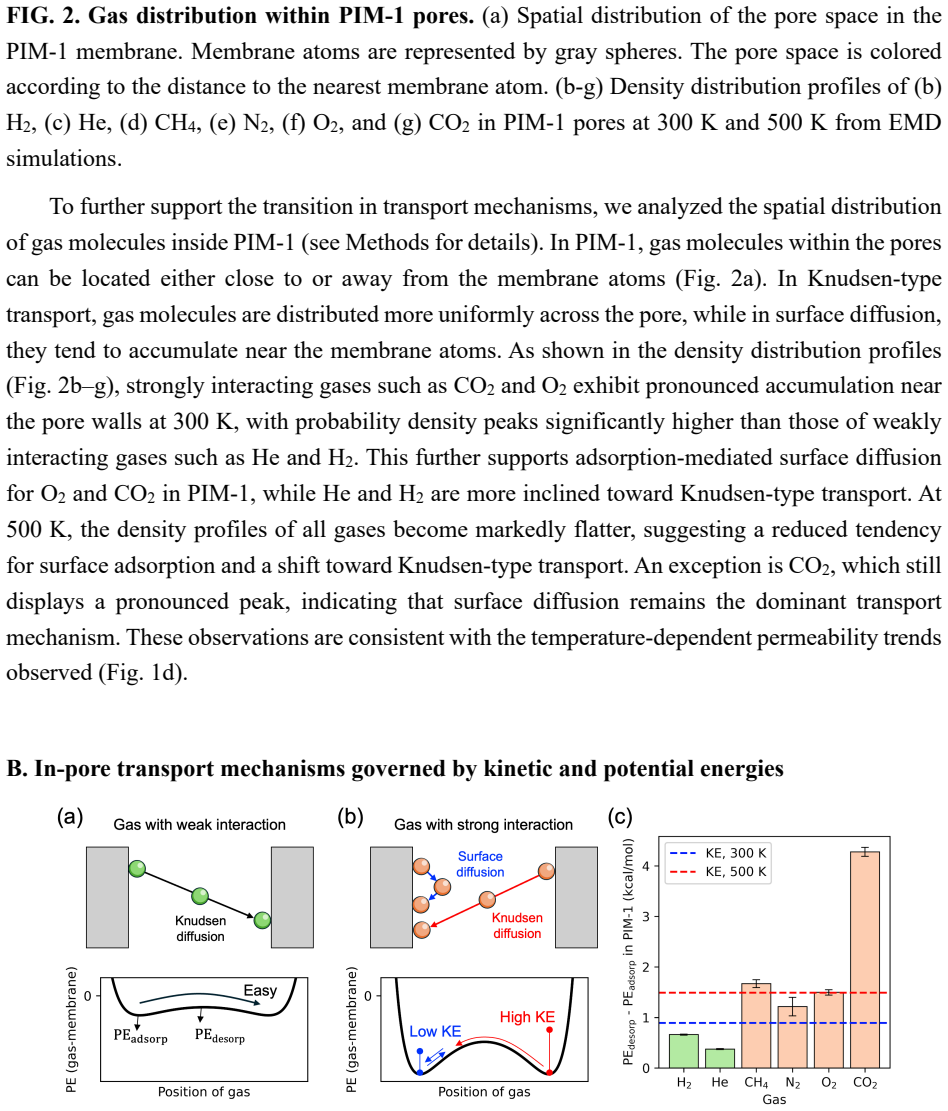
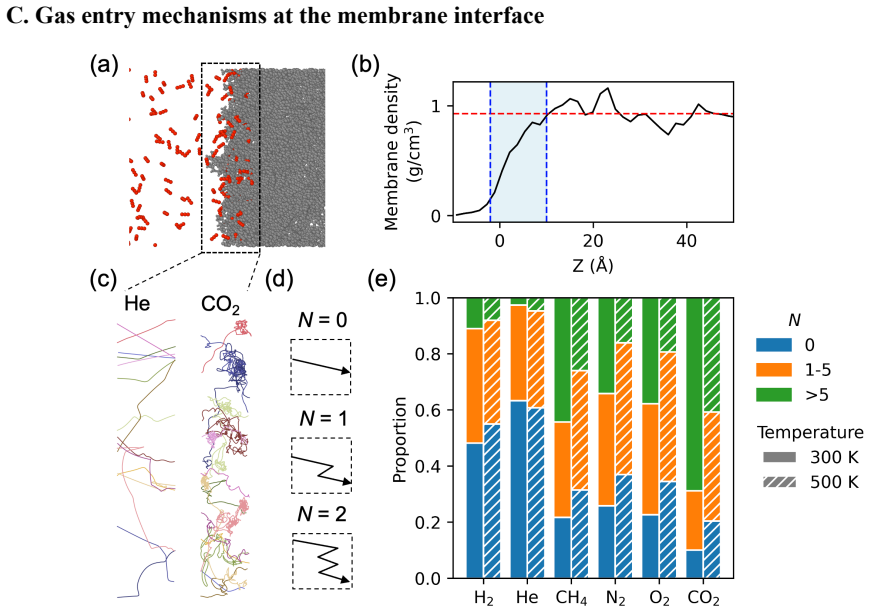
The load-bearing comparison is the difference between the gas-membrane interaction potential energy in a desorbed state and in an adsorbed state, plotted against $3k_BT/2$. The desorbed state is generated computationally by artificially enlarging the Lennard-Jones $\sigma$ of each gas to push it to the pore center, then restoring the parameters; the paper explicitly notes that this is a construction, not a physical desorption path. Supporting diagnostics are the permeability-mass scaling (Knudsen transport predicts $P \propto M^{-1/2}$), the spatial density distribution of gas inside pores, and reversal-count distributions of molecular trajectories at the membrane interface that separate direct from surface-assisted entry.
What would settle it
Compute the adsorbed-to-desorbed energy difference with a physically grounded free-energy method, such as umbrella sampling along a coordinate pulling a single gas molecule off the wall inside the same PIM-1 pore; if the resulting differences reclassify gases so that N2 or CH4 falls below $3k_BT/2$ at 300 K, the predicted surface-diffusion dominance at low temperature would be wrong. Alternatively, measure CO2 permeability versus temperature in a fresh PIM-1 membrane; if it follows $T^{-1/2}$ scaling down to 300 K with no extra boost, the surface-diffusion contribution claimed for CO2 would not appear.
Extended reading notes
Core claim
The central claim is that the dominant gas transport mechanism in PIM-1 is selected by comparing the gas-wall interaction potential energy difference between adsorbed and desorbed states against the thermal translational kinetic energy $3k_BT/2$. For He and H2, the interaction-energy difference is smaller than the kinetic energy at 300 K, so transport is Knudsen-type; for CH4, N2, O2, and CO2, the difference is larger at 300 K, so adsorption-mediated surface diffusion dominates. Warming to 500 K lets N2, O2, and CH4 cross into Knudsen-type transport, while CO2 remains surface-diffusion-dominated. The same energetic competition controls entry: weakly interacting gases enter only via direct collision with pore openings, while strongly interacting gases can adsorb on the interface and diffuse to a pore opening. This surface-diffusion-assisted entry is responsible for the elevated permeability of strongly interacting gases, and its suppression with temperature explains their steeper permeability decline.
Load-bearing premise
The results depend on the assumption that the energy difference between the computationally constructed desorbed state and the adsorbed state faithfully represents the barrier a molecule must overcome to leave the pore wall, even though this desorbed state is not produced by a physical desorption process.
Editorial extensions
If this is right
- At low temperatures, strongly interacting gases (CO2, O2, CH4, N2) can be more permeable than lighter weakly interacting gases, because the surface-assisted entry pathway gives them an extra route into the membrane.
- As temperature rises, the surface-diffusion contribution shrinks, so the permeability of strongly interacting gases falls faster than the $T^{-1/2}$ expectation for Knudsen flow.
- The apparent solubility term in the solution-diffusion model can be read as the sum of direct and surface-assisted entry, giving a microscopic meaning to that phenomenological parameter.
- Selectivity between a strongly and a weakly interacting gas will be temperature-sensitive: the gap between their permeabilities narrows as thermal energy weakens adsorption.
- CO2 remains surface-diffusion-dominated even at 500 K, so its permeability stays above the Knudsen prediction at elevated temperatures.
Reading between the lines
- The same competition criterion could be used predictively: for a given pore wall chemistry, one could estimate the temperature at which a specific gas crosses from surface diffusion to Knudsen transport, which would set operating windows for membrane separations.
- Physical aging in PIM-1 shrinks pores, which should deepen gas-wall interaction wells; if so, the crossover temperature for gases like N2 and CH4 would shift upward, meaning aged membranes could retain surface-diffusion-dominated transport at higher temperatures.
- The sigma-inflation construction for the desorbed state could be tested against a physically grounded method such as free-energy sampling along a genuine desorption coordinate; if the two give systematically different energy differences, the gas classification would need revision.
- Because the framework is pore-based, it suggests that chemically functionalizing pore walls to increase gas-wall affinity (e.g., for CO2) will raise permeability at low temperatures but may hurt high-temperature performance once kinetic energy overtakes the interaction well.
Editorial analysis
A structured set of objections, weighed in public.
Referee Report
Summary. The paper uses non-equilibrium molecular dynamics (NEMD) to simulate permeation of He, H2, CH4, N2, O2, and CO2 through fresh PIM-1 membranes at 300, 400, and 500 K. The authors report that permeability–mass scaling shifts from no clear mass dependence at 300 K to an approximately M^-0.5 dependence at 500 K for all gases except CO2, and interpret this as a temperature-induced transition from adsorption-mediated surface diffusion to Knudsen-type ballistic transport. They attribute the transition to a competition between gas-wall interaction potential energy and thermal kinetic energy, quantified in Fig. 3c by comparing a static energy difference between constructed adsorbed and desorbed states with 3k_BT/2. Trajectory analysis at the membrane interface identifies two entry pathways, direct and surface-diffusion-assisted, and the authors show that the surface-assisted pathway enhances the entry of strongly interacting gases at low temperature. The paper concludes that a pore-flow perspective with competing energetics explains the dependence of gas permeation on gas type and temperature in PIM-1.
Significance. If the central mechanism is correct, the paper provides a coherent and design-relevant picture of gas transport in polymers of intrinsic microporosity, linking pore-wall chemistry to permeability and its temperature dependence. The study has notable strengths: permeability data are averaged over three independent membrane replicas with reported error bars; the linear fits used for permeability have R^2 > 0.97; the direct-entry permeance prediction from kinetic theory (Eq. 2) using helium as a reference is an independent cross-check that agrees with simulations; and the trajectory recording is deliberately tested for frame-interval sensitivity (Fig. S4). The main weakness is that the energetic criterion underlying the mechanism (Fig. 3c) is based on a nonphysical desorbed-state construction, so the quantitative 'governed by' claim is not yet fully supported and needs additional validation or a tempered interpretation.
major comments (2)
- [Methods, 'Interaction potential energy of gas adsorption and desorption in the membrane'; Fig. 3c] The central mechanistic claim that transport is governed by the competition between gas-wall interaction potential energy and thermal kinetic energy rests on the comparison in Fig. 3c between ΔPE = PE_des − PE_ads and 3k_BT/2. The desorbed state is generated by artificially inflating the Lennard-Jones σ of each gas and then restoring it (Fig. S2). As the authors acknowledge, this is a computational construction rather than a physical desorption pathway. The resulting static energy difference is not the free-energy barrier between adsorbed and free states: it omits entropic contributions, polymer thermal fluctuations, and the actual path of escape from the wall. Because the classification of H2/He as Knudsen-type and CH4/N2/O2/CO2 as surface-diffusion-dominated, and the special status of CO2 at 500 K, follows directly from this comparison, the 'governed by' claim is more strongly asserted than the evidence supports. I recommend either computing a potential of mean force along a physically meaningful desorption coordinate (e.g., distance from the wall in a representative pore) or providing an independent cross-check (e.g., residence-time distributions or GCMC adsorption energies) that yields the same ordering of gases. If that is not feasible, the conclusions should be softened from 'governed by' to 'consistent with'.
- [§III.A, Fig. 1d; Table S1] The inference that the absence of mass scaling at 300 K indicates surface diffusion is not unique: permeability is the product of solubility and diffusivity, and compensating solubility effects could also flatten the mass dependence. The authors state this caveat, but the subsequent mechanism assignment leans on Fig. 3c, which is the subject of the previous comment. To make the case more robust, the paper should report the solubility and diffusivity contributions separately (e.g., from equilibrium MD or GCMC) and show that the mass scaling of the diffusivity itself changes with temperature. This would also strengthen the interpretation of the temperature-induced transition.
minor comments (4)
- [Methods, 'Interaction potential energy of gas adsorption and desorption in the membrane'] The sentence 'The relaxed PIM-1 structure containing gas molecules, obtained from the calculated gas density distribution inside the membrane' is ambiguous: the density distribution is a histogram, not a configuration. Please specify how the gas-loaded structure was generated (e.g., GCMC insertion or NVT equilibration with a fixed number of molecules).
- [Fig. 3c caption] The figure caption says 'compared with gas kinetic energies at 300 K and 500 K', but the text specifies only translational kinetic energy (1.5 k_B T). Please make the caption consistent, and consider adding a line showing the rotational/vibrational contributions if they are excluded.
- [§III.C, Fig. 5c] The kinetic-theory prediction for direct-entry permeance is based on helium as a reference, but the text does not state whether P_direct,He is taken from the NEMD simulation or from a theoretical value. Please clarify, and note that the comparison for He itself is then not an independent test.
- [§III.A, Table S2] The discussion of CO2 selectivity would benefit from a quantitative comparison: the simulated CO2/He selectivity is 1.73 versus experimental values of 5.0 and 8.5; the explanation that surface diffusion does not scale with pore volume is plausible but should be supported by a decomposition of CO2 permeability into pore-volume-scaling and surface-diffusion contributions.
Circularity Check
No significant circularity: the energy competition is an independent physical calculation, not a fit to the permeability data, and the paper's self-citations are background only.
full rationale
The paper's central claim is that the temperature-induced transport transition is governed by the competition between gas-wall interaction potential energy and thermal kinetic energy. The supporting evidence in Fig. 3c compares an independently computed potential-energy difference (between adsorbed and constructed desorbed configurations) with 3kBT/2. This energy difference is not fitted to the permeability data; it is a separate force-field calculation using the same interaction parameters that generate the raw permeabilities, but the comparison is interpretive, not a fitting exercise. The paper explicitly acknowledges that the desorbed state is a 'computational construction' and that the average-energy comparison is 'a qualitative indicator rather than an absolute transition criterion,' so the mechanistic explanation is appropriately hedged rather than presented as a forced identity. The direct-entry permeance prediction in Eq. (2) uses helium as a reference and the M^-0.5 kinetic-theory scaling; this is an independent cross-check against the NEMD trajectory classification, not a parameter fitted to the gases being predicted. The self-citations (refs. 15, 23, 25) provide background for Knudsen scaling and energy arguments but are not load-bearing: the paper's own simulations, spatial density profiles, and trajectory statistics carry the argument. No step reduces by definition to its inputs, no fitted parameter is renamed as a prediction, and no uniqueness theorem is imported from the authors' prior work. The acknowledged limitation of the desorbed-state construction is a correctness or free-energy concern, not a circularity.
Assumptions & free parameters
free parameters (1)
- Lennard-Jones sigma inflation factor for desorbed-state generation =
not reported; increased until potential energy converges (Fig. S2)
assumptions (4)
- domain assumption The OPLS-AA force field and the literature gas force fields accurately represent gas-polymer interactions in PIM-1
- domain assumption The 21-step relaxation protocol produces a representative fresh PIM-1 membrane
- ad hoc to paper The computational desorbed state approximates a physically meaningful desorbed configuration
- domain assumption NEMD with molecule insertion and deletion at 20 bar measures steady-state permeability in the linear regime
Cite this review
Pith. "Pith review of Competing Energetics Govern Gas Permeation in Polymer of Intrinsic Microporosity (PIM) Membranes." pith.science (2026). https://pith.science/paper/WRZ4GBAT
@misc{pith2026260806413,
  author       = {Pith},
  title        = {Pith review of: Competing Energetics Govern Gas Permeation in Polymer of Intrinsic Microporosity (PIM) Membranes},
  year         = {2026},
  howpublished = {\url{https://pith.science/paper/WRZ4GBAT}},
  note         = {Machine review of arXiv:2608.06413}
}
read the original abstract
Polymer membranes, particularly polymers of intrinsic microporosity (PIMs), hold great promise for gas separation applications. However, the long-dominant solution-diffusion model, which treats the membrane as a nonporous homogeneous medium, does not resolve how gas-solid atomic interactions govern molecular transport in intrinsic micropores, limiting rational bottom-up membrane design. In this work, we employ non-equilibrium molecular dynamics simulations to investigate the permeation of various gases (He, H2, CH4, N2, O2, and CO2) through PIM-1 as a representative PIM membrane across a range of temperatures. By analyzing the scaling of gas permeability with molecular mass, we identify a temperature-induced transition in the dominant transport mechanism. We demonstrate that this transition is governed by the competition between gas-wall interaction potential energy and thermal kinetic energy: weak interactions or elevated temperatures facilitate Knudsen-type ballistic transport, whereas strong interactions and lower temperatures favor adsorption-mediated surface diffusion. Furthermore, molecular trajectory analysis at the membrane interface reveals two distinct entry pathways: direct entry through pore openings and surface-diffusion-assisted entry. The surface-diffusion-assisted pathway greatly promotes the entry of strongly interacting gases into the membrane, contributing to higher overall permeability, albeit this enhancement diminishes with increasing temperature. These findings offer a mechanistic picture of gas permeation in PIM-1 and explain the dependence of gas permeation on both gas type and temperature. More broadly, they highlight the importance of adopting a pore-flow perspective to understand gas transport in microporous polymer membranes.
Figures
Reference graph
Works this paper leans on
-
[1]
as a function of the trajectory frame interval, for (a) H2, (b) He, (c) CH4, (d) N2, (e) O2, and (f) CO2 at 300 K and 500 K. The fraction is nearly constant near the frame intervals used in this work, 20 fs for H2 and He and 100 fs for the other gases, showing that the classification is not sensitive to the trajectory resolution. [Alt text description] Si...
work page 2008
-
[5]
The future of membrane gas separations,
Influence of gas-wall interaction strength on gas entry pathways. (a) Entry pathways for weakly interacting gases into a porous material. Gray blocks represent the porous material, green spheres denote weakly interacting gas molecules, and arrows indicate gas trajectories. Weakly interacting gases are reflected back to the feed side when colliding with th...
work page 2026
Reviewed August 10, 2026 · model on record in the stance chip above.
Discussion (0). Continue with ORCID to comment.