REVIEW 2 major objections 5 minor 38 references
Adjoint shape optimization of oscillatory rarefied gas flows
T0 review · 2 major / 5 minor · reviewed 2026-08-10 · deepseek-v4-flash
Pith's one-line read An adjoint kinetic solver makes shape optimization of oscillatory rarefied gas flows fast and accurate, with force reductions up to 84 percent.
desk verdict A solid adjoint-GSIS extension for oscillatory rarefied flows, with real derivations and honest validation; the high-frequency near-continuum regime is an extrapolation but not a fatal gap. read the letter →
The pith
A machine-rendered reading of the paper's core claim, the machinery that carries it, and where it could break.
The reading
What carries the argument
The central object is the adjoint general synthetic iterative scheme (adjoint GSIS): a fixed-point iteration that alternates one update of the mesoscopic adjoint kinetic equation with a solve of macroscopic synthetic equations. Those equations are velocity moments of the adjoint equation, closed by Chapman-Enskog constitutive relations and corrected by high-order terms extracted from the distribution function, so that diffusive information propagates across the whole domain instead of only within a few mean free paths. Free-form deformation with B-spline control points maps boundary-node sensitivities to a low-dimensional design vector, so the gradient is computed from converged primal and adjoint fields at a cost nearly independent of the number of design variables.
What would settle it
Repeat the adjoint GSIS convergence test and shape-optimization run at $\delta_{rp}=100$ with Strouhal numbers $S=10$ and $S=100$, so the temporal Knudsen number $S/\delta_{rp}$ reaches $0.1$ and $1$. If the measured spectral radius climbs toward unity or the adjoint sensitivities drift away from the finite-difference gradients, the Chapman-Enskog closure used in the adjoint synthetic equations is the failing component.
Extended reading notes
Core claim
The paper presents an adjoint form of the frequency-domain linearized Shakhov kinetic equation with diffuse-reflection boundary conditions, then closes the moment system by splitting adjoint stress and heat flux into Navier-Stokes constitutive parts plus high-order kinetic corrections. With the Chapman-Enskog closure, the adjoint synthetic macroscopic equations accelerate the kinetic iteration and remain valid in the near-continuum, low-frequency regime. Fourier stability analysis in an infinite domain gives a spectral radius below 0.5, while conventional iteration has a spectral radius approaching unity, and wall-bounded tests confirm convergence within dozens of steps and asymptotic-preserving behavior on cells coarser than the mean free path. The authors present this as a unified adjoint optimization tool for oscillatory rarefied gas flows, and they validate the gradient accuracy against finite differences before reporting the force reductions.
Load-bearing premise
The acceleration rests on a Chapman-Enskog closure that assumes the mean free path is small compared with the device size and the oscillation period is long compared with the molecular collision time; if the oscillation is fast enough that the temporal Knudsen number is not small, this closure and the fast convergence can break down.
Editorial extensions
If this is right
- Solving both primal and adjoint kinetic equations together takes dozens of iterations instead of tens of thousands; at $(\delta_{rp},S)=(100,0.1)$ the speedup over conventional iteration is 42.5 times.
- Because the scheme is asymptotic-preserving, shape optimization can use spatial meshes whose cells are far larger than the molecular mean free path, which is what makes near-continuum MEMS cases affordable.
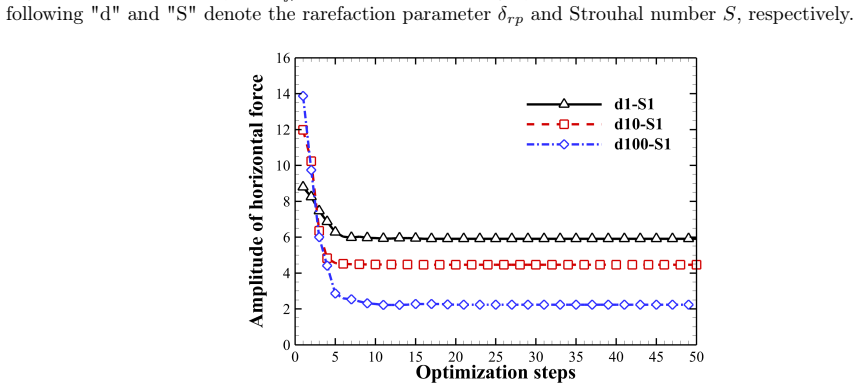
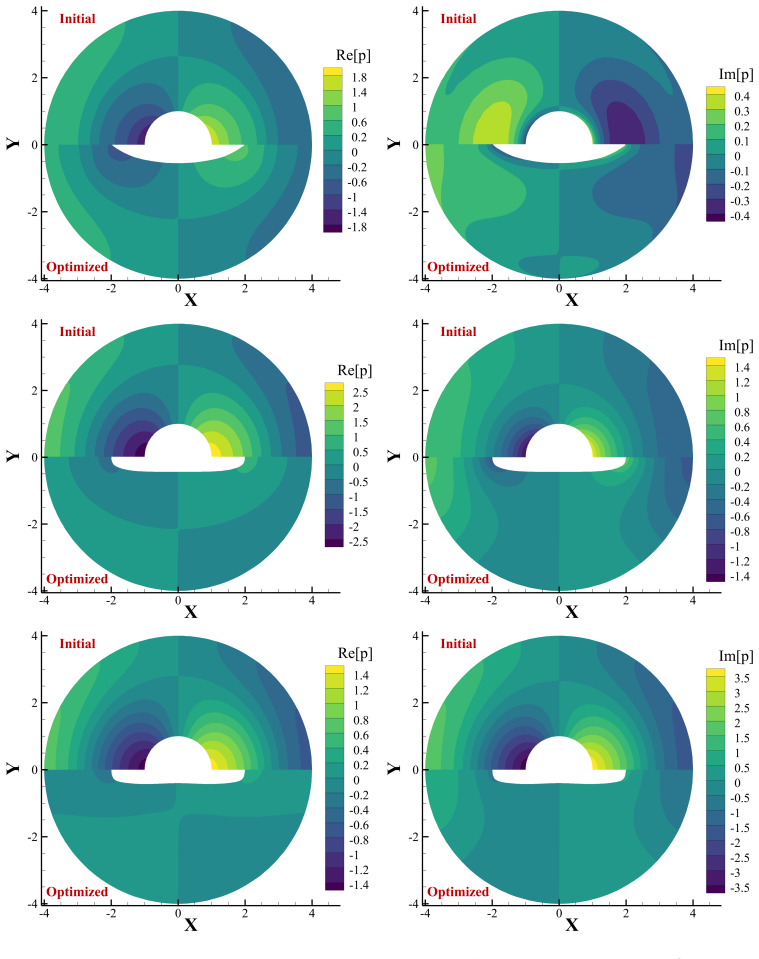
- For the oscillating cylinder, the optimized elongated shape reduces horizontal gas-force amplitude by 33.1%, 62.8%, and 84.0% at $\delta_{rp}=1,10,100$ ($S=1$).
- For the biaxial accelerometer, the constrained optimization reduces damping-force amplitude by 35.5%, 44.3%, and 52.6% at $\delta_{rp}=1,10,100$ ($S=0.1$), and the baseline damping force reproduces the experimental value.
- The adjoint sensitivities agree with finite-difference sensitivities in all tested cases, so the reported reductions come from an accurate gradient.
Reading between the lines
- Editorial extension: the asymptotic-preserving closure is demonstrated at Strouhal numbers $S=1$ and $S=0.1$; at higher frequencies where the temporal Knudsen number $\mathrm{Kn}_t=S/\delta_{rp}$ is no longer small, the Chapman-Enskog closure of the adjoint synthetic equations would need re-examination and the speedup may degrade.
- Editorial extension: the optimized cylinder profiles at high $\delta_{rp}$ converge toward a common elongated shape, suggesting a possible regime-independent low-damping template that could be tested without re-optimization.
- Editorial extension: since the conventional primal and adjoint iterations share the same spectral radius, the adjoint GSIS acceleration should transfer to other kinetic models with the same moment structure, for example, a simplified relaxation-time collision model or the full Boltzmann collision operator, where the sensitivity accuracy can be checked against finite differences.
Editorial analysis
A structured set of objections, weighed in public.
Referee Report
Summary. The paper develops a fast-converging, asymptotic-preserving adjoint shape optimization method for small-amplitude oscillatory rarefied gas flows. It derives a mesoscopic adjoint of the frequency-domain linearized Shakhov kinetic equation from a Lagrangian, constructs macroscopic synthetic equations via velocity moments with a Chapman-Enskog closure and high-order kinetic corrections, and uses Fourier stability analysis to argue that the resulting adjoint GSIS has spectral radius below 0.5. The shape sensitivity is extracted from discretized boundary integrals and passed through an FFD parameterization to a gradient-based optimizer. The method is validated on an oscillating cylinder and a biaxial accelerometer, with sensitivities checked against finite differences and CIS, the primal solver matched to experimental damping data, and reported force reductions of 33.1–84.0% and 35.5–52.6%, respectively.
Significance. If the claims hold, this is a substantial step: it makes adjoint-based shape optimization at the kinetic level practical for vibrating MEMS by replacing slow kinetic iterations with a few dozen GSIS iterations and by permitting meshes coarser than the mean free path in near-continuum regimes. The strengths of the paper are explicit: the adjoint equation is obtained from a Lagrangian rather than postulated; the Chapman-Enskog closure is derived rather than fitted; the stability analysis is carried out analytically; and the sensitivities are cross-checked against both finite-difference and CIS reference results, with the primal solver validated against experiment. These checks give confidence that the derived sensitivities and optimization results are not artifacts of the discretization. The main caveat is that the fast-convergence guarantee is proved and demonstrated only in regimes where the temporal Knudsen number is small, which is narrower than the broad 'vibrating MEMS' framing in the title and abstract.
major comments (2)
- [Sections 3.2–3.3, Eqs. (34) and (40)] The spectral-radius estimate ρ(G)=O(δrp^-2) and the associated 'convergence within dozens of iterations' claim are derived under the assumption ε=1/δrp and εS=S/δrp=Kn_t both small. In the numerical demonstrations, the near-continuum cases keep Kn_t≤0.01 (δrp=100 with S=1 in Section 5, δrp=100 with S=0.1 in Section 6), and the only case with Kn_t=O(1) is at δrp=1, where the flow is rarefied rather than near-continuum. The regime S∼δrp with large δrp, which is physically relevant for high-frequency MEMS operation, is therefore neither analyzed nor tested. Because the fixed point of the GSIS remains exact via the high-order corrections in Eq. (32), the accuracy of converged solutions is not in question; the concern is specifically the advertised fast convergence in the near-continuum high-frequency regime. I ask the authors either to add a numerical test with δrp large and S/δrp of order one, or to explicitly restrict the fast-convergence claim and the abstract/title wording to low temporal Knudsen numbers.
- [Section 2.3, Eqs. (14)–(15), and abstract/title] The objective is the squared modulus |J|^2 of the complex force amplitude. For a harmonic oscillation, the real part of J is proportional to the time-averaged dissipated power (the damping component), while the imaginary part is the stiffness/inertia component. Minimizing |J|^2 does not in general minimize drag or damping. The paper repeatedly describes the results as 'drag reduction' and claims relevance to quality factor and damping, but the optimizer is not constrained to reduce Re{J}; in the reported cases Re{J} does decrease, but this is an outcome, not an enforced objective. The authors should either justify |J|^2 as the relevant MEMS objective for the specific applications, or reformulate the objective (for instance, minimize Re{J} or a weight between the real and imaginary parts) and re-verify the sensitivities and optimizations.
minor comments (5)
- [Appendix A.3] The reduced two-dimensional adjoint system is introduced as a direct construction from the reduced primal system; a short statement explaining why this is equivalent to reducing the three-dimensional adjoint equations would help readers verify the reduction.
- [Figure 2] The caption lists the Strouhal values used and the range of δrp over which the spectral radius is below 0.5; without this information the 'below 0.5' claim in the abstract cannot be checked against the plot.
- [Section 5.2, Eq. (59)] The finite-difference perturbation is fixed at ε=10^-3; reporting the sensitivity of the comparison to this step size would strengthen the gradient verification.
- [Section 3.1, Eq. (22)] The iteration in Eq. (22) is labeled CIS, but the left-hand side already contains the implicit δrp ϕ term; clarifying that the 'conventional' scheme uses the same implicit treatment as the GSIS kinetic step would avoid ambiguity in the convergence comparison.
- [Section 5.2] The phrase 'It's worth to note' is informal; it should read 'It is worth noting'.
Circularity Check
No significant circularity; the adjoint GSIS derivation and its sensitivity validations are self-contained.
full rationale
The paper's central derivation chain is self-contained rather than circular. The adjoint kinetic equation (18) is obtained from a Lagrangian variation of the objective and constraints, not from the result it is used to predict. The adjoint synthetic equations (35) are derived from exact velocity moments of the adjoint equation, with the Chapman-Enskog closure (34) introduced explicitly as a near-continuum approximation; the high-order terms (32) are exact kinetic corrections. The convergence analysis in Section 3.3 is an independent Fourier stability calculation of the resulting iteration operator, and the spectral radius below 0.5 is a computed mathematical property, not a fitted or assumed value. Sensitivities are validated against finite-difference and CIS results, and the primal force is checked against experimental data for the accelerometer, providing external, non-circular support. References to the authors' prior work, especially the frequency-domain GSIS [6] and adjoint frameworks [10,11], supply implementation components and context, but they are not invoked as an unverified premise for the central claim; the adjoint equations, stability analysis, and sensitivity validation stand on their own. The asymptotic-preserving agreement with Navier-Stokes is by construction in the sense that the NS operator is embedded in the synthetic equations, but this is a design consistency property, not a fitted prediction or a derivation that reduces to its input. The untested high-frequency near-continuum regime is a scope limitation and a correctness risk, not a circularity.
Assumptions & free parameters
free parameters (3)
- Curvature bound eta =
0.4
- Fillet radius r =
0.1 L_ref
- FFD control lattice sizes =
8x8 (cylinder), 6x6 (accelerometer)
assumptions (5)
- domain assumption The frequency-domain linearized Shakhov kinetic equation (Eq. 4) accurately models small-amplitude oscillatory rarefied gas flows.
- domain assumption Diffuse reflection boundary conditions on all solid walls (Eq. 12).
- domain assumption Chapman-Enskog expansion with epsilon = 1/delta_rp and epsilon*S much less than 1 gives the adjoint NS closure (Eqs. 33-34).
- domain assumption Fourier stability analysis on an infinite periodic domain characterizes convergence of wall-bounded flows.
- domain assumption The discrete gradient chain rule through FFD and spring smoothing gives a smooth, accurate design-to-boundary map.
Cite this review
Pith. "Pith review of Adjoint shape optimization of oscillatory rarefied gas flows." pith.science (2026). https://pith.science/paper/FSUM66IR
@misc{pith2026260806910,
  author       = {Pith},
  title        = {Pith review of: Adjoint shape optimization of oscillatory rarefied gas flows},
  year         = {2026},
  howpublished = {\url{https://pith.science/paper/FSUM66IR}},
  note         = {Machine review of arXiv:2608.06910}
}
read the original abstract
A fast-converging and asymptotic-preserving adjoint shape optimization method is proposed for drag reduction of multiscale gas flows in vibrating micro-electro-mechanical systems. The convergence of the Boltzmann kinetic equation is accelerated by macroscopic synthetic equations, whose constitutive relations integrate continuum-limit terms and high-order kinetic corrections to faithfully characterize spatiotemporal rarefaction effects. As such, this method maintains near-continuum limit consistency while retaining high kinetic accuracy in rarefied flow regimes. Fourier stability analysis performed in an infinite domain demonstrates that the present method yields a spectral radius below 0.5, indicating that the numerical deviation from the converged solution is halved per iteration. Numerical simulations are conducted on an oscillating cylinder and a comb-shaped resonator. The results verify the high accuracy of the derived adjoint sensitivities and the excellent drag reduction performance of the proposed method across various Knudsen and Strouhal numbers. Compared with conventional kinetic iteration methods, the present method produces convergent primal and adjoint solutions within dozens of iterations and features asymptotic preserving behavior, permitting spatial cell sizes far larger than the molecular mean free path. This facilitates efficient design of vibrating micro-electro-mechanical systems.
Figures


Figures from the paper (6 more)



Reference graph
Works this paper leans on
-
[1]
G. Karniadakis, A. Beskok, N. Aluru, Microflows and Nanoflows: Fundamentals and Simulation, Springer, 2005
work page 2005
-
[2]
W. C. Tang, T.-C. H. Nguyen, R. T. Howe, Laterally driven polysilicon resonant mi- crostructures, Sensors and Actuators 20 (1-2) (1989) 25–32
work page 1989
-
[3]
M. Bao, H. Yang, Squeeze film air damping in MEMS, Sensors and Actuators A: Phys- ical 136 (1) (2007) 3–27
work page 2007
-
[4]
Jameson, Aerodynamic design via control theory, Journal of Scientific Computing 3 (3) (1988) 233–260
A. Jameson, Aerodynamic design via control theory, Journal of Scientific Computing 3 (3) (1988) 233–260. 31
work page 1988
-
[5]
M. B. Giles, N. A. Pierce, An introduction to the adjoint approach to design, Flow, Turbulence and Combustion 65 (3) (2000) 393–415
work page 2000
-
[6]
P. Li, L. Wu, Frequency-domain general synthetic iterative scheme for efficient sim- ulation of oscillatory rarefied gas flows, Applied Mathematical Modelling 156 (2026) 116900
work page 2026
-
[7]
A. Sato, T. Yamada, K. Izui, S. Nishiwaki, A topology optimization method in rarefied gas flow problems using the Boltzmann equation, Journal of Computational Physics 395 (2019) 135–164
work page 2019
-
[8]
R. Caflisch, D. Silantyev, Y. Yang, Adjoint DSMC for nonlinear Boltzmann equation constrained optimization, Journal of Computational Physics 439 (2021) 110404
work page 2021
Show all 38 references
-
[9]
K. Guan, K. Matsushima, Y. Noguchi, T. Yamada, Topology optimization for rarefied gas flow problems using density method and adjoint IP-DSMC, Journal of Computa- tional Physics 474 (2023) 111788
2023
-
[10]
R. Yuan, L. Wu, Adjoint shape optimization from the continuum to free-molecular gas flows, Journal of Computational Physics 537 (2025) 114102
2025
-
[11]
Zhang, R
Y. Zhang, R. Yuan, L. Wu, A fast-converging and asymptotic-preserving adjoint shape optimization of rarefied gas flows, Journal of Computational Physics (2026) 114960
2026
-
[12]
G. A. Bird, Molecular Gas Dynamics and the Direct Simulation of Gas Flows, Oxford University Press, 1994
1994
-
[13]
L. L. Baker, N. G. Hadjiconstantinou, Variance reduction for Monte Carlo solutions of the Boltzmann equation, Physics of Fluids 17 (5) (2005)
2005
-
[14]
T. M. Homolle, N. G. Hadjiconstantinou, A low-variance deviational simulation Monte Carlo for the Boltzmann equation, Journal of Computational Physics 226 (2007) 2341– 2358
2007
-
[15]
D. R. Ladiges, J. E. Sader, Frequency-domain deviational Monte Carlo method for linear oscillatory gas flows, Physics of Fluids 27 (10) (2015)
2015
-
[16]
D. R. Ladiges, J. E. Sader, Frequency-domain Monte Carlo method for linear oscillatory gas flows, Journal of Computational Physics 284 (2015) 351–366
2015
-
[17]
L. Wu, J. M. Reese, Y. Zhang, Oscillatory rarefied gas flow inside rectangular cavities, Journal of Fluid Mechanics 748 (2014) 350–367
2014
-
[18]
P. Wang, M. T. Ho, L. Wu, Z. Guo, Y. Zhang, A comparative study of discrete velocity methods for low-speed rarefied gas flows, Computers & Fluids 161 (2018) 33–46. 32
2018
-
[19]
W. Su, L. Zhu, P. Wang, Y. Zhang, L. Wu, Can we find steady-state solutions to multiscale rarefied gas flows within dozens of iterations?, Journal of Computational Physics 407 (2020) 109245
2020
-
[20]
Jin, Asymptotic-preserving schemes for multiscale physical problems, Acta Numerica 31 (2022) 415–489
S. Jin, Asymptotic-preserving schemes for multiscale physical problems, Acta Numerica 31 (2022) 415–489
2022
-
[21]
W. Su, L. Zhu, L. Wu, Fast convergence and asymptotic preserving of the general synthetic iterative scheme, SIAM Journal on Scientific Computing 42 (6) (2020) B1517– B1540
2020
-
[22]
Y. Wang, S. Liu, C. Zhuo, C. Zhong, Investigation of nonlinear squeeze-film damp- ing involving rarefied gas effect in micro-electro-mechanical systems, Computers and Mathematics with Applications 114 (2022) 188–209
2022
-
[23]
Shakhov, Approximate kinetic equations in rarefied gas theory, Fluid Dynamics 3 (1) (1968) 112–115
E. Shakhov, Approximate kinetic equations in rarefied gas theory, Fluid Dynamics 3 (1) (1968) 112–115
1968
-
[24]
Wu, Rarefied Gas Dynamics: Kinetic Modeling and Multi-scale Simulation, Springer, 2022
L. Wu, Rarefied Gas Dynamics: Kinetic Modeling and Multi-scale Simulation, Springer, 2022
2022
-
[25]
T. W. Sederberg, S. R. Parry, Free-form deformation of solid geometric models, ACM SIGGRAPH Computer Graphics 20 (4) (1986) 151–160
1986
-
[26]
J. A. Samareh, Survey of shape parameterization techniques for high-fidelity multidis- ciplinary shape optimization, AIAA Journal 39 (5) (2001) 877–884
2001
-
[27]
Svanberg, The method of moving asymptotes—a new method for structural opti- mization, International Journal for Numerical Methods in Engineering 24 (2) (1987) 359–373
K. Svanberg, The method of moving asymptotes—a new method for structural opti- mization, International Journal for Numerical Methods in Engineering 24 (2) (1987) 359–373
1987
-
[28]
Svanberg, A class of globally convergent optimization methods based on conservative convex separable approximations, SIAM Journal on Optimization 12 (2002) 555–573
K. Svanberg, A class of globally convergent optimization methods based on conservative convex separable approximations, SIAM Journal on Optimization 12 (2002) 555–573
2002
-
[29]
S. G. Johnson, The NLopt nonlinear-optimization package,https://github.com/ stevengj/nlopt(2007)
2007
-
[30]
J. T. Batina, Unsteady Euler airfoil solutions using unstructured dynamic meshes, AIAA journal 28 (8) (1990) 1381–1388
1990
-
[31]
Chapman, T
S. Chapman, T. G. Cowling, The Mathematical Theory of Non-Uniform Gases, Cam- bridge University Press, 1990
1990
-
[32]
Piegl, W
L. Piegl, W. Tiller, The NURBS Book, 2nd Edition, Springer, Berlin, 1997
1997
-
[33]
L. Wu, J. M. Reese, Y. Zhang, Solving the Boltzmann equation deterministically by the fast spectral method: application to gas microflows, Journal of Fluid Mechanics 746 (2014) 53–84. 33
2014
-
[34]
Wu, Sound propagation through a rarefied gas in rectangular channels, Physical Review E 94 (2016) 053110
L. Wu, Sound propagation through a rarefied gas in rectangular channels, Physical Review E 94 (2016) 053110
2016
-
[35]
Frangi, A
A. Frangi, A. Frezzotti, S. Lorenzani, On the application of the BGK kinetic model to the analysis of gas-structure interactions in MEMS, Computers & Structures 85 (11-14) (2007) 810–817
2007
-
[36]
S. Yoon, A. Jameson, Lower-upper symmetric-Gauss-Seidel method for the Euler and Navier-Stokes equations, AIAA Journal 26 (9) (1988) 1025–1026
1988
-
[37]
Darwish, I
M. Darwish, I. Sraj, F. Moukalled, A coupled finite volume solver for the solution of incompressible flows on unstructured grids, Journal of Computational Physics 228 (1) (2009) 180–201
2009
-
[38]
Zhang, R
Y. Zhang, R. Yuan, L. Luo, L. Wu, An efficient treatment of heat-flux boundary con- ditions in GSIS for rarefied gas flows, Computers & Fluids 315 (2026) 107113. 34
2026
Reviewed August 10, 2026 · model on record in the stance chip above.
Discussion (0). Continue with ORCID to comment.