REVIEW 3 major objections 5 minor 22 references
Measurement of the Electron capture of $^{76}$As into the first excited state of $^{76}$Ge
T0 review · 3 major / 5 minor · reviewed 2026-08-10 · deepseek-v4-flash
Pith's one-line read This paper reports the first measurement with a fully quantified uncertainty budget of the electron-capture branching ratio of 76As into the first excited state of 76Ge, finding (0.0572 ± 0.0029 (stat.) ± 0.0074 (syst.))%.
desk verdict Careful second measurement of a small EC branch in 76As, with a genuinely quantified uncertainty budget, but an internal inconsistency in the dead-time correction means the central value is not yet stable. read the letter →
The pith
A machine-rendered reading of the paper's core claim, the machinery that carries it, and where it could break.
The reading
What carries the argument
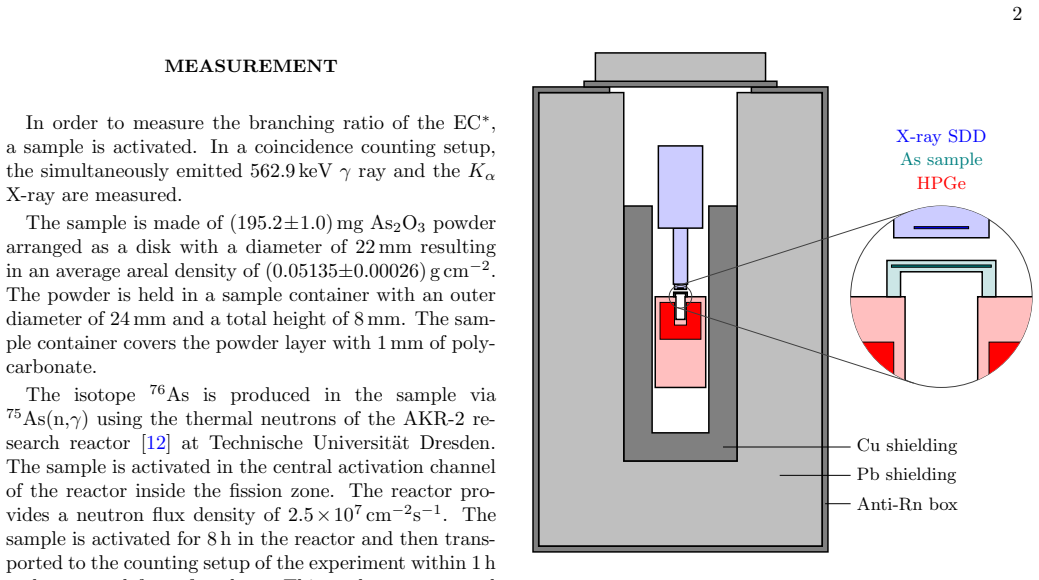
The measurement is carried by a relative coincidence method: the number of EC* decays is obtained from coincident 562.9 keV gamma-ray (HPGe) and 9.9 keV Ge K-alpha X-ray (silicon drift detector) events, normalized to the 559.1 keV gamma-ray reference line that counts 76As decays. Background in the coincidence region is subtracted by a two-dimensional sideband method that assumes the background energy distribution factorizes into independent gamma-ray and X-ray components, and the X-ray detector's large (73–79%) rate- and energy-dependent dead time, caused by a digitizer dynamic-range configuration error that truncates the preamplifier reset signal, is corrected in one-hour time bins.
What would settle it
Independently re-measure the branching ratio with a data acquisition system that records the full reset pulse (or with a different X-ray detector), so the dead time is made negligible; if the resulting branching ratio differs from 0.0572% by more than the combined uncertainties, the central claim would be refuted. A cheaper check is to compute the live time from a first-principles simulation of the reset preamplifier and see whether it reproduces the 4.2% test-experiment deviation.
Extended reading notes
Core claim
The central claim is that the branching ratio ν_EC* of the electron capture of 76As into the first excited state of 76Ge is (0.0572 ± 0.0029 (stat.) ± 0.0074 (syst.))%, measured via coincident detection of the 562.9 keV gamma ray and the 9.9 keV Ge K-alpha X-ray, with a two-dimensional sideband subtraction of a background that includes both random and true beta-decay coincidences. The paper states this is the first measurement with the full uncertainty budget quantified, and that the result translates to a log ft value of 6.99. The measured branch is about 70% larger than the previous measurement of ≈0.027%.
Load-bearing premise
The result stands on the assumption that the rate- and energy-dependent live time of the X-ray detector is estimated without bias after correcting the truncated preamplifier reset signal, even though that estimate was validated only by a 4.2% deviation in test experiments rather than a first-principles model.
Editorial extensions
If this is right
- The measured log ft = 6.99 replaces the previous value of 7.34 as the benchmark for the 2− to 2+ first-forbidden non-unique electron-capture transition.
- A ~70% larger EC* branch alters the expected 562.9 keV and Ge X-ray yields in 76Ge detectors, a relevant input for background modeling in future LEGEND operations.
- With the EC* branch quantified, the remaining unmeasured EC0 branch can be attacked with a 4π scintillator veto detector, as the paper proposes.
- The two-dimensional sideband method and the count-rate quantile consistency checks establish a template for coincidence measurements at high dead time.
Reading between the lines
- If the result holds up, the factor-of-two discrepancy with the 2014 measurement suggests a systematic effect in one of the two experiments; a third, independent measurement would be needed to decide which one is biased.
- The paper's dead-time correction could be replaced by a fully first-principles model of the digitizer/preamplifier interaction, which would likely reduce the dominant systematic uncertainty and make a future EC0 measurement more precise.
- The measured value near the upper edge of theory predictions may motivate updated nuclear-structure calculations for the neighboring EC0 branch, since the two branches share phase-space and nuclear-structure inputs.
Editorial analysis
A structured set of objections, weighed in public.
Referee Report
Summary. The manuscript reports a new measurement of the electron-capture branch of 76As into the first excited state of 76Ge (EC*). 76As is produced by 75As(n,γ) in an activated As2O3 sample, and the EC* branch is tagged by the coincidence of the 562.9 keV γ-ray in a HPGe detector and the Ge Kα X-ray in a silicon drift detector. The number of EC* decays is obtained with a two-dimensional sideband background subtraction, and the total number of 76As decays is obtained from the 559.1 keV γ-ray line. The result is ν_EC* = (0.0572 ± 0.0029(stat.) ± 0.0074(syst.))%, which is about 70% larger than the only previous measurement of ≈0.027%. The paper also proposes several future approaches to measure the unobserved EC into the 76Ge ground state.
Significance. If correct, the result provides a valuable experimental benchmark for nuclear-structure calculations relevant to 0νββ matrix elements, and it is the first measurement of this branch with a quantified uncertainty budget. The experimental work is careful in several respects: the 2D sideband method is tested for separability, the result is cross-checked with one-dimensional and two-dimensional fits, partition consistency is demonstrated, and time-dependent rate effects are investigated. The claimed log ft = 6.99 is a concrete physics output. However, the central value rests on a rate-dependent live-time correction whose numerical consistency is not established, and the factor-of-two discrepancy with the previous measurement is not discussed. These issues must be resolved before the measurement can be considered reliable.
major comments (3)
- [Branching ratio calculation and Table III] The rate-dependent correction factor K_t-dep is internally inconsistent. The text gives t_real = 741.8 h, t_live,SDD = 144.8 h, and k_RCS = 1.020, which yields K_t-dep = 1.020 × 741.8 / 144.8 = 5.22. Table III lists K_t-dep = 5.62 for the same total dataset, implying t_live,SDD = 1.020 × 741.8 / 5.62 ≈ 134.6 h, a 7% difference. Because ν_EC* in Eq. (3) is directly proportional to K_t-dep, the quoted central value is not stable: using 5.22 instead of 5.62 would change the result from 0.0572% to about 0.053%, a shift comparable to the systematic uncertainty. In addition, the stated dead-time range of 79% to 73% is inconsistent with either value: t_live = 144.8 h corresponds to an average dead time of 80.5%, and t_live = 134.6 h to 81.8%. The row-wise K_t-dep values in Table III, combined with k_RCS = 1.020, imply a total live time of about 139 h, again inconsistent with both 144.8 h and the stated range. This arithmetic inconsistency in the largest rate-dependent correction must be resolved before the branching ratio can be quoted.
- [Branching ratio calculation] The live-time correction is validated only by a 4.2% deviation between the rate- and energy-dependent estimator and test experiments with known live times. The dead time is 73–79%, so the correction is large, and the text states that a rate-independent bias would cancel. However, the discrepancy found in Table III (7%) is larger than the 4.2% validation uncertainty and shows that the internal consistency of the correction is not established. The paper should demonstrate, with a first-principles model or an independent measurement, that the correction factor is accurate to the claimed level; otherwise the 2% contribution to the systematic uncertainty is not supported.
- [Conclusion / comparison with previous measurement] The new result is about 70% larger than the only previous measurement of ν_EC* ≈ 0.027% [9]. The paper states this difference but does not discuss possible sources of the discrepancy, such as different background treatment, normalization, or efficiency calibrations. A quantitative comparison of the two measurements, including the uncertainties and any known systematic differences, is needed to substantiate the claim that the new measurement supersedes the previous one. Without such a discussion, the physical conclusion rests on a single measurement that is in tension with the earlier value.
minor comments (5)
- [Cross checks] The text says the rate-dependence check uses data summarized into eight quantiles, while the caption of Figure 8 says ten quantiles; this should be corrected.
- [Branching ratio calculation] In Table I, t_real is given as 741.8 h, whereas the total row of Table III gives 742 h; the difference is presumably due to rounding, but the two tables should be made consistent.
- [Figure 5] The word 'Inlet' in the caption of Figure 5 should be 'Inset'.
- [Equation (4)] The notation in Eq. (4) mixes εHPGe(559.1 keV) with the definition of ε_ref; the text should clarify that ε_ref is the full-energy efficiency at 559.1 keV and that the ratio εHPGe(559.1)/εHPGe(562.9) is the one used.
- [Introduction] The paper states that the EC into the 76Ge ground state has not been observed yet, but the later section on future measurements makes clear that this remains unmeasured; the distinction between EC* and EC0 should be stated more prominently in the abstract or introduction to avoid confusion about what was measured.
Circularity Check
No significant circularity: the branching ratio is a measured count ratio scaled by literature constants and simulated efficiencies; overlapping-author citations are not load-bearing.
full rationale
The derivation of nu_EC* is a direct count-ratio measurement: Eq. (3) multiplies the background-subtracted coincidence counts N_coinc by detector live-time, literature nuclear-data constants (p_K, omega_K, p_alpha), and a simulated efficiency ratio, then divides by the measured 559.1-keV reference counts. No free parameter is fitted to the target branching ratio; the efficiencies come from a Geant4 simulation calibrated to point-like standards, the live-time correction is validated by independent test experiments with known live times, and the two-dimensional sideband background method is cross-checked internally. The overlapping-author citations ([9], [10], [12], [13]) provide context, comparison, or small multiplicative constants (p_K contributes about 1% systematic uncertainty); none is a load-bearing argument, a uniqueness theorem, or an ansatz that forces the result. The apparent arithmetic inconsistency in K_t-dep (t_live = 144.8 h and the stated 73-79% dead-time range versus Table III K_t-dep = 5.62) is a numerical-stability and correctness concern, not a circularity, because K_t-dep is an input correction rather than a fitted output. The central claim is an independent measurement whose derivation is self-contained apart from standard external data.
Assumptions & free parameters
assumptions (3)
- domain assumption Coincident background energy distribution factorizes: P(Eγ, EX-ray) = P(Eγ) P(EX-ray) in the sideband regions.
- domain assumption Literature nuclear data inputs are correct: pK=0.877±0.009, ωK=0.546±0.004, pα=0.869±0.018, νref=(40.670±0.291)%.
- domain assumption The GEANT4 simulation of the coincidence efficiency and the dead-time model are accurate within the quoted uncertainties.
Cite this review
Pith. "Pith review of Measurement of the Electron capture of $^{76}$As into the first excited state of $^{76}$Ge." pith.science (2026). https://pith.science/paper/XSWXLBRN
@misc{pith2026260807010,
  author       = {Pith},
  title        = {Pith review of: Measurement of the Electron capture of $^76$As into the first excited state of $^76$Ge},
  year         = {2026},
  howpublished = {\url{https://pith.science/paper/XSWXLBRN}},
  note         = {Machine review of arXiv:2608.07010}
}
abstract
The neutrinoless double beta decay of $^{76}$Ge is searched for in the large-scale experiment LEGEND. The measurement of the half-life of this process would give access to the neutrino mass using the nuclear matrix element. Experimentally the contribution of the $^{76}$As ground state to the nuclear matrix element can be investigated via the branching ratios of its $\beta^-$ and electron capture decay. While energetically, the electron capture of $^{76}$As into the first excited state of $^{76}$Ge is possible and was measured once before this work, the electron capture into the $^{76}$Ge ground state was not observed yet. The present study investigates the branching of $^{76}$As that is produced via $^{75}$As(n,$\gamma$) on a thin As$_2$O$_3$ sample. A silicon drift detector measures characteristic X-rays emitted by the germanium atoms caused by an inner vacancy after the electron capture. A high-purity germanium detector is used to measure the 562.9$\,$keV $\gamma$-rays emitted after electron capture into the excited state. Investigation of coincident signals in both detectors leads to the branching ratio of the $^{76}$As electron capture into the first excited state of $^{76}$Ge of $\nu_{\mathrm{EC}^\ast} = (0.0572 \pm 0.0029 (\mathrm{stat.}) \pm 0.0074(\mathrm{syst.}))\%$. This is the first measurement with the full uncertainty budget quantified.
Figures


Figures from the paper (4 more)


Reference graph
Works this paper leans on
-
[9]
A. R. Domula, D. Gehre, K. Zuber, J. C. Droh´ e, N. Nankov, A. J. M. Plompen, C. Rouki, M. Stanoiu, A. Klix, A. Buffler, D. Geduld, F. D. Smit, C. Vermeulen, P. Maleka, R.T. Newman, R. Nolte, and A. Wallner, Nucl. Data Sheets120, 44 (2014)
work page 2014
-
[1]
M. J. Dolinski, A. W. P. Poon, and W. Rodejohann, Ann. Rev. Nucl. Part. Sci.69, 219 (2019)
work page 2019
-
[2]
M. Agostini, G. Benato, J. A. Detwiler, J. Men´ endez, and F. Vissani, Rev. Mod. Phys.95, 025002 (2013)
work page 2013
-
[3]
Acharyaet al.(Legendcollaboration), Phys
H. Acharyaet al.(Legendcollaboration), Phys. Rev. Lett.136, 022701 (2026)
work page 2026
-
[4]
Burlacet al.(Legendcollaboration), Nucl
N. Burlacet al.(Legendcollaboration), Nucl. Instrum. Methods A1080, 170779 (2025). 9
work page 2025
- [5]
- [6]
- [7]
Show all 22 references
-
[8]
Meng Wanget al., Chin. Phys. C45, 030003 (2021)
2021
-
[10]
-1 keV -1 Count rate / (s 559.1 657.0 1216.2 1228.6 1439.2 1787.6 1870.0 2096.2 2110.6 2429.1 2655.4 FIG. 3. HPGeγ-ray energy spectrum for all measurement runs before coincidence cuts. The experimental data is divided into two data sets, corresponding to higher (blue) and lowe...
-
[11]
Suhonen,private communication
J. Suhonen,private communication
-
[12]
Turkat, X
S. Turkat, X. Mougeot, B. Singh, and K. Zuber, At. Data Nucl. Data Tables152, 101584 (2023)
2023
-
[13]
Bemmerer, A
D. Bemmerer, A. Boeltzig, M. Grieger, K. Gudat, T. Hensel, E. Masha, M. Osswald, B. Poser, S. R¨ ummler, K. Schmidt, J. L. Ta ´ ın, A. Tarifeno-Saldivia, S. Turkat, A. Yadav, and K. Zuber, Europ. Phys. J. A61, 1 (2025)
2025
-
[14]
Rodriguez, A
J.J.G. Rodriguez, A. Knospe, M. Viebach, S. H¨ ubner, T. Saalfeld, V. Melzer, S. Weichel, D. Gehre, A. Hurtado, and C. Lange, Ann. Nucl. Energy231, 112217 (2026)
2026
-
[15]
Marnada, H
N. Marnada, H. Miyahara, N. Ueda, N. Hayashi, and K. Ikeda, Nucl. Instrum. Methods A450, 270 (2000)
2000
-
[16]
Sch¨ onfeld, and H
E. Sch¨ onfeld, and H. Janßen, Nucl. Instrum. Methods A369, 527 (1996)
1996
-
[17]
The im- plementation of the detectors was optimized to match calibration measurements with point-like radiation stan- dards
particle transport simulation of the setup. The im- plementation of the detectors was optimized to match calibration measurements with point-like radiation stan- dards. For the X-ray detector, sources of 57Co, 133Ba and 65Zn were used at a distance of 50 mm from the detector. ...
1955
-
[18]
Sch¨ onfeld, and H
E. Sch¨ onfeld, and H. Janßen, Appl. Rad. Isot.52, 595- 600 (2000)
2000
-
[19]
Agostinelliet al.(Geant4Collaboration), Nucl
S. Agostinelliet al.(Geant4Collaboration), Nucl. In- strum. Methods A506, 250 (2003)
2003
-
[20]
Hariaszet al.(KDKCollaboration), Phys
L. Hariaszet al.(KDKCollaboration), Phys. Rev. C108, 014327 (2023)
2023
-
[21]
Karny, K.P
M. Karny, K.P. Rykaczewski, A. Fija lkowska, B.C. Rasco, M. Woli´ nska-Cichocka, R.K. Grzywacz, K.C. Goetz, D. Miller, and E.F. Zganjar, Nucl. Instrum. Meth- ods A836, 83-90 (2016)
2016
-
[22]
L. Zou, Z. Li, D. Liu, G. Zha, and W. Jiang, Materi- als textbf19, 545 (2026)
2026
Reviewed August 10, 2026 · model on record in the stance chip above.
Discussion (0). Continue with ORCID to comment.