REVIEW 2 major objections 4 minor 63 references
Entanglement Mpemba Effect
T0 review · 2 major / 4 minor · reviewed 2026-08-10 · deepseek-v4-flash
Pith's one-line read Choosing an initially less entangled state can make dissipative preparation reach a more entangled target faster: the entanglement Mpemba effect, certified by a spectral sign criterion.
desk verdict A clean theoretical result: the strong Mpemba mechanism extended to entanglement monotones with an explicit spectral criterion, exact solvable models, and an honest robustness caveat that limits the practical speedup claim. read the letter →
The pith
A machine-rendered reading of the paper's core claim, the machinery that carries it, and where it could break.
The reading
What carries the argument
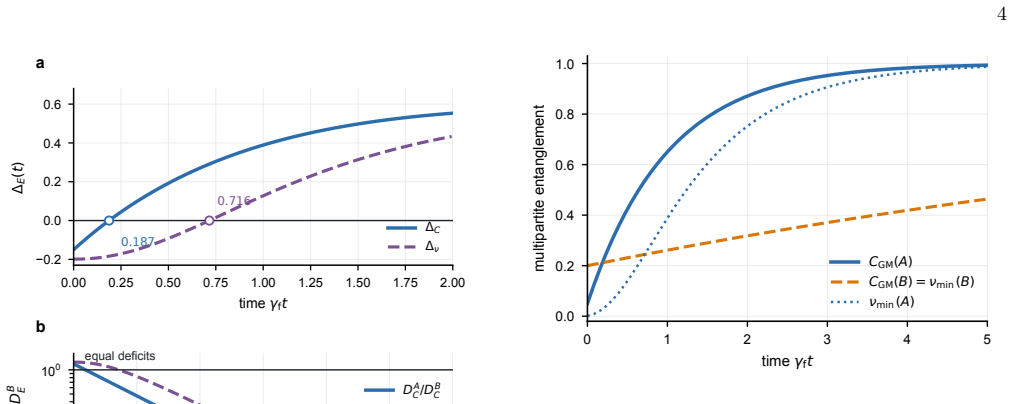
The carrying mechanism is channel selection by initial support. The generator contains two invariant 'source faces' with fast rate $\gamma_f$ and slow rate $\gamma_s$; the less entangled initial state is prepared entirely within the fast face, while the more entangled initial state occupies the orthogonal slow face, so each jump operator annihilates the other trajectory and only one decay rate is visible to each preparation. The formal criterion is the entanglement-visible comparison spectrum: expanding the ordering difference in Liouvillian eigenmodes gives an asymptotic series whose leading grouped coefficient $K_E$ fixes the late-time sign, so $\Delta E(0)<0$ with $K_E>0$ certifies the reversal. A second, measure-independent certificate uses deterministic LOCC reachability: if the initially more entangled state can be converted to the less entangled one by LOCC before the crossing and the reverse holds after, then every entanglement monotone follows the reversed ordering.
What would settle it
Run the two-qubit pump with $a=0.05$, $b=0.60$, $\gamma_s/\gamma_f=0.08$ and monitor the concurrence difference $\Delta C(t)$: if it never changes sign before both states saturate, or if the crossing time differs from $\gamma_f t=0.187$ beyond tomography error, the spectral criterion is falsified. A sharper null test is to look for any population in the nominally empty $|T_0\rangle$ face of the fast trajectory; if it appears, the late-time deficit ratio $D_A^C/D_B^C$ will flatten, at late times, with slope $0$ rather than the predicted slope $-\gamma_f+\gamma_s$.
Extended reading notes
Core claim
The core claim is that entanglement relaxation, not just temperature or magnetization, can display the Mpemba anomaly. For two trajectories $\rho_A(t)$ and $\rho_B(t)$ under the same Lindblad generator with common attractor $\rho_\star$, the late-time ordering is controlled by the entanglement-visible comparison spectrum: $\Delta E(t)\sim\sum_{m,\alpha} q_\alpha^{(m)}(c_{A,\alpha}^{(m)}-c_{B,\alpha}^{(m)})e^{\Lambda_\alpha^{(m)} t}$. If the leading grouped term is nonoscillatory, $\Delta E(t)=K_E t^{q_E} e^{-r_E t}[1+o(1)]$, then the simple pair of signs $\Delta E(0)<0$ and $K_E>0$ is sufficient for a crossing: the initially less entangled state is the more entangled state at all sufficiently late times. The mechanism also works when individual entanglement trajectories are nonmonotonic, and the deterministic-LOCC reachability preorder gives a stronger certificate by which every entanglement monotone sees the reversed ordering.
Load-bearing premise
The entire advantage rests on preparing the supposedly fast initial state with exactly zero overlap with the slow-relaxing sector; if imperfections leak even a small population into that sector, the exponential speedup is replaced by a finite perturbative advantage.
Editorial extensions
If this is right
- Any dissipative Bell- or GHZ-state pump with distinguishable fast and slow source faces can be accelerated purely by preparing the initial state with zero overlap with the slow face, leaving the reservoir and all controls unchanged.
- The LOCC certificate means the ordering reversal is not an artifact of one chosen entanglement measure: near the crossing, every entanglement monotone sees the same reversed ordering.
- Because the spectral criterion does not require monotone trajectories, it extends Mpemba-type reasoning to nonmonotonic entanglement evolution and to observables beyond fidelity or target population.
- In the two-qubit example the two different measures reverse at different times ($\gamma_f t=0.187$ and $0.716$), so no single linear target-population observable explains both crossings.
- The fixed-cycle trapped-ion version reaches concurrence $0.9$ in $8$ cycles instead of $41$, showing the speedup survives digitization into repeated resets.
Reading between the lines
- Editorial inference: the leading late-time coefficient in Eq. (6) could be used as a tomography-free diagnostic, fitting the entanglement-deficit ratio at long times to read off the visible-rate difference without reconstructing full states.
- Editorial inference: the invariant-face construction should transfer to other quantum resources, such as Bell nonlocality or quantum Fisher information, whenever the resource admits a directional expansion around the attractor.
- Editorial inference: a controlled leakage experiment in the trapped-ion protocol, seeding a small $|T_0\rangle$ population into the fast trajectory, would directly map how much face mixing the reversal tolerates; the paper only claims a finite perturbative range of validity.
Editorial analysis
A structured set of objections, weighed in public.
Referee Report
Summary. The paper defines the entanglement Mpemba effect as an ordering reversal of two entanglement trajectories under the same fixed open-system dynamics: an initially less entangled state A overtakes a more entangled state B. It derives a sufficient spectral criterion for such a reversal from the Liouvillian relaxation spectrum, introduces a deterministic-LOCC-reachability certificate that would imply reversed ordering for every entanglement monotone, and illustrates the mechanism with two exactly solvable dissipative pumps (two-qubit Bell and three-qubit GHZ preparation) plus a digital trapped-ion cycle that realizes the two-qubit pump. The central technical content is the channel-selection construction: the less entangled initial state is prepared entirely in a fast-decaying source face, while the more entangled state occupies a slow-decaying orthogonal face, so that the former relaxes exponentially faster toward the same entangled attractor.
Significance. If the results hold, the paper provides a clean and potentially useful route to faster dissipative entanglement preparation by initial-state engineering alone, without modifying the reservoir. The manuscript's strengths are the exactly solvable models with explicit population solutions and closed-form concurrence/negativity expressions, the clear distinction between ordering reversal and first-hitting-time advantage, and the honest statement of the assumptions behind the spectral criterion (diagonalizable Liouvillian, asymptotic directional expansion of the monotone, nonoscillatory dominant term). The two-qubit and GHZ examples are internally consistent, and the numerical claims (e.g., the 11.55-fold speedup at c=0.9 and the 8-vs-41 cycle comparison) follow from the stated formulas. The main weakness is that the practical exponential speedup relies on exact zero amplitude of the slow relaxation mode, and the quantitative robustness to face-mixing is only asserted and deferred to the Supplemental Material; this tempers the experimental claim as presented.
major comments (2)
- [Two kinetic realizations / Fixed-cycle realization] The claimed exponential speedup, including the 11.55-fold preparation-time reduction and the 8-vs-41 cycle estimate, rests on exact zero amplitude of the slow face. The text states only that 'weak mixing between the faces exposes both exponentials but leaves the reversal intact over a finite perturbative range (SM)' and defers the analysis to the Supplemental Material, which is not included in the submission. This is load-bearing for the abstract's practical claim. Please add a quantitative robustness statement to the main text. Concretely, if state A has leakage epsilon into |T0> and state B has leakage epsilon' into |T1>, the deficits near the attractor are D_A^C(t) = (1-a-epsilon)e^{-gamma_f t} + epsilon e^{-gamma_s t} and D_B^C(t) = (1-b-epsilon')e^{-gamma_s t} + epsilon' e^{-gamma_f t}. The late-time reversal persists when epsilon < 1-b-epsilon', but the first-hitting-time advantage for thresholds approaching the attractor tends to (1/gamma_s) ln((1-b-epsilon')/epsilon) rather than growing as (1/gamma_s - 1/gamma_f) ln(1/(1-c)). The paper should state this bound explicitly and compare it with realistic gate and reset error rates in the proposed trapped-ion cycle, specifying the threshold range over which the 11.55-fold and 8-cycle speedups survive.
- [Measure-independent LOCC order] The LOCC-reachability certificate in Eqs. (9)-(10) is a valid sufficient condition, but the paper does not provide any example in which a deterministic-LOCC-preorder reversal actually occurs under the dynamics. The two solvable models demonstrate reversals of specific scalar monotones only, and the initial pair rho_A(0), rho_B(0) is not shown to be LOCC-comparable. Since deterministic LOCC reachability is substantially more restrictive than individual monotone inequalities, the measure-independent certificate remains an abstract statement. Please either add a concrete example (even schematic) of an LOCC-preorder reversal under a Markovian semigroup, or explicitly state that the certificate is a conceptual sufficient criterion whose realization is left open.
minor comments (4)
- [Summary] In the Summary, 'In the original solvable Bell- and GHZ-state pumps' should read 'In the exactly solvable...' or 'In the solvable...'.
- [Preparation-time advantage, Eq. (11)] The phrase 'If sufficiently high thresholds were not reached earlier' is important but appears only once; it would help to note explicitly that in the two examples the entanglement trajectories are monotonically increasing, so the no-earlier-visit condition is satisfied.
- [Fixed-cycle realization] The discrete-to-continuous mapping gamma_i = -delta_t^{-1} ln(1-p_i) is exact for the Kraus cycle, but the text should state that delta_t is the physical cycle duration and that the comparison of 8 versus 41 cycles assumes perfect ancilla resets and gates except for the designed transfer probabilities.
- [References] Reference [54] is a placeholder ('URL will be inserted by publisher'); please ensure that the Supplemental Material is included in the submission so that the perturbative-mixing and Jordan-block derivations are verifiable.
Circularity Check
No significant circularity: the spectral criterion is derived from the generator spectrum, the examples are exact forward computations, and the background self-citations are not load-bearing.
full rationale
The paper's central claim is the entanglement Mpemba effect, defined by an ordering reversal under a fixed open-system dynamics. The sufficient criterion in Eq. (8) follows from the Liouville expansion in Eq. (4) and the asymptotic expansion in Eqs. (6)-(7); it is a mathematical consequence of the generator spectrum and the chosen monotone, not a restatement of the definition of the effect. The Bell and GHZ examples are exactly solved: Eq. (12) defines the generator, Eq. (13) defines the initial states, and Eq. (14) gives the exact populations. The parameters (a=0.05, b=0.60, gamma_s/gamma_f=0.08) are illustrative choices, not fitted to a target reversal or to experimental data; the reported crossing times and the 11.55-fold speedup are computed from the closed-form expressions, so no fitted input is renamed as a prediction. The channel-selection construction intentionally places A in the fast face and B in the slow face, but this is an explicit model assumption rather than a hidden circular input, and the paper does not claim to extract the effect from empirically inferred parameters. The LOCC certificate is a standard theorem credited to Nielsen and Vidal, not a uniqueness result imported from the authors' own work. Self-citations [25,26,44,45] appear only in the background survey of related Mpemba results and are not load-bearing for the derivation. The robustness claim about weak face mixing is deferred to the Supplemental Material; that is a correctness or experimental limitation, not a circular step. No self-definitional reduction, no fitted-input prediction, and no author-imported uniqueness theorem was found.
Assumptions & free parameters
free parameters (5)
- a (initial singlet weight of state A) =
0.05
- b (initial singlet weight of state B) =
0.60
- γs/γf (slow-to-fast rate ratio) =
0.08
- threshold c =
0.9
- p_f, p_s (cycle transfer probabilities) =
0.25, 0.05
assumptions (4)
- domain assumption The dynamics is a time-homogeneous GKSL master equation with a unique stationary state in the accessible sector.
- standard math The Liouvillian L is diagonalizable on the accessible trace-zero operator space.
- domain assumption The entanglement monotone E admits a smooth asymptotic directional expansion near ρ⋆, Eq. (5).
- standard math Every entanglement monotone is nonincreasing under deterministic LOCC operations.
Cite this review
Pith. "Pith review of Entanglement Mpemba Effect." pith.science (2026). https://pith.science/paper/BH3XLWRI
@misc{pith2026260807465,
  author       = {Pith},
  title        = {Pith review of: Entanglement Mpemba Effect},
  year         = {2026},
  howpublished = {\url{https://pith.science/paper/BH3XLWRI}},
  note         = {Machine review of arXiv:2608.07465}
}
read the original abstract
Generating entanglement rapidly and reliably is essential for quantum information processing, communication, and metrology. Dissipative preparation is attractive because engineered reservoirs robustly drive a system toward an entangled target, yet relaxation can carry a substantial time cost. Here we formulate the entanglement Mpemba effect, whereby an initially less entangled state overtakes a more entangled state under the same open-system dynamics. This effect turns initial-state engineering into a route for faster preparation without altering the dissipative protocol. We derive a general criterion for the reversal from the relaxation spectrum, applicable even when entanglement evolves nonmonotonically. A reversal of deterministic local operations and classical communication (LOCC)-reachability preorder provides a measure-independent certificate of reversed entanglement order. Exactly solvable models show that initial-state selection can substantially shorten the time required to reach high entanglement. We further propose an experimentally relevant trapped-ion protocol that can realize the entanglement Mpemba effect.
Figures


Reference graph
Works this paper leans on
-
[1]
C. H. Bennett, G. Brassard, C. Cr´ epeau, R. Jozsa, A. Peres, and W. K. Wootters, Teleporting an unknown quantum state via dual classical and Einstein–Podolsky– Rosen channels, Phys. Rev. Lett.70, 1895 (1993)
work page 1993
-
[2]
A. K. Ekert, Quantum cryptography based on Bell’s the- orem, Phys. Rev. Lett.67, 661 (1991)
1991
-
[3]
H. J. Kimble, The quantum internet, Nature453, 1023 (2008)
2008
-
[4]
Raussendorf and H
R. Raussendorf and H. J. Briegel, A one-way quantum computer, Phys. Rev. Lett.86, 5188 (2001)
2001
-
[5]
Giovannetti, S
V. Giovannetti, S. Lloyd, and L. Maccone, Advances in quantum metrology, Nat. Photonics5, 222 (2011)
2011
-
[6]
Horodecki, P
R. Horodecki, P. Horodecki, M. Horodecki, and K. Horodecki, Quantum entanglement, Rev. Mod. Phys. 81, 865 (2009)
2009
-
[7]
Kraus, H
B. Kraus, H. P. B¨ uchler, S. Diehl, A. Kantian, A. Micheli, and P. Zoller, Preparation of entangled states by quantum markov processes, Phys. Rev. A78, 042307 (2008)
2008
-
[8]
Verstraete, M
F. Verstraete, M. M. Wolf, and J. I. Cirac, Quantum computation and quantum-state engineering driven by dissipation, Nat. Phys.5, 633 (2009)
2009
Show all 63 references
-
[9]
J. T. Barreiro, M. M¨ uller, P. Schindler, D. Nigg, T. Monz, M. Chwalla, M. Hennrich, C. F. Roos, P. Zoller, and R. Blatt, An open-system quantum simulator with trapped ions, Nature470, 486 (2011)
2011
-
[10]
M¨ uller, K
M. M¨ uller, K. Hammerer, Y. L. Zhou, C. F. Roos, and P. Zoller, Simulating open quantum systems: From many- body interactions to stabilizer pumping, New J. Phys.13, 085007 (2011)
2011
-
[11]
Y. Lin, J. P. Gaebler, F. Reiter, T. R. Tan, R. Bowler, A. S. Sørensen, D. Leibfried, and D. J. Wineland, Dissipative production of a maximally entangled steady state of two quantum bits, Nature504, 415 (2013)
2013
-
[12]
Schindler, M
P. Schindler, M. M¨ uller, D. Nigg, J. T. Barreiro, E. A. Martinez, M. Hennrich, T. Monz, S. Diehl, P. Zoller, and R. Blatt, Quantum simulation of dynamical maps with trapped ions, Nat. Phys.9, 361 (2013)
2013
-
[13]
Pandey, S
V. Pandey, S. Bhowmick, B. Mohan, Sohail, and U. Sen, Fundamental speed limits on entanglement dynamics of bipartite quantum systems, Phys. Rev. A110, 052420 (2024)
2024
-
[14]
Pocklington and A
A. Pocklington and A. A. Clerk, Universal time- entanglement trade-off in open quantum systems, PRX Quantum5, 040305 (2024)
2024
-
[15]
Sorelli, M
G. Sorelli, M. Gessner, A. Smerzi, and L. Pezz` e, Fast and optimal generation of entanglement in bosonic josephson junctions, Phys. Rev. A99, 022329 (2019)
2019
-
[16]
Pocklington and A
A. Pocklington and A. A. Clerk, Accelerating dissipative state preparation with adaptive open quantum dynamics, Phys. Rev. Lett.134, 050603 (2025)
2025
-
[17]
Liu and H
J. Liu and H. Nie, Initial-state-dependent quantum speed limit for dissipative state preparation: Framework and optimization, Phys. Rev. A107, 052608 (2023)
2023
-
[18]
E. B. Mpemba and D. G. Osborne, Cool?, Phys. Educ.4, 172 (1969)
1969
-
[19]
Lu and O
Z. Lu and O. Raz, Nonequilibrium thermodynamics of the Markovian Mpemba effect and its inverse, Proc. Natl. Acad. Sci. U.S.A.114, 5083 (2017)
2017
-
[20]
Klich, O
I. Klich, O. Raz, O. Hirschberg, and M. Vucelja, Mpemba index and anomalous relaxation, Phys. Rev. X9, 021060 (2019)
2019
-
[21]
Kumar and J
A. Kumar and J. Bechhoefer, Exponentially faster cooling in a colloidal system, Nature584, 64 (2020)
2020
-
[22]
Kumar, R
A. Kumar, R. Ch´ etrite, and J. Bechhoefer, Anomalous heating in a colloidal system, Proc. Natl. Acad. Sci. U.S.A. 119, e2118484119 (2022)
2022
-
[23]
M. R. Walker and M. Vucelja, Anomalous thermal re- laxation of Langevin particles in a piecewise-constant potential, J. Stat. Mech.2021, 113105 (2021)
2021
-
[24]
Ch´ etrite, A
R. Ch´ etrite, A. Kumar, and J. Bechhoefer, The metastable Mpemba effect corresponds to a non-monotonic temper- ature dependence of extractable work, Front. Phys.9, 654271 (2021). 6
2021
-
[25]
Y. Liu, T. Van Vu, R. Ch´ etrite, F. van Wijland, and H. Hayakawa, The Mpemba effect likes to hit a wall, arXiv preprint arXiv:2604.01543 (2026)
2026 arXiv
-
[26]
Y. Liu, T. Van Vu, R. Ch´ etrite, F. van Wijland, and H. Hayakawa, Predicting the conditions for observing the Mpemba effect, arXiv preprint arXiv:2606.03445 (2026)
2026 arXiv
-
[27]
Lasanta, F
A. Lasanta, F. Vega Reyes, A. Prados, and A. Santos, When the Hotter Cools More Quickly: Mpemba Effect in Granular Fluids, Phys. Rev. Lett.119, 148001 (2017)
2017
-
[28]
Torrente, M
A. Torrente, M. A. L´ opez-Casta˜ no, A. Lasanta, F. V. Reyes, A. Prados, and A. Santos, Large Mpemba-like effect in a gas of inelastic rough hard spheres, Phys. Rev. E99, 060901 (2019)
2019
-
[29]
Biswas, V
A. Biswas, V. V. Prasad, O. Raz, and R. Rajesh, Mpemba effect in driven granular Maxwell gases, Phys. Rev. E102, 012906 (2020)
2020
-
[30]
Santos and A
A. Santos and A. Prados, Mpemba effect in molecular gases under nonlinear drag, Phys. Fluids32, 072010 (2020)
2020
-
[31]
Takada, H
S. Takada, H. Hayakawa, and A. Santos, Mpemba effect in inertial suspensions, Phys. Rev. E103, 032901 (2021)
2021
-
[32]
G´ omez Gonz´ alez, N
R. G´ omez Gonz´ alez, N. Khalil, and V. Garz´ o, Mpemba- like effect in driven binary mixtures, Phys. Fluids33, 053301 (2021)
2021
-
[33]
Deg¨ unther and U
J. Deg¨ unther and U. Seifert, Anomalous relaxation from a non-equilibrium steady state: An isothermal analog of the mpemba effect, Europhys. Lett.139, 41002 (2022)
2022
-
[34]
Biswas and A
A. Biswas and A. Pal, Mpemba effect on nonequilibrium active Markov chains, Phys. Rev. E111, 054136 (2025)
2025
-
[35]
Carollo, A
F. Carollo, A. Lasanta, and I. Lesanovsky, Exponentially Accelerated Approach to Stationarity in Markovian Open Quantum Systems through the Mpemba Effect, Phys. Rev. Lett.127, 060401 (2021)
2021
-
[36]
Ivander, N
F. Ivander, N. Anto-Sztrikacs, and D. Segal, Hyperaccel- eration of quantum thermalization dynamics by bypassing long-lived coherences: An analytical treatment, Phys. Rev. E108, 014130 (2023)
2023
-
[37]
A. K. Chatterjee, S. Takada, and H. Hayakawa, Quantum Mpemba Effect in a Quantum Dot with Reservoirs, Phys. Rev. Lett.131, 080402 (2023)
2023
-
[38]
A. K. Chatterjee, S. Takada, and H. Hayakawa, Mul- tiple quantum Mpemba effect: Exceptional points and oscillations, Phys. Rev. A110, 022213 (2024)
2024
-
[39]
Moroder, O
M. Moroder, O. Culhane, K. Zawadzki, and J. Goold, Thermodynamics of the Quantum Mpemba Effect, Phys. Rev. Lett.133, 140404 (2024)
2024
-
[40]
Wang and J
X. Wang and J. Wang, Mpemba effects in nonequilibrium open quantum systems, Phys. Rev. Res.6, 033330 (2024)
2024
-
[41]
Nava and R
A. Nava and R. Egger, Mpemba Effects in Open Nonequi- librium Quantum Systems, Phys. Rev. Lett.133, 136302 (2024)
2024
-
[42]
D. J. Strachan, A. Purkayastha, and S. R. Clark, Non- Markovian Quantum Mpemba Effect, Phys. Rev. Lett. 134, 220403 (2025)
2025
-
[43]
Turkeshi, P
X. Turkeshi, P. Calabrese, and A. De Luca, Quantum Mpemba Effect in Random Circuits, Phys. Rev. Lett.135, 040403 (2025)
2025
-
[44]
Bao and Z
R. Bao and Z. Hou, Accelerating Quantum Relaxation via Temporary Reset: A Mpemba-Inspired Approach, Phys. Rev. Lett.135, 150403 (2025)
2025
-
[45]
Bao, Initial-State Typicality in Quantum Relaxation, Phys
R. Bao, Initial-State Typicality in Quantum Relaxation, Phys. Rev. Lett.136, 070402 (2026)
2026
-
[46]
L. K. Joshi, J. Franke, A. Rath, F. Ares, S. Murciano, F. Kranzl, R. Blatt, P. Zoller, B. Vermersch, P. Calabrese, C. F. Roos, and M. K. Joshi, Observing the Quantum Mpemba Effect in Quantum Simulations, Phys. Rev. Lett. 133, 010402 (2024)
2024
-
[47]
S. A. Shapira, Y. Shapira, J. Markov, G. Teza, N. Ak- erman, O. Raz, and R. Ozeri, Inverse Mpemba Effect Demonstrated on a Single Trapped Ion Qubit, Phys. Rev. Lett.133, 010403 (2024)
2024
-
[48]
Zhang, G
J. Zhang, G. Xia, C.-W. Wu, T. Chen, Q. Zhang, Y. Xie, W.-B. Su, W. Wu, C.-W. Qiu, P.-X. Chen, W. Li, H. Jing, and Y.-L. Zhou, Observation of quantum strong Mpemba effect, Nat. Commun.16, 301 (2025)
2025
-
[49]
F. Ares, P. Calabrese, and S. Murciano, The quantum mpemba effects, Nat. Rev. Phys.7, 451 (2025)
2025
-
[50]
H. Yu, S. Liu, and S.-X. Zhang, Quantum mpemba effects from symmetry perspectives, AAPPS Bulletin35, 17 (2025)
2025
-
[51]
G. Teza, J. Bechhoefer, A. Lasanta, O. Raz, and M. Vucelja, Speedups in nonequilibrium thermal relax- ation: Mpemba and related effects, Phys. Rep.1164, 1 (2026)
2026
-
[52]
Lindblad, On the generators of quantum dynamical semigroups, Commun
G. Lindblad, On the generators of quantum dynamical semigroups, Commun. Math. Phys.48, 119 (1976)
1976
-
[53]
Gorini, A
V. Gorini, A. Kossakowski, and E. C. G. Sudarshan, Com- pletely positive dynamical semigroups of N -level systems, J. Math. Phys.17, 821 (1976)
1976
-
[54]
See Supplemental Material at [URL will be inserted by publisher] for detailed derivations
-
[55]
M. A. Nielsen, Conditions for a class of entanglement transformations, Phys. Rev. Lett.83, 436 (1999)
1999
-
[56]
Vidal, Entanglement monotones, J
G. Vidal, Entanglement monotones, J. Mod. Opt.47, 355 (2000)
2000
-
[57]
Van Vu and H
T. Van Vu and H. Hayakawa, Thermomajorization Mpemba Effect, Phys. Rev. Lett.134, 107101 (2025)
2025
-
[58]
W. K. Wootters, Entanglement of formation of an ar- bitrary state of two qubits, Phys. Rev. Lett.80, 2245 (1998)
1998
-
[59]
Vidal and R
G. Vidal and R. F. Werner, Computable measure of en- tanglement, Phys. Rev. A65, 032314 (2002)
2002
-
[60]
S. M. Hashemi Rafsanjani, M. Huber, C. J. Broadbent, and J. H. Eberly, Genuine multipartite concurrence of N-qubitXmatrices, Phys. Rev. A86, 062303 (2012)
2012
-
[61]
Mølmer and A
K. Mølmer and A. Sørensen, Multiparticle entanglement of hot trapped ions, Phys. Rev. Lett.82, 1835 (1999)
1999
-
[62]
S. M. Benjadi, R. Egger, I. Gornyi, and A. Nava, Exponen- tial Speedup of Entanglement Generation by Quantum Mpemba Effects, arXiv preprint arXiv:2608.05935 (2026)
2026 arXiv
-
[63]
M. B. Plenio, Logarithmic negativity: A full entanglement monotone that is not convex, Phys. Rev. Lett.95, 090503 (2005)
2005
Reviewed August 10, 2026 · model on record in the stance chip above.
Discussion (0). Continue with ORCID to comment.