REVIEW 3 major objections 4 minor 68 references
Schwarzschild perturbations in Lorenz gauge via elliptic differential equations
T0 review · 3 major / 4 minor · reviewed 2026-08-12 · deepseek-v4-flash
Pith's one-line read The paper claims the first frequency-domain m-mode Schwarzschild metric perturbations, computed by solving ten coupled elliptic PDEs in the Lorenz gauge, with outgoing energy fluxes accurate to about four significant digits.
desk verdict First frequency-domain m-mode Lorenz-gauge Schwarzschild solver with externally validated fluxes to ~4 digits; near-horizon BCs are load-bearing and the missing interior gauge-residual check is the main gap. read the letter →
The pith
A machine-rendered reading of the paper's core claim, the machinery that carries it, and where it could break.
The reading
What carries the argument
The object that carries the argument is the ten-component vector $\vec{\psi}_m$ of rescaled Lorenz-gauge metric perturbation modes, satisfying an elliptic system of the form $(\partial^2/\partial r_*^2 + \Delta/r^4\, \partial^2/\partial\theta^2 + A_m\,\partial/\partial r_* + B_m\,\partial/\partial\theta + C_m)\vec{\psi}_m = \vec{S}_m$. Three mechanisms make it work. First, the effective source method replaces the point-particle delta source with a smooth source on a worldtube, so the elliptic PDE can be solved for a residual field; the puncture expansion of the singular field, new here and written for Kerr spacetime, supplies the subtraction. Second, a second-order finite-difference stencil converts the PDE system into a sparse linear algebra problem for each m-mode. Third, the decisive ingredient is the near-horizon boundary treatment: an eigenvalue analysis of the homogeneous system near $r=2M$ shows that only six of twenty homogeneous solutions have the correct ingoing behavior $\lambda=-im\Omega$ and satisfy the Lorenz gauge, and the paper's boundary conditions combine the four gauge conditions with higher-order frequency-domain radiation conditions, evaluated at $r_*\approx -6M$, to exclude the other fourteen.
What would settle it
Compute the Lorenz-gauge residual of the numerical solution everywhere, especially near $r_*\approx -6M$, at increasing resolution: if the boundary conditions select the true retarded solution, the residual should fall at the expected second-order rate as the grid is refined, while a contaminated solution would show a residual that stagnates or grows near the inner boundary. A second check is to move the inner boundary much closer to the horizon and verify that the flux and full field are unchanged; if the improved conditions only work at $-6M$, the selection is not robust.
Extended reading notes
Core claim
The central claim, stated by the authors in Section VII, is that they have 'calculated Schwarzschild metric perturbations via m-modes in the frequency domain for the first time,' by solving the ten coupled elliptic PDEs of the Lorenz gauge on a two-dimensional grid in r* and theta. The loading idea is that each m-mode of the trace-reversed metric perturbation is represented by a ten-component vector psi_m with carefully chosen prefactors, so that the field equations become a single elliptic system whose source vanishes outside a worldtube around the particle. Regularization is handled with the effective source method, and the paper introduces a puncture expansion written for a point mass in Kerr spacetime, evaluated here in the Schwarzschild limit. The main numerical obstacle was spurious near-horizon behavior: a naive ingoing Sommerfeld condition permits unphysical homogeneous solutions that decay exponentially toward the horizon, contaminating the global solution. The authors claim that imposing the four Lorenz gauge conditions at the inner boundary together with higher-order radiation boundary conditions derived from a 20-eigenvalue near-horizon analysis selects the physical retarded solution, and that the outgoing energy flux computed from it converges to approximately four significant digits.
Load-bearing premise
The whole calculation stands on the assumption that the special conditions imposed at the inner edge of the grid (the four gauge conditions plus a set of improved wave-outgoing conditions at about six gravitational radii from the horizon) actually filter out all unphysical solutions and leave the one true retarded wave; if a wrong mode slips through, the computed energy fluxes could match the independent values by accident.
Editorial extensions
If this is right
- The full retarded Lorenz-gauge metric perturbation is obtained directly, so downstream self-force quantities do not require a separate metric reconstruction step.
- The flux accuracy of about four significant digits is sufficient for second-order dissipative self-force calculations, the stated target application.
- Because all ingredients are written in m-mode form and the puncture is given for Kerr spacetime, the same elliptic strategy can in principle accept a second-order Kerr source once the source modes are built.
- The near-horizon eigenvalue criterion identifies exactly which homogeneous modes are physical at the horizon, giving a transferable test for any future m-mode solver in the Lorenz gauge.
Reading between the lines
- If the boundary-condition selection is as robust as the flux agreement suggests, the m-mode elliptic approach could replace metric reconstruction for Kerr self-force calculations, since it produces the metric perturbation in the Lorenz gauge directly rather than reconstructing it from curvature scalars.
- The failure of the naive ingoing Sommerfeld condition for gravitational perturbations, where the zero field also satisfies the condition, suggests that frequency-domain Lorenz-gauge PDE solvers generally need an explicit gauge-condition boundary treatment; scalar-field solvers may not be a reliable guide.
- A natural next test is to apply the same near-horizon strategy to the omitted m=0 sector and to eccentric orbits; if the six-eigenvalue selection remains sufficient there, it would strengthen the claim that the method transfers to Kerr.
- The Kerr puncture expansion derived here is presented in a form usable by time-domain m-mode codes as well, so it could serve other effective-source implementations beyond the frequency-domain solver presented.
Editorial analysis
A structured set of objections, weighed in public.
Referee Report
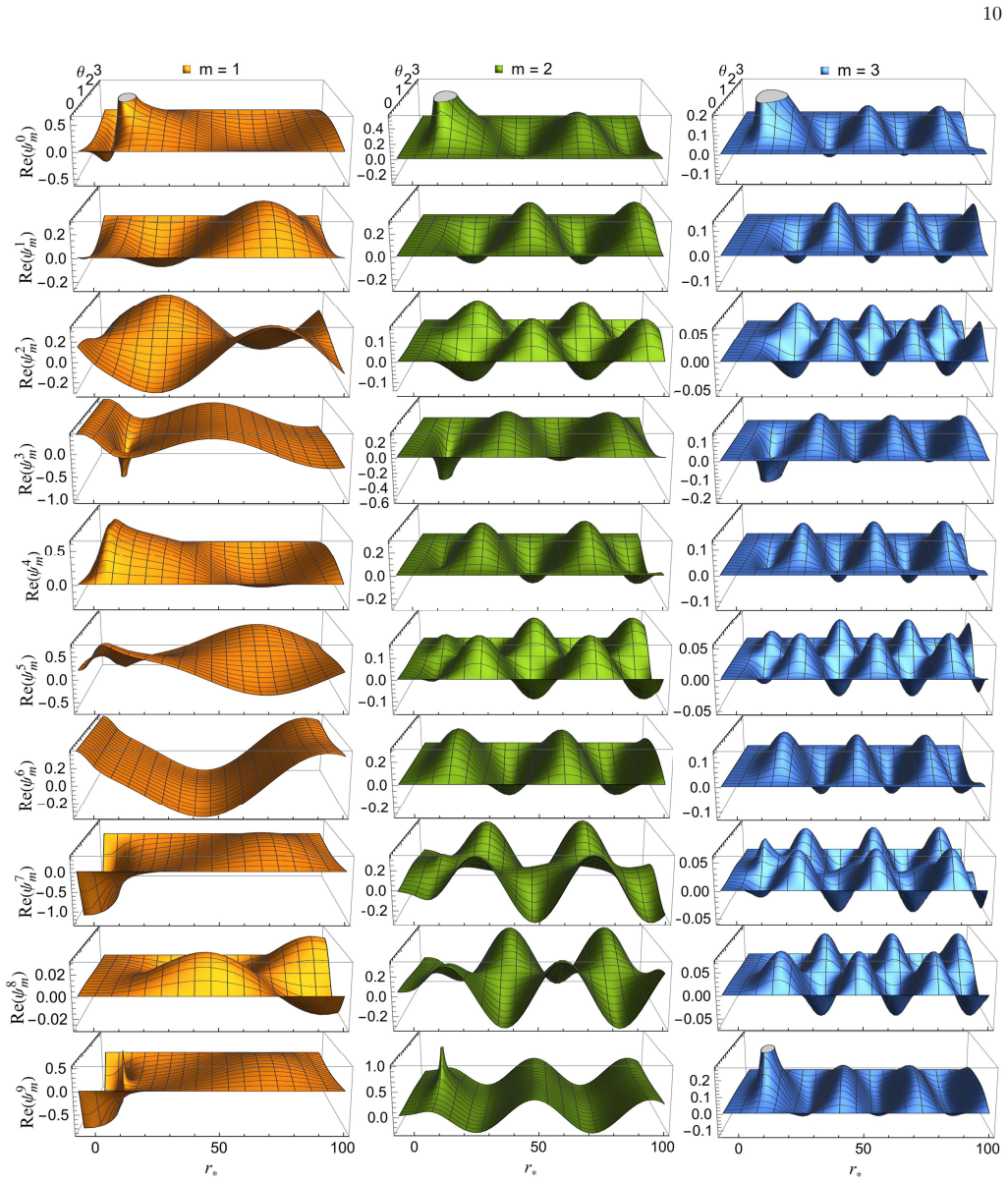
Summary. The manuscript develops a frequency-domain, m-mode method for computing first-order Lorenz-gauge metric perturbations of Schwarzschild. The authors reduce the ten coupled perturbation equations to elliptic PDEs in (r*, theta), discretize with second-order finite differences, regularize the particle singularity with a fourth-order effective-source puncture, and solve the resulting sparse linear systems. After diagnosing near-horizon pathologies through an eigenvalue analysis of the homogeneous solutions, they introduce improved near-horizon boundary conditions consisting of the four Lorenz-gauge conditions plus higher-order Bayliss-Turkel-type conditions on six components. They report outgoing energy fluxes for circular equatorial orbits at r0 = 6M, 8M, and 10M and find agreement with independent Black Hole Perturbation Toolkit Teukolsky data to about four significant digits. The paper also presents the components of the retarded metric perturbation and compares them qualitatively with time-domain results from Ref. [55].
Significance. If the full metric perturbation is correct, this is the first frequency-domain m-mode calculation of Lorenz-gauge Schwarzschild metric perturbations and an important step toward second-order Kerr self-force calculations. The flux validation is external and model-independent: the Black Hole Perturbation Toolkit Teukolsky results are not fitted, and no free parameter is tuned. The paper also contains a useful near-horizon eigenvalue analysis (Table I and Appendix B), novel higher-order near-horizon radiation boundary conditions (Section V C), and a new puncture expansion for a point mass in Kerr spacetime (Section III). The authors are appropriately cautious, explicitly describing the work as partly a progress report. However, the quantitative evidence for the central claim is currently limited to integrated fluxes and qualitative field plots; a full interior validation of the ten-component Lorenz-gauge field is missing.
major comments (3)
- [Sec. V C and Sec. VI B] The quantitative evidence that the full ten-component field is the retarded Lorenz-gauge solution is incomplete. Equation (2.2) is imposed only as a boundary condition at r_min*, and the effective source in Eq. (3.4) need not be divergence-free because the puncture in Sec. III is truncated at fourth order. The main validation in Table II is an integrated asymptotic flux, which is dominated by radiative, largely gauge-invariant content, together with qualitative agreement with Ref. [55] in Figs. 4 and 5. For the stated purpose of feeding second-order self-force calculations, the full metric perturbation in the correct Lorenz gauge is required, so this is an omitted validation rather than an internal inconsistency. Please report interior residuals of both the field equations and the Lorenz condition, and show convergence of individual psi^m_mu_nu components, not only the flux.
- [Sec. V C] The boundary-condition construction is not demonstrated to select the unique retarded solution. Table I identifies six homogeneous solutions with the correct eigenvalue lambda = -i m Omega that satisfy the Lorenz gauge condition; imposing the four gauge conditions and the Bayliss-Turkel-type conditions on psi_4 through psi_9 gives ten conditions, but the degeneracy means uniqueness does not follow automatically from counting conditions. The text asserts that Eq. (5.9c) at r_min* ~ -6M eliminates the problematic solutions, but no numerical experiment isolates this assumption. Please demonstrate uniqueness by, e.g., varying r_min* and the order of the boundary conditions, or by checking that the exponentially growing homogeneous modes are absent from the interior solution.
- [Sec. VI B and Table II] The convergence evidence is limited to the m=2 flux (Fig. 7) and to total fluxes at three radii. Since Sec. V uses the sensitive m=1 mode as the primary test of the corrected near-horizon conditions, the paper should show m=1 (and at least one higher-m) flux convergence and per-mode Richardson-error estimates. Without this, the claimed 'approximately 4 significant digits' is not supported for all modes that contribute to the total flux.
minor comments (4)
- [Sec. II A] The word 'certiain' in the sentence 'One way of calculating h_mu_nu that has certiain advantages' should be 'certain'.
- [Sec. IV B] In the sentence following Eq. (4.11), 'All three above conditions' should read 'All three of the above conditions'.
- [Sec. V C] There is a duplicated word in 'satisfies the the larger boundary condition'; it should be 'satisfies the larger boundary condition'.
- [Sec. I] The phrase 'A through explanation of the advantages' should read 'A thorough explanation of the advantages'.
Circularity Check
No significant circularity: the central flux result is validated against an independent Teukolsky/BHPT benchmark, and no fitted parameter or self-citation chain is used to produce the prediction.
full rationale
The paper's central quantitative claim is the outgoing energy flux for circular equatorial orbits around Schwarzschild, computed from the full numerical Lorenz-gauge metric perturbation obtained by solving a system of 10 coupled elliptic PDEs. The validation is external: Table II compares the computed fluxes to the Black Hole Perturbation Toolkit Teukolsky package, and the paper reports agreement to roughly four significant digits based on resolution and mode-number convergence. No free parameter is tuned to match the benchmark flux; resolution, boundary placement, and puncture order are fixed and reported. The near-horizon boundary conditions in Section V C are derived from an eigenvalue analysis of the homogeneous problem together with an assumed ingoing e^{-imΩr*} expansion, which is a standard radiation-condition ansatz rather than a fitted input. Imposing such conditions selects the retarded solution but does not by itself determine the asymptotic flux, which emerges from the global solve with the point-particle effective source. The self-citations to Osburn and Nishimura [58], Dolan and Barack [55], and Thornburg and Wardell [56] supply numerical techniques and coordinate/puncture constructions, but the central validation does not reduce to those citations; the Teukolsky comparison is an independent, externally falsifiable check. The paper candidly states that it 'partly serves as a progress report' and lists limitations such as omitting the m=0 mode and using relatively rough numerical methods; the skeptic's concern about missing interior gauge-residual diagnostics is a matter of incomplete validation, not circularity. Overall, the derivation chain is self-contained with respect to its main prediction, and no step equates the output to its input by construction.
Assumptions & free parameters
free parameters (5)
- grid spacings Δr* and Δθ =
uniform; not stated precisely, Δr* down to 0.2M in Fig. 7
- outer boundary r_max* =
approximately 500M
- near-horizon boundary position r_min* =
approximately -6M
- m-mode truncation =
sum over m=1 up to finite number; m=2,3,4,5 dominate
- puncture order =
fourth order (λ^-1 + λ^0 + λ^1 + λ^2)
assumptions (7)
- domain assumption Linear perturbation theory with ε = μ/M and h_{μν} of order ε
- domain assumption Small body modeled as a point particle with Dirac-delta stress-energy on a circular equatorial geodesic
- domain assumption Lorenz gauge condition g∇·h̄ = 0 (Eq. 2.2)
- domain assumption Effective source/puncture regularization produces a smooth residual field
- domain assumption Uniqueness of the retarded solution under the chosen boundary conditions
- domain assumption Isaacson averaged stress-energy tensor is valid for computing energy fluxes
- standard math Near-horizon reduction of the PDE system to constant-coefficient ODEs
Cite this review
Pith. "Pith review of Schwarzschild perturbations in Lorenz gauge via elliptic differential equations." pith.science (2026). https://pith.science/paper/WBIXNWPM
@misc{pith2026260807934,
  author       = {Pith},
  title        = {Pith review of: Schwarzschild perturbations in Lorenz gauge via elliptic differential equations},
  year         = {2026},
  howpublished = {\url{https://pith.science/paper/WBIXNWPM}},
  note         = {Machine review of arXiv:2608.07934}
}
abstract
Accurate predictions of gravitational wave signals from asymmetric compact binaries are accessible through black hole perturbation theory and self-force calculations. Faithful waveform models will require contributions from first- and second-order terms in the small mass-ratio expansion. The problem of second-order Kerr perturbations is exacerbated by non-separability of the metric perturbation equations and non-linear mode coupling, which motivates this $m$-mode approach. This work moves towards the eventual goal of second-order Kerr perturbations by calculating first-order Schwarzschild metric perturbations via $m$-modes in the frequency domain for the first time. We solve the Lorenz gauge field equations as a system of coupled elliptic partial differential equations that govern each $m$-mode. Our Mathematica code implements a second-order finite difference representation of the field equations, which we solve as a sparse linear algebra problem. Regularization near the small body is achieved through the effective source method, and our presentation introduces a new puncture expansion of the singular field for a point mass in Kerr spacetime. Issues related to problematic near-horizon behavior are explored and then mitigated by applying sophisticated near-horizon boundary conditions. Our results illustrate the features of each component and $m$-mode of the metric perturbation, and we are able to calculate gravitational wave energy fluxes with sufficient accuracy to enable future second-order self-force calculations.
Figures


Figures from the paper (4 more)



Reference graph
Works this paper leans on
-
[55]
S. R. Dolan and L. Barack, Self-force viam-mode regularization and 2+1D evolution: III. Gravitational field on Schwarzschild spacetime, Phys. Rev. D87, 084066 (2013), arXiv:1211.4586 [gr-qc]
arXiv 2013
-
[1]
J. Bakeret al., The Laser Interferometer Space Antenna: Unveiling the Millihertz Gravitational Wave Sky, arXiv:1907.06482 [astro-ph.IM] (2019)
arXiv 2019
-
[2]
Colpiet al.(LISA), LISA Definition Study Report, arXiv:2402.07571 [astro-ph.CO] (2024)
M. Colpiet al.(LISA), LISA Definition Study Report, arXiv:2402.07571 [astro-ph.CO] (2024)
arXiv 2024
-
[3]
N. Afshordiet al.(LISA Consortium Waveform Working Group), Waveform modelling for the Laser Interferometer Space Antenna, Living Rev. Rel.28, 9 (2025), arXiv:2311.01300 [gr-qc]
arXiv 2025
-
[4]
B. P. Abbottet al.(The LIGO Scientific Collaboration and Virgo Collaboration), GWTC-1: A Gravitational-Wave Tran- sient Catalog of Compact Binary Mergers Observed by LIGO and Virgo during the First and Second Observing Runs, Phys. Rev. X9, 031040 (2019), arXiv:1811.12907 [astro-ph.HE]
arXiv 2019
-
[5]
R. Abbottet al.(The LIGO Scientific Collaboration and Virgo Collaboration), GWTC-2: Compact Binary Coalescences Observed by LIGO and Virgo During the First Half of the Third Observing Run, Phys. Rev. X11, 021053 (2021), arXiv:2010.14527 [gr-qc]
arXiv 2021
-
[6]
R. Abbottet al.(The LIGO Scientific Collaboration, Virgo Collaboration, and KAGRA Collaboration), GWTC-3: Com- pact Binary Coalescences Observed by LIGO and Virgo during the Second Part of the Third Observing Run, Phys. Rev. X13, 041039 (2023), arXiv:2111.03606 [gr-qc]
arXiv 2023
-
[7]
A. G. Abacet al.(The LIGO Scientific Collaboration, Virgo Collaboration, and KAGRA Collaboration), Gwtc-4.0: Updat- ing the gravitational-wave transient catalog with observations from the first part of the fourth ligo–virgo–kagra observing run, The Astrophysical Journal Letters1004, L22 (2026)
work page 2026
Show all 68 references
-
[8]
A. G. Abacet al.(The LIGO Scientific Collaboration, Virgo Collaboration, and KAGRA Collaboration), Gwtc-5.0: Obser- vations from the second part of the fourth ligo-virgo-kagra observing run and updates to the gravitational-wave transient catalog (2026), arXiv:2605.27225 [gr-qc]
2026 arXiv
-
[9]
Agazie, A
G. Agazie, A. Anumarlapudi, A. M. Archibald, Z. Arzoumanian, P. T. Baker, B. B´ ecsy, L. Blecha, A. Brazier, P. R. Brook, S. Burke-Spolaor, R. Burnette, R. Case, M. Charisi, S. Chatterjee, K. Chatziioannou, B. D. Cheeseboro, S. Chen, T. Cohen, J. M. Cordes, N. J. Cornish, F. C...
2023
-
[10]
and Antoniadis, P
J. and Antoniadis, P. Arumugam, S. Arumugam, S. Babak, M. Bagchi, A.-S. Bak Nielsen, C. G. Bassa, A. Bathula, A. Berthereau, M. Bonetti, E. Bortolas, P. R. Brook, M. Burgay, R. N. Caballero, A. Chalumeau, D. J. Champion, S. Chanlaridis, S. Chen, I. Cognard, S. Dandapat, D. Deb...
2023
-
[11]
D. J. Reardon, A. Zic, R. M. Shannon, G. B. Hobbs, M. Bailes, V. Di Marco, A. Kapur, A. F. Rogers, E. Thrane, J. Askew, N. D. R. Bhat, A. Cameron, M. Cury lo, W. A. Coles, S. Dai, B. Goncharov, M. Kerr, A. Kulkarni, Y. Levin, M. E. Lower, R. N. Manchester, R. Mandow, M. T. Mil...
2023
-
[12]
H. Xu, S. Chen, Y. Guo, J. Jiang, B. Wang, J. Xu, Z. Xue, R. Nicolas Caballero, J. Yuan, Y. Xu, J. Wang, L. Hao, J. Luo, K. Lee, J. Han, P. Jiang, Z. Shen, M. Wang, N. Wang, R. Xu, X. Wu, R. Manchester, L. Qian, X. Guan, M. Huang, C. Sun, and Y. Zhu, Searching for the nano-her...
2023
-
[13]
Abacet al.(ET), The Science of the Einstein Telescope, JCAP2026(03), 081, arXiv:2503.12263 [gr-qc]
A. Abacet al.(ET), The Science of the Einstein Telescope, JCAP2026(03), 081, arXiv:2503.12263 [gr-qc]
-
[14]
Evanset al., A Horizon Study for Cosmic Explorer: Science, Observatories, and Community, arXiv:2109.09882 [astro- ph.IM] (2021)
M. Evanset al., A Horizon Study for Cosmic Explorer: Science, Observatories, and Community, arXiv:2109.09882 [astro- ph.IM] (2021)
2021 arXiv
-
[15]
Hu and Y.-L
W.-R. Hu and Y.-L. Wu, The taiji program in space for gravitational wave physics and the nature of gravity, National Science Review4, 685 (2017), https://academic.oup.com/nsr/article-pdf/4/5/685/31566708/nwx116.pdf
2017
-
[16]
Luo, L.-S
J. Luo, L.-S. Chen, H.-Z. Duan, Y.-G. Gong, S. Hu, J. Ji, Q. Liu, J. Mei, V. Milyukov, M. Sazhin, C.-G. Shao, V. T. Toth, H.-B. Tu, Y. Wang, Y. Wang, H.-C. Yeh, M.-S. Zhan, Y. Zhang, V. Zharov, and Z.-B. Zhou, Tianqin: a space-borne gravitational wave detector, Classical and Q...
2016
-
[17]
C. P. L. Berry, S. A. Hughes, C. F. Sopuerta, A. J. K. Chua, A. Heffernan, K. Holley-Bockelmann, D. P. Mihaylov, M. C. Miller, and A. Sesana, The unique potential of extreme mass-ratio inspirals for gravitational-wave astronomy, Bull. Am. Astron. Soc.51, 42 (2019), arXiv:1903....
2019 arXiv
-
[18]
Fernando, D
M. Fernando, D. Neilsen, H. Lim, E. Hirschmann, and H. Sundar, Massively parallel simulations of binary black hole intermediate-mass-ratio inspirals, SIAM Journal on Scientific Computing41, C97–C138 (2019)
2019
-
[19]
C. O. Lousto and J. Healy, Study of the intermediate mass ratio black hole binary merger up to 1000:1 with numerical relativity, Classical and Quantum Gravity40, 09LT01 (2023)
2023
-
[20]
N. A. Wittek, L. Barack, H. P. Pfeiffer, A. Pound, N. Deppe, L. E. Kidder, A. Macedo, K. C. Nelli, W. Throwe, and N. L. Vu, Relieving scale disparity in binary black hole simulations, Physical Review Letters134, 10.1103/kskl-8dcj (2025)
2025 doi
-
[21]
Mahapatra, J
P. Mahapatra, J. E. Thompson, E. Fauchon-Jones, and M. Hannam, The high-mass-ratio challenge in gravitational wave- form modelling (2026), arXiv:2603.26521 [gr-qc]
2026
-
[22]
Y. Mino, M. Sasaki, and T. Tanaka, Gravitational radiation reaction to a particle motion, Phys. Rev. D55, 3457 (1997), arXiv:gr-qc/9606018
1997 arXiv
-
[23]
T. C. Quinn and R. M. Wald, Axiomatic approach to electromagnetic and gravitational radiation reaction of particles in curved spacetime, Phys. Rev. D56, 3381 (1997), arXiv:gr-qc/9610053
1997 arXiv
-
[24]
Poisson, A
E. Poisson, A. Pound, and I. Vega, The motion of point particles in curved spacetime, Living Rev. Rel.14, 7 (2011), arXiv:1102.0529 [gr-qc]
2011 arXiv
-
[25]
Barack and A
L. Barack and A. Pound, Self-force and radiation reaction in general relativity, Rept. Prog. Phys.82, 016904 (2019), arXiv:1805.10385 [gr-qc]
2019 arXiv
-
[26]
Pound and B
A. Pound and B. Wardell, Black hole perturbation theory and gravitational self-force, inHandbook of Gravitational Wave Astronomy, edited by C. Bambi, S. Katsanevas, and K. D. Kokkotas (Springer, Singapore, 2022) arXiv:2101.04592 [gr-qc]
2022 arXiv
-
[27]
Pound, E
A. Pound, E. Poisson, and B. G. Nickel, Limitations of the adiabatic approximation to the gravitational self-force, Phys. Rev. D72, 124001 (2005), arXiv:gr-qc/0509122
2005 arXiv
-
[28]
Burke, G
O. Burke, G. A. Piovano, N. Warburton, P. Lynch, L. Speri, C. Kavanagh, B. Wardell, A. Pound, L. Durkan, and J. Miller, Assessing the importance of first postadiabatic terms for small-mass-ratio binaries, Phys. Rev. D109, 124048 (2024), arXiv:2310.08927 [gr-qc]
2024 arXiv
-
[29]
Barack and C
L. Barack and C. O. Lousto, Perturbations of schwarzschild black holes in the lorenz gauge: Formulation and numerical implementation, Physical Review D72, 10.1103/physrevd.72.104026 (2005)
2005 doi
-
[30]
Barack and N
L. Barack and N. Sago, Gravitational self-force on a particle in circular orbit around a schwarzschild black hole, Physical Review D75, 10.1103/physrevd.75.064021 (2007)
2007 doi
-
[31]
Barack and N
L. Barack and N. Sago, Gravitational self-force on a particle in eccentric orbit around a schwarzschild black hole, Physical Review D81, 10.1103/physrevd.81.084021 (2010). 16
2010 doi
-
[32]
Akcay, Fast frequency-domain algorithm for gravitational self-force: Circular orbits in schwarzschild spacetime, Physical Review D83, 10.1103/physrevd.83.124026 (2011)
S. Akcay, Fast frequency-domain algorithm for gravitational self-force: Circular orbits in schwarzschild spacetime, Physical Review D83, 10.1103/physrevd.83.124026 (2011)
2011 doi
-
[33]
Akcay, N
S. Akcay, N. Warburton, and L. Barack, Frequency-domain algorithm for the lorenz-gauge gravitational self-force, Physical Review D88, 10.1103/physrevd.88.104009 (2013)
2013 doi
-
[34]
Osburn, E
T. Osburn, E. Forseth, C. R. Evans, and S. Hopper, Lorenz gauge gravitational self-force calculations of eccentric binaries using a frequency domain procedure, Physical Review D90, 10.1103/physrevd.90.104031 (2014)
2014 doi
-
[35]
Hopper, E
S. Hopper, E. Forseth, T. Osburn, and C. R. Evans, Fast spectral source integration in black hole perturbation calculations, Physical Review D92, 10.1103/physrevd.92.044048 (2015)
2015 doi
-
[36]
Wardell and N
B. Wardell and N. Warburton, Applying the effective-source approach to frequency-domain self-force calculations: Lorenz- gauge gravitational perturbations, Physical Review D92, 10.1103/physrevd.92.084019 (2015)
2015 doi
-
[37]
S. R. Dolan, C. Kavanagh, and B. Wardell, Gravitational Perturbations of Rotating Black Holes in Lorenz Gauge, Phys. Rev. Lett.128, 151101 (2022), arXiv:2108.06344 [gr-qc]
2022 arXiv
-
[38]
S. R. Dolan, L. Durkan, C. Kavanagh, and B. Wardell, Metric perturbations of kerr spacetime in lorenz gauge: circular equatorial orbits, Classical and Quantum Gravity41, 155011 (2024)
2024
-
[39]
Wardell, C
B. Wardell, C. Kavanagh, and S. R. Dolan, Sourced metric perturbations of kerr spacetime in lorenz gauge, Classical and Quantum Gravity42, 205007 (2025)
2025
-
[40]
Thornburg, Time-domain evolution of lorenz-gauge metric perturbations: taming theℓ=m= 1 gauge instability (2026), arXiv:2606.27016 [gr-qc]
J. Thornburg, Time-domain evolution of lorenz-gauge metric perturbations: taming theℓ=m= 1 gauge instability (2026), arXiv:2606.27016 [gr-qc]
2026 arXiv
-
[41]
Pound, B
A. Pound, B. Wardell, N. Warburton, and J. Miller, Second-Order Self-Force Calculation of Gravitational Binding Energy in Compact Binaries, Phys. Rev. Lett.124, 021101 (2020), arXiv:1908.07419 [gr-qc]
2020 arXiv
-
[42]
Wardell, A
B. Wardell, A. Pound, N. Warburton, J. Miller, L. Durkan, and A. Le Tiec, Gravitational Waveforms for Compact Binaries from Second-Order Self-Force Theory, Phys. Rev. Lett.130, 241402 (2023), arXiv:2112.12265 [gr-qc]
2023 arXiv
-
[43]
Albertini, A
A. Albertini, A. Nagar, A. Pound, N. Warburton, B. Wardell, L. Durkan, and J. Miller, Comparing second-order gravita- tional self-force, numerical relativity, and effective one body waveforms from inspiralling, quasicircular, and nonspinning black hole binaries, Phys. Rev. D10...
2022 arXiv
-
[44]
van de Meent, A
M. van de Meent, A. Buonanno, D. P. Mihaylov, S. Ossokine, L. Pompili, N. Warburton, A. Pound, B. Wardell, L. Durkan, and J. Miller, Enhancing the SEOBNRv5 effective-one-body waveform model with second-order gravitational self-force fluxes, Phys. Rev. D108, 124038 (2023), arXi...
2023 arXiv
-
[45]
N. L. Vu, N. Nishimura, T. Osburn, J. E. Thompson, L. E. Kidder, S. D. Upton, and B. Wardell, Self-force calculations with numerical relativity methods (2026), arXiv:2606.04998 [gr-qc]
2026 arXiv
-
[46]
S. R. Green, S. Hollands, and P. Zimmerman, Teukolsky formalism for nonlinear Kerr perturbations, Class. Quant. Grav. 37, 075001 (2020), arXiv:1908.09095 [gr-qc]
2020 arXiv
-
[47]
Toomani, P
V. Toomani, P. Zimmerman, A. Spiers, S. Hollands, A. Pound, and S. R. Green, New metric reconstruction scheme for gravitational self-force calculations, Class. Quant. Grav.39, 015019 (2022), arXiv:2108.04273 [gr-qc]
2022 arXiv
-
[48]
Mei, Separating the linearized einstein equations in the background of a kerr black hole, Science China Physics, Mechanics and Astronomy69, 10.1007/s11433-026-2975-2 (2026)
J. Mei, Separating the linearized einstein equations in the background of a kerr black hole, Science China Physics, Mechanics and Astronomy69, 10.1007/s11433-026-2975-2 (2026)
2026 doi
-
[49]
Mei, Separating the linearized einstein equations in kerr (2026), arXiv:2607.16581 [gr-qc]
J. Mei, Separating the linearized einstein equations in kerr (2026), arXiv:2607.16581 [gr-qc]
2026 arXiv
-
[50]
Spiers, Analytically separating the source of the Teukolsky equation, Phys
A. Spiers, Analytically separating the source of the Teukolsky equation, Phys. Rev. D109, 104059 (2024), arXiv:2402.00604 [gr-qc]
2024 arXiv
-
[51]
Barack and D
L. Barack and D. A. Golbourn, Scalar-field perturbations from a particle orbiting a black hole using numerical evolution in 2+1 dimensions, Phys. Rev. D76, 044020 (2007), arXiv:0705.3620 [gr-qc]
2007 arXiv
-
[52]
Barack, D
L. Barack, D. A. Golbourn, and N. Sago, m-Mode Regularization Scheme for the Self Force in Kerr Spacetime, Phys. Rev. D76, 124036 (2007), arXiv:0709.4588 [gr-qc]
2007 arXiv
-
[53]
S. R. Dolan and L. Barack, Self force via m-mode regularization and 2+1D evolution: Foundations and a scalar-field implementation on Schwarzschild, Phys. Rev. D83, 024019 (2011), arXiv:1010.5255 [gr-qc]
2011 arXiv
-
[54]
S. R. Dolan, L. Barack, and B. Wardell, Self force viam-mode regularization and 2 + 1D evolution: II. Scalar-field implementation on Kerr spacetime, Phys. Rev. D84, 084001 (2011), arXiv:1107.0012 [gr-qc]
2011 arXiv
-
[56]
Thornburg and B
J. Thornburg and B. Wardell, Scalar self-force for highly eccentric equatorial orbits in Kerr spacetime, Phys. Rev. D95, 084043 (2017), arXiv:1610.09319 [gr-qc]
2017 arXiv
-
[57]
Thornburg, B
J. Thornburg, B. Wardell, and M. van de Meent, Excitation of kerr quasinormal modes in extreme-mass-ratio inspirals, Physical Review Research2, 10.1103/physrevresearch.2.013365 (2020)
2020 doi
-
[58]
Osburn and N
T. Osburn and N. Nishimura, New self-force method via elliptic partial differential equations for Kerr inspiral models, Phys. Rev. D106, 044056 (2022), arXiv:2206.07031 [gr-qc]
2022 arXiv
-
[59]
Panosso Macedo, P
R. Panosso Macedo, P. Bourg, A. Pound, and S. D. Upton, Multidomain spectral method for self-force calculations, Phys. Rev. D110, 084008 (2024), arXiv:2404.10083 [gr-qc]
2024 arXiv
-
[60]
Isoyama, L
S. Isoyama, L. Barack, S. R. Dolan, A. Le Tiec, H. Nakano, A. G. Shah, T. Tanaka, and N. Warburton, Gravitational self-force correction to the innermost stable circular equatorial orbit of a kerr black hole, Physical Review Letters113, 10.1103/physrevlett.113.161101 (2014)
2014 doi
-
[61]
Wardell, I
B. Wardell, I. Vega, J. Thornburg, and P. Diener, Generic effective source for scalar self-force calculations, Phys. Rev. D 85, 104044 (2012), arXiv:1112.6355 [gr-qc]
2012 arXiv
-
[62]
Heffernan, A
A. Heffernan, A. Ottewill, and B. Wardell, High-order expansions of the Detweiler-Whiting singular field in Schwarzschild spacetime, Phys. Rev. D86, 104023 (2012), arXiv:1204.0794 [gr-qc]. 17
2012 arXiv
-
[63]
Heffernan, A
A. Heffernan, A. Ottewill, and B. Wardell, High-order expansions of the Detweiler-Whiting singular field in Kerr spacetime, Phys. Rev. D89, 024030 (2014), arXiv:1211.6446 [gr-qc]
2014 arXiv
-
[64]
Wardell, github.com/barrywardell/effectivesource (2012)
B. Wardell, github.com/barrywardell/effectivesource (2012)
2012
-
[65]
Bayliss and E
A. Bayliss and E. Turkel, Radiation boundary conditions for wave-like equations, Communications on Pure and Applied Mathematics33, 707 (1980), https://onlinelibrary.wiley.com/doi/pdf/10.1002/cpa.3160330603
1980 doi
-
[66]
R. A. Isaacson, Gravitational radiation in the limit of high frequency. ii. nonlinear terms and the effective stress tensor, Phys. Rev.166, 1272 (1968)
1968
-
[67]
Black Hole Perturbation Toolkit, (bhptoolkit.org)
-
[68]
Wardell, N
B. Wardell, N. Warburton, K. Cunningham, L. Durkan, B. Leather, Z. Nasipak, C. Kavanagh, A. Ottewill, M. Casals, T. Torres, J. Neef, and S. Barsanti, Teukolsky (2025)
2025
Reviewed August 12, 2026 · model on record in the stance chip above.
Discussion (0). Continue with ORCID to comment.