REVIEW 2 major objections 5 minor 31 references
Chemical Potential and Analytic Continuation for Non-Hermitian Lattice Fermions
T0 review · 2 major / 5 minor · reviewed 2026-08-14 · deepseek-v4-flash
Pith's one-line read For a solvable 1D non-Hermitian lattice fermion, analytic continuation from imaginary to real chemical potential is valid on a finite lattice but fails after the continuum limit.
desk verdict Useful exact benchmark for non-Hermitian lattice fermions, but the AI-continuation section is a known-ansatz least-squares fit, not a general method. read the letter →
The pith
A machine-rendered reading of the paper's core claim, the machinery that carries it, and where it could break.
The reading
What carries the argument
The load-bearing object is the paired forward/backward finite-difference Dirac operator on a finite one-dimensional lattice. The forward operator $D_+(\mu_1)$ uses a forward shift $e^{-a\mu_1}\gamma^1$, and the backward operator $D_-(\mu_2)$ uses a backward shift with $e^{a\mu_2}\gamma^1$, chosen so that $D_-(\mu_2)=-D_+(\mu_1)^\dagger$ for the two pairings $(\mu,-\mu)$ and $(i\mu,i\mu)$. This conjugacy relation collapses the two-flavor determinant to an absolute square and makes the pseudofermion action Hermitian. The exact propagator is obtained by contour integration over the lattice momentum poles, giving closed-form rational expressions whose $\mu$-dependence is analytic for finite $N_t$; the continuum limit then selects different decay branches, producing the non-analyticity.
What would settle it
Compute the exact finite-lattice propagator at fixed lattice spacing for a chemical potential with $\operatorname{Re}\mu>m$, and take the $N_t\to\infty$ limit at fixed $n=x/a$; if the limiting correlator is still an analytic function of $\mu$ rather than switching branches at $\operatorname{Re}(m-\mu)=0$, the paper's main non-commutation claim fails.
Extended reading notes
Core claim
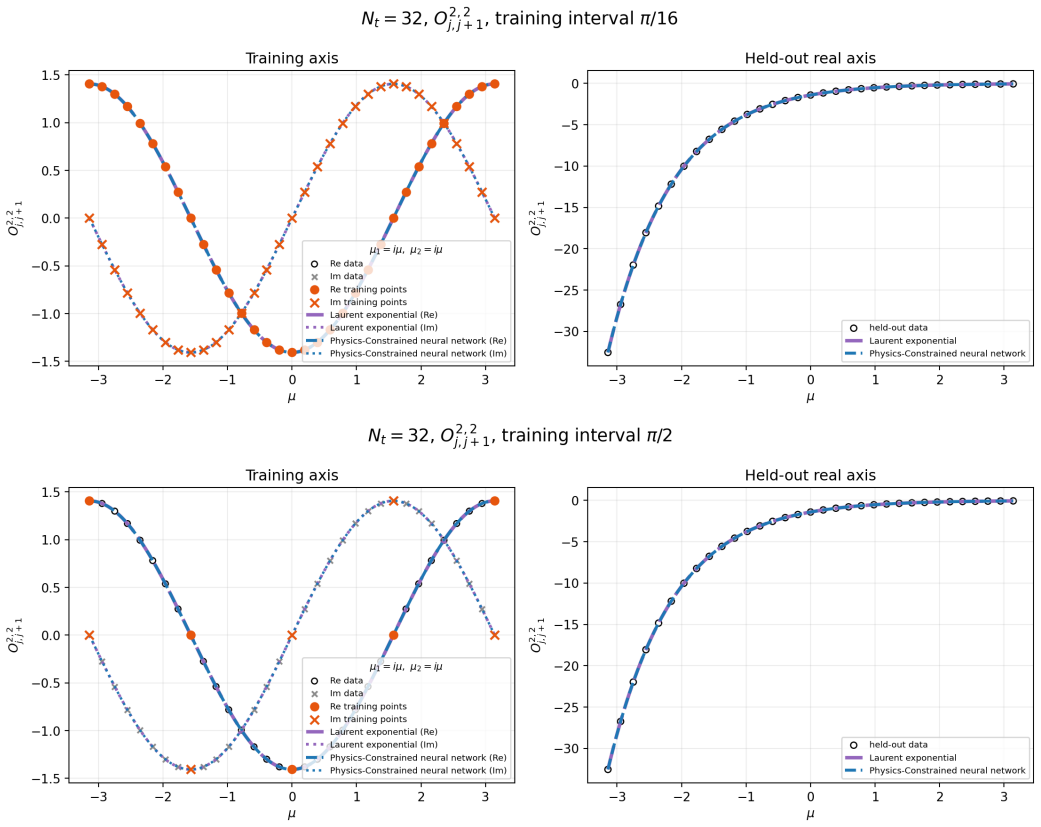
The central discovery is that neither the sign problem nor analytic-continuation failure is intrinsic to non-Hermitian lattice fermions with a chemical potential. For the forward-difference Dirac operator $D_+(\mu)$, the exact lattice propagator has the same functional form for any value of $\mu$ while the lattice size $N_t$ is finite; analyticity in $\mu$ is lost only when $N_t\to\infty$ at fixed lattice spacing, with the correlator switching between exponential decay branches according to whether $\operatorname{Re}(m\mp\mu)$ is positive or negative. In the exponential prescription the chemical potential decouples from the continuum limit, which requires only $ma\to0$. For two degenerate flavors with $D_-(\mu_2)=-D_+(\mu_1)^\dagger$, the determinant identity $\det(D_++m)\det(-D_+^\dagger+m)=|\det(D_++m)|^2$ holds for the pairings $(\mu,-\mu)$ and $(i\mu,i\mu)$, making the partition function non-negative and Hybrid Monte Carlo applicable. The measured two-point pseudofermion correlators agree with the exact solution, and the AI-assisted continuation from imaginary to real $\mu$ matches the exact result.
Load-bearing premise
The AI-assisted analytic-continuation benchmark presumes that the correlator lies in the three-mode space spanned by $e^{-z}$, $1$, and $e^z$, an assumption known to hold only because the exact solution was derived beforehand.
Editorial extensions
If this is right
- On a finite lattice, observables such as the two-point correlator are analytic in the chemical potential, so imaginary-to-real continuation is legitimate before the limits are taken.
- The continuum limit and analytic continuation do not generally commute; simulations that use imaginary chemical potentials should state the order of limits explicitly.
- The exponential chemical-potential prescription needs only $ma\to0$ to recover the continuum theory, so it is a safer lattice definition than the naive additive insertion of $\mu$.
- For two degenerate flavors with $(\mu_1,\mu_2)=(\mu,-\mu)$ or $(i\mu,i\mu)$, Hybrid Monte Carlo is sign-problem-free and reproduces the exact two-point pseudofermion correlators at $N_t=16$ and $32$.
- The sign problem in these configurations coincides with Dirac eigenvalues of negative real part and reflects a technical obstruction to pseudofermion sampling, not a physical breakdown of the fermionic theory.
Reading between the lines
- If the eigenvalue criterion persists in interacting theories, monitoring the minimal real part of the Dirac spectrum during a simulation could serve as an inexpensive early warning for sign-problem onset.
- The absolute-square determinant identity suggests a constructive recipe for other pairings: choose flavor chemical potentials so that $D_-(\mu_2)=-D_+(\mu_1)^\dagger$; testing twisted-mass-like pairings for non-degenerate masses is an immediate next step the paper leaves open.
- The success of the three-mode ansatz is partly circular, since the ansatz was chosen because the exact solution was already known; a practical method would need an independent criterion to select the mode set from the lattice operator's pole structure.
Editorial analysis
A structured set of objections, weighed in public.
Referee Report
Summary. This paper studies one-dimensional free lattice Dirac fermions with a non-Hermitian one-sided derivative and a chemical potential, in both a naive and an exponential implementation. It derives exact finite-lattice propagators and shows that they are analytic in the chemical potential away from poles, while the infinite-volume/continuum limit can destroy analyticity, so the limits do not commute. For two degenerate flavors with paired chemical potentials (mu,-mu) or (i mu,i mu), the pseudofermion determinant is shown to be non-negative, and Hybrid Monte Carlo simulations reproduce the exact correlators for N_t=16,32. The final section presents an 'AI-assisted' analytic continuation from imaginary to real chemical potential using a three-mode Laurent exponential model, a physics-constrained neural network, and a hybrid residual network.
Significance. If the central claims hold, the exact-solution part provides a clean solvable demonstration that finite-volume lattice observables can be analytic in the chemical potential while the continuum limit is not, clarifying an important subtlety for imaginary-chemical-potential methods. The determinant identity (28) extends earlier work on non-Hermitian lattice fermions and yields a sign-problem-free HMC formulation for the paired chemical-potential assignments, with numerical agreement on two lattice sizes. The AI-assisted continuation is the weakest part: as the paper itself acknowledges, the three-parameter ansatz is chosen using the exact solution, the hybrid residual network is never activated, and the method reduces to a linear least-squares fit of a known functional form. The paper is honest about these limitations in Sec. 6, but the abstract and Sec. 1.1 overstate the benchmark value.
major comments (2)
- [Sec. 6.1, Eqs. (32)-(37)] The three-mode hypothesis space H = span{e^{-z},1,e^z} is fixed by the exact solution derived in Sec. 2; the imaginary-axis data for O_{j,j+1}^{1,1} and O_{j,j+1}^{2,2} are single exponentials C exp(-i mu), so the ansatz contains the answer by construction. No model-selection criterion is provided for the truncation order K in Eq. (43) when the exact form is unavailable. The agreement in Figs. 10-13 therefore demonstrates only that a three-parameter least-squares fit reproduces a known functional form; it does not validate an unsupervised AI-assisted analytic-continuation method. This undercuts the benchmark claim in Sec. 1.1 ('providing a benchmark for the method across different lattice sizes') and in Sec. 6.3 ('demonstrate the usefulness of the AI-assisted fitting framework'). The authors should either supply a selection procedure that does not use the exact solution (e.g., cross-validated choice of K with leave-out tests) or explicitly reframe Sec. 6 as an illustration conditional on the known solution.
- [Sec. 6.2.4, Eqs. (53)-(54)] The adaptive gate uses epsilon = 10^{-10}, while the PCNN achieves a normalized RMSE of approximately 10^{-13}, so the residual network f_hyb - f_phys is never activated in any benchmark. The paper's own text states that the study 'validates the design of the hybrid framework rather than demonstrating the practical improvement,' but the abstract and the bullet in Sec. 1.1 present AI-assisted continuation as a demonstrated result. To support the claimed benchmark, the authors should either test the hybrid model on data where the physics backbone is incomplete or noisy (as they suggest in Sec. 6.2.4) or revise the abstract and summary to state that the hybrid component is untested.
minor comments (5)
- [Sec. 3, Eq. (28)] The identity uses a matrix gamma5 without defining it; in this 1D (or 1+1D) setting the authors should specify the explicit matrix (e.g., sigma_x or gamma^3) and note that it anticommutes with gamma1.
- [Sec. 4, Figs. 4 and 5] The caption 'When the simulation suffers from the sign problem...' is attached to panels that include sign-problem-free assignments; for example, Fig. 4 lower-left is (mu1,mu2)=(mu,-mu), which is sign-problem-free, and its minimum real part is positive. The captions should distinguish the sign-problem and sign-problem-free panels.
- [Sec. 2.3, Eq. (18)] The expression '=e nµa' should be written with proper exponents, e.g., e^{n mu a}, and the convention for n for x<0 should be stated explicitly.
- [Sec. 6.1, Eq. (33)] The notation fPCNN(z) = phi(z) w is ambiguous because phi(z) is given as a row vector; define the inner-product convention so that the three trainable weights are unambiguously associated with the modes.
- [Sec. 1.1 and Sec. 6.1] The term 'AI-assisted fitting' overstates the method presented: the PCNN is equivalent to a three-parameter linear least-squares fit, as the paper itself states in Sec. 6.1. A more neutral term such as 'physics-constrained fit' would better match the content.
Circularity Check
AI-continuation benchmark is circular: the three-mode ansatz is taken from the exact solution, so the real-axis 'prediction' is the fitted function evaluated on the real axis.
-
fitted input called prediction
[Sec. 6.1, Eqs. (32)-(37); Sec. 6.3]
"To exploit the analytic structure of the lattice solution, we construct a physics-constrained neural network (PCNN) whose hidden features are prescribed by the analytic approximation rather than learned from data. ... the analytic feature layer is chosen as ϕ(z) = [e−z 1e z] ... shows that both formulations span the same hypothesis space, H = span{e−z, 1, ez}. ... After training, we perform analytic continuation by replacing exp(−iµ) with exp(−µ)."
The real-axis result is obtained by fitting the coefficients of H = span{e^{-z}, 1, e^z} to imaginary-axis data and then evaluating the fitted function at real μ. Since the hypothesis space was chosen from the exact lattice solution ('the three dominant exponential modes predicted by the lattice analysis'), the ansatz already contains the target by construction. The paper gives no data-driven criterion for selecting K or the basis, and its own limitation note concedes 'dependence on prior physical knowledge.' Thus the benchmark validates a three-parameter fit on a known functional form rather than an unsupervised continuation method. The exact-solution and HMC results are unaffected.
full rationale
The exact derivation in Sec. 2 (Eqs. 11-21) and the determinant identity in Sec. 3 (Eq. 28) are self-contained: the finite-lattice propagator is computed directly, the infinite-volume limits are taken consistently, and the HMC sign-problem-free condition follows from the identity D−(μ2) = −[D+(μ1)]^† and γ5 conjugation, not from a fitted parameter or a self-citation chain. The self-citations [18,19,25] are contextual and not load-bearing because the needed determinant identity is proved in-text. The circularity concern is confined to Sec. 6: the PCNN/Laurent model fixes the hypothesis space H = span{e^{-z}, 1, e^z} using the exact solution as prior knowledge, fits three coefficients to imaginary-axis data, and reports the fitted function evaluated at real μ as the continuation. The exact real-axis values are not used in the fit, so this is a legitimate consistency check; but because the ansatz was selected from the exact solution, the demonstration does not establish that the method can select a correct functional form when the answer is unknown. The paper's own limitation statements (Sec. 6.1 and Sec. 6.2.4) acknowledge this. This warrants a moderate circularity score, not a high one.
Assumptions & free parameters
free parameters (2)
- AI fit coefficients a_{-1}, a_0, a_1 =
e.g., -0.4375 for O^{1,1}_{j,j+1} at N_t=16; -1.3125 for O^{2,2}_{j,j+1} at N_t=16
- Regularization coefficient λ and gate threshold ε =
λ tunable; ε=10^{-10}
assumptions (4)
- domain assumption The forward and backward one-sided derivative lattice action with anti-periodic boundary conditions is a valid regularization of the 1D Dirac fermion.
- standard math The mode sums are evaluated using the residue theorem and geometric-series identities.
- domain assumption The exponential (Hasenfratz-Karsch) chemical-potential prescription reduces to the continuum action when ma→0.
- domain assumption The correlator is analytic in μ on the finite lattice and is representable by the three-mode exponential ansatz.
Cite this review
Pith. "Pith review of Chemical Potential and Analytic Continuation for Non-Hermitian Lattice Fermions." pith.science (2026). https://pith.science/paper/7BISSL2Z
@misc{pith2026260808862,
  author       = {Pith},
  title        = {Pith review of: Chemical Potential and Analytic Continuation for Non-Hermitian Lattice Fermions},
  year         = {2026},
  howpublished = {\url{https://pith.science/paper/7BISSL2Z}},
  note         = {Machine review of arXiv:2608.08862}
}
abstract
We introduce a chemical potential for non-Hermitian lattice fermions and show that, for even flavors with degenerate masses and paired chemical potentials $(\mu,-\mu)$ or $(i\mu,i\mu)$, the Hybrid Monte Carlo algorithm is free of the sign problem. For one-dimensional free fermions, we demonstrate that the sign problem is a numerical rather than physical obstruction and derive the exact propagator, which is analytic at finite lattice spacing away from its poles but becomes non-analytic in the continuum limit. Finally, we use AI-assisted fitting to perform analytic continuation from imaginary to real chemical potentials.
Figures


Figures from the paper (10 more)


Reference graph
Works this paper leans on
-
[18]
Naive lattice fermion without dou- blers,
X. Guo, C. T. Ma and H. Zhang, “Naive lattice fermion without dou- blers,” Phys. Rev. D104, no.9, 094505 (2021) doi:10.1103/PhysRevD.104.094505 [arXiv:2105.10977 [hep-lat]]
arXiv 2021
-
[1]
Space-time approach to nonrelativistic quantum mechanics,
R. P. Feynman, “Space-time approach to nonrelativistic quantum mechanics,” Rev. Mod. Phys.20, 367-387 (1948) doi:10.1103/RevModPhys.20.367
-
[2]
K. G. Wilson, “Confinement of Quarks,” Phys. Rev. D10, 2445-2459 (1974) doi:10.1103/PhysRevD.10.2445
-
[3]
Methods of contemporary gauge theory,
Y. Makeenko, “Methods of contemporary gauge theory,” Cambridge Univer- sity Press, 2005, ISBN 978-0-521-02215-6, 978-0-521-80911-5, 978-0-511-05768-7 doi:10.1017/CBO9780511535147
-
[4]
Quantum chromodynamics on the lattice,
C. Gattringer and C. B. Lang, “Quantum chromodynamics on the lattice,” Lect. Notes Phys.788, 1-343 (2010) Springer, 2010, ISBN 978-3-642-01849-7, 978-3-642- 01850-3 doi:10.1007/978-3-642-01850-3 35
-
[5]
Lattice chiral fermion without Hermiticity,
C. T. Ma and H. Zhang, “Lattice chiral fermion without Hermiticity,” Int. J. Mod. Phys. A40, no.23, 2530008 (2025) doi:10.1142/S0217751X2530008X [arXiv:2411.09886 [hep-lat]]
arXiv 2025
-
[6]
Absence of Neutrinos on a Lattice. 1. Proof by Homotopy Theory,
H. B. Nielsen and M. Ninomiya, “Absence of Neutrinos on a Lattice. 1. Proof by Homotopy Theory,” Nucl. Phys. B185, 20 (1981) [erratum: Nucl. Phys. B195, 541 (1982)] doi:10.1016/0550-3213(82)90011-6
-
[7]
Absence of Neutrinos on a Lattice. 2. Intu- itive Topological Proof,
H. B. Nielsen and M. Ninomiya, “Absence of Neutrinos on a Lattice. 2. Intu- itive Topological Proof,” Nucl. Phys. B193, 173-194 (1981) doi:10.1016/0550- 3213(81)90524-1
doi:10.1016/0550- 1981
Show all 31 references
-
[8]
Lattice Fermions in Euclidean Space-time,
L. H. Karsten, “Lattice Fermions in Euclidean Space-time,” Phys. Lett. B104, 315-319 (1981) doi:10.1016/0370-2693(81)90133-7
1981 doi
-
[9]
Properties of Bethe-Salpeter Wave Functions,
G. C. Wick, “Properties of Bethe-Salpeter Wave Functions,” Phys. Rev.96, 1124- 1134 (1954) doi:10.1103/PhysRev.96.1124
1954 doi
-
[10]
Can Euclidean lattice quantum field theory be analytically continued into Minkowski space?,
B. P. Kosyakov, E. Y. Popov and M. A. Vronski˘i, “Can Euclidean lattice quantum field theory be analytically continued into Minkowski space?,” Mod. Phys. Lett. A 41, no.26, 2650146 (2026) doi:10.1142/s0217732326501464 [arXiv:2605.18787 [hep- th]]
2026 arXiv
-
[11]
Hamiltonian Formulation of Wilson’s Lattice Gauge Theories,
J. B. Kogut and L. Susskind, “Hamiltonian Formulation of Wilson’s Lattice Gauge Theories,” Phys. Rev. D11, 395-408 (1975) doi:10.1103/PhysRevD.11.395
1975 doi
-
[12]
A Remnant of Chiral Symmetry on the Lattice,
P. H. Ginsparg and K. G. Wilson, “A Remnant of Chiral Symmetry on the Lattice,” Phys. Rev. D25, 2649 (1982) doi:10.1103/PhysRevD.25.2649
1982 doi
-
[13]
Exact chiral symmetry on the lattice and the Ginsparg-Wilson re- lation,
M. Luscher, “Exact chiral symmetry on the lattice and the Ginsparg-Wilson re- lation,” Phys. Lett. B428, 342-345 (1998) doi:10.1016/S0370-2693(98)00423-7 [arXiv:hep-lat/9802011 [hep-lat]]. 36
1998 arXiv
-
[14]
More about exactly massless quarks on the lattice,
H. Neuberger, “More about exactly massless quarks on the lattice,” Phys. Lett. B427, 353-355 (1998) doi:10.1016/S0370-2693(98)00355-4 [arXiv:hep-lat/9801031 [hep-lat]]
1998 arXiv
-
[15]
A New formulation of lattice gauge theory with fermions,
I. O. Stamatescu and T. T. Wu, “A New formulation of lattice gauge theory with fermions,” CERN-TH-6631-92
-
[16]
Lattice fermion formulation with one-sided derivatives,
I. O. Stamatescu and T. T. Wu, “Lattice fermion formulation with one-sided derivatives,” Nucl. Phys. B Proc. Suppl.42, 838-840 (1995) doi:10.1016/0920- 5632(95)00397-R
1995 doi
-
[17]
Continuum behavior of lattice QED, discretized with one sided lattice differences, in one loop order,
N. Sadooghi and H. J. Rothe, “Continuum behavior of lattice QED, discretized with one sided lattice differences, in one loop order,” Phys. Rev. D55, 6749-6759 (1997) doi:10.1103/PhysRevD.55.6749 [arXiv:hep-lat/9610001 [hep-lat]]
1997 arXiv
-
[19]
Non-Hermitian lattice fermions in the 2D Gross-Neveu-Yukawa model,
X. Guo, C. T. Ma and H. Zhang, “Non-Hermitian lattice fermions in the 2D Gross-Neveu-Yukawa model,” Phys. Rev. D110, no.3, 034502 (2024) doi:10.1103/PhysRevD.110.034502 [arXiv:2404.18441 [hep-th]]
2024 arXiv
-
[20]
ON THE EUCLIDEAN STRUCTURE OF RELATIVIS- TIC FIELD THEORY,
J. Schwinger, “ON THE EUCLIDEAN STRUCTURE OF RELATIVIS- TIC FIELD THEORY,” Proc. Nat. Acad. Sci.44, no.9, 956-965 (1958) doi:10.1073/pnas.44.9.956
1958 doi
-
[21]
Axioms for Euclidean Green’s Functions. 2.,
K. Osterwalder and R. Schrader, “Axioms for Euclidean Green’s Functions. 2.,” Commun. Math. Phys.42, 281 (1975) doi:10.1007/BF01608978
1975 doi
-
[22]
On the Green’s functions of quantized fields. 1.,
J. S. Schwinger, “On the Green’s functions of quantized fields. 1.,” Proc. Nat. Acad. Sci.37, 452-455 (1951) doi:10.1073/pnas.37.7.452 37
1951 doi
-
[23]
Finite density (might well be easier) at finite temperature,
M. P. Lombardo, “Finite density (might well be easier) at finite temperature,” Nucl. Phys. B Proc. Suppl.83, 375-377 (2000) doi:10.1016/S0920-5632(00)91678-5 [arXiv:hep-lat/9908006 [hep-lat]]
2000 arXiv
-
[24]
Finite density QCD via imaginary chemical potential,
M. D’Elia and M. P. Lombardo, “Finite density QCD via imaginary chemical potential,” Phys. Rev. D67, 014505 (2003) doi:10.1103/PhysRevD.67.014505 [arXiv:hep-lat/0209146 [hep-lat]]
2003 arXiv
-
[25]
Imaginary polarization as a way to surmount the sign problem inAb Initiocal- culations of spin-imbalanced Fermi gases,
J. Braun, J. W. Chen, J. Deng, J. E. Drut, B. Friman, C. T. Ma and Y. D. Tsai, “Imaginary polarization as a way to surmount the sign problem inAb Initiocal- culations of spin-imbalanced Fermi gases,” Phys. Rev. Lett.110, 130404 (2013) doi:10.1103/PhysRevLett.110.130404 [arXiv:...
2013 arXiv
-
[26]
QCD phase diagram for nonzero isospin-asymmetry,
B. B. Brandt, G. Endrodi and S. Schmalzbauer, “QCD phase diagram for nonzero isospin-asymmetry,” Phys. Rev. D97, no.5, 054514 (2018) doi:10.1103/PhysRevD.97.054514 [arXiv:1712.08190 [hep-lat]]
2018 arXiv
-
[27]
Chemical Potential on the Lattice,
P. Hasenfratz and F. Karsch, “Chemical Potential on the Lattice,” Phys. Lett. B 125, 308-310 (1983) doi:10.1016/0370-2693(83)91290-X
1983 doi
-
[28]
Target space duality in string theory,
A. Giveon, M. Porrati and E. Rabinovici, “Target space duality in string theory,” Phys. Rept.244, 77-202 (1994) doi:10.1016/0370-1573(94)90070-1 [arXiv:hep- th/9401139 [hep-th]]
1994
-
[29]
Parity Anomaly and Duality Web,
C. T. Ma, “Parity Anomaly and Duality Web,” Fortsch. Phys.66, no.8-9, 1800045 (2018) doi:10.1002/prop.201800045 [arXiv:1802.08959 [hep-th]]
2018 arXiv
-
[30]
AdS 3 Einstein gravity and boundary description: pedagogical re- view,
C. T. Ma, “AdS 3 Einstein gravity and boundary description: pedagogical re- view,” Class. Quant. Grav.41, no.2, 023001 (2024) doi:10.1088/1361-6382/ad17f0 [arXiv:2310.04665 [hep-th]]
2024 arXiv
-
[31]
Non-Commutative Geometry for D-Branes in Large R-R Field Back- ground,
C. T. Ma, “Non-Commutative Geometry for D-Branes in Large R-R Field Back- ground,” [arXiv:2510.24998 [hep-th]]. 38
Reviewed August 14, 2026 · model on record in the stance chip above.
Discussion (0). Continue with ORCID to comment.