REVIEW 4 major objections 7 minor 38 references
Wigner interferometry
T0 review · 4 major / 7 minor · reviewed 2026-08-11 · deepseek-v4-flash
Pith's one-line read Correlating the Wigner functions of the fields received at two points yields a coherence pattern that samples spatial frequencies twice as high as the standard field correlation, opening a route to double the angular resolution of…
desk verdict Wigner interferometry proposes a clever new observable that may double interferometric resolution, but the factor-of-two rests on an unchecked regularization and a delta-function approximation; a serious referee could fix it, and the idea deserves that shot. read the letter →
The pith
A machine-rendered reading of the paper's core claim, the machinery that carries it, and where it could break.
The reading
What carries the argument
The central object is the Wigner correlation function $W(P_1,P_2)=\int\!\int\langle V_1(t+\xi/2)V_1(t-\xi/2)V_2(t+\eta/2)V_2(t-\eta/2)\rangle e^{-i\omega\xi}e^{-i\omega\eta}\,d\xi d\eta$, i.e. the time average of the product of the Wigner time-frequency distributions (joint time-frequency representations) of the fields at the two antennas. The argument is carried by four ingredients: Isserlis's theorem factorises the Gaussian fourth-order moment into pairwise correlations; source incoherence kills all terms except those pairing each source point with itself or with its symmetric counterpart; the surviving divergent double integrals are regularised by normalising to the width of the integration band and taking the limit; and the approximation $K(a)\approx K'(a)\delta(\alpha+\beta)$ selects only axially symmetric source points in the cross-product channel. The factor of two appears because the geometric phase $R_{a1}-R_{a2}\approx\zeta-(p\chi+q\psi)$ enters the exponent twice, once from each of the two correlation functions in the product.
What would settle it
Measure the Wigner correlation from two independent noise sources at two detectors as a function of baseline and compare the spacing of its zeros (or the half-width of its central lobe) with the classical field-coherence pattern obtained from the same time series at the same frequency; if the Wigner spacing is not about half the classical spacing, the central claim fails. For a uniform rectangular source the paper's Eq. (107) predicts zeros at $2kp\chi_0=m\pi$, exactly half the baseline spacing of the classical $\sin(kp\chi_0)/(kp)$ pattern.
Extended reading notes
Core claim
The central discovery is that the Wigner correlation function carries twice the spatial-frequency content of the ordinary field coherence function. Specifically, for a source with intensity distribution $I(\chi,\psi)$, the cross-product contribution reduces, after the divergent double integral is regularised by the band-width normalisation of Eqs. (17)-(20) and with the delta-function approximation $K(a)\approx K'(a)\delta(\alpha+\beta)$, to $L(\omega)=\int_\sigma I(\chi,\psi)I(-\chi,-\psi)e^{i2k(p\chi+q\psi)}\,d\chi d\psi$. The factor of two in the exponent means that a given baseline samples twice the spatial frequency sampled by the van Cittert-Zernike integral $\int I(\chi,\psi)e^{ik(p\chi+q\psi)}\,d\chi d\psi$. The self-product contribution, integrated with the kernel $m_n(a,b,c,d)$, adds a second term of the same physical scale. The paper obtains closed-form Wigner patterns for uniform rectangular and circular sources, reproduces them numerically, and interprets the factor-of-two as a doubling of the angular resolution available to interferometric imaging.
Load-bearing premise
The load-bearing premise is that the divergent double integral defining the Wigner correlation can be regularised by dividing by the width of the integration band and taking the limit, and that this regularised quantity is what a physical time-averaged Wigner-correlation measurement actually records.
Editorial extensions
If this is right
- A fixed maximum baseline would deliver twice the spatial-frequency content, so existing interferometers could image at half their current diffraction-limited angular scale.
- Because the new observable is a fourth-order field correlation rather than the square of the second-order coherence, it does not reduce to intensity interferometry and carries information the classical pattern does not.
- The factor-of-two scaling holds for the two exactly solved source shapes (uniform rectangle and uniform disk), and the numerical simulations reproduce the analytical patterns.
- Practical use will require an inversion method that turns sampled Wigner correlations into sky images, and the paper argues there is no fundamental obstacle to building one.
- The band-limited white-spectrum assumption can be achieved observationally by whitening the received radiation, so the method is tied to a realisable signal-processing step rather than an idealised spectrum.
Reading between the lines
- A bench-top experiment with two phase-uncorrelated noise sources would provide a decisive test: record the two time series, compute Wigner functions, and check whether the measured correlation's zero spacing is half that of the ordinary field correlation.
- The cross-product term's coupling of only symmetric source points suggests that recovering a general brightness distribution will require combining the cross-product and self-product terms; the paper does not spell out such an inversion algorithm.
- Because the derivation starts from generic spherical waves rather than radio-specific assumptions, the same factor-of-two Wigner effect may transfer to optical intensity-interferometry setups or even quantum fields, though the paper leaves that extension undeveloped.
Editorial analysis
A structured set of objections, weighed in public.
Referee Report
Summary. The paper introduces "Wigner interferometry," a proposed measurement technique in which one correlates the Wigner time-frequency distributions of the fields received at two points rather than correlating the fields themselves. For a stationary, zero-mean Gaussian source, the author uses the Isserlis theorem to decompose the fourth-order Wigner correlation into cross-product and self-product contributions. A divergent double integral is regularized by a width-normalized band limit, and the cross-product kernel is then approximated by a delta function localized at symmetric source points. The resulting integral, Eq. (69), contains the phase exp(i 2k(pχ+qψ)) instead of the classical exp(ik(pχ+qψ)), implying that the Wigner coherence pattern samples twice the spatial frequency and has about half the scale of the classical van Cittert-Zernike pattern. Exact analytical solutions for rectangular and circular sources and conceptual numerical simulations are presented, and the author concludes that Wigner interferometry could improve angular resolution by a factor of two.
Significance. If the central claim is correct, the paper opens a conceptually new route to increased angular resolution in interferometry without increasing baselines, which would be of substantial interest to radio and optical interferometry communities. The manuscript is clearly organized and has several strengths: the starting point is a standard Gaussian description of radiation, the factor-two effect emerges from a clean Fourier integral, an openly available simulation code supports the analytical result, and the comparison against classical coherence and its square is a useful sanity check. However, the significance is conditional on the validity of two nonstandard steps: the regularization of the divergent Wigner-correlation integral and the delta-function approximation in Eq. (60). Both steps are load-bearing for the factor-two claim and are not currently justified with controlled errors or a direct link to the simulation estimator.
major comments (4)
- [Section 3, Eqs. (17)-(20)] The regularization step is internally inconsistent and its physical counterpart is not defined. Equation (17) places the Wigner phase as e^{-iωη'} after the change of variables, whereas the correct transformation of e^{-iωξ}e^{-iωη} gives e^{-iωξ'}; Eq. (18) then drops the phase factor altogether. In addition, the normalization in Eq. (20) does not follow from Eq. (19) with the stated change of variables: the Jacobian of (ξ,η) to (ξ',η') is 1/2, so the normalized band limit in Eq. (20) should contain an extra factor of 1/4 (or 1/2, depending on the intended band width). The phase e^{-iωξ'} is not a harmless detail: it reappears in the definition of K(a) in Eq. (57) and is responsible for the factor e^{-i2ωα} that ultimately produces the factor 2 in Eq. (69). The paper must carry the Wigner phase through the regularization consistently and must state precisely which finite-time estimator corresponds to the normalized limit J'.
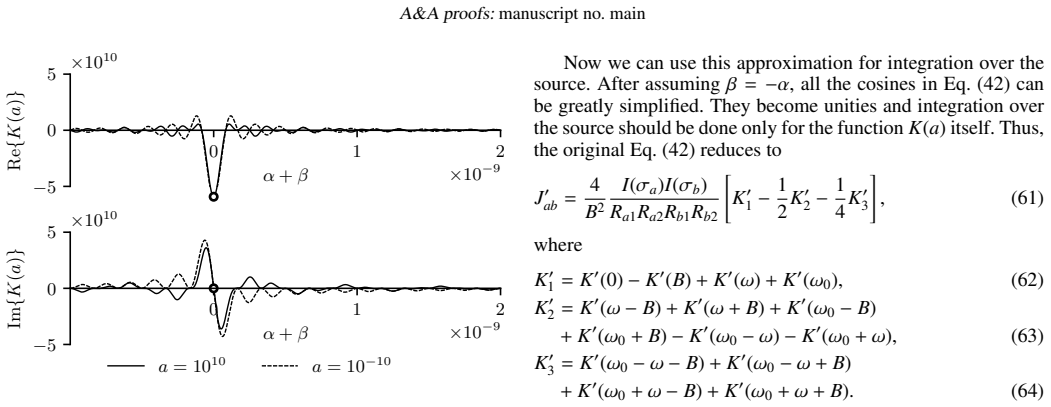
- [Section 5.1, Eq. (60)] The delta-function approximation K(a) ≈ K'(a) δ(α+β) is introduced without an error estimate. The exact K(a) in Eq. (58) is a principal-value integral with a first-order pole at α+β=0 and oscillatory structure away from the pole; replacing it by a delta function eliminates all non-symmetric source-point pairs. The derivation of L(ω) in Eq. (69) and, hence, the factor-two claim depend directly on this substitution. The author should either bound the correction from the non-delta part of K(a), or evaluate the source integral with the exact K(a) (at least numerically) to demonstrate that the symmetric-point contribution indeed dominates to the required accuracy.
- [Sections 5.2 and 6] The abstract and conclusions state that the Wigner correlation pattern is about twice smaller in scale than the classical pattern, but the explicit factor-two result is demonstrated only for the cross-product contribution W_ab. The self-product contribution W_aa (Eqs. 79-105) is governed by integrals m_n(a,b,c,d) that may have a different spatial-frequency content. The paper should show analytically or numerically that the total W_ab + W_aa indeed has a main lobe about twice narrower than the classical coherence pattern, and should quantify the relative amplitude of W_aa so that the total pattern is not dominated by a broader component.
- [Section 7.3] The numerical estimator is described only as selecting the temporal variations of the Wigner distributions at a given frequency, multiplying them for different baselines, and summing the products. Since the analytical theory rests on a particular regularization of a divergent integral, the paper must specify the discrete Wigner window, the normalization, and the exact operation performed in the time average, and show that this estimator converges to the regularized J'_ab and J'_aa used in the theory. Without this link, the agreement in Fig. 3, while suggestive, cannot be used to validate the two nonstandard analytical approximations.
minor comments (7)
- [Section 3, text before Eq. (11)] The expansion of Eq. (10) contains sixteen terms, not twelve as stated; the first group of four plus the remaining three groups of four gives sixteen.
- [Section 4 title] The title reads "Generalization to a continues source"; "continues" should be "continuous".
- [Eqs. (17)-(20)] Beyond the substantive issue above, the displayed formulas contain typographical inconsistencies that should be corrected: the phase variable in Eq. (17) appears as η' and should be ξ', and the normalization factors in Eqs. (19) and (20) disagree with the stated Jacobian.
- [Eqs. (31), (38), (39)] The carrier frequency is denoted ω in Eqs. (31)-(32) but ω0 in the band-limited spectrum definition (38)-(39); unify the notation to avoid confusion.
- [Fig. 3] The simulation points are plotted without error bars or any description of the number of realizations, the source grid, the baseline sampling, and the time-series length; please add these details so the reader can assess the scatter and the independence of the simulation.
- [Section 8, footnote 3] The reference to a similar effect for the Unterberger time-frequency distribution is made without a citation; a reference and a brief explanation would be helpful.
- [Section 7] The statement that the simulation code is openly available is good practice; please cite the repository version and provide the exact commands or configuration used to generate Fig. 3.
Circularity Check
No significant circularity: the factor-of-two Wigner pattern is derived from the stated Gaussian-stationary model via Isserlis factorization and standard Fourier analysis; no fitted parameter or self-citation is load-bearing.
full rationale
The central derivation is self-contained. The Wigner correlation is defined in Eq. (4), and the surviving Wick pairings for a two-point source are identified in Eq. (21). The divergent integral (17) is regularized by the width-normalized band limit in Eqs. (18)-(20); this is an explicit modeling convention rather than a restatement of the target result. The doubled spatial frequency in Eq. (69) originates from the product of the two field-correlation phases — after the beta=-alpha simplification the phase exp(-i2*omega*alpha) in K'(a), Eq. (59), becomes exp(i2k(p*chi+q*psi)) — and is not inserted by the normalization. The delta-function approximation in Eq. (60) is uncontrolled but is an approximation that restricts the cross-product term to symmetric source points; it does not by itself manufacture the 2k exponent. The paper uses no load-bearing self-citations: the van Cittert-Zernike and intensity-interferometry results are standard textbook comparisons, and the numerical simulations independently implement discrete Wigner distributions and time-averaged products. The main caveat — that the regularized J' is not proved equal to the finite-time estimator of Sec. 7.3 — is a correctness and validation concern, not circularity, because the factor-of-two result is a theorem about the regularized quantity regardless of that equivalence.
Assumptions & free parameters
assumptions (6)
- domain assumption The incoming radiation is a zero-mean stationary Gaussian ergodic process.
- domain assumption The source is spatially non-coherent, so correlations between different source points vanish.
- ad hoc to paper Divergent Wigner-correlation integrals can be regularized by normalizing over the width of the integration band.
- ad hoc to paper The dominant cross-product contribution comes from symmetric source points, so K(a) can be replaced by K'(a) delta(alpha+beta).
- domain assumption The radiation spectrum is band-limited white, G(omega)=1 for omega_0 - B <= |omega| <= omega_0 + B.
- domain assumption Large-distance and small-angle approximations from Appendix A, including R_a1 R_a2 approx R^2 and R_a1 - R_a2 approx zeta - (p chi + q psi).
Cite this review
Pith. "Pith review of Wigner interferometry." pith.science (2026). https://pith.science/paper/6WJDEEUE
@misc{pith2026260809657,
  author       = {Pith},
  title        = {Pith review of: Wigner interferometry},
  year         = {2026},
  howpublished = {\url{https://pith.science/paper/6WJDEEUE}},
  note         = {Machine review of arXiv:2608.09657}
}
read the original abstract
Aims. This work aims to introduce a new method of interferometric measurements based on correlation of Wigner functions constructed for the fields from a distant source. Methods. This work presents theoretical studies of correlation of the Wigner functions. Numerical simulations support the findings. Results. It is shown that in comparison to the correlation of the fields, a correlation of their Wigner functions samples twice higher spatial frequencies of the source intensity distribution and has about twice smaller scale of the spatial pattern. This opens a fundamental possibility to improve the angular resolution of interferometric measurements by a factor of two.
Figures


Reference graph
Works this paper leans on
-
[1]
Prudnikov, A. P. and Bry c kov, J. A. and Mari c ev, O. I. Integrals and series
-
[2]
Principles of Optics , publisher=
Born, Max and Wolf, Emil , year=. Principles of Optics , publisher=
-
[3]
Landau, L. D. and Lifshitz, E. M. The Classical Theory of Fields
-
[4]
Hanbury Brown, R. , year=. The intensity interferometer. Its application to astronomy , publisher=
-
[5]
Interferometry and Synthesis in Radio Astronomy, 3rd Edition
-
[6]
Advances in Optical / Infrared Interferometry
Advances in Optical/Infrared Interferometry. , keywords =. doi:10.1146/annurev-astro-121622-045019 , archivePrefix =. 2303.00453 , primaryClass =
-
[7]
Perley, R. A. and Chandler, C. J. and Butler, B. J. and Wrobel, J. M. , title =. The Astrophysical Journal Letters , abstract =. 2011 , month =. doi:10.1088/2041-8205/739/1/L1 , url =
-
[8]
MeerKAT Science: On the Pathway to the SKA , year = 2016, month = jan, eid =
The MeerKAT Radio Telescope. MeerKAT Science: On the Pathway to the SKA , year = 2016, month = jan, eid =. doi:10.22323/1.277.0001 , adsurl =
Show all 38 references
-
[9]
, keywords =
LOFAR: The LOw-Frequency ARray. , keywords =. doi:10.1051/0004-6361/201220873 , archivePrefix =. 1305.3550 , primaryClass =
-
[10]
IEEE Proceedings , year = 2009, month = aug, volume =
The Square Kilometre Array. IEEE Proceedings , year = 2009, month = aug, volume =. doi:10.1109/JPROC.2009.2021005 , adsurl =
2009
-
[11]
Nature Astronomy , keywords =
H _ 2 O MegaMaser emission in NGC 4258 indicative of a periodic disc instability. Nature Astronomy , keywords =. doi:10.1038/s41550-022-01706-y , archivePrefix =. 2302.14738 , primaryClass =
-
[12]
Probing the Innermost Regions of AGN Jets and Their Magnetic Fields with RadioAstron. V. Space and Ground Millimeter-VLBI Imaging of OJ 287. , keywords =. doi:10.3847/1538-4357/ac3bcc , archivePrefix =. 2111.11200 , primaryClass =
-
[13]
First M87 Event Horizon Telescope Results. IV. Imaging the Central Supermassive Black Hole. , keywords =. doi:10.3847/2041-8213/ab0e85 , archivePrefix =. 1906.11241 , primaryClass =
1906 arXiv
-
[14]
ALMA 2D super-resolution imaging survey of Ophiuchus Class I/flat spectrum/II disks. I. Discovery of new disk substructures. , keywords =. doi:10.1093/pasj/psaf026 , archivePrefix =. 2503.21060 , primaryClass =
-
[15]
First M87 Event Horizon Telescope Results. I. The Shadow of the Supermassive Black Hole. , keywords =. doi:10.3847/2041-8213/ab0ec7 , archivePrefix =. 1906.11238 , primaryClass =
1906 arXiv
-
[16]
First Sagittarius A* Event Horizon Telescope Results. I. The Shadow of the Supermassive Black Hole in the Center of the Milky Way. , keywords =. doi:10.3847/2041-8213/ac6674 , adsurl =
-
[17]
Sub-arcsecond imaging with the International LOFAR Telescope. I. Foundational calibration strategy and pipeline. , keywords =. doi:10.1051/0004-6361/202140649 , archivePrefix =. 2108.07283 , primaryClass =
-
[18]
, keywords =
MIGHTEE: the continuum survey Data Release 1. , keywords =. doi:10.1093/mnras/stae2528 , archivePrefix =. 2411.04958 , primaryClass =
-
[19]
, keywords =
The third realization of the International Celestial Reference Frame by very long baseline interferometry. , keywords =. doi:10.1051/0004-6361/202038368 , archivePrefix =. 2010.13625 , primaryClass =
2010
-
[20]
Journal of Geophysical Research (Solid Earth) , keywords =
ITRF2014: A new release of the International Terrestrial Reference Frame modeling nonlinear station motions. Journal of Geophysical Research (Solid Earth) , keywords =. doi:10.1002/2016JB013098 , adsurl =
-
[21]
Classical and Quantum Gravity , keywords =
A guide to LIGO-Virgo detector noise and extraction of transient gravitational-wave signals. Classical and Quantum Gravity , keywords =. doi:10.1088/1361-6382/ab685e , archivePrefix =. 1908.11170 , primaryClass =
1908 arXiv
-
[22]
Journal of the Optical Society of America (1917-1983) , year = 1974, month = jan, volume =
Statistical properties of synchrotron radiation. Journal of the Optical Society of America (1917-1983) , year = 1974, month = jan, volume =. doi:10.1364/JOSA.64.001433 , adsurl =
1917 doi
-
[23]
Essential Radio Astronomy
-
[24]
, keywords =
M 87: a cosmic laboratory for deciphering black hole accretion and jet formation. , keywords =. doi:10.1007/s00159-024-00155-y , archivePrefix =. 2412.07083 , primaryClass =
-
[25]
, keywords =
Jet formation studies in AGN: A search for new targets. , keywords =. doi:10.1051/0004-6361/202453138 , archivePrefix =. 2412.19268 , primaryClass =
-
[26]
Space Telescopes and Instrumentation 2024: Optical, Infrared, and Millimeter Wave , year = 2024, editor =
The Black Hole Explorer: motivation and vision. Space Telescopes and Instrumentation 2024: Optical, Infrared, and Millimeter Wave , year = 2024, editor =. doi:10.1117/12.3019835 , archivePrefix =. 2406.12917 , primaryClass =
2024 arXiv
-
[27]
Galaxies , keywords =
Reference Array and Design Consideration for the Next-Generation Event Horizon Telescope. Galaxies , keywords =. doi:10.3390/galaxies11050107 , archivePrefix =. 2306.08787 , primaryClass =
-
[28]
, keywords =
Radio observations of active galactic nuclei with mm-VLBI. , keywords =. doi:10.1007/s00159-017-0105-6 , archivePrefix =. 1711.07548 , primaryClass =
- [29]
-
[30]
IEEE Signal Processing Letters , keywords =
Discrete Time and Frequency Wigner─Ville Distribution: Moyal's Formula and Aliasing. IEEE Signal Processing Letters , keywords =. doi:10.1109/LSP.2005.849493 , adsurl =
2005
-
[31]
Geometry of Affine Time–Frequency Distributions , journal =
Patrick Flandrin and Paulo Goncalvès , abstract =. Geometry of Affine Time–Frequency Distributions , journal =. 1996 , issn =. doi:https://doi.org/10.1006/acha.1996.0002 , url =
1996
-
[32]
, title =
Isserlis, L. , title =. Biometrika , volume =. 1918 , month =. doi:10.1093/biomet/12.1-2.134 , url =
1918 doi
-
[33]
Novel methods of digital phase shifting to achieve arbitrary values of time delay
-
[34]
John Wiley & Sons, Inc
Random Data: Analysis and Measurement Procedures , publisher="John Wiley & Sons, Inc.", author=
-
[35]
N.,& Stewart, J
Cox, A. N.,& Stewart, J. N. 1969,
1969
-
[36]
Tscharnuter W. M. 1987,
1987
-
[37]
1992, in ASP Conf
Terlevich, R. 1992, in ASP Conf. Ser. 31,
1992
-
[38]
F., Tytler, D
Zheng, W., Davidsen, A. F., Tytler, D. & Kriss, G. A
Reviewed August 11, 2026 · model on record in the stance chip above.
Discussion (0). Continue with ORCID to comment.